PUBLISHING AGAIN?
The latest strip:

I’ve been alternating red patterned panels and lines of black lettering. I’ve run out of lettering, but I’m keeping the red-black-red alternation. This one is also from the V&A 14.931 sampler. I’m working the foreground double running stitch using a single thread of DMC 310 black, and the background in long armed cross stitch using two strands.
I’m having way too much fun with these patterns to stop. I’ve been talking about a sequel to TNCM for years, but now I’m engaged in doing it. I’ll be resuming my search for a decent charting program (or general purpose graphics program) specific to the needs of legible presentation for double running stitch. And given my horrible experience with the publisher of The New Carolingian Modelbook, I’m looking into other options, in specific – the feasibility of self-publishing, but I know very little about the various web-based micropublishing alternatives, but I’m open to all concepts. I do know that for this type of book paper copies are still valued by most. I don’t believe that there’s a critical mass of stitchers out there yet who would make use of an ebook stitch reference when hard copy sits so quietly in one’s workbasket without consuming batteries.
I’m also considering different formats. The last book was a 200+ page compendium of patterns, with lots of appendices of various sorts. I don’t think that’s necessary this time out. Other options exist. Shorter booklets or broadside sheets for example lend themselves more easily to web-based publishing both for the issuer and the downloader. Pricing is also problematic. The income stream this would represent is quite small, and the burden of record keeping as a small business for taxes is immense by comparison to any possible profit (discounting entirely the major effort involved in creating the work itself).
So I put these question to the few folk who visit this place and who I presume might be interested in such a thing:
1. Would you be interested in a sequel to TNCM?
2. Would you find ebook format (meaning to be read on a book reader or iPad) useful?
3. Would you be open to receiving a print-your-own PDF rather than bound paper?
4. What length book would you consider worthwhile – a leaflet of 20 pages or fewer? A booklet of 21-50 pages? A small book of 50-100 pages? 100+? (Bearing in mind that content for a 100+ page book would take a while to compile).
5. Any suggestions for publishing options aside from self-created PDF download via wiseNeedle, or commercial services like Lulu, iUniverse, or Etsy? Any cautions on the commercial service route?
6. Would you object to a higher proportion of original and adapted patterns mixed in with exact stitch recreations, so long as all patterns were documented as to origin and modifications (if any)?
7. Anything else you want to see in a book of patterns of this type?
A PATTERN’S PEDIGREE
The latest strip. As you can see, a relatively un-normal quiet week allowed me to finish up the last lettered strip and begin the next. This one is done in standard double running stitch (aka Spanish stitch, Holbein stitch) using one strand of plain old DMC cotton embroidery floss. I was thinking of working the background, but I think I’ll leave it plain. I don’t want to overwhelm the delicate scrollings.
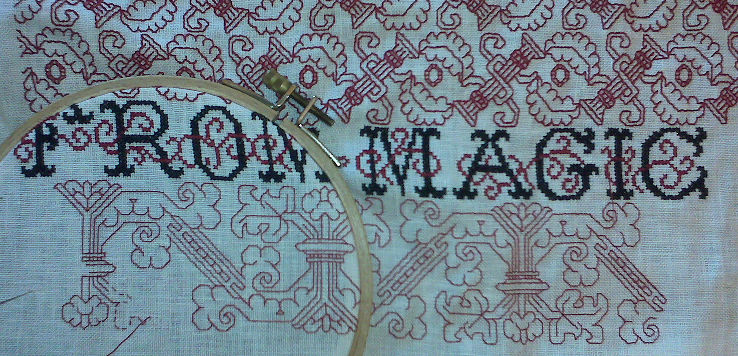
I graphed this from the same photo of a Victoria and Albert Museum sampler that many of the other strips here and in TNCM came from. If the link above doesn’t work, search for item #T.14-1931 (it’s also pictured in Drysdale’s Art of Blackwork Embroidery). It’s listed as Italian, 16th Century in the museum records, but Drysdale lists it as later. Another source lists it as Spanish, which is where the attribution in TNCM came from, but that’s wrong and if I were to re-issue the book, would be corrected. If you squint at the photo you’ll see the sources for my tilting columns, grapes, and the hops flowers and plume flower strips.
But this pattern doesn’t appear only on this one source (right edge, lower four up from the bottom, and just below a red pattern, also see the snippet below). The unknown keeper of the www.drakt.org website took some photos of other samplers at the V&A among them is a page of showing shots of two cases of voided work. Thank you Unknown Keeper! If you look at the centermost of those three photos, you’ll see a pattern very much like the one on 14.931, but instead of outline only like that sampler’s (and my) rendition, this one has a filled in background. Here are the three versions of my current pattern side by side:
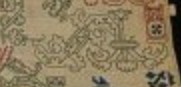
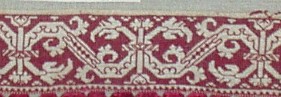

The 14.931’s version is on the left. The unnumbered V&A bit from the Drakt site is in the center, and mine is at the right. I charted mine from 14.931, as best I could. Thankfully I have a better photo from which to work, provided by long time stitchpal Kathryn. For the record, I have not seen this exact base pattern with its distinctive frilled/curvy leaves in my amateur’s wanderings through historical modelbooks, although there are quite a few designs in them that are vaguely similar to it.
Let’s look at the two historical pieces. The V&A calls out 14.931 as possibly being a professional’s work sheet – a sampler in the truest sense of the word, collected by a stitcher of high proficiency as a record, as a reference. The stitcher did just enough of each pattern to set the repeat. The Drakt photo is of a finished band, tricked out with accompanying side flourishes. I’m not sure what the finished band would have adorned. Possibly a pillow or bedcovering, or some table linen. It’s not impossible that it came from clothing, but linens are more likely.
Discounting the worked background, the similarities between the two outweigh the differences. Those are minor – the treatment of the center binding band and stems/bodies of the central flowers, and the treatment of the diagonal arm that links each up-down motif. 14.931 uses a more architectural binding in the center, with more delicate center stems. Its diagonal arm is adorned with an S-shaped squiggle rather than chained solid fill diamonds. But even with the differences between the two historical renditions, it’s clear to me that the two stitchers involved were cribbing from the same source, with minor changes creeping in much like the modern game of telephone, in which a comment whispered to one end of a line and then passed up along the chain often turns out different than the original message. I happen to prefer 14.931’s lines and proportions, so that’s the pattern version I started with.
My amendations are mostly in the treatment of the two terminal flowers in the pattern’s center, a minor elaboration of the binding bars in the center, and the filling in the diagonal arms that connect each central motif. I didn’t like the sponge like “down flower” at the center of 14.931, and I had trouble seeing exactly what was going on with the “up flower.” Plus I didn’t like the smashed tulip look of the comparable center bloom in the Drakt photo. I tried several variations on the S-squiggle in the diagonal arm, but didn’t like any of them. I ended up with th ladder shape in order to make the airy and open terminal acanthus-like leaves look lighter by comparison. And then I added the second narrow binding bar to correct proportions in the motif’s center. I could have raised the original bar two stitches, but I liked the way that it lined up with the separation between the leaves, so instead of moving it I increased its depth and intensified 14.931’s horizontal lines.
I consider my own changes very much in the spirit of the original, and well within the range of variation presented by the two historical samples. I’ve preserved the look and feel of the pattern without debasing the delicacy or detail of the original, and left it a totally identifiable scion of its parents while tweaking it just a bit to my own taste. Your mileage may vary.
UPDATE (2 June 2023):
I have found another example of this design. This snippet is in the collection of the Rhode Island School of Design, Accession 47.292. They do not assign it a geographic or temporal attribution. Because of the way the detail has eroded, it does look a bit shopworn to me, like a copy of a copy of a copy.

ACTUAL PROGRESS!
Thanks to a relatively quiet week with only two late nights and one day of weekend work, I managed to make significant progress on my sampler.

I finally finished the band of tilting columns and started on the final line of lettering.
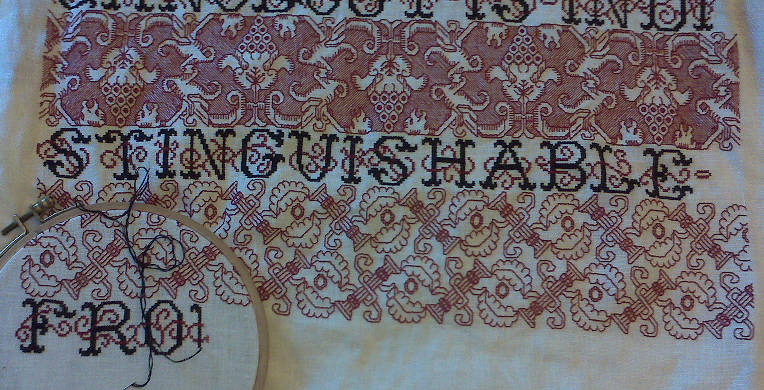
After the lettering I have room for several more patterned strips, the exact number depending on how wide each one is. I’d like to include a row of strawberries, but I haven’t found a historical pattern for them that I really like, so I’ll probably doodle up one myself. I’m also considering several inhabited bands, with dragons, lions or mythological creatures, not unlike the mermaid strip I included in TNCM.

Another possibility would be a series of two-tone patterns, using both black and red in the same strip; or another long armed cross stitch band of a pattern similar in style to the one at the top, but worked voided. That would be very heavy though, and if done at all, should probably be relatively narrow. Maybe I’ll save that for the last one, to give weight to the bottom of the composition.
(SOFT) BOOK OF AGES
Obviously I bored most of the reading audience here totally to tears with the last post. How about something simpler today?
Quite a while ago I tried my hand at submitting patterns to print and on-line magazines. I quickly found out that it’s impossible to arrange creativity on a schedule, and that because my career is 100% hard-stop deadline driven, adding deadlines to my hobbies sucked all the fun out of them faster than teenage vampires exsanguinate each other. Be that as it may, I had limited success – some of my designs were published. See Saw Socks in an early edition of KnitNet, a pattern that helped launch the popularity of self-striping yarns:

I had some pieces published by Classic Elite, a few of which remain in their print collections, and one small item – also published by KnitNet – that I thought had disappeared entirely.
But nothing in my house disappears forever. It might become entombed in a box somewhere, but forgotten in this case is not the same as gone. I was doing some spring cleaning and de-cluttering this weekend and found the soft book baby toy that I knit long before the arrival of Younger Daughter (now in middle school).
This piece does not photograph well, and for my limited camera skills poses an additional challenge. It was knit in a long strip, with “pages” each framed by garter stitch. There are three of them, each with a different motif:


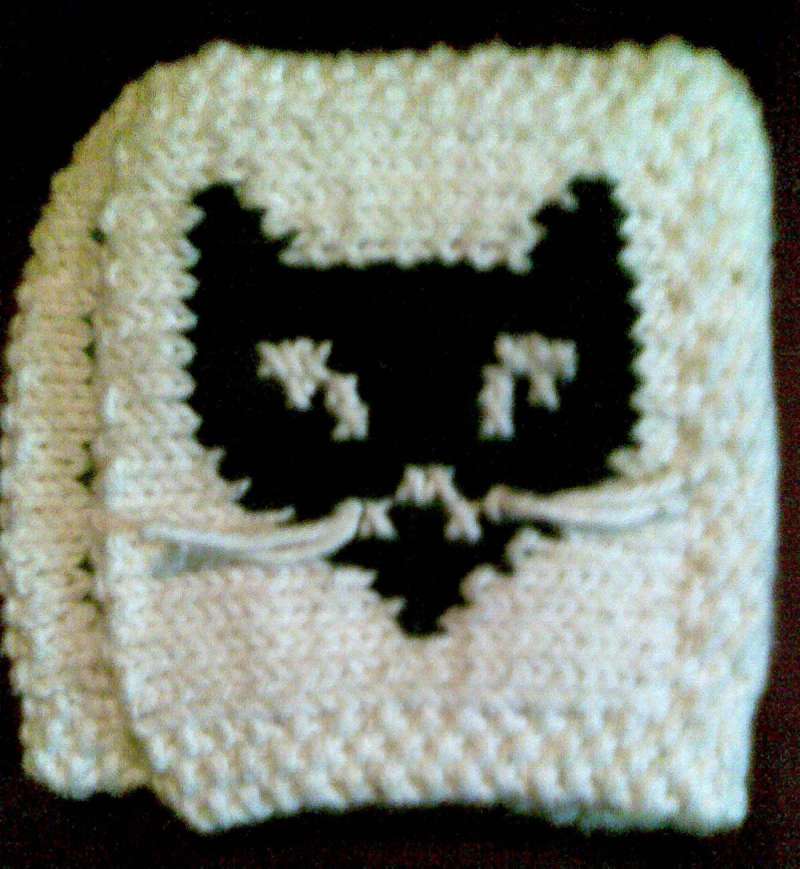
After the strip was knit, it was folded accordion style, and the tops and bottoms of each page were seamed together. Finally the leftmost edge of the front page and the rightmost edge of the last were sewn up to make the spine (I’d left the garter stitch edging on those two ends longer to compensate for the bulk of the book).
I used Bernat Handicrafter cotton at about 5 stitches per inch. The pages are each approximately 5 inches square. The two number-bearing squares each sport bobbles, one on the 1 page, two on the 2 page. The whiskers on the cat face are solidly knotted bits of the same yarn. The idea being that nothing on the book should come loose if it was mauled by the target recipient.
I had plans to offer up a whole bunch of additional simple graphed motifs in concert with the knit sample, but KnitNet was only interested in the original six. I have no idea if anyone else ever made this, but the original book was well loved (and chewed) by Younger Daughter when she was in the toy-ingestion phase. As you can see, the Handicrafter held up well, surviving lots of hot washes, although the yellow triangle and pink 2 pages both are no where near as vibrant as they once were.
 String-Or-Nothing