THE BEST OF ORC MANUFACTURE
We had an entertaining weekend here at String, spending most of it cleaning up the debris of a New England winter and waking up the garden for spring. Now I’m not a very good gardener. In fact I stick to plants that in more hospitable geographic areas are rated as borderline invasive, because they are about the only plants I can’t kill. I trust in my own lack of skill and the odd deep freeze winter to keep them in check.
This weekend’s chores included moving a trillium and a peony to make more room for an aggressive hosta‘s growing hegemony; shuffling some day lilies out of the way; rescuing some tulips and daffs so courteously relocated mid-lawn by squirrels; planting three ultra hardy five petal rugosa roses in some newly freed up spots; and pulling dead leaves out of the giant grass stubble (aka elephant grass, or maiden grass).
How giant is our giant grass? It gets tall enough for its early September plumes to overtop the roof of our front porch. We cut it down before the seed sets and ripens in order to keep it from colonizing the entire neighborhood. But what to do with canes ranging from 8 to 13 feet? The first year we bagged them with the rest of the yard trimmings, for the town to haul off for composting. This fall though I had an idea.
I also attempt to grow what started out as an antique variety of big scarlet speckled runner beans. While I don’t harvest enough of a crop to eat, the kids get a big kick out of our sequential years of Mendelian genetics. We plant our Magic Beans for three springs now – some are still true to their parent’s form, some now look more like French flagolets/ Then we watch to see what color flowers appear (originally all red, now a mix of 25% white/75% red), and what color/form of beans result. They grow very fast, and require strings or a trellis to climb. Last year all we could find at the garden shop were puny 4 foot tall bamboo stakes. Not near long enough. So I decided to dry my giant grass stalks and store them through the winter to furnish the scaffolding for this year’s bean trellis.
It’s not warm enough for bean planting yet (final frost date is the second week of May here), but we did build the trellis and set it up against the sunny southern face of the garage:

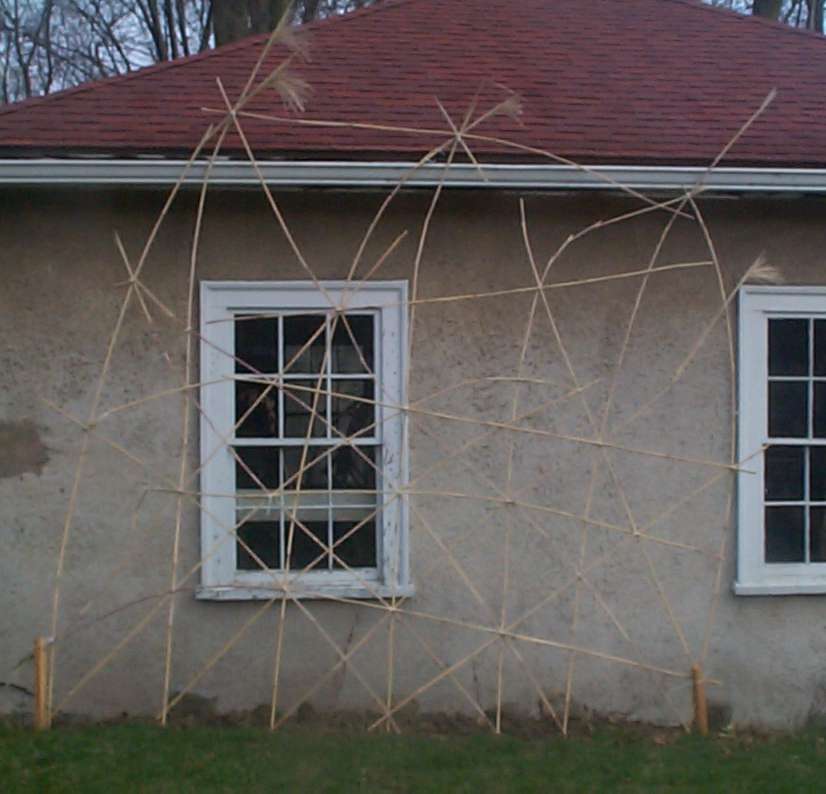
On the whole, given the random length, lack of flexibility and fragility of the stalks, I’m amazed we were able to come up with anything at all. Yes, those are cable ties fastening the thing together. We’re nerds and proud! The structure is sort of pitiful, as if it were built by drunken orcs in World of Warcraft. I’m pretty sure that if they produced something this sad their players would be dunned a dozen experience points for failing so miserably in the attempt. But I like it. Covered in green with little flowers it will look grand. Provided it survives. Which is why we built it early. Better for it to collapse before beans attack it rather than having to disentangle them after the fact.
On the knitting front, I’m just about done with the entrelac socks. They turned out better than I expected.
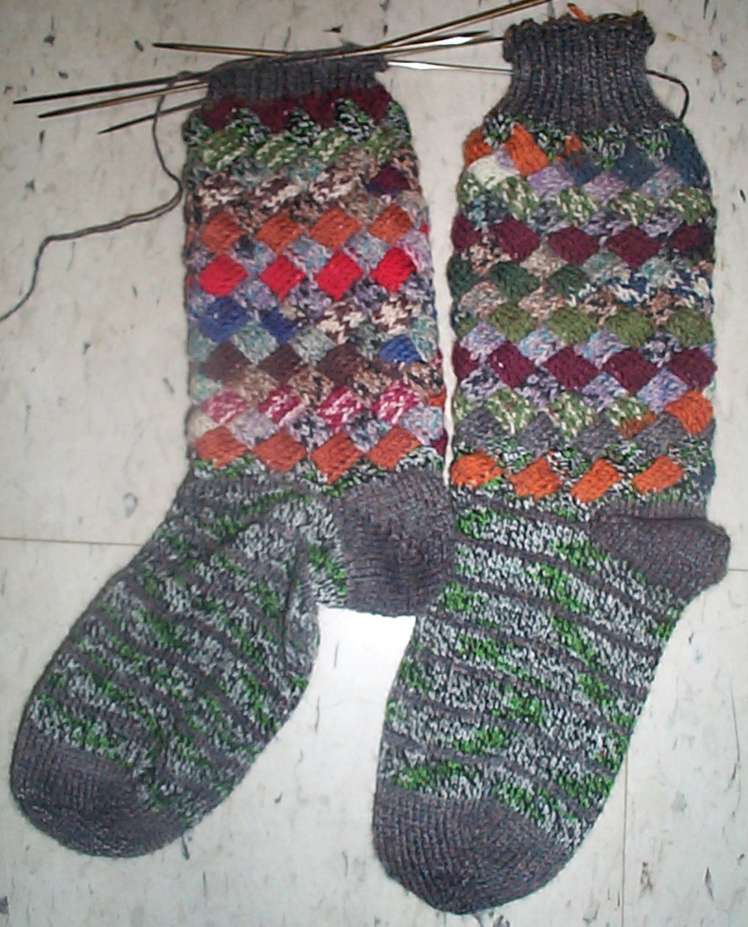
Still a bit motley, but the four colors of leftover self stripers ended up complementing each other, mostly because all of them had green and brown in their mix. In person what looks like bright tomato red in the on-needle sock is more muted. Also, I divided the lot of leftovers into two groups – one that was mostly speckled with few or no solid stripes, and one that had firm solid stripes and spotty bits. The finished sock clearly shows the solids in the entrelac bits worked from left to right, and the speckled yarn in the entrelac bits worked right to left. All in all quite a satisfying project for something starting with such an unpromising quantity of leftovers.
KNITTED SCULPTURE
I stumbled across this on Boing-Boing Gadgets and was fascinated. It’s a piece of circular knitting fashioned from thin, clear plastic capillary tubing. The flow of colored water through the thing is mesmerizing. Although it looks a bit like nalbinding, it’s a twisted loop variant of frame knitting (the frame is upside down on the bottom, forming a pedestal for the sculpture).
Fluid Sculpture from Charlie Bucket on Vimeo.
Fascinating. Hats off to Mr. Bucket and the folk at Casual Profanity for the joy of this piece!
ONCE A SMART ASS, ALWAYS A SMART ASS
More nostalgia. I was digging through an old trunk the other day and I came upon a stack of my old embroideries, mostly unfinished. The majority of my finished work got given away as gifts. The completed pieces I still have I’ve posted here on String already, so this stash is in fact my “Chest of Embroidery Horrors,” a precursor to my “Chest of Knitting Horrors.” The first item in my stack was this odd little object, about 4 inches wide by 7 inches tall.
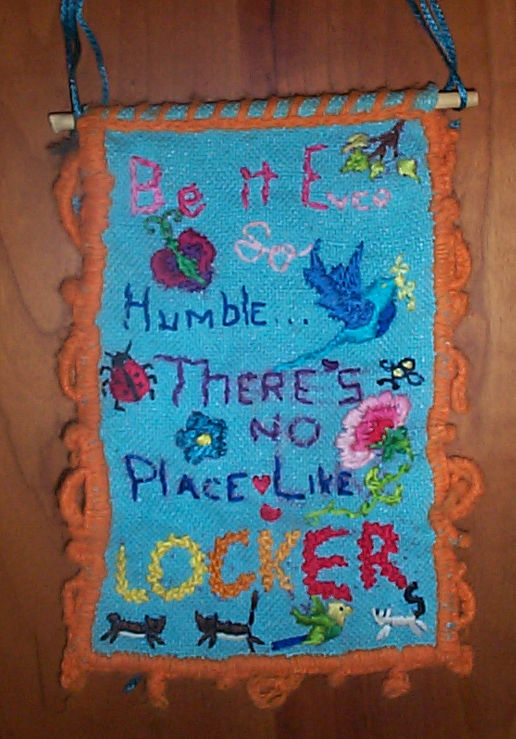
I doodled it up one weekend while I was in 7th grade (age 12 or so), obviously to hang in my middle school locker, picots and all. There was quite a fad for locker interior decorating among the other girls at Teaneck, NJ’s Benjamin Franklin JHS at the time. They did up elaborate confections of varying degrees of utility using contact paper, ruffles, shelf liner, sweet little color-coordinated pouches and shelves, magnetic mirrors, beads, decorative buttons and the like, trying to out-cheery or out-trendy each other. Many did whole themes in the school’s colors, or paeans to favorite bands or actors. Others copied design tips from hot teen magazines. I suppose it’s not shock to see that this same generation grew up to worship at the shrine of Martha Stewart.
I stitched my sad little sampler partly for fun, and partly to poke fun at the overly elaborate, overly girly, just plain over done lockers of my peers. I don’t remember if the other girls thought much of my embroidered commentary, but I do remember a couple of teachers coming by and asking to see the thing, then convulsing with laughter. And seeing it each day jump-started my mornings with much-needed sarcasm. Subversive stitching in 1968 from a sardonic pre-teen.
As to the various animals and plants on the sampler, there’s no deeper symbolism behind them, except for the cats and the budgie at the bottom. When I was a kid we had a couple of cats. The white one with the black tail was named Pixie. The Manx was Cola, from his rain-soaked tabby color and the Spanish for “tail” – an attribute he lacked. The other tabby and the bird belonged to friends. It happens that my severe allergies disappeared when I went off to college, away from home and the cats. I still miss their antics, but I’ll never live with a cat again. Breathing is much more fun.
I’ll post pix of some of the other pieces. At least one of them also qualifies for the subversive label.
READY TO PILLAGE
In counterpoint to the last post – here’s Smaller Daughter, armed with round shield, spear, sword and helm of her own manufacture.

In fact, yesterday her class, armed with similar tin-foil weapons, pillaged the fourth grade and selected offices in her elementary school. She got extra credit for trying to capture the principal.
To explain – her fifth grade class is finishing up a world history unit on the viking era of exploration and conquest. They’ve done famous leaders, history, migrations and settlement, culture, literature, technology and crafts. They played with spinning, sprang, kennings, navigation, sagas, and allthings; and finished up by staging their own raid on the rest of the school. They didn’t really burn or steal anything, instead they mostly ran around shaking their weapons and shouting, held some stuffed animals hostage, seized some pre-arranged “treasure”, tossed some papers around and had general kid-amok fun. No actual fourth-graders were harmed.
I was impressed that the unit mentioned sprang, but it turns out that Smaller Daughter’s teacher is a knitter. I should have known.
LIFE KNITTING AND BOOTIES
Google Images now contains Life Magazine’s vast photo archive. If you’re old enough to remember the heyday of home delivered magazines, you will most certainly remember that glossy, oversized, highly visual catalog of each week’s events. It was spectacular.
Buried in that archive are a nice set of knitting-related images, mostly from the 1930s and 1940s. Most of them are from three issues, a 1939 one on knitting for the British army, a 1941 how-to-knit issue, and a 1952 home/baby knitting article. The accompanying articles aren’t in this archive, but the how-to and finished object pictures that formed the core are. There is also a smattering of celebrities at rest/with family pictures, some travelogue/news shots of women knitting abroad, and a couple of college girls knitting from the late ’40s/ early ’50s – the last time there was an on-campus knitting fad.
The 1941 how-to series pix are interesting because they show the pencil grip throwing style (even though some of the series pix are missing_. There are also at least one 1952 vintage how-to, showing Continental method:
- Long tail cast on
- K2tog decrease
- Binding off technique #1
- Binding off technique #2
- Binding off technique #3
- Purling #1
- Purling #4
- K2,P2 Ribbing
- Picking up along an edge #1
- Picking up along an edge #2
- Knit stitch (Continental , from 1952 article)
And some finished objects
- Knitted faceless Balaclava or hood
- Hat/scarf combo (open end of tube scarf forms hat)
- Another shot of the hat/scarf
- Soaker
Here are some of the other shots:
- Celebrity knitter Eleanor Roosevelt knitting on a plane? train?, 1937
- British showgirls knitting, 1937
- Cover picture from the 1941 how to knit issue
- British store clerk knitting (1939)
- Celebrity knitter Prisca Bunau-Varilla (French Ambassador’s daughter) 1960
- Cute woman gas station attendant knitting
- British waiter doing troop knitting (note method of holding yarn)
- Celebrity knitter Eve Arden, 1959
- Hotel page boys knitting, 1939
- Height of the campus argyle knitting craze, 1948
- Wounded Finnish soldier and nurse knitting, (note that he’s using Continental method, she’s throwing. I bet he learned as a kid at home.) 1940
- Lose weight while knitting? 1940
- Celebrity knitter Jane Froman, 1936
- Chinese girls knitting on long bamboo(?) DPNs, 1946
- Gangsters’ wives knit, too. 1949
- Celebrity knitter JoAnne Woodward. Perhaps Paul is getting socks, 1958
- British toddler playing with knitting 1939
- Celebrity knitter Barbara Bel Geddes 1959
- Striking women auto workers knitting (France), 1937
- British ambulance driver knitting, 1937
- Knitting in public, 1944
- Troop knitting 1939
- Celebrity knitting Byron Nelson and wife (wife knitting), 1945
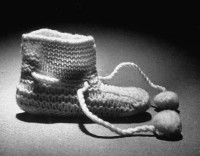
But to me, the most interesting picture is that of this little bootie, from 1952. Although I prefer not to repost the pix of others, I think fair use here applies so you can see these side by side:
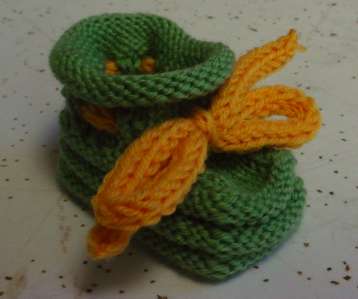
The “Janes Booties” (at right) I often knit are one of those much loved, scribbled-on-an-envelope patterns passed hand to hand. The version I use was posted to the KnitList by Ann Kreckel in 1995. I did a step by step how-to for Ann’s pattern in 2005. Extremely similar patterns have appeared in a letter to Threads Magazine, and in the 1999 Knitters Socks Socks Socks competition book. The Threads letter was printed in the 1991s, and was penned by an elderly lady who said she’d been knitting them since her girlhood. My guess is that the ur-source for this pattern might have been a magazine article or leaflet appearing sometime between 1900 and 1920.
I’m always on the lookout for earlier manifestations of Janes Booties so this shot grabbed my attention. The Life magazine bootie looks a bit squashed and shallow compared to my green bootie, but I can see that it shares basic construction with the pattern I use. First, the bottom looks to be a rectangle of garter stitch. The sides of the bootie look like more garter stitch picked up around the edge of the sole plate strip, then knit in the round. The top of the toe looks like it was worked flat, back and forth, culminating with the tube-knit ankle part, worked in the round on the ankle stitches plus those from the top of the foot. Eyelets form the holes for the tie string.
While the Life bootie is much less plump, with a shallow toe area and overall less boxy appearance (no garter stitch welts to form the sides), and ended off in a plain garter anklet rather than a rolled stockinette top, it was made the same way. I’d consider it a first cousin to Ann Kreckel’s pattern. If anyone spots earlier incarnations of similarly constructed booties in historical sources, please let me know!
UNLEASH THE INNER PUMPKIN
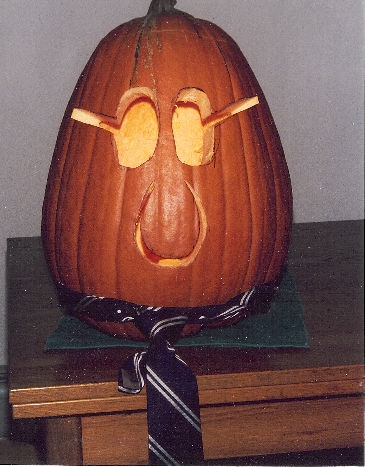
Sometimes the materials speak:
On the knitting front, I’ve been totally consumed again at work. I’ve managed to do a couple more rows of the spiderweb section on my olive green tablecloth, and a little bit more on the OpArt blanket – but not much of either.
I’ve also received a special request for an unusual baby hat, the amazing flood of co-worker fecundity continuing unabated. I am contemplating either the now classic Chicken Viking Hat or the Baby Squid Hat, although I am open to suggestions of other similarly absurd headgear.
CONTINUING THE ILLUSION
The OpArt baby blanket continues to grow. Being all garter stitch with very obvious markers to wake the fingers up when the four increase points are reached, it’s an autopilot project, ideal for knitting while watching subtitled movies:

Right now it’s approximately 22 inches across, and I’m not finished with the second 6-ridge (12 row) set of stripes. The pattern continues on for four more stripes, one each of 7, 8, 9, and 10 ridges, alternating colors (a larger size goes on for two more stripes of 11 and 12 ridges respectively). I’ll keep going until I either run out of yarn, or I feel the thing is big enough to be a lap/basket/car seat blanket – at least another two stripes. The jury is still out on whether or not I’ll end off with one last stripe of orange. The Record 210 yarn is holding out fine. I’m on my third skein of each color, and have at least two more of each as yet untouched. I did hit a couple of poorly plied spots in one skein of the yellow. They were bad enough to excise rather than work in, although that made even more ends.
For the record, given the vast number of ends, I’ve been finishing them off as I go rather than waiting until the knitting is complete. I strongly recommend doing it that way, unless you’ve got a “finishing party” to go to.
What subtitled movie was I watching? Sansho the Bailiff. It’s from famous Japanese director Kenji Mizoguchi, made in 1954. It’s bout the development of compassion in a brutal time. In the movie the family of a noble minded official is torn apart, and the children grow up in the most wretched of circumstances, yet maintain their absent father’s ideals. An excellent film, but very affecting. Bring a box of tissues.
NOODLE FACTORY – DESIGNING IN TRAFFIC AND ON THE NEEDLES
Progress on all fronts, but slow progress here. My green tablecloth continues to grow, at the glacial pace of of four rounds per week due to the massive number of stitches per round. I’ve got two projects in the noodling stage, things that give me ample daydreaming fodder for my commute. One is a rescue of glorious fall foliage color hand-painted yarn from a project long consigned to my Chest of Knitting Horrors. The other is the long patterned stockings inspired by the fashion clip I posted two weeks ago.
I don’t know how other people design things, but my own processes are more like back burner simmering than line cook production. But this can happen in one of two ways.
The first is more project-centric. An idea occurs, I chew on it a while, running through mental CADD rotations to visualize it in three dimensions. Sometimes an idea dies during this process. Some factor (or more usually, reality) makes me realize that the thing can’t be knit or would not have a high probability of success. Other times all things fall into place. I see the finished product, the materials and techniques required, and have worked out all but the final math and gauge long before I pick up the needles. I do this think-work mostly during my commute back and forth to work, and its one of those insidious things that I have to fight off during long, boring meetings. I’d say about half of my projects start this way, and tend to finish almost all of them.
The second is more yarn-centric. If I have a particular yarn in hand the process works a bit differently. It moves out of the think stage very quickly, and often with only the vaguest of notions on how to proceed. In this case I get the yarn on the needles and begin to play. That’s how the Kureopatora’s Snake happened. I stumbled across a couple of left over skeins of the stuff and my magpie color sense was rekindled. I needed a scarf to give as a gift and the yarn’s colors held me in thrall, so I sat down and played. It took me half a movie’s worth of fiddling to get started, but the thing shaped up quickly after that. I ended up ripping out my beginning and starting a second time so I could write down what I had been doing before I forgot.
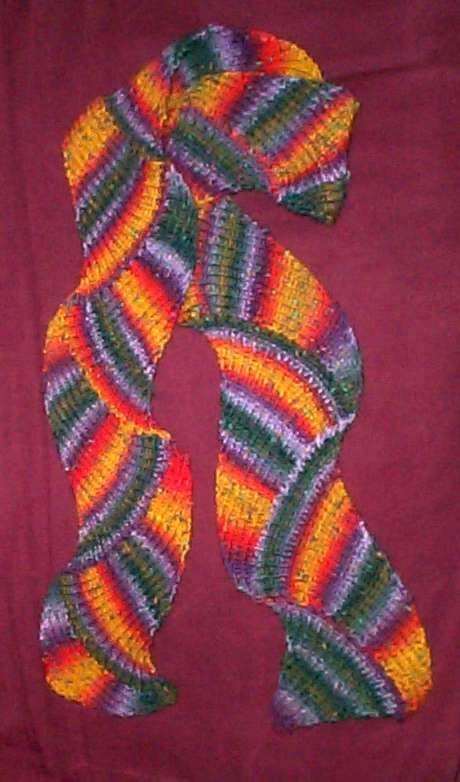
Something similar happened when I did my old See Saw Socks pattern. Regia Ringel was new then, and not widely distributed. I ran across a couple of skeins in a discount bin at the old Women’s Industrial Union crafts shop downtown in Boston (now long gone). The shop person lamented that the colors were nice, but no one was buying this splotchy stuff. Now stripers are understood and appreciated but back then, there being no knit samples or on-line pix of the finished product, the piebald skeins were a hard sell. I started the toe-ups and was delighted by the striping, but didn’t want to make a boring-to-knit all stockinette ankle. So having determined the depth of each stripe (more or less) I began to play with various directionally skewed designs that worked into my stitch count and that row count. And serendipity hit:

Please don’t ask me for the pattern. I sold the original pattern and all reprint rights for See Saw to KnitNet. They’ve subsequently featured it twice in their newsletter. If you want it, you’ll have to go through them.
While the remaining half of my projects do begin with the yarn instead of the extended think session, it’s worth noting that my most spectacular failures and most happy successes all came from this method. The sobering note is that failures that began with the yarn instead of the planning do outnumber the successes, and most of my Chest of Knitting Horrors residents were yarn-inspired.
MORE PROGRESS AND STORE CLOSURE RANT
Elder daughter’s Walker Learn to Knit book afghan continues to grow. She’s working in Cascade 220, in assorted greens gleaned from the orphan skein shelf at Wild & Woolly in Lexington (our local yarn shop).
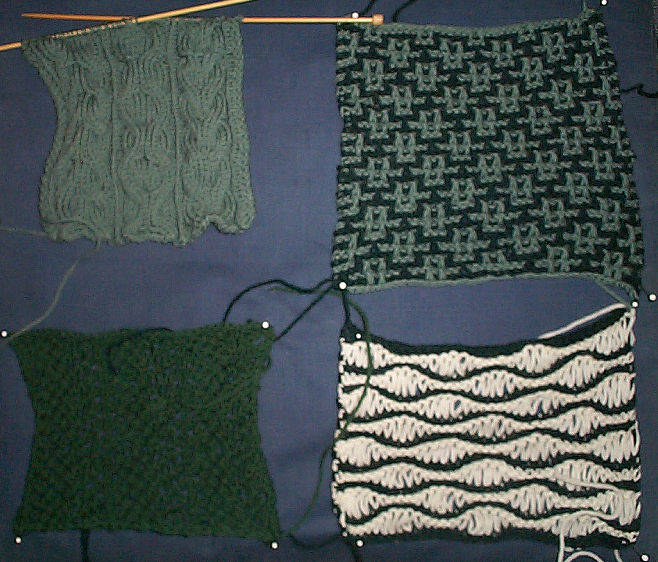
Her goal is to have enough finished by next fall to furnish herself with an off-to-college blanket. Younger daughter has decided that crochet is easier for her to handle than knitting, and armed with books from my library and yarn from my stash, is making a stab at a zig-zag blanket for her favorite stuffed animal. So the transmission of obsession is prospering here at String.
On my own knitting – I am making good albeit slow progress on the olive green tablecloth. The section I’m working now is rather spider-webby. It’s an eternity of rows alternating between [S2-k1-PSSO, (YO)2] and [K (K1,P1)] to make an infinitude of center double decrease columns with large eyelets between them. Given that the piece has something close to 1,200 stitches per round at this point, each row takes forever. Especially the double decrease row. The last thing I want to do is miss a loop. So progress is slow to accumulate, especially because I want this spider web area to be at least six to eight inches deep (yes I do have the play in the linking brides to accommodate the fixed stitch count of this patten and corresponding total diameter increase of the round cloth over the added depth).

In other news, I heard that a local yarn source is closing. Not my favorite shop (thank goodness), but a two-outlet big-box store that focused mostly on fabric and decorating, that greatly expanded and then shrank its yarn department in response to the scarf knitting fad of a couple of years ago. I was always ambivalent about it. Although I did buy fabric there on occasion, didn’t buy their yarn because I wasn’t fond of that store’s effect on other area yarn shops. At one point they absorbed several of the better mid-range suppliers’ products, then using their volume purchase to engineer discounts from the makers, sold those yarns at prices significantly lower than smaller stores could manage. Doing this they cornered the market on (for example) Plymouth Lopi. Small knitshops could no longer afford to stock it and lost significant foot traffic as a result. Now the big box store is closing. No more yarn, no more fabric.
Now the reversal of yarn sales wasn’t the cause. I suspect rising rents (the mall in which it is located has expanded considerably in the past two years), the general decrease in discretionary spending (much of their revenue was from their home decoration department), and a decrease in interest in quilting and home sewing in general. Most of the times I hit the fabric department, I was the youngest person shopping, and being a Boomer, I’m no longer a sweet, young thing. Changes in the economy, changing customer demographics, crashes in the popularity of multiple hobbies, rising infrastructure costs all add up to the loss.
Now there’s a new problem. Where to buy fabric? What’s left in the inner/outer suburb belt here is woefully inadequate – shops that have scaled back their sewing departments in favor of scrapbooking and other low-investment/low skill hobbies. There are a couple of small stores scattered around, useful but with very limited stocks. I haven’t been downtown to what used to be the garment district in Boston in years. It used to be the home of several stores where bolts went to die – remnant shops and mill end type places. But that was long ago, and that neighborhood has gone upscale.
In the mean time, I note the store’s passing, plus the closing of a couple of the smaller yarn shops that opened up at the crest of the scarf knitting fad, and hope that retrenchment will leave us with local yarn stores. I for one need to see and feel yarn for inspiration – the texture, the drape, the weight, the loft, and most of all – the color. I can’t buy blind off the web, based on photos, descriptions, and reviews – even those on wiseNeedle. I value the expertise and help available at local shops, and am willing to pay a small surcharge per skein to support that help (rather than spending it on shipping). And most of all, I like the experience of seeing and evaluating alternatives in person, being able to take leaps of inspiration based on the stock of yarns and patterns at hand.
Perhaps the rise in Internet yarn shopping is part of the stampede towards sameness I see across many knitters’ projects reported on line. Someone knits something, and it turns out quite well. Other well-connected knitters see the success and want to duplicate it. So they too buy the same pattern and same yarn. Both being known entities, purchase sight-unseen is a viable option. Now there’s absolutely nothing wrong with doing any of that, knitting up something that’s a proven winner, or using the exact yarns (or even colors) specified in a pattern or that someone else has used. It’s safe. It’s proven, and the chances of success are magnified. But it’s not the way I knit. And I’m guessing that there are other “bungie jumping” knitters out there that find the proliferation of the latest got-to-knit item stifling, and yearn for a wander through a warren of tactile and visual inspiration. If you’re out there, please speak up. And visit your local yarn shop before it’s gone, too.
END OF SUMMER
It’s official. There may be a week and a half to go before school in this area starts up again, but summer is now officially over. This weekend past we retrieved the offspring from Roads End Farm:

Now it’s the double-time quick slide back to lunch boxes, homework, and maternal nagging.
On the olive green tablecloth – progress continues. I decided to add width by continuing to knit center out rather than adding an edging knit around the circumference. I did some planned increases in a solid strip to bring the stitch count up to a multiple suitable for working an extended pattern I found on another cloth in the same Duchrow volume. It’s a wide panel of [K3tog, (yo)2x] ground, with all of the triples aligning to make prominent radial ridges. Sort of close-in spiderwebby. I’ll work them though as center double decreases to increase the effect. When the panel is about 5 inches wider (about 10 inches total in diameter for the entire cloth), I’ll branch out into the plume-like/peacock final pattern from the Duchrow instructions. My only concern is that I may have to rip back a bit and start again. I think that the new area is a bit rippled. I probably should have continued for a couple more rows of plain stockinette before launching my chosen ridge and terminal frond pattern. I’ll know for sure after the next row. If anyone is keeping track, my circumference is now something like 960 stitches around.
And from the wide-wide world – I was surprised to see this illustration in the fashion column in this weekend past’s Boston Globe magazine section:
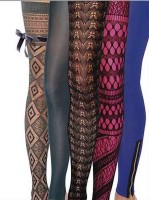
Knitted lace high stockings. I can do that! Perhaps I will. Elder Daughter would probably have a fit of delight to receive a pair.
For the record, some look like they have stirrup bottoms rather than full feet, and some are listed as tights, meaning they have a pantyhose style integrated top rather than just a stocking and garter tie like the leftmost offering in the pix above.
 String-Or-Nothing
