ALL GOOD THINGS
…the saying goes, must come to an end.
So goes the summer of 2012.
One sure sign of summer’s end is retrieving one or more kids from Roads End Farm, the summer camp they both love. As ever, much fun was had. We’ve found there’s a direct correlation between how dirty they are at pick-up, and how great the summer was. Let’s just say that this year we transported a little ball of filth with a big smile. Here’s that same smile, up on Yuma.

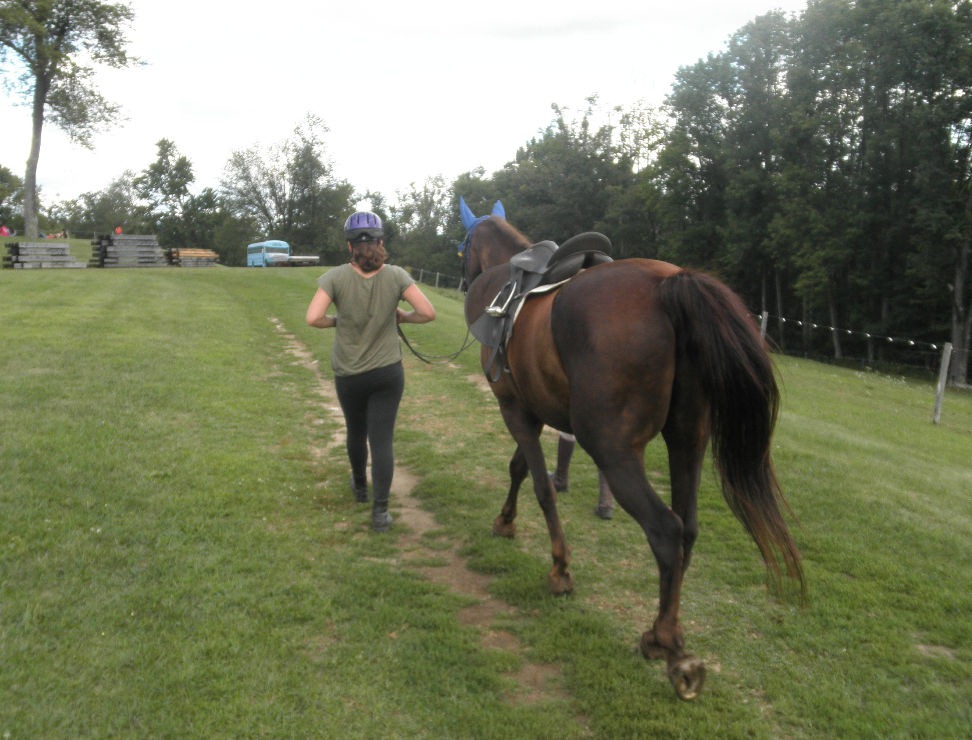
Dante, star of the pix below was having a bad leg day, and was returned to the paddock rather than being pressed into service:

That’s Sue in the background, riding instructor extraordinaire. However you’ll note that Dante is sporting a fashion accessory. It was a very fly-filled season, and to give the horses some relief, they have been wearing fly bonnets. However in the farm’s price range for pre-made, they only come in one-size-fits-all. I don’t have a shot of Elliot, REF’s largest horse, but at well over 16.5 hands, he towers over the farm’s 76-horse mostly Morgan herd. Stock fly bonnets would not fit him – not easily. So I made him one, custom:

He was turned out to graze the morning we visited, otherwise I’d have a shot of the thing being modeled. I used the crochet pattern from Nordic Mart, picking up stitches after the crochet was done to knit the ear socks. I used some old Austermann Record 210 remnants and a size 4mm (US G) hook, approximately 4 skeins total.
A NEW VOCABULARY
As part of the preparation for our grand India adventure, I’ve been reading everything I can about Pune and the surrounding area. This includes on-line editions of local newspapers, history books, and blogs. I’m learning a lot, finding facts, trends, and rumors – the hard and soft aspects of our soon-to-be home and its stew of cultures.
My primary sources are the web-available English language newspapers. I admit that they provide a skewed viewpoint. I know that I would not want someone to draw vast conclusions about the US by reading any one or two papers here (especially the tabloids or political slush papers). Still, slanted as they are in reporting eye catching, sensational crime stories, or presenting views tinted by biases I do not yet understand, they are a fascinating source of words, turns of phrase, references, and names of institutions that are new to me. These usages are just as current, legitimate and topical as any writing or speech anywhere else. I am reporting these not because they are strange, but because they are novel to my ear.
Dacoity – This one was reported by the Resident Male. In the US it would be called “armed robbery” or in an older time – alleybashing. Someone sticking up the local convenience store would be a dacoit.
Sharp weapons – Also reported by the Resident Male. We’d say “edged weapons.” Knives, mostly. Seems to be the favored arsenal for dacoity.
Nullah – A steep sided gully through which infrequent (but dangerous) storm water surges flow. If a natural feature, depending on the part of the country here we’d call it an arroyo, canyon, gully, gulch, or gorge. If man-made it might be a culvert or storm drain.
Housing society – In the US it would be a housing cooperative or “co-op” for short. A building or neighborhood in which the owners share the pooled cost of common area maintenance and general services for all. Like here though, there are maintenance fees and (when needed) special assessments. “Society” is also used to mean the grounds of the housing complex itself, especially enclosed communities formed of single family houses with walled gardens, inside a larger gated perimeter.
Overbridge – Overpass, like a highway overpass or a traffic fly-over.
Municipal Corporation – Depending on the size and organization of the city or town in the US the equivalent would be the city or town council and mayor’s office. I’m still working this out, but it appears that civic governance is not by direct election of representatives to the municipal corporation, but I may be wrong. More on this as I learn myself.
E-Way – The equivalent here would be a expressway, major highway or turnpike, probably a major Interstate or state route.
Lokshahi din – Grievance sessions held by a Municipal Corporation. Citizens with a compliant about municipal function or services delivery can submit it in writing, then go to a hearing where a municipal commissioner can render a judgement, to which all parties are bound. These tend to be held by civic zone (what we’d call city ward or district).
Jawan – I deduce this is a security guard, policeman, or soldier on security detail. Jawans are deployed on the trains to maintain security and order. I’m unsure if the male uniformed guards checking bag contents and running metal detectors outside of most public buildings would also be called jawans, or what (if any) the equivalent term for a female officer might be.
Chowki – This one caught me by surprise but shouldn’t have. It’s a local police station or jail. I’d always wondered where the Brit/US slang “chokey” for the local slammer came from. Now I know.
Chowk – by contrast, this is a town square. I guess in India, Arlington Center would be known as Arlington Chowk.
I’ll continue to vacuum up what I can, posting occasional vocabulary updates as my linguistic dust cup fills.
GONE AWAY, GONE AHEAD
No, this isn’t a Teaching Song moment. Although I try to keep this blog focused on creative things, occasionally life intrudes. In this case – intrudes in a big way.
The Resident Male has accepted a company posting in Pune, India. He leaves this afternoon for a two-year stint. I and Younger Daughter will follow him after the holiday season. She will be finishing 9th grade over there. Elder Daughter will continue on to her senior year of college, and we’ll all be back for her graduation in the spring. After that plans get hazy, but some or all of us will be resident over there with him until he returns.
What does this mean for String? You’re looking at it. Ease of remote maintenance and pre-trip streamlining were two of the reasons for the big port we just completed. I intend to keep on stitching and knitting, posting about it from here or Pune as circumstances dictate.
What’s Pune like? I did accompany him on a whirlwind one week house hunting trip there earlier this summer. Most of what I can report is massive sensory overload. It’s a trip to another world, as surely as any interplanetary trip from a Jack Vance novel. I’ve always wanted a Grand Adventure, and now I’m really looking forward to having one.
I can say that Pune is largely part of New India, the India that has so 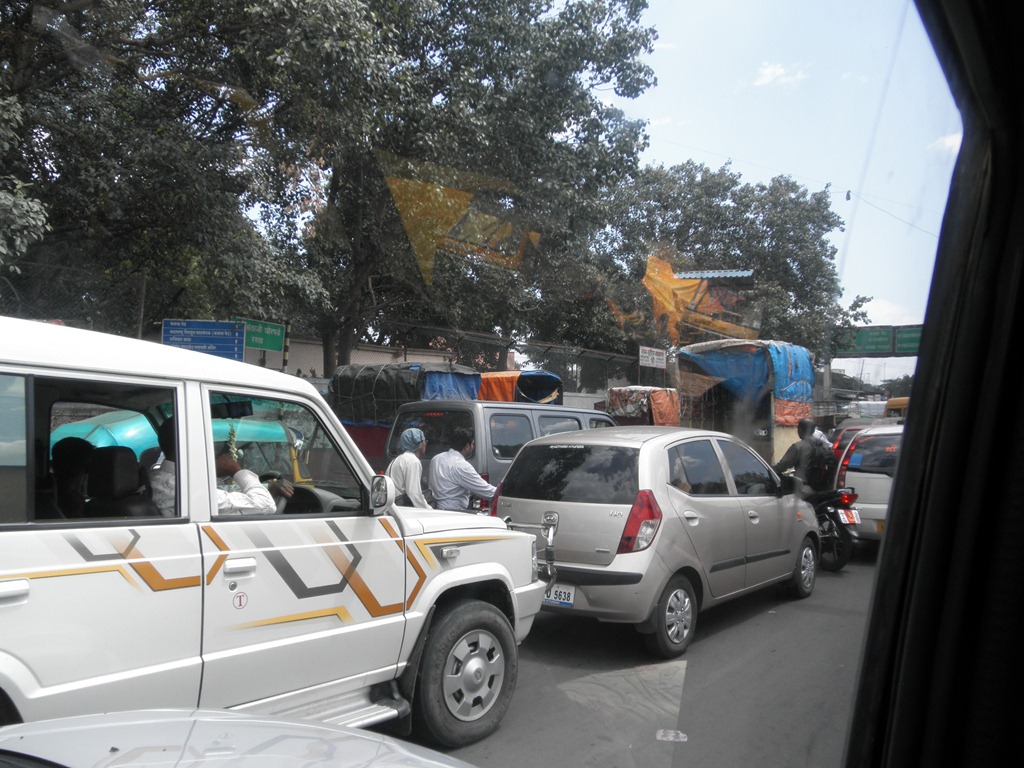 avidly embraced a high-tech economy. It’s a city in the hilly region about a three hour drive east and a bit south of Mumbai. Like Mumbai is part of the state of Maharashtra. Pune is known for its industry (especially automotive), technology companies, universities and teaching hospitals. In the latter three, it thinks of itself as the Oxford (or Boston) of India. Like most of urban India, it’s crowded and noisy, especially by US standards, but it’s also vibrant and very welcoming.
We didn’t get much time to tour the city, but we were able to visit a museum and a historical site on the weekend we arrived. The Resident Male described those bits. I found it all fascinating.  Things happen there that just don’t happen here. For example, while we were there, a conflux of two major pilgrimages occurred. Hundreds of thousands of people walked through Pune in devotion to two Hindu Saints, streaming through the city on every major road. My picture captures only a tiny group of pilgrims on a side street. The main body of walkers totally filled boulevards and bridges, shoulder to shoulder – group after group, as far as the eye could see. Each group began with respected leaders, yellow flags and revered images at the front, followed by a body of men in white suits. After then came a body of women, many carrying bundles of supplies. Lining many streets were well wishers and people who volunteered to tend to the walkers’ needs, offering medical care, snacks or water. Yet as singular as this was to me, it was just another annual happenstance in Pune. It got minimal attention in the local newspapers, and the residents weathered the major transportation disruption with little more than a shrug. When asked, most of the people I spoke to said, “It’s just another religious event.”
While we were there we did find an apartment. Touring the possibilities was more like speed-dating for housing than a considered quest. We looked at lovely stand-alone bungalows, full of quirky romance and surrounded by lush gardens. But when amenities were considered, reason overcame romance and we selected a modern flat. Here’s the view from our balcony-to-be. It’s in the Koregaon Park Extension neighborhood, overlooking a military athletic facility where many members of the Indian Olympic Team train. It’s quiet, with privacy – no road noise intrudes because the back of the apartment complex abuts the military reserve, and there’s no neighbor across the way to peer into our windows.
So there it is. The Resident Male has gone away, gone ahead to pave the way. I continue to prepare, and will follow, to whatever adventure awaits.
(Extra points to those who know the origin of this post’s title).
LONG LOST TWINS, PART II
To continue our museum hopping trip viewing similar patterns, here’s another cluster Again, this is a group that to my limited knowledge is NOT based upon a graph appearing in an extant 15th ro 16th century modelbook (but I haven’t seen them all).
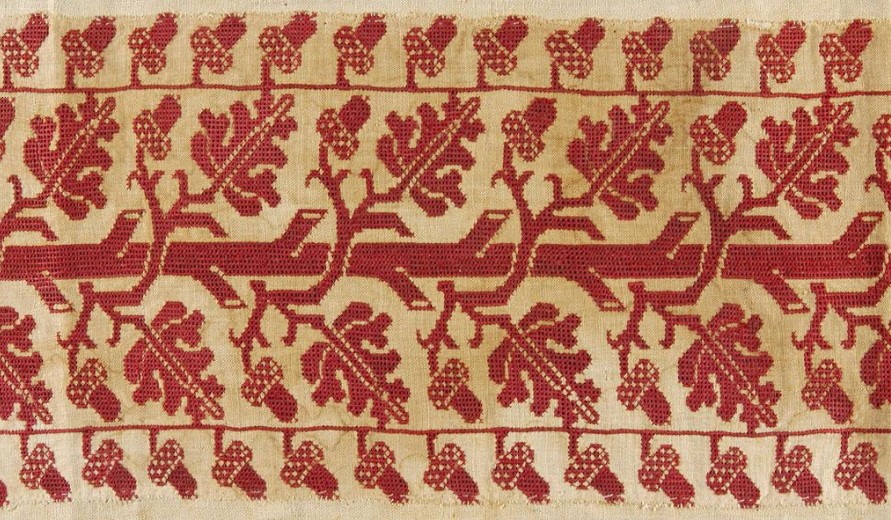
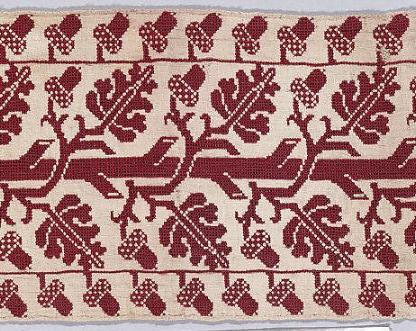
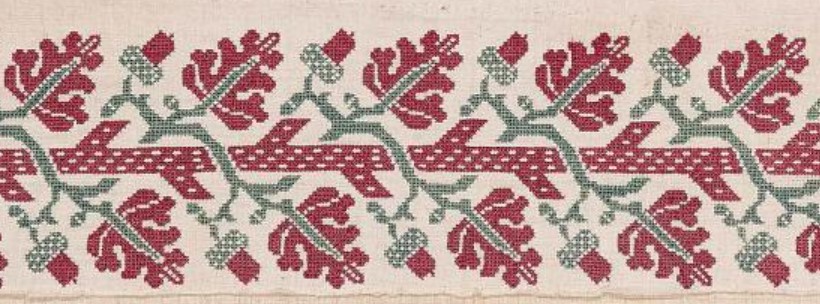
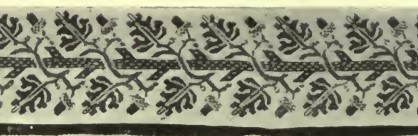
I’ve graphed the MMA and MFA examples (#2 and #3) for inclusion in TNCM2. I also stitched #2 in long armed cross stitch, on my big blackwork sampler: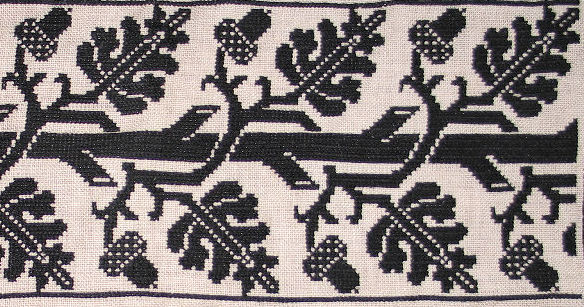
Compare my proportions to the museum examples to see the minor distortion caused by the not-quite-even weave grounds of the historical examples, especially #1.
#1 from the PMA is cited as being worked in silk using cross and eyelet stitches (trapunto). The MFA cites #2 as being stitched in “Punto di Milano,” which is a term they use for a family of pulled thread techniques that produces a mesh-like appearance, often by use of two-sided Italian cross stitch, pulled very tightly. It’s more commonly found as a background in voided work, but pops up for foreground elements and accents, too. There is no consensus among museums on what this technique should be called. To complicate matters, there are several ways of producing the overstitched mesh background look, both single and double sided. Still the execution of these are very close, and both look to have been done using pulled thread technique rather than a withdrawn thread method.
But #1 and #2 are not pieces of the same artifact. I’ve confirmed counts between them. There are enough small differences in strip width, ground cloth thread count proportions, stitching and minor pattern details to conclude that #1 and #2 are not twins separated after birth. But they are so close that I’d opine that they were probably stitched from the same source – pattern collection sampler, printed broadside, hand-drawn pattern, or source artifact. There’s even a remote possibility that one of these is the paradigm for the other. We can’t say for sure, all we can do is note that they’re children of the same family.
Now #3 and #4 might be more closely related. The width measurement, count, proportions, form and color placement on them are extremely close. Even those nasty little skips that give the tree branch bark its texture are spot on exact in placement between the two pieces. But I can’t say for certain that they are either pieces of the same original, or photos of the same artifact. Pieces have moved between museums before, and even the most scholarly author can make a mistake in attribution. The problem is the accompanying descriptions. #3 is in Punto di Milano. But the Kendrick-Holme book specifies that #4 is “embroidered with red and green floss silks in satin and double running stitches.” Again, attributions might not be correct. I wish I could find out if #4 is still in the V&A, and get a closer look at it.
So to sum up, again we’ve got a recognizable and stable pattern, possibly spanning centuries of active use. I think the attribution on #1 is a bit early, but I have no proof. We’ve also got two and possibly three different methods of execution, and evidence that variants of the same pattern were worked in both monochrome and multiple colors. We can posit that multicolor variants came later, but we cannot flatly conclude that monochrome came first, due to the broad and overlapping range of dates given for these pieces (with the 15th century date discounted as a possibly questionable outlier).
There are lots more of these in my notebooks. I find this fascinating, but I realize that not everyone is an uber-stitch-geek like me. Please let me know if you’re bored to tears, or if you’d like to see more examples of patterns over time.
SCHOLA TALK
No pix this week. The Resident Male took my preferred camera with him on a business trip overseas, and I’m not disposed to dump batteries down the gaping maw of the older camera in their joint absence.
I had a lot of fun at the Hrim Schola event in Quintavia (Marlborough, MA) this weekend past. I took both Elder and Younger Daughter, plus Younger Daughter’s Pal. The four of us did the full day of classes and workshops, pausing briefly between activities to nosh out on the offered foods and snacks. I thoroughly enjoyed the three sessions I attended – an overview of fleeces and spinning by Lady Ermengar; a lessons-learned lecture on Italian Renaissance era Perugia towels by Master Peregrine the Illuminator; and an introductory taste of withdrawn thread work given by Kasia Wasilewska. The towels come from the same period as my favorite stitching, and the motifs are very much akin to it. Whitework is on my agenda, especially the early forms of cut and withdrawn thread stitching. And anyone who’s followed here knows that knitting is my hobby-away-from-my hobby – the thing I do when I’m not stitching (and vice versa.)
The kids went to several other workshops on Viking wire weaving; basic chain mail construction (no rivets or soldering); Japanese Kumihimo braiding; combing and carding wool; hand sewing; and needle weaving. Adding in the lucets they’ve both acquired this year (plus the lucet technique book they picked up from Small Churl Books at the Schola), we now have infinitely more ways to play with string in all its forms.
As part of the day’s activities, I gave a whirlwind tour of some of the things I’ve stumbled across doing research for TNCM2.
The first part of the talk was a travelogue of some of the counted styles popular in the 1500-1650 time range. I touched on the difficulty of exact dating due to the nature of the major collections in museums – that they were mostly amassed between 1860 and 1920, by collectors whose boundless enthusiasm and interest was rather more greatly developed than their ability to pin down dates and provenances. I also mentioned that while my original goal had been to develop a chronology of techniques and styles, doing so crisply based on the meager attributions and origins was impossible. Maybe as 16th and 17th century edging and domestic embroidery scraps become as well known and appreciated as samplers, and are studied by academics armed with the latest in dating technology it will become easier, but for now chronology is rather mushy.
After the style stampede I glossed over uses – the usual: clothing, domestic linen (sheets, napery, coverpanes, cushions), liturgical items. I tried to show examples not commonly represented in books or on-line image collections.
Then the real fun began. I tried to show that some standard preconceptions about these works can be challenged in the artifact record. We looked at work that wasn’t just red or black (or blue or green); monochrome vs. polychrome works; mixed techniques; that historical linen was not always even weave by the modern definition; that stitching was most often done over 3×3 or 4×4 threads on finer linen than we use for modern 2z2 countwork. I showed examples of contrasting color outline voided pieces, and some works that were less concerned with adherence to precision pattern fidelity than they were with overall effect. And we looked at some pieces that while worked on the count, were probably drawn on the fabric freehand prior to stitching rather than being reproduced from a graph or previous piece of stitching.
After that it was a short move to the “treasure hunt” part of the talk. I have great fun finding and matching disparate works. I’ve found quite a few pieces that represent distinct pattern families. Some of these designs appear on snippets of finished works and also on specific historical samplers – not English didactic ones, on pieces I believe might have been sample sheets for professionals (my fave V&A sampler falls in this category). In other cases there are groups of finished snippets that were clearly worked from the same master pattern. Some of these have roots in German, Italian, French and English modelbooks. Others have no printed original that has descended to us, but are so close in base design that a common source must have existed. And other snippets, now widely scattered to different museums or private collections might in fact have come from the same origins, sold in small pieces to multiple collectors who visited the same European dealers.
The upshot of my talk is that there is far more variation in these pieces than modern stitchers might realize. That these variations enable a fair amount of play for those wishing to replicate a style. I’m a firm believer in studying the samples in order to internalize the deeper aesthetic and method, then using those vocabularies to produce work that is true to the time, without being a clone of a period piece. I don’t claim that my stitching embodies that ideal. My stuff is modern play-testing, assembled without regard for period aesthetic. Learning pieces at best, and not historical beyond the fact that they incorporate historical designs.
I got some good questions from the group. After TNCM2 is out, I’ll look into ateliers and professional vs. at-home stitching, and see what the academic literature has accumulated in the six or so years since the last time I went on a hunt for that info. I’ll also look more into materials, especially fingerspun floss silks. And I’ll be reworking some of the slides from the talk into blog posts, with source references, so that the small audience here can chime in, too.
I think the attendees enjoyed the talk, although in retrospect, I probably had way too much content for just one hour. I motored through at ramming speed, for sure. By the end they looked exhausted, and a bit overwhelmed. But that could have been my own exhaustion projecting itself onto them.
Needless to say, I had a great time. It was fun to find others interested in this stuff. I met quite a few people face to fact that I’d either not seen in 15 years, or who I have only known through on-line interaction (Hi guys!). I’m not a joiner, and am pretty solitary by nature. I tool along on my own, and have done so for decades. Blogging and boards bring some interaction with kindred spirits, sparks I truly appreciate. But giving the talk and interacting with the attendees was like sitting by a bonfire. If they enjoyed it half as much as I did, I’ll be extremely happy.
Oh. One last thing. Thanks to the group who put this together, running the event, scheduling the classes, manning the kitchen (very tasty!), and otherwise enabling the day. And thanks to Davey whose enthusiasm and encouragement goaded me into crawling out of my basement hole, and volunteering to do a class.
HOLIDAY REPORT
Altogether a satisfying holiday season here at String Central.
We started off festivities last Friday, with a latke-fest.
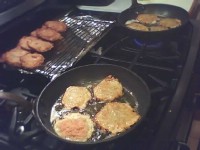
We decorated the tree and deployed the M&M Man Army on Christmas Eve day, while the dinner was cooking:
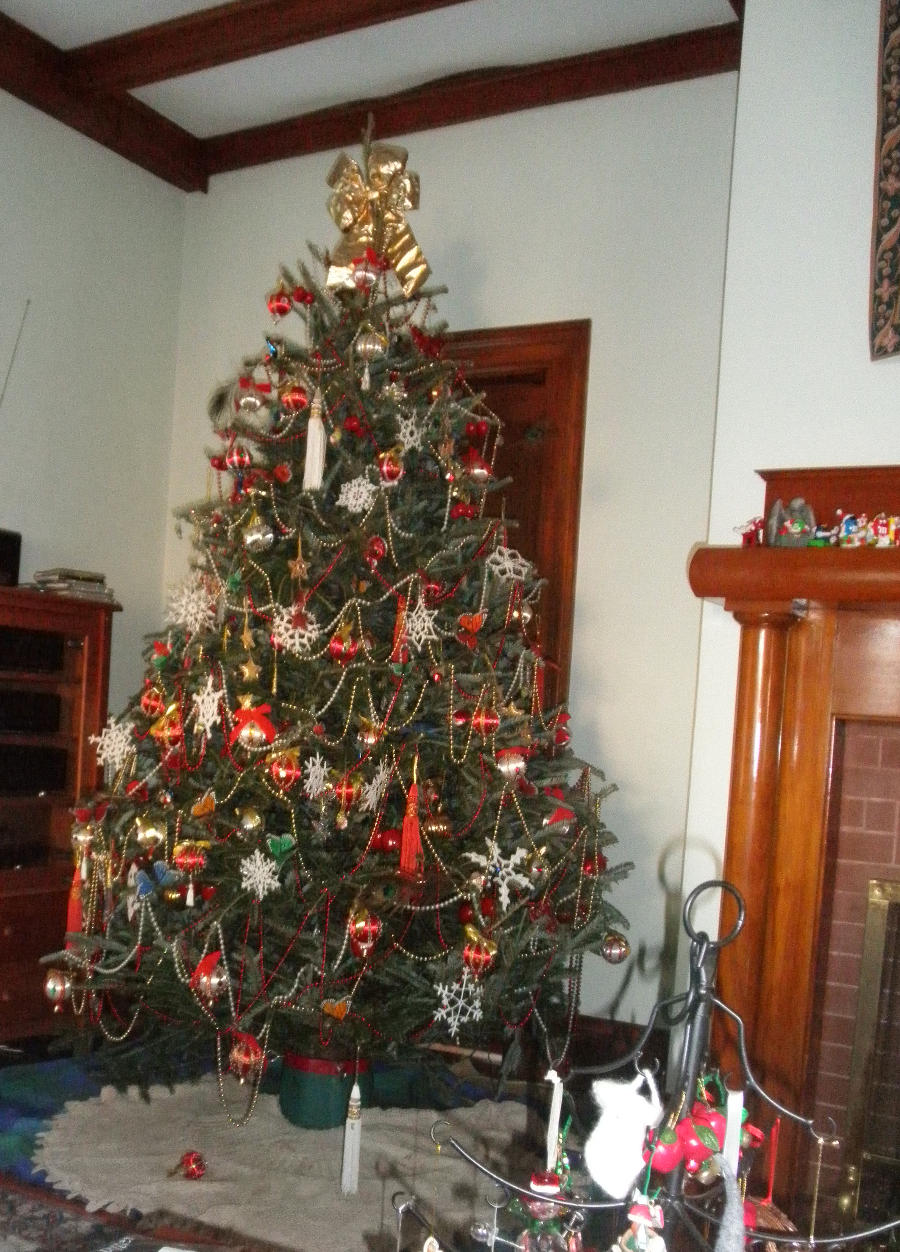
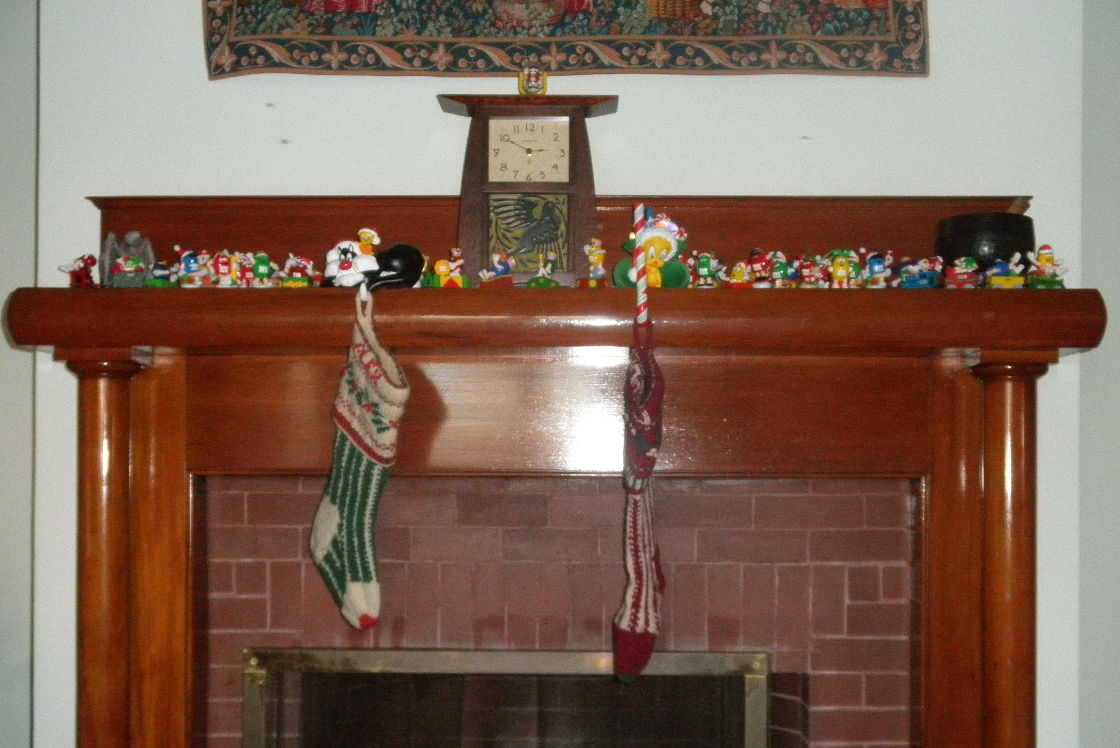
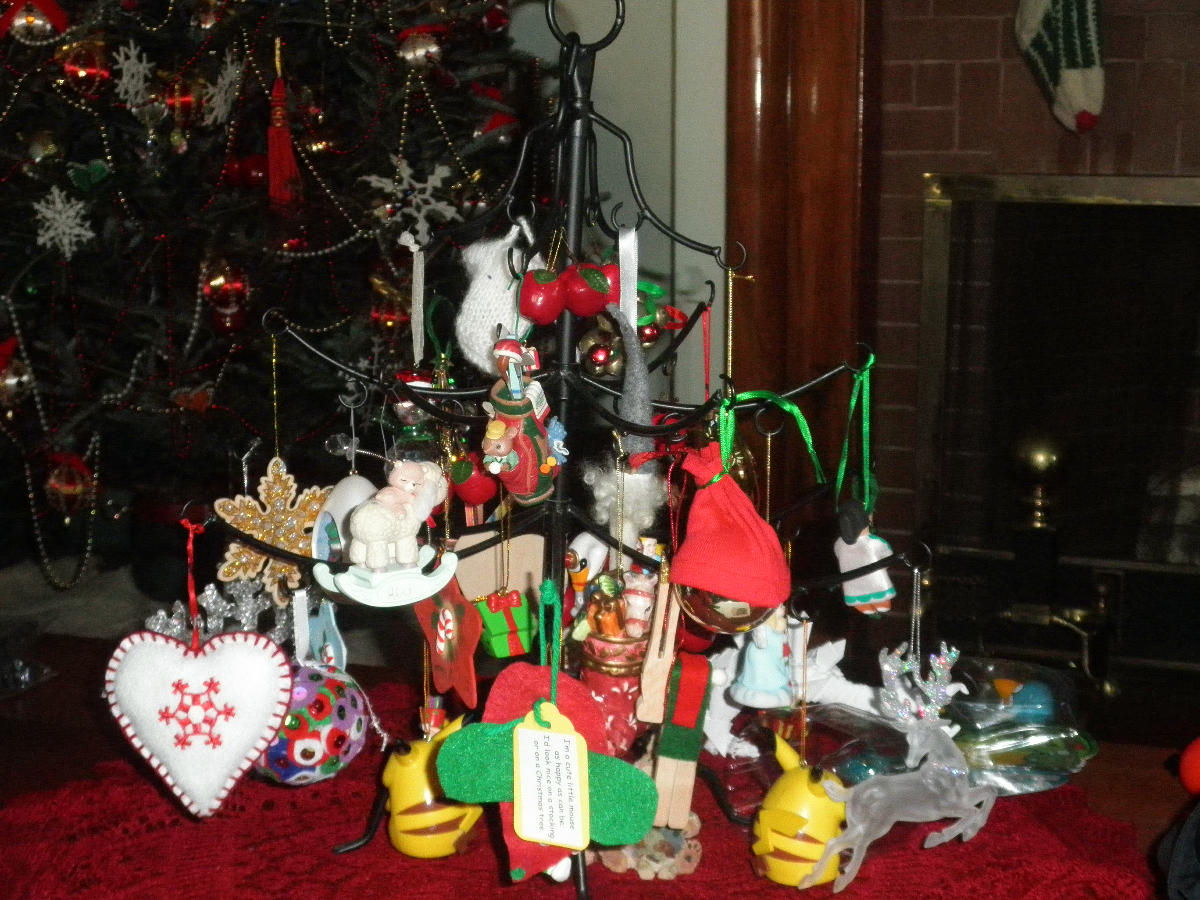
There’s no such thing as too many ornaments in this house, but with so many on the tree, the special ones get overlooked. So they go on a small wrought-iron stand that sits on the coffee table:
Saturday brought Christmas Even dinner. The Resident Male outdid himself, with lobster bisque, pan-seared foie gras, a succulent and crispy-skinned roast goose with chestnut stuffing, ragout of wild mushrooms, and roasted golden beets. He even made an apple charlotte for dessert.
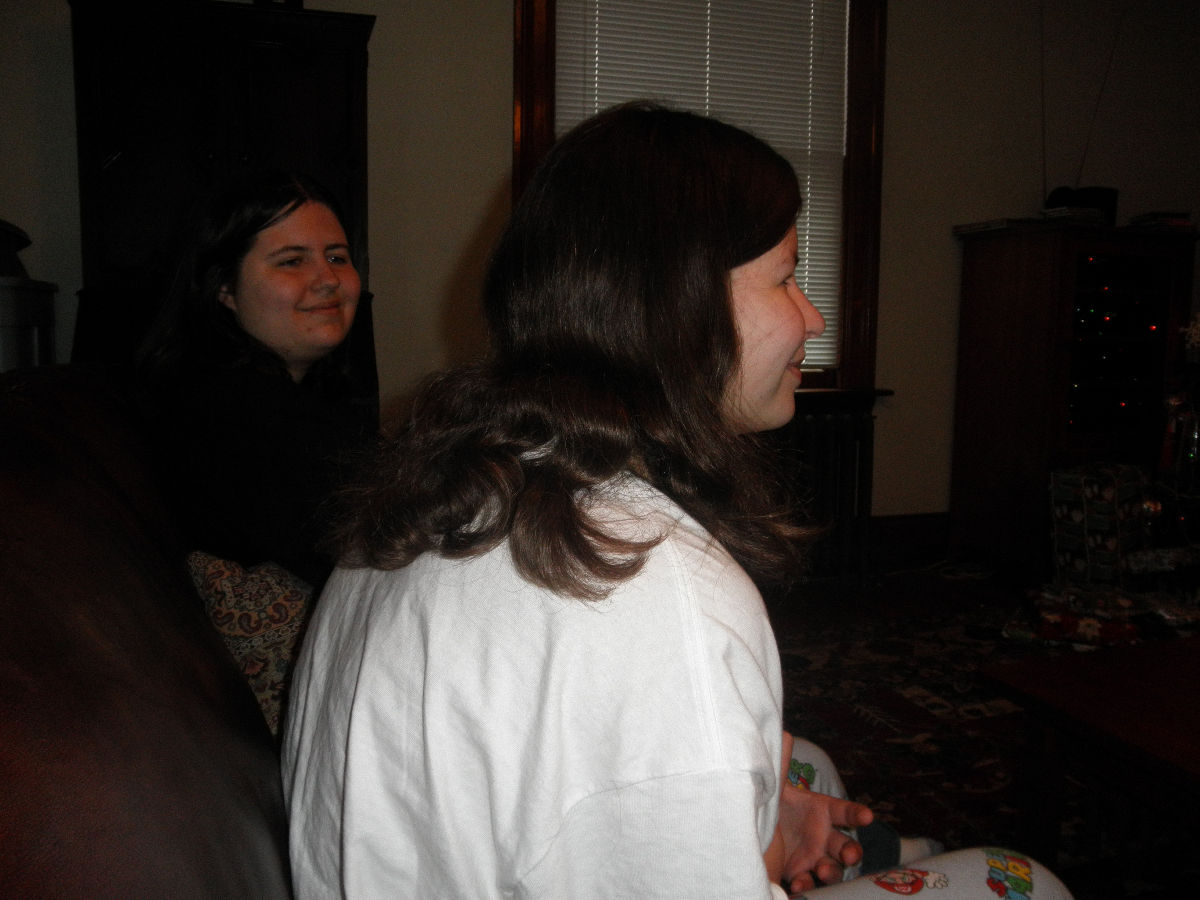
Sunday morning was rife with the traditional anticipation until everyone was awake:
Christmas day was another goose. (You can’t beat a two-goose holiday!) This time at the now-traditional gathering hosted by an old friend. It started as an “orphans’ holiday” in which those of us who had not gone to visit family for Christmas celebrated together. Over the years the gathering has become its own family, with themed dinners. This year’s was Swedish, with a warm and savory fruit soup to start, mushroom tarts, gravalax, the goose, three-meat stew, cream cake and many other goodies I’ve omitted mentioning. And a lot of good fun.
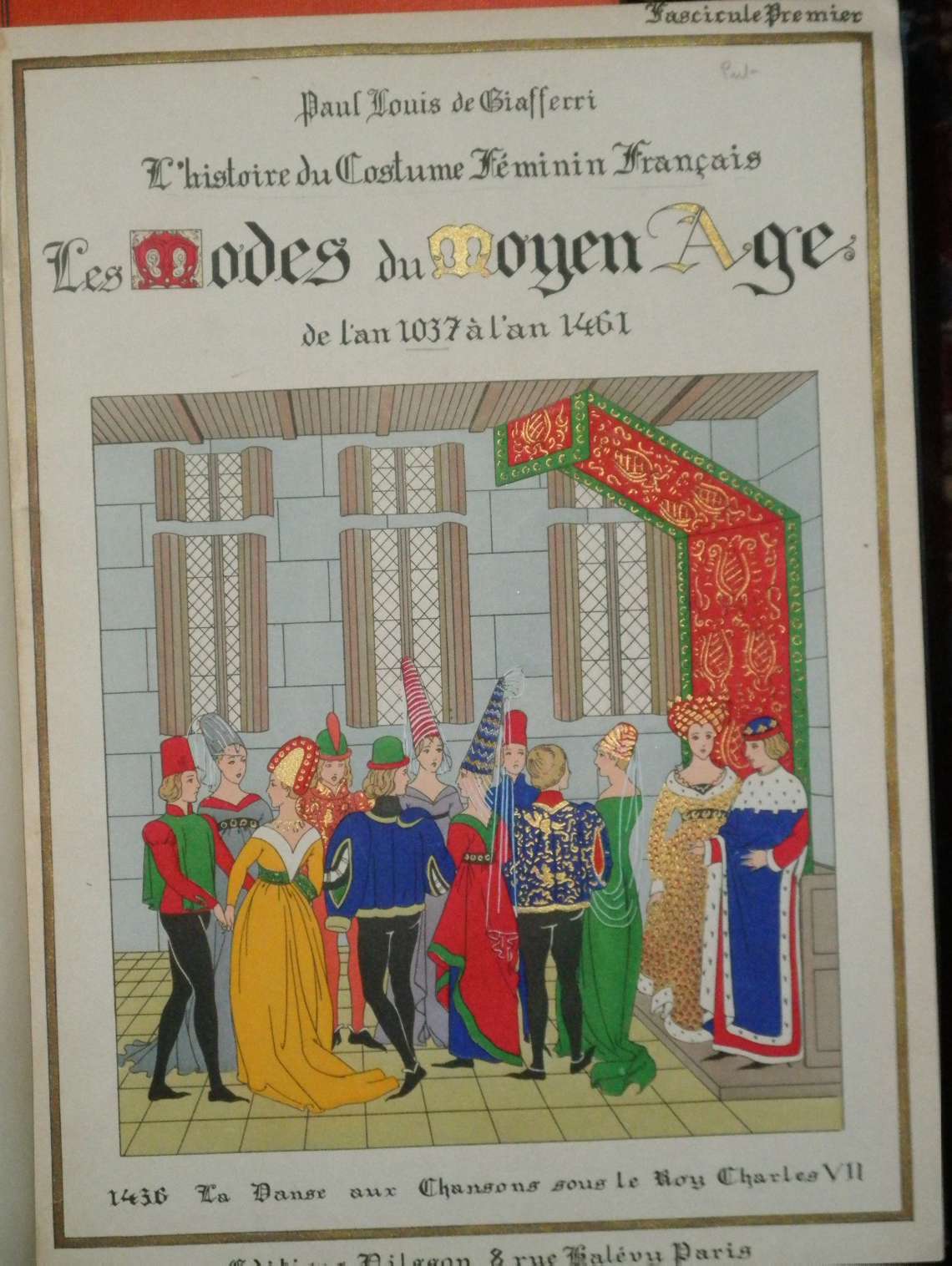
In terms of holiday present haul, I made out like a book bandit, courtesy of The Resident Male and Elder Daughter. Chief among my booty are these two volumes from the husband:
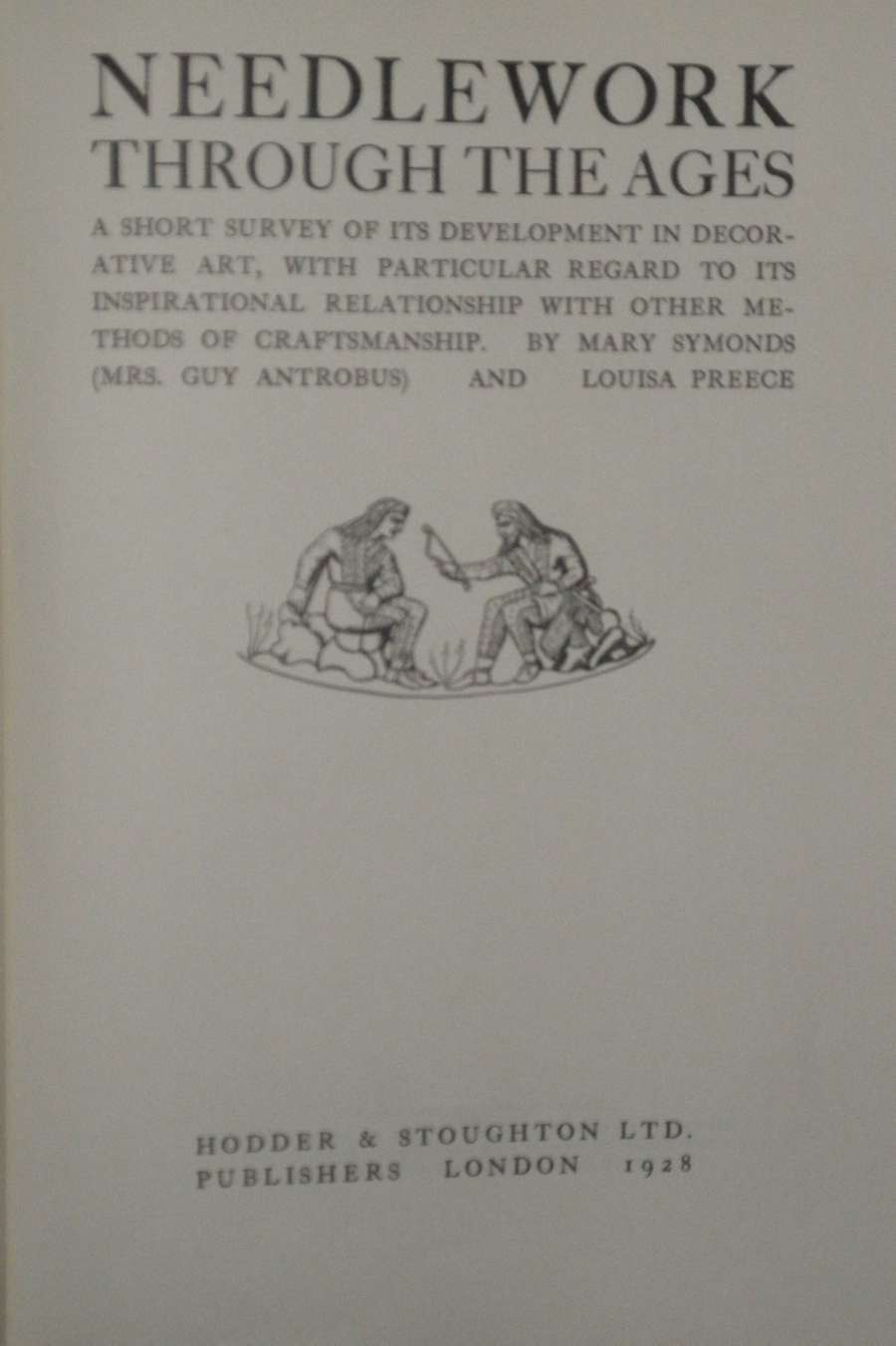
Needlework Through the Ages by Mary Symonds Antrobus and Louisa Preece is a huge tome published in 1928. It’s lavishly illustrated with photos (most black and white but a few in color). It’s a general survey course of embroidery starting at earliest known bits, through the end of the 1800s. A highly opinionated survey, I might add. Many of the photos are of items that are still in private collections, rarely included in other works. I will have much fun reading this, raising eyebrows at the authors’ various diatribes, and exploring the photos it contains.
My other gem is L’Histoire du Costume Femmes Francais 1037-1774 by Paul Louis de Giafferi – the first volume of a two-volume work issued around 1925. (The second volume spans the years from 1774 through 1870.) Each volume contains multiple albums of illustrations – stencil colored (as opposed to ink press printed) – with accompanying descriptions. Some of the plates from this first volume are available on line, and some are available in a 1981 paperback re-issue. But the original is magnificent. And inspirational! My French may be rusty, but reading is easier to speaking, so this is more than a “pretty pictures” book, for sure.
He also gave me a contemporary work, Viking Clothing by Thor Ewing. This looks to be an excellent reference for accurate re-creation of men’s and women’s dress of the period.
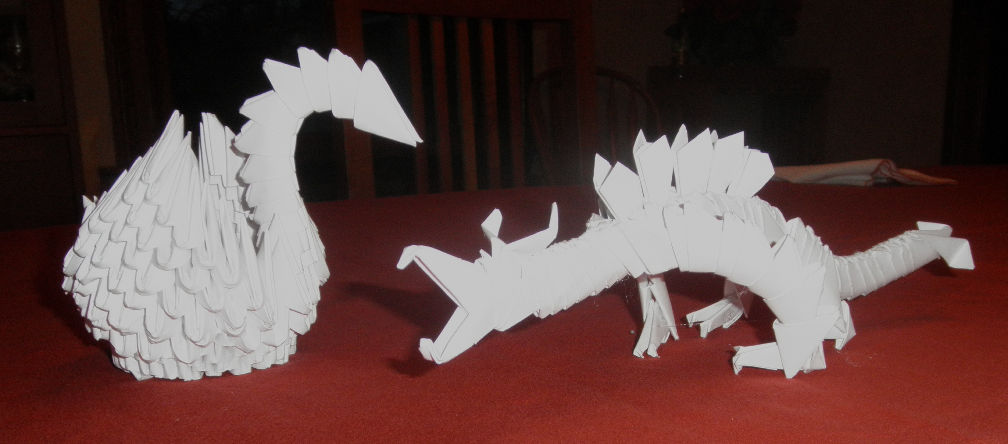
Elder Daughter also caught the historical spirit, but in a lighter mood. She gave me Kate Beaton’s book, Hark! A Vagrant. Highly funny. And Younger Daughter crafted paper sculptures. For me, a swan basket. For The Resident Male, a desk dragon:
Low key festivities continue, with the majority of us being all or mostly off from school and work. Hope your holiday is similarly pleasant, filled with family, friends, good food, and fun.
STORMING THE CASTLE
UPDATE: THE UNICORN PATTERN BELOW IS NOW AVAILABLE AS AN EASY DOWNLOAD PDF AT THE EMBROIDERY PATTERNS LINK, ABOVE.
Holiday over, we slowly revert to standard routine here at String Central. However, that doesn’t mean we have nothing to show off.
First, Smaller Daughter – her class built models of castles, manor farms, and cathedrals as part of their Middle Ages history unit. You can’t see the details she lavished on hers – the working drawbridge, the flower garden, the well (with working bucket), the stables, or the forces manning the towers, but now you know they’re there:
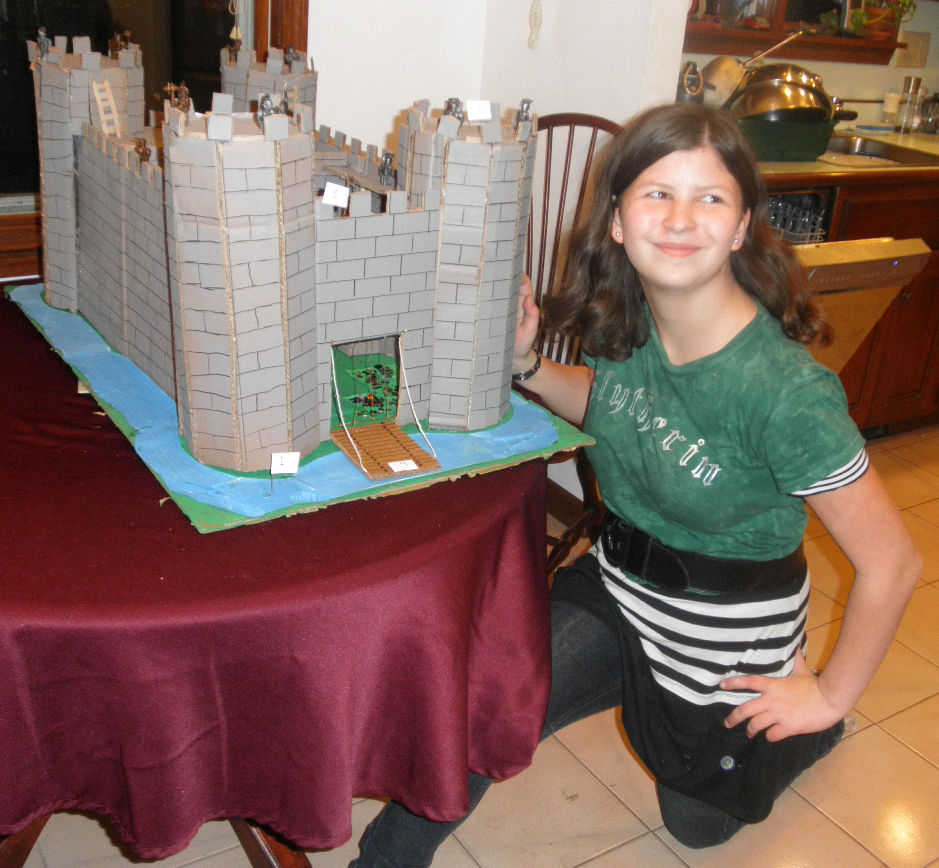
Slytherin? Well, we are Salazars, after all… And there’s the inevitable Castle Uprising Aftermath:

Too bad the teachers don’t grade them on general post-project carnage.
Not less for being presented second, Elder Daughter has been taken with double sided double knitting. She has been adding double knit squares bearing mythical creatures to her Barbara Walker Learn to Knit sampler afghan. Here’s a graph for her next square, an original unicorn, based loosely on a Siebmacher yale (heraldic goat):
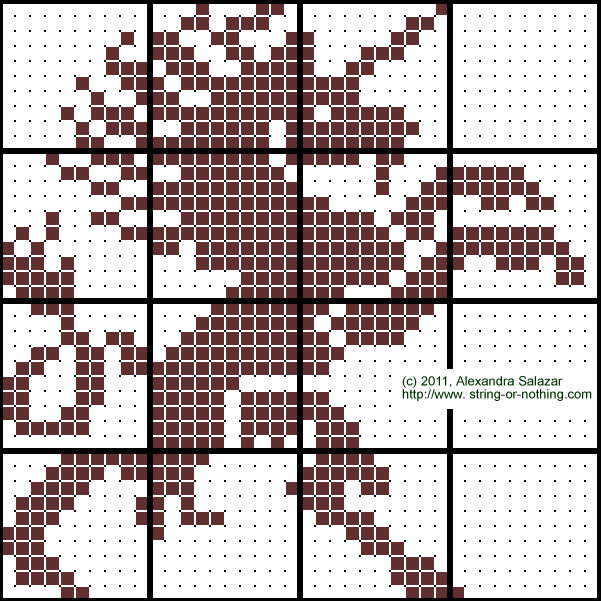
Apple. Tree. Lack of distance between the two is noted. With considerable pride, I might add.
And finally in spite of the welcome and happy chaos of a house crammed full of family, turkey, and way too many pies – I did manage to move a bit forward on the great blackwork sampler:

The dark band with the frilly edging will be in TNCM2. The one just below it was in my first 1974 booklet. I recently rediscovered that I had graphed it from my all time favorite source. It’s the pattern I used for my double sided double running stitch logic lesson back in August, 2010. You can find the lesson (and the pattern) here.
EDGE OF THE KNOWN WORLD
I’ve reached the top edge of my giant blackwork sampler:
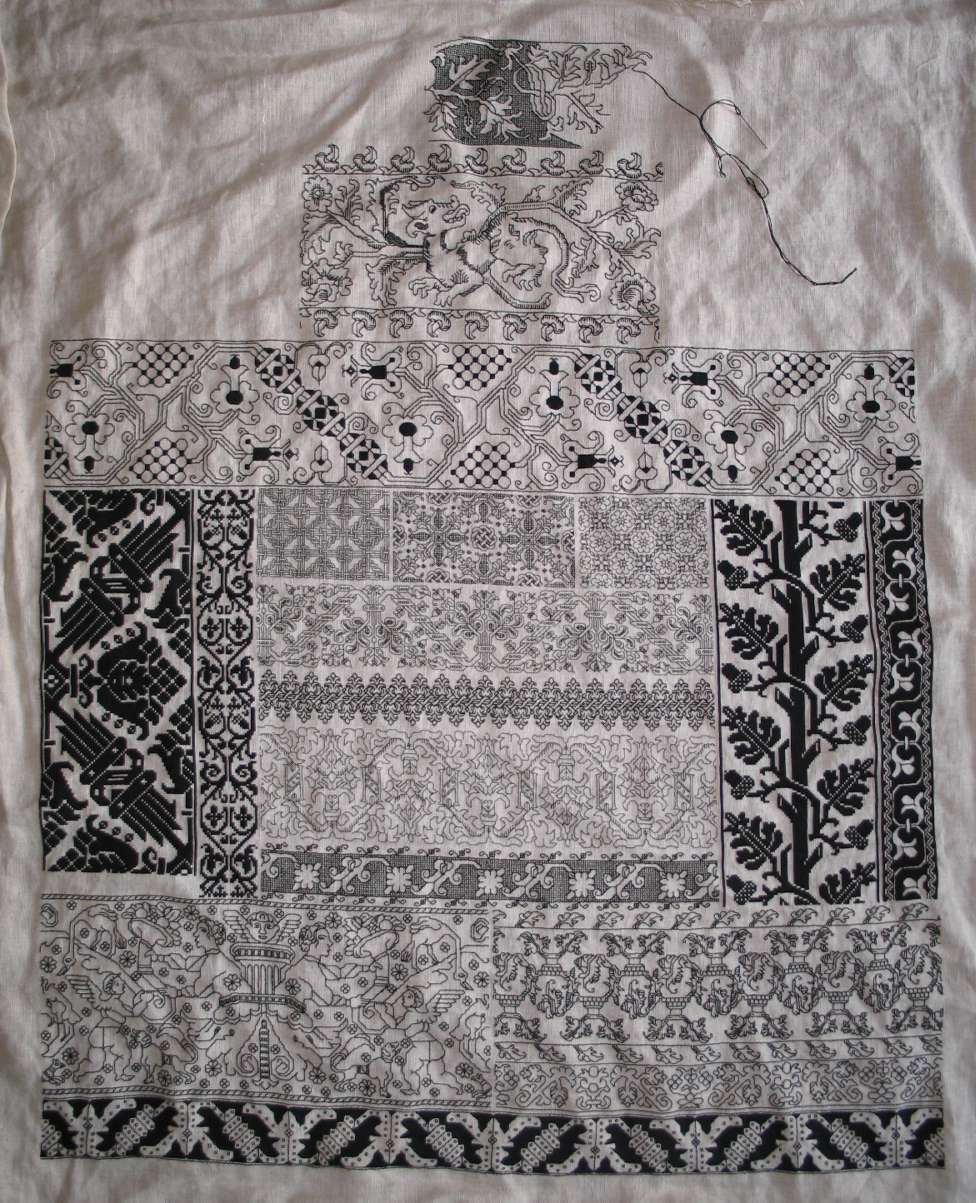
The current panel will span the entire width of the piece:

It’s adapted from a Lipperheide pattern. The original is shown with a pulled thread mesh background, rather than the squared fill I’m using. That background made the book’s illustration very difficult to work from, so I had to redraft the pattern before I could begin. The squared voided fill takes a long time to stitch, so I am guessing that it will be a couple of weeks before I can address the areas to the left and right of my dragon. Not sure yet what will go there – possibly gangs of narrow borders, either horizontal or vertical. We’ll see…
In other news, I am very proud of the whole String family. Smaller daughter has spent the last two weeks farming a sourdough starter “It’s not fair! Other kids get kittens or puppies. Why do I get Francis The Yeast Culture for a pet?”
Yesterday we decided it was time to try it out. The Resident Male took charge of mixing up the dough, the various rises, loaf forming, and baking. Here is the result, crunchy-fresh and hot from the Dutch oven in which he baked it:
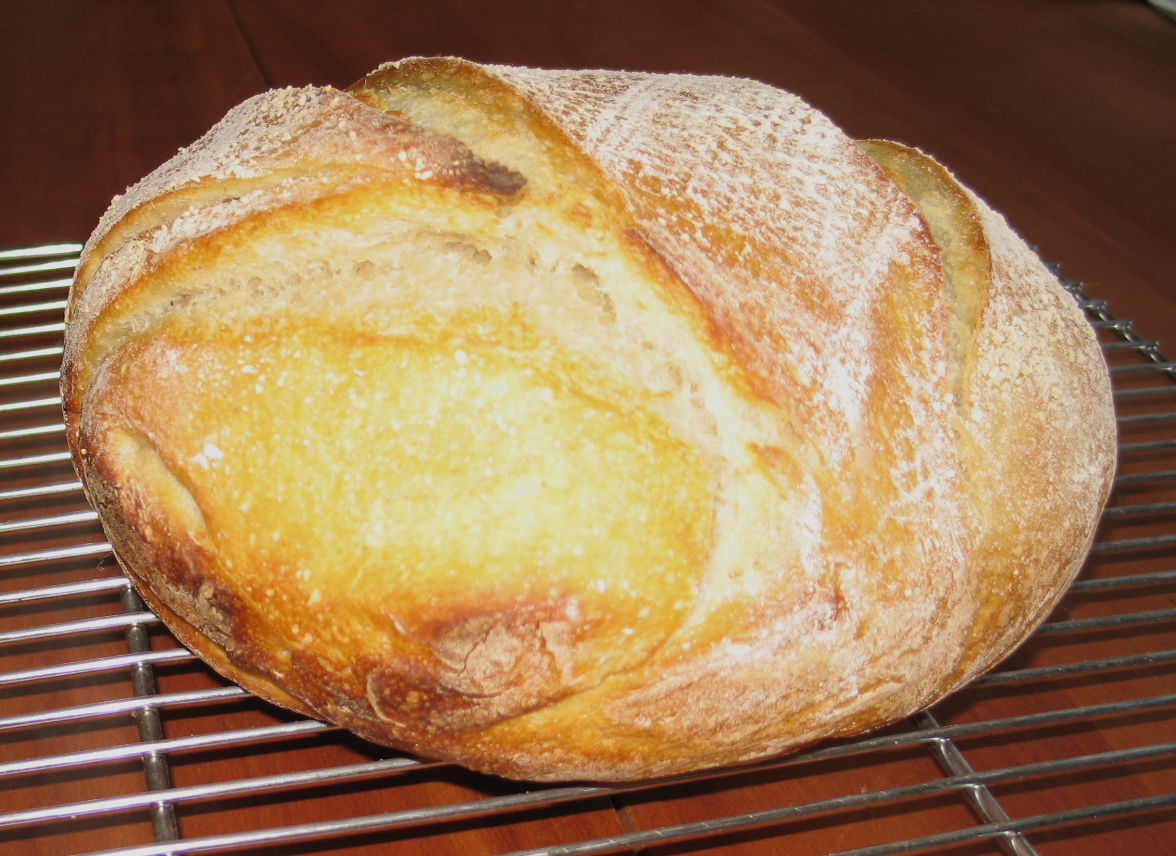
I wish this was Smell-o-‘Net because the house is heavenly right now. Marian would have been proud of him, too!
ADA LOVELACE DAY – CELEBRATE WOMEN IN SCIENCE, MATH AND ENGINEERING
October 7th is Ada Lovelace Day!
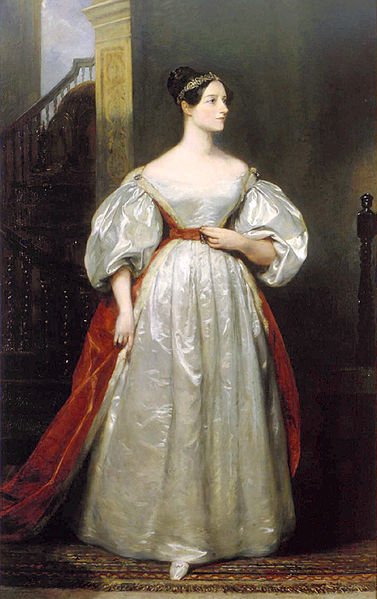 Although every day should be a day to celebrate the achievements of women in the sciences, sadly few folk think hard or long about them. Most people can rattle off the names of a dozen famous male scientists or inventors, but come up with a short list that begins and ends with “Marie Curie” when asked to name accomplished women. Several years ago a group was formed to bring greater awareness of women’s contributions to technical fields. They started Ada Lovelace Day (http://findingada.com hashtag #ALD11 ).
Past ALD posting events have called for folk to honor particular (usually unsung) historical women of accomplishment. I had great fun doing so. This year’s call is different, and far closer to home. The request is to name a personal heroine – a woman in science, math, technology, or engineering – who has shaped you to become who you are today.
As a proposal specialist, I’ve had the privilege to work with many outstanding women in technology – pioneers all – in fields as diverse as civil engineering, robotics, oceanography, and medicine. But I will write about one of the first whom I met in my early career, and who changed my life tangent. Anne, if you read this – apologies! I tried to contact you first. Just sit still and be flattered. 🙂
My Ada Lovelace honoree is Anne Street.
I met Anne back in the ’80s, when we both worked for an engineering firm specializing in infrastructure. She has a dazzling technical background, with multiple degrees from MIT, at a time when women MIT graduates were few and far between. Her specialty then was business development for applied engineering, and she took me under her wing as she made her rounds of the nuclear industry and associated Government and research entities.
Anne taught me a lot. There’s the obvious – how to read and answer Government requests for proposals. And there’s the not-so-obvious. How to engage engineering vision. How to distill the musings of the stratosphere-inhabiting set and transmit their thoughts to non-tech folk, without being didactic or condescending. How to be the only (or almost only) woman in a field dominated by men; taking neither nonsense nor prisoners, but doing so by subverting from within rather than wasting energy on pointless direct confrontation. How to lead the unwilling. How to build a team of people who might not be happy about putting in after hours and weekend work; shaping them so that in the end they were damned proud that their output was of the highest quality, because that way all the overtime was a badge of honor, and not wasted effort.
Through all of this ran a wicked sense of humor. She held a wake when a particularly large and desperately desired potential opportunity came in as a loss – complete with black balloons, a model coffin, and wilted flowers. The telephone play of her convincing the florist that she WANTED dead, droopy flowers was priceless. Her parties were legendary: Tinkertoys as icebreakers; mystery role playing gatherings; just the things to make totally unconnected creative folk from many walks of life unwind together, even though they had just met as strangers. I still have the glass lampwork beads and jewelry we made. Three houses and 20 years later – her daylilies still bloom in my yard. And I’m still writing engineering proposals.
But most of all Anne was always the epitome of encouragement. There was no field, no technical arena, no bit of knowledge too arcane to tunnel into and to share. She taught me to step aside and engage the brain when I read, to assess not only face value content, but possible sub rosa influences; and to always look for the proof or the root cause. And that in the end, everything can be researched because there is no priesthood. Women and men without tech degrees can through curiosity, enthusiasm and perseverance, always find meaningful and substantiated data.
Anne today is president of the MIT alumni association, where I am sure she’s using connections and influence to further the cause.
Way to go, Anne!
Y MARCH
More progress!

The new band is marching across the bottom nicely, bringing a dark footing to the thing. Here you can see that I outline first, then fill in the voided long-armed cross stitch (LACS) background:

Trust me, it’s MUCH easier to work LACS inside an outline. I did it “feral,” (without outlines) on the large dark panel in the center of the left edge. Plain old cross stitch is easier to count than LACS with its braided surface texture. That one panel probably took twice as long to do in LACS as a result. This band is moving along much faster. Another two weeks tops, and I should have the entire bottom edge finished. An aside – there’s a mistake in the current strip. Pat yourself on the back if you can spot it!
In other news, The Resident Male has a project to showcase this week. In the spring we finally replaced our Carter-era washer and dryer with ones that work. Because we had to fit them into an existing alcove, and I wanted efficient front loaders, that took a bit of shopping around. Most front loaders on display in this area are giant capacity/top of the line units or are mini capacity apartment size stackers. Big ones wouldn’t fit in the space we had available, and with kids, we wanted more capacity than the smaller, stackable models. We finally tracked down some mid-size GE units, well reviewed with good repair records, and ordered them.
Now one problem with these front loaders is that the openings are knee height, and users have to stoop to put the laundry in. This is why the makers offer height-raising pedestals as options. Unfortunately, pedestals for our smaller size units are not offered in the US. So the Resident Male, freshly inspired by countless evenings of home improvement TV, tackled the project himself:
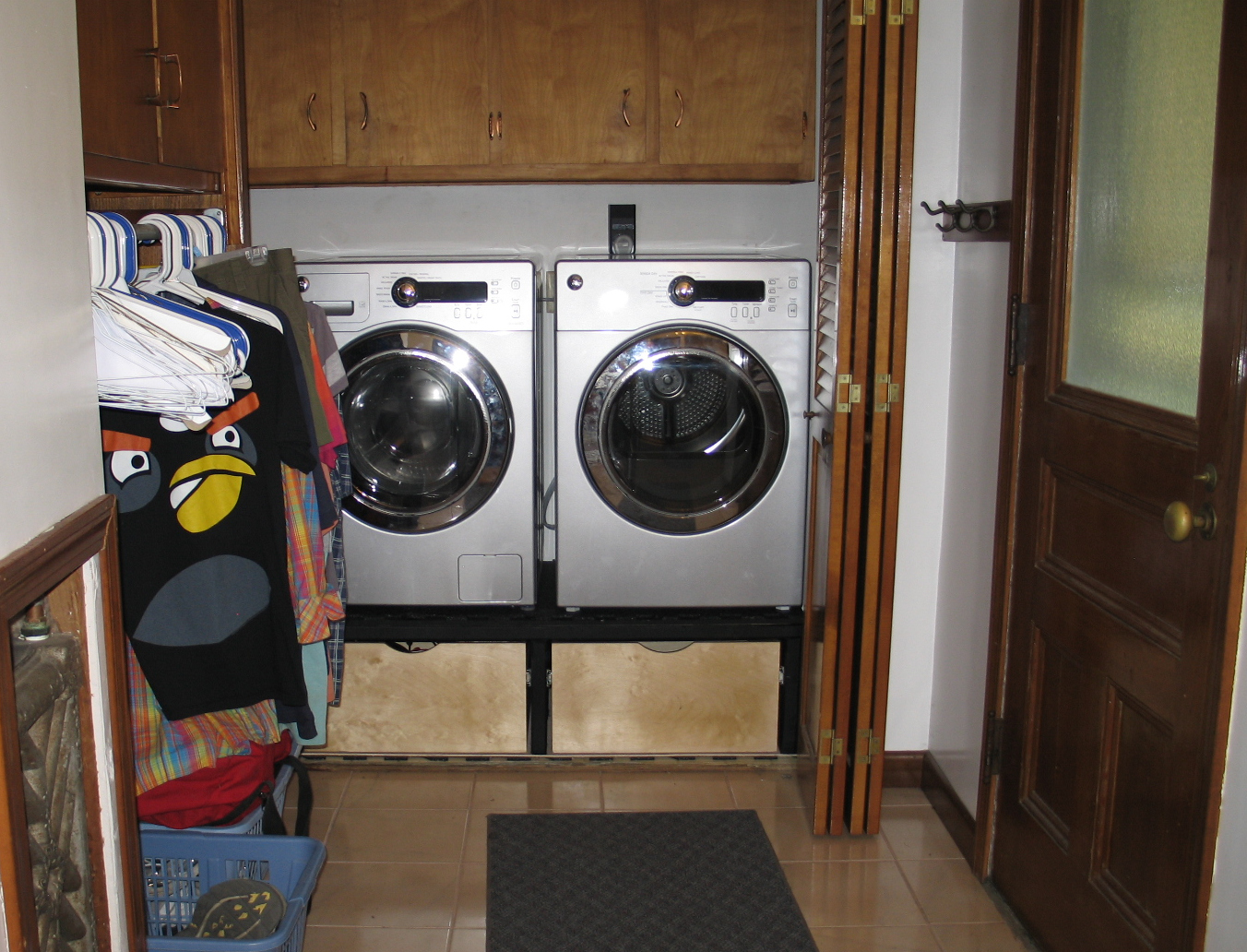
We now have two drawers for storage of once-a-year type kitchen impedimenta – like the big turkey roasting pan. And no more reaching in for that last sock on hands and knees! I declare this project a success. Now how does the new washer perform? It cleans much more thoroughly than my late 1970s/early 1980s vintage Kenmore did, even removing stains I thought were lost causes. The washer/dryer pair sip water, detergent, and energy, noticeably decreasing our consumption of each. And they’re quiet. We can now sit in the kitchen (behind the photographer) and have a conversation while the machines are running. But there are also a couple of minor drawbacks. Cycles take twice as long to complete; the mid-capacity model holds less than the old top loader, so there is one more wash per week; and for some reasons, sheets twist themselves into Gordian knots in the dryer, and do not dry well, unless I take the time to re-assort them several times mid cycle. Drawbacks aside, the new set-up is far superior to the old one, and the raised platform is the icing on the cake.
 String-Or-Nothing