BOUGHS, HOOPS AND STRIPS
More progress on the big sampler:
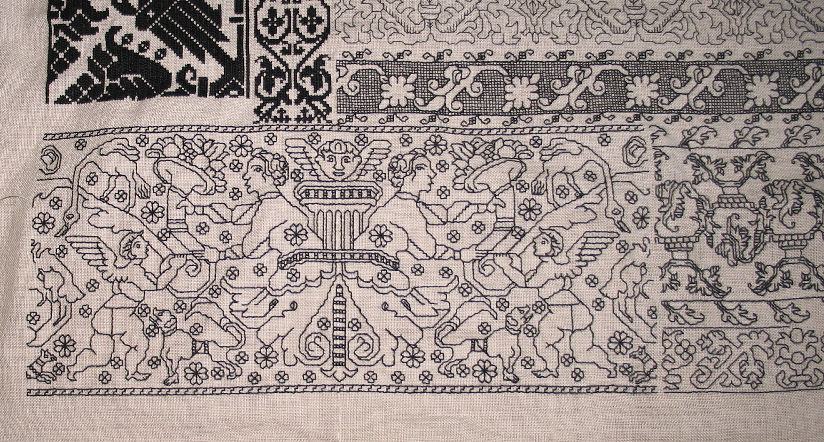

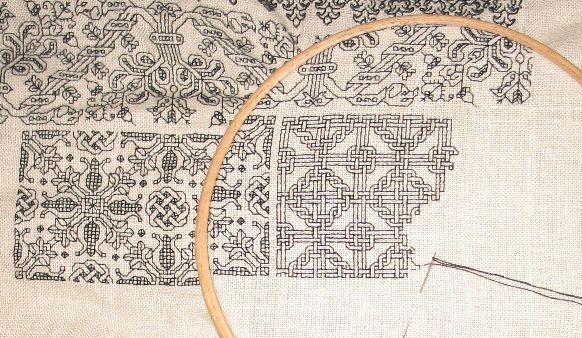
I’ve finished out the excerpt from the big Lipperheide repeat and started another. This pattern appears on the same plate as the one I just finished. Like it, this one was originally worked voided. It turns out to have the exact north-south stitch count I need to eke out the horizontal row, getting ready for a darker, wider strip at the project’s bottom edge. It’s also an extremely quick one to stitch up. The bit above only took about an hour or so.
Anna asked me what kind of hoop I’m using, and whether or not I’ve padded it. I reply:
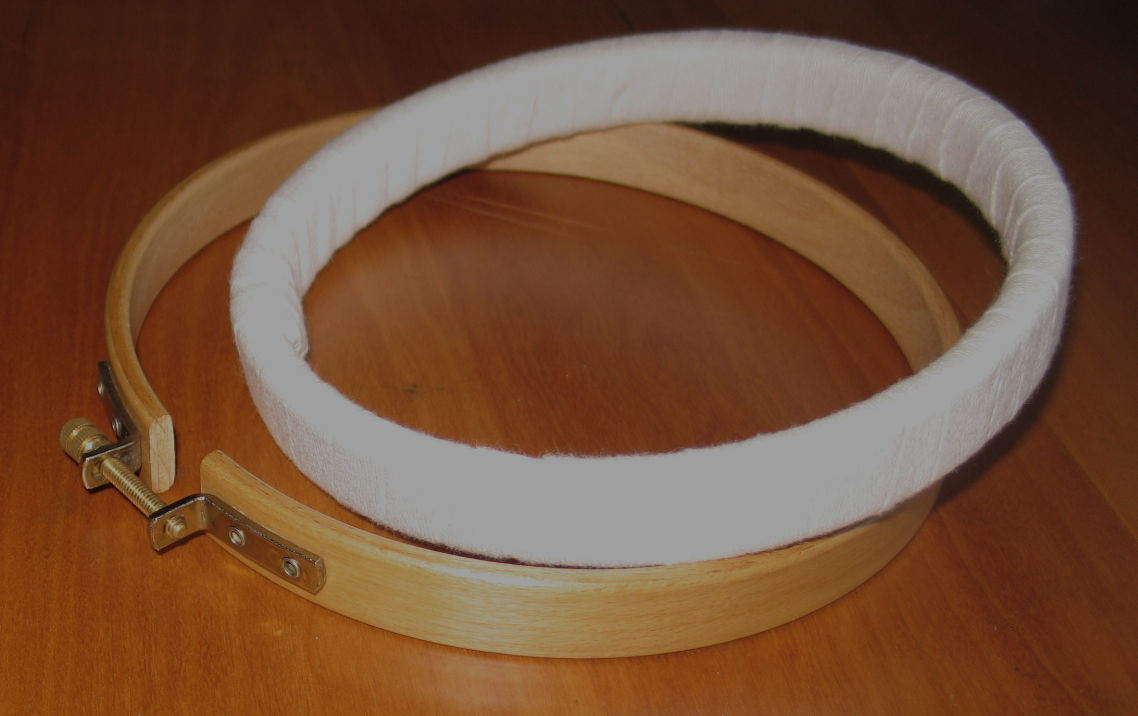
It’s a 7-inch Hardwicke Manor hoop I bought from Hedgehog Handworks, about 10 years ago, but didn’t use until recently. In part because I’d been on an extended vacation from stitching, and in part because I didn’t like the way it tensioned the fabric. At 5/8″ wide it grabbed nicely, but never maintained the tightness I prefer for double running stitch. So finally tiring of my ancient dime store bamboo hoop last month, I got some standard fabric store issue half-inch white twill tape and carefully wrapped the bottom of my Hardwicke frame. It’s hard to see, but the tape is angled at 45-degrees, and overlaps by roughly half a width on each wrapping. The end is tucked underneath and stitched to the bottom hoop’s inside (left on the image, where the lump is), to keep the outside perimeter bump-free. The hoop’s screw closure is long enough to handle the extra diameter of the wrapping. About six turns of the screw’s threading are visible, and I had just popped the thing off the work for the photo.
I now love this hoop. The twill tape cushions the work and minimizes crush and holds the ground cloth drum tight. However wrapping the bottom hoop does reduce the effective stitching area by decreasing the inside diameter. Even with cushioning I would not recommend using a hoop for anything other than flat surface stitching using cottons. When I stitch with silk, metallics, or use any sort of raised or heavily textured stitch I pull out a flat frame.
Where is the crowdsourced pattern of the week? I’ve got a very nifty motif queued ready to go, but it’s only one panel. I’m hoping for at least one more before I post the next update.(Hint, hint…)
Aside: Hoping all on the East coast were spared overly much grief with Irene. Only minor damage here in the leafy close-in suburbs outside of Boston:

Half a tree down, blocking our street, and another big limb in our back yard. Thankfully both fell with surgical precision, missing every structure, vehicle, power line and comms wire. I bow to the courtesy of my neighborhood vegetable friends. Also to the amazingly diligent Arlington, MA DPW crew, that had this cut up and hauled away within 45 minutes of the tree’s fall!
Finally, for folk who landed here looking for Ensamplario Atlantio. (Word is still spreading about it.) It’s here.
BUTTERY PARTLET AND CROWDSOURCING
Thanks to everyone for their kind words about Ensamplario Atlantio (EnsAtl)!
I’m delighted that folk find it useful. I was going to leave it up as the blog’s front page for a while, but two stellar things came in that I had to share. Before them however, please note that I will be leaving the book available on String for a while longer yet.
The two things?
First, I’ve mentioned before that my main joy in designing is seeing what folk do with the patterns. I have to show this one off (click to enlarge the thumbnail):

This partlet was stitched by Kimiko Small (in the SCA, the talented Lady Joan Silvertoppe of Caid). She used the Buttery pattern in TNCM Plate 59:1. It’s one of my originals, but it’s based on period conventions, motifs and aesthetics. The partlet design, stitching, and most obviously the picture above are all hers. The photo is reproduced with her permission.
Kimiko, I’m thrilled! Well done! I’m quite excited to see this particular pattern picked up and worked so well. The partlet is an excellent showcase for your stitching. It’s prime! You can read more about Kimiko’s award-winning project and read her arts competition documentation on her blog.
Now, this ties into the Second Thing.
The Buttery is an omnibus pattern – a frame filled by a large number of different design motifs. In this case, flowers, herbs and fruits. I’ve augmented my original set of patterns, and stitched up even more Buttery fillings on a recent project of my own.
Now the new book is generating some buzz about my patterns. Hannah was kind enough to spread word about EnsAtl on her blog, enbrouderie. In the comments that accompany her post Rachel of VirtuoSew commented on my Dancing Pirate Octopodes pattern. Rachel wondered about working up alternates for DPO. Initial silly filings aside, that pattern has excellent potential to evolve into another omnibus design along the lines of Buttery, and I think Rachel’s idea is a splendid one.
So I announce the first (to my knowledge) Crowdsource Design Blackwork Filling Project.
What’s Crowdsourcing? In a nutshell, it’s putting a project in front of a large number of otherwise unrelated/unassociated people, and asking them to apply their individual creativity to it, spreading the word and bringing all that creativity back together using ‘net based communications. It’s all the rage right now. Even the Defense Department’s research arm (DARPA) has launched a crowdsourced projects to jump start the design process or solve sticky problems.
So. Reaching both behind to the past and into the future – why not one for double running stitch?
Here is a square with just the frame from Dancing Pirate Octopodes:
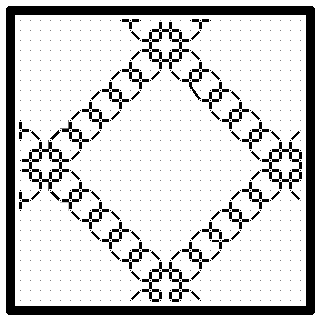
It’s a simple JPG – shown above at full size. Right click on it and save the image. Then attack it with any graphics program, or print it out and doodle on the hard copy. Work up your own filling(s)! Be creative! Run amok! Just one request – this is not an adult-rated site. Please keep your designs family-friendly. (I reserve the right to do light editorial selection, if need be.)
When you’re done, eMail the file, or transcription of the thing, or a scan or photo of your design to me by 10 July at the gmail address listed in this post . I’ll assemble all submissions in one big layout, and share the results back here as quickly as I can. (If you’d like me to withhold your name rather than be credited on String, I’ll be happy to do so.)
This isn’t a contest – I’ve got no prizes to give away. But I think it will be lots of fun to see what everyone comes up with. So fire up your drawing program or sharpen your pencil. Let’s see what our stitching crowd can devise!
Again, thanks to Hannah, the gang at Total Insanity, others at various Yahoo needlework discussion groups, and all other posters and email respondents for their welcome and acceptance of EnsAtl. Special thanks to Kimiko for making my day with her project. Thanks to Rachel for the idea of making more fills for DPO. And thanks in advance to everyone who will take a moment to share their own creativity for the joy of participating, and glory of their needle.
CHALLENGED!
UPDATE: The graph below is available at the Embroidery Patterns link above, in easy to print PDF full page format.
The gauntlet was thrown. I was challenged to produce a chart for The Flying Spaghetti Monster, in all his noodly glory. At the risk of destroying any crumbs of credibility I might have as researcher, I respond.

Hah!
MORE INSPIRATION FROM HISTORICAL SOURCES
Once more I go web-wandering, looking for counted thread inspiration from around 1500 through 1620 or so. This time I present some lesser known examples of counted stitching.
What I really wanted to find were examples of household linens – towels, sheets, pillows or other bedding, cushions, tablecloths, and the like. You’d think with all those innumerable domestic scenes so common in iconography there’d be some. So I looked for Annunciations, domestic scenes of the infant or young Jesus, plus other Bible and Saint’s lives scenes or parables; and tableaus from mythology. Anything that might show a made-up bed, a dining table, someone drying off, or someone getting dressed.
Given the popularity of counted edging patterns and huge number of household linen artifacts in museum collections, one would think these items would be common in paintings and prints. But they’re not. Perhaps the detail of these patterns was too tedious for most artists to attempt to reproduce. And it’s possible that for some of the religious art, the absence of decorated linen is of meaning. Lives of humility might not be graced by otherwise ubiquitous domestic embroidery, and it’s possible that the audience for these paintings noticed the omission. But I leave such interpretations to art historians. (I’m sure there’s more than one dissertation out there on household contents shown in classic religious art scenes.) Here is what I found in my troll of the Web Gallery of Art.
Domestic linen:
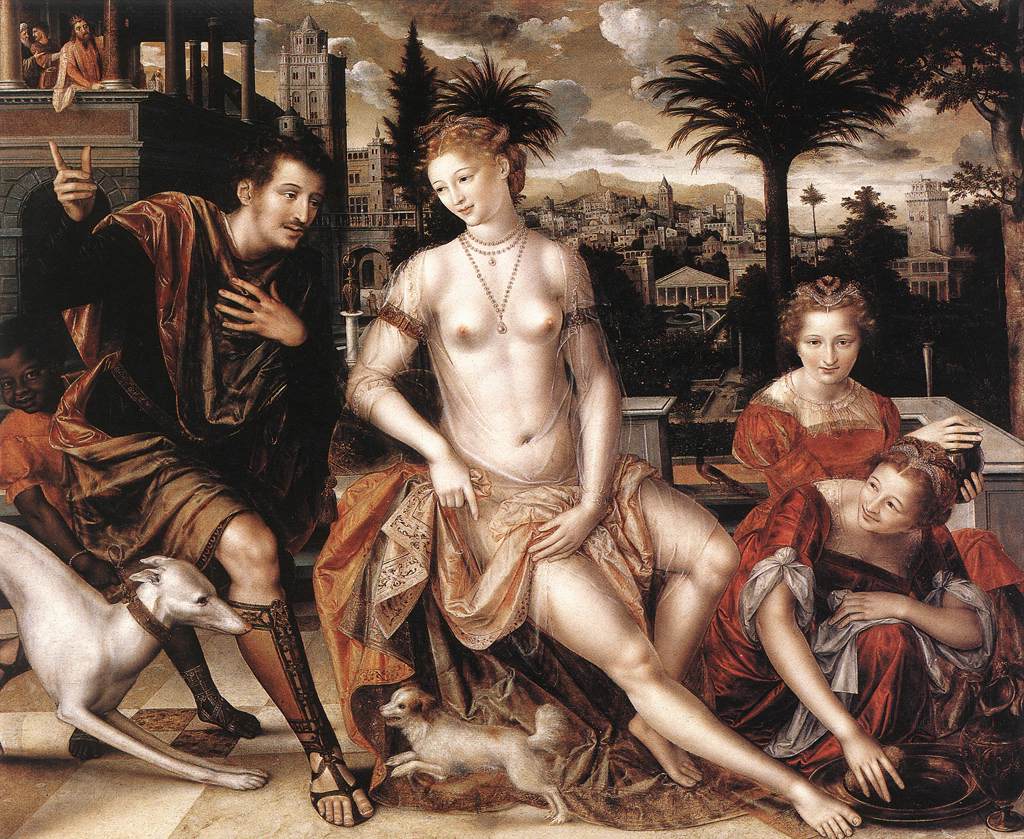
Here’s a nifty Bathsheba, she’s bathing, unaware of the peeping King David. She’s wrapped in either sheets or towels – some of which have elaborate embroidered red trim, with just enough detail to make out that the designs are regular enough to be counted. Although this work is undated in the collection, Jan Masseys other paintings are dated from 1550s and 1560s:
http://www.wga.hu/art/m/massys/jan/bathsheb.jpg
Masseys had a thing for David with Bathseba in disarray. Here’s another with towels or linens, although the detail is a bit more ambiguous that the last. This one is from 1562:
http://www.wga.hu/art/m/massys/jan/david_ba.jpg
And the barest hint of a bit of blackwork on a napkin from a Last Supper painted by Jacopo Bassano in 1546:
http://www.wga.hu/html/b/bassano/jacopo/1/08lastsx.html
A painting by Carvaggio – Supper at Emmaus, 1601. This one looks like it may be a table carpet, upon which a plain white cloth is spread. Even so, the pattern on the carpet is interesting:
http://www.wga.hu/html/c/caravagg/06/35emmau.html
This is by the same artist and same subject the one above, but is a later work (1606). The table cover under the white cloth looks a lot more like a voided pattern stitched on linen:
http://www.wga.hu/html/c/caravagg/08/47emmau.html
Bath linen(?) in lower right corner, edged with geometric. Master of the Fountainebleau School, Diana at the Bath, around 1590:
http://www.wga.hu/html/m/master/fontaine/diana.html
An embroidered pillow with a dainty counted edging along the seams, in Ambrogio Bergognone’s Madonna del Velo, from the 1500s:
http://www.wga.hu/html/b/bergogno/virgin_v.html
Personal linen:
Lots more of these in portraits, although not every painter took the time to do more than indicate the presence of intricate patterns. Certainly not with the graph-able precision of the famous Holbein Anna Meyer portrait on his Darmstadt Madonna panel. Still, detail on scale, placement, and colors can be harvested from these pix. Also I do note that while outer garment styles change and vary from region to region, and placement of the embroidery varies from piece to piece, the styles of the borders patterns and edgings used on chemises and shirts remains surprisingly stable across time and geography.
Black wide geometric stitching on chemise’s high collar neck band. Also edging embroidered on cloth worn as a turban style hat. Carvaggio, The Fortune Teller (detail) 1596-1597
http://www.wga.hu/html/c/caravagg/02/11fortu2.html
Geometrics on man’s wing-style collar. Portrait of Henri II, 1547:
http://www.wga.hu/html/c/clouet/francois/henri2.html
Chemise heavily embroidered in black, but probably not counted. Hans Eworth, Portrait of Lady Dacre, 1540
http://www.wga.hu/html/e/eworth/l_dacre.html
Geometric stitching in red on narrow high collar. Catarina va Hemessen, Self Portrait, 1548:
http://www.wga.hu/html/h/hemessen/caterina/selfport.html
Wide man’s collar and cuffs, in geometric patterns with center panel and complimenting narrow edging bands, worked in red on white linen. Giovanni Battista Moroni, Portrait of Don Gabriel de la Cueva, later Duke of Albuquerque, 1560:
http://www.wga.hu/html/m/moroni/portduke.html
Woman’s chemise with broad center panel and collar band, in black on white linen. Peter Bourbus, Portrait of Jacquemyne Buuck, 1551:
http://www.wga.hu/html/p/pourbus/pieter/portrai2.html
Narrow geometric band at top edge of woman’s low chemise (also may be detail in red on hat). Vittore Carpaccio, Portrait of Young Woman (artist dates are 1472-1526)
http://www.wga.hu/html/c/carpacci/5/021woman.html
Boy’s shirt – narrow collar band, voided in black on white. Jean Clouet, Dauphin Francois. (Artist dates are 1485-1541)
http://www.wga.hu/html/c/clouet/jean/dauphin.html
Man’s shirt – narrow panels with black on white geometric stitching, divided by heavier narrow strips of gold or yellow silk embroidery. Lucas (the Elder) Cranach, Portrait Diptych(detail). 1509:
http://www.wga.hu/html/c/cranach/lucas_e/11/05dipty2.html
Man’s shirt- narrow panels parallel to center front slit. geometric black on white. Lucas (the Elder) Cranach, Portrait of a Clean-Shaven Young Man, 1522
http://www.wga.hu/html/c/cranach/lucas_e/12/03young1.html
Man’s shirt – horizonal panel of either two color stitchery, or one color on brown, appliqued over narrow cartridge pleats to keep them in place. Albrecht Durer, Self Portrait at 26, 1498:
http://www.wga.hu/html/d/durer/1/02/05self26.html
Woman’s chemise, with small black edging allt he way around. Martha and Mary Magdalene, 1596 by Carvaggio:
http://www.wga.hu/html/c/caravagg/02/16martha.html
Another scoop neck chemise in the same style of the one above. St. Catherine of Alexandria, 1598 also by Carvaggio:
http://www.wga.hu/html/c/caravagg/02/15cather.html
A different style of higher neck chemise, this one decorated by wide double bands down the center, plus a band around the neck, and narrow strips of stitching, possibly
on seams. From Portrait of the Artist’s Sisters Playing Chess, by Sofonisba Anguissola, 1555:
http://www.wga.hu/html/a/anguisso/sofonisb/chess.html
A man’s high-neck shirt this time, with a wide band of black geometrics on white. Portrait of a Man, dated 1520-25 by Girolamo Romanino:
http://www.wga.hu/html/r/romanino/manportr.html
Edging on a veil, black on very fine, almost transparent linen. Not too many paintings that show stitched veils! Portrait of Martha Thannstetter (nee Werusin), dated 1515 by Bernhard Strigel
http://www.wga.hu/html/s/strigel/bernhard/portrai2.html
Another stitched veil – this one in multicolors, and possibly dual sided work. Andrea Previtali’s Madonna Baglioni, 1515-1520:
http://www.wga.hu/html/p/prevital/baglioni.html
Multicolor bands on boy’s shirts, done in a style that looks counted to me. Bernhard Strigel’s Portrait of the Cuspinian Family, 1520:
http://www.wga.hu/html/s/strigel/bernhard/cuspinia.html
Voided work edging around a neckline, in black. (Reminds me of the bit at the far right of my current piece). Sanzio Raffaello’s angel – a fragment of the Baronici Altarpiece, from 1500-01:
http://www.wga.hu/html/r/raphael/1early/02baron2.html
Two different narrow edging patterns, both in black, both very simple and easy to duplicate right from the portrait. Sanzio Raffaelo’s Portrait of a Woman (La Muta) from 1507:
http://www.wga.hu/html/r/raphael/2firenze/2/36lamuta.html
Raffaello was very good at clearly depicting intricate stitching. I really like this St. Sebastian (1501-1502) – the tshirt elaborately embroidered in yellow (gold?) with little black cross stitches is clear enough to chart:
http://www.wga.hu/frames-e.html?/html/r/raphael/1early/01sebast.html
Very clearly counted work – a man’s shirt with a wide, heavy two-tone neckband. It looks applied to the shirting underneath to me. Hans Maler’s Portrait of Moritz Welzer von Eberstein, from 1524:
http://www.wga.hu/html/m/maler/welzer1.html
And a lady with a high multicolor stitched collar. This looks like highly embossed stitching to me, not jewelry. And regular enough to make me think that the underlying cartoon was worked on the count, with the embossed stitching done over the cartoon. I have no basis for this opinion other than observation, so feel free to disagree. Willem Key’s Portrait of a Lady, undated, but the artist lived from 1515 to 1568:
http://www.wga.hu/html/k/key/willem/portlady.html
A particularly good view of upper body construction of a woman’s chemise, embroidery framing center slit, following around the collar and radiating out from it. In this case, with one single pattern maintained uniformly throughout. Black on white. Bernardino Luini’s Salome from 1527-1531:
http://www.wga.hu/html/l/luini/father/2/salome1.html
Another killer high neckband on a man’s shirt. Again multicolor with red and yellow (gold?), worked on the count. Jan Gossaert’s A Noble Man dated 1525-1528:
http://www.wga.hu/html/g/gossaert/2/baudouin.html
and finally
Ambrogio de Predis’ Portrait of a Man, from 1500. The pattern on his sleeves is in the forthcoming collection of blackwork filling patterns:
http://www.wga.hu/html/p/predis/portra_m.html
I have references to at least as many again pix as are presented above. Let me know if you’d like me to share them too.
PROGRESS TOWARDS NORMALCY
Steady progress on the latest strip:

Now that life is beginning to get back to normal (or what passes for normal in this house) I can also report progress on the book front(s).
First, on the PDF collection of blackwork filling patterns, to be named Ensamplio Atlantaea, I apologize for the delay. This one will include all of the filling patterns published here over this winter past. And as an extra bonus for everyone’s patience, I will toss in several more pages of additional patterns, not seen here before. It will be free, and will be available for download here at this site. Right now I have 27 pages of patterns (the original 150, plus a dozen more), and hope to make it an even 30. Plus cover and some sort of intro essay. It will NOT include free drawn outline patterns for use with these fillings, nor will it include detailed working methods, although I may abstract some of the double running stitch guidance previously posted here. I hope to have this one up and ready sometime in the coming month.
On the big book – my sequel, to be named A Second Carolingian Modelbook: More Counted Patterns from Historical Sources, I’ve got about 45 pages of patterns drafted out in whole or in part. Each pattern has annotation, noting its origin artifact or source, or if it’s one of the few originals, that attribution. That’s about 100 individual patterns, some of which are main strip plus accompanying border. I also have all over patterns suitable for cushions and body linen, narrow strips for cuffs and collars or seam decoration, and wide pieces that would make nifty tablecloth, sheet or towel borders. Right now about 2/3 of the patterns are for double running stitch, although there are some that are good for Italian two-sided cross stitch, long armed cross stitch, lacis, or other square-unit styles. There are also quite a few that were worked voided, some with straight or double running stitch defining the foreground from the background, and some not. Working methods/colors of the originals are also described, and full sources are provided for all graphs, so stitchers can look them up. I do not anticipate finishing this one any time soon. Feedback is that readers want essays on techniques, materials, and methods of employ. All that will take time. As will figuring out how to do the actual publication. (Right now an on demand service like Lulu or one of its competitors looks most likely). This book will not be free, but I am hoping to keep it affordable.
And in other news, it’s the beginning of Birthday Season here at String. A much recuperated Smaller Daughter celebrated her 13th last Saturday, mostly by laughing with evil intent at the thought that others had decided that her becoming a teen was the cause of the end-of-the-world predictions for that date. Larger Daughter is now back from college for the summer, and celebrates mid-week. I note the passing of yet another anniversary of my 21st birthday at the end of this month. Today’s home-cooked lobster feast was in recognition of all three fetes. The Resident Male, the odd man out in so many respects, does not have to share his natal day with adjoining festivities. We will recognize that occasion later in the summer.
MORAL OF THE STORY…
“Don’t burst your appendix if you can avoid it.”
Younger Daughter is back home, after 19 days at Children’s Hospital in Boston. She’s still got a way to go before she’s school-ready, but she’s happy to be home with quiet, limited interruptions, and familiar food. Thanks to everyone who sent get well wishes!
I’d like to especially thank the staff at Children’s, not all of whose names I caught. They’re a very caring bunch, and did all they could to make the kid better and more comfortable. Here’s her much cherished souvenir – a little squeezy ball they gave to Morgan to exercise her fingers.
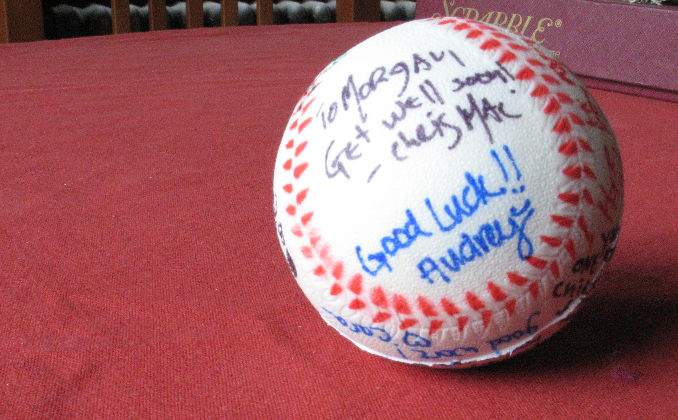
We asked the nursing staff we were assigned to, to autograph our “game ball.” We managed to get most but not all of them. Special thanks to Chris Mac, Sharon, Michelle, Josh, Maria, The Original Chris, Meredith, Rachelle, Caitlin, Paola, Cleanne, Cara, Audrey, Dr. Arnold, Dr. Hamilton, all of the residents on 10NW, and all of the other folk whose names slipped me by when I was in a sleep-deprived fog. The kids still has to go back to have the tatters of her appendix excised, but that’s a one day bit, not another extended stay.
As you can see, while we were there I had lots of time to stitch. I finished out the oak leaves and acorns at the right, and started another band at the left. That one is very dense, in long armed cross stitch, so it’s not exactly zipping along. Also stitching when sleepy led to tons of mistakes and ripping back, so what’s here is probably only about half of what I actually stitched.

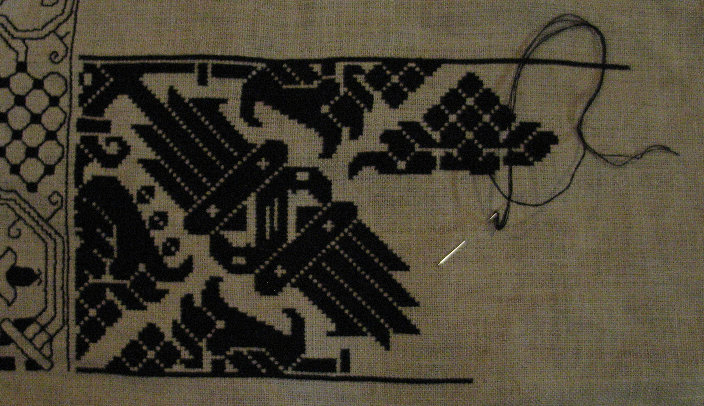
Even with all of the rework, stitching was a much needed self-administered sedative while I was being a bedside mom.
The plan is to make this strip the same length as the oak leaves. Eventually I’ll either find or noodle out an even denser band for the narrow area immediately to the right of the oak leaves, and a less dense but similarly black band to put between the current strip and the established horizontal bands. I might take a break from dense work for a while though, and opt to work something in double running elsewhere on the piece before attempting those two strips. There’s tons more room both north and south of these.
One thing to note. So far, all of the finished strips are bi-directional. At this point there is no up or down on my sampler. Either end could be at the top. I could even opt to finish this out in landscape rather than portrait orientation. Jury is still out on what I will do, but I do have a couple of strips I’d like to include that are figural, with clearly defined ups and downs. Stay tuned to see how I work them in.
WHERE’S STRING?
Here but on brief hiatus.
Younger daughter and her appendix are not on speaking terms right now. The three of us have been resident at Children’s Hospital in Boston since the 14th. She’s on the mend, but slowly.
I’ve been occupying some nap hours to stitch, and progress on the blackwork sampler will be posted when I’m back at String Central, equipped with the proper cameras and software. In the mean time, feel free to explore past posts via the Categories list at the right.
SCALE
Some progress and some answers. First, the progress:

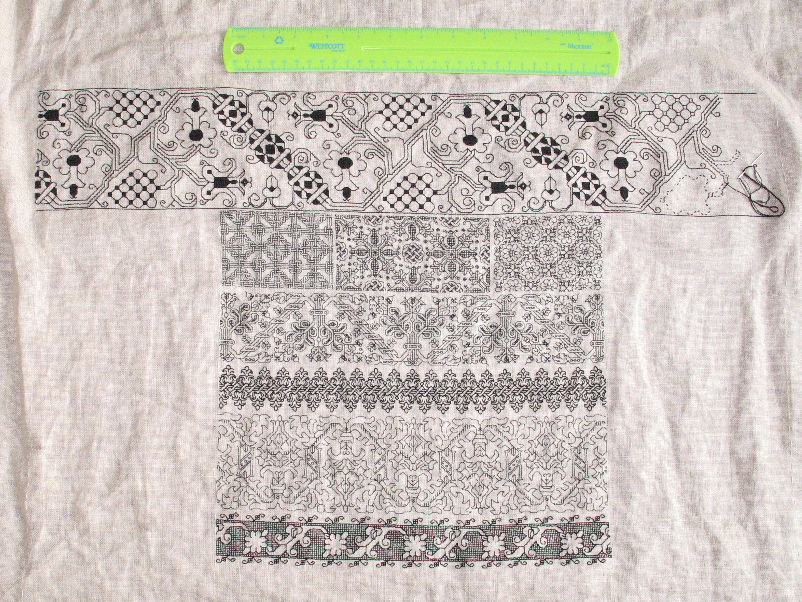
As usual, not as rapid as I’d like, but work limits the amount of time I have to stitch. Now on to the answers to questions in my inbox:
What stitch are you using for the dark areas in the current band?
I settled on Italian double sided stitch (aka Arrowhead stitch), as shown on page 32 of The Proper Stitch by Darlene O’Steen . (I found my copy years ago when it first came out, at the now long gone Yarn Shop in College Park, Maryland.) However, I’m finding that over 2×2 threads I can’t pull it tightly enough to emphasize the holes and make the appearance as mesh-like as I want. There’s just not enough room to compact the weave of my ground cloth sufficiently. If I do another piece using this technique, I’ll work over 3×3, or find a more loosely woven ground.
This is a squirrelly looking band. Is it original?
It’s a redaction of a 16th century artifact in the collection of the Metropolitan Museum of Art, Accession Number 79.1.59 . It’s one of the many patterns that will be in The Second Carolingian Modelbook.
Which end is up?
I haven’t decided yet.
Why is the current band so big?
No particular reason. I saw it, charted it out and decided to play test it. Yes, it’s at a larger scale than the patterns I’ve worked so far, but it won’t be the largest pattern on the piece, nor will it be the least dense. When it’s done this strip will span the entire width of my stitching area. I’ll run some other patterns perpendicular to the established direction, framing the part I’ve already worked. On the other side of this current band will be several more wide bands of various types. They may also be worked horizon to horizon. I’m improvising as I go along.
Have you done any planning at all?
Yes, in a way, but not by orchestrating the entire piece beforehand. Instead I set ground rules. I established stitching bounds and guidelines. I marked the outline and centers of the total stitching area, and added some additional guidelines at 1/4 width and length intervals. I am leaving four threads bare between all stitched units. I’m trying to balance density as I go. I’m working with only one color (good old DMC 310 black), using either one or two strands, depending on the effect I want to achieve. Eventually there will be spots in the ground for which I cannot find or adapt strips or spot motifs of suitable width or height. For those places I intend to use additional fillings from the Blackwork Fillings Collection. And I’m trying to use all-new patterns – stuff I haven’t stitched before, with the goal of experimenting with as many of my new book’s patterns as possible. So you can think of this as a preview of things to come.
Why aren’t you jumbling these up instead of making reproductions? There are tons of beautiful repro samplers out there you can stitch. Why go to all this trouble?
Because stitching someone else’s repro isn’t something I’m interested in doing. I do admire those pattern drafters and stitchers who chose to do those things, but I find the concept has no appeal for me personally.
I’ve written about this before. (It’s the base stance that makes me a “rogue Laurel” in the SCA.) Exact replication is an extremely high form of craftsmanship to be sure, but it doesn’t manifest the highest level of understanding. Just as in a martial art, being able to reproduce the kata – the formal training exercises – shows extreme skill, but it’s something else entirely to be able to take the kata’s movement vocabulary, and improvise if attacked. Not everyone who can demonstrate kata in the dojo can turn that knowledge into effective fighting. Being able to go beyond kata skills is what differentiates the master from the adept. It’s the same for needlework. Reproductions are kata. Making an entirely new piece from the same vocabulary, such that were the new item to be transported back in time it would fit right in – that’s mastering true understanding. Now my current piece is NOT something that could be transported back in time that seamlessly. I do not make that claim. It’s only a training and teaching exercise. But it is one that’s stretching me in new ways – directions I could never achieve by working a stitch for stitch artifact reproduction, or from someone else’s chart or kit.
I intend to keep learning, and I invite you to learn with me. Needlework is a very safe subset of life in general. But make it exiting. Face uncertainty and possible failure. Think about taking inspiration from whatever you find, wherever you find it. Go for broke, combine old forms in new ways (or new forms in old ways). Start with a blank cloth and bungee jump with me. The ride can be scary at times, but it’s tons of fun.
STEEL WOOL?
No, no metal sheep were shorn and knitted up here at String this week. It was however February Break Week for the public schools. Younger Daughter attended a “Staycation” program at Minuteman Technical High for the week.
It’s a very nice program, even for kids not on the vocational school track. Lots of hands-on opportunities to try out various skills. She’s taken some of their programming and robotics classes before, but it’s been cold lately so I think that warmth was on her mind. This session she opted for a day split between welding in the morning, and baking in the afternoon. She loved them both. Good classes with excellent instructors, and ample scope for independent creativity.
Welding was a serious class, not a coddled, watered down experience. She handled arc welding equipment and plasma cutters, first gaining safety awareness and operational skills, and then moving on to her own projects. Here are her final two projects:

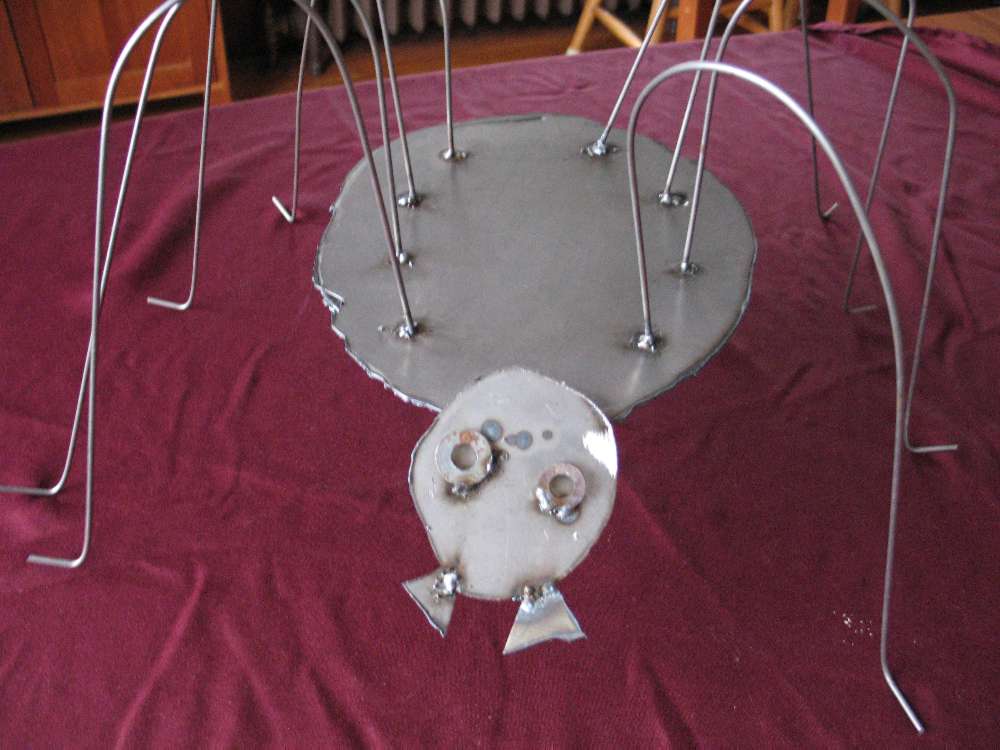
Dragonfly has a two foot wingspan, Spider is similarly sized. Both will adorn the garden come summer.
Baking was also fun. And very prolific, with quite credible, professional looking (and tasting) results. We’re swimming in cookies, rolls, scones, bread, muffins, danish and cheesecake. We’ve fed friends, family, co-workers, frozen a ton of stuff, and even sent a care package off to Elder Daughter at college. To continue the creature theme, two of today’s loaves were a bit creative, too:

I suspect Death Hamster will not outlive supper tonight, with Turtle guest-starring at lunch tomorrow.
NO, I’M NOT NUTS
Toodling along on my current sampler…
…working on another pattern shared in my blackwork fillings collection, just stitching along. Once the base repeat is established, I find I can copy off my own work, rather than referring to the printed pattern. Sure, this one is on the complex side, but it’s a regular repeat and not what I’d consider particularly difficut; and without having to refer to a printed sheet, the project is totally portable. So I brought it with me to my kid’s school chorus concert. There’s always a long wait between the participants’ early drop-off time and the public concert’s start. Lots of parents stay rather than going home and returning later. I was not alone.
I’m used to knitting and stitching in public. I’ve gotten all sorts of comments over the years, ranging from real interest to veiled hostility. The overwhelming majority of people are interesting to talk to, and my project is always a convenient conversational icebreaker.
There are the folks who ask after the item being worked, or volunteer stories of their own about knitting or stitching. They’re usually pleasant and I enjoy talking to them. There are invariably people who say things like “Oooh. I could NEVER do that.” (What runs through my head is the reply, “With that attitude, I bet you’re right” but I rarely voice it.) Depending on how dismissive they are I either smile sweetly and don’t reply out loud, or try to explain that it’s not anywhere near as difficult as it looks.
There are kids who are fascinated by what I’m doing. Knitting socks especially seems to boggle them. I have fun with them, explaining he project and chatting about the craft in general.
Unfortunately, not everyone is pleasant. Some people say that they hate wasting time. I usually point out that at this very moment (mid commute, in the doctor’s office – whatever) I appear to be far more productive than they are. A couple of decades ago there were more derisive and ideological comments. Mostly from women, who were eager to point out that domestic tasks like knitting and stitching were ineherently demeaning, and should be shunned, especially in public. I would usually engage with them, responding that “freedom from” also means “freedom to,” that I had a highly technical career thank you, and that I found relaxation in traditional crafts. We usually parted on less divisive philosophical grounds.
But this week, just sitting there stitching, I found a whole new public comment beast. The ones who decide that anyone doing something alien to the commenter is clearly nuts, deranged, crazy, a lunatic, or otherwise mentally abberant; and should be pointed out to everyone else. It also seems that these folk (aside from their insenstivity towards the differently abled) delight in being loud and obnoxious. Maybe it was the ambience of the high school in which the performance was taking place, but I felt like I’d fallen back among locker room bullies again.
What did I do? First of all, I didn’t move my seat. I’d come early and sat underneath one of the few lights bright enough for stitching. When it became clear that glaring and not responding wasn’t working, I asked the commenters to kindly be quiet, that they were disrupting the people around us – in my best Miss Manners icy-haute tone. “Bitchy, too” was the reply, and they went away. Like vultures everywhere they probably flew off to circle over someone else’s carcass.
I won’t stop stitching and knitting in public. Idiots are everywhere, and I refuse to let them win.
Have your own stitching/knitting in public story? Positive or negative, feel free to share.
 String-Or-Nothing