BRIAR ROSE BISCORNU
Work continues to gnaw on my life and spit out the bones, but I do have something to share. Caroline, a regular reader of the blackwork discussion group on Yahoo, used a line unit pattern from TNCM to make a sweet biscornu:

The pattern she chose is the Brier Rose Twining Border (Plate 51:1). It’s one of my own as opposed to a pattern with a specific period source, and it’s one of my faves. I really like the way she’s taken the corner and adapted it to fill the top of her pincushion with a chaplet of roses. I’ve used the rose pattern several times, but always as a longer border run either with or without the corner; and I’ve never played with working the flowers and stems in different colors.
What’s a biscornu? It’s a little eight sided pillow-type pincushion, made up from two squares of fabric of the same size. They often have a bead, button or stitch dimpling the center to accentuate the shape. Some are stitched on both side, some on one. Biscornus have become more popular recently, with the enthusiasm for them starting in Europe a couple of years ago. Their popularity has blossomed because they’re a charming little project, ideal for showing off counted or freehand embroidery. They’ve been featured in recent issues of both print and on-line stitching magazines and blogs, with lots of free patterns on line. There’s a nice article about making biscornus here.
To get the odd shape (which is the origin of the name, from the French for “quirky,” or “odd shape”), the two squares are sewn so that the points of one square align with the center of the sides of the other (think about taking the two and matching them exactly, then give one of the squares an eighth of a turn clockwise or counterclockwise). Caroline has finished hers especially nicely, with neatly done stitching along the seam. You can see the point of her bottom square matching up with the center of the stitching on her top, ornamented one.
In any case, great job Caroline! A lovely (and useful) little project. I’m delighted that she thought to share the joy of her needle with me, and that she consented to give permission for me to share it with you.
If you’ve stitched, knit or otherwise worked something from one of my patterns and would like to see it posted in String’s gallery, please let me know.
FROM THE BACK
Suzie asks to see the back of my Clarke’s Law sampler. Here it is in the dawn light:

I’ve not been very assiduous about making it 100% two sided, but double running stitch does lend itself to highest efficiency if one follows that logic. I’m also using knots, for which I am wildly unapologetic. Also, I’m not one of the back-is-perfection nazis. Neat, yes. Long jumps and stringy bits can be shadow-visible from the front of the work. Plus work should have a logical progression that uses thread efficiently. Rabid about it though – no. Historical works weren’t perfect.
If you notice, both the plume and hops flower patterns contain elements that cannot be worked 100% double sided – isolated lines or units not attached to the main work area. For example, in the hops flowers those are the little detached diamonds that inhabit the central motif. If I were to work this pattern double sided I’d modify it slightly, adding a vertical connecting each of those diamonds to the lozenge that surrounds it. That way front and back could be completely alike. But since the back on this won’t be visible once it’s mounted, I’m not making an extreme effort. Still, you can see that with the exception of the voided backgrounds, I’m pretty close:

Plus as you can see from the back of the piece at the top, I’m on the letters that follow the hops band. What to do next? I haven’t decided yet.
CASKETS AND SNAILS
Spring floods here. A minor one in the basement, brought on by the inordinate amount of rain we’ve had in this area this month, and at work, with more deadlines rushing one upon the other. Which must be good for business, but is exhausting none the less.
Last post I promised two things. The first one is a dream project. Something I will probably never have the time or resources to accomplish (especially the time): my own embroidered casket. Not the kind you’re thinking of.
Back in the 1600s the crowning achievement of what passed for female education was the completion of a small box covered with embroidery. These were called cabinets or caskets, and often featured dimensional embroidery. They were about the size of a large tabletop jewelry box and were truly spectacular. The Peabody Essex museum in Salem has one one dated to 1655.. Here’s a particularly nice one in the Minneapolis Institute of Art’s collection. They’re highly sought after by collectors.
Via Needleprint, I stumbled across this:

It’s a modern chest base, made by a woodworker specifically for creating cabinets. If you click on the link you’ll see that the individual panels are made to be removed. All that needs to be done is stitch up a piece of the correct dimension and lace it onto the panel, then refit the panel into the cabinet. Now all I need do is set aside two years, a pile of silks and metal threads, some excellent linen, and $800 for the box base (including shipping). Another item on my ever growing never-never list…
The second thing I promised was word of a snail invasion in the Antipodes. Again, not the kind you’re thinking of. Garden plantings are safe. But Friend-of-Friend Fred Curtis, resident in Australia happened upon my book and is doing all manner of happy things with my snails. Here’s a trial for a man’s necktie to be covered with snails. He also stitched a camera straps using TNCM patterns (shown in process), and has used another of its patterns on a baby bib. But back to the snails. Here’s another of his pieces, offering up early spring inspiration to those of us in the Northern Hemisphere.

(Photo reproduced with permission). I’m always tickled to see stuff worked up from patterns I’ve posted, both for knitting and embroidery. If you’d like to see them posted here in the Gallery, please feel free to send me an image or a link. Fred – thanks for the smile!
STRIP BY STRIP
Poking my head up from yet another marathon sprint at work here. With promise of another one hard on the heels of the last, I’m probably surfacing just long enough to note limited progress on my sampler and report other news.
First the progress:
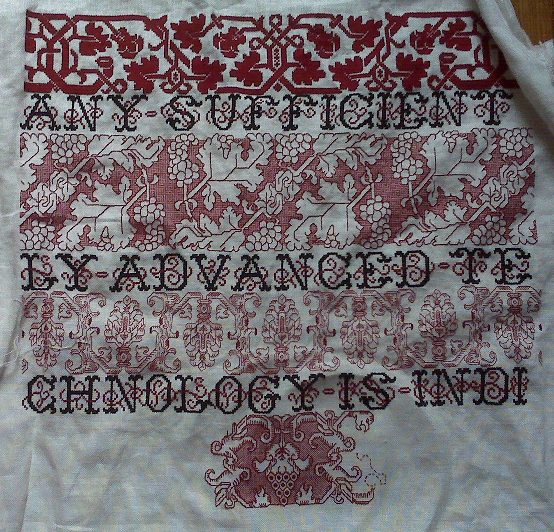

You can see that I’ve completed another row of text, and I’m on to another double running stitch panel. I’m working this one voided too. It’s a mishmash, with the bulk of the elements taken verbatim from the sampler that provided the previous strip. The hops flower(?) and the strange ocarina-like turnip things on the side are direct quotes. The finials on either side of the hops flower were very difficult to copy though, so I took the liberty of substituting bird heads for them. Lots of patterns of this style/era include animals, humans or birds (all or in part) sprouting from vegetation. My treatment of the voided area is however a total flight of fancy. I chose to use half-cross stitch, massed into a field of diagonal lines. I used a diagonal fill on the Do-Right sampler, too:
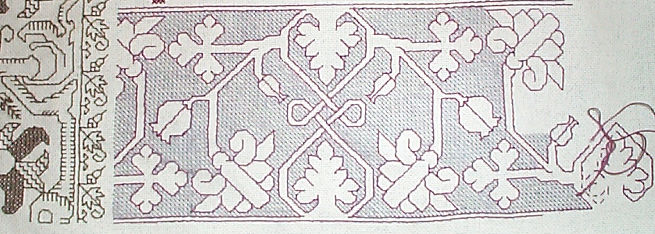
Unlike the graph paper like squared fill I on the grapes strip, I haven’t seen historical precedent for the diagonal line treatment. But it’s not totally illogical. If you’ve seen an artifact worked this way, please let me know. Other unusual treatments of the voiding include working the background narrower than the foreground and the direction of my diagonals. I’ve only seen one historical piece worked this way – a late 16th early 17th century panel photographed in Cavallo’s Needlework. I graphed that one out, it’s in TNCM on Plate 74:1 – I worked a bit of it a while back, and am considering doing it again on this piece:

Mirroring the diagonals on either side of the central motif is new. I haven’t done this before, and I’ve never seen it done on any other piece. Again – I can’t claim originality, there’s only so many ways to do things in needlework, and it’s a sure bet that the most obvious have been tried before. One last thing I’m planning on doing is NOT filling in the voiding in the background behind the little triangular areas above and below the strange, mutant turnip things. That will make the central hops flower motifs on their lozenges of darker background look a bit like a series of very large beads.
Given my impossible work schedule, the stitching density of both the foreground motif (again worked with two threads of my DMC floss), and the background (worked with one thread), this panel should take me quite a while. After this one comes the rest of my quote. So far I’ve stitched “Any sufficiently advanced technology is indi-” Next comes “-stinguishable from magic. In all probability, the “magic” won’t fit on the next line of text. I’ll deal with that problem when I get there.
Next post – snails in the Antipodes! My dream casket! (Not the kind you’re thinking of…) Stay tuned.
SUBTLE AND QUICK TO ANGER
While my current work languishes, here’s a picture of another past sampler. This one I stitched in 1996. It hangs in my husband’s office:
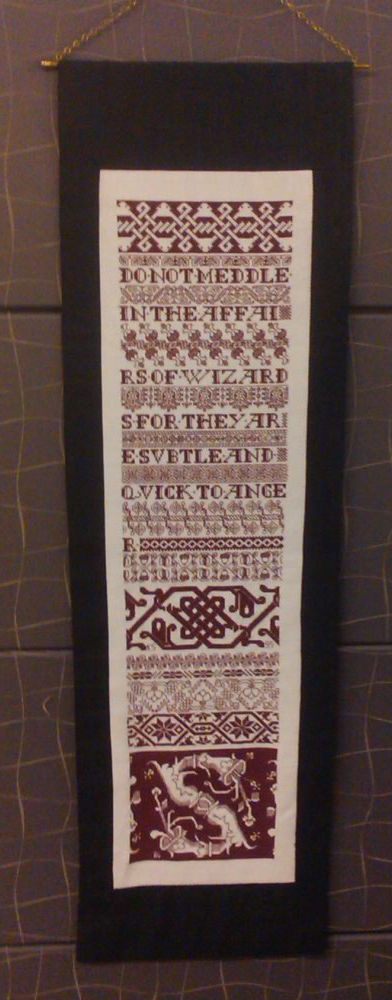
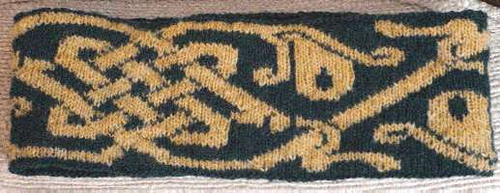
Again most of the patterns are from The New Carolingian Modelbook, and the piece is a mix of plain old cross stitch, long armed cross stitch, and double running stitch, worked in DMC embroidery floss on 36 threads per inch linen (18 stitches per inch). The center twist is the same one I used on the knitted Knot a Hat earwarmer band. (It’s also pictured on Ravelry.) You can see the difference in proportion between square unit based long-armed cross stitch, and the not quite square knitting stitch units. More rows to the inch than stitches across to the inch gives the knit version the slightly squashed appearance.
UPDATES: THE CHARTED PATTERN BELOW IS ALSO AVAILABLE IN AN EASY-TO-PRINT PDF DOWNLOAD ON MY EMBROIDERY PATTERNS PAGE, LINK ABOVE. AND THE KNOT-A-HAT KNIT EARWARMER PATTERN IS AVAILABLE ON THE KNITTING PATTERNS PAGE, ALSO LINK ABOVE.
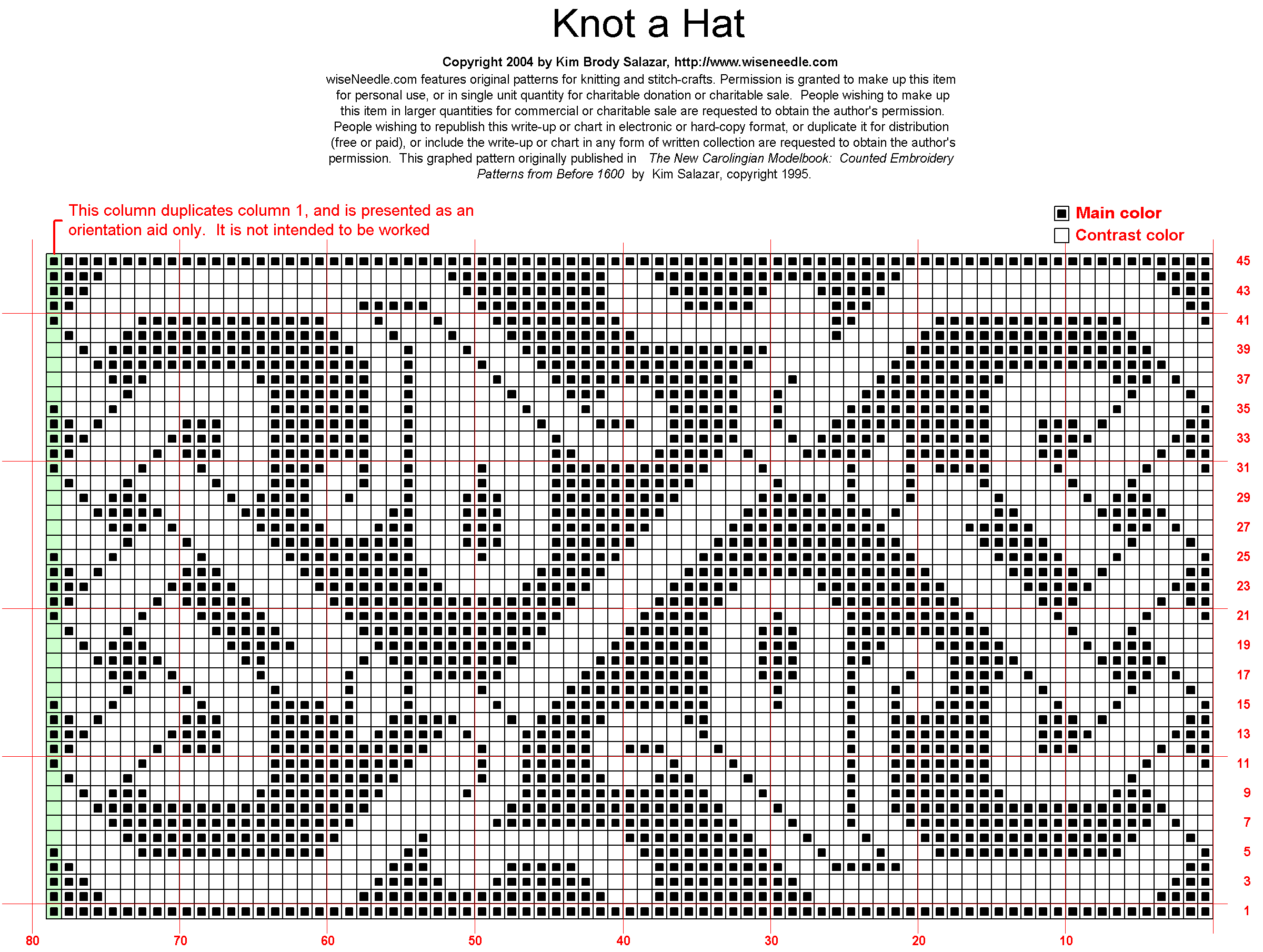
The quotation on this sampler is “Do not meddle in the affairs of wizards, for the are subtle and quick to anger.” From JRR Tolkien’s Lord of the Rings, and totally appropriate for a software developer.
STITCHING AND VISUAL DENSITY
Charlotte asks about the colors of the bands on the Clarke’s Law sampler. She says that each successive band looks lighter than the one before. I answer:
So far I’ve used only two colors of embroidery floss – DMC Red #498 and DMC Black #310. The top band was done in long-armed cross stitch, using two strands of red. Long armed cross stitch produces a particularly dense and raised texture.

Outlines on the grapes band were worked in double running stitch using two strands of the red, but the background grid filling was done in one strand – also in double running.

The current plume flower band is worked in double running using just one strand.

Between the relative densities of the various source patterns and the density of the working methods I’ve ended up with the progressively lighter look for each band even though all are worked using the same thread.
My plan for the rest of the bands is to do more of the double running work, choosing bands of different visual densities and working some but not all of them voided (with a background fill, but not necessarily solid). The next one will probably be somewhat closer in look to the grapes panel, but in between that and the current band in darkness. I will alternate bands of various densities with the black lettering. I’ve used plain old cross stitch for both the letters and the red embellishing squiggles that loop around the letters. If you compare it to the long armed cross stitch snippet above you can see the difference in coverage between the two.

When all of the lettering is done I’ll consider working more long armed cross stitch. Depending on how much room is left on the cloth, I might just go for broke with one massively large pattern, working it voided, so that the piece has a nice dense anchoring segment at the bottom. Or there might be a couple of bands of progressively darker stitching leading up to it. I haven’t chosen the patterns yet and I’m not sure exactly how much room I’ve got, so you’ll have to stay tuned to see how it all works out.
To answer Ellis – the reason you can’t see any lines drawn on on the linen for stitching over is because there aren’t any. This piece is done on the count. I’m using the weave of the linen as my guide, copying patterns drawn out on graph paper, with each grid of the graph paper corresponding to square of 2×2 threads.
To answer Marya – if my pattern contains a straight line that spans two or more graph units I do not make one big stitch over all of them. I make an individual stitch for each grid unit, even if they are all in one straight line. This keeps the work neater and more true to the graphed original. Long stitches are also more likely to catch on things.
To answer [anonymous] who noted that all of these patterns seem to rely on just 90 and 45 degree angles – yes, you’re right. I can’t rule out totally that diagonals over a 1×2 grid unit weren’t used (30/60 degrees), but so far I haven’t found a historical piece that used them in this type of pattern. It’s possible that some in-filled blackwork diaper patterns (the dark outline, different geometric filling variant seen below) used stitches at those angles, but I haven’t had the luxury of examining enough historical works close-up to make that determination. Lots of modern blackwork does use those angles. But for me, I’ll stick to the orthodox and limit my design to 45s and 90s.
BAND THREE ALMOST DONE
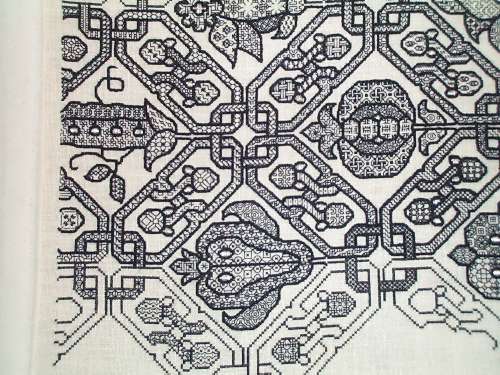
Apologies to the person out there anxiously awaiting the rest of my charting review series. I’ve had a serious attack of work obligations that has eaten into all time not spent sleeping. Even family maintenance has been scaled back. Blogging and research for blogging is right out. But for all of that, I do reserve to myself a half hour in the evenings for de-stressing. So I do have some progress to show on my Clarke’s Law sampler:

When this band of plume flowers and branches is done I do the next line of text. At the current rate of life-obfuscation, I won’t have to worry about picking the next band pattern for weeks yet to come.
Sigh.
PROGRESS AND USING STITCHING CHART PROGRAMS FOR GRAPHING KNITTING
In the middle of this charting program exploration I have had time to do a bit on my Clarke’s Law sampler. But first to answer a question. Aileen read my last couple of posts and wondered what I would consider a complex double running stitch pattern. I answer with pix of my current piece, plus a snippet of this pattern done up using Pattern Maker Pro, from yesterday’s review.

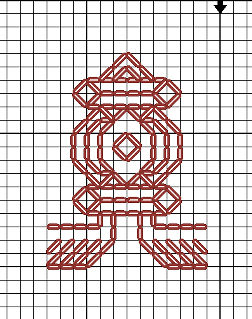
The nickel shows scale (click for better size shots of each). This strip is stitched using one strand of DMC floss, color #498 on 32 count linen (16 spi). Not particularly fine, but fine enough to show the patterns. The entire stitched area is about 15.75 inches across. From the top of the dark red twining strip to the bottom of the the D of ADVANCED is about 8.6 inches.

The top strip and the cross stitch words were all done using two floss strands. The outlining of the motif in the wide grape strip was done using two strands, and the squared background was done using one. (I’ve since found historical precedent for the squared background treatment).
All of the strips between the words will be relatively light in value, done in some combo of plain or voided double running stitch, but they won’t be as wide as the grapes (well, maybe the last one will be just to balance). I won’t do another dark band in long armed cross stitch (either foreground or voided) until after the entire quotation is done. I think it will take another three bands of text before the whole quotation is complete. Then I’ll fill out the cloth with a mix of styles, perhaps doing some in two-tone. It’s all fly by night here. I’ll also figure out something to eke out the line ends where the lettering comes up short. I think that NOT centering each line of text works better for my purposes, especially because I’m breaking text between lines in an unorthodox manner.
Now back to writing up the results of my stitch charting program explorations. Which for my knitting and crocheting readers, will have value. Either of the programs I described yesterday can be used to graph out colorwork repeats, or linear crochet (filet and tapestry styles). Pattern Maker Professional also allows you to assign a True Type knitting font (like the one from Aire River) to the symbol palette, and then using the program in symbols-on-graph mode, to compose knitting charts. Here’s a sample from PM showing a simple double 1×1 twist cable:

Where this falls apart though for knitting is if you try to display both colors and textures at the same time. The purl symbol will always be associated with one chosen color, the knit symbol with another. Although you can override the program and display more than one symbol per color, this program links symbol and color in a way that you can’t have multiple colors per symbol. Numbering rows is also problematic.
As I write up the rest of the sampled programs I’ll include their potential for use by knitters.
STITCHING STORIES
More babbling on here today.
Faithful Reader TexAnne noted my mention yesterday of the “print to transparency” cheat for flipping charted patterns and added another that I had forgotten. Some printer drivers and photocopiers allow you to mirror-image their output. This option is most accessible in the Mac world. I remember my late, lamented Macs having a prominent command in the print dialog that allowed mirror-image printing, something that came in handy for printing out driving directions. I’d print them out in a large font in mirror image and lay them on the dashboard of my car. They were just visible as a right-side reflection on the windshield in front of me, and acted as a “heads-up” display.
Since TexAnne’s note I’ve tinkered with the print dialogs of several PC world printers from HP and others, plus some large office photocopiers, and in most of them I’ve found a buried “Print Mirror Image” command. It’s usually on an “Advanced Commands” tab that summarizes the state of all available printer options, but it’s not often displayed as an easy to get to setting. But it’s usually there somewhere. Scan to print or printing mirror image is a matter of finding and setting this hidden command. It’s another useful way to use technology do do a mirror image chart flip.
Long Time Needlework Pal Kathryn reminded me of a story connected with the pattern I’m stitching now.
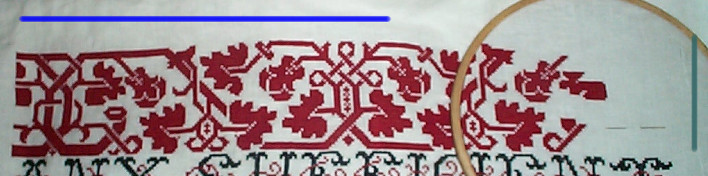

Back when I was working it voided on the Think sampler (lower band, shown flipped to the same orientation as the current work for comparison) I did lots of stitching (and knitting) in public. I worked in the Washington, D.C. area, and would take my projects outside at lunch and do them on park benches. I wrote to Kathryn that one day an elderly lady and her granddaughter approached me. They were of Hmong ancestry, a Southeast Asian people with a rich heritage of traditional counted cross stitch embroidery. With the granddaughter translating, the lady admired the work and asked if the pattern was traditional to my home village or family. I thanked them for their compliments and said that sadly, Brooklyn, NY did not have its own embroidery tradition, and that I’d found the pattern in a book. Kathryn says she’s thought of this particular design as “the Brooklyn Pattern” ever since.
LONG REPEATS, OTHER USES
Not much progress for this week, but my time has not been my own.
This strip will continue marching on to the right, ending approximately at the green stripe. The horizontal blue stripe shows the approximate length of the graph for the repeat as it appears in my book. More on that below…
First, thank you to those who have left comments or sent notes of support. I know that lots of knitting readers are disappointed that I’ve been stitching lately. The huge drop off in visitors is a clue, but some of that is due to other factors. Ravelry for instance has just about killed all but the most popular independent knitting sites. So it goes.
Back to stitching. I’ve got three comments I’d like to address here. The first one is of interest to knitters. Faithful Reader TexAnne points out that long block unit repeats like the one I’m working now would adapt very nicely for double sided double knit scarves. An excellent observation, thank you! I add that anything worked in strips, like a large lap throw, an edging around a circularly knit skirt hem would also show this pattern (and its kin) quite well. I’ve done double knitting from these before. My oven head hat is knit up from an outtake that didn’t make it into TNCM. You can see the negative/positive effect in the flipped up brim:

The chart for this hat appears in a follow-on post to the hat description. And, although not double sided, my Knot A Hat earwarmer band (which appears to have lost its picture link, although the chart link works) uses another historical knotwork strip for knitting:

Charts for both these repeats can be found by following the links above.
The second comment contains questions from Ellen R. She asks if I’ve ever worked these patterns before, and if they can be done in voided (Assisi) style. Here’s an answer to both:
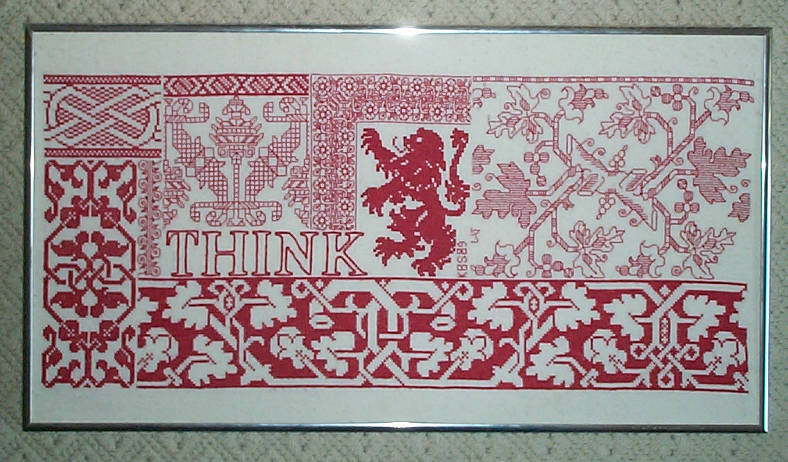
I did “Think” in 1989 and gave it to my husband to hang in his office. At the time he was working for a company that used the Scots lion as its logo. All of these patterns are in TNCM, and you can see the one I’m working on now across the bottom of the piece. It’s upside down compared to the strip I’m working now, and is worked voided – with the background instead of the foreground stitched. The effect is a bit different. To my eye, it’s more formal done this way. You can also see more of the repeat, although even this strip doesn’t capture one full cycle. I’ve worked quite a few of these many times, although even I haven’t done every pattern in TNCM (darn near close, though).
The last comment comes from Anne in Atenveldt, (an SCA region that includes parts of California and Utah). She’s got a copy of my book and notes that the chart for the current strip shows the two interlaces and the segment between, but is much shorter than the length of the strip I’m working now (or for that matter, what’s in the Think sampler). She wants to know how I do the additional segments.
I attempt to answer. The extra length is a mirror image of the section presented in the book. I work along as shown for the center point interlace and then the area between it and the next interlace as shown. On the far side of the second interlace, enough of the established pattern is shown to keep the stitcher on target, but after that point a bit of mental gymnastics is required. The stitcher has to continue on by inverting the graphed segment, mirror image style until the next mirror reflection point is reached. Again, I do show some of the area on both sides of that second bounce point to assist in navigation (and because in this case the interlaces are eccentric), but space prohibits showing a full cycle of the repeat.
Now this doesn’t present a problem for me, but as you can see, I’ve been flogging myself with this sort of thing for a long time. And it’s no shame to say that doing this in-mind reflection is difficult for you. It’s a matter of wiring, and not everyone can do this with ease, no more than can everyone use a map or read music.
If chart flipping presents problems, I do know of one easy shortcut. Office supply stores still carry transparency sheets for overhead projectors. They’re far less common in these days of Powerpoint and projectors, but many schools still use them so they’re kept in stock. They come in several flavors for various types of photocopier or printer, so be sure you’ve got the right kind for your machine. (Hot process laser printers and photocopiers for example use a melt resistant plastic, and can be fouled by using something not designed for them). Copy your chart onto the transparent sheet. Put it in a page protector sleeve with a piece of plain white paper. Work off it as usual. When time comes to do the flip, turn it over inside the page protector. Instant mirror image. The only caveat is that on pattens with eccentric interlaces as the flip point (like the one I’m working now), you’ll need to finish the interlace as charted before flipping to work the “in-between” portion.
In all, thanks to all who continue to read here. I do hope that my prattling on is useful to someone.
 String-Or-Nothing


