INSPIRATION – HISTORICAL NEEDLEWORK POSTCARDS
In answer to yesterday’s questions – yes, the two sleeves of the Sad Little Object are very different. Plus one is fully seamed front and back, and the other is only fastened to the front. Even so, themeasurement across the upper arm on the sleeve on the right (the skinny one) is two inches narrower than the measurement across the same spot of the one on the left. Truly a disturbing little piece… I will however save it as a cautionary lesson. Perhaps just seeing the mismatched upper sleeve colors will scare someone into springing for that extra "insurance skein" the next time they make a closely esitmated yarn purchase.
Needlework postcards
I was out web-walking late last night and ran across some amusing offerings. Please excuse me if I’ve linked to these in some sort of etiquette-violating manner. I’ve got two impulses here – the first is not to unduly burden someone else’s server; the second is to respect their ownership of these materials by not duplicating their files on this site. That being said, here aresome nifty bits. They’re part of a collection of vintage postcards being offered for sale by Postcardman, a collector. [No affiliation, yadda, yadda]. The site is being hammered right now because it was mentioned on Boing Boing (where I found it), so both patience and coming back later might both be in order if the images are slow in retrieving. UPDATE: I’ve gotten so many notes already asking for me to post these directly that I’ve done it.
First, here’s one that makes me want to sharpen my historical investigative skills:
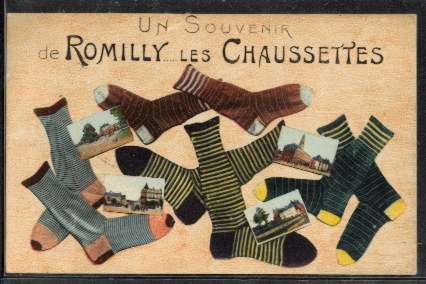
Why was this Romilly, France associated with these socks? Anyone know? It’s also interesting that the stripey ones look a lot like Regia Mini Ringel if one did toes and heels in a contrasting color. Plus there may even be more than one working method shown. The yellow heeled pair and the gray pair with the apricot/brown toes/heels look like they’re worked similarly. But the blue/yellow stripey pair in the center looks a bit different. Examine the way the stripes terminate even with the heel on the yellow toed pair. They don’t do that on the center one. That one looks a lot like the short-row heel socks I make from Ringel, with the stripes "splitting" around the whole heel unit.
Then there’s this one. If you’re more musical than I, please enlighten us all on the nature of this little knitting song. (The image is too big to post conveniently, so you’ll have to click on the link.)As far as translating the lyrics, I get something like:
Song of the Needles
Knit, needles of France
Start ?
Knit with martial cadence
For the heros, the sons of France
Who fight and die down below
Countrywoman or grand city lady
In salons and in ??
Knit the same wool
Without knowing whomyou will clothe.
It goes on from there to speak of fears for the loved ones, that all should undertake this work in the hour of fraternal/patriotic spirit, and ends up with
Inch by inch, stitch by stitch
We repel the German forces.
Everyone is onthe battlefield,
Needles of France, go forth!
Of course my French is mighty rusty, so if anyone else makes more sense out of the thing, please let us know.
Other curious needlework and knitting related cards include Socksof the French Soldier:
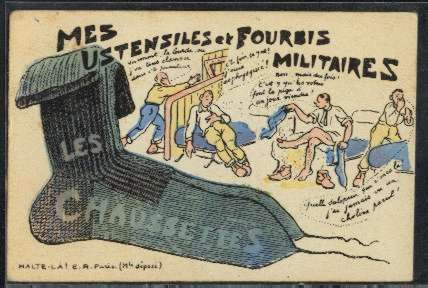
The big caption works out to something like "My tools and army-provided kit." Again, if you can get this photo to load, look at the way the socks are made, with a ribbed top and top of the instep; a heel of a different texture, and what I suppose is a stockinette foot part, ending in a pointed rather than grafted toe. It even looks like the stockinette foot part is of a lighter weight yarn. The strings at the end of the toe aren’t there because the knitter forgot to end them off. They were deliberate additions, intended to make keeping a pair together and hanging them out to dry easier.
There are also quite a postcards having to do with embroidery, spinning, weaving,sheep, and more. The knitting ones came off a miscellanous textiles grouping.
Again, apologies if these pix don’t load. The links are VERY slow. You may wish to save them to look at later when traffic has subsided somewhat.
EVEN MORE QUESTIONS
Apparently the redbit of stitching I posted yesterday piqued a bit of interest. I received some questions on it:
I can’t see the pattern you describe. Can you post a detail shot?
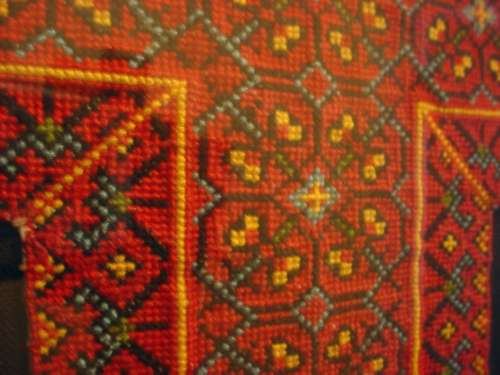
Here’s the best I can do:
Where did you get red muslin?
I didn’t. As you can see in the detail shot, the ground isn’t red. In fact you can’t see the ground fabric at all – the entire piece is completely overstitched in red, black, yellow, green and light blue.
What thread did you use, what stitches, how big is the piece?
Thinking back to ’75 or so when I made this, and hoping I remember it all – I used two strands teased from standard DMC embroidery floss. The entire piece is done in plain old cross stitch, nothing fancy. The muslin was a remnant from the discount table of a neighborhood fabric store, back in the days before big box crafts stores. Iworked mycross stitchover 2×2 threads of my muslin ground. And yes – all the top legs are crossing in the same direction.
The entire thing is about 11 inches wide and 14 inches deep, both measurements taken at its widest points. As far as gauge or stitches per inch, the weave of the muslin wasn’t square, so my cross stitches aren’t square. The flower motifs themselves graph out exactly square, but because of the weave-induced distortion, they end up looking like rectangles. Across the motif (the stretched dimension) it measures out to about16-17 cross stitch units per inch. Up and down the motif (the squished dimension) it measures out to about 21-22 cross stitch units per inch. The imprecision is there because I have the piece mounted in a frame, and it’s tough to hold a ruler close enough to get an accurate count.
The mounting glass is also why this is photographed at an angle. I hoped to bounce the flash so I didn’t get a glare or – like yesterday – a ghost image of me taking the picture reflected by the frame.
What’s the design source for this one? Why is it a funny shape?
I started with a couple of traditional Ukranian counted thread patterns, most notablyan illustration in Mary Gostelow’s Complete International Book of Embroidery, then played with them a bit. What I ended up with was a yoke for a blouse or dress. I did wear this yoke, appliqued onto two garments. The first was a very thick linen peasant-style blouse, smockedjust beneath the panel and finished with gathered and tied cuffs. After that blouse met an untimely soy sauce/bleach-related death, the second was a black straighttunic-type linen top, rather North African in shape. Thankfully the embroidery itself was unharmed by the soy sauce and subsequent attempt to clean it. Another thing – this is the piece that was recognized with the Nellie Custis Lewis prize at the Woodlawn Plantation Needlework exhibition in ’93. That year the special prize was given for garment trim or accessories.
So, what relevance does all this have to knitting anyway?
One thing that gets me fired up is the possibility of cross-pollination among needlecrafts. Why can’t I take a 16th century pattern intended for lacis, counted embroidery or weaving, and use it in filet crochet or knitting? Why do I have to stick to traditional Scandanavian, North Sea island, and Baltic motifs for stranded colorwork? For example, why not mess with this red bit of stitching, adapting its motifs for knitting?
Why for that matter do I have to stick to any one type of needlework? I’ve done that. I’ve made the repro historical pieces.It’s virtuoso work when done to the nth level, but it’s also limiting. I want to do more. What gets me trulyinvolvedis moving away fromstaid verbatimreproductionin one of two directions, either –
- Making an entirely original and new piece, but doing it in such a way that were it transported back in time it would be accepted as yet another contemporary example of its type.
- Taking motifs, designs, or aesthetics from one branch of traditional needle arts and using them either in combo with another form, or for use entirely in another form.
Thisattitude one of the things that makes me a Rogue Laurel in the SCA. Yes, making an exacting reproduction of a meticulously researched and documented artifact is a manifestation of skill (and perseverence) on a high order, but I don’t see it as the ultimate expression of the deepest level of understanding.
Believe it or not, I seethe elusive goal of true mastery of a needlework formas having parallels in martial arts. It’s one thing to learn fencing, Judo, Karate or Aikido exercises perfectly and to perform them with grace and precision when required. It’s another thing to abstract the principles behind the exercises, and be able to summon them up to defend oneself from someone who doesn’t know the otherside of the script. It’s the inner form of these arts, the part that you can recognize at a visceral level, internalize, and use as a point of spontaneousapplicationthat is the goal of practicing the outer form of the techniques.
So from street fighting, I cycle back to stitching and knitting. I have donemany of these other things amd tried out many different needle artsbecause I see deeper parallels among them; because the lessons I learn in onepursuit inform my investigations of others. And bogus pseudo-philosophy aside – mostly I do these things because they make me happy.
Footnotes: SCA = Society for Creative Anachronism. Laurel = SCA’s kindgom-level award for achievement in the arts – one of the highest achievements possible withing the group, and an ardently sought-after goal. Iam honored to have been recognized in the East Kingdom in ’79 for fostering the practice of historically accurate embroidery, in specific – blackwork and related styles. Rogue Laurel = one so honored whose opinions differ from the established consensus, who ends up being in the minority on most arts-related issues, see related entries under "pain in the butt," and "gadfly." I’m mostly retired from active participation in the SCA these days, but I can still be found on occasion at events in Carolingia (greater Boston, Massachusetts area branch).
YOUR FRIENDLY KNITTED-UP SPIDERMAN
Somewhere out in the dark of nightlurks Mark Newport; a fiber artist with time, imagination, and a fullattic of vintage comic books.
Mr. Newportknits head-to-toe superhero suits. You canpurchase his one-of-a-kindSpiderman; Mid ’60s Batman; Daredevil (with nifty ribbed hood) or Mr. Fantasticoutfits. If he selected a nice, springy wool,he’s probably figured out what I never could as a kid – howReed Richards wasable to stretch his arm to ten feet long butneverburst out of his suit. (Later when I got older I thought of the implications of being his wife Sue Storm, but that’s another speculation left over from a more innocent time.) My embroiderer and comic-collector selves also really appreciate the oddity ofMr. Newport’s embroidery on papercomic book samplers, too.
Mr. Newport’s work is being gathered into an upcoming exhibit at the Greg Kucera Gallery in Seattle, Washington. Be warned however – he overembroiders or embellishes many types of printed matter in addition to comic pages, including what in a more genteel era would have been called "French Postcards." The gallery’s site does explore those materials as well.
Yarn Reviews at wiseNeedle
Thank you, thank you, thank you!
Since yesterday 24 new reviews have been logged in. That’sthe most reviews received in one day since early ’95, when the collection was just starting out! Knitters everywhere will be extremely grateful as they find your comments on all those yarns. I’m particularly impressed with the blog community, and the way that it’s rallied behind this project. I feel like I’m back in ’94,part ofa happy band of knitting zealotsspreading their shared banner throughthe electronic ether. Thanks also to the folk from the KnitList who slogged on over to the site to add their experiences to the pile. I also really appreciate all the people who took time to say they’d miss the yarn review collection if it disappeared.
I’ve still not decided what to do to make the collection self-supporting, but I did get a couple of good ideas to chase down, both left as comments on yesterday’s page and mailed to me directly. I notice that other people don’t have the ethical/editorial independence problem I see with accepting ads from yarn makers or retailers. One person wrote to suggest that I offer a "buy me" sidebar, with a list of vendors appearing whenever a review is pulled up. The logistics on that might not be feasible, especially considering that many individual yarns have the half-life of a mayfly, and the indexing would have to be done by manufacturer’s line rather than individual offering. Plus, I’m afraid that if I become dependent on money from industry sources, the collection will become less impartial as people become hesitant to criticize the same stuff they see advertised. Also I might be swayed (even unconsciously) to favor advertisers over non-advertisers. Perhaps I’m too much a stickler here. More thought is needed.
Another intriguingidea was to see if sellers of knitting inventory software might be interested in licensing the database. Another was to sell bags or tee-shirts with knitting-related stuff on them. If anyone has had experience with Cafe Press or similar collateral services, could I beg a little guidance? (You can send me an eMail off-blog at using the "contact" link at the right.)I also got a suggestionto add a line of for-pay patterns to the free ones already there. I’m not convinced though that anyone would pay for these as the more complex ones are working descriptions rather than stitch-exact direction sets; and the less complex ones are so intuitive that I can’t believe people would plunk down a fee for them. Then again, there are people selling other simple patterns on the web and on eBay at surprisingly large prices…
Buttons?
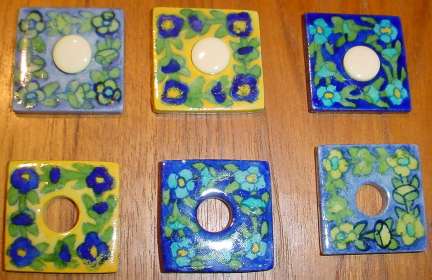
Some people asked for a closer view of the ceramicbuttons I’ll be using on the fulled pillow. Here they are, both with and without the little yellowplastic onesI’ll be using to hold them on.
 String-Or-Nothing