VINTAGE LACE SCARF; ATTACHING LACY EDGINGS
Where have I been? Well, first there was another spate of chaos deadlines at work. Then it was the beginning of Birthday Week here in the String household (they’re 7 years and four days apart, with mine shortly thereafter). And to no one’s surprise, I came down with a nasty flu. I’m not yet over that, but it was severe enough for me to stay home from work – something I’ve done only once or twice in the last decade.
For her birthday Smaller Daughter specified a volcano cake with a dragon on it. She’d seen something like this in a kiddie cookbook – a bundt with a lava-like frosting poured on, surmounted by some clever marzipan decorations. So we made it a group project. I provided the almond bundt with chocolate fudge filling and frosting; Older Daughter molded the marzipan dragon with dried apricot wings; and Smaller Daughter made the strange red prey creatures fleeing from the dragon:
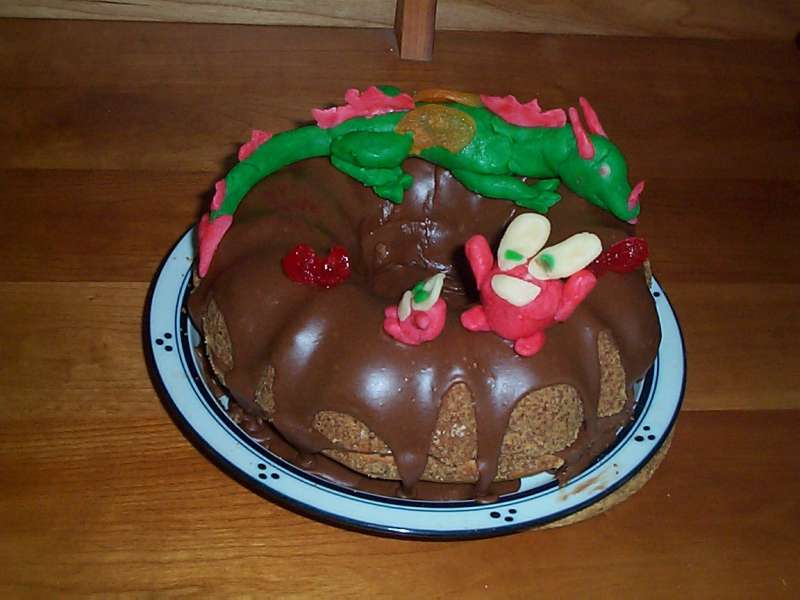
We were hard pressed to find enough room for the obligatory birthday candles. The cake and decorations however were delicious.
I did manage to make some progress on the lace scarf over the last week. I’ve finished the center section, and am working on the edging. It looks like I’ll have to nip into my third skein of Prescott, so I’m thinking of pausing on the edging to go back and add some length to the center section before lapping all the way around that last end. I’m not doing anything fancy here – no mitered corners. I’m just working an extra repeat of the pattern into the cornermost stitch, and hoping that all blocks out evenly later.
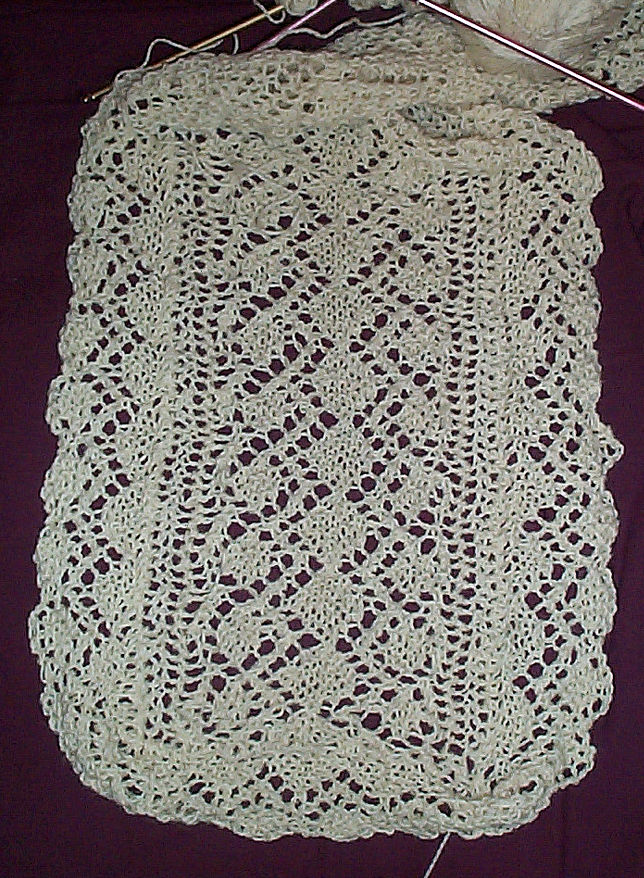
UPDATE: THE LACY EDGING BELOW IS NOW AVAILABLE AS A SINGLE PATTERN DOWNLOAD UNDER THE KNITTING PATTERNS LINK, ABOVE.
I played with quite a few edging patterns for this piece, finally settling on the “Doris Edging” from Miller’s Heirloom Lace. It has framed diamonds that exactly complement the center strip. Along the way I noodled up another simple triangle-based edging. This is an out-take, and didn’t end up on the scarf. I won’t violate copyright by sharing Miller’s edging (which I used more or less verbatim), but I will share this one:
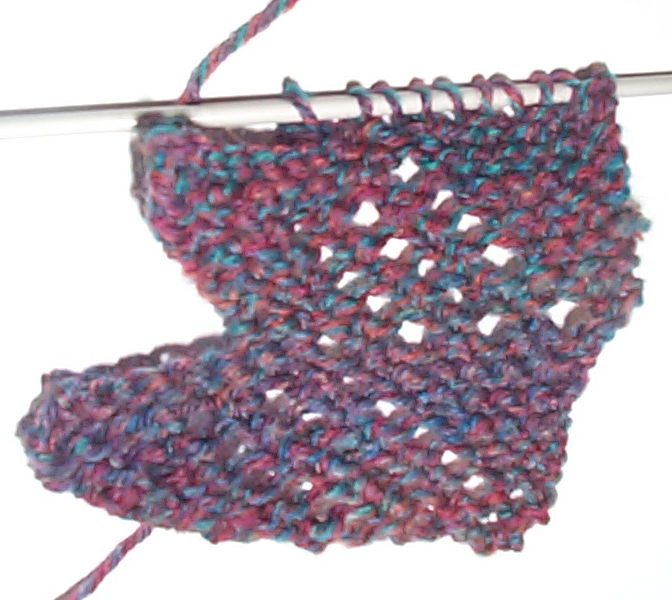

Knitting an edging onto a piece isn’t difficult. It helps if your base item was worked with a slip stitch selvage edge, but that’s not mandatory. I’ve knit edgings onto all sorts of things, including finished fulled/felted items, fabric, and leather (some caveats on this, below). The slip stitch selvage just makes it easier. Your chosen trim will have one edge intended to hang free. Most often that will be dagged, serrated, scalloped or otherwise fancified. It will also have one (more or less) straight edge. This straight edge is intended to be sewn or knit onto something else. I like to work in the orientation shown in the knit sample and pattern, above – with my straight edge on the right, and the fancy edge on the left. My right-side rows commence from my main piece outward, and my wrong-side rows return from the fancy edge back to the main piece.
Sometimes I use a provisional cast-on and start my lace rows immediately after it. Other times I use a half hitch cast on, then work one row back in knits before starting my lace patterns. There’s no real rhyme or reason here. It’s just what I felt like doing at the time. In this case, I cast on using half-hitch, and worked a row of knits back, working my first join on that “back from cast-on” non-repeated row. The join itself is quite simple. When I get to the last stitch of my wrong side row, I pick up one stitch in the edge of my established body piece. Then, for the first stitch of my right-side lace row, I either knit or purl that newly created stitch along with the next stitch after it on my needle.
If I knit those two together I end up with a neat column of stitches that makes a visual line between the lace edge and the main body. While this can be desirable in some cases, it does present a different appearance on the front and reverse of the work. Because the lace center of this piece is garter, and the edging is also presented in garter, I used a P2tog to make the join. The front and back of the work look less different from each other if I purl the join instead of knit it. Once the join is made, I work out the remainder of my right-side lacy row, and the return row. So long as I remember to pick up one stitch at the end of every wrong-side/return row, then work that stitch together with the next one as I begin the right side row, my edging will be firmly united with my main body.
Sometimes you don’t want to do a row-for-row join. Occasionally the stretch of the lace edging or the ratio of the edging rows to body rows isn’t 1:1. This might happen if you are working the edging on smaller needles; or if you are working the edging across a row of live stitches (or across the top or bottom cast-on or bound-off edge) rather than along the “long side” of the work, parallel to the main body’s knitting. In that case you may need to either work additional non-attached lace rows every so often, or pick up at the end of the wrong-side/return rows by knitting two body stitches together, again every so often. The former adds more length to the lace, the latter subtracts width from the body. Which method is used depends on the stretch of the body.
The biggest caveat in attaching knitting by knitting on rather than by seaming is that if you do so, the lace is no longer “portable.” Let’s say in a fit of Suzy Homemaker frenzy, you edged out a set of exquisite hand towels. It’s now some years later, and your children have stained those towels beyond recognition, but the edging still looked good. If you had knit the edging separately and seamed it on it would be very easy to remove and re-apply to new towels. But even if you had run a band of slip stitch crochet down the edge of the towel to provide an easy edge for attachment first, if you had knit that edging onto the towel, removing the fancy lace from the towel will be …problematic.
As far as knitting onto fabric, fulled material or leather – it CAN be done. If the edge can be pierced by a needle tip (or was conveniently punched beforehand), you can knit right onto the edge of anything. BUT the warning about not being able to take the lace off again or adjust it later is strongly in effect. If you want to attach a lace edging to any of these substrates, it’s worth it to work one row of slip stitch or single crochet along the item first, then knit (or seam) your knitted edging onto that crocheted foundation row. The foundation row of crochet gives you a stable, evenly placed line of stitches for the joins, and stabilizes the base item’s edge somewhat. It also (in the case of leather) makes working into previously punched holes easier (a crochet hook is much easier to thread through and grab a strand than is a knitting needle’s tip). Plus, if you think the item being trimmed might shrink, consider seaming rather than knitting on so you can make adjustments later.
So. If you plan on using a lace edging again on another item, or you think your base item might shrink – take the time to seam (collars, cuffs, bed or bath linens). If the edging will remain on that piece, living and dying with the item that bears it – consider knitting on instead (knit counterpanes, scarves). To illustrate this post I wish I still had the denim jacket I trimmed out in knitted lace, or the baseball jacket that used strips of recycled fur interposed with white Aran style heavy cables…
In any case, back to sniffling and a nice lie-down.
APPLIED STRIP EDGING WITH MITERED CORNER
I’ve played around some with methods of producing and applying the edge finish to the khaki vest. First I tried the separately knit/sewn on band method, using a couple of different approaches to the seaming (fold band longitudinally, sew the band up, then apply it; sew on both sides in one pass; sew on the display side, then do a separate seam to affix the facing side). Of all of them, the last method worked best, but it was the most effort intensive of them all.
So I looked further. Plain I-Cord (knit on or applied) was too narrow to stabilize the edge, and two courses of it would have been too bulky. I didn’t like the way that picking up along the edge then knitting out looked – especially along the curve of the armhole.
Even more experiments ensued. Finally I landed on knitting-on a strip parallel to the edge, then going back and seaming down the free side on the inside of the piece. Doing that I could produce an edge of any desired width, go around curves and even plan on mitering the vest point corner. Here’s a swatch with a mitered corner. Note that I haven’t sewn down the facing on the inside yet, but natural stockinette curl is keeping it nice and neat. (For some, the inside seaming might be optional, but I plan on doing it on my finished piece).

To miter the corner of this 8-stitch strip, I used short rows. Here’s how I did it:
Applied 8-stitch Strip Facing with Mitered Corner
Start with the public side of the work facing you, holding it with the bulk of the piece on the left, so that you’re working up the right side of the thing (upside down from the picture above). Using straight needles, cast on 9 stitches, then pick up one stitch in the edge of the piece being finished. While the strip is 9 stitches wide, one is consumed during joining, so the part that protrudes is really only 8 stitches wide.
Row 1 (wrong side): P8, k1.
Row 2: S1, k6, ssk, pick up one stitch in edge of swatch
Row 3: S1, p7, k1
Repeat Rows 2 and 3 until you reach the corner, having just completed an odd number (wrong side row)
Row 4: S1, k6, wrap and turn.
Row 5: Slip the wrapped stitch, p6, wrap and turn
Row 6: Ignoring any previously wrapped stitches, S1, k5, wrap and turn
Row 7: Ignoring any previously wrapped stitches, Slip the wrapped stitch, p4, wrap and turn
Row 8: Ignoring any previously wrapped stitches, S1, k3, wrap and turn
Row 9: Ignoring any previously wrapped stitches, S1, p2, wrap and turn
Row 10: Ignoring any previously wrapped stitches, S1, k2, knit the next stitch along with the loop around its base, turn
Row 11: Ignoring any previously wrapped stitches, S the stitch you just knit, p2, purl the next stitch along with the loop around its base, turn
Row 12: Ignoring any previously wrapped stitches, S1, k3, knit the next stitch along with the loop around its base, turn
Row 13: Ignoring any previously wrapped stitches, Slip the stitch you just knit, p4, purl the next stitch along with the loop around its base, turn
Row 14: Ignoring any previously wrapped stitches, S1, k5, knit the next stitch along with the loop around its base, turn
Row 15: Ignoring any previously wrapped stitches, Slip the stitch you just knit, p6, purl the next stitch along with the loop around its base, turn
The corner is complete, return to repeating Rows 2 and 3. Optional finish – seam down the inside edge of this facing.
I’ve stated applying this same edging to the armholes of my vest (having previously seamed the shoulders).
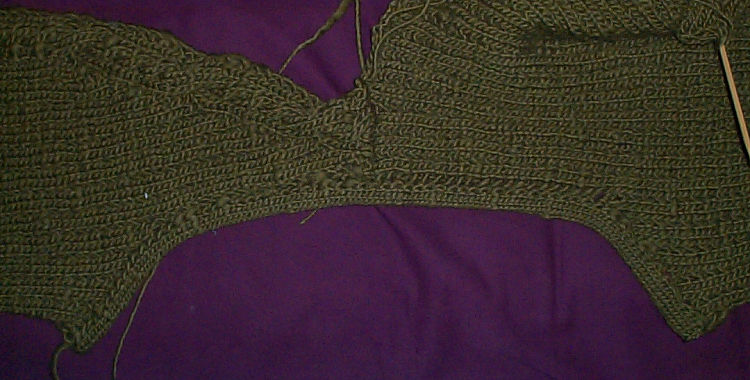
I plan to do the bottom edge next, incorporating the mitered corner on the vest points. But I haven’t played with the buttonhole band treatments yet. Sadly, I have misplaced my copy of InkKNitters. It’s here. Somewhere… Weekend plans include tossing my knitting library to find it.
Oh. Unless a monsoon is upon us, weekend plans also include attending the annual Gore Place Sheepshearing Festival in Waltham, Massachusetts. Not a big festival as fiber fairs go, but very local and lots of fun. Look for me with both Elder and Smaller Daughter in tow.
DRAGONFLY MITTENS – FINISHED PATTERN
UPDATE: THIS PATTERN IS NOW AVAILABLE AS AN EASY TO PRINT PDF, AT THE KNITTING PATTERNS LINK, ABOVE.
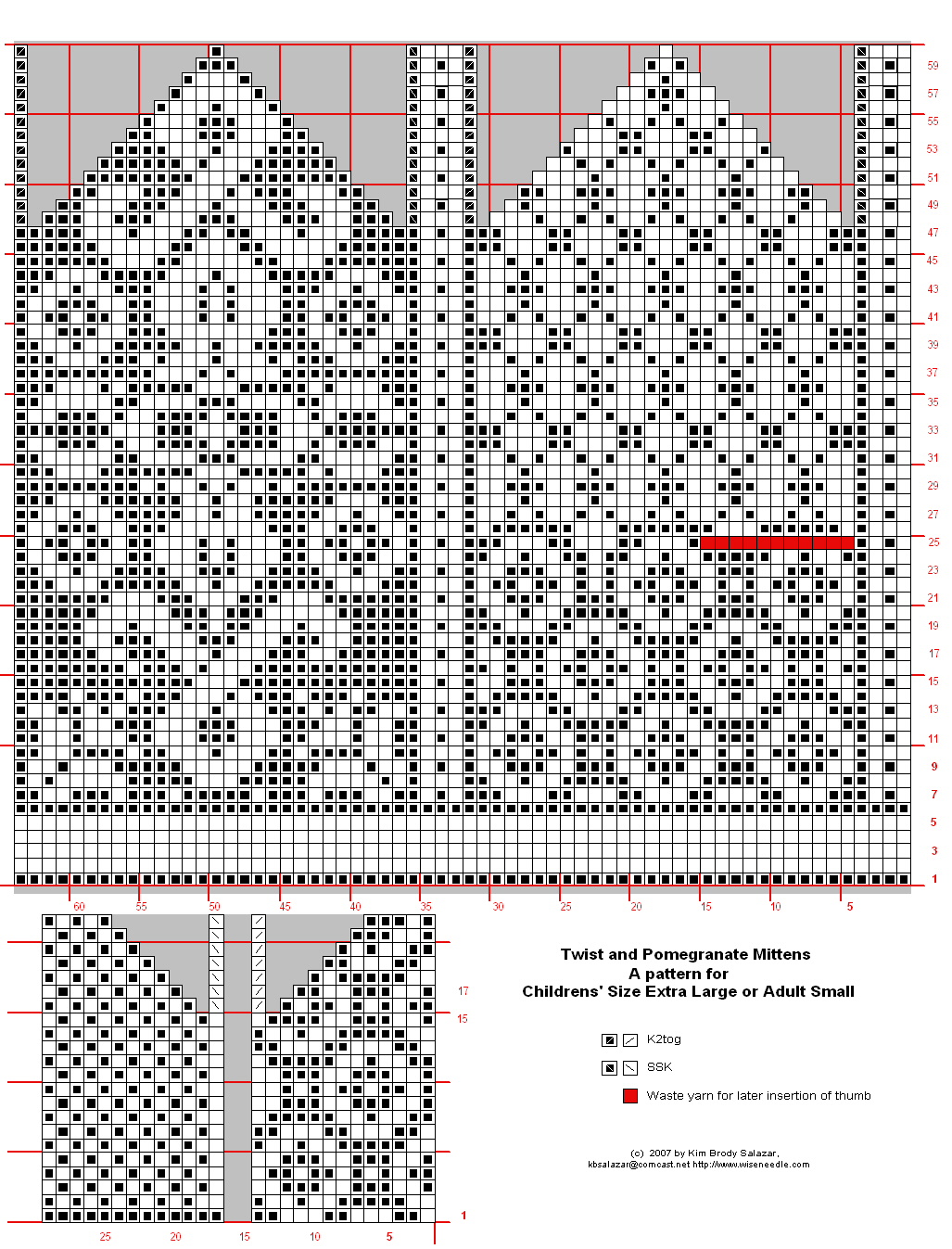
My mis-matched mittens are done. Today I present pix plus a write-up and more reliable graphs. I changed the placement of the decreases on the graph. They’re now shown along the side strips rather than on the triangle that forms the mitten top. This eliminates any confusion caused by the double // notation inherited from the original inspiring mitten blank. I’ve also fixed the pattern alignment on them so that they integrate better with their palms and graphed my thumbs out to be a stitch wider than the hole provided for it in the mitten body. I found that I needed to pick up a stitch at the left and right corners of the slit formed when the provisional stitches were removed. If I didn’t do that, I ended up with a hole at either side of the base of my thumb.
First, proof that the mittens are done, courtesy of overly dramatic Smaller Daughter (code name Sarah Heartburn).

She does have very large hands and feet for an 8-year old, a sign that she’ll probably inherit my family’s height (at 5’8″ I’m the shortest female in my immediate family). But the mittens are a bit large on her. I’d call them kids’ extra-large, or teen/small woman size.
Dragonfly/Pomegranate and Knot Mittens
a knitting pattern,
(c) 2007, Kim Brody Salazar, http://www.wiseneedle.com


Materials:
Approximately 1.5 ounces total of lofty Shetland style sport weight yarn, with a native stockinette gauge of about 6 stitches per inch. (This will be knit down to a much tighter gauge to make a warmer mitten). Four colors were used:
- Color A: About 50% of the total – Navy blue
- Color B: About 35% of the total – Light green
- Color C: About 10% of the total – Cranberry
- Color D: About 5% of the total – Light blue.
Size 3.25mm double pointed needles (Two circs or one-circ “magic loop” methods can be substituted). DPNs highly recommended for the thumb.
Scrap of contrasting color yarn or string for thumb “place holder”
Gauge:
8 stitches = 1 inch
Finished measurements:
Mittens measure approximately 4″ across the palm and 9″ from tip to cuff
Instructions:
Using the predominant color and a tubular cast-on, cast on 64 stitches. Work in two-color K1 P1 corrugated ribbing for 2 inches, using Color A for the purl columns and Color C for the knit stitches. Using Color A, knit one row and then purl one row. Using Color D, knit four rows. Using Color A, knit one row and then purl one row.
Using the chart of your choice (below) for stranded knitting, work as shown. The creative will note that given four different and interchangeable mitten sides, any combo thereof would make perfectly suitable mittens – all four as presented needn’t be used. Regardless of the mitten graph chosen, introduce a small bit of waste yarn or string for the stitches indicated in red. Make sure that you mirror that placement for your left and right mittens, as shown in my charts. Alert: On the pomegranate and knot mitten chart, I call for decreases done in Color A. I’ve introduced a separate symbol for those decreases. It’s noted on the chart. End off the mitten at the top by grafting together the last 8 stitches.
Thumb:
Returning to the waste yarn introduced for the thumb, carefully remove it, slipping the live stitches above and below the newly formed slit onto DPNs. Using a third DPN start at the side of the thumb to the right of the newly created hole. Looking at the thumb chart for the visible side of the thumb (the one with the pattern that matches the palm), pick up one stitch in the right side of the newly created thumb slit. Do this in the color indicated for the first stitch of the thumb chart. Note that the thumb pattern should seamlessly integrate with the palm pattern, although each of these mittens does that in a different way. Work across row 1 of the visible side thumb chart. Switch to the inside-the-thumb chart (the one with single stitch checks), again starting with the first charted stitch, pick up one stitch in the side of the thumb slit prior to working across the rest of the thumb chart. Follow chart as shown, grafting the final stitches at the tip of the thumb. Darn in all ends.

JUSTIN’S COUNTERPANE; BLOCKING BOARDS
A couple items from my inbox.
Question on Justin’s Counterpane
Cindy wrote to say she was having problems conceptualizing how the pieces to make my Justin’s Counterpane pieced blanket fit together. This particular blanket is a large scale intro to white cotton/lacy knitting. Only twelve main units are needed to complete it – six keyhole shaped motifs, and six whole octagons. Ten triangles are used to eke out the sides and make them straight. An optional edging finishes the thing. They’re put together like this:

I did not use additional triangles at the corners to make a true rectangle because it’s easier to go around a more gentle angle without mitering than it is to go around a 90-degree turn. And I didn’t want to go through the bother of mitering my corners.
Because of the relatively few units used and the simplicity of the classic pinwheel motif, I think that people wanting to make a first item in this style might find the pattern useful. Being a blanket, it doesn’t have to fit anybody so gauge is a guideline, not a mandate. It can be worked in any cotton or cotton blend yarn you like. The yarn I chose was a very inexpensive DK weight, but by using the appropriate size needles, a piece of usable dimensions could be made in anything from sport to worsted. Much heavier than that though and you’ll get into weight issues, cotton being quite a bit massive than its equivalent thickness in acrylic or wool. (You could even work this in standard wool or acrylic, but I think the design will be crisper in cotton.)
In any case, some basic guidelines for knitting and seaming together pieced counterpanes include binding the motifs off especially loosely; blocking the units before assembly, by wetting them down and pinning them out while stretching them to their maximum extent; and using whip stitch or when possible, mattress stitch done in half of the edge most stitch to sew them together. Back stitch or mattress stitch done further into the motifs will make the seams too dense and rigid, and may introduce cupping.
Bargain Hunters’ Blocking Boards
Rachel and I had an eMail chat recently. I think it was over on one of the knitting-related boards at Live Journal. She was looking for advice on blocking. In specific, she was looking for low-cost alternatives for blocking. We went through the standards – pinning out on carpet covered with towels or on a padded table or bed, but she wanted a rigid surface that was easy to stow in addition to being inexpensive.
I recommended getting a half-sheet of drywall from the hardware store, taped around the edges to reduce crumble, and topped with a flat sheet through which the pinning happens. I also suggested scouring yard sales or opportunity shops for the squishy/spongy foam pattern/alphabet block floor tiles or play mats favored by the parents of toddlers. They’re indestructible and often outlast the toddler years, landing at second-hand venues. Top those with a sheet and pin away, happy that you’ve found a modular, easy to store solution that as a creative recycle, nibbles away at the waste stream.
Rachel decided to go with the play mat idea. She sent me a note of thanks, and included this shot of her shawl blocking:

(Photo is hers, used with permission). She also notes that she got her mat at WalMart, and it was less than $20. Love the shawl, Rachel, and as ever – I’m delighted to have been useful.
1941 VEST – FINISHED
My ultra quick 1941 vest project is finished. That’s 7 days from cast-on to finishing off the final end. Considering I only knit an hour or two a day, that’s lightning quick.


The fit is a bit different from most contemporary patterns. For one, the shoulders are wide and shaped, and the armholes aren’t gappy. My tiny cut-out at the back of the neck rides well with a golf shirt’s collar, and the length is just what he wanted. The fabric is soft and lofty. Since I rarely knit for him and the few times I have the results haven’t been optimal (mostly too big or too warm), I’m delighted to have produced a winner.
On the yarn – I think Cascade 220 is a yarn that’s overlooked in the mad scramble to Merinos. Yes, it’s not a Merino, and doesn’t have that silky hand. But it’s not an itchy or stiff yarn, and knits up quite nicely. The number of ends to finish off are minimized because of this yarn’s superior ability to spit-splice, and the 220 yard skeins. In terms of care, it’s quite pill-resistant. I’ve made several things from it, and have never found any flaws in it. Not so much as a knot. So pause a bit in your haste to knit this stuff up only if fulling/felting is your goal. Try some out for a non-shrunk garment. I think you’ll be pleased with the result.
As promised, here’s a modern pattern for the thing in Size 46. To make life simpler for us all, I’ve used Sweater Wizard to construct it.
Man’s 1941 Style Vest in Garter Stitch, a Redaction from Minerva #46
(c) 2006, 2007, 2013 Kim Brody Salazar

Needles: 7, plus size 6 circs or DPNs for finishing armholes and neck ribbing. One stitch marker.
Gauge:4.5 sts10 rws per 1″ Estimated Ydg: 1212 yards standard worsted weight yarn with a native stockinette gauge of 5 stitches = 1 inch.
Back
With rib needle, cast on 102 sts. Estab rib pat on Row 1: *K2 , P2. Repeat from *. End K2 . Work 29 rws. On row 30, increase as below. [2.75″].
Rib-to-Body Inc Row
6 incs total done this way: Work 14 [inc 1 in next st, work 13, inc 1 in next st, work 14] 2x. [inc 1 in next st, work 14] 2x. (108 sts) With body needle, work in pat st until piece meas 14.5″[row 118].
Armhole Shaping
Bind off 6 sts at beg of next 2 rws. Dec 1 st each side, every other row 5x. Cont in pat st until piece meas 25.5″ from start [row 228].
Shape Shoulders and Back Neck
Bind off 7 sts beg of next row. At beg of next row, bind off 7 sts, work 14 sts, attach a second ball of yarn and bind off 42 back neck sts. Complete row. At beg of next row, bind off 7 sts and dec 1 st at each neck edge.Bind off 7 sts beg of next row. Bind off 7 sts beg of next 2 rws. End off.
Front
Work as for back, including all shaping,and, at the same time when piece meas 16.1″ [row 134]
Begin Neck Shaping
Work to center, attach another ball of yarn and complete row.Turn. Work both sides at once. Dec 1 st at each neck edge every 2nd rw 3x, then every 4th rw 19x. Cont in pat st until piece meas 25.5″ from start [row 228].
Shape Shoulders
Work shoulder shaping (at shoulder edge) to correspond with back.
Armhole Edging
Seam sides. Seam shoulders. With smaller size ndle, pick up 108 sts around armhole edge. Work in K2, P2 ribbing for five rows. Bind off loosely.
Neck Finishing
With smaller circular or dp needles and RS facing, pick up 48 sts from back neck, pick up 60 sts from left neck edge, place center marker, pick up 60 sts from right neck edge, place end of round marker. (168 sts).
Round 1, 3 and 5 – Work first round in K2, P2 rib until two stitch before the center marker. K2tog, slide marker to right hand needle. SSK, continue in K2, P2 ribbing taking care to match the sequence immediately after the centermost decreases to the sequence immediately before them.
Round 2 and 4 – Work in established pattern.
Bind off. Darn in all ends.
ANOTHER REASON TO SUPPORT YOUR LOCAL YARN SHOP
Because they are in irreplaceable source of knowledge.
I swatched out several yarns that I had here in stash, trying out possibilities for my 1941 vest. Everything ranging from some navy/maroon ragg style Bartlett worsted (circa 1998) to a recent find from Webs – a tweedy garnet. The Bartlett is really an Aran or light bulky. I achieved gauge, but the sample stood up like cardboard. The Webs 2/4 Highland Tweed purports to be Aran to worsted in gauge (4.5 to 5 spi) but it knit up like a DK. Again I achieved gauge, but the sample looked meshy and sparse. I suspect that it would have bloomed a bit after I washed it, but in an added complication, TRM mentioned that he liked the color but hated the tweedy flecks. So it was off to my local yarn shop on a fishing expedition.
I went to Wild & Woolly in Lexington, MA – my knitting home-away-from-home. Now Jackie the owner is a knitter with decades more knitting experience than I have. She gave me an important bit of advice. When looking over patterns in these older booklets, don’t go by the gauge any yardage deductions based on just one project. Look at all the projects in the book that call for the same yarn. You’ll probably notice a discrepancy among them. So we did. A couple of the other patterns look closer to true worsted gauge than the light worsted/DK thoughts I had when I walked into the shop. To top it off she also remembers the Minerva (and later Columbia-Minerva) yarn specified. She steered me to Cascade 220 – which is slightly denser and less lofty than the Minerva but of similar gauge. The more airy nature of the Minerva is what threw me off, providing the extra yardage and making the stuff seem like a DK . So I bought some Cascade in a regal heathered burgundy and took it home.
I swatched it up and it was perfect. Spot on for gauge, with a soft hand and drape. So offering up thanks for the entire Wild & Woolly family I set to work on my vest project.
I measured the target recipient, plus one of his favorite store-bought vests that fits well. Then we sat down together and looked at the original pattern, pointing out fit and finish items that made it especially appealing, and other things that we might want to forgo. For example, TRM likes the depth of the V-neck, and the proportions of the waist and armhole/neckline ribbing, but is less enamored of the short length, tailored at the time to compliment pants worn with the higher, more formal waistline of the 1940s.
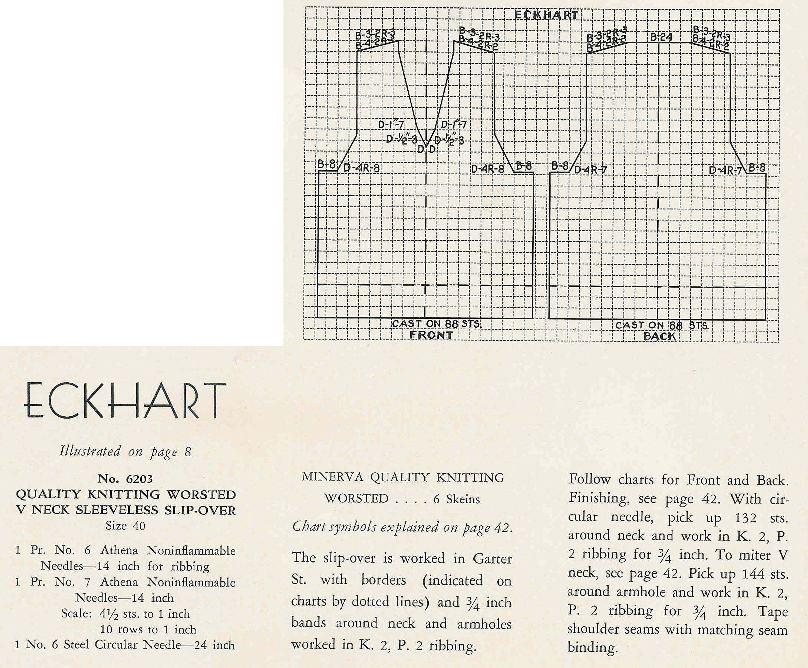
Then I looked at the pattern. I reproduce it here in its entirety, under fair use because I am using it to illustrate how to go about both reading an unusually formatted historical pattern, and how to go about redacting it for modern use.

You’ll notice that the write-up is much shorter than a modern pattern. There’s only one size given, plus a schematic with some notations on it and cursory working notes.
This pattern if translated straight would rely heavily on the schematic. The boxes represent a 1-inch square grid. Instructions on how to interpret notes like B-8 an D-1-7 are elsewhere in the pattern leaflet. Here’s what I start with – my interpretation of the original directions, plus a bit of editorializing.
“Eckhart” – Man’s 1941 Garter Stitch Vest from Minerva Hand Knits for Men in the Service, Vol. 62, size 30
Gauge in garter stitch: 4.5 st = 1 inch, 10 rows (5 garter ridges) = 1 inch
Back: Cast on 88 stitches. Work 3″ in K2,P2 rib. Then switch to garter stitch. Work even until piece measures 13 inches from bottom edge. Bind off 8 at the beginning of the next two rows. Then decrease one stitch at the right and left edge of the work every four rows. Do this edge reduction seven times total. At the end of the armhole decreases you will have 58 stitches. Work these 58 stitches even in garter stitch until the piece measures 11 inches from the under-arm bind off row and you end ready to work a right side row. Form shoulders by binding off four stitches at the beginning of the next four rows, then bind off three stitches at the beginning of the next six rows. Bind off remaining 24 stitches to form center back neck.
Front: Work as for back EXCEPT place a marker between stitch #44 and 45. On a right-side row when work measures approximately 15.5 inches from the bottom edge, knit to two stitches before the marker, K2tog. Then attaching a second ball of yarn, and starting with a SSK, work the rest of the row. Note that this happens BEFORE you finish making the underarm decreases, so watch for it.
You now have each side of the top front on either side of the V opening being completed from its own ball of yarn. From this point on you’ll be making paired decreases on either side of the opening on some right side rows, using a K2tog when indicated on the side that ends at the center, and a SSK on the side that begins at the center. Work three of these decrease pairs spaced approximately 1/2 inch apart (you’ll probably be doing the decreases every 4 rows). Then work seven of these decrease pairs spaced 1 inch apart (probably every 10th row). You will finish these neckline-defining decreases at about the same point where you need to commence the shoulder decreases. Finish the shoulders as directed for the back.
Finishing: Seam shoulders together. Starting at a shoulder seam, pick up 132 stitches around the neckline, taking care to space them evenly, and work in K2, P2 ribbing. Count off the stitches to make sure that the center two that will be in the point of the V end up as a K2 pair, and place a marker between them. Work the mitered join at the center front point of the V-neck by knitting the last two stitches just before the marker, and working a SSK immediately after the marker – do this EVERY OTHER row until the ribbing measures 3/4 of an inch deep. Bind off. Sew side seams. Pick up 144 stitches around each armhole and work even in K2, P2 rib until ribbing measures 3/4 of an inch deep. Bind off and finish ends. If you wish, reinforce shoulder area with a strip of seam binding, sewn by hand to the inside of the sweater to cover the shoulder seams.
O.K. Clear as mud? Now for the kicker. I need to work a size 46, slightly longer, with a bit of a center back neck scoop out (he doesn’t like the straight across the back of the neck bind-off). Plus I want to tinker with the depth of the V. How I do that alchemy is next.
NORTH TRURO COUNTERPANE LAYOUT
[Repost of material originally appearing on 3 August 2006]
First, here’s a picture showing one finished meta-unit, plus one that’s mid-assembly. You can see the swirl hex in the center, plus where the square and triangle units fit.
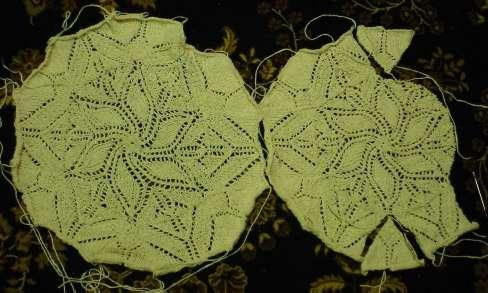
In the layout I’m using, these meta-units fit together with plain triangles inserted at the point where three meta-units meet.

I suppose I could have made just one big triangle for those spots instead of four smaller ones. That design variant will have to wait for a future blanket. In the next photo you can see how the concept above actually works:

Finally, here are some other arrangements for the same basic units. The swift will note that the one in the upper right is in fact the layout I am using:

In addition to these, the squares and triangles can also be used by themselves, or in combo. LATE UPDATE: The two layouts on the right are in fact different. While both employ entire meta-units, with plain triangles where they meet, the top one butts the meta-units up against each other by uniting the edges of the squares, the other unites the edges of the triangles. The differences are subtle, but the lines of the piece do look different if the lower right hand arrangement is made.
In terms of technique used and hints for seaming – the squares fit stitch for stitch along the edge of the hex. Due to decrease ratios, the triangles are in fact just a bit wide at the base. To eat up that extra width, I play with ease, plus I sew them in using mattress stitch. I take a slightly bigger “bite” out of the triangles’ sides than I do out of the edges of the squares to which I am sewing them. So far it has worked out well enough. Other spots where cast-on/bind-off edges meet are sewn together with whip stitch, picking up the innermost edges of the chains formed by the cast-on or bind off (or if no chain was formed, the equivalent edgemost stitch).
I do note that I’ve gone back and forth several times between working the hex, then sewing on the squares, or working the hex, then working the squares directly onto it’s live stitches. I had forgotten I had done this as I began this summer’s production, but looking at my finished blanket, I’m hard pressed to identfy the abberant sewn-on squares. I’ll go back to the knit-on method on the next meta-unit. In the mean time, I’ll just sit here in the heat and think about knitting, because at over 100-deg F indoors, it’s too hot to actually do anything more than sit in one spot and pant like a dog.
Now. Has anyone else tried the hex yet?
PATTERN – NORTH TRURO COUNTERPANE, PART 3
[Repost of material originally appearing on 2 August 2006]
As promised, here is the third unit needed to build my North Truro Counterpane. I won’t say the last, because I still intend on squaring out the sides and adding coordinated strip-knit coordinated trim. That will require some half-hexes, half-squares and the trim itself. But I’m not there yet.
Like the square, the triangle is knit flat and is quite straightforward. In addition to the patterned piece graphed below, I also make some plain triangles to fit in between the larger meta-motifs. In essence they are the triangle graph below, but without any patterning. To make them I cast on 31, then work entirely in stockinette, employing only the shaping directions shown at the ends of the right-side rows.
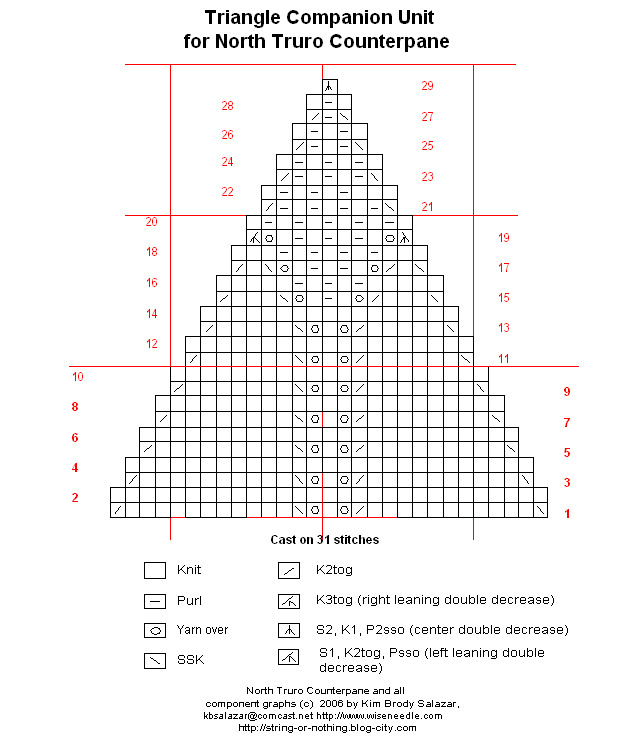
[Click on pix above for larger rendition]
I think that I might have done the patterned triangle a bit differently if I were to assay it again now. I might have eliminated the YOs and companion decreases down the center on rows 1-11. Or maybe not. I’d have to play with it to see if I liked the meta-unit (and how multiple metas fit together) after assembly without those radial spikes.
Tomorrow I’ll discuss again how these go together, and present some alternate arrangements.
PATTERN – NORTH TRURO COUNTERPANE, PART 2
[Repost of material originally appearing on 1 August 2006]
As promised, here is the square I use to build my North Truro Counterpane – the first of the companion units needed to build the thing along with yesterday’s hexes.
I could see someone making a blanket of only the squares, or only the triangles (tomorrow’s post), but I did design them to fit visually with the swirl counterpane to make up the larger star meta-motif. I like the contrast between the patterned, almost embossed central swirls and plain stockinette. The lines of the square extend and frame the swirl’s motion, spreading the design out beyond the borders of the hex itself.
The square is knit flat, back and forth on straights. I use two of my longer DPNs for all the smaller units. Since these are quick and almost never languish on the needles, don’t bother finding a pair of traditional straights with end buttons.

[Click on pix above for larger rendition]
Now, why did I go to all this trouble? For the classic reason. Why not?
I’m not a big fan of pieced quilting. I think it can be visually quite lovely, and value it as a medium for artistic expression, but I don’t enjoy manipulating all those little patches of cloth myself. I am however fascinated by simple geometry. Things like tessellations tickle my fancy. I can’t pass by a bit of interesting mosaic or brickwork without pausing to appreciate regular polyhedral tiling. Traditional Islamic non-figural ornamentation is a source of wonder to me. When I stumbled across Phillips Knitting Counterpanes I skidded to a halt and hung on every page.
Since then I’ve kept my eye open for more pieced counterpane style patterns of all levels of complexity. But I notice that very few are built on layouts beyond all squares, triangles, or hexes; or (at the most) on octagons plus small squares. I wanted to play with some of the more unusual layouts – to see if I could bend knitting around them. There are lots of ways to tile an area with simple regular polygons, and simple regular polygons are easy to knit. Why not mix squares and triangles? Or hexes, squares and triangles? Or (be still, my heart), dodecagons, hexes, and squares? North Truro is my first attempt.
I wonder what trouble i could get into if I departed the single plane, and ventured into the 3D world of polyhedra? Hmmm….
PATTERN – NORTH TRURO COUNTERPANE, PART 1
[Repost of material originally appearing on 31 July 2006]
O.K. Apparently I’m not the only crazed loon out there that’s interested in knitting something with ten thousand ends. So in response to requests, I share my North Truro Counterpane.
Please note that as a pattern, this is still in Beta stage. I have no yarn quantities, gauge estimates, or recommended needle sizes. There also may still be an error lurking in the upper right double moss area on rounds 35-43, after the centered leaf motif. I think I’ve corrected it on this version, but since I mostly work my motifs on autopilot at this point, I can’t swear that I’ve payed close enough attention to test-knitting this particular edition of my graph. If you run into oddness, remember that the double moss area on each side of the center leaf should mirror. If it looks like you’re developing a rib on row 37 or 39, invert the knits and purls after the center leaf and all will be well.
In terms of materials, I can say that I’m using a insanely inexpensive unnamed coned cotton flake yarn found in the back room at Webs. It’s soft, with some open and relaxed sections, rather than a tightly spun mercerized cotton. In terms of weight it’s probably closest to fingering, with occasional puffy bits making it hard to describe. I’m getting 16-17 wraps per inch.
For needles, I’m using 3mms. NOT US #2s, which tend to be 2.75 mm, but true European 3mm needles. I’ve got a mix of 10-inch and 8-inch long steel DPNs of that size, and am working my hexes on four, moving to seven when the number of stitches on the needles makes that more comfortable (one needle per side, plus one to knit with). Now not everyone is as DPN happy as I am, so if you prefer using one or two circs, try starting out with a set of 4 DPNs, (two hex sides per needle), and using them until the piece is large enough to make the transition practical – probably around round 23 or so.
Please remember to note the one-stitch transition on round 35. I shunt the beginning of the row one stitch to the left on that round. You should knit the first stitch of Round 35 onto the last needle of Round 34, then work around, doing that terminal K2tog on the last stitch of each repeat and the first stitch of the next one. If you’re using circs and markers, move the marker to after that K2tog. The final repeat of Round 35 will work out even – the last K2tog will combine the previous final stitch of that repeat plus that stitch you knitted and transferred at the beginning of the row.

[Click on pix above for larger rendition]
I will post the graphs for the companion square and the triangles tomorrow. The hex can be used alone or in combo with the other units. In fact, the geometry of the thing allows several possible assembly layouts I’ll write more about that later in the week.
Finally, there’s one more reason why this is just in Beta. I haven’t finished the total counterpane design yet. It is my intent to (eventually) draft out companion half hexes and half-squares, to finish the piece off as a rectangle, then trim the whole caboodle with a custom-designed edging that complements the design elements of the motifs.
Needless to say, I’m not there yet.
 String-Or-Nothing