MODULAR KNIT LOG CABIN BABY BLANKET FINISHED!
I’ve finished the baby blanket. In short, log cabin in a self striper or space dyed yarn with the strips worked sequentially around a center is an idea worth additional exploration.

Because this yarn is largely cotton with a lot of acrylic in it and very unstretchy, I won’t be blocking the thing. I’ll probably give it a quick gentle wash and pat dry just on principal (better to give a baby a clean present). I’ll doodle with a top down simple hat today. There’s only about half a skein left. I might be able to eke out a matching stockinette newborn cap with a rolled brim, to make this a home-from-hospital set.
I don’t particularly like the Batika in general. It’s not as soft as I hoped. While it’s not scratchy, I thought the result would be spongy, but the nylon binder bunches the chainette up and gives the yarn a crunchy rather than pillowy surface feel. It also breaks surprisingly easily. It’s a good thing I used the join method I did because I found that the tapestry needle’s eye broke the end strands when I was darning in. If you are going to knit with Batika, take special pains to avoid leaving ends in the middle of rows, and use a VERY large eyed needle when ending off.
In case someone else wants to duplicate my working method and play with this idea, a description of how to work the strips using long-loop joins is here, and the directions for the simple triangle edging are here.
LOG CABIN BLANKET EDGING
Moving on with the modular log cabin baby blanket, I decided to take the center square and finish it off as a rectangle, in order to end up with a more usable object. Due to yarn quantity constraints this is a small basket/car seat size blanket – not a crib size throw. It measured about 20.25″ x 31.5″ before I began adding the simple edge triangles. It’s a bit smaller than the blankets I made recently however I’m not worried. I found with my own kids that small blankets were supremely useful for traveling and naps, and were indispensable parts of the lug-around baby support kit.
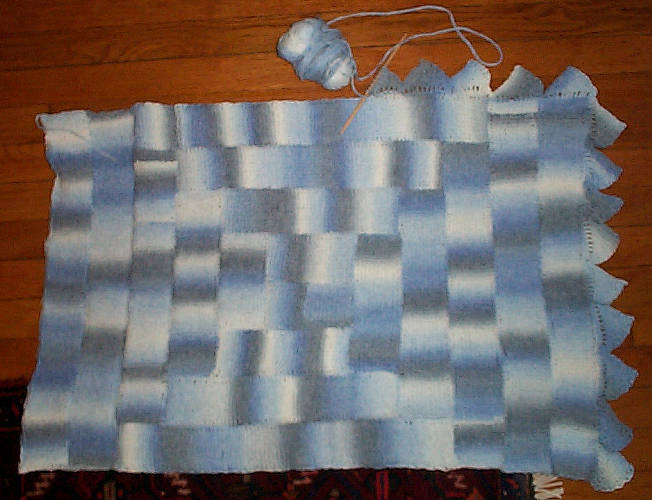
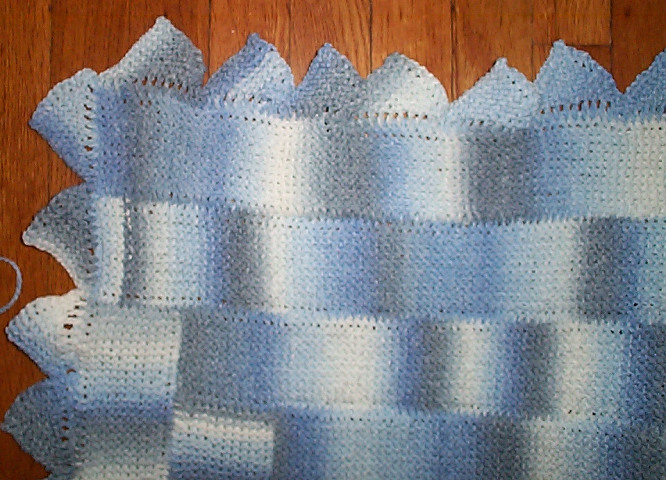
I started with 10 balls of the Batika. I’m working from the ninth right now, and will probably dip into the last one. If I have enough, I’ll make a hat to match from the last ball.
Again, the blues are a bit boring, but I really like the way the strips play with this yarn’s shading. I mixed starting at the center and the outside of my yarn balls, to magnify the helter-skelter effect. I also tried to minimize ends. I was able to join yarn throughout by taking a needle and threading the new strand through the center of this chainette for a couple of inches, then tugging the new strand until its end was completely buried in the center of the working strand.
When I worked the final two non-circumference strips at left and right, to avoid having to cut the yarn and begin again, I worked the outermost strips picking up my attachment points purlwise instead of knitwise, to keep all the “seams” on the reverse. I will have only four ends total to darn in at completion: my cast-on end, the cast-off end on the outermost strip at the left, and the end resulting from rejoining the yarn to make the two final strips on the right. I even started my edging at the bind off point for the final right-most strip, and began my edging without breaking off the yarn. Every other end is already buried.
The edging is super simple. There’s no point in doing anything fancy with the garter stitch texture and the native shading of this yarn. I used the same pull the loop through attachment method I used on all of the strips. About the only thing I did that was in the slightest bit creative was to move the increase point from the outermost stitch of my triangles to the inside attachment edge. I did this in order to keep the edges of the triangles firm and to avoid little baby finger trapping loops.
Because my blanket is made up of garter stitch strips that are 12 stitches wide by 12 ridges, I know for a fact that all of my edges will be multiples of 12. Therefore I’m working a simple edging that is also a multiple of 12. Doing so guarantees that I can avoid working complex corners or mitering. I begin and end each side at Row 1 of my edging, with one stitch on the needle. (If need be and the count of a side is off, I can fudge a stitch or two provided I spread any fudge points out and work them an inch or two before the corner). Super simple.
I’m not done with this concept. I plan to do another piece with a long-repeat yarn. Unfortunately my budget right now constrains me to work from stash for a while, so splurges on blanket quantities of Noro or other similarly demonstrative wild color yarns will have to wait.
Simple Garter Triangles Edging
Multiple of 12 rows
Cast on 1.
Row 1: With right side of your main item facing, pull a 12 inch long loop through the edge-most stitch of the item to be trimmed. Using the loop yarn turn the work over, then YO, K1. (You now have 2 stitches on the needle).
Row 2: Slip the first stitch purlwise, K1. Grab the yarn strand going back to the ball and pull the excess length of the loop to the back of the work, drawing the edging snugly up to the item to be edged, but taking care not to collapse the little “bride” (twisted threads) that will eventually form an arcade of eyelets between the main piece and the edging.
Row 3: Draw another working loop through the next stitch of the main piece. Turn the work over, YO, K2. (You now have 3 stitches on the needle)
Row 4: Slip one purlwise, K2, snug up excess loop length.
Row 5: Draw another working loop through the next stitch of the main piece. Turn the work over, YO K3. (You now have 4 stitches on the needle)
Row 6: Slip one purlwise K3, snug up excess loop length).
Continue rows 7-11 in this manner until you have 12 stitches on your needle, ending after finishing row 11.
Row 12: Bind off 11 stitches. You should have only one stitch left on your needle.
Repeat rows 1-12 as desired.
LOG CABIN BLANKET GROWTH AND CREATIVE REPURPOSING
The modular baby blanket continues to grow. To get an idea of large it is, the wooden Brittany birch DPN in the upper left is about 7.5 inches long. I’ve used approximately four balls of yarn so far. Although this yarn is rather ho-hum in its color gradients, I am really liking the effect.

Done in brighter colors, this might have an effect reminiscent of the wonderful play of narrow striping exhibited by larger Kente Cloth pieces made from many strips of narrower weaving.
The Batika yarn is turning out to be a minor annoyance. It’s one of those slipperies, put up in self-destructive puffballs. The balls implode when worked center out, and tangle when worked from the outside end. I’m doing both in order to swap around the color progression. But last night as tomatoes were sliced for dinner, I had a brainflash. The little foam nest that protected the tomato (and that can often be seen around Asian pears) can be repurposed as a yarn tamer for puffball put-ups:
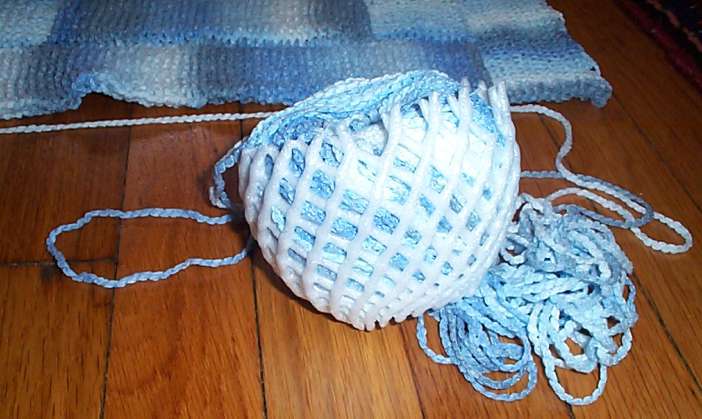
It works quite nicely for this shape yarn ball, even better than the green mesh cylinders that the wine store uses to cushion bottles if you buy more than one (which I also use to tame cylindrical pull skeins).
LOG CABIN MODULAR BLANKET WORKING METHOD AND CROCHETING ON
First, in answer to a question about how to draw up a loop, I do a normal pick-up one into one chain selvage (or bind off, or cast on) stitch, then I grab it and pull more yarn through, distending the newly made stitch until I’ve pulled a foot or more of yarn through. Once I’ve got the giant loop, I use it to knit the next two rows. When I’ve finished the two rows I grab the strand leading back to the ball and give it a firm tug to pull any left-over yarn back out of the loop, and to snick the newly knit piece up closely to the existing work. Here you see the loop being pulled through prior to knitting with it:

After much trial and error, I’ve hit on the best way to cast on for the strips in my modular knit Log Cabin Baby Blanket. (Wish I’d looked at yesterday’s comments before all that fiddling and seen Karen’s suggestion). Crocheting onto a knitting needle, like I do when I start off the waste chain for a provisional cast on, works nicely. It produces an even chain type edge, analogous to the strip’s bind off and chain selvage edges. I’ve described crocheting on before, but here’s another swag at it.
In the snap below I’ve stuck my crochet hook into the final stitch remaining after I’ve cast off the stitches on the last strip. I’m holding the working yarn BEHIND the target knitting needle, and I’m reaching OVER the needle with the crochet hook

I’m grabbing the working strand with the crochet hook and am about to pull the just-grabbed strand through the existing stitch (in effect, I’m making a crochet slip stitch).

Ignoring the errant strand of Smaller Daughter’s hair in the shot above, what we wind up with is a stitch on the knitting needle. I’ve moved the working strand to the back of the knitting needle again, and am poised to make another.
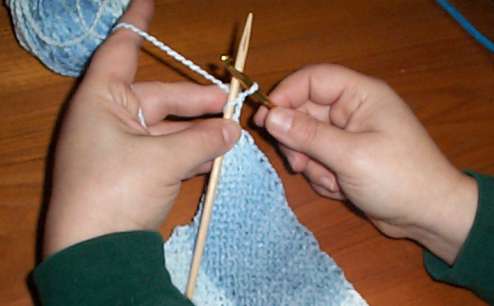
Crocheting on works especially nicely for provisional cast-ons. Instead of crocheting a long chain THEN fiddling with the bumps on the back of the chain, trying to pick them up, this method produces the chain edge and mounts the stitches in one step. It’s one of the core techniques I teach in my occasional “Crocheting for Knitters” workshop.
As you can see, my blanket is growing. According to the logic diagram, I’m in the middle of unit #7:


Finally, here’s the working method. It’s not a pattern because I am not giving yardage estimates, gauge or dimension. These log cabin blocks can be made to any size and assembled like a standard patchwork quilt, or the working logic can be used to make a larger object as a single square. For the record, I’m using Austermann Batika Color, a bulky weight yarn with a native gauge of 4 stitches per inch in stockinette, on 6mm needles. I’m getting roughly 4 stitches per inch and four garter ridges per inch in garter stitch on US #9s (5.25mm). My initial square was about 3×3 inches (roughly 7.6cm), and all my subsequent strips are about 3 inches wide.
The best way to join ends of Batkia when starting a new ball is to thread the new strand into a standard tapestry needle and stitch it through the center of the chainette for about 2 inches, like feeding an one eel to another. Once the doubled length has been knit, any flapping ends can be trimmed back without fear of raveling.
Working Method for Modular Log Cabin Square
First square:
Cast on 12 using crocheting on.
Row 1: Slip the first stitch purlwise, knit 10, k1b.
Repeat Row 1 until you form a square of garter stitch. In all probability there will be 12 chain selvage edge loops running up both sides of the square. Cast off 11. One stitch should remain. Do not break yarn.
Strips:
Using the last remaining loop, crochet on 12 stitches.
Row 1: Slip the first stitch purlwise, knit 10, k1b. Draw a loop through the first available chain selvage stitch on the previous square or strip (it will be the edge to the left of the new strip’s attachment point). Enlarge this loop until it’s big enough to knit with. Turn the work over.
Row 2: Pulling the loop tight and making sure you’re knitting with the anchored side rather than the side that runs free back to your ball of yarn, knit 11, k1b. Turn the work over.
Row 3: Slip the first stitch purlwise, knit 10, k1b.
Repeat Rows 2 and 3 until your new strip runs the whole width of your piece. The first time you do this, it will be a square of 12 stitches x 12 garter ridges. The second strip will be a rectangle of 12 stitches x 24 garter ridges and will run across the top of the first two squares.
Next row: Cast off 11. One stitch should remain. Do not break yarn.
Repeat the strip directions, always adding strips counterclockwise around the perimeter of the piece, with each strip running the full length of the available side.
ANOTHER ONE DONE, MOD KNIT BABY BLANKET METHOD
The latest fish is finished – all ended off, seamed, and eyes affixed.
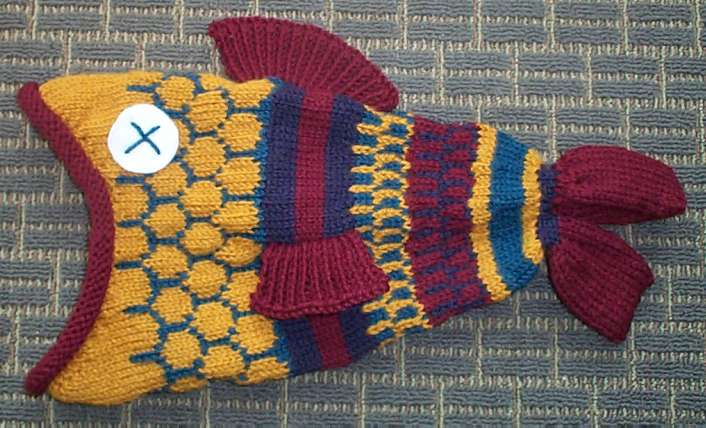
The recipient is thrilled. So am I. I usually don’t like making more than one of anything. I even hate that inevitable second sock, mitten, or sleeve. Exceptions to this are rare. I did four of these fish. It makes my short list of multiple project patterns, right up there with the Wonderful Wallaby sweater (five, for my own kids plus some nephews/nieces); the Ridged Raglan pullover (two, one for my kid and one for a niece); the Cabin Fever 1,2,3 Top Down pullover (for a work pal’s kids); plus several Kombu Scarves, and several Kureopatora’s Snake Scarves. Note to self – I should dig out a couple of the Wallabies to write about here.
The colors on the shot above are truer than the ones in my previous photo, which made the thing look particularly dark and gloomy. Blame sunlight.
On the Log Cabin Baby Blanket, I’m having fun experimenting. I ripped the whole thing out and restarted, using the long loop join I mentioned in the last post. It still makes a ridge, but a far less prominent one. Plus I’ve figured out a couple of tricks to keep all of the ridges on one side. Right now I’m playing with several cast-on methods to start each segment, looking for one that is the easiest foundation for picking up on subsequent segments. I also decided to start not with a centermost group of four squares, but with just one, more in keeping with the traditional quilt block’s geometry. I’m happy with the result, although I think I was overly generous in picking up one of my segments, and need to go back and redo it. I also think that this would be far more spectacular done in a Noro, Daikeito or other long repeat space dyed striping yarns:
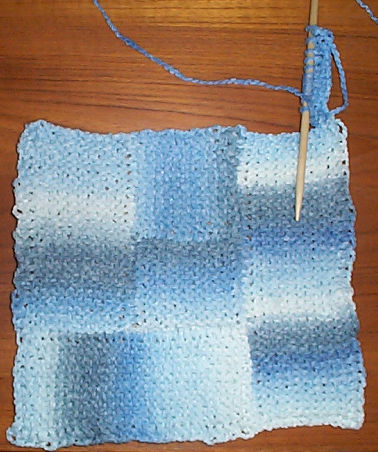
I started with the center square, then worked the one above it, followed by the peripheral strips, counterclockwise. Here you see the reverse side, photographed at an angle to make the ridges stand out:

In general, I cast on 12 stitches and knit a garter square with slip stitch edges (also known as chain selvage). I left the stitches live at the top of the original square, then cast on 12 using a standard half-hitch cast on (more on this later) and knit back to the main square body. Then I knit a second square perpendicular to the first one by pulling a long loop through the next availably body stitch from the first square, and using its yardage to work each pair of rows, At the end of each right side row when I was back at the body (as opposed to the free edge) side, I’d snick up any excess length left over in my drawn loop, and do it again.
Working the second square onto the live stitches of the first one totally eliminated the between-square ridges, BUT not every stitch on every side of every square is live. To continue around making strips joining onto the chain selvages would result in those join ridges – not as prominent as the ones formed by a k2tog or ssk join, but they’d still be there, even if I picked up only one leg of each chain. So I decided to end each square by casting off all except the one final stitch, and treating the cast-off row like a chain selvage row when picking up to knit on subsequent strips. That leaves only the cast-on edge (you can see where it is in the just-begun strip sticking out of the top of the work on the photos above). Half-hitch cast on makes a messy edge for picking up. I don’t like the way it looks. I’m playing right now with some of the knitting on variants, to see if they make a nicer foundation for drawn loop joining.
I’m not sure that I grok this well enough to explain the method better than the sketch above, but if there is interest, I’ll start taking more complete notes and consider doing a full project write-up of the Log Cabin Modular Baby Blanket here on String.
MORE STRAGGLER FISH, MODULAR BABY BLANKET
I’ve finished the knitting on the latest fish:
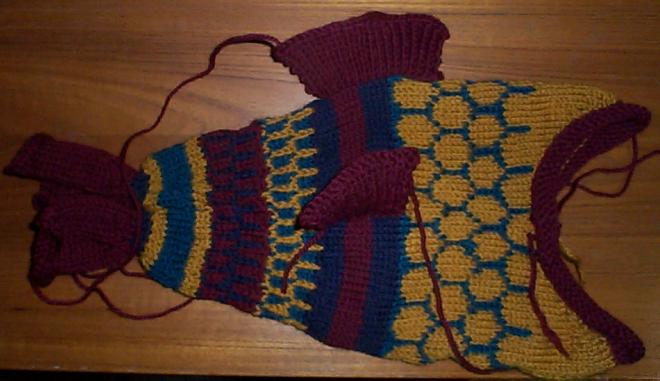
You can see that I used two of the four scale patterns from my last fish post in it, opting instead for plain stripes on the sections that were not divisible by 6 or 3. Now there’s just darning in all those ends, sewing up the tail, and placing the eyeballs. I’m holding off on final completion until I find out from the recipient whether she wants her hat dead or alive.
I also started a new project – a baby blanket worked in modular knitting, along the lines of a traditional log cabin quilt. In typical heedless style, although I’ve seen patterns and descriptions of this style of modular knitting before, I’m not working from a pattern. I’ve got the image of what it should be in my head, and am stumbling towards execution by trial and error.
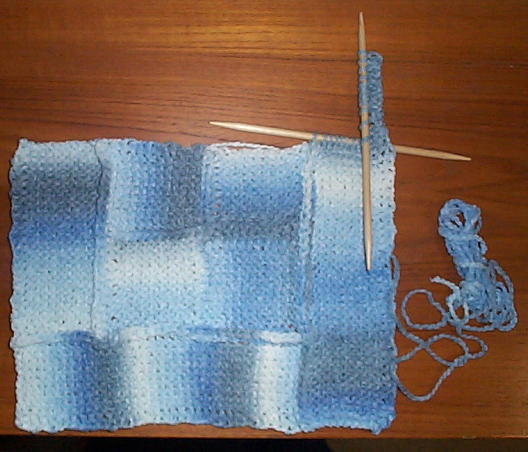
I’m working in Austermann Batika Color, a cotton/acrylic/nylon blend that came out in 2004. I got a bag of it at Wild & Woolly in Lexington at their annual mid-winter sale, for an excellent price. This is a machine wash/dry flat yarn with an interesting texture – sort of a chainette bound by a tight nylon strand. As you can see, it’s a shaded yarn. Knit normally from horizon to horizon, the grays, creams and blues would make partial row tweedy stripes. Worked in narrow 12-stitch wide bands I’m getting more of an umbral effect.
I like what’s happening with the color blending, and I like the analog to the traditional log cabin quilt block layout. I like the working method more than I thought I would. I’m not fond of the prominent seam ridges formed by using ssk to join. What you see is one night’s work, using up most of one ball of yarn. I’m thinking of ripping it all out and restarting, using a different join method. Possibly the long loop join I used in the Lightning scarf pattern. My fall-back is to do a standard throw using medallions knit out from the center, so that the color changes radiate with each medallion starting in a slightly different spot on the sequence. That would work well for this yarn, too – but would involve lots of sewing up, which I was looking forward to avoiding by using the modular technique.
STRAGGLER FISH AND QUESTIONS
Some folk have written to me privately with questions about the Fish Hats:
What yarn did you use, and at what gauge?
We used oddballs and leftovers for the set of four – all acrylic mostly given to me by a dear family friend (Hi, Jean!). She is a big fan of yard sales and flea markets, and accumulates yarns of all sorts over the course of a year, to use as packing material when she sends gifts to the kids at holiday time. Some of her yarn I knit up myself, and some I donate to charity or to schools. Not all of the yarn I used for my fish hat retained its original label, but the skeins that did included Red Heart Classic, Lion Jamie (which I used doubled), Sears Best Worsted, Caron Sayelle, Woolworth Worsted and Phentex – a regular salad of mass market acrylics.
With the exception of Jamie they’re all marked as worsted, but they’re really not. Except for Jamie they all work up (normally) at 4 stitches per inch, which makes them sort of in between bulky and light Aran weight. (Textbook worsteds knit up at 5 stitches per inch.) I did the fishes on US #7s, at the specified 4.5 stitches per inch, knitting these acrylics down in gauge somewhat. In this case the tighter gauge is acceptable, yielding a denser and stiffer and slightly more windproof hat. Also in this case – for kids’ sledding/snowboarding hats – washable acrylic is a good choice. I’ve seen how muddy play mittens and coats can get when the snow gets melty and worn down to grass. These hats can be thrown in the washer and dryer.
Did you make any mods to the Fish Hat pattern?
No. I knit it up as written, with only a couple of minor elaborations:
1. After finishing the stockinette stitch mouth, I worked one row of the head color before leaping into the Shape Mouth section. I did this so that any wraps I did would be embracing stitches of the same color. (You can see red wraps on white stitches in the pattern’s close-up of the pink-headed fish).
2. On one of the hats I did the knit the wraps trick. It made little difference in the overall appearance EXCEPT in one spot. I strongly suggest knitting the wrap along with its carrying stitch on the last two stitches wrapped – the leftmost and rightmost ones. Otherwise you get a slight gap in the row behind the fish’s grin. It’s not necessary to do the others, but working the wraps formed on rows 15 and 16 does avoid holes.
3. When picking up the fins I identified the point on the body specified in the pattern for the first stitch to be picked up, then counted down the requisite number of stitches towards the tail. I held a length of yarn the same color as the fin on the inside of the body, and using a crochet hook, picked up my stitches. Once I had enough on my needle, I joined my working yarn on the outside of the fish and finished the fin. This left four ends per fin to finish: two of the scrap yarn on the inside of the body; and two of the working yarn on the fin itself. I found that picking up towards the head rather than towards the tail was much easier.
4. When working the fins, I did them entirely in twisted ribbing (k1b, p1b) to give them a bit more body and stiffness.
5. To sew up the fins, I used mattress stitch for the vertical seam and whip stitch for the cast-off row.
Are you fished out?
Not yet. It’s a fun form, easy to play with, and faster than a sock. I’ve got a request from an adult pal for a hat. This one I’ll make out of some other all-wool leftovers. I’m pretty sure this set of remnants is Jamieson Aran weight 100% wool, bought as an experiment for a pullover that I ended up deciding not to make. I’ve only got four skeins of the stuff – these and a deep plum, but the recipient asked for no purple. Lovely stuff with great stitch definition. If these colors are not to her liking, I think I’ll keep this hat for myself.

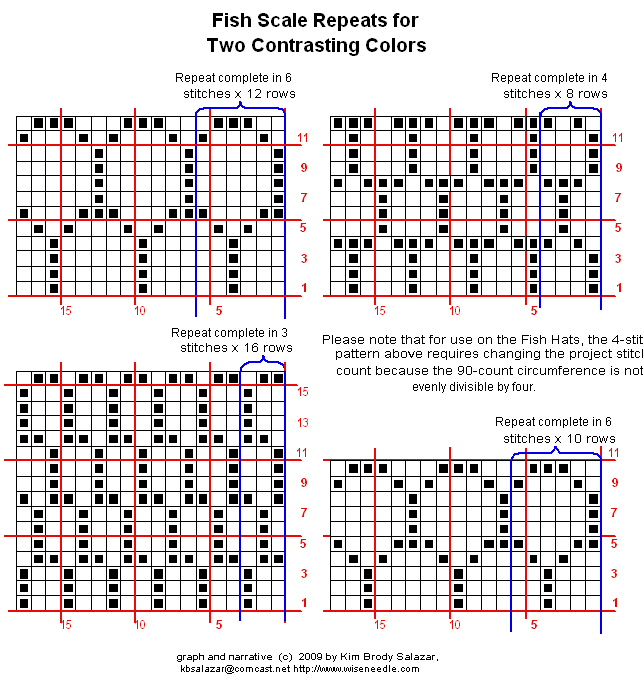
I’ve decided to rip back the small teal and gold scales shown, and restart the head section using a larger scale pattern. I’ll use a smaller scale variant closer to the tail (click on thumbnail below for full size). And yes, I use my wire Strickfingerhut for stranding at this weight, too.
Contemplating any other mods?
Possibly. It would be easy to knit on a segment of sawtooth edging instead of the picked-up and knit-out-from-the body fins. I see a shark in the future. Or if I use a lacy edging for all of the fins, end of the body blunt and add a tail of the same lacy edging, perhaps an angelfish variant. But why stop there? I’ve got a body shape now thanks to this pattern. Fantastic fins, tentacles, catfish style whiskers – all manner of body mods are possible. Perhaps I’ll end up working some sort of sea monster. But to do that, I’ll have to find someone willing to wear a (woolly) aquatic nightmare through the winter.
FINAL FISH FINISHED
Here are all four, finished and ready to swim. Elder Daughter did the one at the upper left, with the lighter orange fins and tail.

The two new ones are the dark green fish that looks something like a cross between an athletic sock and a trout, and the pastel fish, with its pattern of stranded scales. Dark green and pastel will be wriggling their way to my nephew and niece in Buffalo by Monday.
If you’re working your own fish hat and want to do stranded scales, here’s my six-stitch repeat. It fits nicely into the 90 stitches around segment of the body, and the clever can probably work it into the decreased sections as the body slims down towards the tail, which are also multiples of six. Click on the thumbnail below for the full size version.

A MESS OF FISH
Well, not a mess, actually. Some pretty good but goofy fish.


These are two fish of my manufacture and one of Elder Daughter’s. Elder Daughter made the gold face, ultra stripy hat for herself (and in the process learned a lot about darning in ends). I made the slightly less stripe one for her younger sibling (dark orange mouth and fins). We worked on them while we were visiting our Buffalo family, and in the process my niece and nephew were likewise fish-smitten. Being a soft touch, I agreed to make two more.
The half finished green/gold/white fish is for nephew Justin, he of the blanket pattern, now a middle school kid. I’ll be starting younger niece Veronica’s fish hat later today. She’s requested softer blues, greens and pastels. I’ll do my best out of my stash; but be they pastel, screaming oranges and golds, or in-your-face green, these hats are a supremely silly must-haves. At least in this family. Kudos to Thelma Egberts and her muse Jonas, Master of Fish!
HALIBUT FOR TWO, AND RED LACY SCARF
Back to knitting.
Here you see the Estonian Lace Scarf by Nancy Bush I started back over Thanksgiving. I ripped it out began again, using a US #6 for the Malabrigio Baby Merino Laceweight instead of the #4 recommended for the laceweight named in the pattern. The look and drape are both MUCH better. Although red photographs poorly, and my own lousy camera skills don’t help, in real life you can see the small nupp style bobbles, which now look like soft cranberries dotting the surface. I don’t know if I’ll be able to make this the recommended length and still have enough left over to do the specified edging. If not, it can live unedged, or with something less yarn-voracious of my own devising. Stay tuned to see how this challenge will be met.

But in the mean time I made the mistake of showing my kids the Fish Hat from the latest edition of Knitty. They’re totally smitten. Especially because they know I’ve got a pile of lurid orange and yellow acrylic sitting around, just waiting to become a pair of randomly striped ultra silly goldfish.
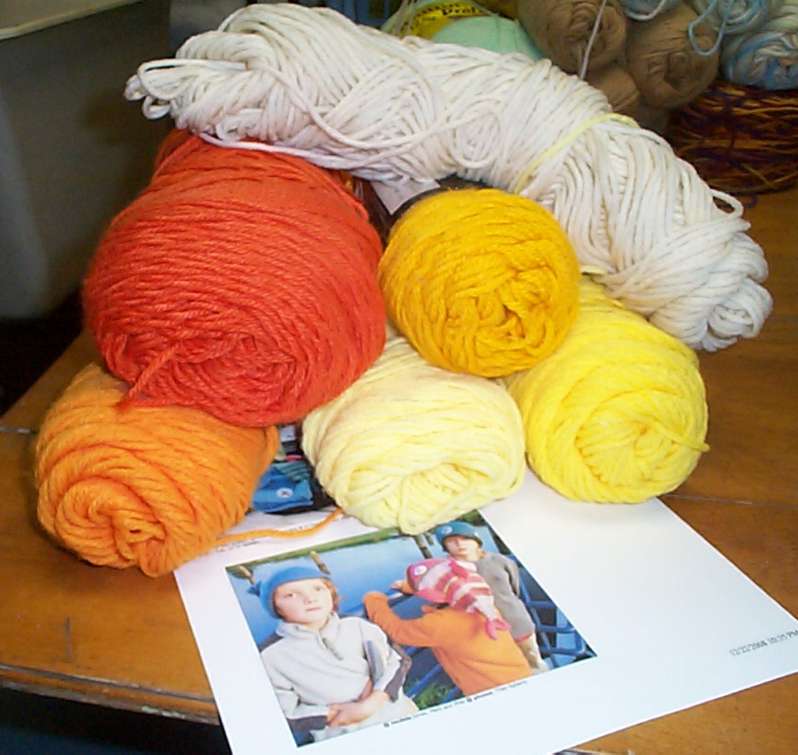
I may have to do up a couple of these over the holiday, just to keep the peace. Oh. And to enable a local rendition of the classic Fish Slapping Dance.
Finally, happy holidays to all from us here a slightly snowy Casa Magnifica, somewhere in Eastern Massachusetts.

 String-Or-Nothing
