FRAMED AGAIN
The shawl continues to grow. My center is very busy. I thought that the final piece would look nice if I used a complementing frame of a more solid appearance. After paging through lots of lacy knitting books and pattern treasuries and finding nothing that sang to me for this purpose, I decided that I needed to make up my own design for the framing phase of my gray-brown shawl (curiously gray in natural light, and tobacco under artificial light).
I came up with this (click on it to see it full size):

[LATE BREAKING NEWS: THE DIAGRAM ABOVE WAS CORRECTED ON 28 JUNE 2007]
I’ve taken the center diamonds that fill the interstices in the basketweave and framed them with an interlace two “lace bars” deep (the basketweave sports lace bar elements that are four deep. I’ve got the thing charted out alternating solid centers with the diamond centers, but I am not sure if I’ll keep that or fill all of the centers with diamonds. Also, no I didn’t make a mistake. I deliberately cut off the pointy tips of the outermost lace bar unit. I charted it out both ways, but preferred the snipped tips. I think that one tiny detail adds to the horizontal focus of the piece.
A real challenge in doing this was to come up with something that would work well both with my established stitch count (upped one to 52 per repeat to aid symmetry, with the required stitches to make the repeat count and corner picked up on one plain knit row just before commencing), and that would play nicely with a mitered corner. To do that, natural YO diagonals had to figure somewhere in the pattern, where they were (mostly) unaccompanied by a corresponding decrease. If they were coupled with a decrease, my stitch count for that round would not increase the required 8 per round needed to keep the piece flat. I’ve marked those lines in blue and green on the chart above.
By placing my mitered corners at the indicated points I minimize the need for fudging counts – almost all of the green and blue squares bear a YO anyway (those that don’t I’ll work as one on the corner-most repeat). There are a few rows that might pose problems. – 27, 31, and 35, also 61 and 55. On each of these a blue or green YO needed to form the mitered corner is paired with an immediately adjacent decrease on the “will be worked” side of the diagonal establishing the miter. I’m not quite sure what to do about them, and will experiment when I get that far. Right now I suspect that I’ll need to do a double YO at that those spots in order to maintain stitch count.
So I will continue knitting along, working my framing chart until its completion. After that I might work another row of double YO beading to finish off the section. And then comes choosing (or devising) a suitable edging.
If anyone out there has done this – designing an original lacy knitting mitered corner on the fly – and is now experiencing a forehead-thumping moment because I’ve missed something obvious, please let me know. Your input would be most appreciated!
CENTERED. SORT OF.
No, I haven’t forgotten about the ongoing projects here. I’ve been a bit buried in the usual tumult of work-related deadlines, but progress is being made.
First, on the lace shawl, I finished the center square. When that was done, I picked up stitches all the way around the edges – taking care to pick up the same number of stitches on every side, and indicating the corner points with stitch markers. Then, taking a riff from the Spider Queen, I worked two knit rows, then a purl row, a row of wide eyelets [(K2tog, YO, YO)repeat], followed by another purl row (with P1,K1 in the double eyelets) and two more rows of knit. I interrupted that patterning with a standard odd row – YO, K2, YO/even row – all knit corner centered on each corner marker. I did this not only because I like the framing look of the big eyelet bands, but also because that row is good for disguising any oddness necessary that might arise in forcing equal stitch count pick-ups along all sides.
I’ve now got four equal sides, each 153 stitches long, with clearly defined corner points. Since it’s now on one big circ, it looks vaguely snood-like:

I’ve also got another conundrum. what to do next…
As I knit the center part, I was thinking of what borders might complement it. Because the basket weave was so geometric I wanted something that had similar lines, but that added a different movement. I found this in the new Duchrow book:
At first glance I thought it was knit from edge to edge, rather than longitudinally. I based this on the mirrored center. I thought that with a little play, I could map it to my project. But closer examination of the chart shows that it’s knit strip style – the long way. That’s one problem. Even though I wanted to work this bit center out, I was willing to bend the paradigm and work this pattern along the edge.
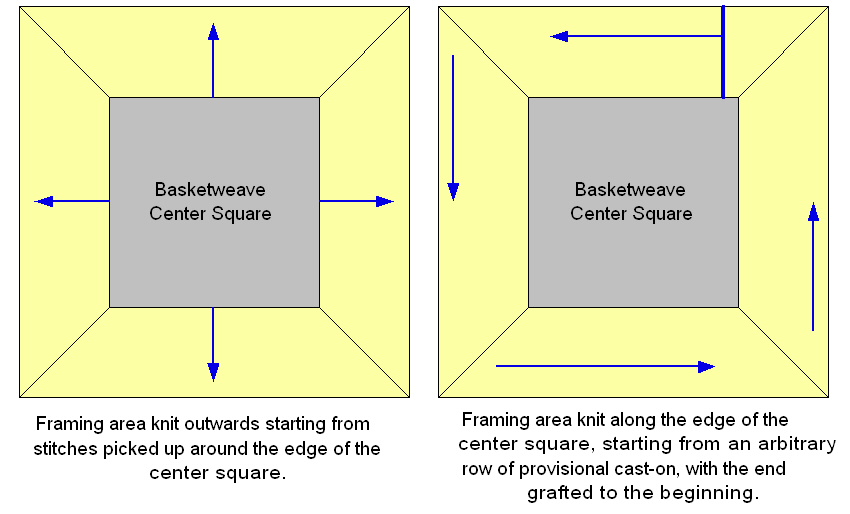
But there’s a second problem The graph offers up the repeat, plus a piece that makes the turn backs seen at the strip centerpoints (green indicator on photo above), but offers it for only one orientation – knit beginning at the center turn back and working back towards the corner. I can’t just take the graph and invert it to make that mirrored center. The spots where increases and decreases are formed are not direct cognates. For example, you can’t use a double increase in place of the K3togs that form the top points of the angles if you’re headed in the other direction. It just doesn’t look the same.
It may be that in the accompanying German there are directions on either how to get that flip, or instructions to knit eight half-strips, then sew them together at the centers and along the mitered corners (orange indicator on photo above).
So I’m back to thinking on what I can use on this next project stage, riffling through my stitch pattern and lace books. I think though I’ll end up rolling my own. I’ve played with lace and texture pattern design before. My design elements are pretty simple (four-stitch moving bars, interlaces, diamonds filling the interstices). Maybe I’ll be able to pull some of the elements from the Duchrow longitudinal piece and apply it to mine, but knit it side to side.
On the bathroom project, it’s one step forward, two steps back and recover. The crew had framed in the shower, but did it to the wrong dimensions (there would not have been enough room for the bathroom door to open next to the sink). Luckily we trust but verify, and pointed out the error in time for it to be fixed.
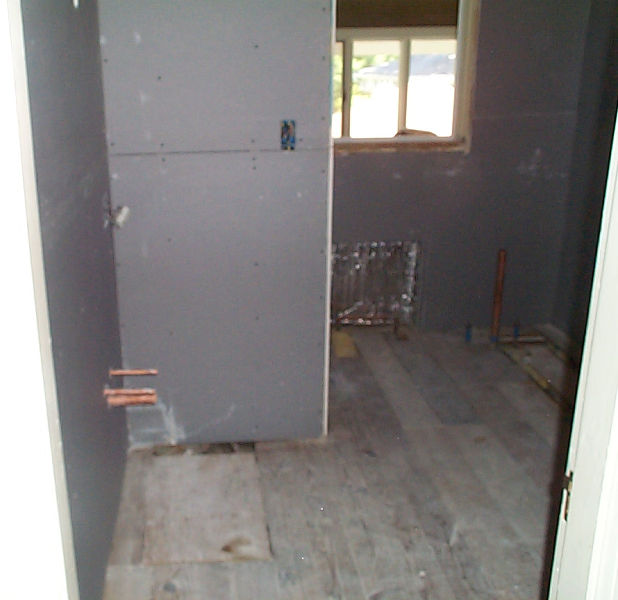
Moral of the story: I don’t care if they’re professionals. Confirm all measurements yourself as the project progresses. Ask for explanations if you note discrepancies. If the crew’s mumbles seem specious, escalate the issue to the foreman. And if answers are still mushy – to the business owner.
Next big interruption – another spate of work-related deadlines, plus a baby shower gift I didn’t realize would be needed so soon. Perhaps another Oat Couture Curlicue blanket… Stay tuned.
INCHING ALONG
Incremental progress on two fronts here at String. First, demolition is now complete. Evil Upstairs Bathroom having been stripped to the studs now finds itself at the very beginnings of build-out. The new larger shower stall has been roughed in, and the electrical work has commenced.

You can see the back side of the lath and plaster hallway walls on the outside of the old wall studs. 1912 was deep in the pre-drywall and wallboard era.
And on the lace shawl, I’m over the half-way mark in constructing the center square. I’ve got only one or two repeats left before my proportions are correct.
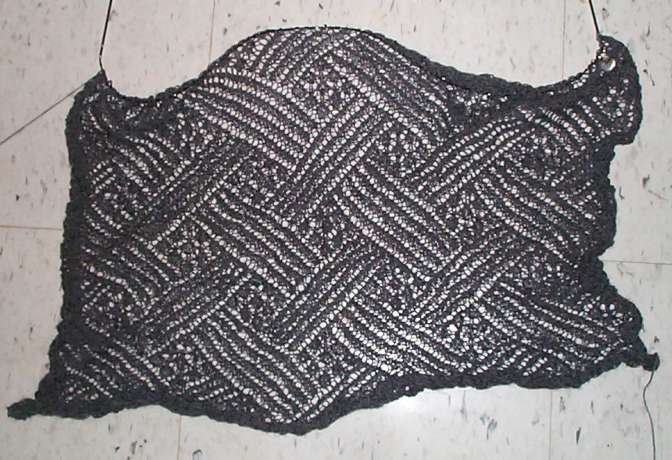
I’ve also tinkered a bit with the base pattern, translating it to modern notation and changing the directionality of some of the decreases to sharpen the lines. Since I have changed it somewhat and recharted it, I present the result. Click on the thumbnail below to load a full-size image
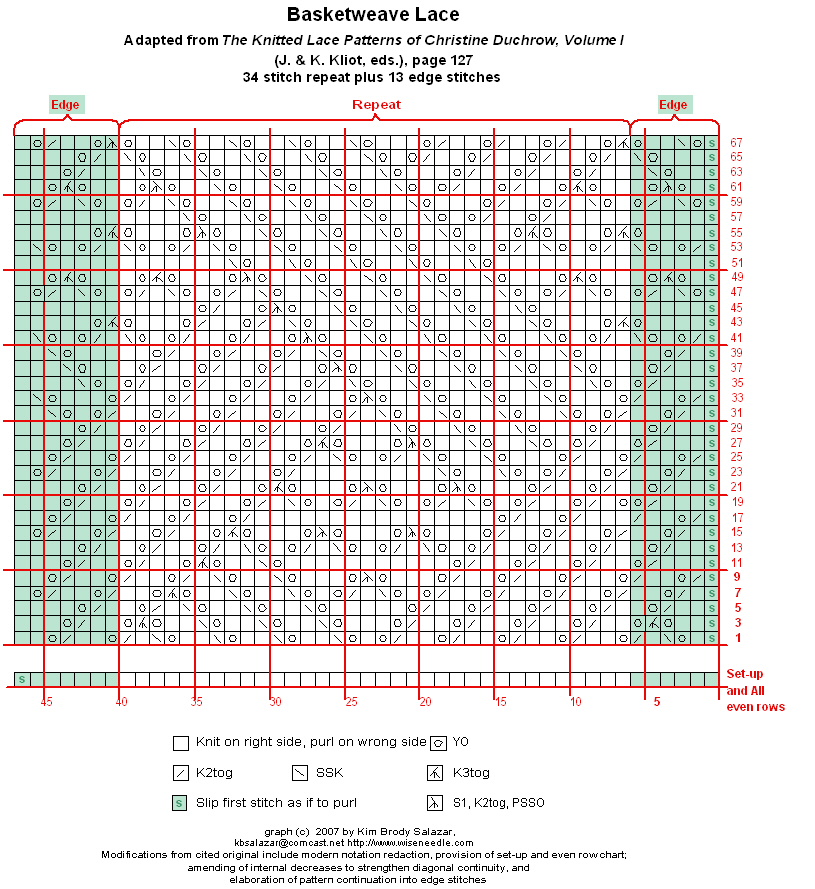
The original lacy knitting pattern from The Knitted Lace Patterns of Christine Duchrow, Vol. 1 was presented as part of two complex garment designs – a blouse and a baby bonnet. There are a couple of complementary simple band patterns for cuffs and trim on those projects. Except for the introduction (which provides a helpful translation key for the symbols and some historical German knitting terms), the entire book is in the original German. From what little knitting German I’ve picked up I can tell that even the written parts aren’t quite modern German knitting prose. Like English knitting instruction writing, the conventions in German have changed over time. While I can work from the chart to make my own whatever, it would be an extreme challenge to knit up the blouse as described.
As the editors of this book report, Duchrow was among the first to try to present knitting instructions in graphical rather than prose format. Her graphs are idiosyncratic by modern standards and use letters and symbols rather than visual representations to represent the various stitches, but with a bit of practice her graphs are not difficult to knit from. Even though I can’t read a word of the accompanying text in Vol. I, I’ve ordered a couple more books in the same Duchrow reprint series. If you’re a lace and lacy knitting fiend, you’ll probably have as much fun with Duchrow patterns as I am.
I feel confident I can share the design because I have redacted it into modern symbols, included corrections, and made changes in the pattern as presented. While my graph is recognizable as a variant of the historical one, there are subtle differences. For example, the original graph for this pattern treats all double decreases identically, rather than using directional variants to reinforce the framing diagonals. It also didn’t continue the pattern into the edge areas as uniformly. It also didn’t show the even numbered row. But for all of that, the pattern works up quite nicely even in the original presentation. I share my redaction/correction as tribute to the original author and the editors of this work, to help other knitters bridge from modern instructions to historical ones, and to encourage others to seek out these patterns and knit them without fear.
Interesting conjecture – from the style of the blouse, it would not be a stretch to say that it was current around the time my house was built. For all I know, the original owner may have sat in the library 95 years ago, knitting the same lace patterns I am working from today.
BACK FROM SAVANNAH
Back from the conference and trying to catch up, I show off my airplane knitting – the beginnings of the lace shawl I mentioned in my last post.

I’ve pinned it out somewhat so you can see the detail. The lace texture pattern is from Knitted Lace Patterns of Christine Duchrow (Vol. 1). It’s the last one in the book, and is shown as a bodice and a cap. The book itself is in German, with an idiosyncratic (but charted) notation system. Judy Gibson has posted a nice set of hints for working from Duchrow charts for people like me who don’t read German. As far as difficulty, the 34 stitch repeat – though large – is pretty easy to memorize. Once it’s established, the progression is very logical. My piece contains four full repeats plus about 14 edge stitches.
My plan is to work a square of this basketweave pattern, then pick up around the edges and work one or two tiers of patterns outward, mitered at the corner; then finish the entire thing with a knitted on edging. I haven’t chosen the next set of framing patterns yet. By the time I get there, I’ll have figured it out.
As far as the proposal conference went, it was valuable from a couple of viewpoints. First, it turns out that I know more about my subject than I thought. Second, the state of the art has moved on in the last dozen years since I went to official proposal training. I did pick up quite a bit. The next challenge will be to impose the improved structures and tools in the workplace.
In other news – my upstream No Sheep swap partner sent me some wonderful goodies (more on this in the next post), but I have not heard from my downstream receiving partner yet. If I don’t hear tell of her preferences by mid week, I’ll have to pick something out with no guidance on yarn weight or color type. I hope I guess correctly.
And finally, I celebrate another birthday that came and went while I was away at the conference. I was treated to an excellent dinner at Savannah’s Olde Pink House by a dear friend, but also to celebrate, I just ordered myself three more books on lace knitting. Happy birthday, me!

COLONIALS INVADE
Life continues to intrude on my knitting time. Besides the regular flock of work-related obligations last week, I was surprised by Smaller Daughter. Thursday morning, rummaging in her backpack looking for her lunchbox, I found a notice for her elementary school’s Colonial Day. It’s an interactive festival sort of day, but one that requires all of the kids to dress in some attempt at a historical costume. (To be fair, I had heard about it long ago but forgotten.) So with a costume needed within 7 days, but my being away on a business trip starting Monday, my Memorial day weekend activities now included a close huddle with my ancient Elna sewing machine.
I wanted to make something relatively early – closer to first encounter than the Revolutionary War so that target child had a chance of wearing her outfit again. I pelted over to the fabric store during lunch hour on Friday and picked up a couple of remnants – 2.75 yards of a soft green twill whatever (plus matching thread), and one yard of a linen-look in white, all for about $10.00. The price was right.
Then I came home and thought about what to make. I had already made her a puffy white pirate shirt that could double as a chemise, and I have a small white cap and coif set. A skirt, a bodice of some sort, plus an apron would be enough. Drawstring skirts are easy enough, but the bodice part was tougher. Front lacing (instead of buttons) would do. Thankfully the topography of an 8-year old is easier to accommodate than that of a post-pubescent. I took measurements and drafted out a simple tab-bottom bodice with short sleeves. To make it substantial enough, I cut two of everything, so that the whole thing is self-lined. Here are the resulting pattern pieces, snipped from Red Sox coverage in the Boston Globe, plus all of the pieces sewn and assembled into the final bodice/jacket.
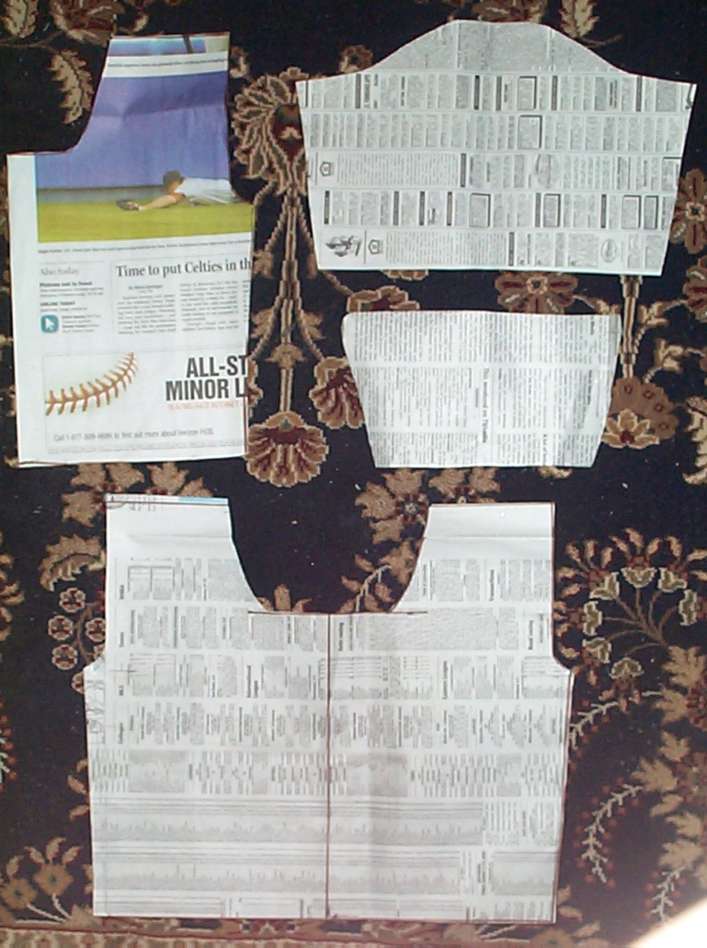
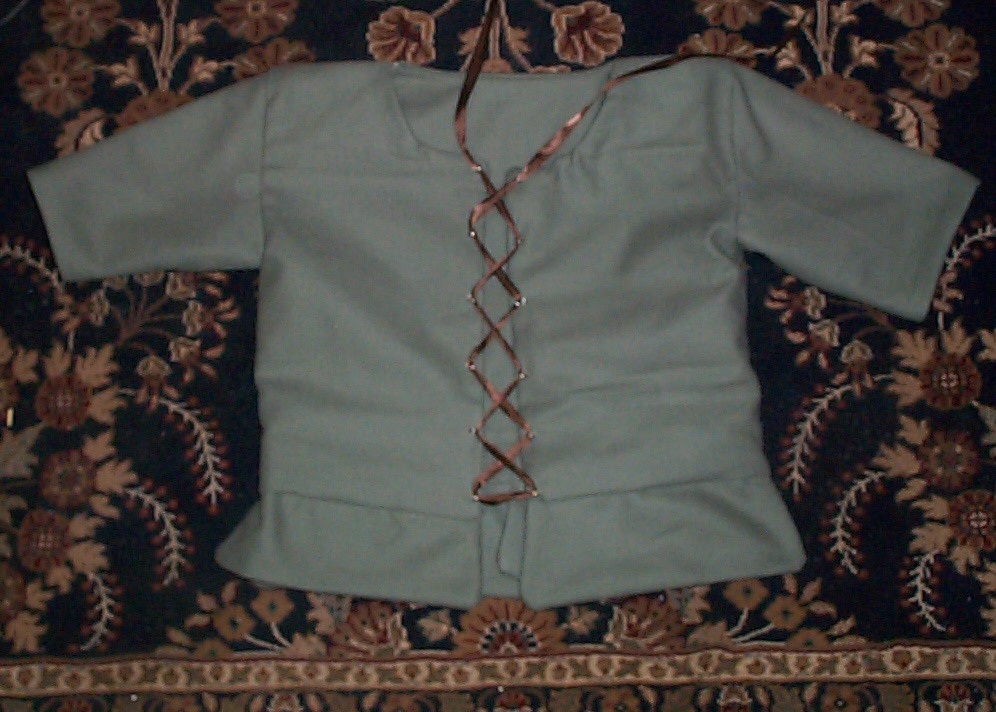
Things went pretty smoothly. I started by sewing the shoulder seams of the outer and inner shells, then uniting them along the neckline by sewing them together up the center front closure and around the neck. Then I sewed the side seams of the inner and outer shell, inverted the inner lining and pressed everything flat. The sleeves went together quickly, too. I sewed the inner and outer sleeve along the bottom edge, then did the underarm seam for the united unit all at once. I inverted the inner linings and pressed my sleeves. Once the sleeves were together, I set them in the bodice. Then I sewed together the inner and outer side of the tabs (that odd shaped piece below the sleeve) – making one for each quadrant of the garment. I turned them inside out and seamed them to the bottom edge of the outer shell. Last, I folded the inner shell’s lower edge down to cover the raw edges of the tabs, and hemstitched it down by hand (too may layers for my sewing machine to cope with).
Since I didn’t have much time, I didn’t go with a zillion buttons or hand-made lacing holes. There’s little if any tension on a little girl’s bodice, so I didn’t bother with reinforcing the lacing edge. I opted for the not very historical but really quick stage option – small rings sewn along the lacing edge to hold the fastening ribbon. Sacrificing a dozen split rings, formerly in use as place markers for lace knitting, I stitched them down by hand.
The apron was also easy. I cut two strips off the top of my yardage and lapping them end to end, pressed the seam lines for the apron’s band and strings. Then I sewed the edges of the remaining piece (again doing it double-sided for additional body), gathered the raw edge and encapsulated it in the center of the apron. Time from taking the first measurements to final hemming – approximately 16 hours of work.
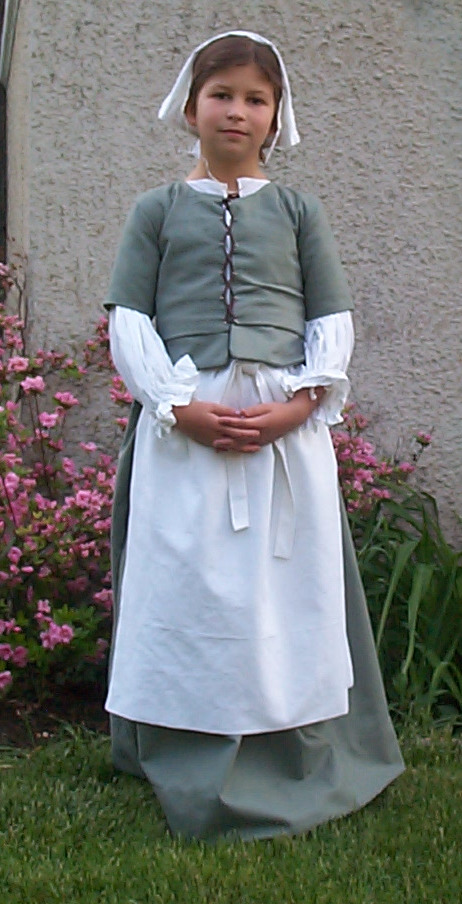
Here’s the end result: one semi-historical kid-suit, inspiration from the 1620s. And yes, Target Child did help, learning how to use the sewing machine and working it for long, straight seams, tracing the pattern pieces with chalk, and doing a bit of the hand-work.
Knitting? I finished my vintage lace scarf. Blocking was postponed on account of Colonial Day.
VINTAGE LACE SCARF; ATTACHING LACY EDGINGS
Where have I been? Well, first there was another spate of chaos deadlines at work. Then it was the beginning of Birthday Week here in the String household (they’re 7 years and four days apart, with mine shortly thereafter). And to no one’s surprise, I came down with a nasty flu. I’m not yet over that, but it was severe enough for me to stay home from work – something I’ve done only once or twice in the last decade.
For her birthday Smaller Daughter specified a volcano cake with a dragon on it. She’d seen something like this in a kiddie cookbook – a bundt with a lava-like frosting poured on, surmounted by some clever marzipan decorations. So we made it a group project. I provided the almond bundt with chocolate fudge filling and frosting; Older Daughter molded the marzipan dragon with dried apricot wings; and Smaller Daughter made the strange red prey creatures fleeing from the dragon:
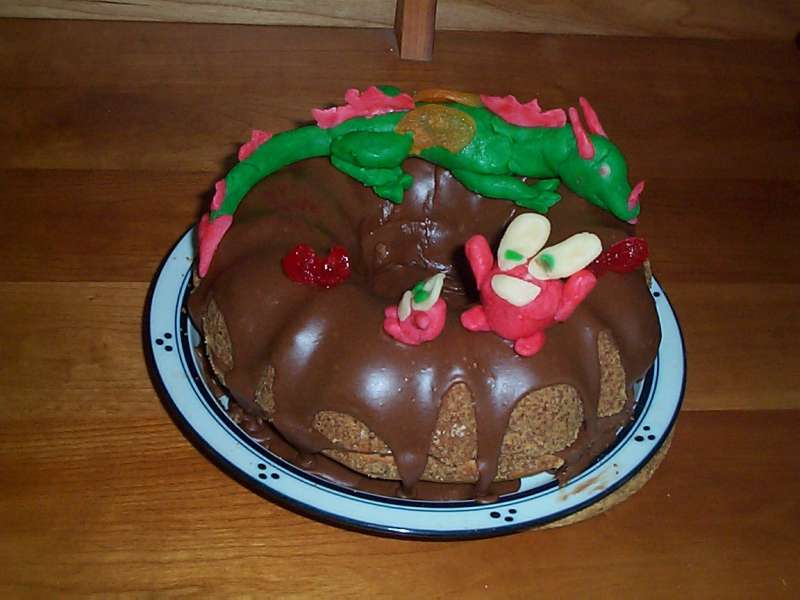
We were hard pressed to find enough room for the obligatory birthday candles. The cake and decorations however were delicious.
I did manage to make some progress on the lace scarf over the last week. I’ve finished the center section, and am working on the edging. It looks like I’ll have to nip into my third skein of Prescott, so I’m thinking of pausing on the edging to go back and add some length to the center section before lapping all the way around that last end. I’m not doing anything fancy here – no mitered corners. I’m just working an extra repeat of the pattern into the cornermost stitch, and hoping that all blocks out evenly later.
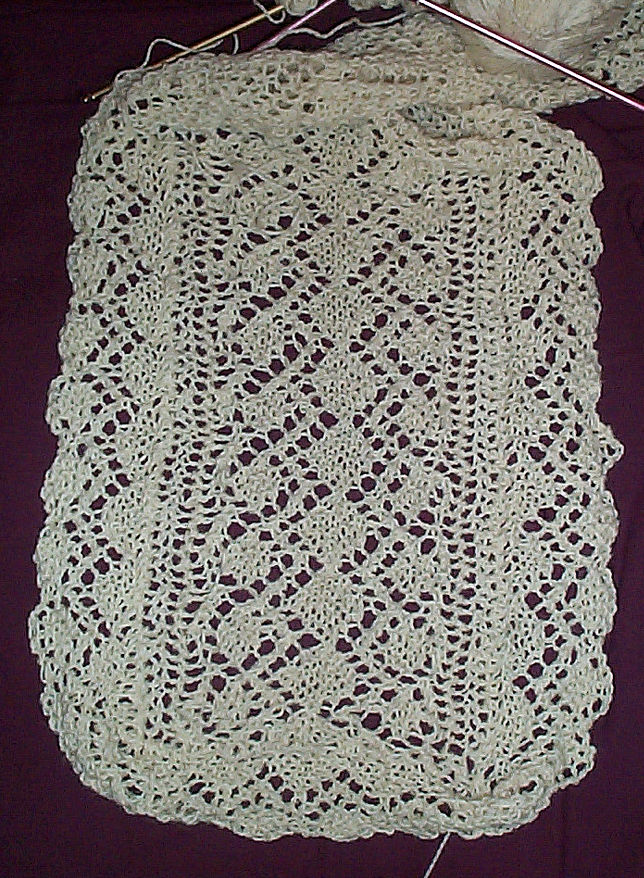
UPDATE: THE LACY EDGING BELOW IS NOW AVAILABLE AS A SINGLE PATTERN DOWNLOAD UNDER THE KNITTING PATTERNS LINK, ABOVE.
I played with quite a few edging patterns for this piece, finally settling on the “Doris Edging” from Miller’s Heirloom Lace. It has framed diamonds that exactly complement the center strip. Along the way I noodled up another simple triangle-based edging. This is an out-take, and didn’t end up on the scarf. I won’t violate copyright by sharing Miller’s edging (which I used more or less verbatim), but I will share this one:
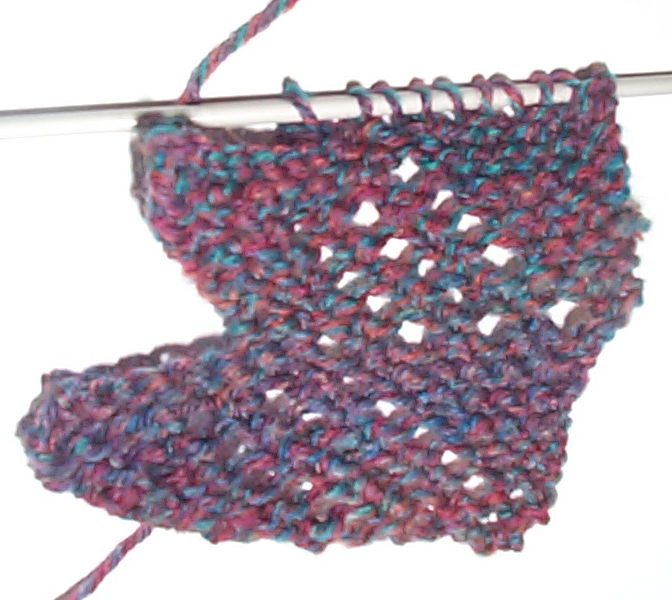

Knitting an edging onto a piece isn’t difficult. It helps if your base item was worked with a slip stitch selvage edge, but that’s not mandatory. I’ve knit edgings onto all sorts of things, including finished fulled/felted items, fabric, and leather (some caveats on this, below). The slip stitch selvage just makes it easier. Your chosen trim will have one edge intended to hang free. Most often that will be dagged, serrated, scalloped or otherwise fancified. It will also have one (more or less) straight edge. This straight edge is intended to be sewn or knit onto something else. I like to work in the orientation shown in the knit sample and pattern, above – with my straight edge on the right, and the fancy edge on the left. My right-side rows commence from my main piece outward, and my wrong-side rows return from the fancy edge back to the main piece.
Sometimes I use a provisional cast-on and start my lace rows immediately after it. Other times I use a half hitch cast on, then work one row back in knits before starting my lace patterns. There’s no real rhyme or reason here. It’s just what I felt like doing at the time. In this case, I cast on using half-hitch, and worked a row of knits back, working my first join on that “back from cast-on” non-repeated row. The join itself is quite simple. When I get to the last stitch of my wrong side row, I pick up one stitch in the edge of my established body piece. Then, for the first stitch of my right-side lace row, I either knit or purl that newly created stitch along with the next stitch after it on my needle.
If I knit those two together I end up with a neat column of stitches that makes a visual line between the lace edge and the main body. While this can be desirable in some cases, it does present a different appearance on the front and reverse of the work. Because the lace center of this piece is garter, and the edging is also presented in garter, I used a P2tog to make the join. The front and back of the work look less different from each other if I purl the join instead of knit it. Once the join is made, I work out the remainder of my right-side lacy row, and the return row. So long as I remember to pick up one stitch at the end of every wrong-side/return row, then work that stitch together with the next one as I begin the right side row, my edging will be firmly united with my main body.
Sometimes you don’t want to do a row-for-row join. Occasionally the stretch of the lace edging or the ratio of the edging rows to body rows isn’t 1:1. This might happen if you are working the edging on smaller needles; or if you are working the edging across a row of live stitches (or across the top or bottom cast-on or bound-off edge) rather than along the “long side” of the work, parallel to the main body’s knitting. In that case you may need to either work additional non-attached lace rows every so often, or pick up at the end of the wrong-side/return rows by knitting two body stitches together, again every so often. The former adds more length to the lace, the latter subtracts width from the body. Which method is used depends on the stretch of the body.
The biggest caveat in attaching knitting by knitting on rather than by seaming is that if you do so, the lace is no longer “portable.” Let’s say in a fit of Suzy Homemaker frenzy, you edged out a set of exquisite hand towels. It’s now some years later, and your children have stained those towels beyond recognition, but the edging still looked good. If you had knit the edging separately and seamed it on it would be very easy to remove and re-apply to new towels. But even if you had run a band of slip stitch crochet down the edge of the towel to provide an easy edge for attachment first, if you had knit that edging onto the towel, removing the fancy lace from the towel will be …problematic.
As far as knitting onto fabric, fulled material or leather – it CAN be done. If the edge can be pierced by a needle tip (or was conveniently punched beforehand), you can knit right onto the edge of anything. BUT the warning about not being able to take the lace off again or adjust it later is strongly in effect. If you want to attach a lace edging to any of these substrates, it’s worth it to work one row of slip stitch or single crochet along the item first, then knit (or seam) your knitted edging onto that crocheted foundation row. The foundation row of crochet gives you a stable, evenly placed line of stitches for the joins, and stabilizes the base item’s edge somewhat. It also (in the case of leather) makes working into previously punched holes easier (a crochet hook is much easier to thread through and grab a strand than is a knitting needle’s tip). Plus, if you think the item being trimmed might shrink, consider seaming rather than knitting on so you can make adjustments later.
So. If you plan on using a lace edging again on another item, or you think your base item might shrink – take the time to seam (collars, cuffs, bed or bath linens). If the edging will remain on that piece, living and dying with the item that bears it – consider knitting on instead (knit counterpanes, scarves). To illustrate this post I wish I still had the denim jacket I trimmed out in knitted lace, or the baseball jacket that used strips of recycled fur interposed with white Aran style heavy cables…
In any case, back to sniffling and a nice lie-down.
CHARTING 107 – WORKING FROM ANTIQUE KNITTING PATTERNS
Apparently my post on knitting patterns from books published prior to 1920 or so has struck a chord. I’ve gotten a couple of requests on how to go about translating these older knitting patterns to modern notation. I did a six part section on how to graph up patterns from written notation before (Charting 101, 102, 103, 104, 105 and 106 ), so this sort of follows as optional post-lesson workshop.
This time I’ll start with a web-available pattern. K. Harris at Vintage Connection has posted a transcription of a knitted insertion pattern that first appeared in The Delineator magazine, in June 1896. I’ll be producing a modern notation graph for that lace panel. Before we begin, it’s worth noting some common features of turn-of-the-century knitting. Not every technique known today was widely used, and terms varied a bit – even more widely than they do now. I’ll try to cover some of the most common notations.
Knit and purl – k, p
Not much difference. Basic knits and purls were pretty much as we know them. There were however a couple of associated usages that are less common today. Knit plain usually meant work in knit stitch only. One complication – it follows then that for things knit in the round knit plain came to mean “work in stockinette.” Occasionally by extension knit plain was used to indicate stockinette done in the flat rather than in the round, even though intervening rows of purl by necessity exist. I’ve also seen it used very infrequently to mean “continue working in established pattern,” but that’s rare. More often the term work even was used in that context.
Another alternate usage – purls were sometimes referred to by the term seam, as in the instruction “knit two, seam two” to produce k2 p2 rib. This is probably a hold-over from early sock making, in which a column of purls on the back of the leg was used in imitation of a seam line.
Narrow – n, k. 2t, t,
The modern equivalent of narrow is K2tog – the standard right leaning decrease. Sometimes this is written up as K2, with the “tog” part of K2tog being left out entirely. Older patterns did not use SSK. Occasionally they call out a SSK equivalent of “slip one, knit one, pass slip stitch over” (see below) but most often they don’t bother with a left leaning decrease, and use K2tog, even when the cognate would be visually more balanced or appealing. Close inspection of accompanying illustrations reveals that the knitters did employ K2tog for almost all decreases. Less frequently this decrease is referred to as together (t) or knit 2 together (k. 2t.).
One unusual notation on narrow – a couple of patterns I’ve seen use n followed by the note “by slipping the needle through the back of the stitches.” This does sound a bit like a proto-SSK. But unless otherwise modified or explained, it’s pretty safe to assume that any n means k2tog.
Slip – s
Another movement that’s pretty standard. Unless otherwise modified, slip in historical context means slip purlwise – transferring the stitch from the left to the right hand needle without changing its orientation.
Slip and bind off – sb, sbo, sl&b,
Another historical way of referring to the left leaning decrease or SSK equivalent, this refers to the s1-k1-psso unit.
Over – o, th, w, tho, th. o,
Yarn overs or eyelet producing increases – still a source of multiple terms today – have even more names if you go back through time. I’ve seen YO referred to as over (o), throw (th), throw over needle (tho or thn) eyelet (e), widen (w), make (m), put over (po), yarn on needle aka yarn over needle (yon), wool round needle (wo, wrn, won).
Special note on double YOs. Most of the time modern patterns use a multiple-unit YO if a really big eyelet is needed. But in historical patterns when YOs were used to make columns of fagot-stitch lace, it was common for the YO that formed them to be specified as a double yarn over, probably because of the yarn manipulation used to create them needed to allow for a subsequent p2tog. If a pattern with fagoting calls for a double yarn over but the stitch count on the subsequent row doesn’t account for the additional new stitch (or doesn’t mention dropping it), it’s a good indication that a modern redaction will call for only one YO and not two.
Make – m
This can be problematic. It’s on the previous list as a euphemism for YO, but it is also used in historical patterns for invisible increases – where an additional stitch is added without creating the eyelet hole formed by a YO. Modern “make” is usually interpreted as a raised bar increase, although other forms of adding a stitch like knitting into a stitch on the row below are also sometimes used. A bit of close examination of any illustrations or even experimentation may be called for here. The term made stitch is also sometimes used to indicate the new stitch formed by a YO in a previous row – especially when more than one YO created multiple adjacent loops on the needle.
Purl two together – p. 2 t., p2to, pto
Purl two together was a very common instruction, especially when columns of fagoting style lacy knitting were used.
Crossed knit – c, t, b, tw
Crossed knits are modern twisted knit stitches, produced by knitting into the back of a stitch (ktbl). I haven’t seen a historical pattern that includes a purl through the back of the loop (ptbl), but that doesn’t mean that one doesn’t exist.
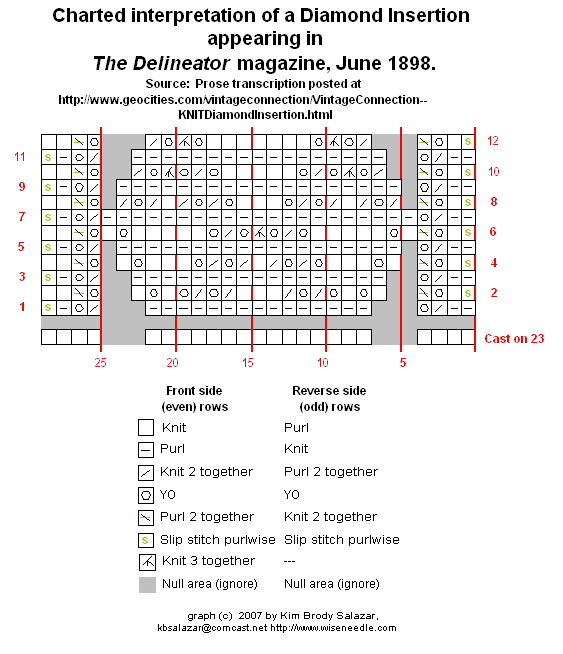
Now with all this set out, I can graph up the diamond insertion from the Delineator. It starts out with a cast-on of 23 stitches. It includes double YOs, but all double YOs are followed by p2tog units, producing the columns of fagoting in either side of the center design. I’ll show the progression from as-described rows through modern notation.
First, as written, preserving the double YOs; without flipping the wrong-side rows in accordance with the modern charting convention of showing the work as it appears on the front (public) side; and without centering the rows or norming the chart to have parallel edges we get this: (click on images below for larger versions):

We quickly see that stitch counts vary from row to row, although the pattern is more or less internally proofed because wrong side rows do contain the same number of stitches as the right side rows that preceded them. We also see that the double YO followed by P2tog problem is here. Were those YOs to each be “real” each following wrong side row would need to be two stitches longer, and the lacy effect would not be achieved.
Other features of this pattern are pretty straightforward. YOs are YOs, whether they appear on the front or reverse side rows. The K3tog unit only shows up on front (even) side rows. P2tog when seen from the back is a plain old k2tog, so that’s also easy to flip.
So. Norming the presentation so that wrong-side rows are shown using the correct right-side row equivalent symbol, and isolating the side columns of fagot stitch, and consolidating the YOs we get:
I’ve gone through all of this not only for the fun of sharing, but also because I am using this particular pattern to knit up a new quick lace scarf. I’ll edge the thing out with something complementary, but for now, here’s how it looks:

Knit somewhat overscale in Swift River Prescott on US #8s, one panel of this lacy pattern is perfect for a scarf – curl-free and totally reversible!
TAMING WILD SOCK YARNS AND USING UP LEFTOVERS
Self stripers, multi-ply color twist yarns, and hand-dyed yarns are lots of fun. There’s a ton of color there to enjoy. But sometimes a vast and unbroken expanse of color play can be boring or can produce some oddly pooled or cluttered results that look nowhere as nice as the yarn did in the skein. That’s why I like to fool around with multicolor yarns, trying to find a way that they play best, or are shown to better advantage. Sometimes it’s not easy (regular readers here know of at least two of my multicolor yarn experiments have landed in the limbo of my Chest of Knitting Horrorstm over the past couple years. But sometimes it is easy.
I finished up a pair of socks as a “chaser” after the vest was done. I used a stash-aged 50g ball of Stahl Wolle Socka Color, in a multistrand twist of maroon, pine, blue, and marigold – #9140, plus another well-aged 50g ball of Patons Kroy Socks in hunter green – #409. While the colors aren’t exact matches, they are close enough to complement each other. Both of these were found in last-ball sales, but several years and many miles apart. Since I need around 80-90g of most fingering weight sock yarns to make a pair, between the two bargain basement balls I had enough to finish and still have leftovers – provided I used more or less equal amounts of each.
My solution was to work heels, toes, and ribbing, plus about a little under a third of the sock’s body in my solid green, plus the remainder in the multicolor. I used very simple seven-row striping repeat, working five rows of multi, and then two rows of solid green (2/7 = about 28% of my sock’s body). I like how the multi is visually broken by the bands of solid green. The end result has at once more contrast and more subtlety than working the whole sock from multi alone, even if I still did contrasting color toes, heels and ribbing.
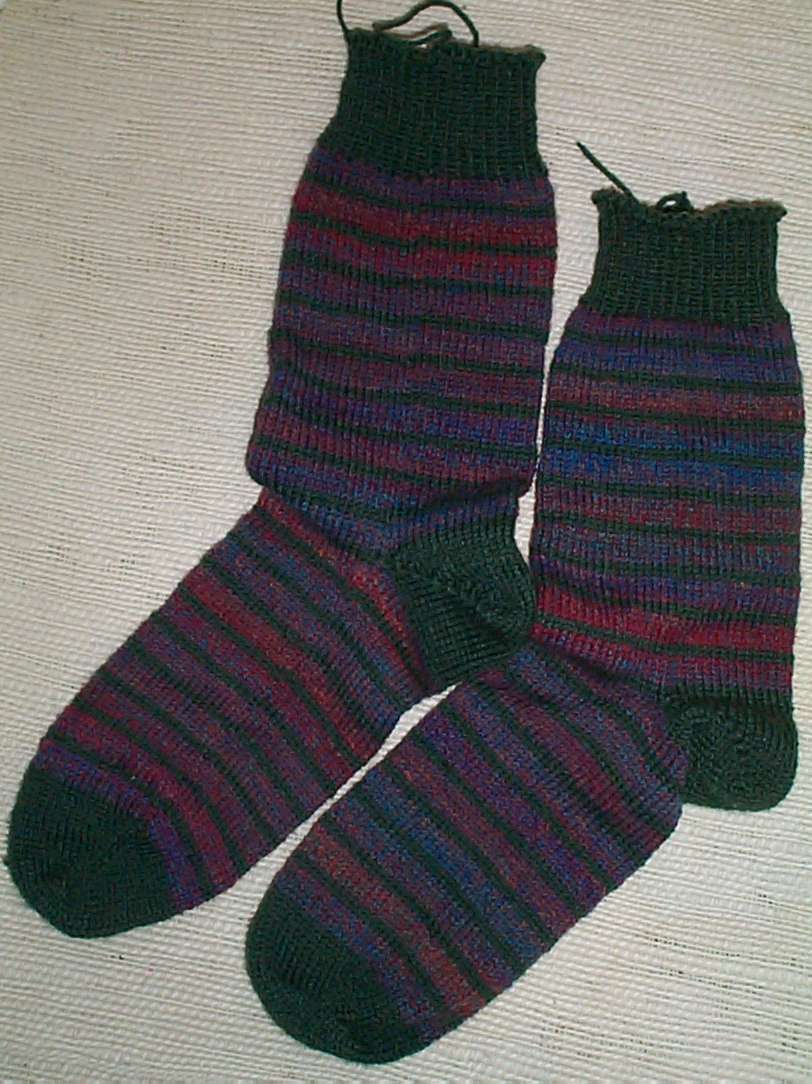
Of course the other advantage of working simple stripes on socks is to idiot-proof achieving two socks of identical size. It’s very easy to count five row units and two row units. When I had completed ten muticolored stripes, it was time to start the heel, which is much easier than having to count every row or trust in doing a measured or eyeballed estimation of foot length.
So. If you find yourself with odd lots of sock yarn, don’t despair. 100g of fingering weight sock yarn knitting is ample for most socks up to around men’s US shoe size 10.5 or so (slightly smaller if yarn-eating textures are used). You can either work color block style, using up one leftover and then another, or you can stripe. But how wide to make the stripes?
Heels, toes, and ribbing in my standard short-rowed heel sock consume about 25g (a conservative estimate). I have large and wide feet for a fem, so if you are knitting for yourself chances are that you use roughly what I do or less. Weigh it out and set it aside. Then weigh the rest of your leftovers. If you have (for example) 40g of blue, 20g of yellow and 20g of green, you’ve got a ratio of 2:1:1. If you worked a stripe repeat conforming to that ratio (let’s say two rows of blue, two rows of yellow, two rows of blue, two rows of green), you should have enough of each color to complete the pair.
Obviously, I had enough and did complete my pair. And I did have leftovers. As expected, I had a bit more of the multi left than I did the green, because my heels, toes, and narrow green stripes added up to about 60% of total yarn consumption.
KHAKI VEST – DONE
After some dithering back and forth, ripping back the front placket and reknitting it, I present my re-worked and adapted khaki vest, mid-block:

The color variation is due to some parts still being wetter than others. I’ve used US size 1 14-inch straights as blocking wires for the vest’s points. Thanks to the texture pattern I’ve used, plus the edging, they don’t really curl, but I did want them to start life as straight as possible.
As far as the interminable edging goes – it wasn’t that bad. I knit it on as described before, then seamed down the free facing edge on the back. I did end up making the extra wide, double thick buttonhole bands, and I did end up working the entire buttonhole band/neck edge in one pass – shaping it with decreases on both sides to match. And I did end up using the Neatby Magic Buttonhole in my double-thick placket.
Why did I go back to the heavy placket when I had whined about it before? Mostly because the vest didn’t fit as well without it. The heaviness seems to act a bit like a stomacher in a 1600s gown. It lends stability and structure to the center of the piece and prevents Dread Buttonhole Stretch, even when worn (that gap-itis that happens when buttoned knitting stretches into scallops around the buttons.) I did go back and readjust the ratio of picking up and knitting, which did help a bit. So did the final seaming, which squished the placket flat (I may still go back and steam this edge to make it even more flat).
On the buttonholes – I am not comfortable explaining in detail the Magic Buttonhole working method in detail. It’s unique and it’s Lucy’s, available in her leaflets and workshops, and in the Fall 2004 issue of InkKnitters. But I will say that her method is pretzel-clever, and much easier to work than it looks. There’s a very simple logic to it, and the stitches to be grafted and the direction for each stitch to be taken are all very clearly laid out. I did do one minor modification – instead of working this buttonhole on a placket that was picked up and knit out perpendicular to the direction of the body piece’s knitting, I worked it on a band that was knit in the same direction as the main piece. The perpendicular way is a bit easier to achieve because of the side-by-side alignment of the two buttonhole-to-be strips of scrap yarn, but with a bit of patience and fiddling doing it the other way is perfectly achievable.

Finally, for those of you who asked – the kids and I had fun at the Gore Place Sheepshearing Festival this year. But it does seem to be headed away from its sheep and yarn focus a bit. There are still both hand snip and electric clipper shearers, and there’s still a sheep dog demo; but the spinning and weaving demo tent formerly staffed by the Boston area spinners and dyers guild was missing – a big loss. Also, there was only one sparsely populated wool/yarn/spinning vendors’ tent – down from two in years past. It’s possible that the threat of really bad weather kept away some of the yarn people, but I see far less foot traffic through the yarn tent than in years past. It’s possible that low sales are the root cause of the lack of vendors.
Still, in spite of low yarn availability, we did enjoy the day and I did find some nice things to buy. First, I got a couple more skeins of Nicks Meadow Farm rustic Maine style heavy worsted/Aran, this time in barn red. He was also selling a softer Merino this year, but I got the older yarn to eke out some leftovers from previous purchases.
I also got a few skeins of a small producer’s yarn that’s new to me. Swift River Farm was showing Shetland and Shetland-silk blends. They offer both off-the-sheep undyed yarn colors, and dyed yarns. I got some of their Prescott, a fingering-weight 95% Shetland/5% silk in a natural unbleached white. Prescott is labeled with a gauge of 32-35 stitches over 4 inches on US #3 or #4. It’s a lofty two-ply in that pleasing Shetland texture, but a bit softer due to the silk. My guess is that it could be knit down to 8 to 9 spi, but that it would also look good at 6.5 to 7 spi. Of course gauge swatching is called for here since without it all I can do is guess. I’m leaning towards using it to make one or two lacy scarves as holiday gifts, along the lines of the Spring Lightning scarf I did a couple of years back. But playing with different lacy patterns for both the center and the edging.
I’m not sure what I will be knitting next alongside the Galaga hat (which also progresses). In the mean time, my “upstairs knitting” has been finishing off a couple of pairs of started but not yet completed socks – each pair begun as a briefcase project to do in the corners of time at lunch at work, or on plane flights. One can never have too many socks.
KHAKI VEST – BAD, BAD, BUTTONHOLE BAND
Hmm. Not quite happy.
I’ve finished the trim around the armholes and bottom edges of the front of the khaki vest. O.K. so far there. I’ve gotten well into the trim along the buttonhole band/neck edge. Not so good.
I wanted to move the buttonholes from between the band and patterned area as shown on the original, to being centered in a true buttonhole band. So I cast on for a wider buttonhole band, and planned to work Neatby’s Magic Buttonholes (sideways). But the proportions of the wider band, plus the odd narrowing I had to do to accommodate the V-neck, along with what will be the sheer weight of this center section when buttoned (four thicknesses of Aran weight yarn) is making me reconsider. You can see for yourself:

The buttonhole band has been turned under so that you only see the temporary stitches marking the place of a single column of buttonholes. There’s a comparable set tucked inside on what will be the facing.
I think tonight I might rip back the beginnings of this front band and start it again.
 String-Or-Nothing
