1941 VEST – THE V-NECK FRONT
I’m tooling along on the vest. I’ve got the front completed up to just a row or two below the point where the stitches at the bottom of the armholes are ended off. I’ve also looked more closely at the width of the shoulders and back of the neck. I’ve decided that at this point I really don’t want to make the back of the neck wider, nor do I want to make the armholes deeper. Therefore the shoulder pieces are going to remain the width they are now. Of course, if I get the thing assembled and TRM doesn’t like the fit, the possibility of ripping back and reknitting both pieces still exists. But for now I will carry on just carrying on.
Now, my original shoulder and back of neck widths are predicated closely on the width of the original pattern’s V-neck. Although I’ve sized up the rest of the sweater, doing the math indicated that the original opening would be adequate. Were I making this in an even larger size I would probably play with these proportions, but for this quickie redaction, I’m keeping the neckline’s progression of decreases more or less the same. I am however moving the entire unit down just a tad. Since that makes the thing deeper (but not wider) there will be a little bit of plain knitting with no neckline forming decreases at the top of the opening near the shoulders. If you look closely at the original pattern you’ll see that it also sports a similar coping strategy. My extra .75 inch isn’t going to make a huge difference here.
So I arrive at my pre-armhole point. Poised to begin the simultaneous shaping of the shoulders and the V-neck; well on my way to finishing this project in about 2.5 weeks. Pix tomorrow when there’s something more interesting to see.
1941 VEST – SIZING UP
As you can see, I’ve made a fair bit of progress on my 1941 man’s vest. Here is the completed back:
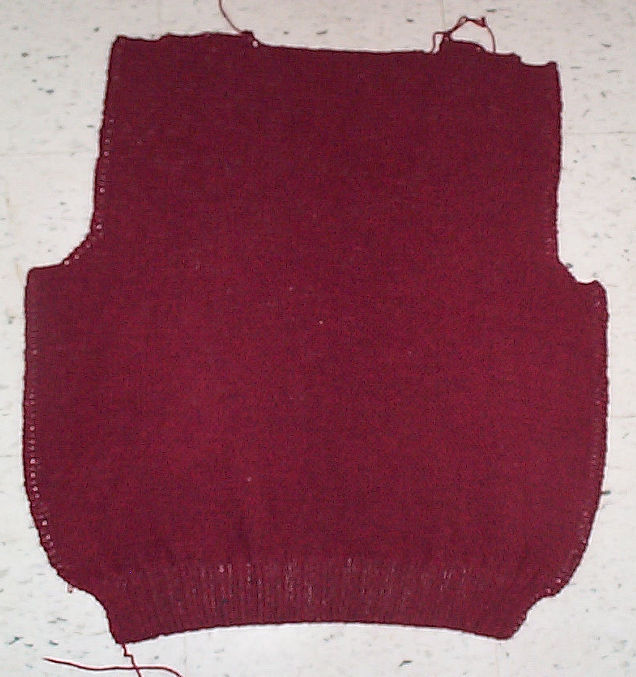
The color is a bit darker and more heathered with a touch of gray than is the virulent cranberry reported in the photo.
Now to go from the original size 30 to my customized 46, I did a couple of things. First I measured The Resident Male and one of his favorite store-bought vests. Then we sat down and discussed what he liked and didn’t like about the historical vest. We came to this set of observations
- He liked the ultra simple garter stitch texture
- He liked the wide waist ribbing in contrast with the narrow armhole edge and neckline ribbing
- He liked the K2 P2 ribbing texture
- He liked the close fit
- He wanted a deeper V because he’d be wearing the thing over golf shirts, and not over dress shirts with ties.
- A closer look at the dimensions of the original rather than the photo revealed that the piece was longer than we originally thought, so no adjustments there were necessary.
- He didn’t like the straight edge at the back of the neck, and preferred a tiny bit of contour there
So comparing his measurements and the original I come up with
| Original | Custom size | |
| Length | 25″ | 25″ |
| Chest width | 30″ | 46″ |
| Bottom rib | 3″ | 3″ |
| Other ribs | 0.75″ | 0.75″ |
| Depth of V | 9″ | 10″ |
| Armhole depth | 12″ | 10″ (from fave vest) |
| Back neck depth | 0″ | 0.75″ |
| Shoulder width | 3.5″ | 5.25″ |
So I plugged my measurements into the original pattern, multiplying by the original gauge (which I achieved), and came up with the piece above. I knit the back first so I could become familiar with the armhole and shoulder shaping before adding the complication of the vee neckline. I also knew that because it has no vee, the back would take more yarn. If I consumed more than half of my yarn while knitting it, I’d know that I needed to buy another skein. As it was, I used two and a quarter skeins out of five, so I should have enough to finish.
To confirm my noodling (and because I had the tool at hand), I pulled out Sweater Wizard and typed my measurements into that, too. I came up with a pattern that was very close to my own hand-tinkered one – minus the erasures and bogus false starts. If I end up sharing the redaction, I’ll use the Sweater Wizard product for clarity and ease of use.
One lingering worry – the shoulders. They seem wide although they are comparable to the target store bought favorite vest’s measurements. I may go back and rip them out, increasing the width of the back neck and decreasing the width of the shoulders to about 4.5 inches. More thought here is required.
ANOTHER REASON TO SUPPORT YOUR LOCAL YARN SHOP
Because they are in irreplaceable source of knowledge.
I swatched out several yarns that I had here in stash, trying out possibilities for my 1941 vest. Everything ranging from some navy/maroon ragg style Bartlett worsted (circa 1998) to a recent find from Webs – a tweedy garnet. The Bartlett is really an Aran or light bulky. I achieved gauge, but the sample stood up like cardboard. The Webs 2/4 Highland Tweed purports to be Aran to worsted in gauge (4.5 to 5 spi) but it knit up like a DK. Again I achieved gauge, but the sample looked meshy and sparse. I suspect that it would have bloomed a bit after I washed it, but in an added complication, TRM mentioned that he liked the color but hated the tweedy flecks. So it was off to my local yarn shop on a fishing expedition.
I went to Wild & Woolly in Lexington, MA – my knitting home-away-from-home. Now Jackie the owner is a knitter with decades more knitting experience than I have. She gave me an important bit of advice. When looking over patterns in these older booklets, don’t go by the gauge any yardage deductions based on just one project. Look at all the projects in the book that call for the same yarn. You’ll probably notice a discrepancy among them. So we did. A couple of the other patterns look closer to true worsted gauge than the light worsted/DK thoughts I had when I walked into the shop. To top it off she also remembers the Minerva (and later Columbia-Minerva) yarn specified. She steered me to Cascade 220 – which is slightly denser and less lofty than the Minerva but of similar gauge. The more airy nature of the Minerva is what threw me off, providing the extra yardage and making the stuff seem like a DK . So I bought some Cascade in a regal heathered burgundy and took it home.
I swatched it up and it was perfect. Spot on for gauge, with a soft hand and drape. So offering up thanks for the entire Wild & Woolly family I set to work on my vest project.
I measured the target recipient, plus one of his favorite store-bought vests that fits well. Then we sat down together and looked at the original pattern, pointing out fit and finish items that made it especially appealing, and other things that we might want to forgo. For example, TRM likes the depth of the V-neck, and the proportions of the waist and armhole/neckline ribbing, but is less enamored of the short length, tailored at the time to compliment pants worn with the higher, more formal waistline of the 1940s.
Then I looked at the pattern. I reproduce it here in its entirety, under fair use because I am using it to illustrate how to go about both reading an unusually formatted historical pattern, and how to go about redacting it for modern use.

You’ll notice that the write-up is much shorter than a modern pattern. There’s only one size given, plus a schematic with some notations on it and cursory working notes.
This pattern if translated straight would rely heavily on the schematic. The boxes represent a 1-inch square grid. Instructions on how to interpret notes like B-8 an D-1-7 are elsewhere in the pattern leaflet. Here’s what I start with – my interpretation of the original directions, plus a bit of editorializing.
“Eckhart” – Man’s 1941 Garter Stitch Vest from Minerva Hand Knits for Men in the Service, Vol. 62, size 30
Gauge in garter stitch: 4.5 st = 1 inch, 10 rows (5 garter ridges) = 1 inch
Back: Cast on 88 stitches. Work 3″ in K2,P2 rib. Then switch to garter stitch. Work even until piece measures 13 inches from bottom edge. Bind off 8 at the beginning of the next two rows. Then decrease one stitch at the right and left edge of the work every four rows. Do this edge reduction seven times total. At the end of the armhole decreases you will have 58 stitches. Work these 58 stitches even in garter stitch until the piece measures 11 inches from the under-arm bind off row and you end ready to work a right side row. Form shoulders by binding off four stitches at the beginning of the next four rows, then bind off three stitches at the beginning of the next six rows. Bind off remaining 24 stitches to form center back neck.
Front: Work as for back EXCEPT place a marker between stitch #44 and 45. On a right-side row when work measures approximately 15.5 inches from the bottom edge, knit to two stitches before the marker, K2tog. Then attaching a second ball of yarn, and starting with a SSK, work the rest of the row. Note that this happens BEFORE you finish making the underarm decreases, so watch for it.
You now have each side of the top front on either side of the V opening being completed from its own ball of yarn. From this point on you’ll be making paired decreases on either side of the opening on some right side rows, using a K2tog when indicated on the side that ends at the center, and a SSK on the side that begins at the center. Work three of these decrease pairs spaced approximately 1/2 inch apart (you’ll probably be doing the decreases every 4 rows). Then work seven of these decrease pairs spaced 1 inch apart (probably every 10th row). You will finish these neckline-defining decreases at about the same point where you need to commence the shoulder decreases. Finish the shoulders as directed for the back.
Finishing: Seam shoulders together. Starting at a shoulder seam, pick up 132 stitches around the neckline, taking care to space them evenly, and work in K2, P2 ribbing. Count off the stitches to make sure that the center two that will be in the point of the V end up as a K2 pair, and place a marker between them. Work the mitered join at the center front point of the V-neck by knitting the last two stitches just before the marker, and working a SSK immediately after the marker – do this EVERY OTHER row until the ribbing measures 3/4 of an inch deep. Bind off. Sew side seams. Pick up 144 stitches around each armhole and work even in K2, P2 rib until ribbing measures 3/4 of an inch deep. Bind off and finish ends. If you wish, reinforce shoulder area with a strip of seam binding, sewn by hand to the inside of the sweater to cover the shoulder seams.
O.K. Clear as mud? Now for the kicker. I need to work a size 46, slightly longer, with a bit of a center back neck scoop out (he doesn’t like the straight across the back of the neck bind-off). Plus I want to tinker with the depth of the V. How I do that alchemy is next.
MORE HISTORICAL KNITTING – 1941 MAN’S VEST
Another historical knitting project is in the works. Yes, I’m also still working on the leaf pullover and am almost finished with the back. But rare special requests from wiseNeedle’s technical wizard take priority. The Resident Male (TRM) has requested a particular vest from the 1941s vintage Minerva troop knitting folio he gave to me for the holiday.


This is a very plain garter stitch vest. It has slightly set in armholes, and K2, P2 ribbing. He’d like the V-neck opening to be a bit lower, but other than that, he likes the slim fit and style.
Now knitting this ultra simple thing will not be a straightforward as one might think. For starters, the leaflet offers up only size 40, and TRM is a 46. On top of that, the pattern is particularly sketchy, and not in a format used widely today. (More on this tomorrow). I could just look at the picture and then come up with something from scratch, fobbing it off as the real thing, but that wouldn’t be as much fun as trying to redact the original, keeping as close as possible to the 1941 instructions.
Let’s begin by looking at the materials specified – Athena Noninflammable Needles size 6 and 7, plus Minerva Quality Knitting Worsted – 6 skeins. I am delighted to report that this pattern DOES include specific gauge – 4.5 stitches = 1 inch, 10 rows = 1 inch. Gauge is not always included in these older patterns, and having it makes a huge difference.
The size 6 and 7 needles are about right for the stated gauge and are probably comparable to modern US 6 and 7, but an exact match is irrelevant. I need to use the needles I need to achieve the stated gauge. The sizes suggested in any pattern (not just this historical one) are supposed to be starting points for your own swatching purposes, not absolute dictates. It doesn’t matter a whit if you actually end up using 4s and 6s or 7s and 9s – so long as you achieve the specified gauge, your garment will fit as the pattern author intended.
Why “noninflammable” in the name of the needles? Prior to the early 1940s time early pre-plastic needles were either Bakelite or cellulose based. Cellulose needles were easy to ignite and burned quite hotly. The Athenas were probably either Bakelite or a new material (possibly nylon based), that melted rather than ignited when exposed to flame.
Now, “Minerva Quality Knitting Worsted – 6 skeins” is a bit more problematic. How much yarn is that? What would be a modern equivalent? How much do I need?
From the look of the picture, it’s clear that the yarn is a plain, smooth finish multi-strand yarn. If this pattern was knit in stockinette, I’d guess that it was a heavy worsted yarn, But it’s in garter stitch, which enlarges gauge somewhat, so I suspect that the yarn used is lighter than that, perhaps a true worsted with a native stockinette gauge of 5 stitches per inch. Possibly even a DK, with a native stockinette gauge of 5.5 stitches per inch. (True DK might be pushing it, as I’m not sure I can get 4.5spi with garter in DK without the fabric looking limp and loose).
More noodling is needed here. To start, I have a rough idea that a man’s sleeveless vest in size 40 should take approximately 900-1000 yards of worsted weight yarn. I base this on my Nancy’s Knit Knacks yardage estimator card, plus confirmation from Sweater Wizard, and from personal experience. If the original pattern called for 6 skeins, that would mean each skein would be around 150-166 yards. My absolute textbook standards for worsted weight yarns are Brunswick Germantown and Cascade 220. Both clock in at 220 yards per 100g (3.5 oz) or 110 per 50 g (1.75 oz). By contrast, DK weight smooth finish classic Rowan yarns tend to be between 240 and 255 yards for 100g (120 to 127 for 50g).
A web search on “Minerva Knitting Worsted” brings up an article on translating a 1934 vintage pattern, which calls out a yardage of 152 yards for 1.75 oz. Now 152 x 6 = 912 yards – within the target range, but 152 yards for 1.75oz (50g) sounds much lighter than worsted. I also find Columbia Minerva worsted on the Vintage Knits yardage chart. There it’s listed at 280 yards for 4 oz. That works out to 245 yards for 100g (3.5 oz), or 122.5 yards for 1.75 oz. Still more than Cascade/Germantown’s 110 and closer to DK than I expected when I started looking.
So to sum up my yarn weight findings, I’m now leaning to the light worsted/DK end of available choices, but without truly solid confirmation. Obviously intensive swatching is the next step. I want to make this vest out of stash-aged yarn. I’ve got a couple of choices on hand which I will detail in the next post.
VOYAGEUR’S CAP/LIBERTY HAT/FORAGER’S HAT
My forager’s hat is finished – a nice big modified stocking cap with a blunt end and a double-thick self-lined brim (no ribbing). The only thing left to do is to find out if my re-enactor pal wants the optional big honking tassel at the top or not. Here you see it modeled by Smaller Daughter. This is really an adult size hat. It’s not stretched at all on her head.
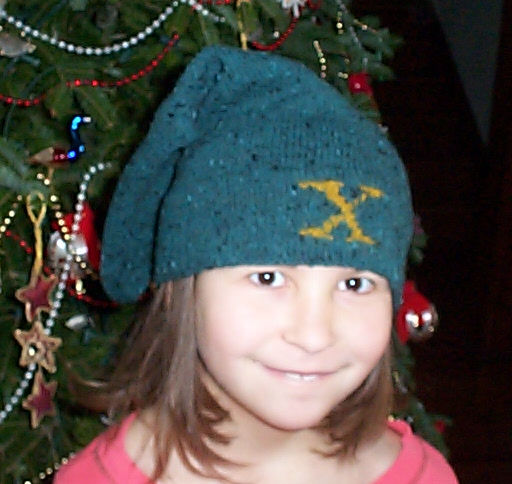
I used a very dense deep teal hand-spun yarn 100% wool yarn. I purchased it from an outside vendor at a local spring farm festival held at Drumlin Farm in Concord, MA. This yarn had no name, and the spinner (selling her own products) didn’t include a card with the sale. The gold is a fragment of another single of similar weight. I know that the gold is Merino, but I don’t know the fleece type of the teal, but it’s scratchier than the gold (but not too much so to limit wearing).
My yarn has quite a bit of slubbing, and looks like the color was produced by aggressively combing together black and teal dyed fibers prior to spinning (some of the slubs are clearly one or the other color, others are blended). It’s not bad, but it’s not uniformly good, either. The staple is short and the twist is uneven. As a result it breaks easily. The good news is that it also splices easily. In terms of weight, it counts out to 15-16 wraps per inch, which lands it in between fingering and sport in weight.
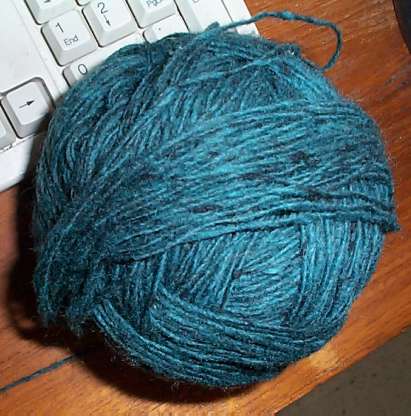

You could use a lofty sport, knit down to gauge, or a very dense fingering – something thicker than a standard sock yarn though. I think the Regia and Socka style European sock yarns would be too thin for this. My hat weighs in at about 90 grams, which is about right as I used all of one 50g skein plus a bit more than half of a second. I haven’t made a tassel yet so I can’t estimate how much more yarn would be needed for one.
If you are making a Voyageur’s hat – they were most often deep red. Liberty caps were most often red or blue. Sometimes liberty caps had patriotic mottoes knit into the brim area. “Don’t Tread on Me” would work. An aside – Older Daughter tells me that people wanting to cosplay Link from Legend of Zelda would also want one of these hats, but in green and with a bit more of a pointed rather than rounded end.
This patten is a transcription of my working notes. I haven’t test-knit a second item from them, so mistakes are certainly possible.
Voyageur’s Hat/Liberty Cap In the Style of the Mid-1700s

Materials:
- Roughly 90 grams of a heavy fingering/light sport weight yarn, with a recommended label gauge of 6.5-7 stitches per inch (this does not include any yarn for a tassel)
- Waste string for provisional cast-on
- Double pointed or circular needles – US#0 (2mm)
- Extra circular or double pointed needle to hold stitches while fusing the brim US #0 (2mm) or smaller
- Tapestry needle for ending off
- Five stitch markers
- Optional: A graph of a motto or design that is no more than 30 rows tall
- Optional: A 4-6 inch long tassel made from the same yarn as the hat, and a small holed button (not a shank button) to sew it onto on the hat’s inside as a reinforcement.
Gauge and Dimensions:
- Taken over stockinette on US #0 (2mm) needles – 6.75 stitches and 9.5 rows per inch
- Finished hat will fit most adults. It’s 21 inches across the bottom opening (stretching to fit easily on a 23 inch head). It measures roughly 17.25 inches from brim edge to top.
Using a provisional cast-on, cast on 130 stitches. Distribute on DPNs or if you’re using the two-circ method – onto two circular needles. Knit 32 rounds, then purl two rounds to create a fold line. If you are inserting a pattern follow the optional directions below. If not, skip to the no design instructions.
If inserting an optional graphed colorwork design. Your graph can be worked in stranding or intarsia, but must be no more than 30 rows tall. For best proportions and an authentic look, I suggest single color (plus background) patterns of no more than 20 rows in height. My X is 16 rows tall). In terms of horizontal placement, the hat’s brim finish ensures that there is no visible jag where the cast-on round begins, and there is no front or back, so don’t agonize about centering the pattern in any one particular spot. Subtract your graph’s row count from 32, then divide the result by two. Knit that many rounds before starting your graph. Knit the remainder after the graph is complete. To prepare for the next step, look at your colorwork area. Take a moment to tug any extra loose ends so that the appearance on the front is as neat as possible. If any are particularly unruly, thread them onto a tapestry needle and take a little sewing stitch to secure them. So long as you flick the loose ends right and left so that there is no giant lump of strands in any one spot, you don’t need to take the time to end them all off neatly.
If not working an optional graphed colorwork design. Knit 32 rounds.
All knitters. At this point you are ready to fuse the brim. The knitting done before the fold welt will become a self facing, totally encapsulating any loose ends resulting from the optional colorwork. Unzip or unpick your provisional cast-on, threading those stitches onto spare DPNs or a circular needle.
Hold the work folded at the purl welt with the purl sides inside. Then knit around one row, knitting each stitch from your active needles along with its complement on the needle holding the now awakened stitches from the provisional cast on. At the end of this row you will have the same 130 stitches left on your active needles, and the brim will be completely fused to the hat body with all ends neatly out of sight.
Continue knitting in stockinette (all knits) until your hat measures 8 inches when measured from the bottom of the purl welts at the brim’s opening. On the last round before you begin the decreases, place a stitch marker every 26 stitches
Decrease rounds:
Round 1: (Knit 24, K2tog)5x – 125 stitches remain (You will be knitting to two stitches before the each stitch marker, then working your K2tog)
Knit 10 rounds
Round 12: (Knit 23, K2tog)5x – 120 stitches remain
Knit 10 rounds
Round 23: (Knit 22, K2tog)5x – 115 stitches remain
Knit 10 rounds
Round 34: (Knit 21, K2tog)5x – 110 stitches remain
Knit 10 rounds
Round 45: (Knit 20, K2tog)5x – 115 stitches remain
Knit 5 rounds
Round 51: (Knit 19, K2tog)5x – 110 stitches remain
Knit 5 rounds
Round 57: (Knit 18, K2tog)5x – 105 stitches remain
Knit 5 rounds
Round 63: (Knit 17, K2tog)5x – 100 stitches remain
Knit 5 rounds
Round 69: (Knit 16, K2tog)5x – 95 stitches remain
Knit 5 rounds
Round 75: (Knit 15, K2tog)5x – 90 stitches remain
Knit 5 rounds
Round 81: (Knit 14, K2tog)5x – 85 stitches remain
Knit 5 rounds
Round 87: (Knit 13, K2tog)5x – 80 stitches remain
Knit 5 rounds
Round 93: (Knit 12, K2tog)5x – 75 stitches remain
Knit 5 rounds
Round 99: (Knit 11, K2tog)5x – 70 stitches remain
Knit 5 rounds
Round 105: (Knit 10, K2tog)5x -65 stitches remain
Knit 5 rounds
Round 111: (Knit 9, K2tog)5x – 60 stitches remain
Knit 5 rounds
Round 117: (Knit 8, K2tog)5x – 55 stitches remain
Knit 2 rounds
Round 110: (Knit 7, K2tog)5x – 50 stitches remain
Knit 2 rounds
Round 113: (K6, K2tog)5x – 45 stitches remain
Knit 2 rounds
Round 116: (K5, K2tog)5x – 40 stitches remain
Knit 2 rounds:
Round 119: (K4, K2tog)5x – 35 stitches remain
Knit 1 round
The rounded point:
Continue working (K1, K2tog) until fewer than 10 stitches remain. Break the yarn leaving a 6 inch tail. Thread tail onto tapestry needle, and use the tapestry needle to gather up all remaining stitches draw-string style, pulling them together and securely ending off on the inside of the hat. Affix any optional tassel to this center point, sewing it on through a small button placed on the hat’s inside. This button acts as a reinforcement and decreases the chance of the tassel pulling out or distorting the end to which it is sewn.
VOYAGEURS HAT/LIBERTY CAP
I’ve promised a re-enactor pal a forager’s cap that he can wear at historical recreation bivouacs with his Revolutionary War era British regiment. He described it as being basically the same shape as a voyageur’s hat (the ancestor of the toque) or a liberty cap – a rather blunt stocking cap of medium length related somewhat to the Phrygian cap seen on some statues of Lady Liberty, and omnipresent in the French Revolution (but without a turned brim).
It’s tough to see from the various representations of similar hats in paintings and illustrations (mostly created long after-the-fact tiny thumbnails of behatted folk rowing boats, or running around in idealized depictions of famous battles), but I don’t think they had a modern ribbed type bottom edge like most of the contemporary knitting patterns show. Some look to have a sturdy split section that was turned up to make a sort of a bottom cuff (the Phrygian cap variants), others look to have plain edges. Some look like they’ve been fulled or made up from fulled yardage of some sort. Voyageur’s hats are usually described as being either red or blue. So are liberty caps. Some liberty caps bore mottoes either knitted in or embroidered on the bottom edge. And finally both hats are mentioned as sometimes, but not always having a large tassel on the end.
Throwing any attempt at historical accuracy beyond this cursory level of attention to the winds, I’ve taken a middle ground among all of these. I am making a blunt end slightly tapered stocking cap, long enough for the top to flap down to just below the brim when worn. The verdict is still out on the tassel thing. To recap, I’ve decided that instead of ribbing, I’m going to use a doubled ear band done with a self-facing and turning row of welting. And I’m going to knit an X into the brim (my friend’s regiment number). I am also going to use a hand-spun single that’s probably heavier and probably coarser than what would have been used back then, but is closer in spirit to a period yarn than is modern factory-made DK or worsted. I am somewhat limited in color choice. As I described before, my red is heathered with too much white for this purpose. Instead I’ve got a nice, strong tealed blue/green, with the X done in a mustardy gold.
So. Here’s what I have so far.

I ripped out what I had before because it was too big.
I began again on US #0s and did a better job of swatching. For my hat to fit snugly at my demonstrated gauge of 6.5 stitches = 1 inch on 2mm (US #0) needles, I cast on 130 stitches. I used a provisional cast-on and knit 32 rounds in stockinette. Then I purled two rounds, and knit another 7 rounds. At this point I was ready to begin my X. I adapted that letter from a graphed alphabet first published in the mid 1500s, but stretched it out a row to improve the proportions. Yes, this is wildly anachronistic, but the letter form was pleasing, and in keeping with type faces current in the mid 1700s. Then I worked my 18 row tall X in stranding. Sort of.
I’m knitting in the round here on two circs. I cheated. To do the first two rounds, I broke off a length of about 8 inches from my ball of gold yarn. Then starting in the center, I worked the first row of my X. I dropped the gold when I was done with that area and continued around. When I got to round two of the pattern, I used the second leg of my length of gold to finish it. I continued in this manner, using broken pieces for every two rows of my X chart.
When my X was done, I worked another 8 rows in stockinette. At that point when the brim was folded along the purl welt, the facing side was the same length as the X-bearing part. So I unzipped my provisional cast-on, and threaded those stitches onto a spare needle. I tidied up the X, and did a couple of anchoring stitches to keep the gold from wiggling loose and to make sure that the ends weren’t lumping up in one mass, but I didn’t bother doing a full darn-in/finish on them. They are after all going to be completely encapsulated in the double-thick hat brim. Holding the piece folded along the welt, on the next row I knit together one body stitch along with one stitch rescued from my provisional cast-on. When it was done I had my double-thick brim neatly finished, with no pesky ends of my X to peek through.
I’m now at the “make the thing longer until you can’t stand doing it any more” stage of lengthening the hat body. I’ve read several descriptions of how others have formed the top of their caps, plus other speculations. Since 130 isn’t a particularly convenient number for evenly staged decreases, I’ll be noodling out this part on the fly. Some descriptions of these hats opine that there is no taper at all, just a drawstring finish. But I don’t believe that the people who wrote that have ever knit. A drawstring on an untapered tube would not make the graceful shapes I see in the paintings, instead that finish would make something that looked like a gathered pants leg, with a bulby end.
I’ll keep posting here as I go along. Comments from anyone with real historical citations to either support or blast to shreds any supposition here are most welcome.
HACKING THE HOLIDAYS
Not much knitting here beyond finishing up the gift socks mentioned yesterday, which later today will be given to the target recipient. I also posted a yarn review for the Schoeller/Stahl sock yarn I used.

(Please consider leaving reviews of your current yarn yourself, as a holiday present to fellow knitters worldwide).
I can in the spirit of ecumenicism born of our happy, culturally jumbled household recommend two non-knitting related holiday hacks.
First for Hanukkah (and Kwanzaa): Every kid is fascinated by the candles used in menorahs and other holiday candle holders. They burn quickly, and often being close together, act on each other to make strange melting patterns and drips – especially when “encouraged” by the viewer. And every kid who grew up with a menorah in the house will either admit to performing said encouragements, or by virtue of being watched constantly, not having the chance to do what he or she really wanted to do. But not every parent can hover over the candles for the entire time they are lit for eight nights straight.
Now devices are no substitute for parental supervision, but accidents happen in even the most careful household. Place your menorah on a shallow lipped pan (like an inexpensive jellyroll pan or in my case – the liner pan that came with a now defunct toaster oven) and fill the pan with about a quarter inch of water. Drips will fall into the water, and won’t weld the menorah to the table or counter top. Should your offspring be too helpful and a candle come loose from its moorings – it will fall harmlessly into your mini-reflecting pool and be extinguished.
Second for Christmas trees: Fighting one’s way underneath the lower branches to water the thing is a major pain. I cheat. I float some packing peanuts or crumpled aluminum foil on top of the water so I can see the level while still standing. I also take a tube or pipe (in this house, the unobtrusive brown extension tubes from our upright vacuum cleaner) and wedge them into the tree holder’s bucket area. I use some twist-ties to anchor the tube against a branch. The tube remains there as long as the tree is in the house. Then when watering time comes, I take a watering can and pour into the tube until I see my floating markers rise. No bending, no needles in my hair, no overflows.
PEARLS AND PURLS (BUT NO SWINE)
We celebrated Hanukkah this weekend past in our own style. Fried foods are traditional. We did crab cakes. Not traditional by a long shot, but tasty none the less.
The Resident Male, finding himself at the fish shop buying the crab was tempted by some beautiful Bluepoint oysters. So he brought home four as a special grownups-only treat.
So there we were, happily slurping down our excellent oysters, when I thought I found a bit of shell. Not uncommon in oysters opened by amateurs*. But it wasn’t shell.
It was a pearl.
A natural pearl. Far from gem grade, but round and pearly enough to qualify, even though you can see a bit of the gravel that inspired it sticking out from one end.
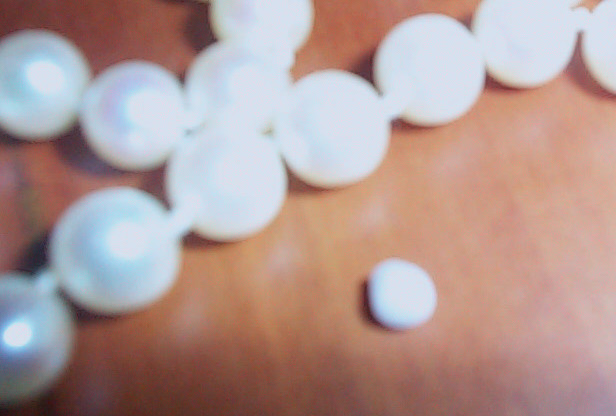
I’ve put my tiny pearl next to a strand of cultured pearls for size comparison. I’ve joked about finding a pearl, and have known it was remotely possible. But I’d never heard of anyone actually finding one. So what to do with my inferior but extremely lucky pearl? Wear it for luck, of course. I’m thinking of getting a tiny silver charm in the shape of a cage to keep it in.
And I’ll probably make the traditional latkes tonight.
As far as knitting goes, I’m trying to zip through the remainder of a pair of socks, plus get a start on the foraging cap (in the style of a Liberty or voyageur’s cap) for my re-enactor friend. I’ve got a nice hand-spun wool fingering weight single, in a color sort of between forest and teal, with a touch of black. I would have preferred a barn red, but the red I had was heathered with too much white and from a distance read “pink.” Shown here are my larval beginnings (I’m working on the area that when finished will be the facing in the earband, plus the too-pink yarn. Gauge here is between 5.75 and 6 stitches per inch. I’ve got 130 on the needles, and am getting a band big enough to fit a 23″ circumference head. There’s some allowance for stretch and the hat will be double thick at the earband, but I don’t want to make it so tight that the wearer will get a headache. You can see just a bit of provisional cast-on peeking out at the bottom of that dark green wiggle:

Other than that, I am finishing up yet another pair of gift socks. This one from Schoeller+Stahl Fortissma Colori/Socka Color, color #5.

* We follow the safer Julia Child oyster method (learned while watching her on TV). It involves identifying the hinge and using the pointy end of a bottle opener to dislocate it. Then using a thin, sharp knife – winkling it into the opening made by the unhinging and running it around the oyster inside to scrape it top and bottom from its shell.
LEAVES AND COTTON SOCKS
As promised, here’s my knitting progress. First, the leaf pullover:
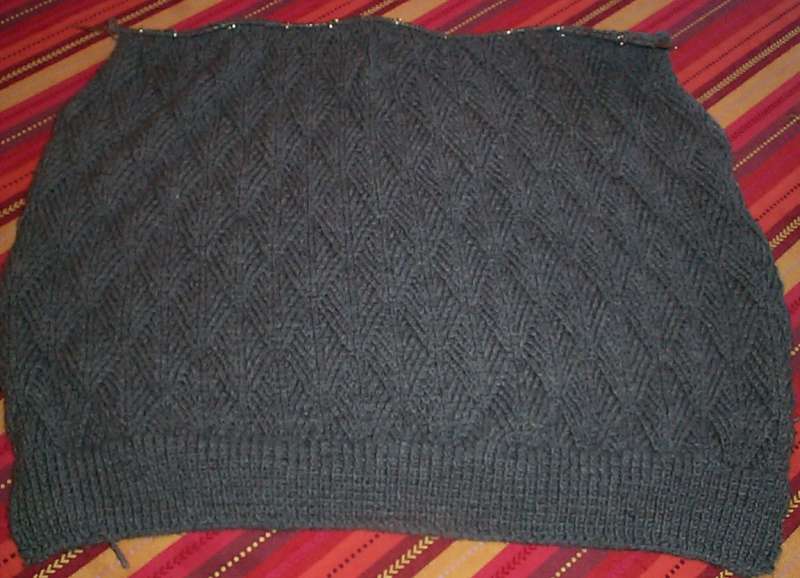
As you can barely see, I’m now well past the underarm narrowing, about half-way from that point to the beginning of the neckline. It’s still very slow going because of all the 1×1 twists, but I’m very pleased with the effect, in spite of the thing being a bit off gauge and an inch too wide (I like loose fitting sweaters in mid-winter). Although I’m mired in holiday gift knitting right now I’m making a point of NOT putting this down in its entirety. I want to avoid what I now (thanks to blogging) see as a familiar pattern – the sidelining of my October/November project due to gifts leading to its eventual consignment to my Chest of Knitting Horrors ™.
And in gift knitting, here is a mostly done sock worked in a combo of black Cascade Fixation and raspberry Elann Sock it To Me Collection Esprit. Both yarns are 98.3% cotton, 1.7% elastic. Both are marked with the same yardage (186 yards stretched or 100 yards relaxed), and same gauge 25st and 40 rows = 4 inches or 10 cm. Fixation also carries a crochet gauge of 29 double crochets and 12 rows = 4 inches or 10 cm. As far as I can tell, they look like exactly the same yarn. While the yarn review collection reports Fixation as a worsted based on its initially reported gauge, current labeling moves it down to the sport yarn realm in line with Esprit’s labeling. I say neither is spot on, and would call both yarns DKs.
My own gauge using 3mm needles at a reasonable sock gauge is 6.5 stitches and 12 rows = 1 inch. The fabric is markedly stretchy, even more so than a comparable weight wool yarn knit at the same tight gauge. Now I know many people who have reason to avoid wool socks swear by this stuff, but I’m less enchanted. I selected it because I am knitting socks for someone who is both wool sensitive and diabetic, who requested very stretchy cotton socks with a specific wide ankle measurement in comparison to the foot area. I am working my standard toe-up sock on a foot circumference of 48 stitches, moving up to 52 stitches just prior to the short rowed heel, and then 54 stitches immediately after. I add another four stitches at the uppermost black stripe for an ankle part stitch count of 60 stitches. Based on progress so far I predict I’ll use one ball of raspberry on each sock, plus most of one ball of black between the two. I bought 4 raspberry and two black, so I’ll have enough left over to make another pair, should I so desire.
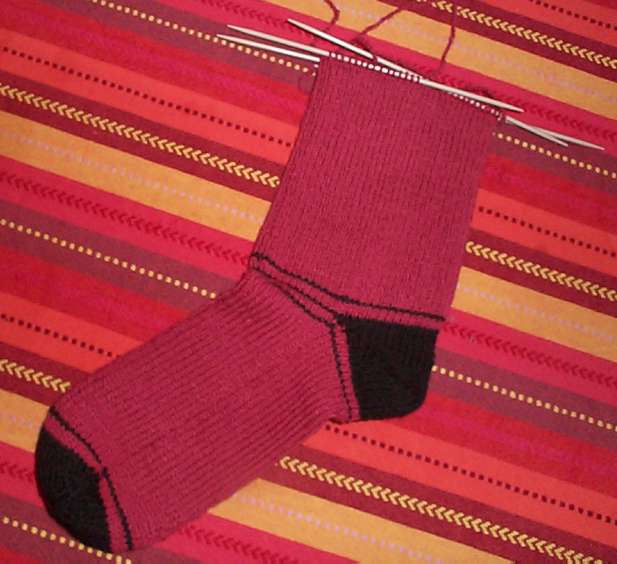
But I’m not sure I so desire. Although this sock is suitably uber-stretchy, and the cotton yarn is relatively lofty, I don’t like the feel of cotton socks for myself. I find them cold and hard compared to wool, and walking in them feels like walking in a massage sandal studded with thousands of little pebbles. But I don’t have problems with wool. If you do, this yarn is an acceptable substitute, although at its weight you’re going to end up with nice, thick hiking socks, not fingering weight socks that are wearable in a wider range of shoes.
I was also disappointed in the color of the raspberry bought via the Web from Elann. Standard cautions on buying based on color displayed on a computer monitor apply. Remember – no color monitor displays true color fidelity, and lighting conditions at the photographer’s end can add complications (to demonstrate this, call up different photos of the same color card at multiple retailers’ websites, and/or view the exact same color card photo on different monitors). On line the stuff looked much deeper, almost wine in hue (which was the color requested by the recipient). In person the raspberry is closer to an unexciting mauve. Color fidelity is another reason I vastly prefer to buy yarn in person rather than by mail order. Color cards help, but since I have so many excellent local yarn source options, and am always looking for new yarns rather than repeaters, I do not buy by mail often enough to invest in them.
My next bit of gift knitting will be a wool foraging cap for a historical re-enactor friend. It’s mid to late 1700s or so in target, and will be based on Voyageur’s Caps and Liberty Caps. I’ll take notes as I create that hat in case the thing catches on with his re-enactor regiment. Second cotton sock will probably take me through Thursday or Friday, so I won’t be beginning his hat until later this week.
HALF BAKED HOLIDAYS REDUX
If you’ve been reading along here for a while, you might remember I’ve mentioned this family’s holiday cookie fixation before. Ten kinds. Every year. (I do give most away to co-workers and friends rather than let us eat them all ourselves). This year’s list is a mix of first time experiments and family favorites. It includes:
- Chocolate chip cookies – the classic, but made with mini chips and pecans instead of walnuts, slightly smaller than their non-holiday brothers. Mostly from the official Toll House recipe printed each year on the bag of chips (although I do cheat and use non-official chocolate).
- Peanut butter cookies – my kids would shudder in horror if I left these off the list. Done with crunchy peanut butter, just for fun. Otherwise it’s the standard from Joy of Cooking
- Buffalo rum balls – a version of the classic crushed cookie bourbon ball, but done with rum and cocoa, rolled in cocoa. Our variation comes from a recipe published in the Buffalo, NY evening newspaper some time in the 1960s
- Sugar cut-outs – the iconic holiday cookie. This year we get to use the Hannukah cookie cutters. Also I put lemon zest in the batter, and mix the icing with lemon juice instead of milk or water
- Oysters – a family invention. A hazelnut spritz sandwich cookie, filled with dark chocolate ganache
- Linzer cookies – New this year, from the King Arthur website recipe collection. Mine have little leaf shaped holes, that being the smallest cookie cutter I had on hand to do the center hole.
- Chocolate crinkles – Also from the King Arthur website. Killer chocolate flavor, fantastic texture. We use extra cocoa instead of espresso powder. My kids call these “Earthquakes” because the white sugar outside flaws and cracks in baking to reveal chocolate fault lines. I made these the first time two years ago from a very similar recipe sent by a friend and they’ve become favorites. (Hi, Kathryn!)
- Almond/cherry biscotti – Another new one. I’m cribbing this recipe together from several sources, including a basic biscotti recipe in the always wonderful Baking with Julia book. This is instead of the Panforte which although excellent deserves a break after a two years running appearance
- Lime cookies – Again a new experiment. This one depends on my finding sour salt (citric acid) locally. My grandmother used it to make her stuffed cabbage and to restore the shine to aluminum pots and pans (boiling them in a bath of water and sour salt). Another King Arthur website find.
- Pecan sandies – A family recipe, basically a nut-rich shortbread, rolled in granulated sugar and topped with a pecan half. These tend to alternate appearances with Mexican Wedding Cakes in our roster, as both are pecan shortbread type cookies.
I made a lot of progress this weekend past. I’ve got two cookies left to bake – the biscotti and the lime cookies. Plus I have to fill the oysters and Linzer cookies, and the kids get to ice the cut outs.
In other news, knitting did get done. Here you see the second of my two emergency baby shower gifts blocking on a balloon. The Regia 6-ply Crazy Colors has a relatively long repeat, so it makes wide stripes on both booties and hat. The white sections and broad yellow welting (including the tips of the I-cord bootie laces and hat bow) however are done in another well-aged leftover.

I also managed to get another couple of inches done on my ribbed leaf pullover, and complete about half a sock of other holiday gift knitting. But more on those tomorrow.
 String-Or-Nothing