WAVE SCARF PROGRESS
Back from a business trip, I exhibit productivity.
I was able to get work in during the plane rides and layovers. I’ve managed to get quite a bit further along on the Wave scarf’s edging: Overall, if I were to do this pattern again instead of following it verbatim, I’d change the ratio of attachment to make it a bit less ruffly, and I’d up the rate of attachment at the corners to diminish the cupping that occurs at the corners.
These things might have been less in evidence if I had chosen a wool yarn for my stole. I used linen, with very little stretch. When you use an unstretchy cotton, silk, or linen yarn for a pattern written out for wool, you need to be much more precise in the rate of attachment and in working the corners because you can’t rely on natural elasticity to even out tight or loose bits.

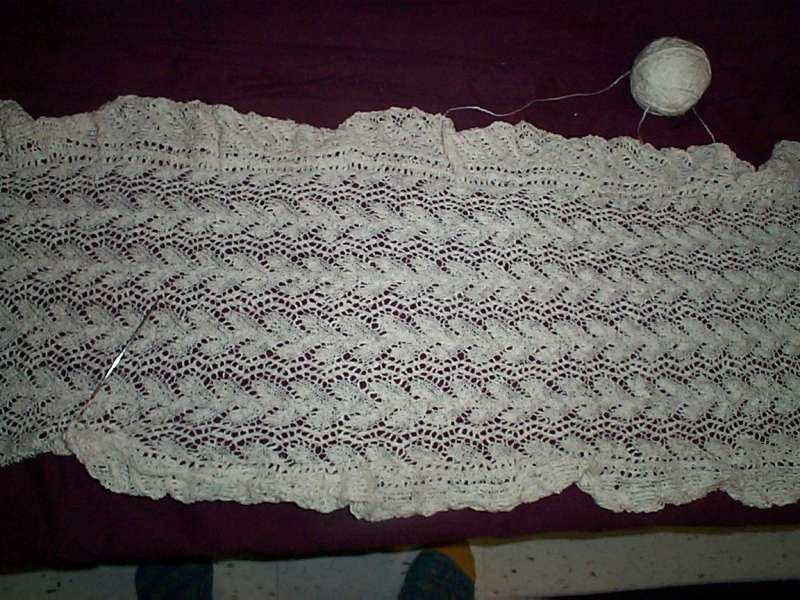
Obviously aggressive blocking is called for here, even though it will be only partly successful.
As to where I went and what I did – if you saw a tall gal with glasses and short dark hair knitting on this project in Logan, Chicago Midway or Dallas/Ft. Worth airports over the weekend – that was me.
WAVE SCARF – ROUNDING SECOND
Back to the Print o’ the Wave scarf/stole. I didn’t have enough time to sit down and noodle out a hat last night. Invention tends to happen over the weekends here at string. Instead I continued on with the knit-on edging. I’m within an hour or so of completing the second side and working the second corner. At that point I’ll be about half done, as I began my edging pretty close to the first corner.

The thing looks wing-shaped because I’ve got a zillion remaining live stitches picked up around the circumference all on a single circular.
Aside from the error in the chart described before, I’ve experienced no problems with the edging. It’s taking forever, but if you’re a process knitter like me, that’s a design feature, not a bug. The only remaining debate about this piece is to whom I will give it as a holiday present.
WRAPPED SPANISH HAT – EXPERIMENT 1
As promised, here is my experimental foray at the wrapping technique used on the 18th Century Spanish hat from the V&A’s photo collection.

I tried out three different methods of making the floats. First, this is the second swatch. My initial attempt was working this in the flat. It was a mess. So I switched to working in the round, on the principle that the inspiring hat was probably knit in the round.
The largest section on the bottom (green arrow in the photo) was done using Tamar’s suggested method – bringing the yarn to the front of the work, slipping the stitches to be wrapped purlwise, moving the yarn to the back of the work, returning the slipped stitches to the left hand needle and then knitting them off. You can see that it works nicely, but has a tendency to distort the stitch immediately preceding the wrapped segment. This is most evident in the columns of wraps, in which the same stitches are wrapped on several succeeding rows to produce a vertical column. It’s still there on the area where I shifted the wraps to produce a diagonal, but it is less evident.
The second section (red arrow) was done using the method I first posited – moving the yarn to the back of the work, slipping the stitches purlwise, bringing the yarn to the front of the work, returning the slipped stitches to the left hand needle, tucking the working yarn behind again, and then knitting off the formerly slipped stitches. It has slightly different weaknesses than Tamar’s method. In this case, I seem to be more prone to drawing the loop too tightly, and there is also a slight distortion of the stitch immediately preceding the wrapped section. It does however look just a little bit neater to me.
The third method (blue arrow) was one that came to me while I was fiddling with the other two. I worked those final two rows of wraps not as wraps, but in two passes. On the first pass I brought the yarn to the front, slipped the stitches that I wanted to “wrap”, returned the yarn to the back, slipped the plain stitches after them, brought the yarn to the front, slipped the “wrap” stitches, returned the yarn to the back, and slipped the plain all the way around. This laid one continuous thread in a single loop around my work. Then I knitted off the entire row. You can see I had time to do this twice. This does make a neater line than the wrapped methods, but has other drawbacks. First and foremost – it’s hard to keep an even tension on the continuous loop as it’s carried around the entire piece. Second, having a single continuous loop limits knitting’s natural elasticity. While this might be a useful technique to help maintain tightness in areas you don’t want to stretch out (like on the cuffs of an all-cotton sweater), I don’t think it is optimal for a hat.
Now going back and looking at the V&A picture again, it does look like there’s slight distortion of the stitches immediately before the wraps, and the wraps do look more like the slightly bowed ones produced by both Tamar’s and my posited methods. Without seeing the artifact itself, it’s hard to say which of the two was used. I lean to mine, just because I can control the distortion a little bit better with it than with hers, but both are functionally equivalent, and I’d say both are possible use case candidates that can’t be entirely ruled out without actually seeing the artifact’s front and back, both close-up.
MORE MUSINGS ON THAT SPANISH HAT
Back to that red Spanish hat. Several people wrote in with comments that deserve further testing.
First, Nancy and Jean suggested that it might have been done with two-end knitting or Tvndsstickning (also called Twined Knitting). I haven’t played with this technique yet, but from the appearance of the side sporting the standings in this Knitty article, I have my doubts on its application for this purpose. It looks like each individual stitch in this technique bears a wrap. The Spanish Hat clearly shows longer floats that wrap several stitches together. The twined/two-end knitting technique does look very interesting, and could clearly be used not only to make the double thick fabric for which it is justly famed, but might also have additional decorative implications if the twisting was shunted from back to front and vice versa, following a simple geometric pattern. But I don’t think it was employed on this hat.
Tamar (of the infinite needlework library) also wrote with another simpler suggestion. She was able to get a closer look at the bottom edge of the hat in the V&A’s picture. She says:
Especially at the bottom of the picture on the V&A site,
you can see the wrap yarn coming directly from the bottom
of the knit stitch to the right. So the wrap goes
immediately in front of a group of stitches.I haven’t tested it, but perhaps the wrap is done first
around the previous row’s stitches, and then they are
knitted.
This makes sense, and would probably be a bit less fiddly than knitting and then the wrapping in the same row method I posited on Friday. I’ll test out both wrapping methods, possibly tonight, to see. If all goes well, I’ll put down my lace shawl and do up a quick hat pattern using my findings. It would be highly cool to reverse engineer a knitting technique of the 1700s, and rescue it from historical obscurity!
PROGRESS REPORT – PRINT O’ THE WAVE SCARF
Back to the project in hand. I’m up to adding the edging to the Print o’ the Wave scarf, which in part sparked the past two days’ digression into general edge-affixing techniques.
I am sad to say I have errata for the pattern as available now. I wrote to the author over the weekend to report it. While the mistake is not something that will trip up people who are comfortable with lace construction, people doing this scarf as a first or second lace project will be a bit more frustrated.
In Chart B – the graph for the edging, the next to last stitch box on rows 9, 11, 13, and 15 should be a K2tog, not a plain knit.
A good way to “proof” graphed lace patterns is described in the Lewis Knitting Lace Book published by Taunton. It’s in several others, too but I think Lewis outlined it the most clearly. To paraphrase, special techniques and weird row-perturbers aside,, for most simple lace to remain at a constant width, with left and right edges parallel, the number of stitches increased must equal the number of stitches decreased. For lace to grow wider, there must be more increases than decreases. Conversely, for lace to narrow, there must be more decreases than increases.
On the edging in question, we know that rows 9, 11, 13, and 15 are the ones on which the pattern narrows, forming the “downhill” side of each repeat’s gentle pyramid point. But if you count up the increases and decreases on (for example) row 9, you end up with four stitches added (all YO increases), and four stitches decremented (two k2tog, and one k3tog double decrease); yet the pattern shows a net one-stitch loss on each odd numbered row. Since the visual lines established in the design are very strong, there’s only one logical place where that extra stitch can be lost – the next to last position on the row.
I have to admit that I was a bit tired when I first played with the edging pattern and kept messing up. But I muddled through, and then compared this variant of the Ocean edging to those in my other reference books (most notably the most excellent Heirloom Knitting by Sharon Miller). Those patterns do put an additional decrease in the penultimate position on each “downhill” row, so my guess has precedent.
I also have to moan about another minor lace tragedy, visible in the photo below:

All that muddling about at the beginning, starting the trim and ripping it back resulted in a dropped stitch over near the beginning of the edging (I’m working along the top edge of the stole first). Aaargh! I don’t want to rip back, so I’ll have to repair it tonight.
INVESTIGATIONS – FILET KNITTING AND CROCHET
Done with the reposts! I hope. Here’s something from String, first appearing on 27 June 2004.
INVESTIGATIONS – FILET KNITTING AND CROCHET
More investigations on filet knitting and filet crochet have convinced me that while filet knitting will be worth doing, provided I use very fine threads and 4/0 (1.25mm) needles or smaller, it’s not going to work out for my dragon panel.
I’m having gauge problems working my design into the desired dimensions, even if I eke out the too-narrow dragon motif band with additional borders top and bottom. For the record, my design is something like 43 units tall by 135 units wide. I’ve got a space to fill that’s 19 inches tall by 30 inches wide (although I can go over a bit on this). That means for the width, I’ve got to hit something like 4.5 rows per inch. Now in filet crochet, looking at a series of filet patterns with gauges found at the Stargazer site, I’m seeing gauges the smallest gauge I see (size 30 crochet cotton) is something like 10 rows = 2.3 inches. That’s about 5 rows = 1.15 inches. My 135 rows at this smallest gauge would be something like 31 inches wide. By contrast, the smallest I’ve been able to do so far in knitting is 3 squares = 1 inch (that’s about 14 or so knitting stitches per inch). At 3 squares per inch, my 135 units turns out to be 45 inches wide. I suppose I could hunt down longer size 5/0 or 6/0 needles (or make them) and finer threads, but I’m not inclined to do that right now. Interim verdict: Filet knitting is certainly worth further experimentation, but it’s not suitable for this project.
I think I’ll have to fall back on filet crochet to do my door curtain. I think I’ll take it and my Crazy Raglan with me as my official vacation projects.
Crochet Dragon Panel Pre-Project Calculations
Using these theoretical base calculation points for two thread sizes, I posit these rough dimensions and yarn consumption factors:
- Base for Size 20 cotton – 10 squares x 10 rows = 2.2″ x 2.4″; a piece that’s 100×50 squares or 21.3 inches x 12 inches will take 519 yards, using old US size 9 steel crochet hook.
- Base for Size 30 cotton – 10 squares x 10 rows = 2.1″ x 2.3″; a piece that’s 100×50 squares or 20.4 inches x 11.5 inches will take 485 yards using old US size 11 steel crochet hook.
Doing the math for Size 20 cotton (and working across the height instead of across the width to preserve sanity), that means my piece of 43 x 138 squares would be 9.16 inches x 33.12. Since my piece is 5934 squares total (138*43), and the original was 5000 squares, mine is roughly 19% bigger. I’ll round up to 20%, and I come up with a new yardage consumption estimate of 519 *1.2 or roughly 623 yards. I’ll add 10% to that for a fudge factor and round up – 686 yards. Repeating the operation for Size 30 cotton, I get an estimated finished dimension of 8.8 inches x 31.74 inches, and an estimated yarn consumption forecast of 641 yards. Remember that these yardage estimates are for the base dragon strip alone. I need to make it taller because the window space I need to cover is taller. With height estimates of 9.16 and 8.8 inches respectively I’ll need to either find or design complementing border strips that roughly double the project’s height. That means I need to double my yardage estimates – 1372 yards or 1282 yards for size 20 and 30 cotton, respectively. These estimates are VERY rough at best, but with luck should be good enough to get me started.
Now on to crochet hook sizes. The circa 1919 instructions on which I’ve based these calculations specify size 9 and 11 steel crochet hooks for sizes 20 and 30 cotton. According to various authorities (very few of whom agree), an 11 can be as large as 1.1mm, and as small as .75mm; a 9 can be as large as 1.4mm or as small as 1.25mm. My modern Susan Bates set goes from 0 to 10 (2.55 to 1.15mm). I’ll have to play and see what I can achieve using those sizes.
I haven’t decided which size thread or hook to use yet. Much will depend on what I can find locally, and on what size hook I can dig up without staging a raid on the storage cubby where all my tools and goodies are stashed.
So apologies. This knitting blog is going to take a side trip into crochet. But since I’ll be doing it during a forced blogging hiatus, I’ll only bore you with a couple large gobs of progress rather than by reporting in inch by inch.
WORKING REPORT – CRAZY RAGLAN
This post originally appeared on 26 June 2004.
WORKING REPORT – CRAZY RAGLAN
You know what I like about knitting? Among others, two things in particular:
- 99.9% of all mistakes can be dealt with without losing anything except time
- You never stop learning
Knitting is a very forgiving pursuit. Woodworkers can’t un-cut a mis-measured plank. Cooks can’t get the extra egg back into the shell. Sewers and tailors can’t return their fabric to the bolt once it’s been snipped. But knitters can grab and end, yank and reduce the most recalcitrant problem back to its larval state, ready to be knitted again. That suits me, as many of my projects proceed one step forward, two steps back.
I’m a slash-and-burn knitter (swidden knitter). By that I mean that I try to expand my mental knitting territory on almost every project. I’m always hungering for new challenges, new techniques, or trying to figure out easier/less error-prone ways of doing things. So far I haven’t run out of challenges, as even the simplest thing can end up being a roadblock. I’ve got knitting pals that always say nice things about the projects I finish, but probably don’t realize that like an untrained rat in a maze, I spent considerable time scurrying up and back dead ends. But learning flows from making mistakes, having the patience to figure out what went wrong in the first place, and the fortitude to correct them.
I have a hard time understanding all the people who post that they tried something and gave up, some even tossing the project out in disgust. True, I’ll lager the most egregious away for a while or even rip back particularly spectacular failures and re-use the yarn for something else, but I can’t imagine getting so disgusted that I would throw away the whole mess.
Case in point – my sorry excuse for what was supposed to be a mindless busy-work project, filling in extra post-exhaustion hours and (perhaps) lasting long enough to take me through a blissfully non-thinking week of vacation. I could make all sorts of excuses for what’s happened so far, but why bother. Here are the facts:
- I mis-measured my gauge – not once, but twice
- I mis-measured my kid’s circumference, and settled on making the wrong size
- I entered the above bogus data into Sweater Wizard, then mis-read the resulting print-out, and cast on too few stitches.
- I didn’t bother to confirm measurements until I was at least 7 inches into the thing. Twice.
The result? Another opportunity to reclaim and re-use yarn. I should be on target now. I’ve confirmed my gauge, recalculated The Smallest One’s size, and re-drafted the pattern (thank goodness for Sweater Wizard). Given that I was going to have to rip back anyway, I took the opportunity to do what I mentioned yesterday – using two balls of yarn to knit the front and back, doing it with an intarsia-style join at the center front. This makes the stripes even wider, as the span of stitches traveled by each strand is even smaller than before. I’m getting nice, wide sock-type stripes now, with a “seam” up the center front (apologies for the lousy pix, my camera is out of batteries so I had to improvise with another):
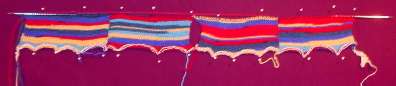
At the very least, this continues yesterday’s visual lesson on using variegated yarns. The narrower the span of stitches covered, the wider the stripes will end up being. How to know if your yarn will stripe or make that stippled effect? Look at the length of each color section. The longer it is, the more likely it will be to stripe. How to estimate on the fly? In general, a row consumes roughly 3 to 4 times its length in yarn. That’s a very rough estimate. If the color sections are at least three times the width of your piece to be knit you’ll end up with a one-row stripe. That stripe might not begin at the commencement of each row, and may end up being a wider puddled “bounce-back” section on a side, but it will take at least that much length of any one color to have any hope of visual striping.
More length? Easy. Wider stripes, and the possibility of knitting up larger garments that sport them. (Custom dyers take note – LONG repeats made by looping up double length skeins before applying color may be cumbersome to produce, but I bet they’d sell quite well compared to skeins with shorter color runs.)
Less length? A mottled, speckled or streaked appearance, with the predominant color overwhelming the others when seen from far away. Some yarns with shorter color runs can be a challenge to use. I’m not particularly fond of yarns with color sections that are an inch wide or less. In a fingering weight yarn that’s a run of about four to six stitches (depending on needle size). In a worsted, about two stitches. In a bulky/superbulky – that’s only one stitch (or fewer!).
One of the things that drove me to play with entrelac for the Tee I’m also working on right now was the short length of the color runs. Colors lasted for about three to five inches before changing. I didn’t like the blotchy, streaky effect that gave. Working in entrelac though on tiny 5-stitch squares allows the colors to bounce back and forth forming mini-stripes on each block. It’s tedious, but gives a more painterly effect.
I think if I ever wrote a book on knitting the name might be The Lazy Knitter: How to Avoid Mistakes In The First Place. Either that or Chest of Knitting HorrorsTM: How To Get Out and Stay Out. So it’s back to the fertile field of making mistakes, both for my own edification and to provide vicarious amusement for those who read this blog.
WORKING REPORT- CRAZY RAGLAN
Another post from the missing month. This originally appeared on 25 June 2004
Back to knitting.
Having successfully restarted my younger daughter’s raglan in Regia 6-ply Crazy Color, I can now report a modicum of progress:

It’s interesting to compare this pattern of striping with the one I was getting back when I was working in the round:

Same yarn, different width. If I had the strength I might even begin again, using the same strategy I employed for my Typeset Tee. That would make even wider stripes, but I’m too lazy to begin this no-think fill-in project for a third time.
The Play’s the Thing
How did I manage to knit off six inches each of the back and front in one night? I was at an audition.
I’ve mentioned before that The Resident Male was in a production of King Lear back in March (he played Kent). He has just tried out for a small role in a staging of Macbeth. But I didn’t go with him. My older daughter is caught up by the whole thing. At 13, she went to try out for one of the boy’s roles – Fleance (2 lines) or even MacDuff’s son (about a dozen lines) . She dutifully prepared her audition piece – Quince’s prologue to the miniplay in Midsummer Night’s Dream in Act 5, and read for the part. I told her that she’d be the youngest person there by a dozen years or more, but she was undaunted. She even made her way through the infamous tongue twister
Whereat with blade,
with bloody, blameful blade,
he bravely broached his boiling bloody breast.
Something I can’t see myself managing. I was tickled that she did so well. I have no idea if she got the part. Callbacks are on July 1st, but whether or not she’ll be cast she did us all proud.
The Latest Buzz
House nonsense goes apace. Yesterday’s big setback was the discovery of a huge colony of bees nesting in the floor below the sleeping porch. They get in through an old drainage pipe that sticks out through the stucco. The electricians working on wiring that part of the house were less than delighted to find the things. I was even less amused.
Under Massachusetts law the only available option besides letting them bee is to hire a licensed beekeeper to relocate the colony (not that I’d want to poison the little buggers). The hive must be removed after the bees are moved, as its contents would decay over time and cause even more problems. We’re trying to get a fix on how long the bees have been there. The longer they’ve been hoarding honey, the larger the removal cost, extent of the demolition required to get at the hive, and subsequent repair costs will be.
The only consolation is that the beekeepers will test the honey for edibility. If it’s uncontaminated (highly likely), we get to keep it. If there’s any quantity, I intend to have mead brewed from it so we may at the least, drink to both our and the bees’ new homes. Needless to say, things like this are not covered by insurance.
PROJECT – STRAKER GANSEY IN SHRINKING COTTON
More from the missing month of June. This originally appeared on 23 June 2004.
PROJECT – STRAKER GANSEY IN SHRINKING COTTON
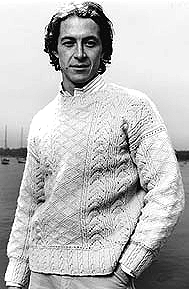
The summer has finally arrived and it’s cotton knitting season, so I thought I’d show off my project from early last winter (I’m seasonally dyslexic). I’ve always had a yen to knit up Penny Straker’s Inverness Gansey, but had never found the right wool to use:
In a fit of serendipity, I ran across one of the naturally dyed, guaranteed to shrink cotton yarns at a recent clearance sale at my local yarn store: Marks & Kattens Indigo Jeansgarn. Although the yarn was cotton and not wool, the two meshed in my mind. So I went about messing with the pattern, taking into consideration:
- It wasn’t intended for cotton
- It wasn’t intended for a shrink-to-fit cotton
- The sizing is for men
- My gauge both before and after shrinkage wasn’t a match to the pattern
But challenge is the frosting on my cake, and I loved the thought of the indigo yarn slowly fading along the crisp cable and King Charles Brocade pattern edges like jeans seams do. I plunged ahead, knitting up the required swatch.
The length of my test swatch shrank about 5% the first wash, but continued to shrink in each of two successive washes/volcano drys. Total shrinkage after three washes was on the order of 8-9%, so I figured that the 10% shrinkage listed on the label was close enough. Width shrinkage was on the order of 1-2%. Minimal.
I’m a little handicapped in writing this up because my copy of Inverness is tucked away in the storage cubby along with all of my yarn and pattern stash. I recall the pattern was written for worsted weight, with a recommended gauge (in stockinette) of 5 stitches per inch. My yarn was listed as a DK, but it was a rather robust DK, closer to worsted than to sport weight. Also, because I planned for shrinkage, I figured that knitting it a bit loosely wouldn’t matter. My gauge swatch results bore this out.
So I went ahead. I recall that there was quite a bit of ease in the largest size (a men’s 42). I did add a little over an inch of width to the body. That wasn’t hard because the sleeves are dropped sleeves and aren’t set in. I made the seed stitch panels on the side under the arm each 3 stitches wider. No fuss.
Now, the sweater was long to begin with, but I’m tall. I decided I wanted to keep it long, so I added 10% to the length measurements. That means that I knit around 30 inches of body. I also added to the sleeves (more on this below). Having done my adjustments, I cast on and knit away merrily.
This was one of the most enjoyable, fun sweater patterns I’ve done in quite a while. The texture patterns, while visually complex were quick and easy to memorize. The yarn was a dream. Yes, as a naturally dyed guaranteed-to-fade indigo, the dye crocks and comes off on one’s hands, needles, stitch markers, but cleanup was quick. I avoided sitting on the chair with the light upholstery and washed my hands after each session. And yes, it’s a cotton and relatively un-stretchy, and working cables in it is more of a pain than working cables in a nice, elastic wool – but the thing really flew. Here’s the result:
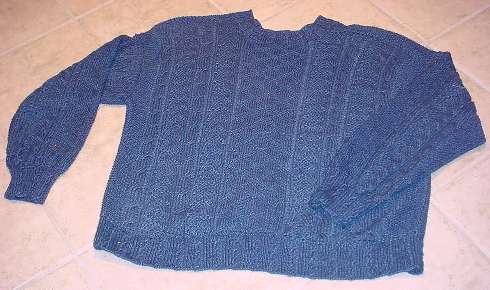
I especially liked the small details that don’t show up in the photo. The ribbing bears a nifty little cable. There’s a row of eyelet welting above it, and just below the seed stitch mock saddle shoulders, and at the top of the sleeves. The sleeves are joined to the body by working a row of picked-up stitches along the shoulder line, then doing three needle bind-off to join those stitches to the live sleeve top stitches. All in all, tons of fun.
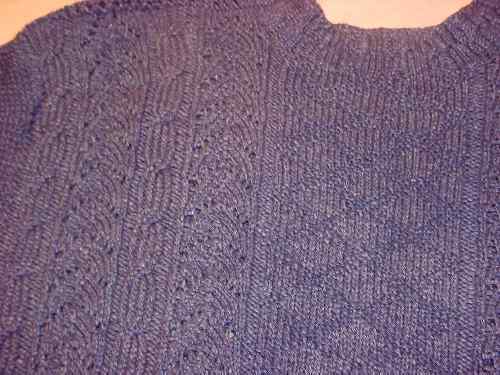
Apologies for the color in this detail shot. It’s tough to take a snap of something that’s dark blue without using studio type floodlights, even with a flash. The actual color is closer to the full view, above.
After my knitting was finished I washed my giant sweater as I had my swatch: hot water, cold rinse, followed by volcano heat in the dryer in the company of my navy blue sheets (so I wouldn’t have to worry about the sweater’s blue migrating to other things). Three trips through and I had achieved around the same percentage shrinkage as my test swatch.
I adore my finished sweater. It’s soft and supple, and the comfortable kind of baggy that only the most beloved an worn-out sweatshirts ever achieve. I can wear it indoors without something underneath in spring and summer, and layered over another shirt in the winter. (Were it wool, it would be too warm for all but winter wear indoors.) Even though it’s cotton and weighty compared to wool, the thing isn’t heavy and saggy. The color is fading as I anticipated. The exposed edges of the twist stitch cables and purls in the brocade are becoming lighter than the surrounding background. I’m looking forward to seeing this effect intensify over time. Plus I love being able to fling the thing into the washer and dryer instead of pampering it like I do most of my other sweaters.
I do have one miscalculation to report. Remember I said I added 10% to the sleeve length? That wasn’t a good idea. I had forgotten that I was starting with a man’s pattern. My sleeves are too long, even after shrinking. Eventually I’ll find the strength to pick out the seam, ravel back the excess and re-knit the cuffs. Someday…
WORKING REPORT- CRAZY RAGALAN
This was the entry that I was hunting for when I discovered my missing month. It describes crocheting onto a needle to start a provisional cast-on instead of just making a crocheted chain and picking up stitches along the back ridge of bumps. This was originally posted on 22 June 2004.
WORKING REPORT – CRAZY RAGLAN
Enough boring everyone with rehab junk. You came here to read about knitting, and not to visit This Old House.
I’ve ripped out the entire mindless knitting raglan and started again. This time I’m doing it in the flat, and working both pieces side by side. Because I hate seaming ribbing I’ve decided to add it later in the round, after I’ve sewn the sweater body, so I’ve started out with a provisional cast-on. I favor the crochet chain method of provisional cast-on, but I detest fiddling with the crocheted chain, picking up the bumps along the chain’s back. Instead I crochet my chain directly onto my knitting needle. Here’s how:
First I pick a nice smooth cotton string-type yarn, and a crochet needle a size or two larger than I’d use with it for a crochet project. In this case, I raided the Baby Georgia I was using for the filet knitting project, and grabbed a Bates F size crochet hook (more on hook sizing another day).
To start, I chain up about five stitches, just to have a stable spot to begin and an end to hold as I do so. Then I take my knitting needle and hold it like this:
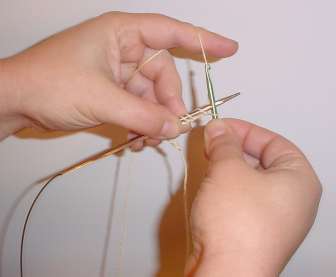
Holding the yarn in the back of the knitting needle, I reach up across the front of the knitting needle to grab the strand and form my crochet stitch. This lays a loop around the knitting needle itself, with the leading leg of the loop correctly oriented. After the stitch is formed, I use my left forefinger to flick the yarn around to the back of the knitting needle again:

Once the yarn is in the back of the needle, I’m ready to crochet on my next stitch.
I usually crochet on several more stitches than I need, just to be sure I have enough, and end off with five or six plain chains as insurance. Once the stitches are on the needle, I can switch to my knitting yarn and begin my first row of knitting. If I have more stitches cast on the needle than I need, I just slip off the excess. They become normal crochet chain stitches and sit quietly until the end of the project. No worries.
When it’s time to awaken the provisional stitches and begin knitting in the other direction, I find the last chain stitch I did (tie a knot in the dangling end if you think you might not remember which is which), carefully unpick that last stitch, then pull the strand to zip out the crochet stitch by stitch. As each knit loop is freed, I slip it onto a waiting needle.
Here’s my newly re-started raglan. Note that I’m knitting the back and the front at the same time. That way I am guaranteed that they match row for row and decrease placement for decrease placement.

I’ve done something here with the crocheted provisional cast-on that helps me keep life straight when working two pieces side by side. I’ve crocheted all of the stitches I need for both back and front in one long strand. First, following the procedure above, I made enough stitches for the back. Then I crocheted about ten free stitches without making loops on the needle. After that I made the stitches for the front, ending with a few extra chains. Using a different ball of yarn for each piece, I knit across first the front and then the back. The little bar of crochet anchors my two pieces together in the center and helps me remember which direction I’m going so that I don’t get to the half-way mark, then head back across the same piece instead of working the other one. (As the work gets longer I’ll safety pin the two pieces together closer to the top for the same reason.)
How did I manage to take the photos above? Not by growing extra arms, that’s for sure. So far all of the “hands working” shots on this blog have been taken by Alex, my 8th grade daughter. She may not knit, but she handles a mean digital camera.
 String-Or-Nothing