MORE ON ATTACHING AN EDGING – DRAWN LOOP METHOD
Yesterday I described two of the more usual methods for attaching edgings to project bodies – plain old mattress stitch seaming, and knitting onto a live stitch or finished edge. Today I continue with a third method. I’m not quite sure what it’s called, so I’ll call it the drawn loop method for now.
I learned this while doing the Forest Path Shawl (Interweave Knits, Summer 2003). If you plan on finding a copy of IK and working the Path, be aware that it appears to be sold out from the back issue collection on the IK website, and that there’s a correction posted in the magazine’s errata pages.

Drawn loop is intended for working a knitted trim onto a finished edge, and seems to be the least bulky of the three methods when used for that purpose. Like plain knitting on, the attachment is worked row by row as the knitting proceeds. Many patterns that use plain knitting on include directions to pick up an endless number of stitches prior to working the attached edging so that the trim is applied to live stitches rather than the original finished edge. The drawn loop method avoids that annoying exercise in endless counting although it does work best when done on a slip-stitch selvage. Unlike knitting on, there’s no column of double stitch thickness decreases formed where the edging meets the main body. As such, it’s particularly airy. It is however a bit fiddly to do, and works more easily with a smooth finish yarn than with a hairy mohairy type lace yarn.
To use drawn loop, you cast on much as for knitting on. If you use half-hitch, knitting on or a cable cast on to add your edging’s worth of stitches, you do so to your right hand needle, but instead of making a slip-knot for the first, you establish that first stitch by picking up a stitch in the edge-most loop of your main body, then work back a wrong side row to return the yarn strand to the rightmost side of your edging (and point of attachment). If you had the foresight to have incorporated a slip stitch edge in your main piece this will be easy. Otherwise you’ll have to eyeball where to pick up. Difficult (which is why many patterns want you to pick up stitches along finished sides) but with practice this is do-able.
If you use a provisional cast-on like a crocheted chain, you’ll put those new stitches onto the left hand needle, then work a wrong side row using your good yarn to return the rightmost side of the edging (and point of attachment).
Once you’re back at that rightmost edge, you use your needle tip to draw another stitch up through the next selvage loop of the main body. Here’s where it gets tricky. Enlarge that “stitch” until it’s a loop of about 18 inches or so diameter (how big to make it will become clear after you’ve done a couple of iterations). That loop will have two “ends” – one firmly attached to the knitting, the other sliding free trailing back to your yarn ball. Grab the fixed end and give it a gentle tug to make sure there’s no extra slack, then using the loop, work across the right side row of your edging. Flip the work over as usual, and work the wrong side row back, again using the giant loop. When you get back to the point of attachment, give another slight tug to the strand coming from the yarn ball to pull out any excess left over from your giant loop. Then repeat the process, drawing up another giant “stitch” in the next selvage loop and using it to knit a pair of edging rows. All of this sliding of the yarn back and forth as the large loops are made is the reason why this method works better with smooth rather than hairy finish yarns.
Again, like any attachment method that involves butting two pieces of perpendicular knitting, some adjustment of the ratio between rows worked to selvage stitches may be necessary. If the newly done edging is beginning to get too ruffly and fluttery, you may need to rip back a row or two and skip a selvage stitch. If the edging is drawing up and the body is beginning to gather, you may need to work an additional pair of edging rows without attachment.
Like I said, it’s fiddly but effective, creating the lightest possible line of attachment between an edging and a live-stitch-lacking main piece, and avoiding pain-in-the-neck sessions picking up a zillion stitches around a piece’s perimeter. I used drawn loop to good advantage on my Spring Lighting Lacy Scarf pattern, and plan on using it again on future designs.

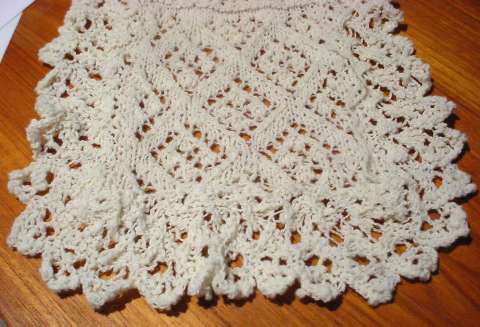
KNITTING AN EDGING ONTO LIVE STITCHES
Now. Back to the present.
Sallyknitter sends an eMail asking how one goes about attaching an edging to a row of live stitches. I’ll try my best to answer.
First, there are several ways of doing it. The simplest but most fussy is to knit the edging entirely separate, as a long strip – then sew it on using mattress stitch. Effective, but boring. Plus even using mattress stitch you can end up with a relatively bulky seam on the reverse compared to the rest of a gossamer-fine lace piece. I used this method on the two counterpane patterns in the wiseNeedle pattern collection, and on the tragic pink blanket now awaiting repair.
Having had my fill of producing an endless roll of edging, then an eternity sewing it on neatly, I now prefer knit-on edgings. They have the advantage of keeping one’s stitches securely on the needles until they are both edged and bound off in the same pass. Knitting them on is relatively easy. Let’s use an edging pattern I’ve described here before:
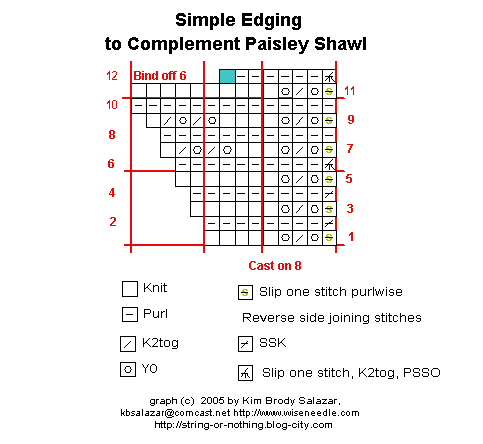
To work this onto the edge of a row of live stitches, I wouldn’t even need to break my yarn off after completing the last round of my main piece. Using a half hitch I’d cast 8 stitches onto my right-hand needle, adjacent to the last stitch worked in the main body. If I started with half hitch, I’d purl 8 back, working row 12 of the pattern, with the exception that the blue box would be a plain purl instead of the “artifact” stitch left over after binding off 6. If I were to use a provisional cast-on employing waste yarn, I’d cast on 8 onto a DPN or the left-hand needle, then work across starting with row #1, but working the first stitch as a plain knit.
I’d then work the rows of my chart as directed. You’ll note that on the final stitch of the even numbered (wrong side) rows, I purl the last edging stitch along with a live stitch from the existing edge. In the case of this particular pattern, given the row and stitch gauge difference, I found I had to “eat” additional live stitches as I attached, in order to prevent ruffling (which on some pieces can be a design feature rather than a bug). So on rows 6 and 12, I purl one stitch from my charted edging along with two live stitches from the piece’s body.
Now. What do you do if there aren’t live stitches? You pick them up. To knit the edging above onto a FINISHED edge, instead of purling the last even row stitch together with one stitch from the live body, I’d finish the even rows by picking a stitch up along the body of my finished piece. My odd numbered rows would then begin with a K2tog, knitting that new stitch together with the first stitch of my edging pattern.
Using these method, any edging from dead simple I-cord to elaborate lace can be attached to a live stitch edge or a finished piece. You can even use an edging to both finish and seam together TWO edges. I did that on these pillows.
I recently learned another slightly more involved method of knitting an edging onto a finished piece. It’s the one I use in the Spring Lightning lacy scarf (pattern elsewhere on wiseNeedle). More on that tomorrow.
WORKING REPORT- CRAZY RAGALAN
This was the entry that I was hunting for when I discovered my missing month. It describes crocheting onto a needle to start a provisional cast-on instead of just making a crocheted chain and picking up stitches along the back ridge of bumps. This was originally posted on 22 June 2004.
WORKING REPORT – CRAZY RAGLAN
Enough boring everyone with rehab junk. You came here to read about knitting, and not to visit This Old House.
I’ve ripped out the entire mindless knitting raglan and started again. This time I’m doing it in the flat, and working both pieces side by side. Because I hate seaming ribbing I’ve decided to add it later in the round, after I’ve sewn the sweater body, so I’ve started out with a provisional cast-on. I favor the crochet chain method of provisional cast-on, but I detest fiddling with the crocheted chain, picking up the bumps along the chain’s back. Instead I crochet my chain directly onto my knitting needle. Here’s how:
First I pick a nice smooth cotton string-type yarn, and a crochet needle a size or two larger than I’d use with it for a crochet project. In this case, I raided the Baby Georgia I was using for the filet knitting project, and grabbed a Bates F size crochet hook (more on hook sizing another day).
To start, I chain up about five stitches, just to have a stable spot to begin and an end to hold as I do so. Then I take my knitting needle and hold it like this:
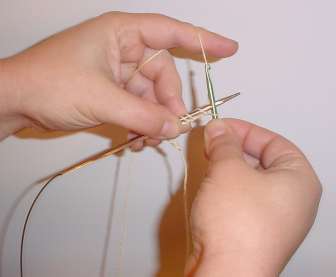
Holding the yarn in the back of the knitting needle, I reach up across the front of the knitting needle to grab the strand and form my crochet stitch. This lays a loop around the knitting needle itself, with the leading leg of the loop correctly oriented. After the stitch is formed, I use my left forefinger to flick the yarn around to the back of the knitting needle again:

Once the yarn is in the back of the needle, I’m ready to crochet on my next stitch.
I usually crochet on several more stitches than I need, just to be sure I have enough, and end off with five or six plain chains as insurance. Once the stitches are on the needle, I can switch to my knitting yarn and begin my first row of knitting. If I have more stitches cast on the needle than I need, I just slip off the excess. They become normal crochet chain stitches and sit quietly until the end of the project. No worries.
When it’s time to awaken the provisional stitches and begin knitting in the other direction, I find the last chain stitch I did (tie a knot in the dangling end if you think you might not remember which is which), carefully unpick that last stitch, then pull the strand to zip out the crochet stitch by stitch. As each knit loop is freed, I slip it onto a waiting needle.
Here’s my newly re-started raglan. Note that I’m knitting the back and the front at the same time. That way I am guaranteed that they match row for row and decrease placement for decrease placement.

I’ve done something here with the crocheted provisional cast-on that helps me keep life straight when working two pieces side by side. I’ve crocheted all of the stitches I need for both back and front in one long strand. First, following the procedure above, I made enough stitches for the back. Then I crocheted about ten free stitches without making loops on the needle. After that I made the stitches for the front, ending with a few extra chains. Using a different ball of yarn for each piece, I knit across first the front and then the back. The little bar of crochet anchors my two pieces together in the center and helps me remember which direction I’m going so that I don’t get to the half-way mark, then head back across the same piece instead of working the other one. (As the work gets longer I’ll safety pin the two pieces together closer to the top for the same reason.)
How did I manage to take the photos above? Not by growing extra arms, that’s for sure. So far all of the “hands working” shots on this blog have been taken by Alex, my 8th grade daughter. She may not knit, but she handles a mean digital camera.
VINTAGE YARNS
More goodies from the mailbag. Laura wrote:
I recently came across the Mary Francis Knitting and Crocheting Book. It is darling! Even though the credits don’t specify, I assume it’s a reprint of a book originally written around 1920. Woven within the story are quite extensive photo demos of knitting and crochet, along with many patterns for doll clothes, and even Red Cross knitting patterns. The text of the book describes yarns as 2-fold, 3-fold or 4-fold, and appear to be referring to what we would call ‘ply’ today–though perhaps more in the UK style. The book then goes on to say that yarns are named Germantown Zephyr or Germantown Wool (4-fold or 8-fold), Knitting Worsted, Saxony Wool, Woolen Knitting Floss, Teazle Yarn, or Angora Wool. Would you have any info on what the modern equivalents of these might be? Any references to point me toward? I did a google search, but mostly came up with “Bear Brand Germantown Yarns,” a few skeins of which have retired in my stash….It would seem that Germantown could refer to worsted weight or heavier (about a 3 or 4 in the modern number scheme trying to standardize the industry), Saxony might be more of a baby or sport weight (2ish, I suppose) and Knitting Floss might be more like Shetland yarns–lace or baby/fingering weight (1 or 2ish, I’m thinking).
I know there are lots of people now interested in older knitting patterns – everything from ponchos published in the 1970s through the truly vintage stuff going back to the late 1800s. The older the book, the harder it can be to figure out how to make the garment using today’s materials. Laura’s problem is a very common one for anyone looking at these older patterns.
I can’t claim to be an expert on this on this, but I have had a little bit of experience with legacy/historical patterns. From my limited exposure, Laura’s guesses are spot on.
For the yarns described in her book, Germantown’s closest equivalent is true worsted (not just something within the group system 3 or 4 designation; (the group system being a lousy method yarn classification – 2021 update and elaboration of my 2004 rant here). The closest modern yarn is Cascade 220 – a 100% wool that knits at 5 stitches per inch. Many patterns call for that size yarn to be doubled. I’ve had good results using either a true worsted, or even a lofty DK when the pattern calls for knitting with two strands.
Saxony was often used for baby items, knit on 15s or 16s. The modern needle size equivalent would be 00s or an size in between 00 and 000. I’ve had success substituting modern three-ply fingering or baby yarn. (4-ply fingering is standard sock weight, knitting at 28 stitches = 4 inches, 3-ply is lighter, usually knitting at 32 stitches = 4 inches.) Perhaps Jamieson Shetland Spindrift might work, being lofty and able to be knit down to that gauge. Brown Sheep WildFoote is one of the lightest sock yarns around now that Kroy 3 Ply is discontinued. Froelich Wolle Special Blauband is also on the thin end of the fingering spectrum. Much thicker and denser but machine washable is Dale Baby Ull. Knit tightly it might work, but I think that the Spindrift or Wildfoote would have a more historically accurate look.
I also suspect that Knitting Floss is lace weight. Skacel Merino Lace might make a good substitute.
Teazle, and Angora Wool are tougher. My suggestion would be to look at the needle size and gauge. Since most historical patterns don’t give gauge, are sized fairly small and fit FAR tighter than modern ones, the best way to figure out gauge is to look at the stitch count around the wrist or cuff rather than around the chest. Fit on wrists don’t change much, nor is ease generally a big factor there. Compare whatever you get to the wrist measurement of a modern piece – women’s small, men’s small, or children’s about size 6 for post-baby garments. Using that measurement roughly estimate how many stitches per inch the piece had just above the ribbing.
I’ve been working on this chart for a while, collecting historical yarn names and modern gauge/needle size equivalents. Also some suggestions on possible modern yarns. I started with some needle size data abstracted from Lois Baker’s highly useful comparative needle chart. Most of the historical yarn types I cite are from patterns before the 1930s. Note that these are not hard and fast categorizations, many yarns/needle sizes can slip up or down a peg. Also note that texture is difficult to match. I have no way of knowing if one yarn type was say, closer in feel to Spindrift than it is to Regia. Feel free to attach corrections/additions in the comments. I’ll update the chart body and put a link to it under ‘Reference’ at right.
For yarns from the 1950s through 1970s, VintageKnits maintained a very useful guide to fiber content and actual gauges of specific yarn brand names. It’s divided roughly by weight into several pages.
|
Historical Needle Size |
Modern Needle Size |
Expected Gauge |
Typical Historical Yarn Names |
Possible Modern Substitutes |
| 0.25mm | 1 ply Cobweb wool Cotton thread |
|||
| UK 24 | 0.5mm
US #00000000 (8/0) |
1 ply Cobweb wool Cotton thread |
Size 80 cotton | |
| UK 22 | 0.75mm
US #000000 (6/0) |
1 ply Cobweb wool Cotton thread |
Wool Floss Spool Cotton Knitting cotton |
|
| UK 19 US 18 Steel |
1.0mm US #00000 (5/0) |
1 ply Cobweb wool Cotton thread |
Size 50-80 cotton Jamieson 1-Ply Cobweb Wool |
|
| US 17 Steel | 1.125mm | 1 ply Cobweb wool Cotton thread |
||
| UK 18 US 16 Steel |
1.25mm US #0000 |
2 ply Lace weight Cotton thread |
Berlin Wool Briggs Knitting Silk |
Size 50 cotton Skacel Merino Lace |
| UK 17 US 15 Steel |
1.5mm US #000 |
2 ply Lace weight Cotton thread |
Berlin Wool, Andalusian Wool | Size 30 cotton Skacel Merino Lace Lorna’s Laces Helen’s Lace |
| UK 15 US 14 Steel |
1.75mm US #00 |
3 ply Fingering Light Fingering 30-32 st = 4 in |
Saxony, Shetland, Pompador, German Fingering, Alliance |
Jamieson Shetland Spindrift, Brown Sheep Wildfoote, Dale Baby Ull (knit very tightly), Kroy 3-Ply Most of |
| UK 14 US 13 Steel US 0 Standard |
2mm US #0 |
3 ply Fingering Light Fingering 30-32 st = 4 in 4 ply Fingering |
Saxony, Zephyr, | Jamieson Shetland Spindrift; Kroy 3-Ply
Most of the lighter weight sock yarns |
| UK 13 US 12 Steel |
2.25mm
US #1 (some) |
3 ply Fingering Light Fingering 30-32 st = 4 in 4 ply Fingering |
Saxony, Zephyr, Cocoon | Jamieson Shetland Spindrift; Kroy 3-Ply Dale Baby Ull (knit very tightly) Most of the lighter weight sock yarns Most standard sock yarns; Rowan 4 ply yarns |
| US 1 Standard | 2.5mm
US #1 (most) |
4 ply Fingering 28-30 st = 4in |
Saxony, Beehive, Penelope | Most standard sock yarns; Rowan 4 ply yarns |
| UK 12 US 11 Steel US 2 Standard |
2.75 mm US #2 |
4 ply Fingering 28-30 st = 4 in |
Beehive, Peacock, Penelope | Most standard sock yarns; Rowan 4 ply yarns |
| UK 11 US 10 Steel US 3 Standard |
3mm
US #3 (some) |
4 ply Fingering 28-30 st = 4 in Lighter sport weights |
Koigu; GGH Marathon; Zitron Libero |
|
| UK 10 | 3.25mm US #3 (most) |
Sport weight 24 st = 4 inches |
Louet Gems Opal Merino; Jaeger Matchmaker |
|
| US 9 Steel
US 4 Standard |
3.5mm
US #4 |
Sport weight 24 st = 4 in |
Louet Gems Opal Merin; Jaeger Matchmaker |
|
| UK 9 US 8 Steel US 5Standard |
3.75mm US #5 |
Gansey weight, 5-ply 23 st = 4 in |
Jumper wool | Wendy Guernsey 5 Ply |
| UK 8 | 4mm US #6 |
DK weight 22 st = 4 in |
Germantown, Zephyr, Saxony doubled |
Jaeger Matchmaker DK; Jo Sharp DK Wool; Most standard DK weight yarns; Most 4 ply fingering weights, doubled |
| US 6 Standard | 4.25mm | DK weight 22-21 st = 4 in |
Lighter airy worsteds, heavy cable spun DKs, most 4 ply fingering weights doubled Whatever can be knit to just under regulation worsted weight |
|
| UK 7 | 4.5mm US #7 |
Worsted 20 st = 4 in |
Germantown | Cascade 220 |
| US 7 Standard | 4. 75mm | Worsted 20 st = 4 in |
||
| UK 6 US 8 Standard |
5mm US #8 |
Heavy worsted
19 st = 4 inches Aran |
Most standard Aran weight yarns; Most standard sport weight yarn, doubled; Most standard mass market yarns labeled “Worsted” with on-label gauges of 19-18 stitches over 4 inches (10cm) |
|
| UK 5 (some) US 9 Standard |
5.25mm | Aran 18 st = 4 inches |
||
| UK 5 | 5.5mm US #9 |
Light bulky 17-16 st = 4 in |
||
| US 10 Standard (some) | 5.75mm | Light bulky 17-16 st = 4 in |
||
| UK 4
US 10 Standard |
6mm
US #10 |
Light bulky 17-16 st = 4 in |
||
| UK 3
US 10 1/2 Standard |
6.5mm US #10 1/2 (some) |
Bulky 15-13 st = 4 in |
Germantown doubled | Two strands of Cascade 220; Most standard worsteds, doubled |
| UK 2 | 7mm
US #10 1/2 (some) |
11Bulky 15-13 st = 4 in |
||
| UK 1 | 7.5mm | 11Bulky 15-13 st = 4 in |
||
| UK 0 | 8mm
US #11 |
Bulky 15-13 st = 4 in |
||
| UK 00 | 9mm US #13 |
Super bulky 12 or fewer st = 4 in |
||
| UK 000 | 10mm US #15 |
Super bulky 12 or fewer st = 4 in |
||
| 12.5mm US #17 |
Ultra 10 or fewer st = 4 in |
|||
| 14mm US #18 |
Ultra 10 or fewer st = 4 in |
|||
| 15.5mm
US #19 |
Ultra 8 or fewer st = 4 in |
|||
| 19mm US #35 |
Ultra 8 or fewer st = 4 in |
|||
| 25mm US #50 |
6 or fewer st = 4 in |
 String-Or-Nothing