TRANSLATING BETWEEN KNITTING IN THE ROUND AND KNITTING FLAT – Part III
[Repost of materail originally appearing on 12 June 2006]
We’ve looked at taking a pattern that’s been written for circular knitting and parsing it out for knitting in the flat. That’s pretty easy, as most items knit in the round are not drafted with much complex shaping. Texture designs and colorwork do impose limitations, as does some shaping. In most cases it’s a matter of identifying seamlines, then doing the math to apportion the existing stitches into pieces defined by those seams.
Going the other way is harder, mostly because of the range of complexity of shape that can be accommodated by knitting in the flat. In general, the simpler the shape, the easier a piece is to translate. Drop shoulder sweaters with backs and fronts that are nearly identical are a cinch. Stuff with waist shaping, darts, “>princess style seaming, or other tailoring presents special challenges. But in spite of shaping most things can be knit either whole or in part using circular technique.
Starting with something simple, the Spring ’06 edition of Knitty contains Jamesey, a pattern by Mary Neal Meador. It’s a nicely patterned simple men’s pullover, worked flat in knit/purl combos. There’s minimal shaping, and the texture pattern with no row count abberations or increases and decreases is easy to translate for in the round knitting. There’s one tiny bit in her Sideways Stitch description that bears paying special attention.
To work Jamesey in the round, I’d add the total stitches front and back. I would NOT modify the pattern to substitue a full pattern repeat for theextra non-pattern-repeat stitches at the leftmost and rightmost sides of the front and back unless I were very ambitious. Doing so is a refinement to be sure, but one that’s totally optional. Unless the piece was intended to be very fitted or the gauge was large, I wouldn’t eliminate any stitches on the sides that in a sewn piece would be eaten up by seam allowance. BUT if I felt that four extra stitches of width at my gauge WOULD make a noticeable difference in fit, I’d take the time to refigure the stitch counts without them (remember that this would have to be done all the way around the piece, on the body and sleeves both).
In general, first I’d begin reading the pattern and noodling out how to deal with it’s tougher parts. This sounds like a dumb thing to say, but I know lots of people who knit with the “headfirst off the pier” approach. They grab needles and yarn and start in without taking the time to work through the piece mentally and to make sure they understand it. While this step can be less intensive if you’re knitting something verbatim as written, if you’re translating between flat and circular knitting not taking the time to really understand the original can be fatal to your project. I’d also point out that if you are knitter who rarely reads ahead, you are far more trusting than I. I’ve found lots of patterns that were poorly written or confusing. At the very least, knowing ahead of time that rocks are in the stream makes the the rapids less of a surprise.
In this case I’d begin by casting on the stitches for the front, placing a marker, casting on the stitches for the back and working the pattern as written up to the tricky Sideways Stitch rows. I’d work the front to the marker, then the back to the second marker. Every row will be a right-side row, so the texture pattern – conveniently graphed out – would be very simple to follow. The piece would grow as a single tube until the Sideways Stitch rows.
Those rows are written up for back and forth knitting, and need a bit of examination to translate them. Round 1 is pretty easy – it amounts to working the pattern as described, but laying the stitches so that their front legs are in the back of the needle. This twists them. (If you’re unfamiliar with stitch mounting, you can pop over here.) The second row requires the knitter to work backwards the way he or she has come. In the case of knitting in the round, it would be simplest to turn the tube inside out and accomplish the directions as written, knitting counterclockwise around the piece until the starting marker was reached. BUT just before I’d do so, I’d wrap what would have been the next stitch if I were to have continued around normally. Wrapping this stitch, then when it is encountered later, working it along with its wrap will help prevent a little hole from forming. Once I’d done the second round of the sideways stitch, I’d flip my tube back out so that the public side was on the outside of the thing, then continue with the third row of the Sideways Stitch pattern.
Having accomplished the tricky bit, I’d return to plain old knitting in the round until I had gotten to the point where the sleeve would eventually be set. That point isn’t marked on the schematics, but it’s pretty simple to figure out in a drop shoulder piece. I’d take the measurement across the top of th the pattern’s flat-knit sleeve and divide it in half. Then I’d subtract that from the height of the body. When I’d reached the point where the bottom of the sleeve was to be sewn on, I’d have a choice. The easiest way to finish off would be to split the piece front and back, and finish each piece knit flat on the circ, using a separate ball of yarn for each one. However this is a return to knitting in the flat. For some people it might smack of defeat. Others have very different gauges when they knit in the flat – enough to make a visible horizon across the sweater.
The alternative is to steek. Remember the markers indicating the “seam lines” dividing the front and back stitches? I’d work up to one, cast on three or four stitches, then continue around to the other and repeat the procedure. This will add a couple of stitches left and right to the sleeve area. The body will be just a bit wider at this point, with the extra width being clear to spot. I’d work the extra in plain stockinette. I’d continue to finish out the body, perhaps following the simple neckline shaping directions verbatim (with the introduction of that second ball again); or perhaps knitting straight across that area in anticipation of forming the shape by machine stitching and cutting later. (We’ll get back to steeking in a bit).
Sleeves are easy in this piece. There’s simple shaping – increases at the left and right of the pieces at regular intervals, making them into simple elongated trapezoids. Again I’d cast on and join in the round – probably starting out on DPNs. I’d introduce a stitch marker to indicate the beginning of the round, and assort my stitches so that it wasn’t apt to fall off the end of a DPN. Then I’d work in the round, introducing my increases as paired increases on either side of the marker.
Once I had the sleeves and body done, if I had chosen to steek, I’d stabilize the extra stitches I introduced to the body tube. Some people do this with a line of slip stitch crochet or hand-embroidered chain stitch. I prefer to whip out my ancient Elna and run a couple lines of machine stretch stitch on either side of my intended cut line. I’d then cut carefully between the machine stitched lines to make my opening. If I were doing the stitch and cut method of making the neckline, I’d draft out the curve I wanted onto a paper template, pin it to my piece and machine stitch along its edge.
Although this sounds hard, mostly it’s figuring out how wide and how deep the neck area should be, then taking a piece of paper and folding it in half – marking the width and depth on it and cutting a symmetrical curve by hand to match. Paper is cheap so if it takes several tries it’s o.k. The alternative of course is to whip out the French curve or drafting program and produce a proper drafted piece. Either part of the paper can be used, although I do find using the smaller inner curve piece to be easier to pin out flat onto my knitting.

At this point finishing whether you’ve worked flat for the upper body or in the round for the whole thing is pretty much the same – sewing the shoulder seams and setting in the sleeves.
Now. What about pieces with complex shaping – waist nips or princess line seams?
Those features work more or less like the sleeves. I introduce a marker at the point where the seam line should be, then work the increases or decreases as directed, on either side of the marker in accordance with pattern directions. Areas where you are told to cast off can be harder. For example in the princess style schematic, at the head of the front body side panel in there’s a “blind end” where the body side panels terminate short of the sleeve. I suspect I’d have to noodle on that one quite a while, and the solution would require short row shaping. Not easy. But for the determined willing to experiment and rip back – not totally impossible, either.
I can’t cover every eventuality of shaping and its implications for translation from flat to round knitting, but I hope I’ve given you an idea of the general process.
Yesterday’s Post
I wasn’t claiming that the Knitters pattern was ripped off from mine. First of all, it’s not my pattern. All I did was slap a couple of ornamental stitches onto a well known published piece. I own nothing here. Plus traffic on this site is so low that it’s highly unlikely that anyone who saw something on String two years ago consciously repeated it. My post was instead more of a “neeener neener neener” piece, accompanied by gloating rather than accusational finger pointing.
TRANSLATING BETWEEN KNITTING IN THE ROUND AND KNITTING FLAT – Part II
Before I was overtaken by creeping Deadline Disease, I promised three things – some general principles on translating flat knit patterns to kntting in the round; a list of increase and decrease stitch equivalents for right and wrong side rows; and why someone would want to knit either way. That’s a bit much for one day. Even for long-winded me. Let’s start with the most subjective – why one would choose one style over the other.
To start off with I’l make some bold statements that kntting historians are welcome to debate. Knitting garments in the round was far more prevalent during most of knitting’s history. Think of socks, hats, and traditional sweaters – most of them were worked that way. Seamed knitting (knitting in the flat) appears to have taken off around the time that knitting made the transition from traditonal garment to fashion wear – roughly about the same time when written patterns became more prevalent. I believe it did so in order to conform better to fashionable clothing’s styles, tailoring and fit, and to allow greater reproduceability of results among an audience already familiar with sewn garment methods.
Why knit in the round?
- Simple, quick garment construction
- Simple pattern writing for boxy shapes
- Minimizes purling on stockinette pieces
- Eliminates (or minimizes) seaming
- Takes advantage of knitting’s inherent elasticity for fit
- Easier production of stranded colorwork
- Easier production of texture and lace patterns that require increase/decrease manipulations on every row
- Ideology (there’s a strong lobby of knitting purists that advocate it as the most natural or historically-connected way to knit)
- Fewer pieces to lose or match in gauge
- Flashing (color stacking of space dyed yarns) works better
- Easier to ravel back and add length or replace worn sections.
- If using one circ, fewer needles to use than knitting in the flat
Why knit in the flat?
- More complex and tailored garment shapes can be achieved
- Pattern writing for complex shaping is simpler for designers trained in garment construction theory
- Easier to adjust tif you need to produce complex garments in multiple sizes
- Seams can add structure and strength to a piece
- Smaller individual units can be more convenient to produce
- Intarsia colorwork is easier to do
- Eliminates cast on row join challenge, especially on fine gauge garments that employ large stitch counts
- Eliminates the at-join color jog problem (to be specific it substitutes a match stripes at seam problem)
- Can be easier to measure garments in progress to determine compliance with required dimensions
- In flight modification for fit can be simpler because problems can be spotted after one piece is made, and the entire garment does not need to be ripped back to make adjustments
- Easier to add width while the garment is in progress
- No scary DPNs or circs needed. Fewer needles to loose compared to DPNs, no DPN juncture ladder problems
- Straight needles are less expensive than circs, and multiple lengths needn’t be purchased. No need to have multiple diameters of the same size needle on hand to accommodate tubes of various diameters (required unless many DPNs, a two-circ or the oversized circ method is used)
- Easier to block pieces before final finishing stage.
I’ve probably left the reason why you chose one method or the other off these lists. Feel free to add it in a comment.
Each method has its own strengths and shortcomings. Each has styles for which it is particularly suited. And each can be manipulated to do most of what the other style is better suited to do. You can make faux seams on something knitted in the round. You can do stranded colorwork on something knitted in the flat. You can add shaping to an in the round piece through planned and judicious use of increases and decreases to mimic the fabric manipulations of darts or tailored seaming.
n many cases there’s logic in the choice of one method over another. Dale’s Norwegian stranded pieces are perfectly suited for knitting in the round. They employ strategies like steeking to place shaped collars or introduce other construction features. I’m sure people have done it, but I wouldn’t want to translate one of them for knitting in the flat – there’s nothing to be gained by doing so. Complex tailoring like this from a discontinued Berroco pattern would be a headache to render in circular knitting. BUT logic doesn’t always prevail. I have seen commercial patterns for stranded sweaters that ARE knitted in the flat. I’d take a hard look at them to see if I could produce them in the round. Likewise, I’ve seen all sorts of contortions and cutting done to circular knit patterns in the name of making them less boxy. Again I’d have to take a closer look to see if using an alternate approach was better.
While you’re far more likely to see in-the-round direction today than you were 25 years ago when I started knitting, you’ll still find that many fashion oriented magazines and yarn manufacturers booklets offer up more patterns for knitting in the flat than they do the other method. I’m thinking pubs like Vogue Knitting, Adriafil’s Dritto& Rovescio and most of the modern European books, plus the old Phildar, Aarlan, and Pingouin books.
As in so many things, ideology does play a part. You can find books written in the 1940s through 1960s that sniff at knitting in the round, calling it "peasant work" or noting it in passing as the dreary ancestor of more modern applications. And you can find books written by knitting revivalists that excoriate the torture of imposing tailored seamed construction on a medium that has so many virtues in its most simple form. I’m dogma-agnostic. I use whichever method is best for me to produce the project at hand. Which brings me to the real reason why I think patterns are written one way or the other:
- It’s what the pattern’s author/designer is most comfortable with
Overall though, the motivation to change something from flat to circular knitting is far more common than yesterday’s case. Anything with a rectangular construction and minimal shaping is a natural – especially sweaters with drop shoulders. The exceptions might be sweaters in yarns that are prone to biasing or stretching, or ones in particularly flimsy yarns or knit in very open textures. In those cases the structural integrity imposed by firm seams might be crucial to garment drape and longevity. I’ll look at this in more detail in the next overly long post.
TRANSLATING BETWEEN KNITTING IN THE ROUND AND KNITTING FLAT – Part I
HolidayInnEloise saw yesterday’s post and sent in a question via eMail. She’s not a fan of knitting in the round and wants to know if the Cabin Fever pattern I am using can be worked flat back and forth on two needles. She’s a bit confused by how to change a top down in the round sweater into a more standard format. I’ll try to answer.
First, while there are exceptions, most things that are knit in the round can be parsed to knit in the flat either in part or in their entirety. Many but not all things that are knit flat can be knit in the round. Like with everything in knitting, knowing the logic behind the design can help you make the transition.
To go from round to flat, there are two big things to take into consideration – the garment shape and the knitting texture or colorwork pattern used. In order to transform a seamless thing into a knit-flat thing, seams must be introduced. Sometimes figuring out where to put them can be a challenge. The sweater I’m working on now is of very simple construction, but even it presents a challenge.
Following the original pattern, I started by making a tube for the collar. After that there was a row of increases to add a bit more scope for the next step – symmetrical increases on either side of four diagonal lines from collar to armpit (the raglan lines). The piece proceeded more or less like a poncho or capelet until the depth of the raglan increase lines accommodates a loose shoulder toarmpit fit (along the way one is directed to stop making increases otherwise the piece would grow too wide, but that’s a minor quibble). After the capelet type shoulder yoke was done, the sleeve stitches were slipped off onto holders, and with the addition of a few extra stitches under each arm, the remaining stitches for front and back were worked as a big tube. After the body tube was completed, the sleeve stitches were retrieved from their holders and worked out to the cuff, with some decreases at the bottom center to remove bulk.
Thinking through the logic top down we’ve got a challenge right off the bat. To me, the turtleneck collar is a lost cause. No one wants seams on the inside of an already bulky turtleneck. That feature will probably need to be knitted in the round on DPNs. After that we’ve got the capelet yoke area, formed by the faux raglan style increases. The most obvious choice to flat-ify this part is to turn the unibody capelet back into four pieces – a front, a back and two sleeves – to be seamed together along the raglan lines as real raglans are.
To do this, I’d probably take the stitch count from the after-collar increase row just before the faux-raglan feature starts, and deconstruct it back into those four pieces. For example, I’d take the recommended stitch count for the front and add two selvedge stitches. These will be eated up as seam allowance when the garment is sewn together. Then I’d follow the instructions for the front area, working my increases as directed, but doing them TWO stitches in from the edge (one stitch to make the decorative line, plus the selvedge stitch for sewing up later). At the post-raglan point where the piece is long enough according to the original pattern, (when the sleeve stitches were slipped onto holders), I’d cast on one quarter of the total stitches that are to be added at the left edge of my piece and half at the right, then continue knitting to the specified total length. (Remember the original just gives one number to be added between what is the front and back. I need to divide that by four and put one quarter at each edge of my front. The remaining stitches would be added to the back.) I’d end up with an object shaped like a house with a Mansard roof. The other pieces would be made the same way. The back would be identical to the front. The sleeves would be similar but predicated on a smaller initial cast-on. I’d assemble the thing by first sewing the raglan seams, then the seam from lower hem to cuff. Finally I’d pick up my provisional stitches at the neck and add the collar.
But I’m not bound to do this piece top-down. I could also knit it in the flat bottom-up. I could divide the ending body stitch count in half (adding a selvedge stitch at either side to make up for a seam allowance) and working on half the stitches – knit the front and back flat up to the undearm. At that point, I’d cast off the stitches that were added in the original just after the sleeves were slipped off, removing one quarter at each edge. Then I’d start the raglan shaping. But in a bottom-up piece, that shaping will be formed by decreases rather than increases. To preserve the simple yarn over detail of the original I’d need to do a bit of playing. First I’d work an inch or two plain (in the original the raglan area ended before the piece was long enough to reach the underarm). Then I’d work the left edge of my piece K1, SSK, YO, SSK; and the right edge K2tog, YO, K2tog, K1. The K1s are the selvedge stitches. The [decrease] YO [decrease} unit adds up to a net loss of one stitch, with one of the decreases making up for the decorative YO. This won’t be exactly analagous to the original because the stitches framing the YOs will be heavier, but it will be close enough to preseve the general appearance. When I had the requisite number of YOs and my stitch count was equal to the post-collar neckline count (plus two for the selvedge stitches), I’d slip everything onto a holder and begin the next piece. The back would be made the same way.
The sleeves would start off with the final stitch count for the cuff, and along the way add a stitch at either edge right or left (I’d probably do M1 increases two stitches in from the edge at the ends of a row just to keep things neat when I seamed). I’d knit the same length below the raglan line that I did on the front and back, then plunge into the same logic to make the decorative raglan line itself. Once there were the same number of YOs in the raglan line of the sleeve I would guess that the sleeve’s upper dimension matched that of the front and back exactly (the open holes are more than decorative, they make the thing easier to count and measure). I’d slip the remaining stitches onto a holder and seam all the raglan lines. After that I’d sew the side seams and pick up and knit the collar in the round on DPNs.
Another alternate method would be a hybrid between flat and circular knitting. I’d work the front and back up to the point where the extra stitches are cast off, and the sleeves until they met the body to cuff measurement. Then I’d arrange them all on a circular needle, and finish out the couple inches of plain work followed by the raglan capelet yoke part in one big knit in the round piece. I’d still have seams to sew under the arms and from the armpit to the hem, but that would be it. (To do this, I’d eliminate the selvedge stitch that I added to the raglan edges in my first all flat knit alternative.
The second factor that might affect the transition from round to flat knitting is texture. In this particular sweater it’s not an issue. I’ve got miles of stockinette, a couple of rows of purl welting, and some K2, P2 rib. That’s it. In the round stockinette is "never stop knitting." Flat stockinette is alternate rows of knit and purl. No big translation problem there. However, if I had a texture pattern and the original was knit in the round I’d need to do the mental shuffle, turning knits to purls and vice versa for the odd numbered wrong-side rows. Having a texture pattern in chart format makes the right-side/wrong-side translation easier. I might even need to adjust the row on which the pattern starts so that the bulk of my increases and decreases end up on an easy-to-manipulate right side (knit) row. Yes, they can be done on a wrong side (purl) row, but then the problem of which increase or decrease when done on the purl side mimics standard right side row stitches intrudes. All exist, but many are puppy awkward to do (more on this tomorrow).
Colorwork in the original can also present a challenge. Many people find stranding easier in the round. You always have a right-side row facing you, and it’s very simple to see the design build as you knit. Stranding can be worked flat too, with every other row a purl row. It’s harder to see the pattern on the purl side, and some folks don’t enjoy manipulating multiple strands while making purls.
So there you have it. The first thing to do is to examine the original in the round pattern and see where seams would go. The second is to look at the texture or color pattern used to see if it can be comfortably translated. Once the individual pieces are determined, the cast on numbers can be derived from the original pattern (half for the front, half for the back, plus an optional selvedge stitch). Then it’s just a matter of knitting and seaming.
Tomorrow I’ll look at going in the other direction, what the equivalents of standard increases/decreases are if you do them on the wrong side, translating flat knitting into circular knitting and why one might want to work in one style or the other.
MR BUNN’S FIRST LESSON – USING A McMORRAN BALANCE TO DETERMINE YARDAGE
Some people have asked how Elder Daughter (about to be 15) did all the math that led up to her bunny’s pirate sweater. I don’t think they were asking how she was able to accomplish the task in the first place, but instead, what methods she used. All those numbers sound daunting, but it’s really not that hard if you take it step by step. I wanted to to do as many steps as possible, so we started out with as little information beforehand. Here’s what she did, taken in large part from the write-up that was on her poster.
First, as I said – I was evil. I gave her a lump of yarn without a label.

Now I knew what it was, but Evil OverMoms don’t tell. The first thing she did was determine how many yards of yarn she had. Here’s her write-up (the spacing on the equations is a bit squirrely because they were exported from MS Word’s equation editor):
First, I had to find the total weight of the yarn. Using a scale, I found I had to 225 grams of yarn, total.
Then, I turned to a precision instrument to help me. The McMorran balance is designed to determine yardage per pound. The formula that comes with the balance requires the user to first find out how long a piece of yarn is needed to make the balance register level. My balancing length for this yarn was 9.75 inches.
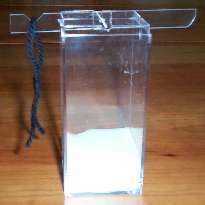
The next step is to use the formula that comes with the balance to determine yards per pound (YPP):
In my case
My yarn has 975 yards per pound, but I needed to find out how many yards were in 225 grams. The formula to convert grams to pound is:
Plugging in my values I find out:
Now I multiply YPP times my weight in pounds:




And so Elder Daughter defeated the first yarn demon, and determined how much yardage was contained in her tangle – a whopping 482.6 yards. I’ll post more in this series when she brings her poster home and we can scan her drawings. For the record, McMorran Balances also come in a metric version. But I have the Imperial unit one, and it was more fun to make sure she did as many conversions back and forth as possible.
SHORT ROW HEELS – THOSE LITTLE HOLES
I promised to describe how I avoid those small holes that can form at the top of the diagonal line of joins formed by short row style heels. Please bear with this household’s limited photography skills. Those are my hands. Elder Daughter (now 14) is manning the camera.
To start – here is my sock, worked toe up on five needles. Each with the same number of stitches on it. This sock is ideal for illustrating this process because I have planned my sock foot depth to hit at the points of color change. It’s easier to refer to stitches by color. Apologies if you’re color-impaired.
I have just completed the knit side row in which I have knit together that last wrapped stitch along with the wraps at its base. There are no more stitches "in front" of me, waiting to be wrapped. I’m ready to rejoin the body of the sock. But before I do so there’s one last step that needs to be done with the leftmost heel needle and streteched out stitches in the interstice between the heel needle (green and white stitches) and the body needle (orange stitches). I’ve put down my empty needle and am about to do this next step using the needle bearing the green and white heel stitches.

In step two, you can see that I’ve gone one round down below my active row and am in the process of picking up one stitch, using the tip of my heel needle.

Step 3 shows that picked up stitch (light green), safely parked on my heel needle. At this point, my just-completed heel needle contains ONE MORE stitch than all of the others. After Step 3, I pick up my fifth needle and knit across the first then second needle bearing my top-of-foot stitches.
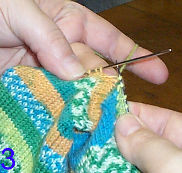
When I get to the other side of the top-of-foot stitches and have my fifth needle poised to start working up the right side of my heel, I pause. There are two anomalies on this side. First – we’ll need to do the same pick-up of one stitch as we did at the end of the first heel needle. The second is a bit trickier. If you look closely, you’ll see that because I launched directly into my first full round after re-activating the last wrapped heel stitch on heel needle #1, I never got back to the commencement of the heel to re-awaken the rightmost heel stitch on the other heel needle. You can see it below, noosed by its blue wrapping stitch. THIS IS O.K. NOT TO WORRY. We’ll deal with it as part of this side of heel.

Now (in spite of blurry pix), you can see that using my empty fifth needle, I am picking up one stitch in the row below the first stitch on my heel needle. It’s light green, and is being formed in the orange stitches below the start of the turquoise heel stripe.
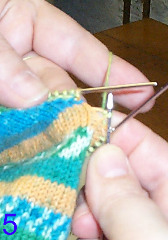
Next is the wrapped stitch cheat. In the shot above you can see there are actually two wraps on this first heel stitch. One is blue, one is green/white. The blue stitch happened first, and is lower on the carrying stitch than is the nearly impossible to see green/white one. It is extremely difficult to work both of these wrapped stitches along with the carrier. So I cheat. I lift the lower wrap (blue) and place it on the end of my heel needle. Then I knit it and the carrier stitch together, ignoring that other green/white wrap. UNLESS THEY’VE READ THIS CHEAT, NO ONE WILL EVER NOTICE THE OMISSION. It will have no effect on sock wear, or the presence or absence of that litle hole.
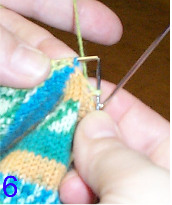
Now because I’ve picked up a stitch on this needle too, I have two top-of-foot needles that each bear my original number of stitches, plus two heel needles that each bear my original number + 1 stitch. On this next round I take care of that. I work across heel needle #1, taking care to do a SSK on the last two stitches. I’m now back to my original count, and have eliminated the gusset hole on this side of the heel. I work across the top of the foot stitches as usual. When I get to the other heel needle, I knit the first two stitches together. Again I’m back to my original count, and have snicked up any potential hole on this side. Once I’ve completed this "remedial decrease" row, I consider my heel complete and go on to do whatever I feel like for the ankle.
Here’s the result:

ANOTHER SOCK QUESTION – WEIGHING THE SKEINS?
Linda writes in with a sock-related question.
Do you weigh your skeins/balls of sock yarn before you start?
She goes on to point out that she weighs her sock yarn that comes in "makes a pair" size balls (usually marked at 100g). Because (like me) she knits for big feet, she is also often afraid that she’ll run out if she makes sock #1 too large. Weighing the remaining yarn as she knits sock #1 tells her how close she is to having used up 50% of the total.
It’s a good idea, but I don’t do it. Mostly because the lousy kitchen scale I have at home isn’t precise enough for the task at hand. That and laziness. Also at this point, trust. I know that a 100g ball of yarn is plenty for a pair for me, even with my clown-sized feet. and that if I knit the foot to fit, then knit the ankle part as long as the foot, I’ll have enough left over for 2 inches of ribbing. That doesn’t mean I don’t get nervous. I do. Sometimes I do run short. So I suppose I really should go out and buy a decent scale…
This brings up Linda’s second observation. To paraphrase:
Sometimes the ball weight is less than the label states. My ball of Sockotta I just started is labeled 100 gms but weighed in at only 94 gms. Maybe my scale is wrong…
While a calibration or accuracy difference between any two measurement devices is always a possibility, perhaps her scale isn’t wrong. Yarn weight is measured under "standard conditions." Presumably if Linda was experiencing the same set of conditions (most specifically – humidity), her ball of yarn would weigh the full 100g. It’s also not entirely unknown for distributors to offer products that hit the exact mark only as an over-the-lot average, with some balls being heavy and others light. Certainly not optimal but not uncommon either. Inconsistent yardage has been mentioned in the wiseNeedle yarn reviews (sample: Diana, Dulce, .Manos, Melin, Tibet). Finally there ARE some yarns that are consistently short of the listed yardage. That’s a big flaw that has also cropped up a few times in the yarn reviews posted on wiseNeedle (sample: Superwash 12 Ply, Nature Cotton).
Should one expect every skein to hit the 50g or 100g (or whatever mark)? Under ideal conditions, yes. But I doubt it will happen often in our imperfect universe. My solution to the problem is on larger projects – to buy that extra skein as insurance. I’ve dipped into my insurance yarn often enough to make it a standard part of my yarn purchase planning.
THAT TWIST JOIN PROBLEM
Several people wrote to express surprise and/or commiseration that I was struggling with the join-twist problem on my camo-flash tee. It’s an easy problem to have, and one that’s not limited to beginners. I find some things exacerbate the chance of twisting:
- Having too many stitches for the needle’s circumference
If the stitches are jammed onto the needle they have a tendancy to ruffle the cast on edge, no matter what cast-on is used. Even more so if the cast-on edge is narrow. That’s why I ended up knitting several rows of stockinette in waste yarn. That gave my "cast-on row" some bulk and weight, and helped sort out the ruffle
- Using a circular instead of a flock of DPNs.
Now most people will disagree with me on this one. DPN fear runs deep. But I at least find it far easier to tame an in the round cast-on row if it has been done on several smaller straight needles than on one circ (or two circs). A couple of factors here get in my way with the circs. First, even if they’ve been carefully de-kinked using the hot water method, they still curve. Second, they are not uniform in girth around their entire circumference. Stitches twist more on the skinny cable part than they do on the fatter business ends of circs. Using DPNs all the stitches are held on areas of uniform thickness. I usually cast onto my DPNs in sequence, then lay the entire work out flat on the table, in a rough circle, making sure each needle’s cast-on edge is turned to the inside of the circle. On DPNs that edge stays where I want it, held in place by friction on the needle’s thickness. Circs aren’t as easy to sort out this way. The stitches on the skinny part twist every which way, and the springy cable parts themselves rebel at neat alignment. Keeping two circs in proper orientation is even harder.
- Lots of stitches in the absolute
The bigger the piece, the harder it is to keep the stitches in alignment. The hardest circular cast on I ever did was on a cardigan I knit for my grandmother. It was black, with an originalstranded pattern in white in the traditional Fair Isle yoke area. It was also in fingering weight acrylic (a slippery yarn) as she specified "easy care" for the gift. At 8 spi I had something like 340 stitches around. And around. And around…
So for the most part, I use DPNs to start off circular pieces. Even adult circumference sweaters. I do use a couple of tricks though.
First, unlike this piece, I do not often start out with a provisional cast-on. The need to go back and work the live edge later did introduce an element of complexity, and until I did the waste yarn thing, made an even more ruffly than usual bottom edge. This in turn made keeping it sorted out more difficult. For large circumference pieces, I usually use a tubular cast on, similar to the method Kris described in a comment on yesterday’s post. I use straights, and using a provisional cast-on, create half the number of stitches needed. I knit five or so rows in plain stockinette. Then I unzip the provisional cast-on and stick a second straight into the newly freed stitches, making sure that the points of both straights end up on the same edge of my now suspended strip of knitting. Next I fold the strip in half, and using a third needle (often in this case, a circ), alternately knit one stitch off the needle in front and purl one stitch off the needle in back. This gives me a sturdy and attractive edge, and enough of a bottom ridge that when joined into a round for circular knitting, avoids the twist problem on the first truly circular round. If people are interested in pix of this, I’ll try to take a demo sequence, but at this point I’m sure the tubular cast-on I describe can be found on photo how-to sites elsewhere.
My second trick is casting on using long DPNs. I adore Euro-style extra long DPNs, and buy them whenever I see them. My collection is far from complete, and the sizing and set numbers are a bit strange because many of my finds are yard sale orphans or even "antique" British needles that originally came in sets of only three. Even so, I do have several DPN sets in the 12-18 inch long range. Theyr’e very convenient for casting on, even if they end up being a smidge off standard sizing. A half or quarter size down is usually a good thing if casting on wool, to control stretch; conversely the same amount larger can be useful in casting on cotton or linen to introduce a bit more ease in a tight initial row.
Some people swear by using a contrasting color for the cast on row. As you can see from my problems with this project, having a white row at the bottom of a mostly-green piece didn’t help much. So there you have it. Reasons (not excuses) why this problem plagues so many people at all levels of expertise.
FLASH DANCE – PART II
Yesterday I wrote about establishing the flash value. Today I write about what might go wrong while you’re doing so.
First, there’s the gauge problem. When I do it, the gauge of the row that I pick up off the provisional chain isn’t exactly the same as my plain old stockinette gauge. The waste yarn choice or tension of how I knit that first row can cause all sorts of oddities. This is especially true for me when I use larger size needles (anything over a US #3). As I knit the second row I might find my color alignment drifting because there are too many or too few stitches in the pick-up row. Not many, but enough to throw things off. For example, row two might hit a designated color change point several stitches before that same spot appeared on the cast-on row. If that happens I might cheat on the knit row immediately following my cast-on. If I see the color repeat drifting too much to the right, I might knit two stitches together. Conversely, if I "over-run" a color match point, I might rip back a couple of inches, then do a make-one to add a stitch, bringing the target sploches into better alignment.
I do however have to take care if I change the stitch count. If you look at my parrot-color sweater, you’ll see wide swings where the colors lurch from side to side. That’s normal. Two things make the zig-zags happen. First, one’s tension is not always uniform. Most of us have near imperceptible changes in gauge as we sit through a knitting session. We knit more tightly when we sit down, then loosen up a bit as our hands relax. Finally when we get tired, we tighten up again. Tighter knitting migrates the colors to the right. Looser knitting migrates the stripes to the left. I knit my parrot sweater’s body in two sessions. They’re easy to pick out.

Hand painted yarns also have a playful imprecision in color placement. They are never as regimented in their color placement as machine printed yarns (sock self-stripers). That’s the second factor, and what makes the edges of the stripe so step-like. Color segments seep into the hank at different rates at different places, yielding different saturations and slightly different lengths of the color segments from strand to strand. And some blobs may not go all the way through the hank and may seem to disappear after several repeats.

You can see clearly, above. Look at the 8:00 position on my skein. There’s a spot of brown. It encroaches on the teal and bleeds into the khaki, but doesn’t do it uniformly through the hank. It’s most evident on the top of the skein. Underneath it looks like the teal touches the khaki directly, with no intermediary fling into brown at all.
This brings me to the second thing that can go wrong. Not every hand-painted skein is ideal for this type of knitting. The longer the repeat and wider the individual color splotches, the better suited a yarn is for flashing. My new yarn is borderline. I expect some parts will align nicely. The big teal areas show special promise. I am expecting the brown and khaki bits to dance between the teal areas because they are so short and so haphazardly sized. I am not going to get the clear zig-zag stripe of my parrot sweater. Instead I’m expecting something with more of a softer forest floor/camoflauge look.
UPDATE: The third factor that limits flash is generated by how the skein is dyed, in conjunction with the total garment circumference. Strands that are adjacent in the original hank when it was dyed are more likely to be close or near-close matches than are strands that are further apart. If you have a garment that’s small enough to be traversed around by only two repeats, the color stacking you will see will be much more in alignment than will a garment knit from the same yarn that takes five full repeats to complete one round. That’s wny it’s not uncommon to see flash kits for toddler sweaters but less common to see them for adult sizes. If I were into dyeing and wanted to aim for flashing yarn in an adult circumference, I might try winding my yarn into hanks that are significantly wider around than the sizes most commonly used.
Now after several fits and starts of my own project – all the result of the pitfalls outlined abouve (you have to be willing to rip out several times if you’re going to start a flash sweater), I think I’ve got the stitch count thing down. I hope to have actual pix of it in the next post.
FLASH DANCE – PART I
First a cool thing: stud earrings in the shape of the end buttons from old Susan Bates US #1 straights (bottom of the page).
Flash Dance
I’m working with my latest yarn present – the hand-dyed cotton brought home from Arizona by the Resident Male:
My goal is to turn it into a t-shirt that flashes. By that I want to have the color segments line up one on top of each other so that the finished product looks like it was painted:

Based on new yarn’s look and circumference, I’m reasonably certain that I can do this, but two questions remain.
- Will the final dimensions dictated by having to use full multiples of the skein length for each round of knitting be useful sizes. In other words, my final sweater size will be dictated by how many stitches it takes to achieve flash. Will that size fit?
- How does one go about figuring out how many stitches to cast on to achieve this effect anyway?
The two questions are closely related. This skein is similar to a yarn I’ve used before. In that yarn (not the one above), it took about 60 stitches to consume an entire repeat (give or take). At five stitches per inch, that works out to about 12 stitches of linear knitting per repeat. A flashing garmet knit from that yarn could be roughly 24 inches, 36 inches or 48 inches around. 24 inches would be too small for Younger Daughter, but a 36-inch sweater will Older Daughter. 48 inches will fit me.
But will my new yarn hit that target. Not closely enough to be absolutely certain. This skein is a tad smaller in circumference than the old one. (To determine the skein diameter of the old one, I took my balled up leftovers and wound some around my swift, lining up the color slices. When the colors aligned, I knew I had "reconstructed" the original skein’s width.) The old skein was about a full yard in circumference. This one is about 30-31 inches so I’d expect that the color cycle would be smaller. For a rough approximation, I divided 36 inches by 60 stitches. I get about .6 inch of yarn consumed per stitch. That seems a bit high but not outside of reason. 30 inches "eaten" at the same rate would result in 50 stitches. I suspect that my flash value will be somewhere in the 50-stitch neighborhood. Five repeats of 50 stitches and a gauge of 5 stitches per inch would yield a garment circumference around 50 inches. A bit big, but not outside of wearability.
Now all the math theory in the world can’t substitute for actual experimentation. Having done the base noodle work, it’s time to try it out. I know that whatever I end up knitting, I will want to be as yarn-economical as possible. It might be necessary to eke out my limited amount of flash yarn with something else for ribbings or edgings, so I’ll start with a provisional cast-on.
I like the crochet chain provisional cast-on, preferably worked right onto the needles to avoid the fiddly bit of picking up stitches in the chain’s back bumps. I cast on far more stitches than I needed because with the crochet chain cast-on, you can slide any excess off the needles (or not pick up in the bumps) with no adverse effect on the project. So using a plain old bit of cotton string for ease of removal later, I cast on about 270 chain stitches and set it aside.
Another complication. In a screamingly bright color combo like the parrot sweater above, it’s easy to figure out where a color cycle begins. That yellow is killer and can’t be missed. My new yarn however contains colors that are much closer in value. There are three repeating segments per full cycle: teal, khaki, brown. How will I know when I’ve gotten back to the beginning point? Having wound my yarn into a big ball already it is no longer obvious where the cycles end. An artificial flag is necessary.
Just like I did to determine the skein length of my old yarn, I hauled out the swift again, and re-wound several turns of my new stuff, taking care to adjust the swift until I could align my color patches. I put a safety pin into the yarn at the end, and another into the yarn five turns (five full cycles) later, making sure that both pins marked matching spots in the cycle. I now had five repeats marked out. Starting with the point marked by my pin, I began to knit the loops off my provisional chain and continued until I cit the second safety pin. Counting up, I had about 260 or so stitches on my circ before joining. Or so? Why the imprecision? Am I ready to knit off happily watching the flash pattern grow?
Not exactly. Tune in tomorrow to find out why, and what I did next.
WASH FIRST/KNIT FIRST
Tracey asks if I plan on washing my Webs-acquired Highland Tweed before I work with it, or if I plan on washing the sweater after it has been knit.
I think in this case, I’ll wash my yarn first. A couple of years ago, I knit something in a yarn that like the Highland Tweed was full of whatever they use to make machine spinning easier It was a cone of some unidentified 100% wool I got at the old Classic Elite mill end store. I swatched it up, got gauge, washed the square, re-gauged and knit up Flor’s gansey pullover for my older daughter. (Flor’s pages are off-line, but the pattern can be found in the Internet Archive.) Then I washed the thing. I was never quite pleased with the fit. The yarn relaxed and fluffed out a bit, but looked "strangled" in the sweater. Proportions shifted slightly in unexpected ways. I’m sure if I had taken the time to wash the yarn first, then take a gauge on it rather than doing the lazy route, everything would have worked out better.
That being said – how to wash yarn? It’s easy.
I take my swift (or two chairs back to back in my pre-swift decade) and wind a fair bit off the cone. Then I’ll take some cotton string and loosely tie the newly made hank in two or three places. I note that many hanks I buy are tied in a two or three "stitch" manner rather than in one big clump. It looks like the person who did it took a length of tie string and looped it around the accumulated hank. Then, he or she bunched up about a third of the hank’s yarn and plunged one end of the tie string through the thing from top to bottom, and the other end through at the same spot, from bottom to top. Then they grouped up the next third, and repeated the process. The whole idea is to keep the yarn in an easy to unwind hank, but not tie it so tightly that the yarns rub up against each other and encourage fulling.

Once my hank is loosely tied, I’ll wash it the same way I wash my finished items. I’ll fill my washing machine part way with cool water and add a wash agent. Right now my favorite is Kookabura Wool Wash, but I’ve also used Eucalan in the washer. If I were doing this OUT of the washer in a tub sink or bucket and had no wool wash to hand, I’d try a liquid dishwashing detergent or inexpensive shampoo. Warning though, adding either dishwashing liquid or shampoo to a washing machine can mean a Lucy Moment as you deal with the resulting overflow of lather.
With the washer’s wash cycle off, but with the wash agent mixed well in the water, I submerge my hanked yarn in the tub and let it soak for a while. I might swish it a bit very gently in the water to encourage the process but I don’t turn the washer on, or otherwise squeeze, rub, or agitate the yarn mass. Once the yarn has soaked for a bit (usually about a half hour, or until I remember I’ve put it in), I advance the washer dial to rinse. I let the machine empty, then refill partway with the SAME temperature water in which I did the wash, but stop it before agitation begins. I let the yarn sit a bit in the cleaner water (again with perhaps the most gentle of hand swishes), then advance the machine to final spin. This time I let the water drain out and let the machine go through its final spin, to fling as much water out of the yarn as possible.
After the wash I take my hanks and loop them around plastic hangers, then hang the hangers somewhere to dry. Over the shower rod with a towel underneath is fine. The trick is to find somewhere out of direct sun that’s un-humid enough to encourage quick drying. My basement in this case is right out, as it is too damp down there for quick drying. On a very humid day I might direct a fan to blow at my drying hanks in order to speed the process.
Am I doing this right now? Not yet. I admit I’ve been sidetracked (the story of my knitting life). I’m playing with the nifty cotton I described yesterday, messing with gauge measurements and stitch count, trying to establish my flash dimension. It’s a bit harder than before because although the yarn has the right dimension and color placement to flash, the color set doesn’t have a wildly obvious marker like a screaming orange stripe. A visually distinctive bit helps eyeball where the repeats should overlap. More on this as I work the problem through…
 String-Or-Nothing
