DOUBLE RUNNING STITCH LOGIC 103 – ACCRETED AND HYBRID APPROACHES
Accreted Section Double Running Stitch Logic
I promised to discuss a second logic for double running stitch. I call this one “accreted section” and use it for the more complex patterns, especially non-linear ones.
What’s a linear pattern? Pretty much any of the banded strapwork style strip patterns I’ve been using on the Do-Right and Clarke’s Law samplers. However the phoenix from Do-Right is distinctly non-linear:
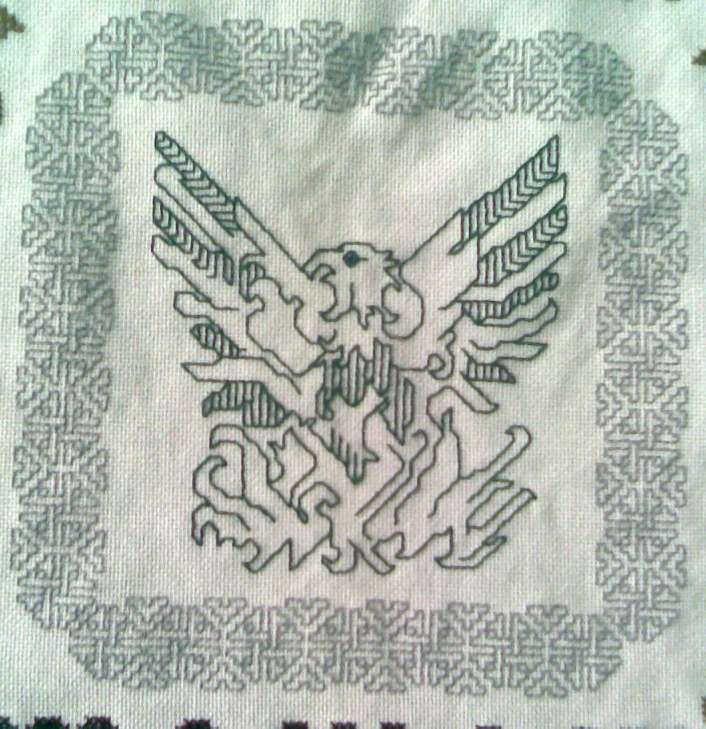
I could work the phoenix using the baseline method by identifying one of a zillion possible baselines and following it in the usual way. The outline would make a good baseline:
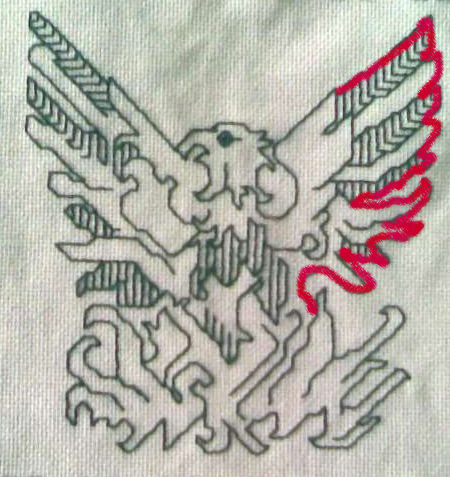
If I were to use baseline, I’d start at a point on the outline, then work in the indicated direction, following the little detours as I came to them. But in this case there are LOTS of detours. It’s too easy to get lost. For example, If I were to start at the indicated spot at the base of the flight feather, then continue up to the wingtip, it looks like I’d be following the little striations on the first feather. Not too hard. Little lines and hatchings like these make the pattern easier to follow because they can be easier to count than straight runs of stitching with few reference points to use for location verification. BUT I have a lot of possible detours. It’s very easy to start the feather with the stitch from the feather base to the first striation, then verge off down that bit of shading to the lower part of the wing and from there get lost in the body.
I find it easier to break up patterns like this into logical units:
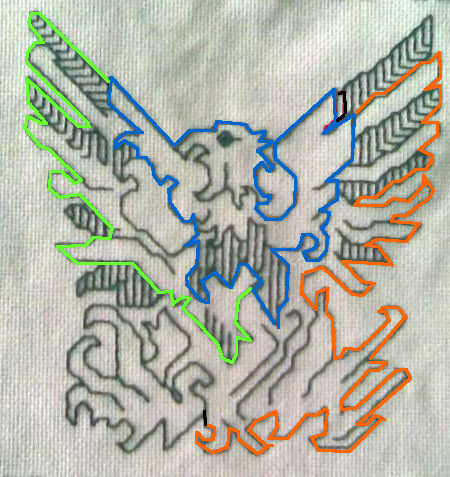
Purists will note that the blue segment might be considered a baseline, with the other elements as detours off of it, but that’s quibbling. For me at least, parsing the pattern into three units helps keep me on track. When I stitched this I started with the blue unit, working the bird’s neck and breast detail as departures from that line. I did have the luxury of not needing to do this piece double sided, so I did begin a new strand to work the green section, stitching the feather striations and other connected bits as I went along. The same with the orange section. I did that last, again working the feather stripe and flame detours as I came to them. The flame section at the pattern’s bottom left is a closed loop departure off of the orange line.
Baseline First/Hybrid Logic
So far I’ve established a visual baseline, then worked along it, stitching all departures from that baseline. The last step has been to stitch back along the baseline to complete the work. But sometimes it’s better to stitch the baseline first. Occasionally I work a pattern that way – making my first pass along the baseline to outline or otherwise establish the location and veracity of pattern placement, then working the details or fillings on the second pass:
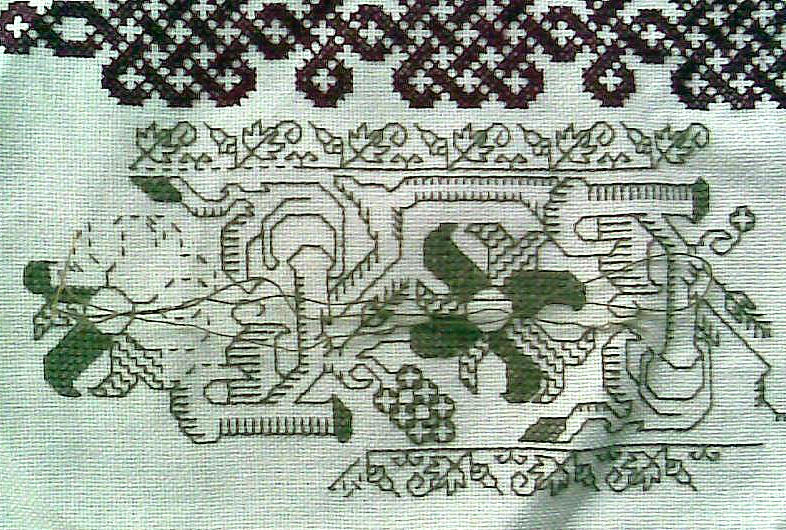
You can clearly see that I did that on this strip from Do-Right. I started with a baseline that outlined the flower, then on the second pass, filled in the petal details. In this case I worked using a hybrid logic. Instead of establishing one baseline for the entire repeat, I worked it more along the lines of the accreted method above – isolating the flower, then the branch from which it buds, and then the branch segment that connects this flower to the next (flipped) repeat.
For some very wide patterns, this mixed approach works best, especially if you’re using an in-hand tambour style round frame. With a round frame the area that’s taut and ready to work is quite small. Large repeats easily occupy more than the space at hand:
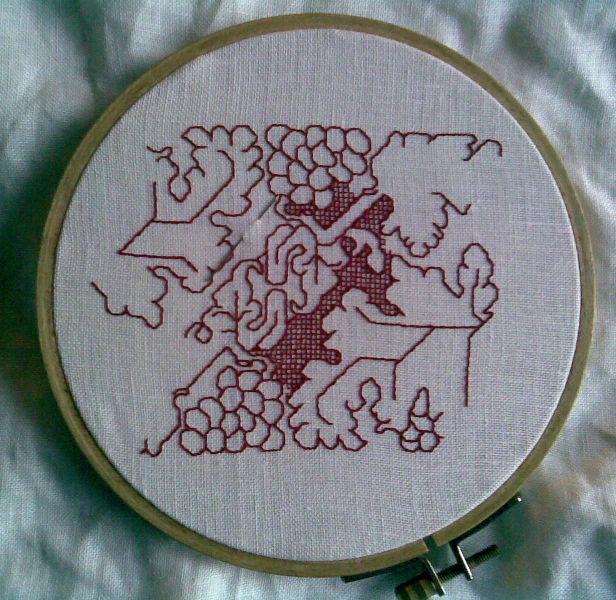
Being limited to the frame’s real estate lends itself to this compartmentalized, hybrid approach.
Having the luxury of using a flat, slate, or roller frame that provides acres of tautness makes a sprawling approach easier:
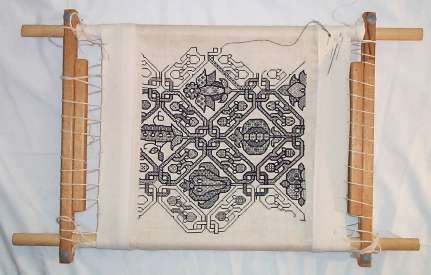
In any case, this concludes the series on double running stitch logic. Please feel free to ask questions. I don’t pretend to know it all, but chances are I’ve faced some of the same stitching problems that might be challenging you, and I’d love to help.
DOUBLE RUNNING STITCH LOGIC 102 – WORKING FROM THE BASELINE
Well, with luck this mini-series will be useful to someone out there. There is someone out there, right?
Continuing from the last post, now that we’ve figured out that our design can be worked double sided, and we’ve identified the baseline, how do we go about the stitching? What logic can we follow to ensure that no areas of the pattern are orphaned, and that all lines are covered?
The method most often followed is the baseline method. The other I’ll call “accreted section” and deal with it in a later post.
BASELINE
I find baseline to be pretty easy – nearly foolproof, provided the stitcher can remember the nested logic of detours-within-detours encountered along the way. Some stitchers keep a paper copy of the design, and overtrace it to keep track of where they’ve been. Some use a paper copy to try out their logic before committing needle and thread. I have to admit I do neither. I just go for it.
Let’s look at this pattern. It’s from my very first booklet on Blackwork, a hand-drawn photocopied piece done in my teens and distributed entirely within the SCA. I know I got this particular design from a historical source, but my original annotation wasn’t complete enough for me to include in later books or in fact to find the source again, so this design has sat on the shelf ever since. I’d consider this one to be a pattern of intermediate complexity, but well within the reach of most beginners (click on pix below for enlargements).
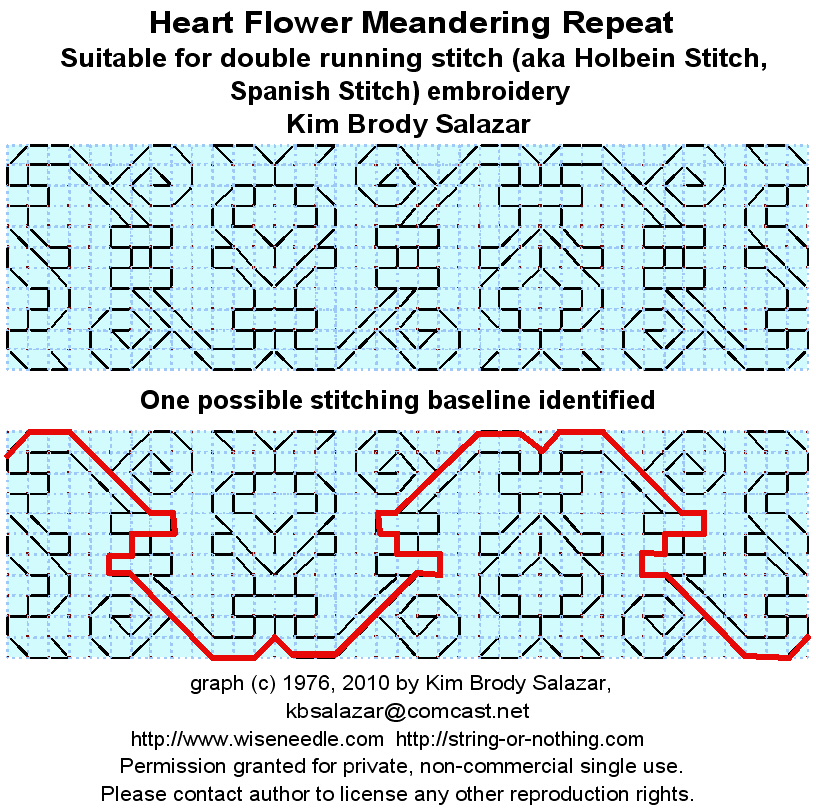
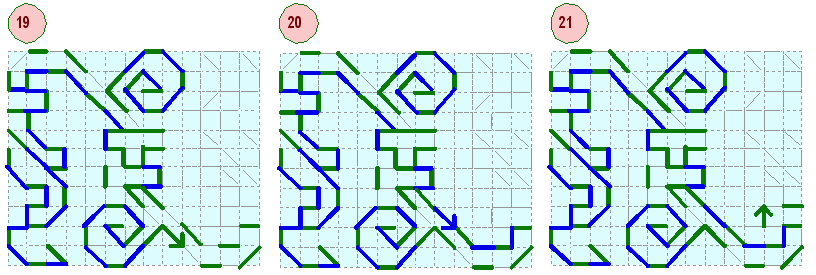
To parse out the stitching logic, let’s look at a half repeat. I’ll illustrate the entire stitching path for one half repeat. The logic to complete a whole repeat is very much the same. In the pix below, green indicates my first pass of double running, and blue marks a return path, in which I retrace my steps. The first stitch and its direction in any pass or return is marked by an arrow. Click on any of the drawings to enlarge. And please keep in mind that the method below is just one of a huge number of possible paths through this particular pattern. Path planning and trying out different strategies is what keeps this style of stitching fresh to me. Which is to say there’s no guarantee at all that I work every repeat in exactly the same manner. YMMV.
To work this design double sided, I’d start along the baseline leaving at least three inches of thread extra on the back (no knots). I find it helpful to wind the excess around a pin placed in an inconspicuous spot. I travel along the baseline (1) in double running stitch until I encounter a branch. My preferred logic is to then follow the branch to its end, then turn back and fill in the “every other” running stitch, to eventually return to the baseline (2). Then I continue on to the next branch decision and follow that detour (3).

In this case I’ve gotten to the first of the double bracelets on the main stem. Unless a branch is a turn left only branch, given a choice, I tend to turn right. Gamers, the mathematical and those who study behavioral sciences or robots/autonomous navigation will recognize this – it’s a classic. Any maze can be successfully navigated by putting one’s hand on the right hand (or left hand) wall, and following it, without taking one’s hand from the wall. The path traced may not be the most efficient, but sooner or later, the wall-hugging, maze-wandering mouse, robot, or high school topology student will emerge from the exit.
So here I am at the top of the brackets. I could continue down and wander around the bracelets, or I can turn right again and follow the main stem back to the half-heart motif on the left edge of the swatch area. I take a right hand turn from my line of travel, and stitch back up to the main motif (3). When I get there, I notice one little tiny detour – the single stitch between my current line and my starting point. (4) makes quick work of that. Then I continue around the necklace at the base of the heart motif. Again I turn right (5), then double back on my path and continue down and around the wing at the base of the heart (6).

After completing the first pass at the base of the heart and ending up at my “bounce line” – the centermost point of the strip repeat – I do a mini-step back to the heart’s outline (7), then I continue around the heart’s perimeter, eventually reaching the detour point to complete the small inset detail in the heart’s center (8). Again I stitch to the bounce point, and then return to the heart’s perimeter (8).

Once I’m back at the edge of the heart, I can do the antenna that sticks up from its top (9). Heading back from there turns out to be a long run all the way back to my baseline, filling in all of the “missing” stitches to complete the first half of the left hand heart motif (10). Now for a minorly tricky bit – one that folk unfamiliar with double running stitch logic occasionally miss – the little detours that fill in the bracelets around the stem. It’s easy to miss stitches in these, and very easy to get lost, not remembering which way to turn next. We’ll step through.
The first bit is to progress along our baseline. The initial stitch is marked with the arrow. I work it, then the two stitches along the bottom of the upper bracelet, followed by the stitch that completes the three that define the top of the bracelet (12).

Time to head back to the baseline, but it’s not very far away. One stitch brings us back to it (13). On the next step because it’s extra confusing, I’ve marked two stitches with arrows. First I head south from the upper bracelet, then work around the lower one (14). There’s now one stitch left to finish defining the box between the two bracelets. I take that one stitch (15).

Now I’m ready to return to the baseline again. A couple of quick stitches takes me there (16). If you look at the work now, you’ll see only one “unfilled” path through the two bracelets area. That’s the path of our baseline. All of the other stitches have been completed, and none are orphaned, unworked. Now to progress along the baseline again. I detour for the little side curl, worked there and back again style just like I did before (17, 18) landing me back on the baseline again.

The logic should be a bit more obvious by this point. I progress along the baseline, making a detour back up to complete the outline of the stem unit (19). And back again to the intersection just below the necklace at the base of the next heart flower (20), and up around it (21).
Now I move on to the wing section that defines the lower edge of the flower (22). As before, having hit the center point, I head back to the outer edge of the heart (23), then continue around the heart’s perimeter, and down into its center detail (24).

Almost done now, there’s just heading back out to the edge of the heart (25), and doing the first half of the antenna (26). Our grand finale is here! Starting at the antenna, we work all the way back around the heart’s edge, and then all the way back to the beginning of our pattern, following the established baseline. At this point there’s no more counting, just following the snail trail laid down before (27):

It’s done! The entire half repeat – worked 100% two sided in double running stitch, with no little orphaned areas left unstitched. We worked through the baseline concept on a pattern of moderate complexity, stitching along detours as they present themselves, always returning to the baseline before moving on, and leaving one long final unifying run along that baseline to finish off the pattern. Yaay!
O.k., some of you ask. “Smarty pants, that all works great for the half-repeat shown above, but what about the full repeat?” I answer – the logic is the same. With the exception of the antenna which needs to have both “ears” worked one after another the first time they’re encountered, the stitcher can follow the “to the center” logic above, verbatim, or can work each heart flower as an entire unit when it is first encountered, following around its entire perimeter up to the point of return to the baseline before doubling back around the heart to arrive at the original spot of departure from the baseline.
If you’ve got questions about this logic, please post them. I’ve already gone on long enough for one post. The next post will be on the accreted section method and when to use it or the baseline approach. The series will end with how to finish off ends invisibly for double sided work. Hope this is helpful!
DOUBLE RUNNING STITCH LOGIC 101 – TWO SIDED WORK AND BASELINE IDENTIFICATION
Surfacing…
There’s been a discussion of late on the Yahoo Blackwork embroidery discussion group about stitch order, direction and stitching logic in double running stitch – especially reversible (two sided) double running stitch. I contributed to the discussion with these thoughts, but the answer below is a bit of an elaboration on my original discussion group post.
Double Sided Double Running Stitch – Is it possible for your chosen pattern?
The first thing to do is to determine whether or not your contemplated design can be done 100% reversible. Those that can have every design element connected. There are no floating little diamonds or sub-motifs off on the side un-connected to the main design. This simple design is easy to do two sided:

This one, although vastly more complex, only presents a couple of challenges. The center diamond in the nodule at the base of the plume flower is one. Every other element is connected, but that one diamond stands alone. If I were to work this design double sided, I’d add a stitch to the top and bottom points of the diamond to connect it to the rest of the design. The visual impact of that modification would be minuscule. The other challenge is the presence of some detached stitches in the “bark” area of the branches – the little floating verticals unattached to the main body of the work. If I were to do this one double sided, I’d either omit them, or lengthen them to intersect with a segment of the branch’s outline. A pain, but not totally fatal, and both changes wouldn’t be very evident.

By contrast the column and wreath design below, though simpler, presents a greater challenge for two-sided stitching. Each of the small circlets in the centers of the wreath units stands alone. Attaching them to the rest of the work would diminish the impact of the design. Although the rest of the design can be worked entirely two sided, the circlets are problematic because they’re free floating and rather small. If they were worked independently, with their own lengths of thread, there isn’t enough real estate in each one to cleanly hide the thread ends.

Much of this mermaid panel can be worked double sided, but by now you can spot the facial features, fruit dimples, flower centers (and prominent nipples) as presenting problems that can’t be solved by modifying the design. BUT the small dolphins, although separate from the main pattern aren’t a problem. They’re big enough to stitch with their own threads

O.k. Now we’ve determined which designs can be done double sided without modification – the ones that have no isolated design elements. On to stitching logic.
Stitching Logic – Baseline
I use two methods for completing a double running stitch pattern – baseline and accreted section. I’ll tackle baseline first
Baseline Identification
In the baseline method, the stitcher identifies a line that travels the entire length of the pattern. That’s the baseline. It can be obvious, like a stem from which all of the pattern’s flowers grow, or part of an outline; or it can be less obvious. In this oak leaves and acorns border, one baseline is blindingly obvious:
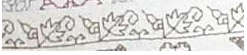
It’s the ground line from which the little motifs sprout.
In this pattern it’s slightly less clear. Any one of several options can be used as an effective baseline:
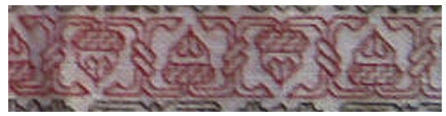
Here’s one possible baseline:
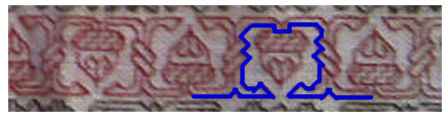
Every other element of the design can be worked as a detour off this main highway. You’ll note that the baseline needn’t march around the perimeter of the acorn. In fact the entire acorn is one nested set of detours. And this isn’t the only possible baseline. Here’s a more efficient though less intuitive one:
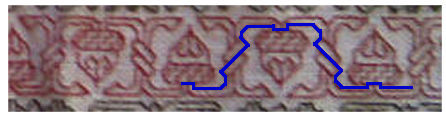
Both are perfectly logical. I might use the one at the top if I wanted to quickly establish the height of my piece. It’s just one unit shy of total pattern height. But the only reason to chose one or the other is personal preference. Please note that the logic of these to baselines applies equally well to the horribly complex plume flower:
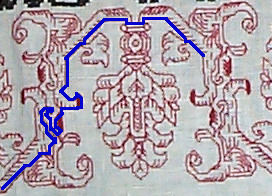
I’d suggest folk new to double sided work start with patterns with easily identified baselines, and work up to some of the more daunting patterns.
Next post – stitching logic. Traveling along the baseline and its detours.
VISIO STENCILS AGAIN
I noticed quite a few hits in the past couple of days from people looking for my Visio knitting symbol stencils (templates). They’re the tools I use to do all of the charts here on String. However those files appear to have gone astray. I’m having problems going back and editing the original posts to edit the links there, so I am offering up this set of links instead.
I’ve got two sets, both for older versions of Visio. For Visio 5 here’s a Zip file containing the basic shape set, increases and decreases, and cables. And here’s the same thing for Visio 2000. I know for a fact that my stencils work with Visio 5, Visio 2000 and the last version of Visio in MS Office 2003. I haven’t had an opportunity to test the latest Visa version of Visio with my templates yet.
Here’s a link to the original post describing my method, but in short – I’ve built a series of “alphabet blocks” each bearing a standard knit symbol. I build my patterns up block by block. I can group or rotate blocks as needed. Once my blocks are in order, I add chart notations, including my grids and row numbering, and a key. I can also use the same system for colorwork charting by assigning my desired colors either to the whole block, or to a small square unit in a block’s center, as needed.

I offer up these stencils to anyone who wants to use them. For the record, I’ve heard that these blocks can be imported and used in other less expensive graphics programs including Edraw. I know that Edraw can open Visio files, but I don’t know if it uses a stencil or template library that can import Visio stencils. I suspect that to adapt my symbols you’d take one of the files in the zip dowloads above, then use Edraw to open it and copy the symbols out.
If you do use my files to create your own charts, I’d greatly appreciate a link back or a line of acknowledgment in your final work. I hope that someone else finds these useful as I do.
CHARTING 108 – LACE STRUCTURE
Apparently my last post caused some confusion. A couple of people wrote to say that they didn’t understand why the original graph wasn’t knit-able. I’ll try to explain again.
One principle of lacy and other texture knitting is the equivalence of decreases and increases. In patterns with parallel edges, for every new stitch introduced into a row via a YO, Make 1 or cast on, there is an equivalent stitch removed by a complementing decrease. That decrease can come in many forms – a K2tog, a SSK, a cast-off, or as part of a multiple stitch decrease (Sl-K2tog-PSSO, K3tog, SSSSK, etc.) Yes, there are some exceptions – patterns that deviate by having a decreased stitch count on one or more rows, but if they have parallel edges, they must restore the stitch count on subsequent rows. I’ve graphed both types here before.
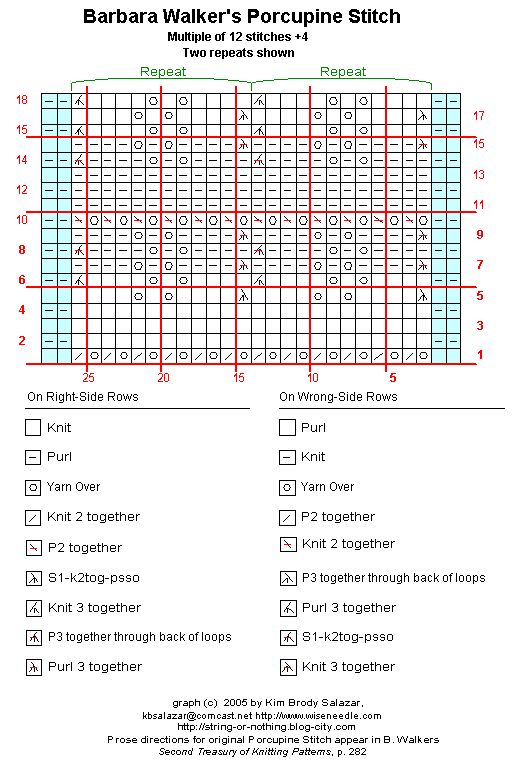
Walker’s Porcupine Stitch uses increases and decreases balanced throughout to maintain parallel edges
By contrast, her Starlight Lace Stitch is a parallel edge insertion that has a modified stitch count on rows 16 and 14, that is restored in both places on the next right-side pattern row. The presence of those evil gray “no stitch” boxes is a dead give-away that stitch count monkeying has happened.

To create a panel with one or more decorative edges – edges that zig in and out to make nifty curves, scallops, or sawtooth or triangle points – the stitch count has to be deliberately altered so that the width of the piece grows and then shrinks in a predictable manner. Most of these decorative panels are edgings – strips with one nice firm straight edge that is usually knit or sewn onto the thing being trimmed, and one fantastical dagged edge – the decorative points or ruffles that hang free. There are two-edged edgings that in the past were used as trim or decorative strips all by themselves – lingerie straps, camouflage for shelf edges, free strips appliqued onto towels and house linen, but they’re far less common and are rarely seen in modern pattern collections.
The stitches introduced (or decreased) to form the points can occur anywhere in a row. Placement as well as the number helps determine the overall shape and depth of the point. If the new stitches accumulate or disappear from the left of the location of increase/decrease, the points tend to be a bit sharper. If they accumulate between the stable edge and the location of the increase/decrease the points formed are more like waves or scallops. We saw that in the pattern I charted in the last post, where the point-forming increases/decreases were relatively close to the stable right edge of the piece, stitches were accumulated between the stable right edge and the location of increase decrease, and that spot was followed by a relatively large section that had a stable stitch count. Here are simple graphs of a few basic edging shapes, stripped of all lace detail. Note that in each and every one, if a row has more (or fewer) stitches than the one that preceded it, there is a clearly discernible cause on that preceding row – an increase or a decrease that’s clearly to blame.

It’s the absence of any stitch-to-blame in the historical chart that made it un-knitable:

Yes, the graph looks good. The points march in and out in clearly defined order – but the causes for that patterning are absent. Every YO on this graph is countered by a decrease. There are none left over to form the basic triangle point shape.
Now as to why the chart was published this way – the pattern book I was working from is a direct facsimile of a work produced in Germany in 1921, in a language I can’t read. I did double check the instructions, both against the English key thoughtfully provided by the book’s modern editors; and against the original diagrams presented at the front of the book. Those show standard symbols and a little engraving of what the resulting work should look like. I also successfully reproduced another pattern on the page that uses the same symbols, so I’m pretty sure that in spite of not being able to read the accompanying text I didn’t miss anything substantive.
My guess is that because charting was new, and the symbols used in the original book are not standard (charting symbols aren’t standard even today), among the pattern designers, the artist that laid out the pattern, the typesetter, and the proofer, errors slipped in. Proofing knitting patterns isn’t an easy thing, as any modern professional pattern writer/editor can tell you. In my experience, the most accurate patterns appear to have been produced between 1950 and arbitrarily – 1985. Stuff before in general isn’t as stitch for stitch perfect or isn’t in modern notation; and stuff after seems to have suffered from a lack of skilled manpower and/or editorial time. Not to say everything published after 1985 is junk, but we’ve all seen books rushed to market that required dozens of pages of errata. Books published during the designated “sweet spot of knitting” era tended to require far fewer corrections than do many contemporary works. Kudos to those professional authors/editors/publishers who have taken on the extra time and expense in pursuit of perfection. Eyebrows are raised at those who cut corners. Slack is cut for pre-modern works, especially those that pioneered new forms of instruction.
So the moral of the story in knitting as in far more weighty world matters, is “trust, but verify.”
Afterword: People new to charting might find the Charting 101-107 series here on String useful. You can find those posts under my Reference Shelf tag.
CHARTING 107 – WORKING FROM ANTIQUE KNITTING PATTERNS
Apparently my post on knitting patterns from books published prior to 1920 or so has struck a chord. I’ve gotten a couple of requests on how to go about translating these older knitting patterns to modern notation. I did a six part section on how to graph up patterns from written notation before (Charting 101, 102, 103, 104, 105 and 106 ), so this sort of follows as optional post-lesson workshop.
This time I’ll start with a web-available pattern. K. Harris at Vintage Connection has posted a transcription of a knitted insertion pattern that first appeared in The Delineator magazine, in June 1896. I’ll be producing a modern notation graph for that lace panel. Before we begin, it’s worth noting some common features of turn-of-the-century knitting. Not every technique known today was widely used, and terms varied a bit – even more widely than they do now. I’ll try to cover some of the most common notations.
Knit and purl – k, p
Not much difference. Basic knits and purls were pretty much as we know them. There were however a couple of associated usages that are less common today. Knit plain usually meant work in knit stitch only. One complication – it follows then that for things knit in the round knit plain came to mean “work in stockinette.” Occasionally by extension knit plain was used to indicate stockinette done in the flat rather than in the round, even though intervening rows of purl by necessity exist. I’ve also seen it used very infrequently to mean “continue working in established pattern,” but that’s rare. More often the term work even was used in that context.
Another alternate usage – purls were sometimes referred to by the term seam, as in the instruction “knit two, seam two” to produce k2 p2 rib. This is probably a hold-over from early sock making, in which a column of purls on the back of the leg was used in imitation of a seam line.
Narrow – n, k. 2t, t,
The modern equivalent of narrow is K2tog – the standard right leaning decrease. Sometimes this is written up as K2, with the “tog” part of K2tog being left out entirely. Older patterns did not use SSK. Occasionally they call out a SSK equivalent of “slip one, knit one, pass slip stitch over” (see below) but most often they don’t bother with a left leaning decrease, and use K2tog, even when the cognate would be visually more balanced or appealing. Close inspection of accompanying illustrations reveals that the knitters did employ K2tog for almost all decreases. Less frequently this decrease is referred to as together (t) or knit 2 together (k. 2t.).
One unusual notation on narrow – a couple of patterns I’ve seen use n followed by the note “by slipping the needle through the back of the stitches.” This does sound a bit like a proto-SSK. But unless otherwise modified or explained, it’s pretty safe to assume that any n means k2tog.
Slip – s
Another movement that’s pretty standard. Unless otherwise modified, slip in historical context means slip purlwise – transferring the stitch from the left to the right hand needle without changing its orientation.
Slip and bind off – sb, sbo, sl&b,
Another historical way of referring to the left leaning decrease or SSK equivalent, this refers to the s1-k1-psso unit.
Over – o, th, w, tho, th. o,
Yarn overs or eyelet producing increases – still a source of multiple terms today – have even more names if you go back through time. I’ve seen YO referred to as over (o), throw (th), throw over needle (tho or thn) eyelet (e), widen (w), make (m), put over (po), yarn on needle aka yarn over needle (yon), wool round needle (wo, wrn, won).
Special note on double YOs. Most of the time modern patterns use a multiple-unit YO if a really big eyelet is needed. But in historical patterns when YOs were used to make columns of fagot-stitch lace, it was common for the YO that formed them to be specified as a double yarn over, probably because of the yarn manipulation used to create them needed to allow for a subsequent p2tog. If a pattern with fagoting calls for a double yarn over but the stitch count on the subsequent row doesn’t account for the additional new stitch (or doesn’t mention dropping it), it’s a good indication that a modern redaction will call for only one YO and not two.
Make – m
This can be problematic. It’s on the previous list as a euphemism for YO, but it is also used in historical patterns for invisible increases – where an additional stitch is added without creating the eyelet hole formed by a YO. Modern “make” is usually interpreted as a raised bar increase, although other forms of adding a stitch like knitting into a stitch on the row below are also sometimes used. A bit of close examination of any illustrations or even experimentation may be called for here. The term made stitch is also sometimes used to indicate the new stitch formed by a YO in a previous row – especially when more than one YO created multiple adjacent loops on the needle.
Purl two together – p. 2 t., p2to, pto
Purl two together was a very common instruction, especially when columns of fagoting style lacy knitting were used.
Crossed knit – c, t, b, tw
Crossed knits are modern twisted knit stitches, produced by knitting into the back of a stitch (ktbl). I haven’t seen a historical pattern that includes a purl through the back of the loop (ptbl), but that doesn’t mean that one doesn’t exist.
Now with all this set out, I can graph up the diamond insertion from the Delineator. It starts out with a cast-on of 23 stitches. It includes double YOs, but all double YOs are followed by p2tog units, producing the columns of fagoting in either side of the center design. I’ll show the progression from as-described rows through modern notation.
First, as written, preserving the double YOs; without flipping the wrong-side rows in accordance with the modern charting convention of showing the work as it appears on the front (public) side; and without centering the rows or norming the chart to have parallel edges we get this: (click on images below for larger versions):

We quickly see that stitch counts vary from row to row, although the pattern is more or less internally proofed because wrong side rows do contain the same number of stitches as the right side rows that preceded them. We also see that the double YO followed by P2tog problem is here. Were those YOs to each be “real” each following wrong side row would need to be two stitches longer, and the lacy effect would not be achieved.
Other features of this pattern are pretty straightforward. YOs are YOs, whether they appear on the front or reverse side rows. The K3tog unit only shows up on front (even) side rows. P2tog when seen from the back is a plain old k2tog, so that’s also easy to flip.
So. Norming the presentation so that wrong-side rows are shown using the correct right-side row equivalent symbol, and isolating the side columns of fagot stitch, and consolidating the YOs we get:
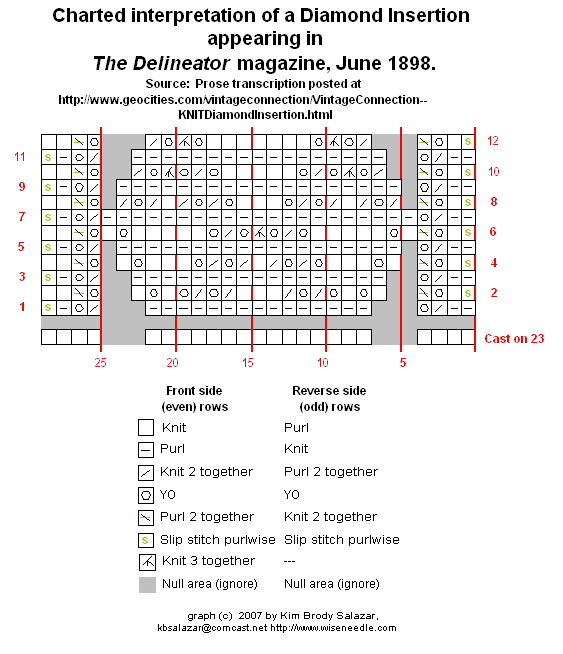
I’ve gone through all of this not only for the fun of sharing, but also because I am using this particular pattern to knit up a new quick lace scarf. I’ll edge the thing out with something complementary, but for now, here’s how it looks:

Knit somewhat overscale in Swift River Prescott on US #8s, one panel of this lacy pattern is perfect for a scarf – curl-free and totally reversible!
CHARTING 106 – SECOND EXAMPLE
Here’s the last item in the chart series. Thank you for all the kind
words. I’m delighted that people are finding this useful.
I
have gotten some questions about why I am not using the standard
Japanese symbol set. That set is quite broad compared to most of the
sets in Western books. My answer is that it’s relatively unknown in the
US and Europe. Perhaps I’ll add a symbol glossary that equates its
symbols to notations used by other more commonly available sources.
That’s a big project though, and might be better suited for wiseNeedle
than for this blog.
Barbara Walker’s Starlight Lace, Second Treasury of Knitting Patterns, p.288
I
will use this last Walker pattern to show some more complications to
charting life. This time, the pattern’s stitch count varies in a couple
of rows, plus there is a large number of edge stitches. My method is to
graph out everything verbatim row to row, then (if needed) introduce
no-stitch boxes for clarity. Again, all quotations from Walker are in
bold. Here goes…
Multiple of 6 st plus 5
Row 1 (wrong side): and all other wrong-side rows – Purl.
Row 2: K2 *yo, ssk, k1, yo, ssk, k1-b; rep from *; end yo, ssk, k1.
The
repeat is only 6 stitches, but I think I’ll chart out three repeats plus
edge stitches. That should give me enough room to see the play of the
edge stitches, and the staggered effect of the offset design itself.
Row 1 is plain old purl, but it’s a wrong side row, so it graphs out as
shown below, with the “1” on the left hand edge rather than the right
hand edge. Remember, I’m just graphing verbatim at this point. I’m
making no effort to read ahead. I just want to get the stitches down on
my chart.

We’ve
got 23 stitches [(6×3) + 5]. Note that the k1-b (knit one stitch
through the back of the loop to twist it) has its own symbol. All wrong
side rows in this pattern are plain – worked as purls if the thing is
knit flat, and as knits if it’s worked in the round.
Digression:
Most modern texture patterns alternate rows with something happening on
them (cable crossings, decreases, increases, etc.) with plain rows, and
many pattern authors don’t bother graphing the alternate rows if
they’re all plain. This can cause a bit of confusion. I got tripped up
recently by Hazel Carter’s Spider Queen shawl. It’s a masterful bit of
charting, but the first chart is stripped of those plain wrong-side
rows. The later charts include them. I wasn’t paying attention, and
didn’t notice that the numbering on that first chart labeled every row,
but counted by twos. I ended up having to rip back a bit when I noticed
that my piece didn’t looklike the project photo. So be warned. Look
at the numbering. If it begins with “1” on the left, and you’re
knitting flat you start off with a wrong-side row. If the “1” is on the
right and you’re knitting flat, you start off with a right-side row. If
every other number is missing, you’ve got a pattern with the plain rows
left out. Look elsewhere in the write-up to find out if those plain
rows are to be knit or purled.
I’ll skip writing up the plain rows, but I will include them in my growing graph:
Row 4: K3, *k2tog, yo, k1-b, yo, ssk, k1-b, rep from *; end k2
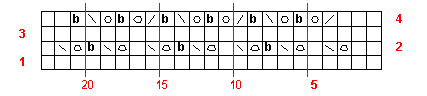
Again,
no problems here. Everything graphs out nicely and stitch count is
constant. There are equal numbers of stitches increased (the yos) and
stitches decreased (the ssks and k2togs).
Sometimes if I’m
having problems with a repeat, even if it’s charted, I’ll grab a piece
of graph paper and draw out my stitches. Sometimes I catch an error in
my knitting using my pencil that went totally unnoticed on my needles.
Row 6: k2, k2tog * yo, sl2-k1-p2sso, yo, sl1-k2tog-psso; rep from * end yo, sl2-k1-p2sso, yo ssk, k2.
This
is where that “off to hell in a handbasket” feeling begins to creep in.
We’ve got double decreases, both with the rightmost leg on top
(sl1-k2tog-psso), and with the centermost stitch on top (sl2-k1-p2sso).
We’ve also got a number of yarn overs, and just for fun – a couple of
plain old decreases, and an unknown number of times to do the ** repeat
between the k2, k2tog opening unit, and the end yo, sl2-k1-p2sso, yo,
ssk, k2 closing unit.
To figure this out, we need to remember
that we’ve got 23 base stitches on the previous row. That’s 23 stitches
to play with. All of the plain knits plus the stitches in the decreases
on Row 6 must add up to 23. Let’s look at the math:
- One ** repeat on this row adds up to six stitches (the two double decreases).
- The pre-** opening row unit is four stitches (k2 plus one k2tog)
- The after-** closing row unit is seven stitches (one double decrease plus one ssk and k2)
If
you add up our fixed numbers (the pre- and post-** stitches) you get 11
stitches. The previous row contained 23, and we subtract those 11 from
the total. We get 12, which (serendipity) is a multiple of our ** unit.
We graph out the pre-* stitches (shown in blue) plus two repeats of the
** unit, followed by the post-** unit (also shown in blue.

We’re out of that handbasket, even though our graph is showing a very
short row. Not to worry. Going through and counting stitches confirms
that we’ve got the correct number here. We’ll worry about neatening
everything up and inserting those no-stitch boxes after we get all the
rows charted. So let’s move on.
Row 8: K3, *k1-b, yo, k1, yo, k1-b, k1; rep from*, end k2.
This
row is also problematic. How many times to repeat the stuff between the
**s? Again , stitch count comes to our rescue. Evil Row 6 brought the
stitch count down to 17. Row 7 (worked plain) preserved that count. Now
on Row 8, there are increases, and “as-is” stitches but no decreases.
There should be 17 stitches on this row EXCLUSIVE of the YOs. Again we
do the math. We start with 17 stitches, then account for the three
before the *, and the 2 after – that’s 12 stitches left. NOT counting
YOs, each between the ** repeat contains 4 stitches. We need to graph
out three iterations of the stuff between the **s. Happily once we
graph in these instructions (including the 6 YOs) that restores us to
the original stitch count of 23.

Remember,
we’re not worrying about lining stitches up right now, our only concern
is getting the correct number of them on the chart. We’ll think about
how to represent those low-count rows 6 and 7 later.
Row 10: K2, *yo, ssk, k1-b, yo, ssk,k1; rep from * end yo, ssk, k1
We’re
back to a stable stitch count, with the same number of increases and
decreases per row. Graphing it up is easy. I notice something here
though:

See
those two blue units? They’re identical. It looks like this pattern is
formed by an exact duplicate of rows 1-6, offset by three stitches (one
half of the repeat). While you can see it (sort of) in the prose
directions, the duplication leaps out in the charted ones. I find this
sort of half-drop duplication and charting makes the pattern really
easy to memorize. More on this later, after we’ve charted some more
rows.
Row 12: *K2tog, yo, k1-b, yo, ssk, k1-b; rep from *, end k2 tog, yo, k1-b, yo, ssk.
Again this looks veeerrrryyyy familiar! I’ve highlighted the repeat (in fact I just cut and pasted those boxes).
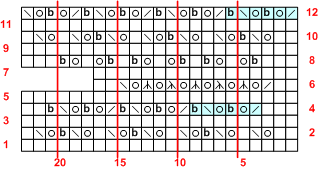
Row 14: K1, *yo, sl2-k1-p2sso, yo, sl1-k2tog-psso; rep from *, end yo, sl2-k1-p2sso, yo, k1.
Remember
Evil Row 6, with all those double decreases? It’s back! Offset three
stitches, but otherwise the same. We start with 23 stitches on the
previous row, then subtract the 1 before the **, and the 4 after the
**, leaving 18 stitches – so we do the 6-stitch bit between the **s
three times.

Row 16: K1, k1-b, *k1, yo, k1-b, k1, k1-b, yo; rep from * end k1, k1-b, k1.
Just
like row 8, offset again by three stitches. Again we’ve got 17 stitches
on the previous row to account for. Not counting the YOs, we’ve got 2
stitches before and 3 stitches after the ** accounted for, leaving 12 –
so we do the 4-stitch ** unit three times. One you add in the YOs,
we’re back up to to the 23 stitches of our original count.

Now
to add the finishing touches. It looks like each of the decrease units
on Rows 6 and 14 visually caps off the clusters of decreases on the
rows below. So I’ll spread them out across the row, adding in my
no-stitch boxes as best I can to maximize the read of the pattern
compared to the photo of the worked swatch.
I’ll also add in
my stitch key, header and footer info at this point. Remember that
there are NO increases or decreases on alternate rows. Therefore I
don’t need to include that second column of “if it’s a
right-side/wrong-side row” instructions that I had to include in
yesterday’s write-up.
One final note, there is one small bit of
strangeness here. Because of the way that the repeat works out, and the
way that edge stitches are handled, the last decrease on Row 6 is
handled differently if it is the final stitch of an “inside repeat” or
if it is the final stitch of the last repeat on the row. Since this
isn’t easy to graph, I’ve added a special note about it, and made it
blue on the chart.
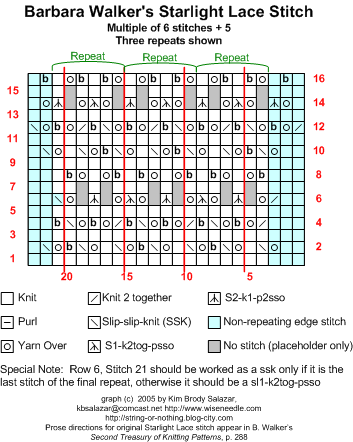
The memorization thing?? This pattern looks complicated at first glance. Especially if you just look at the prose directions. However it’s not that tough. There are only four substantive rows – 2, 4, 6, and 8. The entire pattern repeat is only six stitches wide. Everything else is a repeat, either straight on the same row, or (in the case of rows 10-16) offset by three stitches (one half the width of the repeat). ? I can’t remember the prose directions verbatim, but I can and do memorize the pattern in its visual representation. Not everyone can memorize a nonverbal visual representation (and it’s no shame not to have that bit of wiring) but many people can, and have surprised themselves by being able to do so after becoming comfortable with charts.
This
concludes my mini-series on graphing – how to read them, how to build
them, and how to solve common problems translating prose directions to
charts. Please feel free to post additional questions about graphing
and reinterpreting prose instructions as charts, but please know I will
not be offering a graphing service here. My goal is to show others how
to do it for themselves, not do it for them.
One last tech note
– the visual presentation of the charts changes mid-way through this
note because I experienced a massive computer failure. I ended up
finishing this post on a different machine using a different version of
MS Visio. The later version has a slightly different GIF translator
than the earlier version I normally use. So it’s not your monitor –
it’s me. Apologies for the visual confusion.
CHARTING 105 – EXERCISES
So far the nominations for stitches to use as object lessons have been rather sparse. I’ve gotten suggestions to do:
- Porcupine Stitch from B. Walker’s Second Treasury of Knitting Patterns, p. 282
- Drooping Elm Leaves from B. Walker’s A Treasury of Knitting Patterns, p. 217
I’ve also gotten notes from people who said that given the hints posted over the past week they’ve been able to graph up
- Mermaid Mesh from Walker’s Second Treasury, p. 267
- Madeira Cascade from Walker’s A Treasury, p. 222
As the big boss at work would say, “Good on ‘ya!”
These two patterns are not quite straightforward. Cascade has five stitches above and beyond the repeat that need to be apportioned into edge stitches. It does however have a very strong central spine – a double decrease that lines up on all right-side rows. Mesh is a bit harder in that it has both lots of edge stitches, plus a massive number of decreases and increases that use natural slant of the decreases to
visually wander left and right. Certainly not a pattern for the
faint-hearted to graph!
For the object lesson I’ll do Porcupine and Walker’s Starlight Lace (Second Treasury, p 288). Drooping Elm is interesting, but doesn’t pose some of the conundrums that these two do. I’ll start today with Porcupine. Starlight will appear later in the week.
Porcupine Stitch from B. Walker’s Second Treasury of Knitting Patterns, p. 282
Porcupine has some interesting features. It’s a 9 row repeat, in which only three rows are substantive. BUT those three rows are each repeated at least twice, and the same instructions are repeated on both the right and wrong side rows of the piece. There are also four stitches requested over the 12 stitch repeat count that will have to be accounted for in edge stitches, but they seem to always stay outside the ** repeat marks, so keeping track of them shouldn’t be a problem.
Walker notes that this texture design is of Victorian origin. It does have a major feature that was much more common in early instructions than in later ones. Porcupine includes patterning on both right side and wrong side rows. You don’t see this often as most modern? patterns confine increases, decreases or other shaping elements to right-side rows only. Flipping the instructions for decreases is far more confusing than just translating knits to purls and vice versa.
My write-up will intersperse the as Walker gives them with how that row ends up being graphed. The Walker quotations will be in bold.
Multiple of 12 stitches plus 4
Row 1: K2, *Yo, K2tog; rep from * to last 2 sts, end k2
Looking at the pattern, I suspect it will be a good idea to graph out two repeats of the pattern, that’s 24+4 = 28 stitches across my chart. We start with a right-side row:

Row 2 and 4: K2, purl to last 2 st, end k2
Very easy. Remember this is a wrong side row, and that mental inversion thing should be invoked to “flip” knits to purls and vice versa.
Row 3: Knit
Because Row 4 is the same as Row 2, I’ll graph up both 3 and 4 here. 
Row 5 and 8: K2, *sl1-k2tog-psso, k4, yo, k1, yo, k4, re from *, end k2
Now it begins to get interesting. Still, stitch counts are maintained. How can I tell this? By looking at the part between the **s. It includes a double decrease that finishes with the rightmost stitch on top, plus
two yos to compensate for the two stitches eaten by the double decrease. Warning though. It’s not all that hard to visualize row 5, it’s a right-side (odd numbered) row, but I can sense some hyperventilation among those who have noticed that this same sequence is repeated on a wrong-side (even numbered) row. We’ll deal with that bit of chaos when we get there.
Row 6, 7 and 9: K2* p3tog, p4, yo, p1, yo, p4, rep from * end k2
We have now hit the twilight zone row – the one that will cause many people to give up graphing. But it’s not impossible. Remember that mental flip thing? Flex your brain because we’re now going to do some gymnastics.
On Row 6, we’ve been told to do a p3tog on a wrong side row. Now, a p3tog on a wrong side row, if viewed from the right side of the work is a dead ringer for a k3tog. How do I know this? The Sainted Barbara tells me so in the glossary of chart symbols in her Charted Knitting Designs (aka Walker III), and A Fourth Treasury of Knitting Patterns (aka Walker IV). Also I experimented. I’ll use my symbol for k3tog, BUT
I’ll remember to build a double column glossary to accompany this pattern that describes what should be done when this symbol is encountered on both right-side and wrong-side rows.

Now on Row 7, we’re told to do the same thing as on Row 6. But we’re on a right-side row. A p3tog on a right side row is a p3tog on a right side row. I don’t have a symbol in my set for a p3tog, so I’ll have to make one up. Visually, in a P3tog done on an odd numbered row, the right hand most stitch of the three worked together ends up on top. I’ll make a hybrid symbol that sort of reminds me that three stitches are being worked together, the right hand most one will end up on top, and that it’s a purl. If it turns out that I like this symbol, I’ll add it to my permanent stencil collection in Visio:

Row 5 and 8: K2, *sl1-k2tog-psso, k4, yo, k1, yo, k4, re from *, end k2
Row 8 is a repeat of Row 5, but it’s done on a wrong-side as opposed to right-side row. Again referring to the Sainted Barbara, we see that a s1-k2tog-psso done on the right side has as its wrong-side counterpart
the delightfully awkward p3tog through the back of the loop. Again – remember we don’t actually have to DO a p3tog through the back of the loop here unless we are doing this pattern in the round, but the symbol we use on the chart is the same one that would be used for one of those awkward puppies worked on the right side. I don’t happen to have a standard symbol for p3tog through the back of the loop, so I’ll invent one.
Row 6, 7 and 9: K2* p3tog, p4, yo, p1, yo, p4, rep from * end k2
Row 9 is a duplicate of Row 7. We’ve already graphed that. So we now have the nine rows of our repeat. It’s also become clear that stitch counts are rock-stable row to row, and that the four extra stitches here are just garter stitch selvedges there for convenience, and aren’t required to eke out partial repeats of the pattern. I’ll mark the four extras off in blue.
But we’re not quite done even though all nine rows are graphed out. We’ve got a repeat made up of an odd number of rows. That means that Row 1 repeats on Row 10. In fact, although rows 10-18 are the same as Rows 1-9, each one graphs up as its opposite-side sibling. (I can sense I’ve lost quite a few of you, so I’ll show rows 10-13: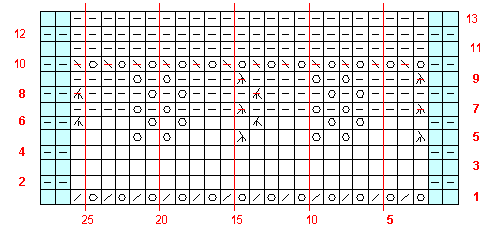
Row 10 duplicates the action of Row 1, but does it on a wrong-side row. Therefore, the stitches that graph up as K2togs in Row 1 use a different symbol in Row 11. Likewise the knits/purls of rows 11-13 show as their opposite.
Row 14 duplicates Row 5, but as a wrong-side row. We’ve already graphed that bit of twisted thinking on Row 8, so adding it isn’t a problem. Row 15 replicates Row 6, again we already did that flip on Row 9, so a simple cut and paste takes care if it, too.
Row 16 duplicates Row 7, which has its wrong-side counterpart originally on Row 6. Row 17 is another Row 8 in its right-side expression (Row 5). Row 18 is another Row 9 flipped for the wrong side (Row 6). If you place all of them on the chart, add the stitch key, grids, titles, and attributions you end up with this:

Now this may seem a long way to go for a short drink of water compared to Walker’s original write-up. In this case, the prose description is only five lines long, but the chart takes up half a page. There’s no bonus
for brevity awarded for the charted format. But there is one major advantage to having this described in a graph. This chart is equally useful to people knitting in the flat and people knitting in the round, because all the right/wrong side transformations have been done.
People knitting in the round experience every row as a right-side row. To knit this reversible pattern entirely in the round, they’d cast on an even number of the stitch multiple (without the four blue extra stitches) then they’d follow every row starting at the right hand edge of the graph, and using the key symbols as interpreted in the “On Right-Side Rows” column. People knitting in the flat would follow the chart in the manner I described before, starting the odd numbered rows at the right edge, and the even numbered rows at the left, alternately using the appropriate columns from the accompanying symbol key.
Have fun with this one. Try out Porcupine Stitch in a swatch. You’ll find the lacy effect is magnified if a larger needle than one would usually use for a given yarn is used. Lacy or dense, the result will be rather puffy. Given the appropriate yarn it would make nice two-sided scarves, shawls, or blankets. Stay tuned for more adventures in charting!
CHARTING 104 – THINGS THAT MAKE LIFE DIFFICULT
In a perfect world there would be an intuitive set of graphing symbols
that would be quick and easy to understand. They’d cover all possible
maneuvers in knitting, and would be useful in every circumstance. This
is however, a total pipe dream. Knitting is near infinite, and
knitters are fiendishly clever in the variant ways they have found to
produce their desired results. There are a number of knitting
techniques and stitches that pose special problems to charting:
Large numbers of stitches increased or decreased at the same time
When you see instructions like “make 5 in next stitch” you’ll need to invent
a symbol to handle it. I’ve seen German and Japanese charts that use a
variant on something like this:

Decreasing a large number into one stitch would generate need for something
similar, perhaps with the V upside down, and the number of stitches to
be eaten indicated between its open toes.
Also unless you’re dealing with an edging, it will probably be impossible to graph up a
pattern containing massive group increases or decreases without using the
no-stitch boxes we discussed yesterday. Still, these problems fall into
the “inconvenient but not insurmountable” camp.
Bobble and bell-shaped semi-detached units
Some bobble and bell units are produced by knitting back and forth over a
small number of stitches, to make a blister-like addition that’s
attached to the main work at top and bottom. Most chart authors treat
this type of unit as a separate sub-process. The main chart may have a
single box with a specified symbol in it, indicating where the unit is
to be placed. The unit itself will be described either in prose, or in
a “mini-chart” accompanying the main chart as a sidebar. Another
“inconvenient but not fatal” challenge.
Patterns containing stitches either slipped from or knit into the row below
These can pose real charting problems, especially in linen stitch family
textures where large numbers of stitches are worked “out of row.” I’ve
seen large V-shapes superimposed on the graph that are supposed to
represent these distended stitches, but they are visually difficult to
deal with. If there are lots of them, the clutter can be overwhelming,
and some linen stitch or slip-stitch based patterns may be impossible
to graph at all.
It is interesting to note that B. Walker used a special charting notation for her slip-stitch based mosaic colorwork. In that format each row of the chart represented two rows of knitting
instead of the more conventional one row worked = one row charted
ratio. She didn’t try to show stitch deformation by the use of a symbol
set, instead she stuck to two-color mosaic patterns that swapped colors
every two rows. The squares on her charts indicate whether one is to
form the next stitch by working with the current strand, or slipping
the color of the previous two-row set up onto the needle.
Threaded stitches or stitches with right-side floats, or decorative wraps spanning one or more stitches
There are some patterns that form colorwork or texture patterning by using
separate strands that are threaded back and forth through live stitches
during knitting. Other patterns use as decorative elements floats or
wraps of one or more stitches, deliberately formed on the right side of
the work. These are both very difficult to represent in charts. I’d
probably go with some sort of notation in the main chart that Effect #1
happens here, and accompany the chart with a separate detail write-up.
Novelty stitches
Some popular novelty stitches are near impossible to chart. Loop Stitch is a
good example. That’s the stitch used to make a surface completely
covered in shag-rug style loops. The manipulations required to make the
loops don’t lend themselves to graphing, and beyond noting which
stitches carry the loops in a piece that uses both adorned and
unadorned areas for contrast, indicating their presence is of little
value.
In spite of these exceptions, if a pattern contains just knits, purls, cables, simple increases and decreases – even twisted stitches – it can probably be graphed. The graph may be massive, but it can be done.
I’ve got only one nomination for a particularly vexing pattern to use in tomorrow’s object lesson. If you’re got one to suggest, please send me an eMail (replace the “AT” in the address with the standard @ sign).
CHARTING 103 – THE STITCH THAT ISN’T THERE
We’ve covered basic charting, and charting variable width edgings. Now
for panels and insertions. Those are patterns that can be used as
accents in the main body of your piece. Sometimes they show up as
single strip scarves, sometimes several repeats of the design are
combined across to make an all-over design (occasionally fitted
together with half-drop variations), sometimes a single panel is
repeated to make a long stripe in combo with a stockinette ground,
sometimes just one vertical repeat of the design is used as a spot
accent, sometimes panels of different patterns show up side by side.
What makes them different from edging patterns is that they can be
embedded in the center of a piece, and that piece can be knit in the
round.
These insertion style patterns can have either stable or variable stitch
counts from row to row. One with a stable count (either no
increases/decreases or an equal number of increases to decreases on
every row where they occur) are graphed more or less the same way as
the pattern in Charting 101. The ones with changing stitch counts do
pose special problems.
Let’s consider this simple variable count
insertion. It’s my own write up of a simple embossed leaf inside a
framing K2, P2 rib:
Cast on 9
Row 1 (wrong side): P2, K5, P2
Row 2: K2, P2, (K,P,K in one stitch), P1, K2
Row 3: P2, K2, P3, K2, P2
Row 4: K2, P2, (K1, YO)2x, K1, P2, K2
Row 5: P2, K2, P5, K2, P2
Row 6: K2, P2, K2, YO, K1, YO, K2, P2, K2
Row 7: P2, K2, P7, K2, P2
Row 8: K2, P2, K3, YO, K1, YO, K3, P2, K2
Row 9: P2, K2, P9, K2, P2
Row 10: K2, P2, SSK, K5, K2tog, P2, K2
Row 11: P2, K2, P7, K2, P2
Row 12: K2, P2, SSK, K3, K2tog, P2, K2
Row 13: P2, K2, P5, K2, P2
Row 14: K2, P2, SSK, K1, K2tog, P2, K2
Row 15: P2, K2, P3, K2, P2
Row 16: K2, P2, K3tog, P2, K2
As you can see, the thing starts out being nine stitches across, but grows on row 9 to 17 stitches across.
How to chart? The symbol set is pretty straightforward. Each
individual row poses no problems. For example, here’s row 8:

If we normed one edge like we did with the edging patterns, we’d end up with this:
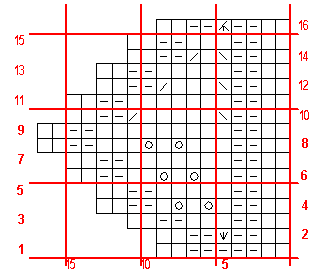
While all the info is there and this chart could be worked from, it’s
deceptive in that it looks like an edging. Plus one of charting’s prime
directives – representing knitting in a format that’s visually akin to
the finished product – has been fouled.
So. Let’s look closer at this pattern, looking for obvious points of internal symmetry or
reference. We quickly see that the thing IS symmetrical. There’s a
center stitch in every row. Let’s stack our rows on the center stitch:
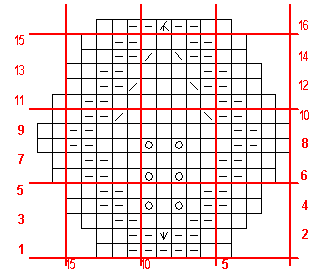
That’s closer. You can begin to see the leaf shape in the center,
but the wiggly edges are still a bit confusing. Here’s another
cut at the same basic concept. This time however, I’ve lined up
not only the center stitch, but also the knit ribs that frame it:
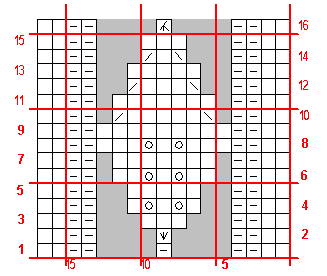
Those gray areas? They don’t exist. Flat out aren’t
there. They’re the equivalent of the stage attendants dressed in
all black who move props around in full view of the audience during a
drama or puppet performance. You’re not supposed to see them, even
though they’re in plain sight.
The grayed out areas are spacing mechanisms introduced for the sake of
visual clarity in the rest of the pattern. They have no
correlation to stitches in the actual knitted piece. Working from
this chart, I’d skip right over the gray background. My first row would
be P2, K5, P2, just as in the written directions. Now different
authors represent non-charted “no stitch” or null spaces
differently. I chose to use a general background shading, with no
boxes marking individual stitches. Other people don’t bother
removing the box notation from the no-stitch spaces. On their
charts the no-stitch boxes can be a bit harder to interpret.
How to know when to use mystery no-stitch boxes? Although it’s a
matter of personal preference, sometimes they’re absolutely necessary
because there just isn’t room to graph out your piece unless they’re in
the mix. I could graph out my embossed leaf without the
no-stitch areas, but if this leaf was part of a larger graph covering a
wider area, the distortion introduced by the width of the longest row
might ripple out and perturb the representation of design elements to
either side. In that case, using the no-stitch boxes would keep
my two edges parallel and let the leaf panel sit more comfortably in
the total project chart. That in turn would help the
knitter keep his or her place on the wider graph.
Tomorrow I’ll look at patterns that are extremely hard (if not
impossible) to chart out. The final piece in this series I’ll
build one chart for a lacy or complex cabled design that has presented
a special challenge. Nominations for the final object lesson will
be accepted. Please contact me off-list before Thursday night if you know of a prose texture pattern you’d like to suggest for group edification.
 String-Or-Nothing