WINTERTHUR NEEDLEWORK CONFERENCE REPORT
Where was String last week? At a conference! This was a new experience for me. I’m pretty much a lone-wolf stitcher. I don’t belong to guilds or stitching circles, and have no local pals who pursue this stuff. I toodle along on my own, with a couple web-pals and chat boards for company, and have persisted this way for decades. So it was a huge departure for me to splurge on attending the Winterthur Needlework Conference With Cunning Needle: Four Centuries of Embroidery.
First off, I was amazed that so many people were there. I expected maybe 100, tops. But there were many more, possibly as many as 600+(doing the math on the rows of chairs at the big lectures). It was a big treat to be surrounded by so many knowledgeable and enthusiastic folks!
Here’s my report. I hesitate to post pix, not being sure if “private research use” covers blog use. Also apologies for massive blocks of text. Feel free to skip this and head off to eye candy elsewhere. I won’t be offended. Oh. And I didn’t take notes, opting instead to concentrate on the presentations. The summary below is from memory. Apologies if I get the details wrong. If you were there, please feel free to correct me or add on.
Day One:
The first two lectures focused on the Faith Plimouth Jacket. The first one was by Dr. Tricia Wilson Nguyen and the second by Jill Hall – the two leaders of the Plimouth Plantation jacket re-creation project. Fascinating. Together they presented a general overview, but not a content free skim over the top. All parsed in terms of the socioeconomic context of the world in which the jacket was produced. Which sounds dull, but wasn’t. Why were the English embroidery styles used on the jacket largely detached? Why were the gold and silver laces and spangle of the period so sketchily done? Why did the jackets disappear from the historical record so quickly? Why were the techniques represented in the jackets used? What was the purpose of wardrobe pieces like this, and how did that purpose persist in the face of changing styles?
Wilson opined that in part the creation and popularity of these sumptuous jackets has to do with the lack of an English banking system in late Tudor, Stuart and Cromwell eras. We wandered off into regulations of the gold thread drawing industry, the economics of frippery (second hand clothing), the apprenticeship system, thread production and use patterns, and the time/thread consumed by competing techniques. In short, these were rapid production pieces, made by workshops, valued as much (if not more) as walking bank accounts – the detached embroidery, lace and spangles could be snipped off and melted down – cashed in against need, in the days before reliable deposit accounts existed. When deposit banking became more stable and wealth could be more safely kept, the jackets (and I’m betting some other forms of household plate and ornament) fell out favor.
Another major takeaway from Wilson’s talk was the prevalence of marled threads. You now all those subtle color to color transitions? The stitching ateliers and private embroiderers did not maintain massive stocks of zillion shade increment threads. Instead they used a smaller number of colors, but custom split and twisted stitching lengths on an as-needed basis, often blending colors to achieve “in-between” color values. The silks did not come pre-spun in ready-to-stitch skeins. Silks came in raw reeled but dyed hanks, tightly twisted into almost baton like lengths. The stitchers would tease out the requisite fibers, and twist up just the length they needed, plying colors as needed. This technique is also used in historical and contemporary Japanese embroidery. In addition to the marled colors, you can see evidence for custom split and twisted thread on samplers made by beginning embroiderers, who were not yet skilled enough to produce lengths of uniform thickness.
Some of Hall’s main takeaways were the shaping nature of bodies (corsets) worn under garments like the jacket, and how knowing of their presence can make sense of (to we unbound moderns) posture, movement, and actions shown in historical art pieces. She went more into jacket shapes and construction, showing variants. She also explained how silhouettes changed over time and how even with changing fashions (and creative ways to wear them), the jackets maintained their presence.
The 2+ hours of lectures flew by so quickly I didn’t notice how dense pack the morning was until it both were over.
After lunch there were two more lectures – Old London to New London: Tracing Needlework Patterns and Skills in Early America by Susan Schoelwar and Artful Adornments; Embroidered Accessories of Boston Schoolgirls by Pam Parmal, curator of textiles at the MFA, Boston.
The first talk centered on several styles and object classes common to Eastern Connecticut valley in the early to mid 1700s – showing how this rather insular frontier community (which it was back then) produced several identifiable clusters of work that can be related via formal schooling (needlework teachers and pattern drawers) or via familial relationships. The second discussed what Boston area schoolgirls were embroidering other than samplers, especially what older girls boarding with teachers were up to. I would have preferred more pix of the latter rather than descriptions or household inventories, but both lectures were engaging and well-delivered, and quite informative.
After lunch I went to a workshop on the Sarah Collins sampler, led by Joanne Harvey. She also put the piece into a social context, tracing the lineage of other contemporary 1600s American samplers, both through points of origin and ownership/lineage. Then she reviewed double running stitch for those who had never done it before, and for the folk who had – presented a variant of four sided stitch done both horizontally and on the diagonal. This variant produces diamonds on the reverse when the stitch is done on the diagonal. I hadn’t done that before.
My main take-away from the whole day is that no artifact can be examined out of context. That context can be economic, didactic, familial or any other set of circumstances, but all aspects play in every piece. Examine a stitched item on only one vector (say craftsmanship) and you miss a wealth of associations that reveal greater import to the piece than mere beauty. Even though that beauty may be what attracted attention in the first place.
Day Two:
A very long day, indeed.
The morning lectures started with a talk from Karen Hearn, the curator of 16th and 17th century art at the Tate museum in the UK. Her topic was embroidery depicted in period portraits. She presented a range of pictures from the gallery’s collection, and discussed whether or not portraiture can be used as a reliable resource for period needlework investigations.
The verdict was “not very.” All sorts of things intervene. First there can be a huge shift in colors, due to pigment color migration over time. She showed some blues that were vivid azure when new, that are now a totally unrelated beer-bottle brown. Other complications include artists that were more or less skilled in needlework depiction or who had varying levels of interest in rendering needlework with stitch accuracy (some pix are flat out representational and not literal). This could have been a product of whether or not the artist had access to the textile independent of the sitter (increases veracity). I can imagine that some sitters may not have actually worn all of the clothing pieces in which they are depicted at the same time. Some may have taken all their best, wearing it all at once for their sitting. Others may have been painted with family items or accouterments, in an effort to look richer or more influential than they really were. Takeaway from this lecture is “view all with grain of salt.”
The second talk was William Kentish Barnes – the master gold thread maker who supplied the jacket project. He spoke on the history and methods of his craft. While an engaging anecdotal speaker, he had rather more content and enthusiasm than public speaking experience and ran out of time before his talk finished. Still, it was interesting, if rather rambling. His main point is that motive power (human, animal, steam, electricity) may have changed, but the physical production of drawn wire threads remained stable until the invention of plating via electrolysis; and there’s nothing in the 1600s that we can’t make now, given demand to spark manufacture. He hinted quite broadly that if the stitchers in the audience wanted quality, historically accurate materials, that demand would suffice.
After break the third speaker was a PhD student, Nicole Belolan with a talk from her amusingly named thesis, The Blood of Murdered Time. Her talk explored Berlin woolwork (19th century needlepoint). Now Berlin is long maligned as a debased, populist craft. Although widely practiced, it had the same disparaged reputation in its time as plastic canvas tissue box holders have today. Belolan put it in social context, and looked at it through the experiences of a woman invalid, who although isolated through illness, maintained a long-distance social life and community via pattern sharing and gift exchanges with friends and family. I’m not likely to run out and stitch a sentimental spaniel among the posies, but Belolan did do a good job of showing the value of this populist style, and the populist, accessible appeal that it had at the time.
The last talk was by Dr. Lynn Hulse Archivist of the Royal School of Needlework. She spoke about the late 19th century revival of Jacobean-inspired crewel work, largely fostered by the Royal School of Needlework and some famous practitioners, most notably, Lady Julia Carew. Imagine one of today’s E! or gossip page luminaries, but highly talented at needlework, setting a style through personal production and sponsorship. With prodigious personal output including an entire room full of floor to ceiling panels, plus dozens of pieces of furniture and smaller pieces. Very interesting, and laudable – a product of the arts and crafts movement for sure. A very interesting talk about a very interesting woman. I’ll be looking for more info on Lady Carew.
After lunch I had selected two tours instead of sit-down workshops.
The first was a session in the rare book rooms of the Winterthur library (which is largely accessible on-line). No 1600s era modelbooks, but lots of slightly later works, plus 1600s era emblem and natural history works – both used for needlework inspiration.
The high point of the entire weekend came for me in the second half of the library tour, when we went down into the room to view ephemerata (really old non-book stuff, like pamphlets, scrapbooks, pattern pages, snippets, and broadsides). There, in an assembled book of textile fragments, awaiting restoration/mounting was an actual piece of 1600s era Italian voided work, done in red silk on linen. Exactly the style that I research and graph. It was done on around 50+count linen. While the pattern was rather more like some of the ones I used on my last piece, it had a squared background, exactly like the strip I am working now. I was able to see both front and back. There were knots! And the background was identical front and back – NOT in four sided stitch with little x’s on the reverse. I was THRILLED, I’d never been up close and personal with an exact representation of the stuff I’ve been graphing! We WERE able to take pix in the library, so I have photos of this piece. I intend to write to Winterthur and ask permission to include a chart for this unpublished work in TNCM2.
After that the second tour I took was rather anticlimactic. Which is strange to say for specialty a needlework tour of the Winterthur estate, of artifacts, interiors, textiles, and furnishings collected by the Dupont family. Samplers by the dozens. 1700s era, 1800s era. Some famous, some not. Mourning pictures, armorial pages, allegorical scenes. Fishing ladies. Hand-stitched and heirloom knotted rugs. Bed hangings. Quilts. Pinballs and etuis. Purses, pockets and pocketbooks. Clothing. Household linens. Stitching and knitting tools. After touring the on-display rooms, we went to the back stacks and looked at the off-display collections. More than any one human could process in the two hour tour. I now have stitching overload – SO many images running together in the brain that I can’t form a clear description of any one.
Conclusions:
My big gains from the weekend are the importance of studying artifacts in context – knowing why and how they were produced, and for what purpose. That historical linens were rather gauzy compared to modern ground cloth of the same count. That historical pieces aren’t beyond the technical skill level and reach of modern stitchers, although the time investment may be on a greater scale than most of us can easily invest.
I learned that experiences like the Winterthur conference are extremely valuable – full of learning opportunities both in and out of the lectures. If you get a chance to attend something like it, and can manage to attend, by all means, do so! That there are lots more people pursuing the needle arts with serious scholarship and intent than on-line presence indicates, and the electricity of gathering them together is very special.
I also came away with a ton of contacts. Special hellos to the gang from Calontir, Jeanne, Ria, Janet, Sharon and all the other people who took time to chat with me. Apologies if I’ve left names out – I’m better at content and faces than names. I’m astounded that folk in the real world know of my book. Totally shocked in fact that almost everyone I mentioned the book to, owned a copy. Never having done book tours, nor having received any reports of sales, I had no idea…
Japan Earthquake Relief
Heartfelt wishes are extended here to String or Nothing’s large readership in Japan. I hope everyone’s family and friends are safe in the wake of the earthquake and tsunami.
If folk elsewhere wish to assist, please consider donating to the relief effort.
HAPPY ADA LOVELACE DAY!
O.k., so it’s not knitting. But String today celebrates Ada Lovelace Day, and takes part in a meta-project to honor women in technology, science and engineering worldwide on Tuesday 24 March. Although I’m non-of-the-above myself, I supposed if I had more support in advanced math, I’d have made it. But I didn’t and ended up a proposal writer – interpreting between the worlds of the engineer and the decision maker. So it goes.
It happens that the very first proposal I worked on was a series of grants for New York Institute of Technology to establish a pipeline program, providing tutors and other assistance to girls and minority students starting in fifth grade, with the goal of piquing then maintaining their interest and abiltiy in math and science. After completion of the program those students were pre-admitted to NYIT. I have no idea how many kids that program helped, but by my estimate the first group of them should be ten or so years out of college by now (fewer if they went on to grad school). Perhaps they’re fueling a quiet revolution in biotechnology or advanced computing somewhere.
In any case, on to the point.
A good place to start is the Smithsonian’s Women in Science gallery. Sure, it’s got pix of Marie Curie, of whom everyone has heard. But it also has pix of many women engineers, scientists, and science educators who are not as well known, but who should be.
I choose to honor Annie Jump Canon (1863-1941), luminary in astronomical research and stellar classification. Although living in a time deeply ambivalent (if not hostile) to advanced education for women, and suffering from profound hearing impairment after a teenage bout with scarlet fever Annie graduated from Wellsely College in 1884 with a degree in physics. She returned there for graduate studies in physics and astronomy, eventually gaining an MA in 1907. During her time at Wellsley she was hired by the Harvard College Observatory, and along with several other women, paid a pittance (less than a Harvard secretary) to assist Edward Pickering to compile the Draper Catalog, a massive, annotated atlas of all the stars in the sky.
While she was part of this project (itsef funded by Anna Draper, a wealthy widow of an amateur astronomer), Annie was instrumental in defining the spectral classification system, which defines the star classes O, B, F, G, K, and M – a system based on stellar temperature that along with later enhancements is still used today. Annie’s personal work included extensive cataloging of variable stars, including 300 for which she is credited as discoverer, and classifying over 230,000 stellar bodies, the most anyone has defined to this day.
You can read more about Annie and her work at a dedicated memorial at Wellesley’s website. There are other pages about her here, and on Wikipedia.
I close with a quotation from her:
“In our troubled days it is good to have something outside our planet, something fine and distant for comfort.”
Annie, shine on!
RAVELED?
We’ve done science this week, why not science fiction, too?
How about sock puppets in space? With luck this opus sheds light on one of life’s eternal mysteries – where that second sock really ends up.
KNOTTY PROBLEMS
Science once again catches up to knitting. This article from Live Science details some recent advances in knot theory – a discipline that examines the rules, topologies and probabilities of physical tangles. It’s actually a useful area of study. There are lots of areas ranging from biochemistry to materials sciences that would benefit from a better understanding of what happens when filaments, proteins, or fibers touch. Still, it’s hard not to say “No kidding!” when faced with some of the observations listed in the write-up:
- It is virtually impossible to distinguish different knots just by looking at them
- “Surprisingly little disturbance or motion is even needed [to generate knots]”
- “A highly flexible string placed in a very large container will have a
higher probability of becoming knotted than a stiff one that’s confined
in a smaller container.”
I can now officially classify my knitting bag as an Official Basic Science Research Laboratory. Perhaps I can apply for grants to fund further exploration of the phenomenon.
UNDER MY (KNITTING) TREE
A happy holiday week to all. I report knitting-related developments here at the world of String. First and foremost, we had a wonderful holiday, full of of friends, immediate family and food. Not necessarily in that order. All cookies and tamales were well received, as were this year’s various knitted gifts. I in turn received a couple of knit-related gifts from The Resident Male.
His first gift was a universe of Clover needles and accessories – a trove he scored on eBay.

There’s one of every size 10-inch and 14-inch straight, plus a good sampling of the larger diameter circs, mostly in the 24 inch length, and a couple of crochet hooks and two kinds of stitch markers. A princely gift, and I am looking forward to using some of them in the very near future (see below).
His second gift was a bit more esoteric – three knitting leaflets from the 1940s, also found on eBay:

The two in front are troop knitting compendiums, each containing sweaters and accessories for men. The Minerva one has excellent instructions for several types of shooters mittens and marksman’s gloves – some with separate trigger fingers, some with convertible flip-tops. One pattern – a simple garter stitch v-neck vest in worsted weight – has already been bespoken by the giver, and will be knit on my new bamboo needles (see above). Since bidding was hot and heavy on his eBay finds, he asks me to extend apologies to anyone reading here whom he may have inadvertently trampled.
The third booklet contains several very simple but elegant sweaters knit in fingering weight cashmere. While I doubt that I’ll be stumbling across fingering weight cashmere in quantity any time soon, the shaping on the patterns is particularly flattering. Also because sizes are small (typical for the era, when an 18 is the equivalent of a modern 10), adjustment to a slightly larger gauge than 8 stitches per inch will enable easy production in larger sizes.
The final item is a bit of a lagniappe. I did most of my stocking-stuffer shopping at American Science & Surplus. I got all manner of inexpensive silly things for the kids – small flashlights, magnifiers, craft supplies, and the like. (For the record, this site is worth keeping an eye on for measuring tools, scales, calipers, scissors, bags and containers of all types – all things that knitters can use.) While I was there I also got myself a full page magnifier and two packs of military type assorted metal shank buttons. Each pack contained 10, of mixed styles and sizes. Two packs are needed to make up a usable quantity of the larger size buttons. Between two I received enough buttons for four sweaters, the majority bearing Soviet star with hammer and sickle motifs. I also got four Canadian Air Cadets buttons. At under $2.00 total for the entire lot, the price can’t be beat:

LEFT TWIST (1X1 CABLE) – MINOR REFINEMENT
Just because there’s nothing in my world that doesn’t get tinkered with just for the distraction of the tinkering, I played a bit more with twist stitch directions last night, and found a minor refinement that (for me at least) improves the look of a left twist – the one where the rightmost stitch ends up on top of a 1×1 cable:
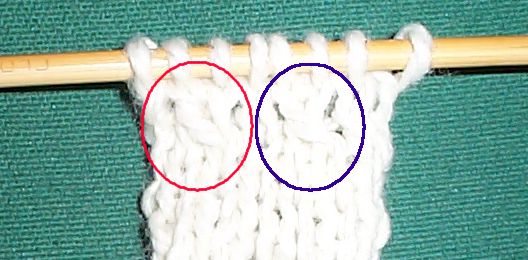
I know the photo is very hard to make out (blame my cheap camera and poor skills), but in the purple circle is a left twist that looks a bit pinched at the bottom. That was done the way described yesterday, the way that’s outlined in Walker and most other books:
- Identify your two-stitch unit. Skip the first stitch and knit into the back of the second, then knit BOTH stitches together through the back of the loop and slide the entire unit off your needle
I did almost the same thing to the twist in the red circle on the left – with one minor additional manipulation, shown in red, below:
- Identify your two-stitch unit. Slip the first stitch knitwise, then return it to the left hand needle. Now knit into the back of the second, then knit BOTH stitches together and slide the entire unit off your needle
This flips that first stitch over and places its leading leg to the rear of the needle. This eliminates the slight twist that’s formed at the base of the topmost stitch. If you’re unfamiliar with the leading leg problem, there’s a short summary on it here.
Other than this minor epiphany and about an inch of the back of my Ribbed Leaf Pullover, not much got done here last night. I’m in the midst of holiday shopping (100% on-line), plus planning for our annual cookie deluge, and for the hand-made-tamales-to-feed-30 I promised would be ready for an annual holiday bash held on Christmas day. I also owe lots of personal replies to letters and notes. I’m getting there. Glub.
APOLOGY
Life in the form of work has attacked. Today’s post postponed due to total chaos. Apologies if you’ve checked back because of my promise to post more yesterday.
DO NOT ADUJST YOUR SET
Yes, I know I’m missing. What’s happening can be explained in part by the fact that I haven’t finished digging my way out of a last-minute work-related crisis yet. At 1:50 am on a Tuesday I’m still at the keyboard. String will be back ASAP, once this new bit of chaos is beat into submission. And after I catch up on sleep.
One hint of what’s coming: it’s a "gang aft agley" moment on my flash project.
SIX!
Last week was a very Life-Dense week. I didn’t get as much time to knit as I usually do, so progress isn’t as dramatic as it otherwise might have been. Still, I got another meta-motif done and sewn onto the ever-growing counterpane:

At the rate of one meta-motif per week, I think I’ll be working on this queen-size blanket for another 25 weeks or so. That means March or April ’06 is my earliest possible completion date at the current rate of production. I’d better start (or resume) another project and work on the two in tandem just so that I have something interesting to report on. Production on this piece will slow down if I’m time-splitting my nightly hour or two of knitting. Possible completion well into 2007?? Stay tuned…
 String-Or-Nothing
