CROCHETED ROOM
BoingBoing (my favorite souce of offbeat news) just posted this link to what they call a knitted 1950s era sitting room. Actually most of the decor examples shown in ABC Tasmania’s article on this bit of unusual art are crocheted and not knit, but they’re amusing none the less. ?
MANY HAPPY RETURNS – NIGHT AND DAY SOCKS
Back from a business trip to Tucson, Arizona. No, I wasn’t there for the incredibly huge Gem and Mineral Show, but wandered by one of the show’s many pavilion complexes in the little bit of free time I had on Saturday.
In the knitting realm here’s what I got:
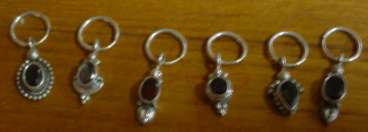
These are little silver mini-earrings – the kind some people line up by the half dozen along the edge of their ears. The dinglebobs (a technical term) hanging down are small faceted semiprecious stones – mostly garnets and pale amethysts, in small silver settings. They were incredibly inexpensive. (I’m sure somewhere in India there’s a whole village making these by the barrel full for next to nothing.)
While I was in Tucson, I happened to meet Dr. David Crawford, the Executive Director of the International Dark Sky Association. His group advocates for increased awareness of the problems caused by light pollution, and changes to local zoning/building regulations in favor of more efficient use of outdoor lighting. There are compelling reasons to improve outdoor lighting, including increased energy efficiency, reduced cost, and improved visibility where it is truly needed. There is also a growing body of research documenting how light affects people’s health and well-being, and the negative impacts that indiscriminant lighting can have on organisms of all types. When all of the other benefits are taken into consideration, the aesthetic and scientific benefits from preserving the dark night sky almost become secondary concerns.
In any case, Dr. Crawford’s impassioned (and sensible) ideas stuck with me on the over-long flight home. I turned out that the sock yarn I brought with me sort of fit the darkness and light theme, so I present Night and Day socks (still in process):

This particular yarn is Regia 4-Ply Ringel, Multi Effekt Color #5383. I’ve done a standard toe-up on US #00s, with 17 stitches on each needle (68 around). After the heel, I increased two stitches to a total count of 70. I did the increases where the corners of the short-rowed heel ends. Those two stitches help fill in the small hole that can form at that point. Normally I add a stitch on each side at that point anyway, then decrease it away on the next row. This time I just left them in.
The ankle pattern is a 10-stitch repeat I doodled up on the plane. I’m sure similar things exist in stitch dictionaries:

I hope that the the organization doesn’t mind having something as silly as a pair of socks dedicated to it. I’ll be writing up the pattern at greater length as I do Sock #2. If you decide to knit them, consider investigating (and making a donation to) Dark Skies.
Oh. The red jelly-bean looking things in the sock photo are lampwork glass ladybug beads, about to become a necklace for The Smallest Daughter. The other received earrings made from slices of a very small fossil ammonite, set in silver. My gift for myself was an unusual silver wire necklace thingy, meant to display large dinglebobs (see above). The ones I chose were rectangles of cobalt blue dichroic glass set in silver. (Dichroic glass is that iridescent stuff that looks like someone vitrified a peacock.) The Resident Male got an entire backpack full of various types of dried chili peppers – things that are hard to lay hands on here in this small corner of Massachusetts. He’s much happier with something edible.
LILLEHAMMER MYTHOLOGY
Posted in absentia. I’m off on a business trip, but left this behind.
A couple of people did write to say they would be interested in reading more about the symbols on the Lillehammer. Please bear in mind that this is just one person’s interpretation. I may be reading more into the little bits than the designers intended. And I am not someone schooled in this stuff. This is just one Avid Reader’s observations. Apologies if I’ve forgotten my Eddas and sagas, or have messed up the spellings.
Here’s my Lillehammer:
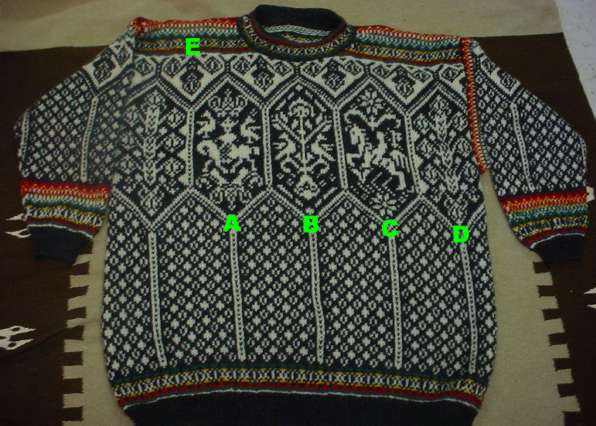
Starting with Lozenge C, just because I like to skip around, we see Odin chief and father of the gods, and god of battle and honorable death. He is riding on his ultra-speedy, eight-legged horse Slepnir (the extra legs are implied by the zig-zags). He carries his customary spear Gungnir (hard to see, but I think it’s here because he’s holding something long and thin in his hand) and has a raven following him. (More on Odin’s ravens below). I think he’s shown in profile because Odin has one eye (more on that below, too). The flower shapes might be an obscure reference to poetry (flowering words), as he was the source of bardic poetry and runic writing; and was the special protector of bards and poets.
Slepnir has a nifty parentage of his own, involving Loki masquerading as a mare to distract the dray stallion of a giant (the adversaries of the gods), to get him to default on a building deadline. The trick worked, the giant was unable to complete his project and received the penalty specified in the bargain, but Loki (a male god) was too tempting to the stallion, and ended up with foal.
Lozenge B carries Yggrdasil or Hoddmimir, the world tree. It’s a giant ash tree, most often described as white and covered with flowers. It grows from three roots in springs of knowledge, while its top shades all nine worlds, including Asgard (home of the gods), Midgard (where people live), Jotunheim (where the giants live) and Niflheim (the underworld). One of the roots was in the spring of Mimir. Mimir was an all-knowing god, whose head (some say skull) was thrown in the spring after he was beheaded. His knowledge though wasn’t lost, and some of it could be obtained by drinking from his spring. I see Mimir’s head in the ovoid object at the tree’s base.
On Yggdrasil are flowers that drip a honey-dew of inspiration, and are the ultimate source of all bees’ honey (and the exaltation that comes from drinking mead – a fermented honey-wine). Odin’s two ravens, Huginn and Munin perch on its branches. These two birds overfly the earth every day, observing everything and whispering that information back to Odin every night.
Odin is also closely associated with Yggdrasil because he sacrificed part of himself to obtain knowledge from the springs that feed the tree. In some tales he allows a raven sitting on the Yggdrasil to peck out one eye in exchange for a sip from Mimir’s spring. In others he hangs for nine days on the tree, transfixed to it by his own spear. During this ordeal he learns nine songs of power and the basic runes.
Lozenge A holds Freya, wife of Odin, and foremost female deity of the pantheon. Freya is a fertility goddess and wards agriculture and birth. I’m kind of stumped by the creature she’s riding because Freya’s mount was Hildesvini – a former lover disguised as a fierce boar. Either that or she got pulled around in a cart drawn by cats. The thing she’s riding on is way too long-legged to be a big pig. But the pattern calls out this motif set as being her, so I’ll try to find more in it. Freya did have the ability to transform herself into a bird by use of a magic cloak of bird feathers. She does have a large flat thing in her lap (perhaps the cloak); and there are birds around her. Perhaps the strange shapes at her mount’s feet are supposed to be cats as well. Her palace of Folkvang is supposed to be flower-strewn, so perhaps that’s a big flower below the cats. The royal crown above her is not uncommon on Norwegian embroideries, and so might signify her queenship over the gods.
Lozenge D and the partials up along the neck/shoulder line and sleeve tops all carry the same sort of organic growing thing. To me they look like fruit. The most famous fruit in this cycle of tales would be the apples of Idun. Idun was the goddess of youth, married to the Bragi, whose special charge was poetry. She kept a tree and stock of golden apples, which the gods ate to stay eternally youthful. Idun was once captured by a giant, and without her apples the gods aged quite quickly. There’s a whole cycle of stories about the quest mounted to get Idun and her apples back.
That’s about all the figural elements I can pick out from the design. The rest is just generally decorative. I do however particularly like the use of the close color banding at the top and edges. It looks reminiscent of tablet weaving, in a geometric that wouldn’t be inappropriate for before 1000AD. Likewise with the lozenge framing mechanism and brocade-like voided and filled dots. That’s not to say that knitting of this type was done back then (it wasn’t); but the style of the ornament on this sweater echoes weavings and textile decorative composition of a time when worship of these deities was widespread.
If you want to read more about Norse mythology, there’s always the public library – that wonderful resource in your own back yard. On line there’s also the Prose and Poetic Eddas, translations of which are both available on-line.
FINALLY, AND CHALLENGES/BEGINNINGS
51 days, and eight increasingly irate telephone calls later I finally am typing this on my base station machine using my replacement monitor from Samsung. UPS brought it yesterday morning.
Then they came back at 4:30 and brought another. Apparently one was shipped last week, but Samsung neglected to send it second-day air as agreed; and forgot to note that one had been shipped out at all. So when I called on Monday they sent another because they had no record of anything being sent since mid January, when they shipped two monitors sequentially to different wrong addresses. I refused Box #2.
The saga isn’t over yet. There is supposed to be special return paperwork and labels included in the replacement’s box. I need those to ship back the broken unit. Without those tracking numbers, I run the risk of my return not being logged in and my credit card being dunned for the full cost of the replacement unit. Call #9 looms….
On the knitting front, the socks progress. I may have to defer start on the hoodie for at least a week because of a very welcome business trip. Welcome because it’s always nice to earn income, and because it is to a much warmer part of the country. Somehow I don’t feel so bad leaving family home to freeze in Massachusetts if I bring back a paycheck from the sunny Southwest.
Favorite Patterns
Still, this starting off on another project and considering Rogue is making me think of my all-time favorite (boughten) patterns. I’m trying to distill what made them so much fun, as they range all over the spectrum, from stranded colorwork to fine lace. Some were easy, some were more challenging. Not every one was flawless, either in write-up or in my final excecution. And I can’t even say that I’d knit any of them again (been there, done that…).
I’ve mentioned the lace patterns before -? most notably Hazel Carter’s Spider Queen, and Fania Letoutchaia’s Forest Path Stole. I’ve also done the Tudor Rose pattern from Kinzel II, although it’s sitting on the needles in my Chest of Knitting Horrorstm, waiting for me to find enough of the right weight cotton to do a final round of leaves and an edging. All were scads of fun. Each inch was an accomplishment, and I loved seeing the complexity build.
Watching the complexity accumulate was also key to my enjoyment of Dale’s Lilliehammer pullover. (Here’s a link to Wendy’s fantastic implementation of that pattern. I’ll dig mine out for photos another day). I also had lots of fun with the mythology behind the figures on it. Not everyone can say they’ve knit a sweater with an eight-legged horse, a giant’s skull, and the apples of immortality on it. (If anyone’s interested, I’ll do a myth dissection of this piece on another day).
I’ve also written here about the Ridged Raglan from Knitters #54 (Spring, 1999). I’ve done three of them to date – one of the few patterns I’ve knit more than once. It wasn’t complexity this time that drew me in, but the clever construction method held my interest. I never used the color combos, yarns, gauge, or number of colors shown in the mag, so perhaps a bit of "let’s see how this turns out" was in my enjoyment mix.
Other sources of particularly noteworthy patterns in clude Penny Straker: Inverness and this Blackberry Jacket. I show this picture because I can’t find it anywhere else on the Web. It may well be discontinued. While I don’t have the sweater anymore, I do have lots of fond memories of it. Blackberry was my first knit project, and I did it in raspberry-color Germantown wool worsted (very much like Cascade 220), and finished it out with black leather knot style buttons. I picked this pattern because I thought that the bumpy texture of the trinity stitch would disguise any irregularity of my own knitting. It did.

That first project took about three months to complete. I was knitting solo, with occasional over the shoulder help from a friend. I figured out stuff like "make left side to match, reversing shaping", seaming the textured pieces, making/seaming the spread collar, and buttonhole formation/placement on my own, and the sense of accomplishment at having done so was so intense I can still feel it today. Alas, this particular piece is long gone. I think I might have lent it to a sister, years ago. Too bad.
My Blackberry Jacket’s biggest legacy is my belief that so long as you don’t tell? new knitters that something is difficult they will buzz away happily confident that it is within their ability. Yes, there are things that might take longer to work through than others, and materials that drive even experienced knitters stark raving mad,? but I think that a keen desire to make something specific trumps most challenges, especially for people as stubborn as I am.
I’ve wandered a bit away from the original premise of this entry – what makes a pattern fun, but not very far as I think about it.
What makes a pattern fun is the sense of accomplishment, of surmounting challenges, and watching something build under my fingers. The commercial patterns I’ve enjoyed the most have all been challenging, either through internal complexity or complexity imposed by making changes or taking side explorations in an unconventional piece. This has remained true throughout my knitting life, starting with the very first piece.
OOP BOOK REVIEW – PATCHWORK KNITTING
Yes, there is more than one book by this name. In addition to the more recent Horst Schulz work on modular knitting, there’s also Patchwork Knitting by Gail Selfridge (New York: Watson-Guptill, 1977).
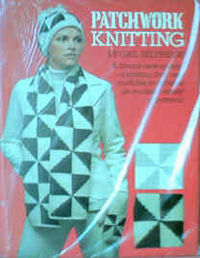
Like the later book, this is an exploration in making garments and home decor items predicated on smaller, geometric units. Unlike recent domino/modular knitting books, these motifs are all knit indvidually and later seamed together, there’s no directional knitting mentioned nor are the modules knit onto each other, saving seams. ? Instead this book explores the use of basic squares, ranging from four to eight inches across. Simple striping and Intarsia is used to emulate pieced patchwork style nine patch, twelve-patch, pinwheel, and log cabin modules, plus some simple figural motifs like hearts and stars. These modules are then assembled into mittens, scarves, sweaters, blankets, and other items.
While the styles shown betray its 1970s-origin, and there are now less labor-intensive explorations into the modular concept, this book isn’t entirely passe. It is one of the first that introduced the aesthetics and geometry of pieced quilting into knitting. While we’re used to seeing some of its concepts more or less regularly (like the log cabin quilt block reinterpreted in knitting) – there is still depth here to explore.
It also does a good job of explaining how to trick out an array of basic squares into a (more or less) shaped garment. Selfridge adds gussets and ribbings to bring some fit into what would otherwise be drop-shouldered, cubical pullovers and cardigans. The adapt-a-square instructions even cover adding thumbs and rounded ends to squares to make mittens, and adding limbs to squares to make toys. It’s this latter group of small projects, including scarves and hats plus the blanket layouts, that might be the most useful.
For example, I’ve got two Little Kid Knitters here in the house. Their attention span doesn’t extend to blankets or even whole pullovers, but they are both taken with the thought of making small squares that can be turned into teddy bears, hats, scarves, and mittens. Even if I have to do the thumb shaping or bear ears for them, the ideas shown in this book are a welcome addition to my store of "What can I make next?"responses.
I note that this book sells on the used market for a wide range of prices. While I certainly don’t think there’s enough here to merit the premium end of that spectrum, if you stumble across it at a reasonable cost it might be worthwhile, especially if you’re teaching kids.
I also note that this book is very widely held in regional library networks. You can probably find a copy near you. I’d like to shamelessly plug local libraries here. They may not always be able to afford The Latest Thing anymore, but they are treasure troves – especially if they participate in a regional reciprocal loan program. Get out there and explore their holdings. Borrow something. Books – including knitting books – are more likely to be remaindered or discarded if they languish on the shelves. Help keep the stock of these older, still useful books available by letting your library know they are still desired and appreciated. And while you’re at it, let the staff know that THEY’RE still appreciated, too.
HOODIE AND SOCKS
I’m still noodling on the hoodie project. Target child is waffling about her requirements. I’d rather wait until she settles into firm conviction before casting on. Some questions came in after Friday’s post:
Why start with Rogue instead of designing your own from scratch?
First, I really admire this particular pattern, its proportions and the way the cables are so cleverly used. Since it fits so closely with the original set of requirements and/or mods to it would not be difficult, why not start out with it? Cardigan-ization isn’t tough, nor would be knitting a smaller size to compensate for gauge differences. As for the rest – the texture pattern and saddle shoulders with a cable down the center of the arms, as Target Child looks over the photos of other people’s finished Rogues, she’s becoming less attached to those concepts.
You know you can use knitting design software to help.
Yup. I know that. I’ve got Sweater Wizard and the older Cochenille product. Hated the latter. I didn’t mind the non-standard format of the directions, better suited for knitting machines than for hand knitters, but I was totally turned off by the lack of technical insight provided by customer support. The thing wasn’t cheap, and I could never get it to run properly. Only one or two of the supplied templates produced any sort of output, and even they were unable to produce more than one or two of the available sizes. “Support” claimed that it was a problem unique to my set-up and there was nothing they or I could do about it aside from waiting for the next upgrade and seeing if that worked any better. Since we’ve got an average of six or seven working computers in this house at any one time (all with different processor/opsys/video card combos), and I tried the software on all of them and turned up exactly the same bugs, I rather doubted that one unique set-up was the problem.
Rather than throwing good money after bad, I decided not to spend close to $100 to upgrade Cochenille (with no guarantee that the new version would work any better. I switched over to Sweater Wizard. It’s got far fewer design templates and isn’t a full-size sloper drafting program, but what it has actually works, and is quite easy to use both during the design and knit-from phases. Which is refreshing compared to my previous experience. My only criticisms of the product have to do with personal preference and fit. I find the standard fit a bit tight for my taste, so I always add extra ease (which is verysimple to do).
My real desire though is to be able to produce the full-featured graphs of actual garment pieces, showing color or texture pattern placement like the ones in Rowan magazines. So far no knitting pattern design tools come close to that degree of integrated pattern shaping/motif placement. Yes, there are export features that allow customization of garment shapes for colorwork placement, but no total pattern maker that lets you tinker with all parameters in one interactive console. (If you gotta dream, dream big. [grin])
Meanwhile, Back at the Ranch
Although progress is slowly burbling along on the hoodie, there wasn’t enough to keep my fingers happy over the weekend. So I started a pair of quickie socks. Standard Figure-8 toe toe-ups with short-row heels. I’m using Lana Grossa Melienweit Fantasy, on US #00s, at the (for me) relatively large gauge of 9spi (68 stitches around). Ankle pattern is an impromptu feather and fan variant:

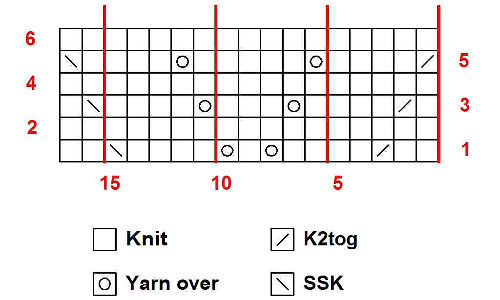
Here’s the graph for the ultra-simple six-row feather and fan variant used on the ankle. It’s 17 stitches wide and six rows long. I’m working my socks on five needles (four in the sock, one to knit with). Because each needle has 17 stitches on it, this graph is worked once per needle:
More info on knitting socks of this type, including basic how-tos for both the Figure-8 toe and short-rowed heel can be found in any of the sock patterns on wiseNeedle.
NEW PROJECT – BLUE HOODIE
Monitor Dearth Watch = 47 days and counting. Samsung’s latest excuse is that they mailed out the thing twice, but each time to a different wrong address, in spite of the fact that my address is correct in their records. Unpleasantness ensued until they conceded that error on their part doesn’t amount to $300. worth of liability for each monitor on my part. Since someone at those other addresses signed for the monitors, I can expect that they will now have the joy of paying for them. Which leaves me still without a monitor.
Now, those of you considering purchasing a Samsung product right now are probably taking this sample of exemplary service efficiency into account as a data point in that decision. And you’d be correct to do so…
Hoodie. Possibly Rogue-derived.
Can’t put it off any longer. I promised the older daughter that I’d knit her a sweater of her own design. I’ve gotten back this set of thoughts to play with:
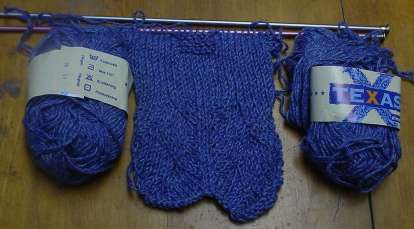
- Yarn choice: Almedahls Texas, a 100% cotton loosely twisted multiply worsted weight yarn in faded jeans/chambray blues. Slightly marled. It’s a yarn sale acquisition from last winter that has been stash-aging a while. Very soft, splits like crazy. Knits up nicely on US #6 needles at spot on classic worsted gauge of 5spi/7rpi.
- Required shape: Oversize zip-front hoodie, saddle shoulders and slightly belled sleeves.
- Desired decorative elements: Cables! Especially up the center front and around the hood’s edge. Also if possible – the Dragon Skin texture pattern from Walker #2 (p. 136).
Now I’ve thought about starting with Rogue (a truly excellent bit of design work that I envy). There are some problems though:
- The gauge of my yarn is wrong for it, but I can cope with that.
- Also it’s not a cardigan. I can also cope with that, too. Others have split the front and made it into a zip-up, so I wouldn’t be the first.
- The cotton I’m doomed to use is also rather inelastic for this sort of thing, but I’ve done complex cabled pieces out of the most intransigent of yarns, so I don’t think that this one will be too difficult.
- The thing really isn’t set up for saddle shoulders. (I think this
point isn’t a life or death requirement, and Target Kid will be happy
without cables up the arm to the shoulder so long as she’s got the
cabled cuff detail). - Much of the beauty of the piece comes not only from its excellent shaping, and clever incorporation of cable increases into accents, but also from the contrast of the very plain body with the deeply embossed cabled trim. Using an all-over texture pattern like dragon skin would cut into that contrast.
Problem:? How do I either talk Target Child out of the dragon skin texture pattern, modify dragon skin’s stitch count/repeat to make it easier to use in a project of this scale; or talk myself into adapting Rogue to use it?? More explorations and/or negotiations are necessary. I’ll probably order the pattern early next week, after I’ve finished swatching out the Texas and playing with Walker’s repeat widths.
Here’s my initial swatching play of the texture pattern as she wrote it. (Dragon Skin is on the bottom of the thing. )
SUSAN’S IMPRESSIONIST BLUES ‘LEMONADE’
I managed to land in both a snow and knitting rich area. Many of my neighbors knit. One even holds an informal knitting circle that meets once a week. I’ve been going when I can, and have watched the creation of a really nifty project that happened as a late-course correction on what might have been a tragedy.
Susan The Architect has been knitting a magnificent impressionist blues/purples mohair stole to wear to a Very Important Event. She cast on plenty of stitches on a long circ because she was going to knit it the long way (rows running end to end) rather than across the narrow dimension. It was tough to get a fix on her gauge because so many stitches were on the circ, and she had forgotten that she had done her swatch on a smaller sized needle than the one she ended up using.
She knit happily away in K5, P5 rib until her stole was about 18 inches wide. Then she bound off and discovered that she’d made a strip 18 inches wide by 12 feet long!? Although she’s on the tall side, she’s not tall enough to carry off a 12-foot strip without constantly stopping to re-drape it or creating a tripping hazard for herself or those around her. Serious thought was needed, as ripping back mohair isn’t a pleasant experience.
Susan decided to keep what she had made, but engineer a new use for it. I apologize for not having a model photo of the final piece, but I didn’t have a camera with me. Here’s a schematic, though:

She folded roughly one foot up on each end of the piece, then stitched the resulting flaps down at the cast on and cast off edges. She also seamed about three quarters of the way along the top of the flaps. This made nice pocket ends. Then she folded the piece in half, and seamed down the cast-on edge approximately 18 inches from the center fold. This joined the back into a hood-like shape.
She wears the piece with the hood either draped down her back, or over her hair. The two ends hang down in front – each with a handy pocket end at her fingertips, or are worn with one end flipped up over the opposite shoulder. From the center back of the neck (the base of the hood) to the bottom edge is now about 3.5 feet (12 foot total length/2 = 6; 6-1 foot for pocket = 5. 5-1.5 feet for hood = 3.5 feet), a far cry from the dangling 6 foot from the collar length of the piece when worn as a plain stole. Very wearable, and if I might say so, very flattering, too. Here are directions if you want to make Susan’s Stole for yourself.
Susan’s Stole
4 skeins King Cole Luxury Mohair (110 meters each, approx 440 meters or 480 yards, total)
Size US #13 (9mm) circular needle, 36 inches long.
Tapestry Needle for sewing up.
Gauge = Approximately 8 stitches = 4 inches or 10cm
Cast on 285 stitches.
Row 1:? (K5, P5), repeat, end K5.
Row 2:? (P5, K5), repeat, end P5.
Repeat rows 1 and 2 until your piece measures approximately 18 inches across, or you run out of yarn. Cast off and darn in ends.
Fold left and right edges in towards center, making end flaps approximately one foot deep. Seam up cast on and cast off row edges. Seam approximately 2/3 of the top edge of the flap to form a pocket.
Fold piece in half so that pocket ends are opposite each other. Seam about 18 inches from fold towards free ends along cast-on edge (the opposite side from hand opening), to create a hood-like opening.
Final word:? Why ‘Lemonade?’? From the old adage that begins “If life gives you lemons…”
VINTAGE YARNS
More goodies from the mailbag. Laura wrote:
I recently came across the Mary Francis Knitting and Crocheting Book. It is darling! Even though the credits don’t specify, I assume it’s a reprint of a book originally written around 1920. Woven within the story are quite extensive photo demos of knitting and crochet, along with many patterns for doll clothes, and even Red Cross knitting patterns. The text of the book describes yarns as 2-fold, 3-fold or 4-fold, and appear to be referring to what we would call ‘ply’ today–though perhaps more in the UK style. The book then goes on to say that yarns are named Germantown Zephyr or Germantown Wool (4-fold or 8-fold), Knitting Worsted, Saxony Wool, Woolen Knitting Floss, Teazle Yarn, or Angora Wool. Would you have any info on what the modern equivalents of these might be? Any references to point me toward? I did a google search, but mostly came up with “Bear Brand Germantown Yarns,” a few skeins of which have retired in my stash….It would seem that Germantown could refer to worsted weight or heavier (about a 3 or 4 in the modern number scheme trying to standardize the industry), Saxony might be more of a baby or sport weight (2ish, I suppose) and Knitting Floss might be more like Shetland yarns–lace or baby/fingering weight (1 or 2ish, I’m thinking).
I know there are lots of people now interested in older knitting patterns – everything from ponchos published in the 1970s through the truly vintage stuff going back to the late 1800s. The older the book, the harder it can be to figure out how to make the garment using today’s materials. Laura’s problem is a very common one for anyone looking at these older patterns.
I can’t claim to be an expert on this on this, but I have had a little bit of experience with legacy/historical patterns. From my limited exposure, Laura’s guesses are spot on.
For the yarns described in her book, Germantown’s closest equivalent is true worsted (not just something within the group system 3 or 4 designation; (the group system being a lousy method yarn classification – 2021 update and elaboration of my 2004 rant here). The closest modern yarn is Cascade 220 – a 100% wool that knits at 5 stitches per inch. Many patterns call for that size yarn to be doubled. I’ve had good results using either a true worsted, or even a lofty DK when the pattern calls for knitting with two strands.
Saxony was often used for baby items, knit on 15s or 16s. The modern needle size equivalent would be 00s or an size in between 00 and 000. I’ve had success substituting modern three-ply fingering or baby yarn. (4-ply fingering is standard sock weight, knitting at 28 stitches = 4 inches, 3-ply is lighter, usually knitting at 32 stitches = 4 inches.) Perhaps Jamieson Shetland Spindrift might work, being lofty and able to be knit down to that gauge. Brown Sheep WildFoote is one of the lightest sock yarns around now that Kroy 3 Ply is discontinued. Froelich Wolle Special Blauband is also on the thin end of the fingering spectrum. Much thicker and denser but machine washable is Dale Baby Ull. Knit tightly it might work, but I think that the Spindrift or Wildfoote would have a more historically accurate look.
I also suspect that Knitting Floss is lace weight. Skacel Merino Lace might make a good substitute.
Teazle, and Angora Wool are tougher. My suggestion would be to look at the needle size and gauge. Since most historical patterns don’t give gauge, are sized fairly small and fit FAR tighter than modern ones, the best way to figure out gauge is to look at the stitch count around the wrist or cuff rather than around the chest. Fit on wrists don’t change much, nor is ease generally a big factor there. Compare whatever you get to the wrist measurement of a modern piece – women’s small, men’s small, or children’s about size 6 for post-baby garments. Using that measurement roughly estimate how many stitches per inch the piece had just above the ribbing.
I’ve been working on this chart for a while, collecting historical yarn names and modern gauge/needle size equivalents. Also some suggestions on possible modern yarns. I started with some needle size data abstracted from Lois Baker’s highly useful comparative needle chart. Most of the historical yarn types I cite are from patterns before the 1930s. Note that these are not hard and fast categorizations, many yarns/needle sizes can slip up or down a peg. Also note that texture is difficult to match. I have no way of knowing if one yarn type was say, closer in feel to Spindrift than it is to Regia. Feel free to attach corrections/additions in the comments. I’ll update the chart body and put a link to it under ‘Reference’ at right.
For yarns from the 1950s through 1970s, VintageKnits maintained a very useful guide to fiber content and actual gauges of specific yarn brand names. It’s divided roughly by weight into several pages.
|
Historical Needle Size |
Modern Needle Size |
Expected Gauge |
Typical Historical Yarn Names |
Possible Modern Substitutes |
| 0.25mm | 1 ply Cobweb wool Cotton thread |
|||
| UK 24 | 0.5mm
US #00000000 (8/0) |
1 ply Cobweb wool Cotton thread |
Size 80 cotton | |
| UK 22 | 0.75mm
US #000000 (6/0) |
1 ply Cobweb wool Cotton thread |
Wool Floss Spool Cotton Knitting cotton |
|
| UK 19 US 18 Steel |
1.0mm US #00000 (5/0) |
1 ply Cobweb wool Cotton thread |
Size 50-80 cotton Jamieson 1-Ply Cobweb Wool |
|
| US 17 Steel | 1.125mm | 1 ply Cobweb wool Cotton thread |
||
| UK 18 US 16 Steel |
1.25mm US #0000 |
2 ply Lace weight Cotton thread |
Berlin Wool Briggs Knitting Silk |
Size 50 cotton Skacel Merino Lace |
| UK 17 US 15 Steel |
1.5mm US #000 |
2 ply Lace weight Cotton thread |
Berlin Wool, Andalusian Wool | Size 30 cotton Skacel Merino Lace Lorna’s Laces Helen’s Lace |
| UK 15 US 14 Steel |
1.75mm US #00 |
3 ply Fingering Light Fingering 30-32 st = 4 in |
Saxony, Shetland, Pompador, German Fingering, Alliance |
Jamieson Shetland Spindrift, Brown Sheep Wildfoote, Dale Baby Ull (knit very tightly), Kroy 3-Ply Most of |
| UK 14 US 13 Steel US 0 Standard |
2mm US #0 |
3 ply Fingering Light Fingering 30-32 st = 4 in 4 ply Fingering |
Saxony, Zephyr, | Jamieson Shetland Spindrift; Kroy 3-Ply
Most of the lighter weight sock yarns |
| UK 13 US 12 Steel |
2.25mm
US #1 (some) |
3 ply Fingering Light Fingering 30-32 st = 4 in 4 ply Fingering |
Saxony, Zephyr, Cocoon | Jamieson Shetland Spindrift; Kroy 3-Ply Dale Baby Ull (knit very tightly) Most of the lighter weight sock yarns Most standard sock yarns; Rowan 4 ply yarns |
| US 1 Standard | 2.5mm
US #1 (most) |
4 ply Fingering 28-30 st = 4in |
Saxony, Beehive, Penelope | Most standard sock yarns; Rowan 4 ply yarns |
| UK 12 US 11 Steel US 2 Standard |
2.75 mm US #2 |
4 ply Fingering 28-30 st = 4 in |
Beehive, Peacock, Penelope | Most standard sock yarns; Rowan 4 ply yarns |
| UK 11 US 10 Steel US 3 Standard |
3mm
US #3 (some) |
4 ply Fingering 28-30 st = 4 in Lighter sport weights |
Koigu; GGH Marathon; Zitron Libero |
|
| UK 10 | 3.25mm US #3 (most) |
Sport weight 24 st = 4 inches |
Louet Gems Opal Merino; Jaeger Matchmaker |
|
| US 9 Steel
US 4 Standard |
3.5mm
US #4 |
Sport weight 24 st = 4 in |
Louet Gems Opal Merin; Jaeger Matchmaker |
|
| UK 9 US 8 Steel US 5Standard |
3.75mm US #5 |
Gansey weight, 5-ply 23 st = 4 in |
Jumper wool | Wendy Guernsey 5 Ply |
| UK 8 | 4mm US #6 |
DK weight 22 st = 4 in |
Germantown, Zephyr, Saxony doubled |
Jaeger Matchmaker DK; Jo Sharp DK Wool; Most standard DK weight yarns; Most 4 ply fingering weights, doubled |
| US 6 Standard | 4.25mm | DK weight 22-21 st = 4 in |
Lighter airy worsteds, heavy cable spun DKs, most 4 ply fingering weights doubled Whatever can be knit to just under regulation worsted weight |
|
| UK 7 | 4.5mm US #7 |
Worsted 20 st = 4 in |
Germantown | Cascade 220 |
| US 7 Standard | 4. 75mm | Worsted 20 st = 4 in |
||
| UK 6 US 8 Standard |
5mm US #8 |
Heavy worsted
19 st = 4 inches Aran |
Most standard Aran weight yarns; Most standard sport weight yarn, doubled; Most standard mass market yarns labeled “Worsted” with on-label gauges of 19-18 stitches over 4 inches (10cm) |
|
| UK 5 (some) US 9 Standard |
5.25mm | Aran 18 st = 4 inches |
||
| UK 5 | 5.5mm US #9 |
Light bulky 17-16 st = 4 in |
||
| US 10 Standard (some) | 5.75mm | Light bulky 17-16 st = 4 in |
||
| UK 4
US 10 Standard |
6mm
US #10 |
Light bulky 17-16 st = 4 in |
||
| UK 3
US 10 1/2 Standard |
6.5mm US #10 1/2 (some) |
Bulky 15-13 st = 4 in |
Germantown doubled | Two strands of Cascade 220; Most standard worsteds, doubled |
| UK 2 | 7mm
US #10 1/2 (some) |
11Bulky 15-13 st = 4 in |
||
| UK 1 | 7.5mm | 11Bulky 15-13 st = 4 in |
||
| UK 0 | 8mm
US #11 |
Bulky 15-13 st = 4 in |
||
| UK 00 | 9mm US #13 |
Super bulky 12 or fewer st = 4 in |
||
| UK 000 | 10mm US #15 |
Super bulky 12 or fewer st = 4 in |
||
| 12.5mm US #17 |
Ultra 10 or fewer st = 4 in |
|||
| 14mm US #18 |
Ultra 10 or fewer st = 4 in |
|||
| 15.5mm
US #19 |
Ultra 8 or fewer st = 4 in |
|||
| 19mm US #35 |
Ultra 8 or fewer st = 4 in |
|||
| 25mm US #50 |
6 or fewer st = 4 in |
QUESTIONS – BOTH INTERESTING AND ANNOYING
Interesting Question
Yesterday Marcia asked about the K2P2 rib I posted about. She wants to use it on a hat where the brim is worn folded up. She’d like to have the pattern visible on the flipped up part, and wants to have the twists on the hat body and brim oriented with the same leg on top.
I haven’t tried this, but I think that if this stitch were worked two-sided – with crossings on both sides, Marcia’s effect would be achieved. To do this you need to make it a six-row rather than a five row pattern. Marcia was also concerned with the leg direction, but if the thing is worked two-sided this way, when flipped up the reverse will display the cable twist crossings going in the same direction as the front. (Try it by making slash marks on both sides of a piece of paper, then folding it.)
To do it flat, I’d work:
Cast on a multiple of 4 stitches
Round 1: (K2, P2), repeat
Round 2: (K2, P2), repeat
Round 3: (Right twist using this method: [K2tog, leaving unit on left hand needle. Re-insert right hand needle tip into stitch closest to end of left hand needle. Knit this stitch. Slip entire now-twisted two-stitch unit to right hand needle], p2), repeat
Round 4: (K2, P2), repeat
Round 5: (K2, P2), repeat
Round 6: (Right twist using this method: [K2tog, leaving unit on left hand needle. Re-insert right hand needle tip into stitch closest to end of left hand needle. Knit this stitch. Slip entire now-twisted two-stitch unit to right hand needle], p2), repeat
In the round I’d work:
Round 1: (K2, P2), repeat
Round 2: (K2, P2), repeat
Round 3: (Right twist using this method: [K2tog, leaving unit on left hand needle. Re-insert right hand needle tip into stitch closest to end of left hand needle. Knit this stitch. Slip entire now-twisted two-stitch unit to right hand needle], p2), repeat
Round 4: (K2, P2), repeat
Round 5: (K2, P2), repeat
Round 6: K2, (Right purl twist using this method: [Skip the first stitch but retain it on the left needle and purl the second one, also retaining it on the left hand needle. Then purl together both the skipped stitch and the second stitch and move the resulting two-stitch unit to the right hand needle], repeat
Of course another way to deal with the problem is to knit the cuff area using the pattern as described yesterday. When it was deep enough, you’d add three rows of purls to make a welt (the fold line); then reverse direction and knit the cap part, using the opposite twist stitch wherever the original called to use one. That would put the right side of the cuff showing when folded up against the hat body.
Another Interesting Question
FeliciaSix says “Wow. Eyes. Monitor. Bright. Hurt. Why did you pick that most unsubtle of color combos for the Fingerless Whatevers?”
Because it’s cold, dark and dreary in the winter and I wanted to wear the opposite.
Annoying Questions
None of them are worth repeating. Some days I wish every computer came equipped to display this error message:

You can build your own error messages, too.
 String-Or-Nothing