WORKING REPORT – ENTRE DEUX LACS
I’ve been playing around with the multicolor yarn I mentioned yesterday. It’s Mountain Colors Wool Crepein a symphony of vivid blues, accented with greens and a smidgen of purple. The yarn review page shows a manufacturer’s gauge of 2 stitches per inch. Apparently that was for multiple strands used at the same time. The review posted shows 4 stitches = 1 inch for double strands, but I intend to use it single stranded.
The yarn is a very stretchy wool crepe – almost a boucle in texture. That means it can be worked over a wide range of gauges. Right now I’mswatching atabout 6 stitches/8 rows= 1 inch on 4mm (US #6). The fabric is very light and bouncy, and the bumpy texture of the yarn makes it more opaque than I originally thought I’d see working on this needle size.
Although the texture of the yarn is interesting, it’s the color that captured me. Color sections are medium sized- about 6 to 10 inches, and the colors are especially intense. Using this over long rows would mull the colors together because each would last for an inch or so over one row and then change. While the result would be pleasing, it’s not what I want to do. I also don’t want to do a big flash piece because the color sections aren’tlong enough to do that easily. I want puddles of these blues, and to achieve a moreMonet’spond lookthana Jackson Pollok effect.
With a repeat so short, I’d need to make little tiny sections to let the colors accumulate into puddles (reference bad grammar French pun for this project’s code name). Entrelac appears to be good for this. I’ve never been a big fan of it – mostly because I find the large diamonds or squares on most entrelac pieces to be clunky looking, but I did have fun with the Forest Path Stole. That was subtle, with the entrelac technique skewing the scraps of lace and introducing lots of movement into the design. So I started playing around with plain stockinette entrelac. After several swatch attempts at various patch sizes, I think I’ve found the effect I was looking for – a six-stitch block, each block being about 1 inch wide:

The entrelac tilework effect is rather muted, but the colors are puddling nicely. I’ll continue with this swatch for another couple of courses, then see how it blocks out. One thing I’m thinking of doing is to dispense with the M1 increases in favor of plain old YOs. That might add a touch more of an openwork feel without compromising the color-puddle effect.
Once I’ve gotten a look and feel I like, I’ll think about garment shapes. I’ve got only 1450 yards. I suspect that entrelac takes more yardage than plain stockinette just because EVERYTHING fun takes more yardage than plain stockinette. As a result, I’m looking at a short-sleeved three-season top. I’ve decided I like the fit of shaped tops better than flat knit rectangles, but that presents a problem with the entrelac technique, which is better suited for producing unshaped yardage. I’ll continue noodling over that problem…
WORKING REPORT – “SPRING LIGHTNING” LACY SCARF
I’m feeling better and better about the fits-and-starts process by which I usually arrive at a finished project. As I read more blogs I realize that I’m not the only one who’s journey from start to completion is a single linear process. Especially on original pieces, most people have a three steps forward/one step back path of progress. Thank you Joe, Wendy, and everyone else who has documented forward but retrograde motion!
My own retrograde progress is that the lacy scarf is stalled. The good news is that the hand-spun Merino wool I am using for the lacy scarf is still available. The bad news is that I ran out of yarn, and have ordered another skein.
Now I have two choices – finish out the remaining foot of edging and use the piece as is; or rip back to add length. After (already) ripping the first end and re-doing it, I am liking the feel and drape of the piece more. The only thing that is still bugging me is total proportion. It’s wide for its length. Another three or four inches of the center motif would go a long way to making the piece more pleasing.
I’m leaning heavily towards adding length. With an entire extra skein, I’ll have plenty of yarn with which to do so. Plus I won’t have to remove all the edging that’s been completed. The Knitting Gods were with me when I startedthat partbecause all unknowing, I began on the "downhill" side.I worked from the center down to the cast-on row end, then back up the other long side. That means I only need to rip back enough to free the final diamond end.
As you can see, I’ve tentatively decided on a name for this mangled creation. Playing on the zig-zags, plus the petal shaped holes and fluttery edge reminiscent of our cherry tree in bloom, I’ll call it "Spring Lightning." I’m still debating on whether or not I should write the thing up for wiseNeedle.I shoudn’t have a problem doing so, but I don’t think there are many peopleinterested in a scarf of this type. Most of the scarves I see being knitare low-effort/high-tactile-visual-appeal type stuff from novelty yarns. I see people doing complex lace shawls, but not small scarves. (There’s a poll at theright if you’d like to leave your opinion.)
What to start next? Hmm… Ideas have been bubbling around for that blue fingering weight hand-dyedboucle I wound a couple of weeks ago:

I had fun with the entrelac stole. Perhaps I’ll do some swatching for an entrelac or modular knitTee. But I’d like to work in some sort of shaping as most stuff I see in modular knitting is too boxy a fit for me. I’d also like to make the modules very small to capitalize on the intense color patches in this yarn.
Since I’m now stalled on Lightning andon the perpetual wash cycle mode on the felted pillow, it’s back to swatching for me.
JUSTICE (AND KNITTING) FOR ALL (ALSO WORKING REPORT-LACY SCARF)
Yesterday’s visit to the halls of jurisprudence was at the same time, quite dull and quite interesting. Although I was not among the impaneled and got to leave early, watching the process up-close-and-personal was enlightening. I metthree other knitters among those waiting in the jury pool, and got lots of edging done in the hours I sat there:

Two of the people I chatted with were quite nice. Both were women who had knit years ago and who were thinking of getting back into it after reading that the hobby has grown in popularity. Both mentioned "fancy scarf yarn," so I’m guessing that the scarf craze hasn’t exhausted the pool of late adopters yet.
The third was a pain, a pest, an annoyance, and I spent part of the morning trying to dodge her. The problem was that she insisted that what I was doing couldn’t be knitting. It was crochet because it was white, lacy looking, had holes, and wasn’t being worked on long needles with buttons at the ends (I was using two DPNs). After all, everyone knows there’s no such thing as knitted lace.
She wandered over and gushed a bit. I kept working, giving short but (mostly) patient answers. "Gorgeous crochet!"
"Thank you. It’s knitting, not crochet."
"It can’t be. It’s crochet. I can tell."
"Sorry. As you can see, I’m knitting."
"Thats not knitting. I know knitting and you aren’t doing that.
You’re making holes. You NEVER make holes in knitting.
It’s wrong. This is crochet. Don’t tell me what I know."
This went on and on, all in a voice that the entire room could hear. I excused myself, picked up and resettled in another waiting room. After a little while my tormenter followed, commencing whereshe left off. I moved again. She followed. I was ever so grateful when they announced the lunch break. I watched to make sure she left the building, then popped down to the cafeteria for a stale tuna sandwich and a half-hour of relative quiet.
On the edging, I’m about 85% sure that I won’t run out of yarn. I’m also not entirely pleased with the two corners. I did try to miter them, but wasn’t able to manage it in the face of constant interruption. They are more or less symmetrical in stitch count and pattern iteration, but they look clunky to me. I’m also not entirely sure that this project will be successful enough to make it to the write-me-up-for-wiseNeedle stage, or to deserve a name other than its current generic descriptor. So it goes.

If any lace mavens out there can offer up advice (or sympathy for ripping back), I’ll listen with eyes wide.
ABSENT, BUT WITH LEAVE
Today’s entry will be rather short, and posted in advance. I’m off to jury duty, to assist in the dispensation of justice here in the Commonwealth of Massachusetts, USA.
Heaven help Massachusetts.
If you see a tall gal with glasses knitting on a lacy white scarf in the Cambridge courthouse, or at the Cambridgeside Galleria Mall around lunch time, stop by and say hello.
Department of Goofing Off
I was out Web-walking and stumbled arcoss these little frighteners:
 |
 |
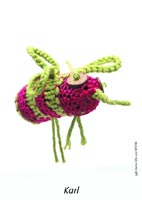 |
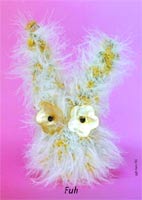
Don’t worry. They’re not recent projects – they’relittle knit "pets" from a set of promotional eCards put out by GGH. You can send these or one of theirseven siblings with your own message. If you live in Germany (or have a cooperative penpal) you canbuy a packet of paper postcards showing the entire set.
Back tomorrow with more tangled knitting thoughts. Unless of course the Commonwealth intervenes.
GADGETS – MAGNETIC BOARDS, BOUGHT & IMPROVISED
As I’ve posted before, I’m in the throes of moving. My entire stash, most of The Chest of Knitting HorrorsTM and the majority of my knitting tools are packed away in the storage cubby. Need however, does not sleep.
This weekend past I needed to work from charts. I like to use a magnetic board, but my slab-o-steel and fancy magnets were packed away with the rest of my goodies. I had several alternatives to the keeping-my-place problem. I could use plain old pencil ticks, marking off rows as they were completed. I could use yellow sticky notes to keep track of where I was. Or I could improvise a magnetic board.
Pencil ticks are a pain, and while they help me see what’s been done, they’re of little use mid-row, especially in a long, or wide repeat. Post-its are useful, but the stickum wears out, and any time I take a stack of them out of the Forbidden Drawer, the kids attack (corollaries to this type of household piracy include liberation of Mom’s Good Scissors, and unauthorized Scotch tape squandering.) Repositioning them is also trickier compared to just nudging a magnet bar.
As a result, I turn time and time again to my magnet board. I’ve gotthe standard issue 8×10 flat model:
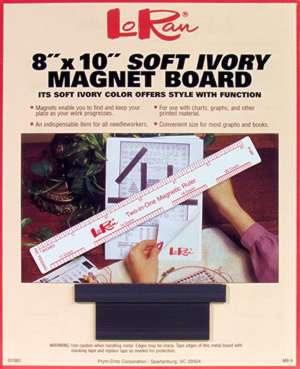
Lo-Ran appears to be the leading (perhaps only) outfit marketing these.Boards come in several sizes both with and without pencil ledges at the bottom. Theyare marketed in several bundles, some with additional accessories. Accessory packs are also sold separately. Mine didn’t come with the little white magnetic ruler pictured, but I bought it a zillion years ago. I also don’t use the magnifying bars, stands, or other supplemental gadgets. The half-barrel shaped magnifiers distort too much for my liking, and as a Wandering Knitter – the less impedimenta, the better.
About the only down sides to using the boards are:
- Even though the corners are now rounded off, the edges can be sharp. I suggest covering them with book repair tape or some type of tape that doesn’t bleed adhesive over time (NOT duct tape, woven electrical tape, or first-aid tape).
- 8×10 is smaller than my pattern pages, so my copy gets battered;
- Being thin, they bend easily. The magnets don’t stick well to an undulating surface, so I’ve had to resort tobangingmine back into shape with a rubber mallet a couple of times over the years.
If I’m using a published pattern, I make a photocopy and put my original back on the shelf (fair use under copyright laws – if I’ve annotated it with notes I want to keep, I staple it to the original and file both away after use; if not, I destroy the copy).I slide the copy into a plastic document sleeve or zip-lock bag, along with my thin metal magnet board. Then I use the magnets on the outside of the sleeve, positioning them as needed to highlight my working section. I place my magnet to cover the row above the one on which I’m working, sliding it up as I go along. That way I can see both the row I’m on, and the rows I’ve just completed. In knitting it’s rarely necessary to mark a vertical, but some people I know do position two additional magnets to frame a repeat, removing these vertical markers when they get to the final iteration and need to work any non-repeating stitches at the end of their rows.
Without my board thisweekend past, I had to improvise. My kid refused to let me borrow her magnetic paper dolls set, having seen my true nature when Iinvaded her K’Nex building toy set for rings to use as stitch markers. Not having a typist’s metal copy stand (remember those?), a tabletopmusic stand, or access to sheet steel and a machine shop, I raided the kitchen.
I found a flimsy, cheap Ecko raised lip cookie sheet/jellyroll panI bought back when I got my first apartment. You know the kind – the type of flat panthat warps at any temperature over 250F, and is guaranteed to burn anything baked on it. I’m sure you’ve got one squirreled away somewhere, making appearances to re-heat pizza or catch drips, but not to do any real cooking. Mine is the worse for wear, havingrecently been rescued froma three-year turn outdoors underneath the barbeque. It’s scrubbed clean, but it’s too nasty looking to use without foil between it and food.
Then I scarfed one of those promotional business-card style fridge magnets that breed with the same frequency as AOL CDs or coat hangers. This whopping big index-card size one came with the thank-you for your membership letter from WERS, a Boston-area Public Radio station based at Emerson College. (Just because I’m ancient doesn’t mean I have to give up on college radio.)
I cut the flexible WERS magnet into strips, slapped my chart on my pan and had my no-cost magnet board. While it’s not as flat as my regular fancy board, it is larger than my sheet of paper, so the edges aren’t getting battered. Also the pan shape has been very usefulas a tray forcontaining spare DPNs, pencils, and other items as I carry my knitting room to room:

My solution isn’t pretty or elegant, but it works; and using all scrounged materials – it was free.
WORKING REPORT – LACY SCARF, FULLED PILLOW II
I continue to make progress on my two at-hand projects.
Lacy Scarf
I finished the center strip of the lacy scarf on Saturday night. The center strip took almost one entire skein of the hand-spun lace weight Merino. That rate of consumption put the last stake in the heart of my first choice of edging (with minimal modifications). I did’t think I would have had enough yarn to do one that wide.
So as I predicted, it was back to the drawing board. I spent my knitting time on Sunday and Mondaymessing around with stitch dictionaries bothhard-copy and on-line, usingthe little bit of yarn leftover from Skein #1, swatching out possibilities. Disappointment. Overall, I felt like a cable TV viewer – I’vehad hundreds of choices, but nothing to watch.
I started with several possiblities from books, then tinkered with them. I even drafted up a couple ideas from scratch.I wanted to use diagonals and/or diamonds to mirror the motifs on the scarf end. The thing should be rather demonstrative as the bulk of the body is so plain. I neededmy edgingto be no wider than 12-14 stitches at its widest point. Asawtooth or point detailwould make going round the corner easier.
After extensive fiddling with dozens of patterns (enough to actually wear out my short length of practice yarn from all the knitting up and ripping back), I cycled back to my original pick.It had the best combo of diagonals and I liked the balance of opage to openwork areas. All that effort wasn’t lost though. What practice did do was give me a better feel for how patterns can be changed around. My initial efforts at modifying the pattern book original were pretty tame – taking out a small insertion detail. This last time I chopped it right in the middle of a vertical pattern element, narrowing the thing down by half. As you can see, it’s working:
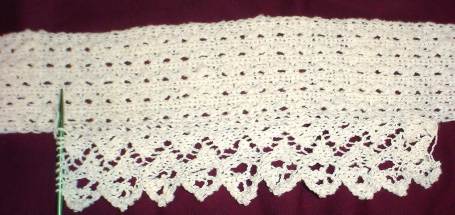
Stitch counts on the eding range from 10 to 15 (the body by contrast is 27 stitches wide, butbecause it’s a ribbing, it looks narrower than that).
To attach my edging, I’m using the same pull-a-loop method employed in the Forest Path Stole. It’s fussy, but it makes a very airy join, with no heavy column of attachment stitches. I will work from the point shown, rounding the first corner to the center of the end. Then I’ll weigh my remaining yarn. That should give me a handle on yarn consumption. If I’ve used more than a quarter, I’ll rip back and slash another three columns from the edging’s repeat, then begin again.
Fulled Pillow II
The fulled pillow went through five wash/tumble drycycles over the weekend, keeping company with the family’s regular laundry. I didn’t expect much in terms of total shrinkage. I’ve used this yarn before and it takes quite a few tries before it’s sufficiently de-lanolined to full.
It did start to fuzz up around Wash #3. I can still see garter stitch ridges, but the individual stitches are getting harder to spot. The pillow has also begun to get denser, and a small bit of shrinkage has occurred, but it’s not worth photographing yet.
Original dimensions were 26 x 14 inches (66 x 36 cm). Right now it’s roughly 23 x 13.5 inches (58.4 x 35 cm). I do note that the yellow stripes account for about half the shrinkage so far. The blue and green ones haven’t tightened up as much. I’ll keep washingthe pillowuntil I’m satisfied but as laundry is only done on weekends, you won’t be hearing about this piece again until next week.
WORKING REPORT – LACY SCARF
Thank you to everyone who wrote to say that they liked the level of detail in these posts. I blush a bit. I’m writing a blog that I’d find interesting to read. But my mom’s main point is taken – not every post need be essay length. I’ll try to make things a bit more readable, perhaps splitting longer thoughts over two or more days.
Lacy Scarf
I ran into a temporary snag on the lacy scarf pattern, but I think I’ve beaten the problem.
I chose a bunch of texture patterns thatI thought would lookgood together. Lots of play among them on diamonds and sharp diagonals. My idea was to knit a pattern panel at each end of the scarf, and use a simpler, coordinating pattern between them for the scarf body, with the entire piece trimmed with a killer edging.
I drafted up my patterns, and swatched each one. Here’s where the mistake came in. I’ve got**just enough**yarn with no chance of getting more, so I swatched each pattern in turn by itself, ripping back and re-using the yarn between swatches. Each looked great on its own, so I cast on and began the piece as a whole. End pattern #1 worked fine. The welted eyelet divider looked fine. But the simpler plain diamond pattern for the scarf body was wrong, wrong, wrong. The proportions of the diamonds just didn’t fit the proportions of the end pattern. They fought, and the piece looked way too busy.
So in a Wile E.Coyote moment, it was back to the drawing board. I decided to go with a contrasting pattern/texture. I had played with the rick-rack rib stitch in the Zen scarf pattern. It looked nice enough in a large gauge, but the texture didn’t really come out. I decided to play with it some more. I separated each column of the zig-zag by a column of p1, k1, p1. I like the look and I think that it’s enough different from the first panel to stand on its own:
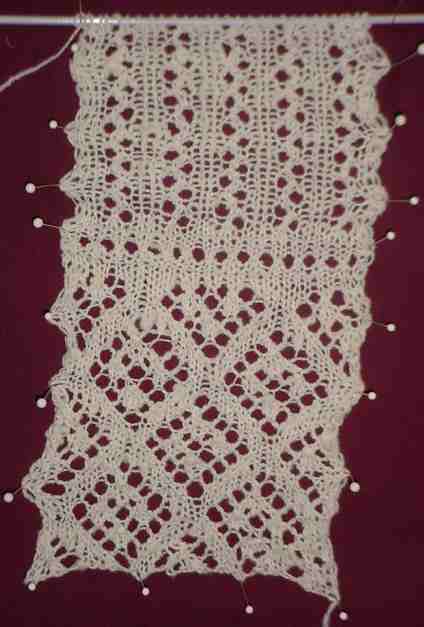
Thinking on the edging I’ve graphed out, I think am going to have the same problem. I’ll scout around today to see if I can find something narrower that has a coordinating presentation.
The yarn is wonderful. It’s a hand-spun super-soft Merino wool, labeled as laceweight, but actually closer to fingering. (I’ll add a yarn review after the project is finished and blocked). It’s fromGreenwood Hill Farm, asmall producer here in Massachusetts, and is my souvenier from this year’s Gore Place Sheepshearing Festival. It’s a rustic-looking two-ply yarn in that there are thick and thin/tightly spun and looser spun, fluffysections on each ply. This makes a very informal feeling bit of lacy knitting – snuggly rather than crisp. (You can see some o the slubby, puffy sections in the piece above – look at the top corner of the top leftmost diamond.) It knits up evenly, there’s none of the kinking back on itself I’ve found in some other small-production hand-spun yarns. One minor annoyance – there was quite a bit of tiny, sharp vegetable fragments in the first third of my skein – about one thorn or spriglet every two inches. I understand the logistical problems/economics ofwhy these shards remain.I don’t expect this type of sheep-to-knitterenterprise to produce pristine yarn; but it’s a minor pain to keep the tweezers on hand to pull out the stickers as one knits. In spite of the rustic look and occasional tiny thorn, thisyarn slides like butter and feels like a cloud. It’s the absolute poster-child for non-itchy natural Merino. I’ve got about 400 yards, enough for a very short overlap style inside-the-coat scarf (as opposed to a wrap-around-the-neck grand scarf). If it performs as I expect it will, I’ll be trying out their sport weight real soon.
Another departure from my original idea: At first, I was going to work this scarf like I didmy Kombu Scarf – starting with a strip of edging, picking up along its spine, then working the edgings at the same time as the scarf body. I decided to work it differently this time, just for the sake of the challenge.
I am going to knit the entire center strip, end to end. Then starting in the scarf’s center (the part usually at the back of the neck), I’ll knit on the edging. I willcalculate the length of each edgingrepeat, so I should be able to work in an even number to the corner. If the edging I end up using is narrow and flexibleenough, I might be able towrap the corner easily, working an extra iteration on the cornerto avoid cupping. If it ends up being too wide for that I think I’ll try mitering the corner with short-rowsto makea nice, finished end. Remember,both approaches are"in theory." I’m not quite sure how I’ll go aboutthe cornersyet. In the mean time, I’ll just keep knitting the center strip.
WORKING REPORT – FULLED PILLOW II
Today I’ll keep it short. My mom found this blog and has told me that I go on so long it’s too much like work to be enjoyable reading.
I’ve finished the garter stitch tube destined to be The Small One’s pillow. I intend to full it as-is, then add some sort of buton or trim to fasten the ends. Although one can never be certain, based on previous experience with this yarn I’m anticipating 40% shrinkage in length and about 10-15% in width. It’s 26 x 14 inches (66 x 36 cm), so I should end up with somethingin the neighborhood of 15.5 x 12 inches (40 x 30 cm). That would let me use a 12-inch square pillow form, in a style similar to the Manos pillow.
Of course, I have to winkle her out of the thing first. She’s taken a liking to it as some sort of kid-specific cocoon:

Which makes me think that knitting up a cuddly tube to use as a nap-sack wouldn’t be a bad idea at all. Hmm….
GADGETS – STRICKMUHLE
A while back I asked for advice on buying one of those little hand-cranked I-cord knitting machines. I now present the outcome. This one is very definitely a boutique sort of item. Not everyone has use for miles of I-cord. I do.
I knit lots of baby booties using the pattern Ann Kreckel posted to the KnitList in the summer of 1995. The pattern is available at Woolworks. There’s a similar pattern in Taunton Press’ Knitting Tips and Trade Secrets. I make them as gifts for friends and family, or for charitable donation.
I don’t have any finished booties on hand right now and my sock yarn stash is in the storage cubby, otherwise I’d whip up a pair to photograph. I’ve modified the pattern a little bit, knitting the cuff with fewer rows so that it is more rolled than folded. I also like the look of I-cord rather than crocheted, braided or longitudinally knitted ties. But I-cord is tedious. It takes me almost as long to knit the I-cord ties as it does to make a bootie, so I splurged on a gizmo to do it for me.
About three years ago I got sick of hand-knitting the ties. I looked at the Bond Magicord Machine, the Inox Strickmuhle, and a couple of older models I found on eBay. Both the Inox and Bond machines have changed from the ones available at that time. Except for color, they’re now identical, both sporting little clear plastic sleeves surrounding a 4-hook needle bed.
|
|
|
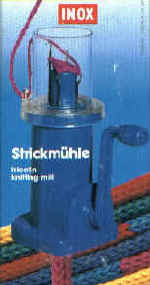

My older version of the Strickmuhle has no sleeve, uses a different type of weight, and has a protruding arm to position the yarn feed:
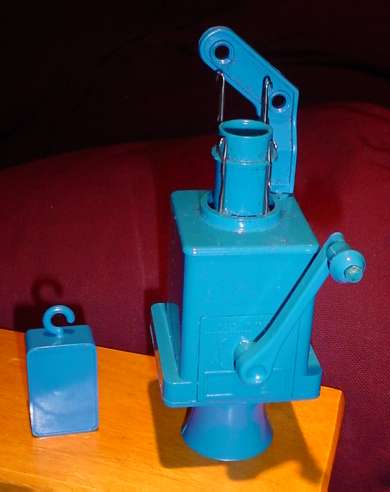
Back when I bought this one there was a big difference in quality between the Magicord and the Inox, with the Inox being much sturdier. Now they’re the same machine, so any differences will be in the accompanying documentation (if any).
You can see the hook-weight on mine(there’s a block of metal inside). On the newer models the hook-weightappears to have been replaced by some sort of clip. Mine also came with a second slightly smaller collar (that’s the blue circle that you can see sticking up among the four hooks). In theory, the smaller collar should be used for fingering and 3-ply yarns, and the larger one should be used for sport and DK, but I’ve never found the two collar sizes to have any effect on ease of production or I-cord evenness.
My machine works best on fingering through DK weight yarn, with best results from sport weight (6 spi). I’ve forced some Cascade 220 worsted through it (5 spi). It worked, and I got I-cord that I later used in a fulling project, but I wouldn’t recommend it for worsted as a matter of course. There’s areal knack to using this toy, especially with heavier yarns. Starting a new cord can be especially trying.
I did pick up a couple of starting tips from the French language instruction card (it came with a French, German and English card, but my English card was missing) – When starting out, make a loop, then stuff the yarn end into the tube’s body. Hang the weight from the loop. Then lay the yarn and turn the crank VERY slowly, skipping every other hook on the first round. You will be using Hook #1,Hook #3, then Hook #2 and finally Hook #4. After you get to Hook #4 you can let the yarn feed without skipping hooks. The combo of constant weight on the dangling yarn, plus the skipping-hook row produces a nice even end and minimizes the un-caught stitches that can make starting a cord difficult.
Once a cord is started, the thing does work quite easily. I often hand off my gizmo to one of my kids and have her crank out the required length. My weight isn’t as convenient as the spring clips, but I can move it up the cord if I need more yardage than the 5-year old is tall. Ending off is easy. I snip the yarn and keep turning the crank until the cord falls through. Then I use a tapestry needle and the dangling end to thread through the cord’s four loops. If I’m making bootie ties, I don’t bother making a two separate cords. Because starting is the trickiest part of operation I make a single cord that’s double long, plus a couple of rows – then snip the thing in the middle and bind off the two new ends.
Looking around, I see other people playing with these toys. Jenanne posted a summary of her experiments with the new version Bond and an Aran weight yarn (4.5 spi). Kate at Will Knit for Food also wrote about making I-cord from worsted weight yarns, then fulling it for bag handles.
Other than cost ,limits on the weight of the yarns it can handle, the difficulty of holding the thing, the yarn and cranking all at the same time (I wish it had a table clamp), and some trickiness starting off a new cord, my biggest disappointment is that the user is unable to alter the number of hooks being used. You get four-stitch I-cord. That’s all. One of the pre-1940s-vintage German-made all-metal machines I was tracking on eBay came with 6 hooks, and could be used with as few as two (sort of as a turbocharged lucet).
I also ran across the Hobby-Knit on eBay:

It looks interesting, but I couldn’t get anyone to confirm whether or not it could be used with a variable number of hooks. Also the very few of them that seemed to offered in operational condition were selling for upwards of $100. Much more than I could justify for such a trivial function.
If anyone knows more about this vintage toy, feel free to clue me in.
 String-Or-Nothing