TAMING WILD SOCK YARNS AND USING UP LEFTOVERS
Self stripers, multi-ply color twist yarns, and hand-dyed yarns are lots of fun. There’s a ton of color there to enjoy. But sometimes a vast and unbroken expanse of color play can be boring or can produce some oddly pooled or cluttered results that look nowhere as nice as the yarn did in the skein. That’s why I like to fool around with multicolor yarns, trying to find a way that they play best, or are shown to better advantage. Sometimes it’s not easy (regular readers here know of at least two of my multicolor yarn experiments have landed in the limbo of my Chest of Knitting Horrorstm over the past couple years. But sometimes it is easy.
I finished up a pair of socks as a “chaser” after the vest was done. I used a stash-aged 50g ball of Stahl Wolle Socka Color, in a multistrand twist of maroon, pine, blue, and marigold – #9140, plus another well-aged 50g ball of Patons Kroy Socks in hunter green – #409. While the colors aren’t exact matches, they are close enough to complement each other. Both of these were found in last-ball sales, but several years and many miles apart. Since I need around 80-90g of most fingering weight sock yarns to make a pair, between the two bargain basement balls I had enough to finish and still have leftovers – provided I used more or less equal amounts of each.
My solution was to work heels, toes, and ribbing, plus about a little under a third of the sock’s body in my solid green, plus the remainder in the multicolor. I used very simple seven-row striping repeat, working five rows of multi, and then two rows of solid green (2/7 = about 28% of my sock’s body). I like how the multi is visually broken by the bands of solid green. The end result has at once more contrast and more subtlety than working the whole sock from multi alone, even if I still did contrasting color toes, heels and ribbing.
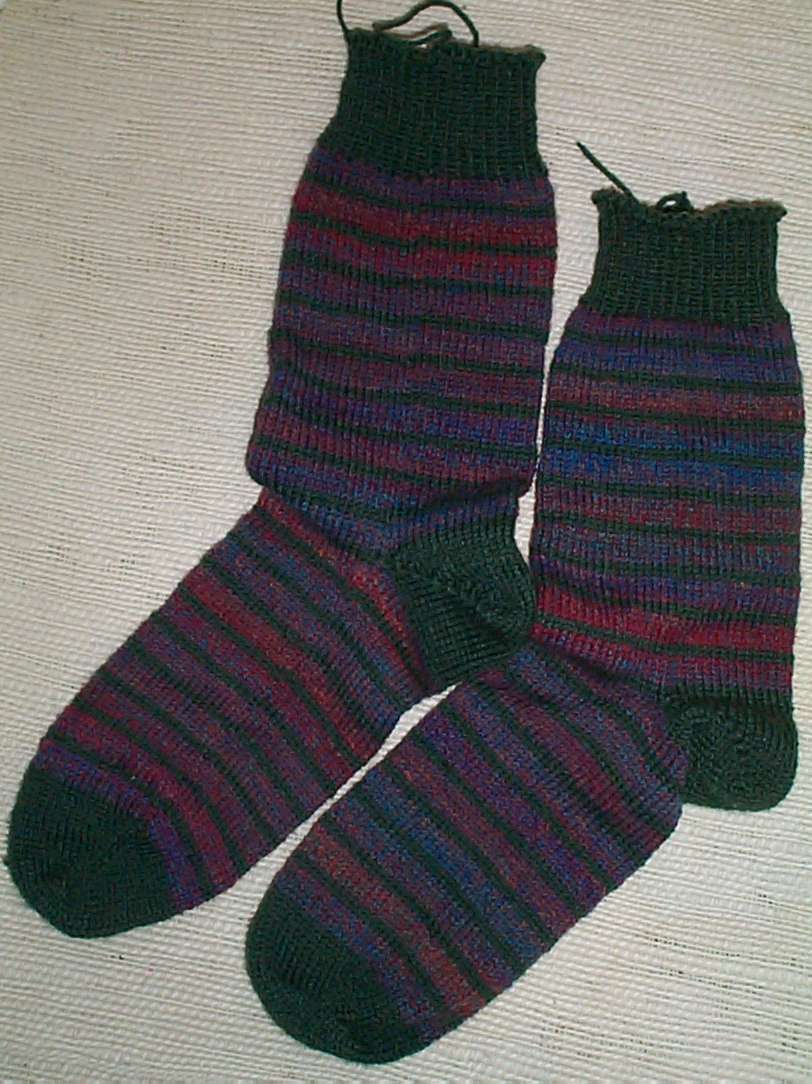
Of course the other advantage of working simple stripes on socks is to idiot-proof achieving two socks of identical size. It’s very easy to count five row units and two row units. When I had completed ten muticolored stripes, it was time to start the heel, which is much easier than having to count every row or trust in doing a measured or eyeballed estimation of foot length.
So. If you find yourself with odd lots of sock yarn, don’t despair. 100g of fingering weight sock yarn knitting is ample for most socks up to around men’s US shoe size 10.5 or so (slightly smaller if yarn-eating textures are used). You can either work color block style, using up one leftover and then another, or you can stripe. But how wide to make the stripes?
Heels, toes, and ribbing in my standard short-rowed heel sock consume about 25g (a conservative estimate). I have large and wide feet for a fem, so if you are knitting for yourself chances are that you use roughly what I do or less. Weigh it out and set it aside. Then weigh the rest of your leftovers. If you have (for example) 40g of blue, 20g of yellow and 20g of green, you’ve got a ratio of 2:1:1. If you worked a stripe repeat conforming to that ratio (let’s say two rows of blue, two rows of yellow, two rows of blue, two rows of green), you should have enough of each color to complete the pair.
Obviously, I had enough and did complete my pair. And I did have leftovers. As expected, I had a bit more of the multi left than I did the green, because my heels, toes, and narrow green stripes added up to about 60% of total yarn consumption.
QUICK SOURCES FOR KNITTING FROM VINTAGE PATTERNS
Rebecca notes that the patterns in the on-line repros of antique knitting and crochet books that I reported on yesterday call for needles specified by outmoded sizing systems, and asks for help in translating those sizes to modern ones.
I reply that there several sources for info on knitting from these older patterns floating around the Web. Here are a couple.
- The most complete size comparison chart I know about that shows older vs. modern needle sizes is at Lois Baker’s Fiber Gypsy website.
- I’ve also got one here at String that speaks to the equivalents between historical and modern needle sizes. I add some common vintage yarns typically used with those needle sizes along with suggestions for equivalent modern yarns (I’ll be updating this soon based on the new info from yesterday’s books).
- The list of ancient yarns with approximate yardages maintained at Vintage Knits is also very useful if you’re trying to work from an older pattern specifying an unknown yarn (often without yarn specs.)
- The yarn database here at wiseNeedle can be helpful, too. We’ve got a smattering of reviews for actual vintage yarns have entered by knitters who stumbled across older products in stashes or yard sales (reviews of discontinued yarns are always welcome here!). Other people have posted reviews noting that they have used various modern products as substitutes for now discontinued yarns. You can find the former by looking up the old yarn name like you would any modern one. You can also use the search comments field on our advanced search page to look for mention of an older yarn in any review.
If you’ve got a yarn review to add, the most efficient way to do it is to first look up the name and see if it’s in the collection. If it is – click on the link on the yarn’s page to add your comments. Or if the yarn is new to our collection, here’s a page where you can add both basic data and your comments at the same time.
- The knitting terms glossary also maintained here at wiseNeedle contains historical British and American usages as well as modern ones. You can limit the result to two or more languages by holding down your <CTRL> key and highlighting the desired ones from the drop-down list.
AMAZING ON-LINE REFERENCE LIBRARY
Out web-walking again, I’ve stumbled across a treasure trove of books on spinning, weaving, and other textile arts. It includes historical and recent works on lacemaking, embroidery, tatting, knitting, crochet and some other less practiced crafts, as well as ethnographic material, periodicals, and academic papers. I’m sure I’m the last to find out about it, but I share the reference all the same.
This textile-related archive is maintained by the University of Arizona. Its collections are available on-line, with the individual works so distributed either aged out of copyright, or presented with the authors’ permission. There are thousands of items – mostly geared to industry and manufacture, but with a healthy smattering of works detailing hand production. Scans are available as PDFs, with the larger books broken out into smaller segments of under 15MB. Not all are in English.
Among the works I found that are of greatest interest to me in specific are:
Whiting, Olive. Khaki Knitting Book, Allies Special Aid, 1917, 58 pages. PDF
This compendium of knitting patterns presents sweaters, wristlets, socks, scarves, mittens, hats, caps, and baby clothes intended in part for troops overseas during WWI, and for the comfort of refugee families displaced by the war. Patterns for knitting and crochet are both included. The socks shown mostly knit top-down, some have a gradually decreased instead of grafted toe. Some of the socks are worked on two needles and seamed. One pair in particular (marked as a pattern from the American Red Cross, p. 13) seems to include a written description of a grafted toe, but it does not name the technique. Directions are a bit more detailed than is usual for pre 1940 knitting booklets. Fewer than a quarter of the patterns are illustrated with finished item photos. Aside from a list of abbreviations in the front, there are no how-to or technique illustrations.
Nicoll, Maud Churchill. Knitting and Sewing. How to Make Seventy Useful Articles for Men in the Army and Navy, George H. Doran Company, New York, 1918, 209 pages. PDF
This book is a bit more detailed than the previous one. It also contains a rundown of standard troop knitting patterns – hats, mufflers, balaclavas (called helmets), mittens, socks and the like. Every project is illustrated either with a photo or a line drawing of the finished product. Instructions are written out in a fuller format than in the Khaki Knitting Book. It also has some valuable bits of instruction including a list of yarn substitutions, plus two full size color plates showing the wools used, identified by name; a small stitch dictionary section,
Of special note are some unusual mittens (including a mitten with truncated thumbs and index fingers – p.68), half-mittens – p. 77, “doddies” or mittens with an open thumb, p. 80, and double heavy mittens intended for seamen or mine sweepers hauling cables – p. 94). The grafting method of closing up sock toes is clearly described AND illustrated, but it is called “Swiss darning” (p.131). I’ve heard that term used for duplicate stitch embroidery on knitting, especially when the decorative stitches are sewn in rows mimicking actual knitting, rather than being stitched vertically, but I have never before seen it applied to actual grafting. The entire section on socks and stockings is particularly clear and useful. There are even a couple of crocheted and knit mens’ ties in the sewing section.
Finally, the sewing section (about a quarter of the book) might be useful to people doing historical costuming or regimental re-creators who are looking to augment their kit. The one drawback is that most of the sewing patterns are predicated on Butterick printed patterns, and the schematics are not provided in the book. Among the offerings are money belts, a chamois leather body protector and waistcoat, various types of shirts and undergarments, pajamas made from heavy blanket fabric, and a book bag (like a messenger’s bag).
Egenolf, Christian. Modelbuch aller art Nehewercks un Strickens, George Gilbers, 1880, 75 pages. Note: Reprint of 1527 book. PDF
Ostaus, Giovanni. La Vera Perfezione del Disegno [True Perfection in Design], 1561, 92 pages. Note: 1909 facsimile. PDF
These are two modelbooks of the 1500s. There are several others in the collection, but they are mostly books of needle lace designs. Ostaus also offers up mostly patterns for the various forms of needle lace, plus some patterns that can be adapted to free-hand (as opposed to counted) embroidery, plus a large section of allegorical plates to inspire stitched medallions, slips, and cabinets. One thing I’ve always liked are some of his negative/positive patterns. These are designs that if laid out on a strip of thin leather or paper and cut can be separated longitudinally into two identical pieces. There are several of these scattered around the middle of the book.
Starting around page 73 or so there is a section of graphed patterns, a number of which landed in my New Carolingian Modelbook collection.
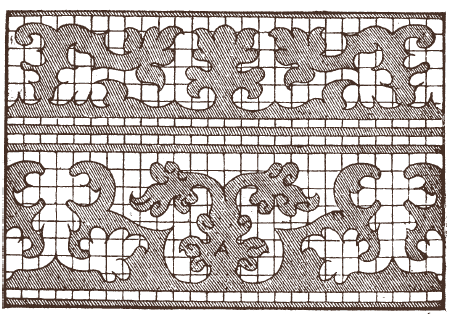
The Egenolf book also is mostly line drawing suitable for freehand embroidery. Some are pretty cluttered, but some are very graceful. The oak border on p. 32 has always been one of my favorites. There’s one plate with a counted pattern, on p. 72.
—. Priscilla Cotton Knitting Book, Priscilla Publishing Co., 51 pages. PDF1, PDF2, PDF3, PDF4, PDF5, PDF6.
This books is obviously a seminal source behind many of today’s reference books on knitting technique and patterns. Notation is sparse and “antique” with n (narrow) being used for k2tog, and o for yarn over, and other oddities. There’s a fair bit of circular doily knitting, but it is of the knit radially and seamed variety seen also in Abbey’s Knitting Lace. In fact many of the doilies appearing in Abbey appear to have been adapted directly from this work. You’ll also recognize many Walker treasury edging patterns in these pages.
In addition to the stitch texture and lacy knitting sections, there’s a bit on “cameo knitting” which appears to be another name for stranding (in PDF2). The section on filet knitting (in PDF3) is relatively extensive, and clearly shows both the strengths and weaknesses of this rarely described style.
—. Priscilla Irish Crochet Book No. 2, Priscilla Publishing Co., 52 pages. PDF1, PDF2, PDF3, PDF4, PDF5, PDF6, PDF7, PDF8.
This has got to be the single most complete and eye-popping source I’ve ever seen on Irish crochet. Not only does this contain an amazing amount of eye candy, it also gives directions on how to create it, offering up pattern descriptions for the individual motifs, the joining brides and grounds, and the working method of fastening the motifs to a temporary backing while the grounds are being worked.
—. Egyptisch Vlechtwerk [Sprang], Holkema & Warendorf, 36 pages.PDF1, PDF2
As an example of the depth of the collection, here’s a work on Sprang, one of the lesser known fiber manipulation crafts sometimes mistaken for early knitting. It is in Dutch and appears to be from before WWI, but it is illustrated with photos of finished pieces and works in progress.
These are just a small sample of the hundreds of works available at the University’s website. Again, most are on the industrial aspects of the textile arts, from fiber acquisition (including sericulture and sheep raising) through spinning, and weaving, but a goodly number are of direct interest to hand-crafters. Topic lists exist for knitting, crochet, embroidery, cross stitch, lace, tatting, and a multitude of other subjects. Support this valuable resource by visiting and using it. I know I’ll be combing through here for years…
KHAKI VEST – DONE
After some dithering back and forth, ripping back the front placket and reknitting it, I present my re-worked and adapted khaki vest, mid-block:

The color variation is due to some parts still being wetter than others. I’ve used US size 1 14-inch straights as blocking wires for the vest’s points. Thanks to the texture pattern I’ve used, plus the edging, they don’t really curl, but I did want them to start life as straight as possible.
As far as the interminable edging goes – it wasn’t that bad. I knit it on as described before, then seamed down the free facing edge on the back. I did end up making the extra wide, double thick buttonhole bands, and I did end up working the entire buttonhole band/neck edge in one pass – shaping it with decreases on both sides to match. And I did end up using the Neatby Magic Buttonhole in my double-thick placket.
Why did I go back to the heavy placket when I had whined about it before? Mostly because the vest didn’t fit as well without it. The heaviness seems to act a bit like a stomacher in a 1600s gown. It lends stability and structure to the center of the piece and prevents Dread Buttonhole Stretch, even when worn (that gap-itis that happens when buttoned knitting stretches into scallops around the buttons.) I did go back and readjust the ratio of picking up and knitting, which did help a bit. So did the final seaming, which squished the placket flat (I may still go back and steam this edge to make it even more flat).
On the buttonholes – I am not comfortable explaining in detail the Magic Buttonhole working method in detail. It’s unique and it’s Lucy’s, available in her leaflets and workshops, and in the Fall 2004 issue of InkKnitters. But I will say that her method is pretzel-clever, and much easier to work than it looks. There’s a very simple logic to it, and the stitches to be grafted and the direction for each stitch to be taken are all very clearly laid out. I did do one minor modification – instead of working this buttonhole on a placket that was picked up and knit out perpendicular to the direction of the body piece’s knitting, I worked it on a band that was knit in the same direction as the main piece. The perpendicular way is a bit easier to achieve because of the side-by-side alignment of the two buttonhole-to-be strips of scrap yarn, but with a bit of patience and fiddling doing it the other way is perfectly achievable.

Finally, for those of you who asked – the kids and I had fun at the Gore Place Sheepshearing Festival this year. But it does seem to be headed away from its sheep and yarn focus a bit. There are still both hand snip and electric clipper shearers, and there’s still a sheep dog demo; but the spinning and weaving demo tent formerly staffed by the Boston area spinners and dyers guild was missing – a big loss. Also, there was only one sparsely populated wool/yarn/spinning vendors’ tent – down from two in years past. It’s possible that the threat of really bad weather kept away some of the yarn people, but I see far less foot traffic through the yarn tent than in years past. It’s possible that low sales are the root cause of the lack of vendors.
Still, in spite of low yarn availability, we did enjoy the day and I did find some nice things to buy. First, I got a couple more skeins of Nicks Meadow Farm rustic Maine style heavy worsted/Aran, this time in barn red. He was also selling a softer Merino this year, but I got the older yarn to eke out some leftovers from previous purchases.
I also got a few skeins of a small producer’s yarn that’s new to me. Swift River Farm was showing Shetland and Shetland-silk blends. They offer both off-the-sheep undyed yarn colors, and dyed yarns. I got some of their Prescott, a fingering-weight 95% Shetland/5% silk in a natural unbleached white. Prescott is labeled with a gauge of 32-35 stitches over 4 inches on US #3 or #4. It’s a lofty two-ply in that pleasing Shetland texture, but a bit softer due to the silk. My guess is that it could be knit down to 8 to 9 spi, but that it would also look good at 6.5 to 7 spi. Of course gauge swatching is called for here since without it all I can do is guess. I’m leaning towards using it to make one or two lacy scarves as holiday gifts, along the lines of the Spring Lightning scarf I did a couple of years back. But playing with different lacy patterns for both the center and the edging.
I’m not sure what I will be knitting next alongside the Galaga hat (which also progresses). In the mean time, my “upstairs knitting” has been finishing off a couple of pairs of started but not yet completed socks – each pair begun as a briefcase project to do in the corners of time at lunch at work, or on plane flights. One can never have too many socks.
MORE ON STRICKFINGERHUTS
Techknitting is posting an interesting series on stranding, and as part of it, mentioned the use of Strickfingerhuts (knitting yarn guides/knitting thimbles), linking back to my original post on the subject.
For those who are unfamiliar with them, they are those gizmos that sit on the end of the left hand index finger, that are used by Continental style knitters (pickers) to hold and separate two or more yarns while doing stranded colorwork.
Adding some more detail on the subject, I’d like to address a problem TK points out as being common among those who hold two yarns in one hand while stranding – differential feed.
If a row has more or less equal numbers of stitches of both colors, both yarn strands are consumed at the same rate. But if a row has lots of Color A, but very little Color B, A will be eaten at a much greater rate, eventually causing the knitter to readjust his or her grasp of the yarn to even things out.
Those of us who do use Strickfingerhuts find that the differential feed rate problem is greatly minimized compared to trying to hold both yarns in the left hand unassisted. Yes, eventually the difference in yarn consumption catches up with us and we have to yank the strands even, but no where near as often.
We do however find that over time we prefer to put the dominant color (the color most represented on a row) in either the left or right eyelet to minimize the feed problem. There’s no hard and fast rule to this, it’s a matter of personal preference.
In stockinette in the round, I prefer to have the dominant color in the right eyelet, and the less represented color in the left. This helps when I lock in my floats:
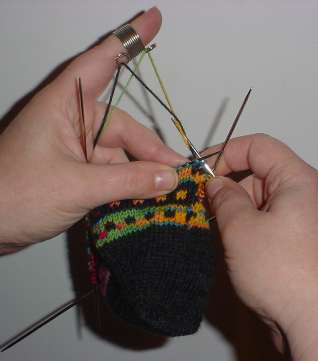
Although I usually work stranding in the round, occasionally I have to do it in the flat. If I’m knitting stockinette in the flat using a Strickfingerhut, and I’m on the purl side, I prefer to have the dominant color in the left hand eyelet.
For the record, I notice no difference in the appearance of the finished product if I mix eyelets – sometimes putting the dominant color in one, and sometimes in the other. I do however note that some other Strickfingerhut users do, and advocate always keeping the background color in the same eyelet regardless of its relative dominance on any one row. Again, experimentation is your friend.
KHAKI VEST – BAD, BAD, BUTTONHOLE BAND
Hmm. Not quite happy.
I’ve finished the trim around the armholes and bottom edges of the front of the khaki vest. O.K. so far there. I’ve gotten well into the trim along the buttonhole band/neck edge. Not so good.
I wanted to move the buttonholes from between the band and patterned area as shown on the original, to being centered in a true buttonhole band. So I cast on for a wider buttonhole band, and planned to work Neatby’s Magic Buttonholes (sideways). But the proportions of the wider band, plus the odd narrowing I had to do to accommodate the V-neck, along with what will be the sheer weight of this center section when buttoned (four thicknesses of Aran weight yarn) is making me reconsider. You can see for yourself:

The buttonhole band has been turned under so that you only see the temporary stitches marking the place of a single column of buttonholes. There’s a comparable set tucked inside on what will be the facing.
I think tonight I might rip back the beginnings of this front band and start it again.
SURE SIGN OF SUMMER’S INEVITABLE APPROACH
Mailing off the kids’ summer camp registration forms means summer is edging ever closer.
For the past 6 summers, Older Daughter has gone to sleep-away camp in New Hampshire. Last year Smaller Daughter joined her for a couple of weeks. They adore the place.
Roads End Farm is a small, horsemanship camp in Chesterfield, not far from Keene. It’s approximately 50 girls at a time, 15 staffers from around the world, and a herd of around 75 horses – mostly farm-bred Morgans, with a sprinkling of rescues and donated horses. Roads End has been around for 35 years, always run by the the Woodman family. It’s a rustic place, sort of summer-on-grandpa’s farm for kids who have no relatives in the country.
The girls do a lot of riding (of course) – all non-competitive English flat, with small group ring instruction and/or trail rides 6 days a week. Here’s Elder Daughter on Ides, and Smaller Daughter on Goldie, both showing off their new-learned abilities on pick-up day. Note that two weeks before this picture was taken, Smaller Daughter knew horses only from picture books and TV.
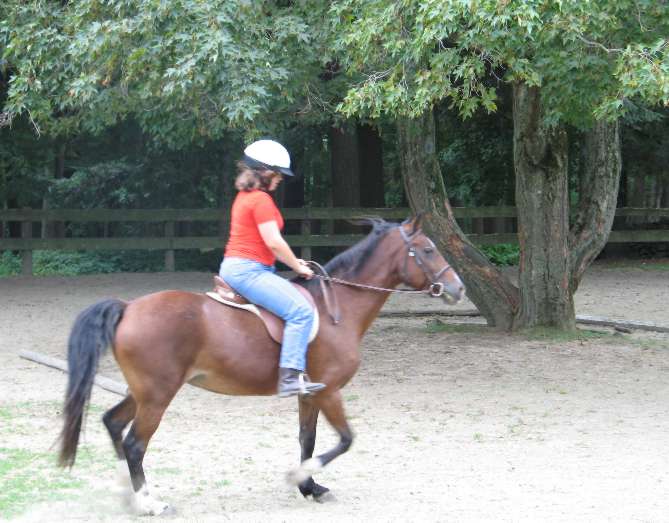

Riders of all ability levels are welcome, from kids who arrive with their own mounts right down to kids who have never seen a horse up close and personal before. The girls are matched in teams of two with a horse of suitable level. Beginners for example are teamed with geriatric animals of sweet disposition (Goldie, last summer was well into her equine senior citizen years). There’s no jumping, and techniques are more geared to riding for pleasure. Safety is a prime concern, both for the campers and the horses. The fact that so many of the horses are still in good condition and working with campers at advanced horse-ages is testament to the high level of animal care at the farm.
The girls provide all the care for their shared mounts – feeding, grooming, AND shoveling. Each girl gets to ride for half the morning, the other half being devoted to farm type chores in the barns, paddocks, vegetable gardens, kitchen or dorms. The afternoons include swimming instruction or free swim in a nearby lake, arts and crafts, and other typical camp-type activities. Hair dryers, TVs and electronics are banned (except for small MP3 players used during quiet times), but my own video gaming/Anime rats don’t long for a single pixel while they are there.
All in all, it’s a small, and very companionable place that’s so much fun the participants don’t realize they are learning big lessons about responsibility and teamwork. I hear that Roads End still has spots open for this summer. If you are looking for a good place for pony-crazy girls ages 8-high school – I strongly recommend the experience.
Oh. Knitting content. My kids bring their knitting to camp with them. That’s where Alex works on her B. Walker Learn to Knit afghan project. She’s accumulated small knitting circles around her each summer.
APPLIED STRIP EDGING WITH MITERED CORNER
I’ve played around some with methods of producing and applying the edge finish to the khaki vest. First I tried the separately knit/sewn on band method, using a couple of different approaches to the seaming (fold band longitudinally, sew the band up, then apply it; sew on both sides in one pass; sew on the display side, then do a separate seam to affix the facing side). Of all of them, the last method worked best, but it was the most effort intensive of them all.
So I looked further. Plain I-Cord (knit on or applied) was too narrow to stabilize the edge, and two courses of it would have been too bulky. I didn’t like the way that picking up along the edge then knitting out looked – especially along the curve of the armhole.
Even more experiments ensued. Finally I landed on knitting-on a strip parallel to the edge, then going back and seaming down the free side on the inside of the piece. Doing that I could produce an edge of any desired width, go around curves and even plan on mitering the vest point corner. Here’s a swatch with a mitered corner. Note that I haven’t sewn down the facing on the inside yet, but natural stockinette curl is keeping it nice and neat. (For some, the inside seaming might be optional, but I plan on doing it on my finished piece).

To miter the corner of this 8-stitch strip, I used short rows. Here’s how I did it:
Applied 8-stitch Strip Facing with Mitered Corner
Start with the public side of the work facing you, holding it with the bulk of the piece on the left, so that you’re working up the right side of the thing (upside down from the picture above). Using straight needles, cast on 9 stitches, then pick up one stitch in the edge of the piece being finished. While the strip is 9 stitches wide, one is consumed during joining, so the part that protrudes is really only 8 stitches wide.
Row 1 (wrong side): P8, k1.
Row 2: S1, k6, ssk, pick up one stitch in edge of swatch
Row 3: S1, p7, k1
Repeat Rows 2 and 3 until you reach the corner, having just completed an odd number (wrong side row)
Row 4: S1, k6, wrap and turn.
Row 5: Slip the wrapped stitch, p6, wrap and turn
Row 6: Ignoring any previously wrapped stitches, S1, k5, wrap and turn
Row 7: Ignoring any previously wrapped stitches, Slip the wrapped stitch, p4, wrap and turn
Row 8: Ignoring any previously wrapped stitches, S1, k3, wrap and turn
Row 9: Ignoring any previously wrapped stitches, S1, p2, wrap and turn
Row 10: Ignoring any previously wrapped stitches, S1, k2, knit the next stitch along with the loop around its base, turn
Row 11: Ignoring any previously wrapped stitches, S the stitch you just knit, p2, purl the next stitch along with the loop around its base, turn
Row 12: Ignoring any previously wrapped stitches, S1, k3, knit the next stitch along with the loop around its base, turn
Row 13: Ignoring any previously wrapped stitches, Slip the stitch you just knit, p4, purl the next stitch along with the loop around its base, turn
Row 14: Ignoring any previously wrapped stitches, S1, k5, knit the next stitch along with the loop around its base, turn
Row 15: Ignoring any previously wrapped stitches, Slip the stitch you just knit, p6, purl the next stitch along with the loop around its base, turn
The corner is complete, return to repeating Rows 2 and 3. Optional finish – seam down the inside edge of this facing.
I’ve stated applying this same edging to the armholes of my vest (having previously seamed the shoulders).
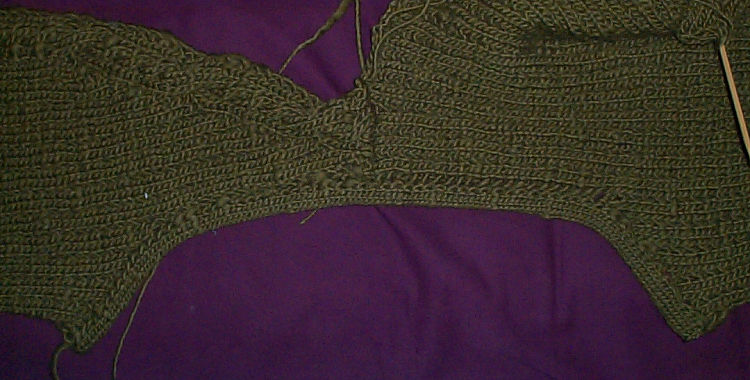
I plan to do the bottom edge next, incorporating the mitered corner on the vest points. But I haven’t played with the buttonhole band treatments yet. Sadly, I have misplaced my copy of InkKNitters. It’s here. Somewhere… Weekend plans include tossing my knitting library to find it.
Oh. Unless a monsoon is upon us, weekend plans also include attending the annual Gore Place Sheepshearing Festival in Waltham, Massachusetts. Not a big festival as fiber fairs go, but very local and lots of fun. Look for me with both Elder and Smaller Daughter in tow.
WAISTCOAT AGAIN
I have finished the major pieces of Older Daughter’s khaki waistcoat (adapted from the 1940 pattern hosted by the V&A Museum). Once I had the right gauge and measurements, they knit up quite quickly. Before I begin sewing them together add the edging, some serious industrial-grade blocking has to take place. Right now they’ve got that larval curled-up caterpillar look. Here is one of the two front panels:
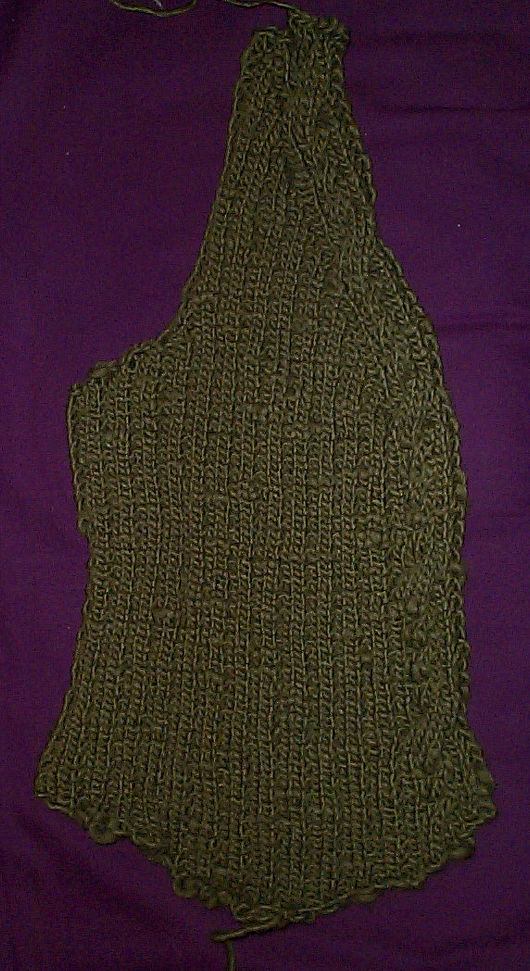
I am quite pleased with the way the cable on the neck edge worked out.
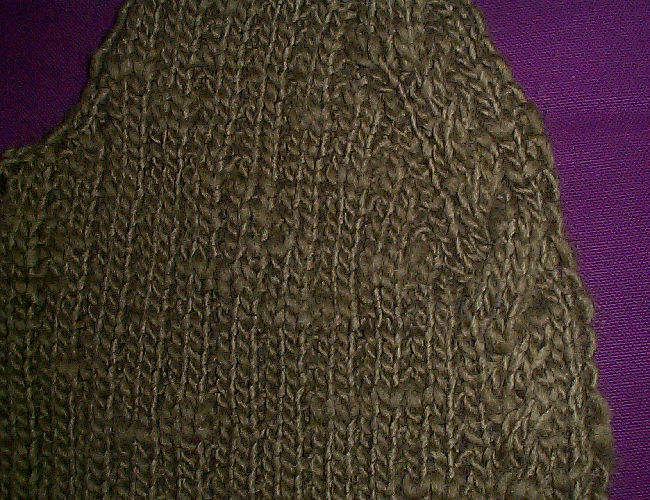
The cable itself is one pictured in Stanfield’s New Knitting Stitch Library. I’ve got quite a few stitch treasuries on my shelves. I leaf through them all, but when time comes to actually employ a stitch – this is one of the few that gets knit from most often.
The next step (after blocking) will be to knit and apply the bands around the armholes and the front. The original pattern suggests that the knitter work 8-stitch bands with slip stitch selvages right and left – 20 inches long for each arm, and 60 inches for the front. The bands are supposed to be folded in half and steamed flat, then sewn on, leaving periodic gaps on the appropriate side to create the buttonholes. Very labor-intensive.
I think I’m going to experiment. I’ll knit a body-like sacrificial swatch and some pilot-project edging to test out various configurations for creation and assembly.
For example – why not knit the edge onto the body pieces on the front side, incorporating a column of purls to make a turning edge down the center, then fold along that line and baste the free selvage down on the inside?
Or why not experiment with an extra-wide i-cord style strip, knit directly on?
Or how about picking up along the edge and knitting out, using mitering to make the waistcoat corners?
And while I’m at it – why not figure out how to move the buttonhole so that it’s centered in the edging rather than floating between the body and the border element? Lucy Neatby has an ultra-nifty buttonhole and band trick I’ve been dying to try. She sells leaflets and videos and holds workshops explaining the technique, and wrote a summary of it for the Fall ’04 edition of InKnitters.
INTARSIA IN THE ROUND
After yesterday’s post on my Galaga Hat, I’ve gotten a couple of questions about the method for working back and forth seamlessly to make a tube. In specific, some people wanted to see illustrated how I make the wrap and turn join. I try to oblige them (click on pix to see them larger):

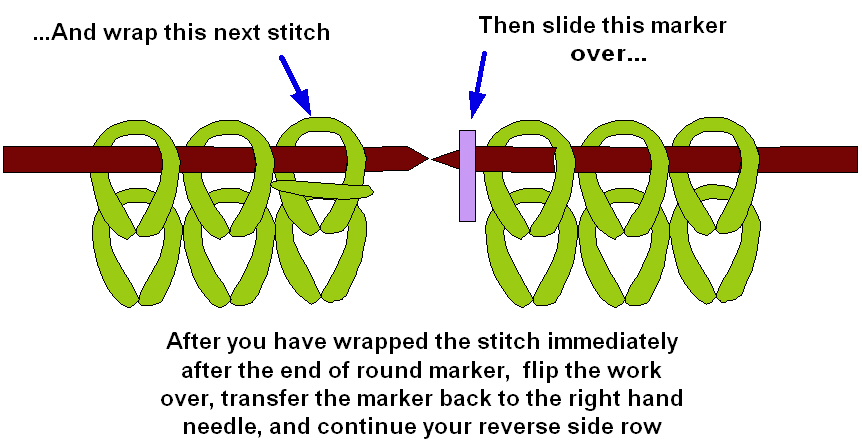
I’ve shown just the knit-side round. The purl side round works in exactly the same way. Work to the marker, making sure to work the last stitch before the marker along with the loop around its base, shift the marker over, wrap the stitch after the marker, flip the piece over, return the marker to the right-hand needle, and continue with the rest of the round.
Why go through all this trouble?
I don’t have enough yarn to strand around the entire piece. Nor do my motifs span the entire circumference of my hat. I am in effect working spot Intarsia motifs (actually I’m stranding between them, but limiting that stranding to the spot motifs). Rather than cut the yarn at the end of each motif, or stretch it back to the beginning of the spot design on each row, I am working the equivalent of flat knitting – going back and forth, alternating rows of knit and rows of purl. When I purl or knit back to my spot motif, my contrasting color ends are on the correct side of the motif for the next round. But I hate sewing up, and want to make a hat without seams. Rather than knit this totally flat (a valid option), I’m using wrap and turn to make the join at the end of each round.
 String-Or-Nothing