OMNIBUS
I’d like to announce some small improvements at wiseNeedle. We’ve added to the search capability in response to user requests.
First, we’ve added a simplified search page to the on-line yarn review collection in addition to the previously existing search capability (which I’ll refer to from now on as the advanced search page). Apparently many people were confused by the number of fields, and tried entering data in all of them every time they searched. This led to a large number of false negative results and some complaints that the page was too difficult to use.
The yarn search link (available in several places on the site) will now take you to this form:

You can type in as much or as little info as you like – yarn name, the first few letters of the maker’s name, some keywords (this searches the fiber and comments fields). You can still get to the old search page by clicking on the “advanced” link in the corner of the new search page.

In addition, should you wish to shortcut the entire process, we’ve added a Google site search box to every page of wiseNeedle, including the front. It appears in the gray bar just under the top banner. Typing a yarn name into that box will bring up every mention of it anywhere on the site – in its original review, in comments tagged to another yarn, on the question/answer board, or even in the commentary here on String.
The simple search page will be most useful to people who want to quickly look up stats or reviews of a known yarn by entering its name or maker; or who are looking for some info likely to be contained in previous comments. The Advanced search page will be of more use to people who are looking for substitutes, or who wish to search on fiber type, yarn weight, an approximate date of the review, or any of the value, suitability, or quality aggregate scores.
We’ve also activated an additional link on the Recently Entered Yarns and Recently Entered Reviews pages. Previously you could retrieve the detail page for each yarn by clicking on the yarn names listed on them. You can now also click on the maker/distributor field to call up all yarns under the listed label. (For the record, the label with the most entries in the collection is Katia, with 142 different yarns.)
In my own knitting, I am finishing up the dropped leaf pullover. I’ve ended collar, using a tubular cast-off. I tried the standard issue one shown on My Fashionable Life, but I didn’t like doing it. Instead I followed June Oshiro’s method, described at TwoSheep. By slipping the available stitches of the ribbing onto two needles (one holding just the knits, and the other just the purls), the cast-off can be treated like any other exercise in simple grafting. The two needle method let me make short work of finishing my collar. I’m now up to sewing the dropped shoulder sleeves onto the body, prior ending off the interior ends and doing the last two finishing seams from bottom hem to cuff.

TRAVELS OF MY SCARF; COLLARED
The Kureopatora scarf I noodled up last winter appears to have taken on a life of its own. It gathered a small bit of interest here in the US around the time I posted the pattern, but no big splash. Then over the summer and fall knitters in Japan found the thing and made it a real knit-fad. A rainbow of finished snakes began crawling through blogs over there. The range of different Noro-type long repeat dyed yarns there is spectacular, and I’ve been delighted to see the color and texture ranges people have used to make their own snake scarves. Now the pattern appears to have been discovered in Germany and the Netherlands. Blogs and discussion boards there are beginning to post pix of finished pieces, and I’m getting lots of referral hits from them.
If you’ve discovered this blog by looking for the Kureopatora’s Snake scarf pattern, welcome! I’m having lots of fun via this vicarious visiting. For the record, the top non-US, non-spider sources of wiseNeedle visitors Canada, China, the UK, Germany, France, Japan, the Ukraine, Spain, Australia, the Netherlands, Finland and Sweden. Many of those visitors are hopping over to the International Glossary of Knitting Terms. Others come mostly for the yarn reviews and patterns both here on the blog and on wiseNeedle proper. Predictably, non-US visitors to the String or Nothing blog site are predominantly from English as a first language countries, although Japan, France, and Germany are also well represented. For the record, my own blog reading travels often find me on French, German and Japanese pages. I can eke out meaning from written French, but to read other two I have to rely on machine translation, which can be almost as incomprehensible to me as the original.
Ribbed Leaf Pullover
I’m up to the collar of my pullover. I feel rather foolish because last night I missed an excellent opportunity for a photo-illustrated blog piece – neatly picking up stitches around a neck edge. In this case, I followed the stitch count suggestions of the pattern exactly, even though the total count looked a bit low. But I ended up being quite pleased with the result. The neck area on this sweater is a bit large, and needs to be pulled in by the deep ribbing around the collar. While I might rip back, reducing the three rows of purl welting to only two, I like the way the collar is shaping up. This shot is also the best I’ve taken so far of the all-over texture.

My guess is that if deadlines and after-hours assignments allow, I’ll finish up the collar tonight. I’d like to do a tubular cast-off to match my tubular cast-on edges, but I haven’t found one yet that I really like. That should lead to lots of fiddling around and possibly even some interesting blog fodder for a change.
SHOULDERS
I’m up to finishing the big gray ribbed leaf pullover now. In the best of all worlds, I would have blocked it first. Yes, I know this is heresy, but I’m short on blocking space right now (the aftermath of a minor basement flood in last week’s mega-rain), and the texture pattern is relatively well behaved. I have only minor curling, so I thought I’d finish out the collar first. Then if I were to be feeling less lazy and more accepting of playing with moisture, I’d block out the piece before setting the sleeves.
In the mean time, here’s one of the shoulders:
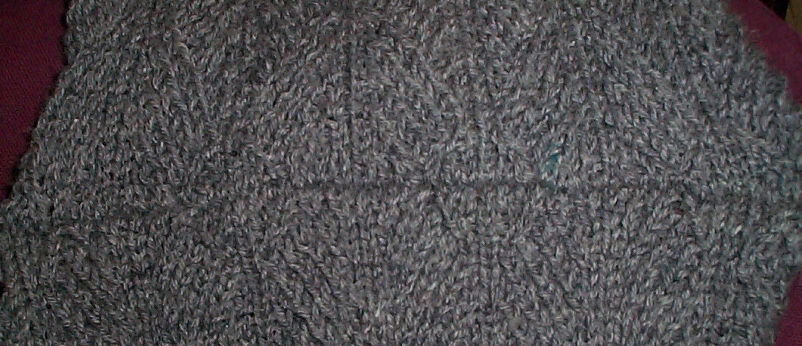
I know the pix are blurry, but I’m hoping you can make out that I’ve managed to match the design elements on either side of the seam. My ribbed leaf texture has a distinct center line for each repeat. Also the front and back ended on the same row of the texture pattern, making direct matching a bit easier. Each piece was bound off at the shoulder. I then butted the two shoulders up against each other and did a stitch-for-stitch-style seam into the stitch immediately under the bound-off edge. The two edges ended up being turned back like selvages. They are however useful, providing seam stability and resistance to stretch. Grafting the two shoulders together as live stitches without the reinforcement of the shoulder seam could lead to distortion of the shoulder region, as the weight of the garment pulled it down. Plus, as a modified dropped shoulder piece, the weight of the sleeve would also tend to distort that area.
Now, why don’t I use three-needle bind-off? Bulk. I find that treatment effective, but heavier than my chosen seaming method. The same goes for back stitch.
Tonight I pick up stitches around the neck edge and begin working the collar.
In other knitting news, I finished the rainbow scarf that matches the rainbow hat. Again, quick and easy to knit, but a bit fiddly to finish. As in the hat, the ends are left super long, then crocheted in chain stitch to make tendril-like fringes. Additional lengths of yarn are cut and added to the opposite end of the scarf to make fringes on it, too. I had one skein of Frog Tree in each color, and had ample yarn left over after making both pieces.

All in all a good project for autopilot knitting. Switching colors meant that progress was easy to see, the bright colors made me happy, the yarn was soft and easy to knit quickly, and the recipient is delighted. My next piece of autopilot knitting is another Klein Bottle hat – yet another special request. This one in conservative Navy blue, with a touch of yellow here and there. I am using a yarn that’s new to me – Garnstudio Drops Camelia Superwash Sport. It’s a very smooth true sport weight, quite soft and with a good hand-feel for a superwash. I’ll probably cannibalize my bright yellow Frog Tree leftovers to do the yellow highlights. What they will be, I haven’t a clue.
And the “gotta make something” bug here isn’t limited to adults. Smaller daughter is in the midst of bead lizard mania right now. I’ve got more geckos in the house today than can be found on a warm Florida lanai at sunset.

WORKING AT THE SAME TIME
I had started this post back when I was up to the shoulders of my ribbed leaf pullover, but life intervened and it languished. Also, the diagrams ended up taking more time than I thought they would. For the record, I write these entries mostly in the half-hour I steal in the morning after breakfast, while my kids are getting dressed for school. Some of the longer and more illustrated ones can take a couple of days to pull together. Yet another reason why my blogging rate has fallen back since leaving the world of consulting for full-time employment.
For the record, I’m now just a couple of rows away from completing the sleeves of the ribbed leaf pullover. I’ll use the piece to do some assembly and finishing posts later this week and next.
————————
Some deadlines have passed, others remain. I did have an hour or so of knitting time last night, which I used to excellent effect, both for some much needed relaxation, and to advance my leaf pullover. I am now finishing up the front, at the point where the centermost stitches are set aside and the shoulders are completed.
Now this stage of production is one that has inspired a huge number of wiseNeedle advice board questions. The directions to join in a second ball of yarn and knit both shoulders at the same time tend to confuse people who are new to knitting. Here’s the basic concept. My postulated directions say something like
Work across 25 in pattern, place center 20 on holder, attach second ball of yarn and work remaining stitches; continue in pattern and commencing on the next wrong-side row, working both sides at the same time, decreasing 3 stitches at each neck edge 2 times, then 1 stitch at neck edge three times. Continue until piece measures 20 inches from bottom and bind off.
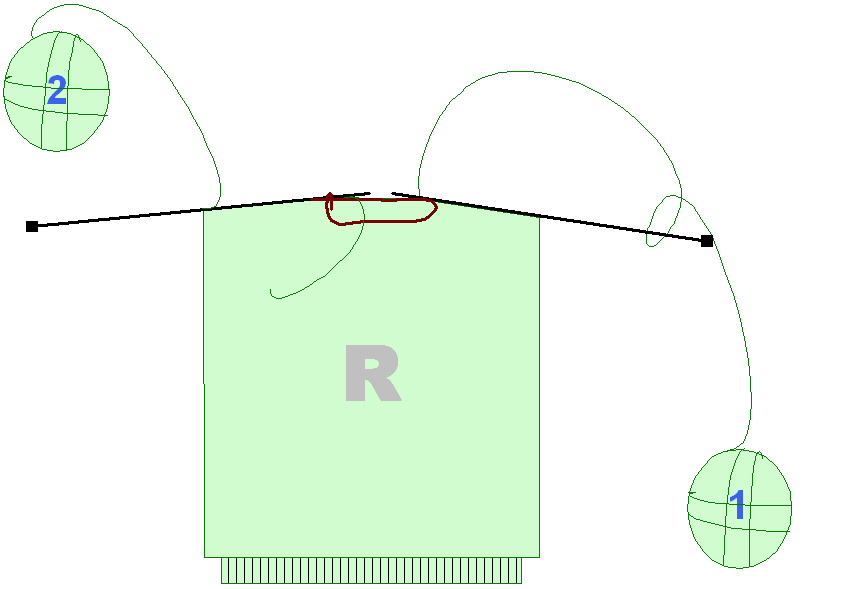
Here you see a basic sweater front (or back), knit in green yarn bearing a big R in the center so we can keep track of the right (read public) side. You see all 70 stitches on one needle, ready to commence a right side row.

At this point, I’ve followed the direction to “Work across 25 in pattern, place center 20 on holder”. Note that the stitches on my right hand needle have been completed.

Now I’m beginning the part that confuses many beginners, “attach second ball of yarn and work remaining stitches.” It’s not difficult. We’re going to do the left and right shoulders simultaneously, mirroring all shaping so that they are symmetrical. The stitches on the holder form the bottom of the neck opening. Sometimes the pattern specifies that they be bound off, other times it asks that they be placed on a holder so that they can be used “live” to form the collar. In either case, they are now parked and won’t be touched again until the pattern revisits collar production and finishing.
Take another ball of the same yarn and starting with the stitches on the far side of the stitch holder, finish out the row. Leave enough tail at the neck edge for easy finishing later. This next diagram shows the work after I’ve completed the “work remaining stitches” bit. I’ve finished my right side row.
The diagram below shows the work flipped over to work back across the wrong side (the non-public side). I’ve got my two balls of yarn set up, one for each shoulder area, and I’ve indicated the spots where the decreases should happen.
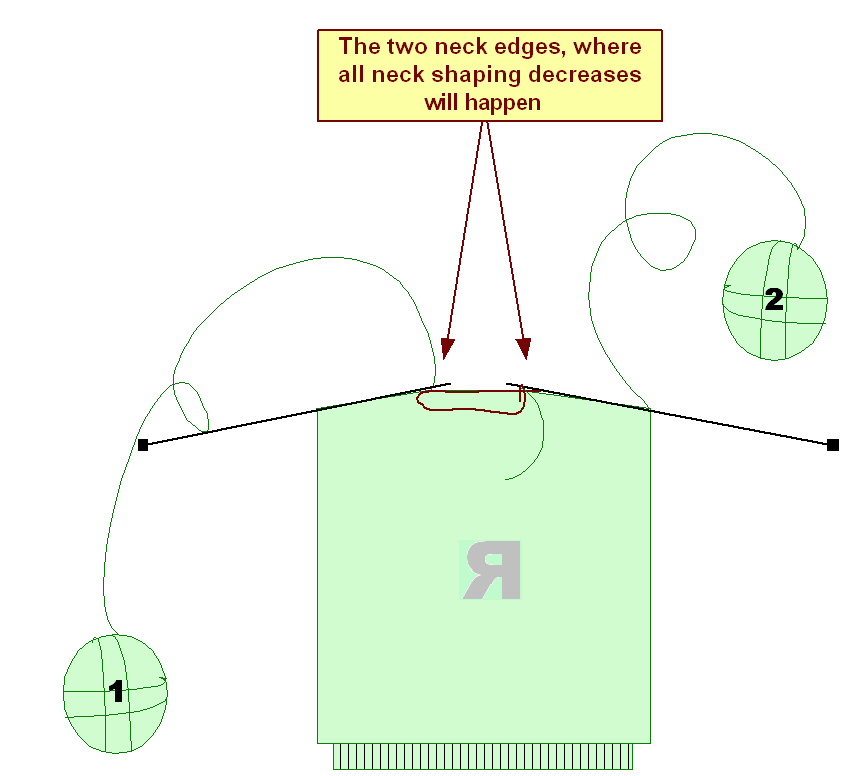
We’re up to continue in pattern, working both sides at the same time, decreasing 3 stitches at each neck edge 2 times.” The pattern is now directing the shaping of the neckline. When a pattern calls for decreasing more than one stitch at an edge I usually bind off at the beginning of a row. Yes, that makes a stepwise decrease, but as you’ll see I minimize the jaggedness a bit. The only exception to this is if I’m working in a giant superbulky (3 stitches to the inch or fewer). In a yarn that big, the steps can be quite noticeable. But back to 99.99% of all knitting.
To accomplish my first set of bind offs I have to remember to work my rows in pairs beginning on a wrong-side row- two rows each with stitches bound off at the beginning yields symmetrical decreases at the right and left edge of the work. In the diagram above, I am poised to begin my initial shoulder decrease. I have worked back across the first bunch of shoulder stitches, ending at the neck edge. No bind-offs yet. But as I begin the second set of shoulder stitches I bind off the first three, then continue across the row. Then I flip the work over to begin my right-side row, work across the shoulder side I just decreased, and perform a similar decrease on the other shoulder
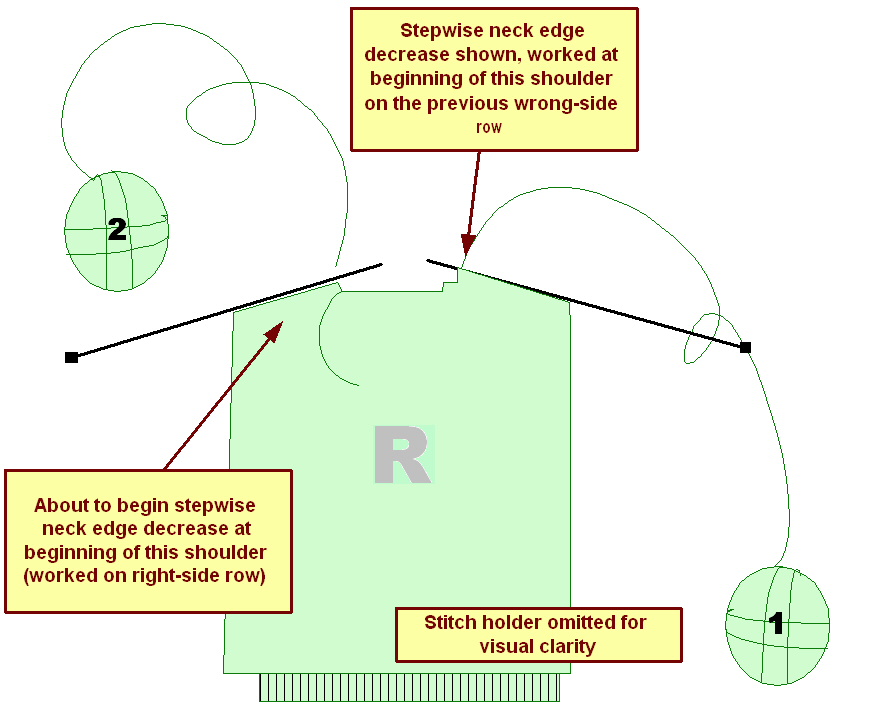
At the end of my second decrease row (in this case, a public side row) I finally have symmetrical decreases on either side of my neck edge, formed by binding off stitches at the commencement of two successive rows. My bind offs are a bit jagged and step like, but that can be diminished somewhat by slipping rather than working the first stitch bound off prior to ending it off.

I am ready to go on to the next direction in my instructions. It says to decrease “1 stitch at neck edge three times”. It doesn’t say to do this by binding off. I could do it that way, and many patterns say so. But I don’t like the jaggies formed by binding off. If I’ve got only one stitch to get rid of, I’ll use plain old K2tog and SSK decreases. Depending on the pattern, I might work them in the edgemost stitches, or in the next-to-edgemost stitches, allowing them to form some sort of decorative detail. Also unlike the bind-off style decrease, there’s no logical reason to separate these between two successive rows. I generally work them on the same row. Most of the time that’s a right-side (public side) row, but in my current project – a piece with heavy texture patterning – it’s easier to do them on the plain purl worked wrong side, using P2tog and P2tog through the back of the loop so as to produce the same effect on the public side as K2tog and SSK. In any case, I place them on either side of the neck edge, creating the curve that is the foundation for whatever collar treatment is specified by the pattern in hand.
An aside: It’s interesting to note that older patterns more commonly suggested completion of one shoulder and then the other rather than knitting them in parallel. Most often those pattens gave directions for the first shoulder, and then said something like “repeat for second shoulder, reversing shaping as necessary.” (A direction that caused me to blink in wide-eyed terror while knitting my very first sweater.) There’s no reason why patterns written in that style can’t be worked in the “at the same time” method. I prefer the two-together method because it’s how I idiot-proof my own knitting to ensure that my shoulders end up being exact cognates of each other. But not everyone likes working this way.
Reasons to stick with the older method might include the unavailability of a second ball (if for example you are working off one immense cone of yarn and don’t want to break it to create a second ball); or the need to concentrate on one set of shaping directions at a time. So long as the you take care to make sure that row counts are the same and that placement of the decreases is a parallel as possible, working one shoulder at a time is a perfectly legitimate way to go. There’s no shame in working the one at a time method, it’s just a matter of mental wiring and personal comfort.
MORE RAINBOW, RETURN OF A FRIEND
Having successfully beaten back yet another deadline storm, and having survived the annual school year February break, some semblance of normalcy returns to the String household. I spent a dreary but strangely relaxing weekend catching up on house maintenance – one that finally allowed me time to knit.
And what did I knit?
I continued my two dueling projects – the dropped leaf sweater, the two side-by-side knit sleeves of which are now approaching the 60% completed mark. There’s no point in showing a blurry picture of yet another pair of indistinct gray objects, larger but still not much differentiated from the last. I am also only four stripes short of finishing the Rainbow Scarf that matches the hat shown off last week. That at least has color and drama, even if the knitting is very mundane:

You can see the long tails at the right hand edge. These will be crocheted into tendrils. Similar strands will be added to the left hand edge after the knitting is done, also to be crocheted into tendrils. I am happy to report that one skein each of seven colors of Frog Tree Alpaca is enough to complete the scarf and hat project. Also that I like the Frog Tree. I’ve met with some minor knots and a couple of unevenly spun spots, but nothing drastic. I haven’t washed the stuff yet so I can’t report on whether or not those Crayola-intense colors hold up. I am already looking on to my next mindless project. I’ve gotten a request for another Klein Bottle Hat. I am thinking of getting more Frog Tree in navy blue to do it.
In other news, I can report a miracle of modern commerce and customer satisfaction.
I have had a small Coach bag for years. I splurged on it when I was gravid with Elder Daughter – so that’s something like 16 years ago. So long ago that Coach no longer includes it in their inventory. It’s a good size, just big enough to hold a wallet,keys, and a phone, and not so large that stuffing it into a backpack or briefcase is inconvenient. Although I have a larger bag and a dressier bag for occasions that demand them, my little Coach has been the default handbag of choice for over a decade and a half. Needless to say that much daily wear took its toll. The binding around the edges was worn through at several spots, and the clasp had given up all hope of fulfilling its function. My bag was well loved, and looked it.
Now Coach has tried to go a bit more trendy in styling and moved more upscale, expanding beyond the “do you want that in black, brown, or camel” mindset of my bag’s day. You’d be hard pressed to find anything similar on their shelves now. But Coach bags are guaranteed for life. So I took my friend to a nearby stand-alone Coach store just after the holidays. My bag was so old that no one in the store recognized the style – not even the manager. I asked if they still repaired bags, and only the manager had an inkling of what I was talking about. But they verified the pedigree of my little guy via the serial number stamped into the inside pocket, and taking a shipping and handling fee (plus issuing a lot of “I don’t know if it’s fixable” type comments), sent it off for repair.
Lo and behold, my little bag returned to me on Friday. Cleaned and somewhat refinished, with a new clasp, new edge bindings all the way around, and a new shoulder strap. All for the handling fee. My friend is back, and I’m very happy.

Moral of the story: That $80 that was so exorbitant 16 years ago was very well spent, and my expensive bag ended up being a better value than any number of cheaper ones I might have bought and worn to death since. You’re always better off buying fewer things of classic style from vendors known for quality and service.
RAINBOWS, SLEEVES AND HATS
Still tooling to deadlines at work, even over the holiday weekend. Which leaves less time for blogging than I prefer. But I can report some project progress.
First, on the perpetual ribbed leaf sweater. Done with the back and front, I now have two sleeves on the needles. As always, I’m knitting them side by side so that the shaping on both is dead uniform. If you look closely you’ll see two things happening with the markers. One is that because this is a wide and easily confused repeat, I’ve got one small silver jump ring marking off each repeat, even though I’ve long since memorized the stitch design. Even so, mistakes can creep in. This helps me keep oriented, and allows me to proof my knitting one repeat at a time. The second is that red marker at the beginning of my row. That’s a counting marker.


My pattern says “Increase one stitch at both sleeve edges every 4th row, 24 times.” I’ve chosen to make that increase on a reverse side row (all purls) because it’s less confusing than trying to do it on the texture pattern side. It really doesn’t make a difference in this pattern, so long as the placement is consistent. I’ve got enough of a headache remembering to do it every fourth row (that’s every other purl row), so keeping track of exactly how many times I’ve done an increase row can become a headache, especially because I only get to knit in short spurts. Pencil and paper would get away from me. Instead, I placed a marker immediately before the last stitch on my purl side row the very first time I did one of the increases. When I began my pattern-side row it was sitting there one stitch in from the edge. On every subsequent increase row I did a make one, one stitch in from the edge. That meant that the new stitch happened between the red counting marker and the edge of the work. After that first row, it’s pretty much automatic because the increase point moves further and further away from the static counting marker as the piece grows. I’ve got six sitting between the red marker and the edge now. That’s six increase rows completed. I’ll continue until I’ve got 24 stitches between the red marker and the edge. Problem solved, so long as I don’t forget to increase at both ends of each increase row, on both sleeves.
The other project I’m working is a more mindless piece. We like to play PS2 games as a family after homework and dinner – the exploration/quest type rather than straight shoot-em-ups or race games. That’s excellent sit and knit time, but because all eyes are needed to spot clues or treasures, not optimal for exacting texture knitting. So that’s when I do socks, hats or other easy pieces. This weekend’s fit the bill quite nicely – Dovetail Design’s Rainbow Hat and Scarf. My LYS kitted the pattern up with Frog Tree Alpaca sport weight – the recommended yarn for the project. I’ve finished the hat and am on the first orange stripe of the scarf.
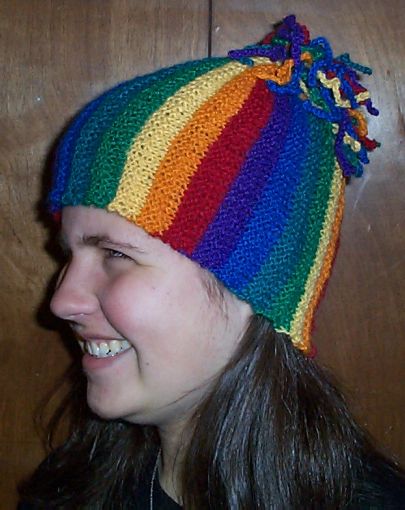
Modeled here by a slightly deranged looking Older Daughter, the hat is a very simple project to knit, but a rather fussy one to finish. It’s knit sideways. Each color is introduced leaving a very long dangling tail, and ended in the same way. There is no shaping, just welts formed by alternating bands of stockinette and reverse stockinette to make a wide rectangle. After the rectangle is finished, the cast on row is joined to the cast-off row. The dangling strands are knotted two by two, then all are twisted and gathered to make a very big single top-knot, forming the closed end of the hat. Finally, using a crochet hook the dangling ends are dealt with, turning them into the crocheted chains that make up the mass of tentacles tassel at the top.
While the basic idea is ultra simple and very easy to knit, there are a couple of refinements that enhance the hat that aren’t covered in the basic pattern. First, the logic of the pattern dictates that some kind of long-tail cast-on be used so that the starting tail is on the same side as end-off tail. but that isn’t called out. In spite of that logic, I used a half-hitch cast-on, deliberately leaving a super long tail. I then used that tail (now on the side of the work opposite that of the zillion dangling long ends) to graft the final row of purple live stitches to the cast-on row of the red. When I was done I treated the dangling end of the grafting yarn just like the other tassel strands. The resulting seam is totally invisible, without much bulk. Second, just tying the tails into a very tightly twisted knot doesn’t close up the hole adequately. Some of the strips stick out like gaping pockets. Others are pleated back inside the hat. I took another strand of yarn and took some carefully placed tacking stitches across the hat just beneath my dense knot, fastening down the tops of the stripes and making the closed end more uniform in appearance. Third, the pattern directs the user to make a slip knot in each strand close to the origin point of the dangling ends near the hat’s closing topknot, and work each one in a crochet chain for as many stitches as possible, ending off the final bit neatly by weaving it back into the crocheted chain. Well and good, but it’s very difficult to work that slip knot in closely. I ended up starting in the center, grabbing a strand and drawing it over one of the others close by in order to make that first foundation loop. After that, I sort of scrummed around, catching the first loop of each new strand somewhere in the mounting foundation created by previous squiggles. It worked out well. The tassel is nice and dense at its base and I skipped the “nurse the slip knot into position” annoyance.
My final criticism is one of yarn choice. I really liked working with the Frog Tree. It’s soft, without the stabbing guard hairs present on many coarser alpaca yarns. The colors are radiant, especially for alpaca which seems to be offered in bright colors less often than other fibers. So far I’ve found some knots in my seven 50-gram balls (one of each color), and some bits where the spinning is a bit uneven, tending to two-inch clumps where the yarn is quite noticeably thicker. But not so many of either that cutting them out was a major problem. So the yarn is fine. But in my opinion this hat should not be made from a sport or even a DK. If you click on the picture above and look closer, you’ll see that the stitches are very leggy, and the fabric is no where near as tightly made as is optimal for a sport or DK weight yarn. The recommended gauge is 4 stitches per inch. The best I could achieve with the Frog Tree was 4.25 (I added a few stitches to the hat to compensate). But I am disappointed in the open, loopy texture. If I were to do this hat again, I’d use a worsted, or heavy worsted (5-4.75 stitches per inch native gauge). Or possibly even one of the most airy and open of the Aran weight yarns (4.5 stitches per inch). I do think that a true 4 stitch per inch yarn would make a hat that’s too heavy.
But sometimes heavy hats are exactly what’s warranted. Older Daughter’s price for modeling her new hat was to show off her own production – a standard issue rolled brim Gusto 10 42-stitch hat.

YEASTY DOINGS
A quiet weekend here at String. Work made some inroads into it, but I had enough time to catch up on some much-needed household maintenance, and even to shovel out a little bit of family-spoiling. To that end, I baked homemade bread, and made flour/salt dough for Younger Daughter to play with. Older Daughter wasn’t interested, but appreciated that Younger Daughter was otherwise occupied for most of the weekend. And both ate the bread.
The immediate inspiration for the bread adventure was Rose Levy Birnbaum’s Real Baking blog. In particular – her recipe for Baby Hot Pot Bread. I’ve made bread before, but I’ve always been very disappointed in the result. To date my breads have been cakey and crumbly, with none of the crunchy crust or stretchy, chewy goodness/hole-filled interior that I like. I got the closest with various Challah recipes. Although good they weren’t what I was looking for.
Rosie’s bread looked too good and too easy not to try. I admit I mercilessly slaughtered her recipe. I did all sorts of things that should have totally sabotaged it. I doubled the recipe because my in-house bread vultures would scarf down one tiny loaf in one meal. Not a good thing to do because in baking ingredient proportions don’t always scale. I substituted a half a cup of whole wheat flour for some of the flour in the recipe because I had it in the house and wanted to use it up. Again not an ideal practice as different flours have different properties. And for that matter, I didn’t use the flour specified. I used King Arthur all purpose, which again is what I had in the house. I didn’t have a Silpat baker’s mat, but I did have a flexible plastic cutting board that served the same purpose, and I only had one cast-iron Dutch oven, so I used a Le Creuset 5.5 quart lidded pot for the second loaf.
But none of these were my biggest challenge. That was the ambient temperature of my house. It’s far too cool here for optimal rising. The usual solution for this is to put the rising dough in the oven with just the oven light turned on. My oven light doesn’t heat the oven enough. I investigated all sorts of alternatives – even writing to Rose for advice. Since I didn’t have the time or resources to build a proofing box, I ended up doing a combo of things, depending on the time of day and what heat resources were available. I turned the oven on very low and put the bowl on top of the stove, covered with a towel. Later I moved it next one of our hot water radiators, again tented with towels. My last resort would have been putting it (well wrapped against dust) on top of our furnace in the basement. To make up for the borderline temperatures, I ended up letting the thing sit for longer than suggested. My first rise lasted more like 24 hours than 18. The second rise was also temperature-challenged. It went very slowly. I don’t think my loaves ever achieved their potential full volume.
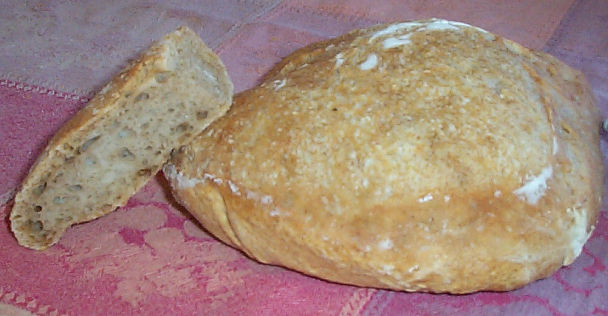
My warmth seeking machinations, the wrong combo of flours, messing with the rise times and other aberrations did not leave me with a high level of confidence when I dumped my two misshapen mini-loaves into their respective pots for final baking. But the recipe is a robust one, able to survive even me. My loaves were perhaps a bit more dense than optimal, but lovely. A very firm, crisp crust; a stretchy, strongly flavored interior, full of holes; no scorching (I was afraid of this given the heat of the pots). And no baking stone full of corn meal, flour, or other burnt crumbs to clean up.
I present the less photogenic of my two efforts. We ate the prettier loaf last night. The sliver of the heel off the narrowest part of my poorly formed bread is just enough to barely make out the airy holes.
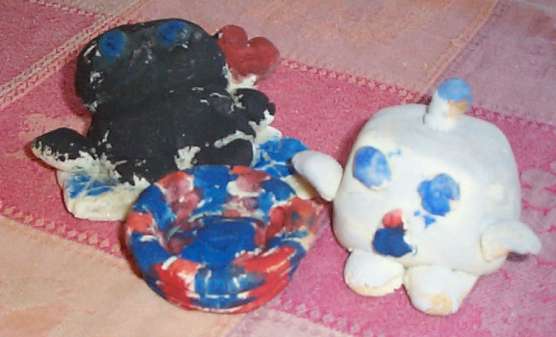
The play dough we made was of the uncooked flour and salt variety: About 2 cups of flour, 1 cup of salt, .25 cup of cooking oil, and about 1 cup of water (we started with 3/4 of a cup but found we needed more). We didn’t bother to color it, knowing that the final product would be baked along with the bread and painted when cool. Here are some of the results. Smaller Daughter saw this entry in the Craft magazine blog, and went on to make her much larger Ninja Valentine statue:
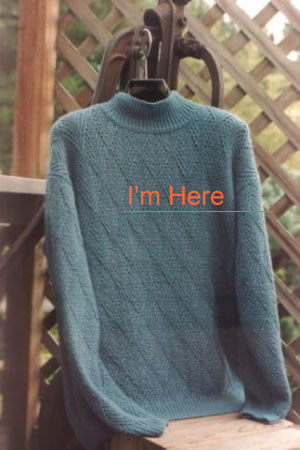
Knitting? I did some of that, too. My Sarah James Ribbed Leaf Sweater back is long complete, and the front is finished to about three inches above the bottom of the armholes.
Rather than give you yet another poorly photographed misshapen object to contemplate, I mark my progress using a visual of the sweater pattern’s own illustration, with a convenient line of demarcation.
Now it’s back to work. The forecast this week is “heavy deadlines, with the possibility of a mid-week blizzard.” February is such a joy.
MAILBOX AND HERO
A couple bits from my mailbox today, plus a long-lost toy.
Yards, grams, and ounces
A reader wrote to ask how to convert ounces and grams to yards, because she’d found a pattern and wanted to buy enough yarn to knit it. I answered with this:
You can’t convert ounces and grams to yards. Yards measures length. Ounces and grams measure weight. One ounce equals 28.35 grams (give or take). One gram equals roughly 0.35 ounces. There are dozens of conversion calculators on the web that can help you flip between the two if you don’t have a calculator or pencil and paper to hand.
Let’s say you had 1.75 ounces (roughly 50 grams) of a 100% wool. You could have about 250 yards of fine fingering weight yarn, or around 135 yards of sport weight wool, or around 120 yards of DK weight wool, or around 100 yards of worsted, or about 80 yards of bulky. And that’s without factoring in stuff like how lofty or dense the yarn is, whether or not it’s made up of multiple strands tightly twisted, or one giant fluffy strand. One five stitch per inch worsted for example might be about 110 yards for 50 grams, but another might be only 90, all depending on the denseness of the strand.
This is further complicated by fiber blends. 1.75 ounces of acrylic at 5 stitches per inch (the textbook definition of worsted) might have significantly higher yardage than 1.75 ounces of 5 stitch per inch wool because the acrylic fiber is in and of itself less massy.
All this being said, there are very loose guidelines of roughly how much yardage a pound of yarn might contain. But remember – use these numbers as a rough guideline only, and only for the fiber type and gauge specified. If you’re planning a yarn purchase and are going on only this type of info – buy at least 25% more than you think you need. I can guarantee that three times out of four, you’ll end up using more yarn than you originally planned. Here’s one set of rough yards per pound figures. Remember – it’s for hand-spun 100% wool only.
Why post patterns for free?
Another person wrote to ask why I post patterns for free. She specifically asked if I was doing it to undercut the people who charged, and wondered why I didn’t write for magazines or other publishers. I wrote back:
I’m flattered that you think my patterns are good enough for professional publication. I think they’re borderline. I don’t do lots of multiple sizes, they tend to be pretty sketchy. Some are more like method descriptions than hard and fast patterns with set yarn quantities.
I post patterns because I find the process of working out the problems they present to be fascinating. My patterns are posted more as a by-product of that exploration rather than the cumulative product. I want to share the fun of both inquiry and production.
I have dabbled in writing patterns for a yarn maker and an on-line magazine. I’m a proposal writer by trade. I spend my professional life running the gauntlet of multiple concurrent hard-stop deadlines. Knitting is an area where my only deadline is “whenever.” I found out that harnessing the creative process to a fixed delivery framework squeezed all the fun (and much of the creativity) out of it. I can’t work under a mandate that inspiration will occur between Thursday next and the 30th of the month, will involve one particular technique and one particular yarn in a color not of my choosing; or that the finished object and full proofed pattern in five sizes will be delivered without delay within 15 days of yarn receipt. Even the web-based magazines brook no delay. So I retreat to my own deadline-free tenth-of-never world, doing whatever the heck I want, when I want to do it.
Why not self-publish and sell the result? Because the burden of handling the business end of the thing (payments, refunds, shipments or downloads, record keeping for taxes) is not commensurate with the pocket change income the effort would bring. I’m re-thinking this in reference to my embroidery book, but to do it for lots of little knitting patterns would be a big pain. Also because patterns people pay for are held to a higher standard than are give-aways. To be competitive, I’d have to knit the trial in a color that photographs well (opposed to the color I want to use), figure out that range of sizes, and use a much higher standard of test knitting than I currently do. While I don’t put out junk as a rule, errors are there. I get to them when I can. But I don’t want to knit everything twice or more – once to create it and at least once more to test the directions, possibly trying out every size offered.
Long Lost Toy
Well, not lost. It’s been sitting in a corner for a while. I made it for Larger Daughter when she was four. Now that Smaller Daughter is out of the hobby horse years, poor Hero isn’t seeing much action. But he’s one of my favorite projects, out of all the things I have ever made.
I had no pattern, some black and green Melton wool scraps left over from some SCA outfits, stuffing, a stick, two brass rings, plus a bit of trim, glue-on jewels, a couple of and bells left over from making holiday ornaments. I improvised and here’s the result.

A stick horse menacing enough for a Nazgul’s child. Needless to say Hero will be spending his retirement here, and not getting passed down to anyone else.
DRAGONFLY MITTENS – FINISHED PATTERN
UPDATE: THIS PATTERN IS NOW AVAILABLE AS AN EASY TO PRINT PDF, AT THE KNITTING PATTERNS LINK, ABOVE.
My mis-matched mittens are done. Today I present pix plus a write-up and more reliable graphs. I changed the placement of the decreases on the graph. They’re now shown along the side strips rather than on the triangle that forms the mitten top. This eliminates any confusion caused by the double // notation inherited from the original inspiring mitten blank. I’ve also fixed the pattern alignment on them so that they integrate better with their palms and graphed my thumbs out to be a stitch wider than the hole provided for it in the mitten body. I found that I needed to pick up a stitch at the left and right corners of the slit formed when the provisional stitches were removed. If I didn’t do that, I ended up with a hole at either side of the base of my thumb.
First, proof that the mittens are done, courtesy of overly dramatic Smaller Daughter (code name Sarah Heartburn).

She does have very large hands and feet for an 8-year old, a sign that she’ll probably inherit my family’s height (at 5’8″ I’m the shortest female in my immediate family). But the mittens are a bit large on her. I’d call them kids’ extra-large, or teen/small woman size.
Dragonfly/Pomegranate and Knot Mittens
a knitting pattern,
(c) 2007, Kim Brody Salazar, http://www.wiseneedle.com


Materials:
Approximately 1.5 ounces total of lofty Shetland style sport weight yarn, with a native stockinette gauge of about 6 stitches per inch. (This will be knit down to a much tighter gauge to make a warmer mitten). Four colors were used:
- Color A: About 50% of the total – Navy blue
- Color B: About 35% of the total – Light green
- Color C: About 10% of the total – Cranberry
- Color D: About 5% of the total – Light blue.
Size 3.25mm double pointed needles (Two circs or one-circ “magic loop” methods can be substituted). DPNs highly recommended for the thumb.
Scrap of contrasting color yarn or string for thumb “place holder”
Gauge:
8 stitches = 1 inch
Finished measurements:
Mittens measure approximately 4″ across the palm and 9″ from tip to cuff
Instructions:
Using the predominant color and a tubular cast-on, cast on 64 stitches. Work in two-color K1 P1 corrugated ribbing for 2 inches, using Color A for the purl columns and Color C for the knit stitches. Using Color A, knit one row and then purl one row. Using Color D, knit four rows. Using Color A, knit one row and then purl one row.
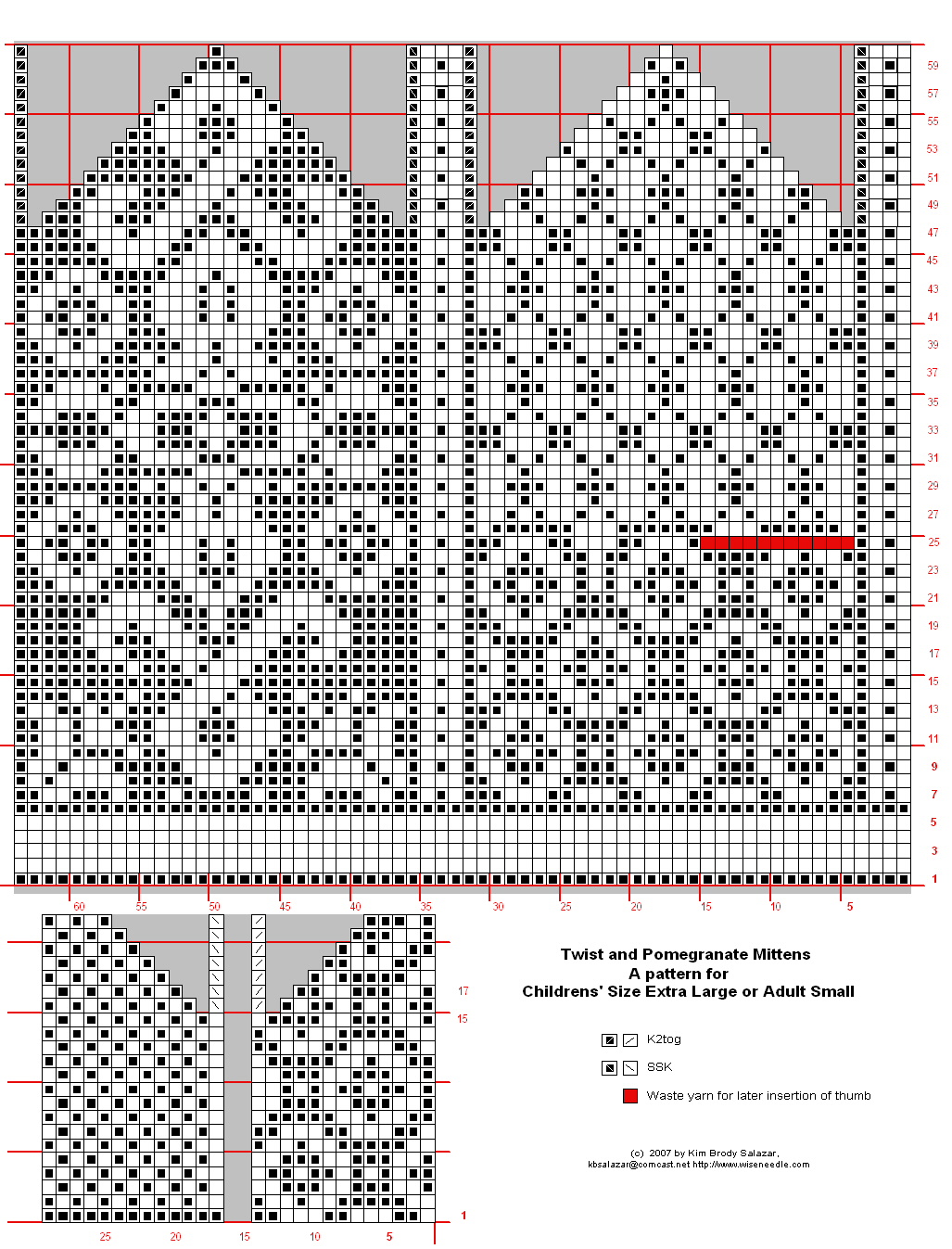
Using the chart of your choice (below) for stranded knitting, work as shown. The creative will note that given four different and interchangeable mitten sides, any combo thereof would make perfectly suitable mittens – all four as presented needn’t be used. Regardless of the mitten graph chosen, introduce a small bit of waste yarn or string for the stitches indicated in red. Make sure that you mirror that placement for your left and right mittens, as shown in my charts. Alert: On the pomegranate and knot mitten chart, I call for decreases done in Color A. I’ve introduced a separate symbol for those decreases. It’s noted on the chart. End off the mitten at the top by grafting together the last 8 stitches.
Thumb:
Returning to the waste yarn introduced for the thumb, carefully remove it, slipping the live stitches above and below the newly formed slit onto DPNs. Using a third DPN start at the side of the thumb to the right of the newly created hole. Looking at the thumb chart for the visible side of the thumb (the one with the pattern that matches the palm), pick up one stitch in the right side of the newly created thumb slit. Do this in the color indicated for the first stitch of the thumb chart. Note that the thumb pattern should seamlessly integrate with the palm pattern, although each of these mittens does that in a different way. Work across row 1 of the visible side thumb chart. Switch to the inside-the-thumb chart (the one with single stitch checks), again starting with the first charted stitch, pick up one stitch in the side of the thumb slit prior to working across the rest of the thumb chart. Follow chart as shown, grafting the final stitches at the tip of the thumb. Darn in all ends.

MORE MITTEN INSPIRATION THAN I BELIEVED POSSIBLE ON ONE SITE
Rebecca over at Pocahontas County Fare points to a fabulous link – a project to outfit all participants at the NATO summit held in Riga with traditional Latvian hand-knit mittens. The conference took place back in November. Rachel details how to download and view the entire collection. I just provide boring links to some of my favorites appearing in the web-accessible galleries of regional styles.
What’s best about the galleries of the mittens at the Riga conference site is that each and every one of the over 5,000 pairs is photographed in detail at high resolution. High enough in fact to mine them for their colorwork patterning. Also high enough to spot some continuities of design.
Some of the mittens shown sport patterns that are extremely similar to those appearing in embroidery modelbooks from the 1500s and early 1600s:
http://www.rigasummit.lv/en/id/galleryin/nid/119/gid/3518/
http://www.rigasummit.lv/en/id/galleryin/nid/119/gid/3507/
http://www.rigasummit.lv/en/id/galleryin/nid/117/gid/3230/
http://www.rigasummit.lv/en/id/galleryin/nid/117/gid/3240/
http://www.rigasummit.lv/en/id/galleryin/nid/117/gid/3092/
http://www.rigasummit.lv/en/id/galleryin/nid/115/gid/2954/
http://www.rigasummit.lv/en/id/galleryin/nid/115/gid/2944/
http://www.rigasummit.lv/en/id/galleryin/nid/115/gid/2933/
http://www.rigasummit.lv/en/id/galleryin/nid/115/gid/2904/
http://www.rigasummit.lv/en/id/galleryin/nid/115/gid/2883/
http://www.rigasummit.lv/en/id/galleryin/nid/115/gid/2869/
http://www.rigasummit.lv/en/id/galleryin/nid/115/gid/2872/
http://www.rigasummit.lv/en/id/galleryin/nid/115/gid/2811/
http://www.rigasummit.lv/en/id/galleryin/nid/115/gid/2801/
http://www.rigasummit.lv/en/id/galleryin/nid/115/gid/2793/
http://www.rigasummit.lv/en/id/galleryin/nid/118/gid/3470/
http://www.rigasummit.lv/en/id/galleryin/nid/118/gid/3458/
http://www.rigasummit.lv/en/id/galleryin/nid/118/gid/3411/
http://www.rigasummit.lv/en/id/galleryin/nid/118/gid/3382/
Others evoke later eras.
http://www.rigasummit.lv/en/id/galleryin/nid/115/gid/2833/
http://www.rigasummit.lv/en/id/galleryin/nid/115/gid/2804/
http://www.rigasummit.lv/en/id/galleryin/nid/115/gid/2812/
http://www.rigasummit.lv/en/id/galleryin/nid/115/gid/2814/
http://www.rigasummit.lv/en/id/galleryin/nid/118/gid/3326/
And some are timeless – with patterns that evoke mosaics or other forms appearing in every era since people first figured out that regular geometrics were pleasing to look at:
http://www.rigasummit.lv/en/id/galleryin/nid/115/gid/2810/
http://www.rigasummit.lv/en/id/galleryin/nid/115/gid/2799/
http://www.rigasummit.lv/en/id/galleryin/nid/115/gid/2790/
http://www.rigasummit.lv/en/id/galleryin/nid/118/gid/3476/
http://www.rigasummit.lv/en/id/galleryin/nid/118/gid/3427/
http://www.rigasummit.lv/en/id/galleryin/nid/118/gid/3433/
http://www.rigasummit.lv/en/id/galleryin/nid/114/gid/2745/
I’m dazzled. I could look at these for hours (and I already have). Special thanks to Rebecca for posting the link, and to the unknown person who wandered over here from there, leaving the ant-trail I followed back to her site out of curiosity.
 String-Or-Nothing