AND WHEN IS A PAIR NOT A PAIR?
When they only sort-of match. Kind of.
Here are my 1.4 mittens. As you can see, they’re very quick. Even faster to do than socks. Now I can see how girls of long ago had the goal of knitting an absurdly large number of mittens to stow away in their hope chests against the needs of their future family. At my almost half a mitten a night rate (in about 1.5 hours of knitting time), I could do a pair a week and still have time left over for other knitting.
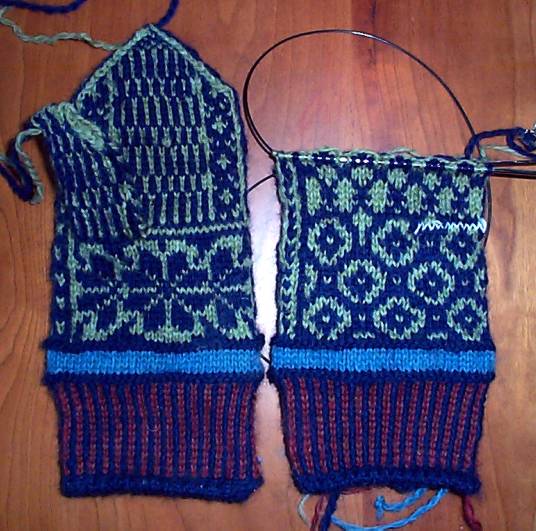

Too much fun, especially since I have no hope chest deadline. I think I’ll have to do another pair for me. Another chance to graph, and to do so on a larger field (at least 35×69 boxes to the mitten tip, instead of 28×61, perhaps a few more). Now, what to put on mine… Sprites from old computer games? Cute, but hardly original at this point. Words? I would have to find some pithy piece I could endure reading day after day. Some other graphed pattern from my book? Perhaps the bunny I shared here before? Something from my out-take notes – the patterns that weren’t documented well enough to make it into the book, or proved out to be from after 1600? Perhaps. Some doodle with no prior precedent? Also not unlikely. One caveat though, I may be delayed in my start on my sequel mittens. I’ve gotten a begging/pleading/groveling request for another Klein Bottle hat.
Two quick cheats – Got a mitten or other strong left/right directional chart on your computer and want a quick and foolproof way to swap that left/right thumb placement without sitting down and taking the two tedious minutes to transcribe it on the hard copy? Most printer drivers in both the Windows and Macintosh worlds have a “print mirror image” setting buried way down on their Advanced Features page, accessible off the printer set-up or print controls dialog page. Use that to print a new copy of your graph. Instant left/right swap.
Or if your printer driver doesn’t have that setting, get a sheet of clear viewgraph transparency plastic that’s meant to go through your printer (the stuff that’s used on overhead projectors). Print on that. Put the result in a page protector with a sheet of white paper behind it. When time comes to do that second mitten, flip it over. Overhead transparencies are becoming rare in this day of cheap full screen projectors, but many teachers still use them and they’re still in the office supply stores.
EVEN MORE MITTENS
This Norwegian mitten thing is entirely too addictive to stop. And who says that lefts and rights have to be identical? I’m just about done with the body of Mitten #1, and am about to start the thumb.


My mittens are about 8 inches around, and 9 inches from the bottom of the cuff to the tip of the fingers. My gauge is approximately 8 stitches and 9 rows per inch. I can wear them – just barely. They’re a bit tight. I’ll probably give this pair to someone with slightly smaller paws – probably to someone who wears a women’s size medium glove. If I were knitting another pair for myself, I’d graph up something that has about eight stitches wider around total, and about six rows longer.
It’s been a long time since I’ve doodled with colorwork or embroidery charts, and I’m having too much fun to stop. Therefore, Mitten #2 will use the same yarns, have the same red and blue corrugated ribbing and light blue racing stripe as Mitten #1, but the upper green and blue patterned part will be different:

Again, totally untested and untried. The motifs on #2 are inspired by (but not directly taken from) the group of 16th century charted designs in The New Carolingian Modelbook. Cautions are therefore given against using this chart before I make a final version.
One observation on the mitten template provided by Hello Yarn: it appears to use \ to mean one ssk decrease or // to mean one k2tog – not two. I’m not sure if I’ll use the same notation in my final chart because it’s confusing.
Finally, on the Modelbook – I’m thinking of investigating coming out with a new edition via one of the self-publishing/publish on demand services. The book divides evenly into square unit graphed patterns useful for knitting, crochet, and embroidery, and line unit patterns, mostly of use to stitchers but not knitters. I have a feeling there is far more demand for the former than the latter, and am considering issuing the two parts separately. Any feedback on this idea?
DRAGONFLY MITTENS
I have absolutely no idea if the pattern I just doodled up (shown below) is going to work.
I made some blind and totally unswatched assumptions about gauge, took inspiration (but not stitch counts) from the Hello Yarn generic Norwegian Mitten template, and ran with it. I’ve used my dragonfly pattern posted here before, plus idle chicken scratches.
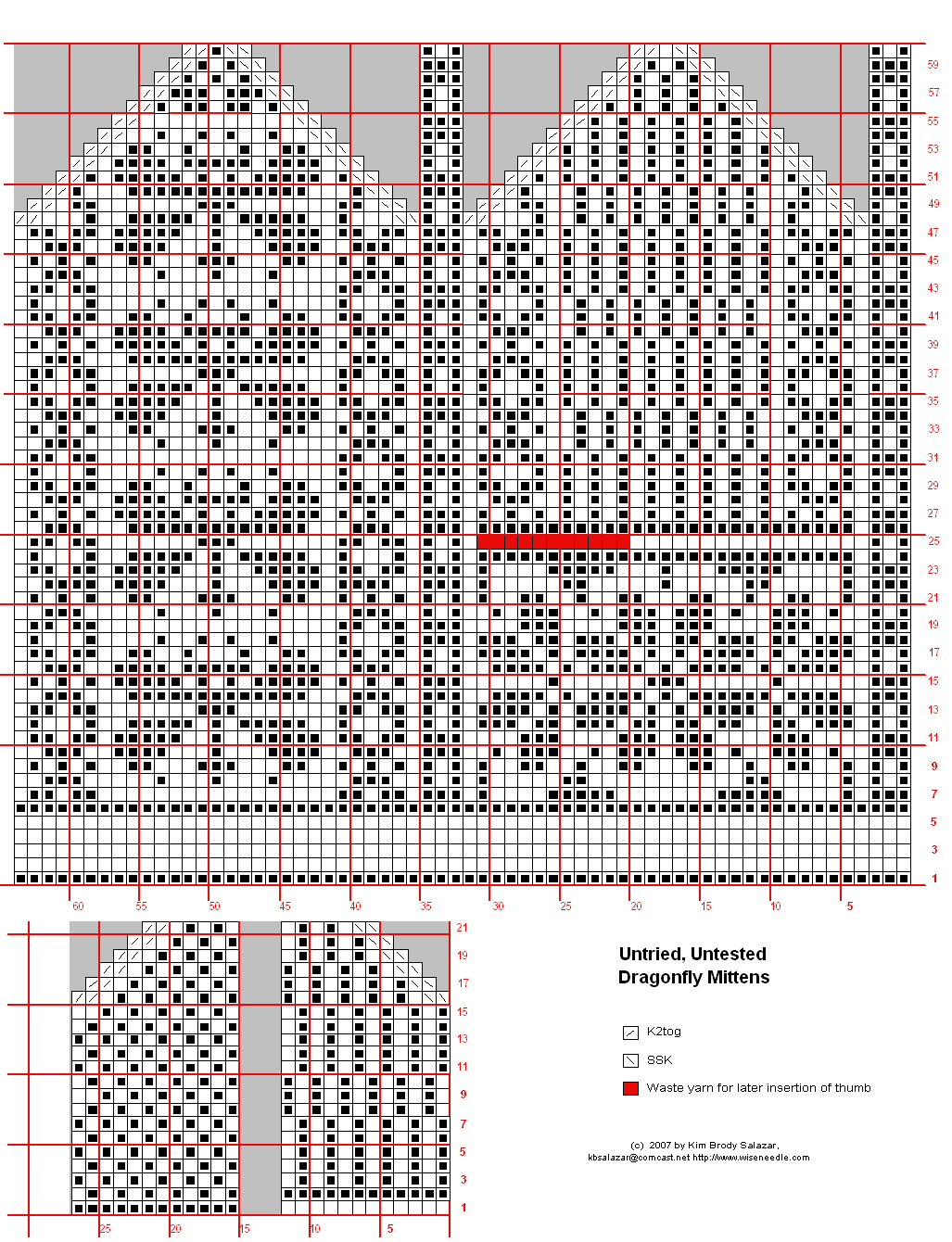
I suppose the next step is to see if I can get about 7.5 spi, figure out which colors I want to use, and try to knit this totally untested pattern.
Heck. Risk can be fun if taken in small doses.
UPDATE: Please don’t try knitting from this graph yet. The JPG filter appears to have cut off a column of stitches (there are 64, not 63 on the cast-on row). I’ll repost a final, corrected graph when I’m further into the project. For the time being, I can report that gauge is working out o.k. for the corrugated two-tone ribbing (two inches, done before row 1 of the chart), using my lofty ancient Britania Shetland on 2.5mm needles. Dense pack, but good for a nice, wind-proof and cushy mitten.

Note that the two-tone ribbing curls up a bit. That’s normal. Corrugated ribbing is not as curl-proof as regular K1, P1 ribbing.
TUBULAR CAST-ON; LEAF SWEATER PROGRESS
June over at Twosheep recently wrote about a tubular cast on. That sent me off looking up various ones. June recommends the one from Montse Stanley’s Readers’ Digest Knitters’ Handbook, although she notes that doing it in stockinette is not as stretchy as doing a ribbed tubular cast-on. She gives links to a couple of nicely photographed instructions at My Fashionable Life, and Little Purl of the Orient. I don’t have that particular Stanley book on my shelf, but I use an entirely different tubular cast on than the one described at those sites and in the book.
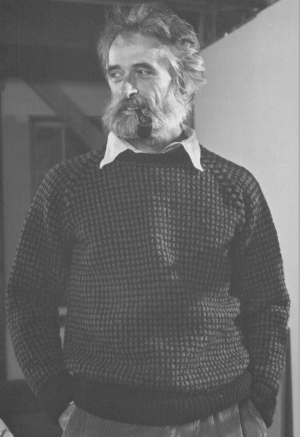
I learned an at once more fiddly and simpler method for a ribbed tubular cast-on during the second sweater I ever knit – Penny Straker’s Eye of the Partridge unisex raglan. Straker’s pattern format included a side bar with helpful advice or bonus illustrations of techniques and tricks. This one included instructions for the cast-on I did Partridge as a gift for one of my sisters. I knit it in Germantown worsted (very much like Cascade 220), in an dusty antique rose and a deeper, almost blood rose for the darker complementing color. It’s long gone now otherwise I’d put a photo here instead of the sample photo from the pattern, shamelessly lifted from a web-based retailer (the pattern itself is still available, and also comes in a kids’ version).
Straker’s method calls for using a provisional cast-on, and casting on half of the stitches called for in the pattern. If for example, the pattern asks for 100 stitches, I cast on 50. Then I knit in plain stockinette for four to ten rows (usually 6). At the completion of the last row, I unzip my provisional cast-on, and place all the newly freed stitches along the bottom edge onto a second needle. I often use a needle one size smaller than I used for the stockinette piece to make this easier.
I now have a long, skinny snake of knitting, suspended like a hammock between two active needles. I hold the needles so that the strip is folded in half, with the purl side on the inside. Then I take a third needle and alternately knit one stitch off the needle closer to me:

and purl one stitch from the needle that’s further away:

(Pictures courtesy of Younger Daughter, already at 8 as good a photographer as her mother will ever be)
When I’m done, I have a nice, neat, stretchy tubular edge in K1, P1 rib that can be made wide enough to accommodate a drawstring. I use this routinely for almost all of my hem edges – even for circular knitting. I’ve made the small divot at the join into a design feature on some pieces where I’ve started my cast-on at the neckline. On others, I’ve used the dangling tail to snick it up and make the starting point invisible.

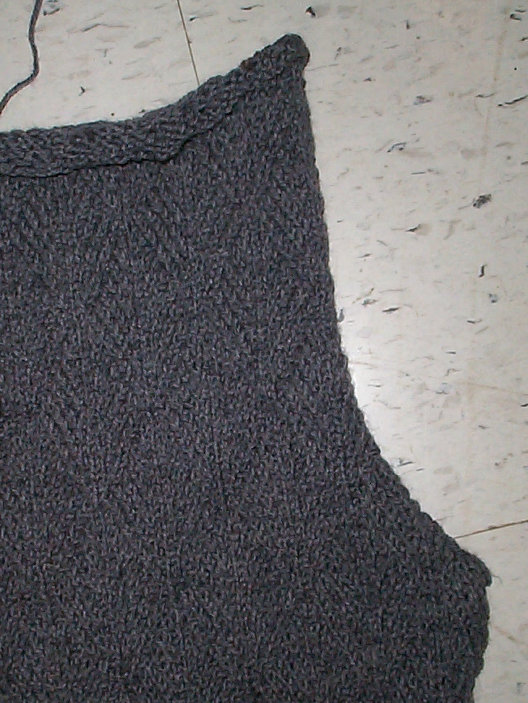
In this case, I broke into twisted rib the row immediately following the cast-on row. How’s the leaf sweater coming? The front of it is starring in the cast-on photos, above. Here’s the back – blurry and hard to see, but proof that I’m done with it. Also proof that yes – a texture pattern that’s mostly stockinette will also curl.
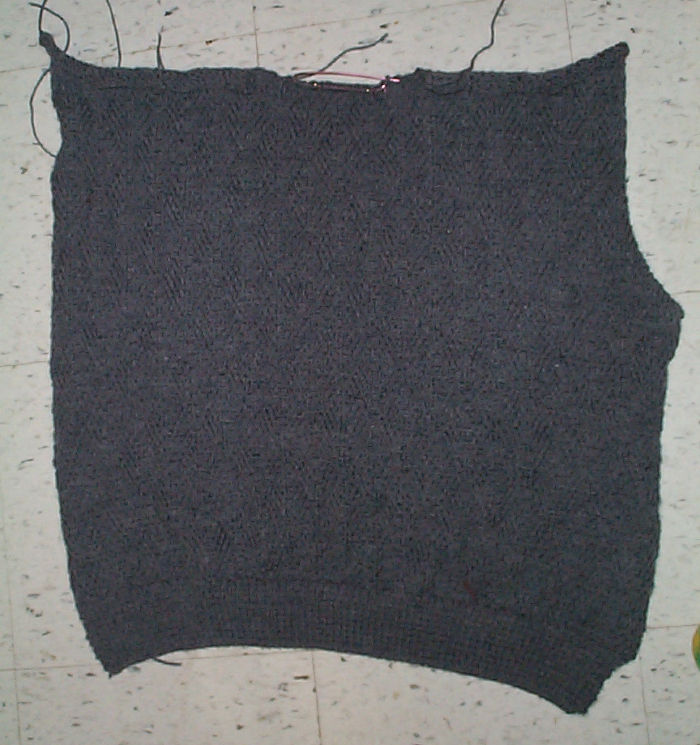
For the record, here’s a bit of detail in which you can barely make out the texture pattern and the armhole decrease area (click on this for a close-up):
And because I’m still sniffing around for a small project to run in parallel with my leaf sweater, plus I’m having fun with my ancient Unger Britania– I’ll take another lead from June. It’s mittens next. The shape of a traditional Norwegian mitten looks pretty simple, yet with ample scope for fun. Hello Yarn offers a PDF of a blank mitten graph. I think I’ll take that idea and run with it – redrafting the template for a smaller gauge, and using some of the historical graphed charts from my book on embroidery. If nothing else, I’ll enjoy the doodle time.
BRAIN DEAD IN THE BOOK AISLE; KLEIN BOTTLE HAT FINISHED
Count me in with the Curmudgeon and Lisa at Rosieblogs on their stance on disparaging knitting books “dumbed down” for today’s chix. I detest the majority of knitting books published over the last three years. I don’t like the attitude, the contents, the presentation, or the base assumptions behind them. Lisa’s rant is spot-on. Knitting isn’t difficult. It is exacting, and does require a fair bit of patience and perseverance to master. But there’s no mystery, and it’s been accomplished very successfully for hundreds of years by people with no formal math education whatsoever.
You could probably argue that the most recent crop of books was not written with my demographic in mind – the grumpy intermediate to experienced knitter looking to learn more. But even if I were nineteen and holding yarn for the first time, I’d be offended. The only thing that differentiates the vast majority of these hip, trendy little no-attention-span patterns from the stuff aimed at teaching Kindergarteners to knit is the absence of wiggly doll eyes on the projects. Cell phone cozies? Let’s forget for a moment that a team of engineers labored for months on achieving the rate of heat dissipation required for a small-footprint electronic device to function properly, and that someone now wants to put a sweater on the damned thing. If I were a novice knitter given a book whose diet of beginners projects ran the gamut of items you could make from a square folded in half, I’d toss the thing aside and dismiss the whole craft as being brain dead.
Now there are intelligent, well-written books out there for beginners. You can usually find them by avoiding key words in the titles. Lisa nominates “Easy.” I nominate “hip”, and “simple.” Stanfield and Griffith’s Encyclopedia of Knitting is a good one. It’s full of inspirational photos, describes lots of techniques in an accessible manner. As a “Knitting 101” type overview it’s broad but not particularly deep – a good gate to further exploration that doesn’t overwhelm a beginner with every knitting fact known to the universe. The only thing its lacking is a bunch of intro projects.
This glut of useless books follows in the footsteps of any hobby fad. It happened to needlepoint, cross stitch, and quilting in the ’70s, ’80s and ’90s respectively. Publishers see people stampeding to a new interest and retool their offerings accordingly. More substantive books are put on hold, general references of interest to all levels go out the window, and minimalist splashy intros soak up every available publishing dollar. In knitting’s case as Lisa and the Curmudgeon point out, this fad-following focus is compounded by a whole flock of wildly patronizing and denigrating attitudes. So count me in with them. I’m not interested in simple, hip, trendy, urban-gritty, easy, shortcuts, weekend, boxy, cropped, giant-gauge, flash, dummies, or quick. I don’t even want books of expensively photographed patterns for clothing that will look dated in a year. I want challenges, complexity, techniques, resources, tailoring, fine gauges, and if I’m going to spend months creating the object – long term wearability.
Perhaps I’ll get more of it. Knitting’s recent expansion is poised for a crash as the majority of the fad knitters move on to the next big, non-challenging thing. I’m delighted to note that a minority (although a healthy minority) of recent learners has the interest and perseverance to move beyond these dumbed-down books. Perhaps in the flotsam of the post-fad knitting environment between them and those of us who knit before it was trendy there will be enough demand to spur the publication of more substantive and useful resources. But more likely the publishers will lemming on after the next self-affirming fad. Scrapbooking anyone? I hear most people had some exposure to scissors, paper and glue in grade school.
Enough ranting. The few folk who come here aren’t scouring the web for editorials. Back to knitting content.
Klein Bottle Hat – Finished
Here’s the finished Klein Bottle Hat, once more ably modeled by Smaller Daughter (the only one still home in the before-school hour I steal for blogging).


I can say that I followed the schematic in the pattern far more than I followed the pattern itself. I found the original to be too big – not big around the head, too long in length. I shortened up the run of plain full-width knitting before the slit is made, and conflated the narrowing and the slit itself (winging it on the rate of decrease) working both the decrease and the slit at the same time. I’m not entirely pleased with the graft. If I were to do this again, I’d knit some small K2P2 swatches and practice grafting them before I tackled the hat itself. But it will do for a quick gift.
My only problem is that I’ve run out of small project before I’ve run out of deadlines. Mittens next? Perhaps.
TRANSFORMATIONAL GEOMETRY
Progress on the Klein Bottle Hat. Some retrograde, but progress none the less.
First, I think the pattern as written is a bit overly generous in length. My hat is very deep to begin with. The direction to work the slit for two inches, then work in pattern for two more inches before beginning the decreases makes a log-shaped piece that bears little resemblance to the thumbnail drawing in the pattern. So I modified it a bit. First, instead of knitting 16 inches before beginning the slit, I shaved off an inch. Then I began my decreases immediately after the slit. But even so, I think I may need to re-knit this again, starting at the second dark blue stripe, shortening the body a bit more, and beginning the decreases at the same time as the slit is worked. I’ll also change the rate of decrease so that the piece narrows faster.
What you see here is the hat folded up into itself, with the skinny tail piece I knit first threaded through the slit. If I wiggle and drag it more aggressively, it does pull up so that the bottom-most blue stripe is eaten inside the hat. But still – I think it’s too deep, and the top isn’t narrowing enough, or quickly enough.
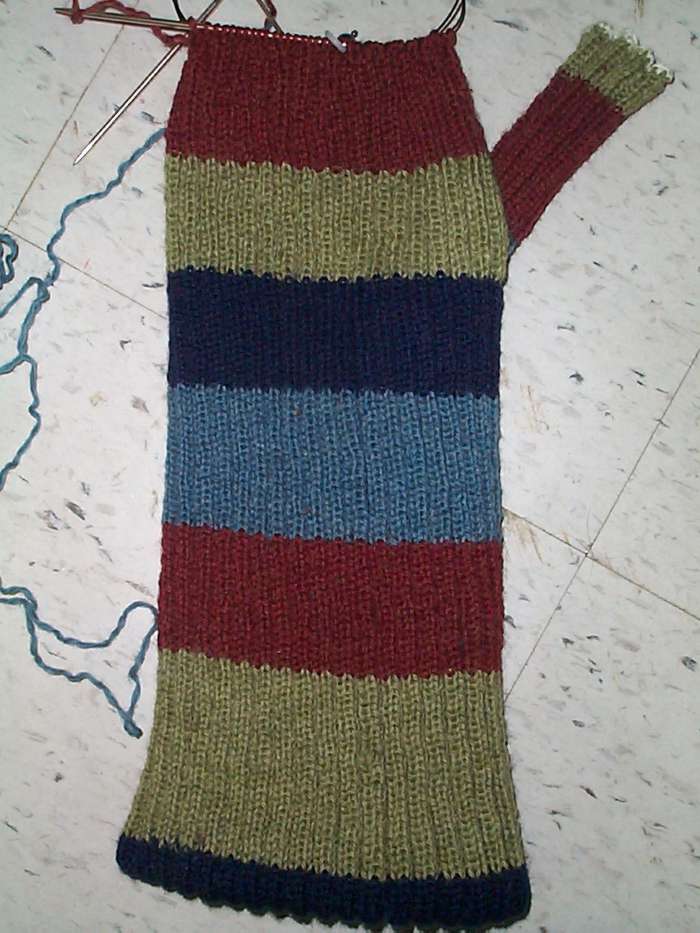
Even though I’m on my third stab at working the top of this hat, opinions will be graciously accepted.
JUSTIN’S COUNTERPANE; BLOCKING BOARDS
A couple items from my inbox.
Question on Justin’s Counterpane
Cindy wrote to say she was having problems conceptualizing how the pieces to make my Justin’s Counterpane pieced blanket fit together. This particular blanket is a large scale intro to white cotton/lacy knitting. Only twelve main units are needed to complete it – six keyhole shaped motifs, and six whole octagons. Ten triangles are used to eke out the sides and make them straight. An optional edging finishes the thing. They’re put together like this:

I did not use additional triangles at the corners to make a true rectangle because it’s easier to go around a more gentle angle without mitering than it is to go around a 90-degree turn. And I didn’t want to go through the bother of mitering my corners.
Because of the relatively few units used and the simplicity of the classic pinwheel motif, I think that people wanting to make a first item in this style might find the pattern useful. Being a blanket, it doesn’t have to fit anybody so gauge is a guideline, not a mandate. It can be worked in any cotton or cotton blend yarn you like. The yarn I chose was a very inexpensive DK weight, but by using the appropriate size needles, a piece of usable dimensions could be made in anything from sport to worsted. Much heavier than that though and you’ll get into weight issues, cotton being quite a bit massive than its equivalent thickness in acrylic or wool. (You could even work this in standard wool or acrylic, but I think the design will be crisper in cotton.)
In any case, some basic guidelines for knitting and seaming together pieced counterpanes include binding the motifs off especially loosely; blocking the units before assembly, by wetting them down and pinning them out while stretching them to their maximum extent; and using whip stitch or when possible, mattress stitch done in half of the edge most stitch to sew them together. Back stitch or mattress stitch done further into the motifs will make the seams too dense and rigid, and may introduce cupping.
Bargain Hunters’ Blocking Boards
Rachel and I had an eMail chat recently. I think it was over on one of the knitting-related boards at Live Journal. She was looking for advice on blocking. In specific, she was looking for low-cost alternatives for blocking. We went through the standards – pinning out on carpet covered with towels or on a padded table or bed, but she wanted a rigid surface that was easy to stow in addition to being inexpensive.
I recommended getting a half-sheet of drywall from the hardware store, taped around the edges to reduce crumble, and topped with a flat sheet through which the pinning happens. I also suggested scouring yard sales or opportunity shops for the squishy/spongy foam pattern/alphabet block floor tiles or play mats favored by the parents of toddlers. They’re indestructible and often outlast the toddler years, landing at second-hand venues. Top those with a sheet and pin away, happy that you’ve found a modular, easy to store solution that as a creative recycle, nibbles away at the waste stream.
Rachel decided to go with the play mat idea. She sent me a note of thanks, and included this shot of her shawl blocking:

(Photo is hers, used with permission). She also notes that she got her mat at WalMart, and it was less than $20. Love the shawl, Rachel, and as ever – I’m delighted to have been useful.
GULPING AIR – KLEIN BOTTLE HAT
Deadlines turn out to be intense but manageable, leaving me a bit of time to get some knitting done. The hat is progressing well, although I had to recast my yarn choice to something lighter. Two thicknesses of K2P2 ribbing in worsted seems too heavy for comfortable wear. So I dug down in my yarn boxes and came up with some lighter leftovers brazenly liberated about ten years ago from my mothers’ stash.
Unger Britania was a Shetland-type yarn of exceptional quality – lofty, soft, stretchy and supple. It’s native gauge covers the range between fingering (knit way down, compressing the loft) to DK (knit very loosely, letting the loft fluff out to fill in the stitches). It worked best at sport weight (6 spi). Mom had done an adult size Intarsia piece with it (possibly an Argyle) but ended up ripping it completely out and re-knitting most of the yarn into something else for a smaller individual. The leftovers are evenly divided among the colors with some virgin skeins, and a few balls made up of short lengths of about 5 yards each. Some fragments are longer, some shorter. I’m starting with the leftovers, spit splicing the short yardage pieces. I am also spit splicing color joins so that there will be no ends to darn in on this one-side/two-sided piece. My striping is rather haphazard. I knit until I run out of a color bit, then decide if I want to splice on the next same-color piece of unknown length, or if I want to shift to the next color.
I’m about a third of the way done, and due to the smaller gauge am more or less winging it, holding onto the dimensions and shaping proportions of the original pattern, but blissfully ignoring stitch count directions. For the record, I’m getting about 8spi in very stretchy K2P2 rib, on US #4s.
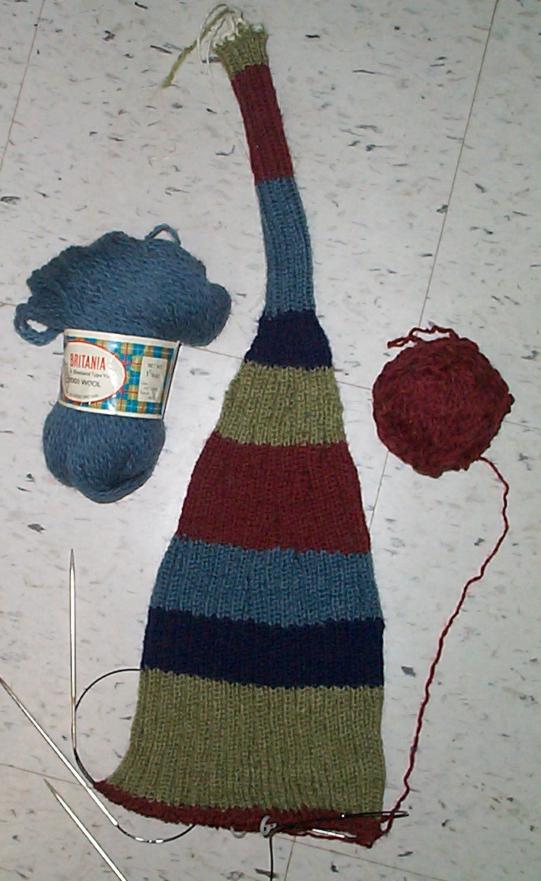
The result, given the 1970s color set and random width striping pattern the result looks rather Whovian. My target nerdpal will be ecstatic.
ON THE OUTSIDE LOOKING OUTSIDE
Another descent into deadline hell looms on my imminent event horizon. Now in the past faced with something like this I’ve dropped all knitting, hung up the blog, ignored wiseNeedle, and pared my life back to the basics: work, do what family maintenance I can, eat, sleep. In that order of precedence. This time I’ll try not to disappear completely. At the very least I’ll farm wiseNeedle, even if I don’t have time to blog. Also I intend to keep a small project going as a stress valve. (Better that than loll in caffeine and chocolate).
I need something that’s pretty mindless, but not so totally dull as to be totally boring. Something new so that there’s a modicum of interest. Huge needles (huge for me at least) so progress is tangible. Socks are right out. Perhaps a hat. An unusual hat…
In fact I think I know the very thing. I make no secret that I fall on the geeky side of normal. I’m an aging grrlnerd with lots of friends who would wear Star Trek Underoos if they came in adult sizes; guys and gals who find joy in mathematical humor, and who view visual puns as an ultimate art form. (I say this with affection and respect, because as a group they exhibit amazing creativity, and wit, and are just plain fun to be around.) So if one of them – a self-described and documented ubergeek – deserves a special gift, what better than a Klein bottle hat?
Some of you reading this are saying “Hey! Cool! I want one, too.” Others are wondering what the heck a Klein bottle is. And I’m sure a couple of you are curious as to why one would need a hat. One might even ask “Where would a Klein bottle wear a hat?” The answer of course being “On the outside.”
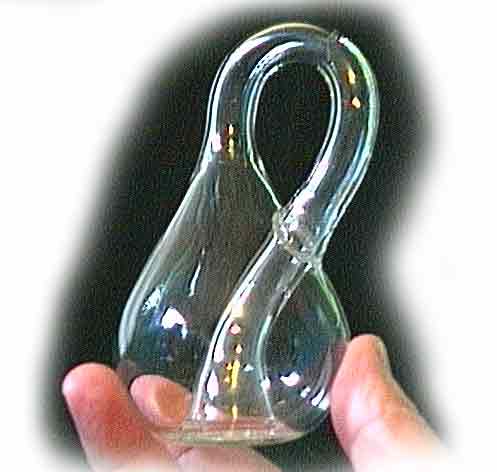

(Bottle image shamelessly borrowed from Acme Klein Bottles, a source for all your topological oddity needs.)
There are far more erudite and far more scholarly explanations of what exactly a Klein bottle is than I could ever offer. It belongs to the same family of topological oddities as does the Mbius strip, another one-surface entity. In effect unlike spheres, cubes or pyramids that form an unbroken skin around an interior space, it’s a solid object that instead of having an outside and an inside, has only one side – the outside. Or the inside. (Which one is present in a Klein bottle is open to debate, but whatever the answer is, there’s only one of them.) The artifacts you see are actually representations of the Klein bottle concept because as a multidimensional trick played on the universe, one can exist as thought but can’t be truly built in the paltry three spatial dimensions we inhabit.
I am far from being the first person to knit up something like this. Acme has a nice selection of ready made Klein Bottle hats. There are several patterns on the web if you want to knit your own. Knitty did one; a good pattern but it’s not my favorite. I think it looks more like a teapot lacking a spout than anything else. There’s one by Sarah-Marie Belcastro, whose joy in her own mathematical geekitude is contagious. (She’s got lucky students). It’s very cool looking, but I think the intended recipient would find it a bit too massive. And there’s another all-prose pattern that I remember being offered as a holiday gift exchange pattern was back in the ancient days of the KnitList, circa ’94. Woolworks has it on archive.
The one I am taking for inspiration is none of the above. It’s by Nathanael Berglund, the sketchiest pattern of all but with a pleasing and recognizable shape. I think it’s conceptualized just enough to provide me with fodder for (minimal) thought. The simple shaping will be just complex enough to keep my interest, yet not so daunting as to require me to slavishly knit to the pattern. And at a DK or worsted gauge will go quite quickly.
So I as I trot along the sorry slope to yet another personal hell, I’ll be trotting along with an air of distraction. Not exactly overjoyed, but glad to know that my ultra-nerdy destressing mechanism is prepared in my backpack, sharing room with my computers and waiting for the least bit of “hurry up and wait” time to be appreciated.
1941 VEST – FINISHED
My ultra quick 1941 vest project is finished. That’s 7 days from cast-on to finishing off the final end. Considering I only knit an hour or two a day, that’s lightning quick.


The fit is a bit different from most contemporary patterns. For one, the shoulders are wide and shaped, and the armholes aren’t gappy. My tiny cut-out at the back of the neck rides well with a golf shirt’s collar, and the length is just what he wanted. The fabric is soft and lofty. Since I rarely knit for him and the few times I have the results haven’t been optimal (mostly too big or too warm), I’m delighted to have produced a winner.
On the yarn – I think Cascade 220 is a yarn that’s overlooked in the mad scramble to Merinos. Yes, it’s not a Merino, and doesn’t have that silky hand. But it’s not an itchy or stiff yarn, and knits up quite nicely. The number of ends to finish off are minimized because of this yarn’s superior ability to spit-splice, and the 220 yard skeins. In terms of care, it’s quite pill-resistant. I’ve made several things from it, and have never found any flaws in it. Not so much as a knot. So pause a bit in your haste to knit this stuff up only if fulling/felting is your goal. Try some out for a non-shrunk garment. I think you’ll be pleased with the result.
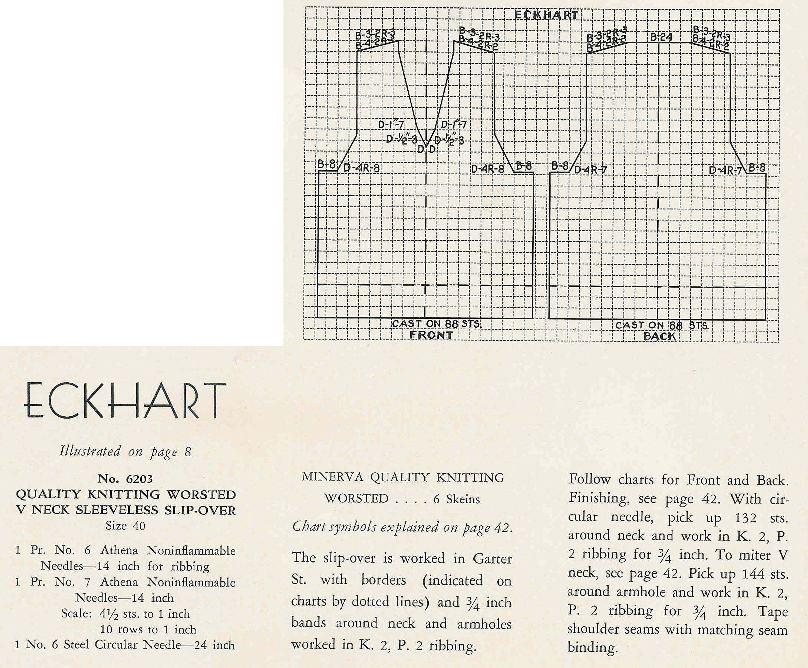
As promised, here’s a modern pattern for the thing in Size 46. To make life simpler for us all, I’ve used Sweater Wizard to construct it.
Man’s 1941 Style Vest in Garter Stitch, a Redaction from Minerva #46
(c) 2006, 2007, 2013 Kim Brody Salazar

Needles: 7, plus size 6 circs or DPNs for finishing armholes and neck ribbing. One stitch marker.
Gauge:4.5 sts10 rws per 1″ Estimated Ydg: 1212 yards standard worsted weight yarn with a native stockinette gauge of 5 stitches = 1 inch.
Back
With rib needle, cast on 102 sts. Estab rib pat on Row 1: *K2 , P2. Repeat from *. End K2 . Work 29 rws. On row 30, increase as below. [2.75″].
Rib-to-Body Inc Row
6 incs total done this way: Work 14 [inc 1 in next st, work 13, inc 1 in next st, work 14] 2x. [inc 1 in next st, work 14] 2x. (108 sts) With body needle, work in pat st until piece meas 14.5″[row 118].
Armhole Shaping
Bind off 6 sts at beg of next 2 rws. Dec 1 st each side, every other row 5x. Cont in pat st until piece meas 25.5″ from start [row 228].
Shape Shoulders and Back Neck
Bind off 7 sts beg of next row. At beg of next row, bind off 7 sts, work 14 sts, attach a second ball of yarn and bind off 42 back neck sts. Complete row. At beg of next row, bind off 7 sts and dec 1 st at each neck edge.Bind off 7 sts beg of next row. Bind off 7 sts beg of next 2 rws. End off.
Front
Work as for back, including all shaping,and, at the same time when piece meas 16.1″ [row 134]
Begin Neck Shaping
Work to center, attach another ball of yarn and complete row.Turn. Work both sides at once. Dec 1 st at each neck edge every 2nd rw 3x, then every 4th rw 19x. Cont in pat st until piece meas 25.5″ from start [row 228].
Shape Shoulders
Work shoulder shaping (at shoulder edge) to correspond with back.
Armhole Edging
Seam sides. Seam shoulders. With smaller size ndle, pick up 108 sts around armhole edge. Work in K2, P2 ribbing for five rows. Bind off loosely.
Neck Finishing
With smaller circular or dp needles and RS facing, pick up 48 sts from back neck, pick up 60 sts from left neck edge, place center marker, pick up 60 sts from right neck edge, place end of round marker. (168 sts).
Round 1, 3 and 5 – Work first round in K2, P2 rib until two stitch before the center marker. K2tog, slide marker to right hand needle. SSK, continue in K2, P2 ribbing taking care to match the sequence immediately after the centermost decreases to the sequence immediately before them.
Round 2 and 4 – Work in established pattern.
Bind off. Darn in all ends.
 String-Or-Nothing