VOYAGEURS HAT/LIBERTY CAP
I’ve promised a re-enactor pal a forager’s cap that he can wear at historical recreation bivouacs with his Revolutionary War era British regiment. He described it as being basically the same shape as a voyageur’s hat (the ancestor of the toque) or a liberty cap – a rather blunt stocking cap of medium length related somewhat to the Phrygian cap seen on some statues of Lady Liberty, and omnipresent in the French Revolution (but without a turned brim).
It’s tough to see from the various representations of similar hats in paintings and illustrations (mostly created long after-the-fact tiny thumbnails of behatted folk rowing boats, or running around in idealized depictions of famous battles), but I don’t think they had a modern ribbed type bottom edge like most of the contemporary knitting patterns show. Some look to have a sturdy split section that was turned up to make a sort of a bottom cuff (the Phrygian cap variants), others look to have plain edges. Some look like they’ve been fulled or made up from fulled yardage of some sort. Voyageur’s hats are usually described as being either red or blue. So are liberty caps. Some liberty caps bore mottoes either knitted in or embroidered on the bottom edge. And finally both hats are mentioned as sometimes, but not always having a large tassel on the end.
Throwing any attempt at historical accuracy beyond this cursory level of attention to the winds, I’ve taken a middle ground among all of these. I am making a blunt end slightly tapered stocking cap, long enough for the top to flap down to just below the brim when worn. The verdict is still out on the tassel thing. To recap, I’ve decided that instead of ribbing, I’m going to use a doubled ear band done with a self-facing and turning row of welting. And I’m going to knit an X into the brim (my friend’s regiment number). I am also going to use a hand-spun single that’s probably heavier and probably coarser than what would have been used back then, but is closer in spirit to a period yarn than is modern factory-made DK or worsted. I am somewhat limited in color choice. As I described before, my red is heathered with too much white for this purpose. Instead I’ve got a nice, strong tealed blue/green, with the X done in a mustardy gold.
So. Here’s what I have so far.

I ripped out what I had before because it was too big.
I began again on US #0s and did a better job of swatching. For my hat to fit snugly at my demonstrated gauge of 6.5 stitches = 1 inch on 2mm (US #0) needles, I cast on 130 stitches. I used a provisional cast-on and knit 32 rounds in stockinette. Then I purled two rounds, and knit another 7 rounds. At this point I was ready to begin my X. I adapted that letter from a graphed alphabet first published in the mid 1500s, but stretched it out a row to improve the proportions. Yes, this is wildly anachronistic, but the letter form was pleasing, and in keeping with type faces current in the mid 1700s. Then I worked my 18 row tall X in stranding. Sort of.
I’m knitting in the round here on two circs. I cheated. To do the first two rounds, I broke off a length of about 8 inches from my ball of gold yarn. Then starting in the center, I worked the first row of my X. I dropped the gold when I was done with that area and continued around. When I got to round two of the pattern, I used the second leg of my length of gold to finish it. I continued in this manner, using broken pieces for every two rows of my X chart.
When my X was done, I worked another 8 rows in stockinette. At that point when the brim was folded along the purl welt, the facing side was the same length as the X-bearing part. So I unzipped my provisional cast-on, and threaded those stitches onto a spare needle. I tidied up the X, and did a couple of anchoring stitches to keep the gold from wiggling loose and to make sure that the ends weren’t lumping up in one mass, but I didn’t bother doing a full darn-in/finish on them. They are after all going to be completely encapsulated in the double-thick hat brim. Holding the piece folded along the welt, on the next row I knit together one body stitch along with one stitch rescued from my provisional cast-on. When it was done I had my double-thick brim neatly finished, with no pesky ends of my X to peek through.
I’m now at the “make the thing longer until you can’t stand doing it any more” stage of lengthening the hat body. I’ve read several descriptions of how others have formed the top of their caps, plus other speculations. Since 130 isn’t a particularly convenient number for evenly staged decreases, I’ll be noodling out this part on the fly. Some descriptions of these hats opine that there is no taper at all, just a drawstring finish. But I don’t believe that the people who wrote that have ever knit. A drawstring on an untapered tube would not make the graceful shapes I see in the paintings, instead that finish would make something that looked like a gathered pants leg, with a bulby end.
I’ll keep posting here as I go along. Comments from anyone with real historical citations to either support or blast to shreds any supposition here are most welcome.
MORE HOLIDAY COOKING – PECAN SANDIES
As promised, here is the Pecan Sandies recipe I use. It’s a legacy from my Buffalo family – from hand-written notes shared by my mother-in-law Gail, originally attributed to her cousin. I’ve redacted the recipe a bit to add instructions (the original groups the ingredients in two units and says little more than mix the groups together, roll into balls and bake). This makes a boatload of cookies, with a yield about twice that of most typical cookie recipes. But then again, considering the large families common in Buffalo in the 1960s, I’m not surprised. I have to admit I’ve never counted exactly how many I get beyond “two boxes full” – probably something in the neighborhood of 6-8 dozen depending on cookie size.
A note on ingredients. I buy a bag of raw, unsalted pecan halves for this at Trader Joes. Then I set one of the kids to sorting the pecans. All the unbroken pretty halves go in one bowl. All the broken ones and pieces go in the second. I usually have enough bits and less attractive pieces to furnish the ground pecans needed in the recipe. The pretty halves are reserved as decoration. I usually have enough of those too. If need be, some cookies go bare. Finishing the cookies with pecan halves is another tinker I’ve done to the recipe. They were naked in the original.
Other notes: There is no need to sift the flour for this recipe. I use shortening for these rather than butter. Butter makes the cookies richer but much softer. I get a good baking rhythm going on these using two insulated baking sheets, two cooling racks, and four pieces of parchment. If you don’t want to use baking parchment, you can lightly grease the cookie sheets. But the parchment is worth the investment in ease in batch manipulation and clean-up, plus speed of production (no washing baking pans between batches). You can substitute store-bought ground pecan meal for the finely chopped pecans. Although I haven’t tried it, I suspect you can also make this cookie with almond meal and top with whole almonds, but then you’d have almond sandies…
Sue, I don’t know if we’ve ever met, but thank you for the cookies!
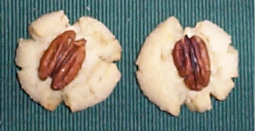
Sue Ralicki’s Pecan Sandies
Makes roughly 6-8 dozen depending on cookie size
Ingredients:
- 1 cup granulated sugar
- 1 cup confectioner’s sugar
- 1 cup shortening
- 1 cup vegetable oil
- 2 extra large eggs
- 1 tsp vanilla
- 4.5 cups all-purpose flour
- 1 tsp salt
- 1 tsp baking soda
- 1 tsp cream of tartar
- 1 cup finely chopped pecans, ground fine in a food processor
- More granulated sugar to roll cookies in prior to baking
- Pecan halves for garnish
Equipment needed:
- Two mixing bowls, one for the wet and one for the dry ingredients
- Flexible stirring spatula or mixing spoon
- Hand held mixer (or stand mixer if you’re lucky enough to have one)
- Food processor to grind nuts (alternate method – put them in a ziplock plastic bag and beat them into submission with a meat tenderizer mallet, rolling pin or other heavy object)
- A small bowl or plastic bag to hold the granulated sugar for coating the cookies
- At least one and preferably two flat baking sheets (not lipped jelly roll pans)
- At least one and preferably two racks on which to cool the cookies
- A tin, ziplock bag, or airtight box to store the finished cookies
In a large mixing bowl, using a hand mixer, beat together confectioners sugar, granulated sugar, shortening, and vegetable oil until completely blended. Add eggs and vanilla and beat to incorporate.
In a second bowl, mix together flour, salt, baking soda and cream of tartar. Pour these dry ingredients into sugar/shortening mixture, stir well to incorporate. Add finely chopped pecans and stir again to ensure everything is mixed together. Chill the dough for about an hour.
When ready to bake, preheat oven to 375-degrees. Form the dough into balls slightly smaller than a walnut. Roll the balls in granulated sugar to cover. Place them about two inches apart on a baking sheet lined with baking parchment (the cookies will puff up and spread a bit). If you are garnishing each cookie with pecan halves, dip the nut halves in water and press firmly on top of the sugared dough balls on the cookie sheet to make them stick. The balls may crack a bit around the edge. That’s expected.
Bake cookies at 375-degrees for 10-12 minutes until lightly browned. Slide the cookie-laden parchment sheet onto a rack to cool. Cookies can be stacked in an open box once partially cool, and the parchment sheet can be re-used for a subsequent batch. Once fully cool, store in an airtight box or cookie tin.
HACKING THE HOLIDAYS
Not much knitting here beyond finishing up the gift socks mentioned yesterday, which later today will be given to the target recipient. I also posted a yarn review for the Schoeller/Stahl sock yarn I used.

(Please consider leaving reviews of your current yarn yourself, as a holiday present to fellow knitters worldwide).
I can in the spirit of ecumenicism born of our happy, culturally jumbled household recommend two non-knitting related holiday hacks.
First for Hanukkah (and Kwanzaa): Every kid is fascinated by the candles used in menorahs and other holiday candle holders. They burn quickly, and often being close together, act on each other to make strange melting patterns and drips – especially when “encouraged” by the viewer. And every kid who grew up with a menorah in the house will either admit to performing said encouragements, or by virtue of being watched constantly, not having the chance to do what he or she really wanted to do. But not every parent can hover over the candles for the entire time they are lit for eight nights straight.
Now devices are no substitute for parental supervision, but accidents happen in even the most careful household. Place your menorah on a shallow lipped pan (like an inexpensive jellyroll pan or in my case – the liner pan that came with a now defunct toaster oven) and fill the pan with about a quarter inch of water. Drips will fall into the water, and won’t weld the menorah to the table or counter top. Should your offspring be too helpful and a candle come loose from its moorings – it will fall harmlessly into your mini-reflecting pool and be extinguished.
Second for Christmas trees: Fighting one’s way underneath the lower branches to water the thing is a major pain. I cheat. I float some packing peanuts or crumpled aluminum foil on top of the water so I can see the level while still standing. I also take a tube or pipe (in this house, the unobtrusive brown extension tubes from our upright vacuum cleaner) and wedge them into the tree holder’s bucket area. I use some twist-ties to anchor the tube against a branch. The tube remains there as long as the tree is in the house. Then when watering time comes, I take a watering can and pour into the tube until I see my floating markers rise. No bending, no needles in my hair, no overflows.
PEARLS AND PURLS (BUT NO SWINE)
We celebrated Hanukkah this weekend past in our own style. Fried foods are traditional. We did crab cakes. Not traditional by a long shot, but tasty none the less.
The Resident Male, finding himself at the fish shop buying the crab was tempted by some beautiful Bluepoint oysters. So he brought home four as a special grownups-only treat.
So there we were, happily slurping down our excellent oysters, when I thought I found a bit of shell. Not uncommon in oysters opened by amateurs*. But it wasn’t shell.
It was a pearl.
A natural pearl. Far from gem grade, but round and pearly enough to qualify, even though you can see a bit of the gravel that inspired it sticking out from one end.
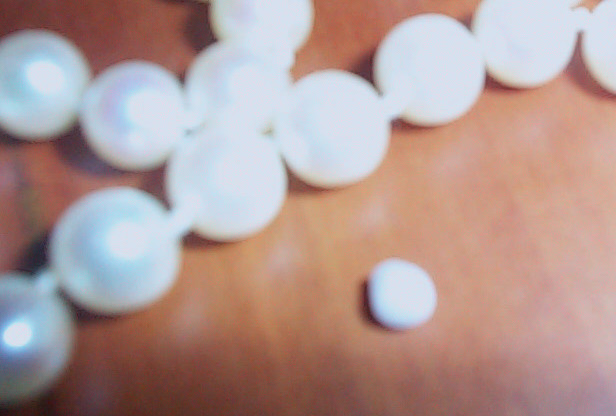
I’ve put my tiny pearl next to a strand of cultured pearls for size comparison. I’ve joked about finding a pearl, and have known it was remotely possible. But I’d never heard of anyone actually finding one. So what to do with my inferior but extremely lucky pearl? Wear it for luck, of course. I’m thinking of getting a tiny silver charm in the shape of a cage to keep it in.
And I’ll probably make the traditional latkes tonight.
As far as knitting goes, I’m trying to zip through the remainder of a pair of socks, plus get a start on the foraging cap (in the style of a Liberty or voyageur’s cap) for my re-enactor friend. I’ve got a nice hand-spun wool fingering weight single, in a color sort of between forest and teal, with a touch of black. I would have preferred a barn red, but the red I had was heathered with too much white and from a distance read “pink.” Shown here are my larval beginnings (I’m working on the area that when finished will be the facing in the earband, plus the too-pink yarn. Gauge here is between 5.75 and 6 stitches per inch. I’ve got 130 on the needles, and am getting a band big enough to fit a 23″ circumference head. There’s some allowance for stretch and the hat will be double thick at the earband, but I don’t want to make it so tight that the wearer will get a headache. You can see just a bit of provisional cast-on peeking out at the bottom of that dark green wiggle:

Other than that, I am finishing up yet another pair of gift socks. This one from Schoeller+Stahl Fortissma Colori/Socka Color, color #5.

* We follow the safer Julia Child oyster method (learned while watching her on TV). It involves identifying the hinge and using the pointy end of a bottle opener to dislocate it. Then using a thin, sharp knife – winkling it into the opening made by the unhinging and running it around the oyster inside to scrape it top and bottom from its shell.
YES, THERE REALLY ARE TEN KINDS OF COOKIES
In fact, this year, there are eleven plus fudge. I offer up ocular proof, plus a round-up of baking notes:

Starting from the top left and reading each row across
Row 1:
- Semisweet chocolate/pecan fudge
- Lemon cutouts with ginger glaze. Cut-outs painted by the kids. Ginger glaze new this year
- My first attempt at biscotti (not entirely successful). Dried cherries soaked in Armagnac and almonds
Row 2:
- Cocoa rum balls
- Classic peanut butter cookies
- Oysters (this year in heart shape). Toasted hazelnut spritz with bittersweet chocolate filling
Row 3:
- Green (and minty) tree-shaped spritz
- Pecan sandies
- Lime cookies with lemon sugar dusting (new this year)
Row 4:
- Classic chocolate chip cookies
- Earthquakes (my kids’ name for chocolate crinkles – soft, moist, and very chocolaty
- Linzer cookies – lightly spiced cut-outs with seedless raspberry jam filling
I’ve linked to or highlighted the source of most recipes. Here are some notes:
Fudge – Absolutely the easiest thing to make if you’ve got a microwave and a microwave safe bowl. We make it last to use up any leftover nuts (and because more than half this household is made up of chocolate fiends). Have a significant other who is mad for chocolate? Impress her/him with this even if your cooking skill so far is limited to opening a jar of peanut butter.
Lemon cutouts with ginger glaze – I start with the basic sugar cut out recipe in Joy, but add lemon zest. I usually frost these with confectioners sugar to which I add lemon juice until it’s paint consistency plus colors. This year since I had another cookie that ended up being more lemon than lime, so I went looking for a flavor we hadn’t done yet in this year’s cookie crop. I thinned the confectioners sugar with ginger juice (grate a thumb-sized piece of ginger onto a paper towel, then squeeze tightly to extract the juice). Wow. A do-again to be sure!
Biscotti – This piece looks good, and they taste wonderful. But I added whole toasted almonds plus the cherries, and the dough proved too crumbly to make many pretty pieces. But we’ll enjoy eating the crumbles! I’ll keep hunting for a better biscotti-with-stuff-in-it recipe.
Rum balls – This year we did the classic cocoa/vanilla wafers/pecans one. I’ve tried other combos but I like it the best. This is another no-bake cookie that’s difficult to mess up, provided you make it at least a week before you serve it so that the flavors mellow.
Classic peanut butter cookies – In this house we use chunky peanut butter. Heresy, but heresy with more texture.
Oysters – I’ve gone on about these before. They’re one of the three “must haves” along with peanut butter, and chocolate chip.
Green mint trees – I got a last minute call from one of my third-grader’s “room moms” alerting me to a party this week and requesting cookies with no nuts in them. While anything produced in my kitchen won’t pass muster for a nut allergic kid, there are no allergies in the class. So I made plain spritz trees, starting with the recipe in Joy of Cooking, adding a touch of mint flavoring and the lurid color. It’s not as forgiving a spritz recipe as my own Oyster one, and the tree shape isn’t one of the more reliable dies, but we got a batch done that will (in its entirety) go to school on Monday, leaving no memories behind other than a lingering ghoulishly green shadow on my fingernails.
Pecan Sandies – A family recipe. I’ll share this one in its entirety later this week. My variation on the thing is to add the half-pecan to the top before baking. An easy and tasty cookie from a recipe with a huge yield.
Lime cookies – I started with the King Arthur recipe, but could not find sour salt (citric acid) locally – my favorite baking supply source having closed forever last month. Horrors. Instead I improvised. Lemonheads candy is mostly sugar and citric acid. So I ground up a bag into a powder, and used it to dust the cookies. It worked extremely well – nice and lemony tart. But it did overwhelm the lime-nature of the cookie itself, and I find that the lemonheads dust is more of a humectant than is plain powdered sugar. The cookies need to be stored with air circulation, otherwise they get sticky and lump together. (I’ll probably roll them one last time in plain powered sugar before sending them on their way).
Classic chocolate chips – the recipe on the back of the Tollhouse bag, although (another heresy) – I use Ghiardelli semisweet chips instead because I like them better.
Earthquakes – I was introduced to these the year before last by a good pal (Hi, Kathryn!) I’m not using the recipe she sent to me, mostly because I know it’s filed here on my desk and saved securely (it was VERY important that I do so). Unfortunately, it’s saved so securely that I can’t find it and am too ashamed to admit it. So I went looking for something equivalent to the one she sent me. This one is pretty good, but hers was better.
Linzer cookies – Nope, you don’t need a fancy set to make these. The set makes it easier and the cookies prettier, but it’s not necessary. I happened to have a fluted circle cutter on hand, and a mini leaf cutter. But you could use a water glass to cut the big circle and a top from a screw bottle of water or soda to make the smaller window. This dough is pretty easy to handle for a roll-out. And the taste is fabulous. More work than most, but according to the Resident Male – worth the effort.
Later this week – ultimate holiday luck, the sandies recipe, plus some actual knitting content.
LEAVES AND COTTON SOCKS
As promised, here’s my knitting progress. First, the leaf pullover:
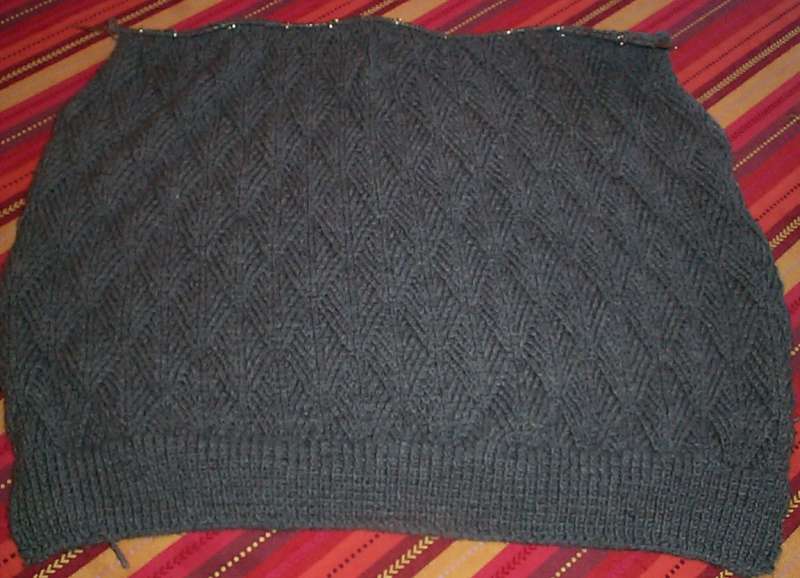
As you can barely see, I’m now well past the underarm narrowing, about half-way from that point to the beginning of the neckline. It’s still very slow going because of all the 1×1 twists, but I’m very pleased with the effect, in spite of the thing being a bit off gauge and an inch too wide (I like loose fitting sweaters in mid-winter). Although I’m mired in holiday gift knitting right now I’m making a point of NOT putting this down in its entirety. I want to avoid what I now (thanks to blogging) see as a familiar pattern – the sidelining of my October/November project due to gifts leading to its eventual consignment to my Chest of Knitting Horrors ™.
And in gift knitting, here is a mostly done sock worked in a combo of black Cascade Fixation and raspberry Elann Sock it To Me Collection Esprit. Both yarns are 98.3% cotton, 1.7% elastic. Both are marked with the same yardage (186 yards stretched or 100 yards relaxed), and same gauge 25st and 40 rows = 4 inches or 10 cm. Fixation also carries a crochet gauge of 29 double crochets and 12 rows = 4 inches or 10 cm. As far as I can tell, they look like exactly the same yarn. While the yarn review collection reports Fixation as a worsted based on its initially reported gauge, current labeling moves it down to the sport yarn realm in line with Esprit’s labeling. I say neither is spot on, and would call both yarns DKs.
My own gauge using 3mm needles at a reasonable sock gauge is 6.5 stitches and 12 rows = 1 inch. The fabric is markedly stretchy, even more so than a comparable weight wool yarn knit at the same tight gauge. Now I know many people who have reason to avoid wool socks swear by this stuff, but I’m less enchanted. I selected it because I am knitting socks for someone who is both wool sensitive and diabetic, who requested very stretchy cotton socks with a specific wide ankle measurement in comparison to the foot area. I am working my standard toe-up sock on a foot circumference of 48 stitches, moving up to 52 stitches just prior to the short rowed heel, and then 54 stitches immediately after. I add another four stitches at the uppermost black stripe for an ankle part stitch count of 60 stitches. Based on progress so far I predict I’ll use one ball of raspberry on each sock, plus most of one ball of black between the two. I bought 4 raspberry and two black, so I’ll have enough left over to make another pair, should I so desire.
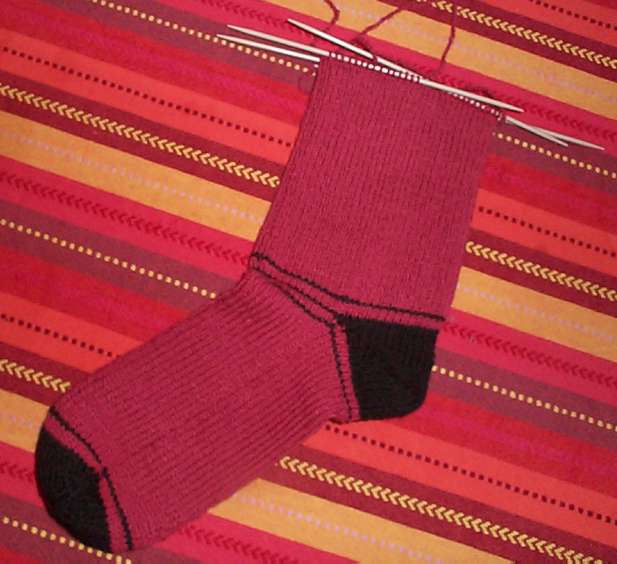
But I’m not sure I so desire. Although this sock is suitably uber-stretchy, and the cotton yarn is relatively lofty, I don’t like the feel of cotton socks for myself. I find them cold and hard compared to wool, and walking in them feels like walking in a massage sandal studded with thousands of little pebbles. But I don’t have problems with wool. If you do, this yarn is an acceptable substitute, although at its weight you’re going to end up with nice, thick hiking socks, not fingering weight socks that are wearable in a wider range of shoes.
I was also disappointed in the color of the raspberry bought via the Web from Elann. Standard cautions on buying based on color displayed on a computer monitor apply. Remember – no color monitor displays true color fidelity, and lighting conditions at the photographer’s end can add complications (to demonstrate this, call up different photos of the same color card at multiple retailers’ websites, and/or view the exact same color card photo on different monitors). On line the stuff looked much deeper, almost wine in hue (which was the color requested by the recipient). In person the raspberry is closer to an unexciting mauve. Color fidelity is another reason I vastly prefer to buy yarn in person rather than by mail order. Color cards help, but since I have so many excellent local yarn source options, and am always looking for new yarns rather than repeaters, I do not buy by mail often enough to invest in them.
My next bit of gift knitting will be a wool foraging cap for a historical re-enactor friend. It’s mid to late 1700s or so in target, and will be based on Voyageur’s Caps and Liberty Caps. I’ll take notes as I create that hat in case the thing catches on with his re-enactor regiment. Second cotton sock will probably take me through Thursday or Friday, so I won’t be beginning his hat until later this week.
HALF BAKED HOLIDAYS REDUX
If you’ve been reading along here for a while, you might remember I’ve mentioned this family’s holiday cookie fixation before. Ten kinds. Every year. (I do give most away to co-workers and friends rather than let us eat them all ourselves). This year’s list is a mix of first time experiments and family favorites. It includes:
- Chocolate chip cookies – the classic, but made with mini chips and pecans instead of walnuts, slightly smaller than their non-holiday brothers. Mostly from the official Toll House recipe printed each year on the bag of chips (although I do cheat and use non-official chocolate).
- Peanut butter cookies – my kids would shudder in horror if I left these off the list. Done with crunchy peanut butter, just for fun. Otherwise it’s the standard from Joy of Cooking
- Buffalo rum balls – a version of the classic crushed cookie bourbon ball, but done with rum and cocoa, rolled in cocoa. Our variation comes from a recipe published in the Buffalo, NY evening newspaper some time in the 1960s
- Sugar cut-outs – the iconic holiday cookie. This year we get to use the Hannukah cookie cutters. Also I put lemon zest in the batter, and mix the icing with lemon juice instead of milk or water
- Oysters – a family invention. A hazelnut spritz sandwich cookie, filled with dark chocolate ganache
- Linzer cookies – New this year, from the King Arthur website recipe collection. Mine have little leaf shaped holes, that being the smallest cookie cutter I had on hand to do the center hole.
- Chocolate crinkles – Also from the King Arthur website. Killer chocolate flavor, fantastic texture. We use extra cocoa instead of espresso powder. My kids call these “Earthquakes” because the white sugar outside flaws and cracks in baking to reveal chocolate fault lines. I made these the first time two years ago from a very similar recipe sent by a friend and they’ve become favorites. (Hi, Kathryn!)
- Almond/cherry biscotti – Another new one. I’m cribbing this recipe together from several sources, including a basic biscotti recipe in the always wonderful Baking with Julia book. This is instead of the Panforte which although excellent deserves a break after a two years running appearance
- Lime cookies – Again a new experiment. This one depends on my finding sour salt (citric acid) locally. My grandmother used it to make her stuffed cabbage and to restore the shine to aluminum pots and pans (boiling them in a bath of water and sour salt). Another King Arthur website find.
- Pecan sandies – A family recipe, basically a nut-rich shortbread, rolled in granulated sugar and topped with a pecan half. These tend to alternate appearances with Mexican Wedding Cakes in our roster, as both are pecan shortbread type cookies.
I made a lot of progress this weekend past. I’ve got two cookies left to bake – the biscotti and the lime cookies. Plus I have to fill the oysters and Linzer cookies, and the kids get to ice the cut outs.
In other news, knitting did get done. Here you see the second of my two emergency baby shower gifts blocking on a balloon. The Regia 6-ply Crazy Colors has a relatively long repeat, so it makes wide stripes on both booties and hat. The white sections and broad yellow welting (including the tips of the I-cord bootie laces and hat bow) however are done in another well-aged leftover.

I also managed to get another couple of inches done on my ribbed leaf pullover, and complete about half a sock of other holiday gift knitting. But more on those tomorrow.
FRANKLIN’S GHOST OF CHRISTMAST KNITTING
I’m with Franklin all the way on this. I’ve been visited by his Ghost of Christmas Knitting, but that specter couldn’t force his way into the room, crowded as it already was by the Ghost of Hastily Announced Baby Shower Knitting, the Ghost of Birthdays Come and Gone Knitting, and the amorphous yet omnipresent-in-December Ghost of Holiday Preparations. The whole spooky committee then voted and consigned me to wherever procrastinators end up, when they remember that they have to be somewhere.
But tamales, cookies (cocoa rum balls and peanut butters both done and lagered away), work, and routine family support tasks aside, I did manage to whack into the baby shower backlog. Which is a good thing because today is the first of several.

The white with speckles hat and white booties are knit in Sirdar Snuggly Snowflake DK. I believe it’s now discontinued, but these are leftovers from a Oat Couture Curlique Coverlet done about six years ago for a niece. It’s a spectacular pattern and I had a great time with the blanket, although (like everything else) I did play with it a bit. It’s difficult to see in the official cover photo, but the thing is a round blanket, knit in garter stitch paisley-type slices, with the shaping formed by short rows and picking up along an edge. I wouldn’t quite call it modular knitting, but if you’re familiar with that style, this blanket will be easier for you than for someone who has never done short-rowing before. What I did was notice that the pattern had a logic that would enable the use of two colors. I knit all of the segments radiating from the center in a white-with-speckles Snowflake, and all of the other segments in plain white Snowflake. What I ended up with was subtle, but effective – a center swirled star with speckles surrounded by a plain white field.
One caveat – because I used the loopy Snowflake, my final texture was sort of reminiscent of a supple light terry cloth towel, with less distinct garter ridges than the pattern’s own photo. I wish I had pictures of that blanket to share, but I made it BS (Before String), and never got a snap back of the target baby with her present. I’d do the blanket again but not in this yarn. In any case, Snowflake worked just fine for my no-pattern hat and standard issue booties, although again, I’ve played with the pattern. I did the Ann Kreckel baby bootie, but because this is DK weight, I worked it on a sole of 8 stitches x 16 rows, and adjusted the rest of the pattern accordingly.
The multicolor hat is knit in other stash-dwelling odds and ends. The multi part is clearly Regia Crazy Color, left over from the Crazy Raglan I made for Smallest Daughter. The solid white and yellow used on the welting and stockinette edge are ancient bits of Baruffa/Lane Borgosesia 7 Settembre DK, shamelessly stolen from my mother’s stash. Both colors are remnants of a project she did around 1993 or so. 7 Settembre was a particularly nice machine wash textbook-standard DK weight 100% wool that came in a wide range of colors, including brights; now long since discontinued. There will be booties to accompany this no-pattern hat, too.
Moral of today’s post – Those half-ball or less odds and ends left over after a project come in handy if you need to do up a quick, small gift; don’t throw them away! Think of it as bonus investment in future gifts. Oh, and that holiday knitting thing? Boo, humbug! There are still 9 knitting days to Hanukkah (which thankfully lasts until the 23rd), and 18 knitting days until Christmas.
DAY OF THE TAMALE – A DIGRESSION FROM KNITTING
Well, three days of the tamale, to be exact.
A good friend of ours hosts a themed Christmas dinner every year. It started out as a “cats and dogs” gathering decades ago, when those who weren’t migrating home elsewhere for the holiday pooled resources and cheer. Over the years it has become a second-family type event, deeply enjoyed by all.
This year’s theme (announced last year) is Mexican food. And in a moment of ebullience and generosity some time after my third egg nog last year, I promised to make tamales for the 2006 crowd. Since tamales freeze well, I decided to do them this weekend. That way should the batch prove unsuccessful, I’d have plenty of time to recover.
Living here in Massachusetts, finding the ingredients can be a challenge. I’ve been collecting corn husks for a couple of years now, buying a bag when I can find them. Fresh peppers, or at least a small selection thereof, can be found here now. Dried peppers are tougher although in some neighborhoods they can be found, too. My own stock is hand-imported from New Mexico and Arizona, either by me during business trips, or through the kindness of another good friend in Albuquerque. And masa flour I can get locally in the local natural/organic food supermarket, or in the same neighborhoods where decent peppers can be found.
So this weekend I spent pretty much in the kitchen. Saturday was cooking the meat filling – in my case pork. Sunday was making the flour, stuffing the tamales and steaming them. And Monday after dinner was assembling and steaming the last few that I ran out of time to complete on Sunday.
I don’t claim to be an expert in making these (I am after all, a nice Jewish girl from Brooklyn, and Mexican only by marriage). My experience is largely a matter of reverse engineering, trying to make tamales that look, feel, and most of all – taste – as close as possible to the ones my father-in-law’s family sends to him. I’m narrowing in on the optimal product now, but I still have a few tricks to learn. Still, these do come out better than any I have had in any Mexican restaurant this side of the Mississippi. So as a mutant multicultural Hannukah/Christmas/Solstice/New Year’s present I share the recipe here.
Please note that these tamales are one of the 365 things you should only eat once per year. Luckily the amount of labor involved limits their appearance to special occasions. This recipe makes enough for a large party or family gathering (recommended), or at 4-5 per serving, enough to freeze for several months of tamale-accompanied meals (see caution on those 365 things).
One Gringa’s Tamales
Makes about 150-165
Special equipment: A huge mixing bowl. A large steamer pot (big aluminum Chinese steamers, large spaghetti pots with steamer inserts, lobster or crab pots with a colander inside all work). Optional: An electric mixer, an immersion blender. One or more helpers for husk-washing and tamale assembly (this is A LOT of hand work for one person)
Meat filling
-
6 pounds of pork shoulder or another fatty, stringy cut, hacked into roughly inch thick slices and gobbets. Plus any bones and skin.
-
About a dozen assorted fresh hot peppers of various types (Fresnos, Serranos, Tepins, yellows, Mirabels, Jalapenos, Mirasols, Cayennes, I use a mix of anything I can find – except habaneros which can overwhelm the dish)
-
About 10 dried New Mexico dried chile pepper pods (use dried California Anaheim peppers if you can’t find the slightly more flavorful and hotter New Mexican ones)
-
About 15-25 other hotter dried peppers (tiny pequins, cascabels, or arbols, again whatever I can find)
-
2 medium or one large onion, finely chopped
-
6 cloves of garlic
-
1 Tbs salt
-
1 can of beer (or equivalent in water)
-
More water to cover
-
1.5-2 tsp dried cumin (comino)
-
2 tsp dried oregano
Day 1: Clean and de-seed dried peppers, soak in beer to rehydrate for at least a half hour. Char and peel fresh peppers. The delicate might want to wear gloves for both of these operations. Finely chop fresh peppers. Crush or mince garlic. Mince or chop rehydrated peppers, saving juice (I cheat by sticking an immersion blender into my beer or water plus peppers and turning the whole thing into a slurry). Toss meat and bones in large stew pot along with all other ingredients, add water just to cover. Simmer for at least two hours, preferably until mean is falling apart, and all the vegetables have denatured into the broth. Taste if you’re brave. The meat should be quite hot because it’s the primary flavoring in the tamale, but is used quite sparingly. Set aside to cool, preferably overnight in the fridge. If you’ve used skin-on shoulder, the broth will set up as gelatin in the fridge. That’s good.
Day 2: The fastidious might want to skim the fat off the top of the cooked meat. I will say as shocking as it sounds – don’t bother. The biggest enemy of tamales is dryness. This is a recipe that I’d rather have full fat once a year, than as a reduced fat shadow of its true self. While the meat is still cool, remove it from the pan (keep the jelled juice and fat – don’t wash the pot yet). Using two forks, shred the meat into strings. Use this opportunity to remove bones and any tough bits. Return meat to the pot and heat it just enough to melt the thickened juice. Pour off as much as is convenient. You’ll probably have between 2 and 4 cups of liquid inclusive of both broth and fat. The meat should be moist, but not dripping. Reserve the liquid and set the meat aside. Fridge both until you assemble the tamales.
Dough and Assembly
-
One 5-lb bag of Masa Harina instant corn flour (to be accurate, the bags are actually 4.4 pounds, I make up the difference from the cupboard)
-
1 pound of lard. Yes lard. This actually makes a tastier and less greasy tamale than the equivalent in vegetable shortening.
-
1 cup of Crisco shortening (reduce this by half if you are only using one 4.5 pound bag of masa). I use this only because I rarely use lard, and I don’t want to buy a second pound and have the remainder sit around forever.
-
2 Tbs salt
-
The reserved liquid from the meat
-
Water or broth. You’ll probably need between 4 and 6 additional cups of liquid, depending on how much you got from your meat and how dry your masa mix is.
-
2 bags dried corn husks
Start by immersing the corn husks in a pot of warm water to cover (you’ll need to weight them down with another pot on top to keep them submerged). Soak for at least two hours. They will almost certainly be a bit dirty, with clumps of dried corn silk in the centers of each bundle. Separate the husk leaves gently, taking care not to split them. Rinse well under running water. Stack them between dishtowels as you clean them. They need to be moist and pliable but not dripping wet when the tamales are assembled.
In a huge bowl (and I mean huge) using an electric mixer, beat the lard and shortening until soft and uniformly creamy. Add all masa and salt and mix by hand until all the fat is incorporated. The dough will look crumbly at this point. Add the liquid from meat – broth, fat and all. Knead to incorporate. Continue adding water (or broth) and kneading by hand until the mixture is just a bit softer than PlayDoh in consistency, sort of like a very stiff peanut butter.
By now your meat should be cool (it’s easier to handle cold). Your corn husks should be softened and clean. Your dough should be ready. It’s time to assemble. Assembly is where my lack of skill really shows. The tamales I’ve had made by my Mexican inlaws’ families are not fat and floppy masa cakes with an open end, like the packaged ones found at Trader Joes supermarkets. Instead they are stogie-thin, with both ends of the husk neatly tucked away to completely encase the filling. I’ve never managed to figure out that second end tuck, so I use a small tie to secure each tamale.
Start by taking roughly a cigar-sized lump of masa and squishing or spreading it onto one of the larger corn husks. Aim for an area slightly right of the center line. You want to make a patch about the width of a pack of playing cards that extends from about an inch from the pointy end of the husk to within about an inch of the wide end, and that is about a quarter inch thick.

Using a fork lay a thin stripe of meat mix down the center of the masa – depending on the size of the corn husk, this can be about a teaspoon or two. Remember – most of the hotness in this recipe is in the meat. The more meat, the hotter the tamale is. Even the hottest meat can be tamed by upping the masa:meat ratio.

Begin rolling the husk and masa tightly to encase the meat.
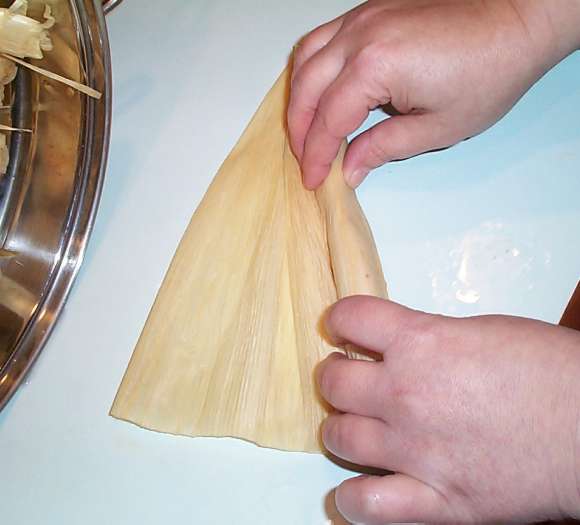
When you’ve got it mostly enclosed, stop rolling and fold the pointy end of the husk in over the growing roll.
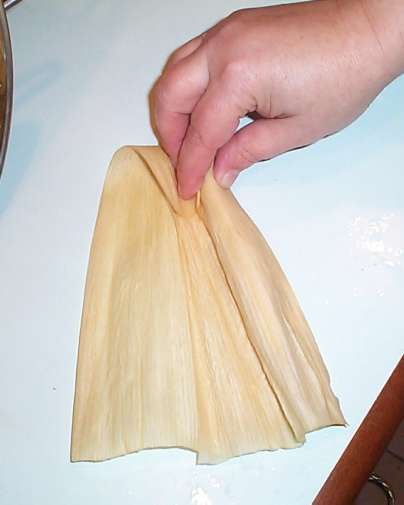
Continue rolling to make a little log with one end tucked neatly away. Now take one of the substandard corn husks (there will be some too shredded or narrow to be useful). Rip off a thin strip and use it to tie the open end securely closed.
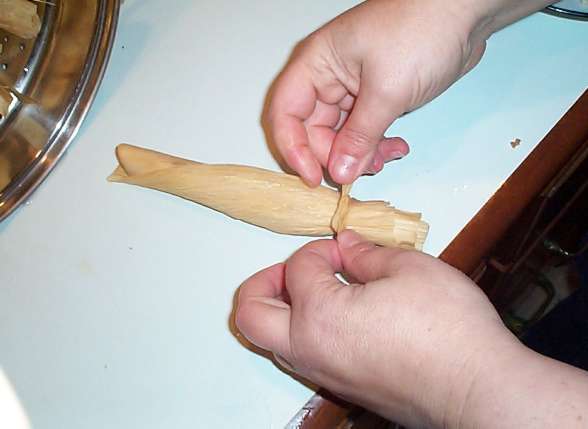
Put all your tamales into a the upper part of a steamer pot with the folded side down. They should be packed tightly enough to stay upright, but not so tightly that they don’t wobble a bit (otherwise they will take longer to steam).

Set the tamales to steam for about two hours. At the end of two hours pull a sacrificial tamale from the center of the batch. Unwrap it. If it’s done the filling will be moist but not sticky, and will separate cleanly from the husk. For the record, my large spaghetti pot/steamer basket can hold about 40 tamales at a time. I steam them as I complete them, and did three batches on Sunday and one Monday night. Unsteamed tamales should be returned to the fridge if they have to wait their turn to be steamed. Cooked tamales should be packed into zip-lock plastic bags or plastic containers and frozen as soon as they are cool enough to handle. It’s worth the time to freeze them in meal-sized units rather than all together.
To serve tamales, I thaw them quickly in the microwave or using a steamer. You can serve them just like that. But best of all once they have been thawed is to finish them by baking them in the oven until the husks are dry, or tossing them into a dry skillet or on a griddle to the same ends. Serve as an accompaniment with any Mexican meal, or as a snack or appetizer. Salsa Verde or any other condiment you wish can round out tamales to make a meal.
Enjoy!
STUPID I-CORD (AND EDGING) TRICKS, PART II
A quickie today.
There have been a few times when I’ve wanted to work I-cord (or a knit edging) onto the perimeter of something, completely encircling it, and ending up by grafting the final live stitches onto the original cast-on row with the hope of creating as near seamless a join as possible. Here’s an example:

To date when I’ve needed to do this, I’ve either knit several rows extra of the I-cord “free” prior to beginning to apply it to the edging, or I’ve used a provisional cast-on with waste yarn for wider knit trims. Working several rows of extra I-cord gives me a snip zone I can cut and then ravel back to produce the cast-on edge live loops I need for grafting. I suppose for narrow trims, I could do a similar thing – knitting several rows of plain garter or stockinette prior to beginning simultaneous application to the thing being trimmed and commencement of my trim pattern. A judicious snip and ravel back will reveal those live loops just as nicely as working sacrificial to-be-cut I-cord does.
But I had a “doh!” moment last night. Why not just cast those few first stitches directly onto a large safety pin or small stitch holder? Unclasp, transfer stitches onto a live needle, and go! To do this, I’d use the simplest of provisional cast-ons, starting out by holding my strand behind my stitch holder and picking one stitch up knitwise, then I’d shunt the yarn to the front of the holder and with my needle tip in back of it, pick up one stitch purlwise, and so on.
Here are seven stitches picked up on a stitch holder:

It looks kind of like the figure-8 cast-on I favor for toe-up socks:

EXCEPT that by picking up the stitches instead of winding the yarn around the needles I’ve managed to mount every other stitch with the leading leg in back. Not a problem. I’d work one corrective row of purls back before beginning my edging, and on that row, I’d purl into that back leading leg to eliminate any inadvertently twisted stitches. Or I could reverse the direction of the stitch holder and wind the yarn on exactly the same way as I do for my fig-8 cast-on, eliminating the problem entirely.
 String-Or-Nothing