ANOTHER INNOCENCE LOST
More reposts. Material originally appearing on 18 June 2004.
ANOTHER INNOCENCE LOST
I can truly say that I’ve had a new experience this week. One that now ranks in my all-time top ten list of nasty things to do.
Removing fiberglass insulation from a crawl space on a hot summer day.
There’s a reason why they call it a crawl space. There’s nothing like doing physical work in a dimly lit baking hot, confined cubbyhole; wearing a hooded long-sleeve sweatshirt, fogged goggles on top of fogged glasses; with dust in the air so thick you can feel it working its way through the fabric of your clothes, and a respirator mask that would better be called an asphyxiation mask.
I’ve finished three of eight cubbyholes. That leaves five plus the attic proper to go. It would be faster except the misguided SOB that installed this stuff insisted on tamping all of the roof soffits full in addition to just tacking the batts to the underside of the rafters. That has to be fished out by reaching down as far as one can into filthy, inky blackness, and grabbing whatever can be found. Insulation, mummified dead birds, whatever…
Then there’s the joy of schlepping mounds of shredded, moldy, irritating fuzz down two flights of stairs and into the dumpster – one armload at a time because anything larger won’t fit through the house’s hallways. If only I could have rented a debris chute, too.
All this is to explain why absolutely no knitting went on in my life yesterday, so there is nothing for me to report on the filet lace project.
Did you know that if enough fiberglass gets into one’s ears, even they itch?
FILET KNITTING
More reposts. Material originally appearing on 17 June 2004.
FILET KNITTING
More reports on the great filet experiment.
First, thank you to Gayle Roehm, Judy Gibson and BJ Knitslikecrazy. Gail and Judy sent me info on a method shown in a Burda Magazine. Burda’s instructions were for a set of curtains in a cyclamen pattern. They offered up the pattern graphed like any standard filet crochet or darned net design, and in prose gave directions on forming both filled and open squares. Gayle sent a photo of her project knit from those directions:

Burda’s method takes four rows to complete a tier from the graphed chart. On the first row, spaces are formed by a YO, K2tog unit. On the second row (the purl side) the K2tog is purled, YO is slipped, and another YO is made. On the third row (knit side again), both YOs are slipped and another is made then the purl is knit. On the fourth row each space starts with a P1, and then the three YOs are purled together. That makes a mesh with heavier verticals than horizontals, but the mesh is more or less square. Not as delicate as filet crochet (which in turn is not as delicate as the darned net or withdrawn thread family of embroidery techniques). Here is Gayle’s note – reprinted with her permission:
A couple of years, I too had a bee in my bonnet about knitting that
looks like filet crochet, and I tried three methods:a) Burda method. I actually knit the cyclamen panel — a partial scan is
attached. Comments follow.
b) Mary Thomas method.
c) Sandy Terp method.None were quite satisfactory, though all work but only sort-of. The
problem is that you don’t get the nice squares and open holes that you
get with 3 dc, 3 chain. The solids are okay, but the holes and bars are
distorted.The Burda method is stockinette-based. From the scan, you see right away
that (a) the holes are still round, and smaller than the closed squares;
and (b) the vertical “lines” are thicker than the horizontal “lines,”
making the squares even harder to see. I think each square of the chart
accounted for two rows.The Terp method, which is garter-based, was only a little better. The
holes were marginally squarer, but the vertical lines are still thicker
— perhaps inevitable because you have to do a k2tog or k3tog. And one
square was (as best I recall, but I’m probably wrong) three or four rows
— slow. If you don’t have Sandy Terp’s method at hand, I think she has
it on her website somewhere, or written up in a leaflet. <snip>
The Mary Thomas method was also unsatisfactory for reasons similar to
Terp — the details escape me.
BJ Knitslikecrazy sent in mention of a style of filet knitting in a needlework technique omnibus called Stitch Wise. The description she sent sounds a lot like the Thomas method – with 3 stitch by 4 row units, with two half-height open spaces stacked to balance the solid knitted squares.
Here’s my swatch. The bottom several rows of garter stitch and bars is the Thomas method. The top checkerboard is my method:
As you can see, the Thomas method first few rows is interesting, and can be done following a graphed chart, but it just doesn’t have the filet look.

The upper part is my stab at doing it differently. Some of the vertical bars in the lower part are sloppy because I was experimenting with several methods of making them. I’m not entirely pleased with the later methods, but progress is being made. In the Kim-method, two rows make one tier of the graph.
Solid squares are formed this way on the first pass (knit side):
K3, turn
P3, turn
K3
On the returning purl row, all of these stitches are purled.
Note that groups of solid blocks can be ganged together. If for example, if the chart shows three solid squares in a row, the knitter would do this: K9, turn; p9, turn; K9.
Spaces are formed this way on the knit side pass:
(YO)3x. Retain 3 loops on needle.
Slip one stitch as if to knit. Slip the next stitch as if to knit. Pass the first slipped stitch over the second and off the end of the needle (sort of a no-knit bind-off).
Slip one stitch as if to knit. Pass the previously slipped stitch over this one and off the end of the needle.
(Reinsert the left hand needle tip into the stitch at the end of the right hand needle. K1.)3x – This makes a 3-stitch vertical “chain”
On the returning purl row do this on each space:
P2tog, K1, P1
Problems with my method:
- I don’t like the way the bind offs in the open spaces pull away from the previous solid space.
- I don’t like the relative thickness of the horizontals and verticals. My verticals are thinner than ones made by decreases, but they’re still thicker than I’d like.
- I don’t like way there’s a little vertical slit left when a solid square follows a space.
But I’m getting there… Constructive criticism and idle thoughts graciously accepted!
BINGO BUNGALOW, FILET KNITTING
Hmmm. As I was writing today’s entry, I wanted to refer back to a post I remembered writing back in June of 2004. Apparently not all of the posts for that month imported correctly when we transferred our archives over. So the posts you’ll see today are hand-carried ports of the AWOL material. Apologies for the deja vu. True new content tomorrow. I promise.
Material originally appearing on June 15, 2004.
BINGO BUNGALOW, FILET KNITTING
Excuse this shortened entry. I’m deeply enmeshed in home rehab, and haven’t had much time to do anything else. Yesterday I measured the entire house so I can draft up a set of dimensioned drawings. That will help us figure out where to put things. While I was doing that I attempted to take some snaps of the house’s more nifty features. I’m a lousy photographer, so I’ve only got a couple.
First the house is a stucco bungalow, built in 1912. That style is pretty unusual for this part of Massachusetts. The majority of older homes in this town are Victorians of various configurations, Dutch colonials built in the 1920s, and saltbox Capes built in the 1930s. In between and in pockets are some older houses dating back to the 1700s and early 1800s, and some post WWII neighborhoods of ranches and raised ranches. The place is fairly big – not as huge as a rambling Victorian, but pretty big compared to the tiny 6-room ranch we’re leaving.
The house has had only two prior owners – the family that built it, and the family we bought it from. It’s been largely left alone, with very little tinkering over the years. That means that we’ve gotten some features you rarely find. Like original lighting fixtures in three rooms (this is the biggest one in the living room):

Another amazing bit of preservation is the downstairs bath. Except for the butterfly handles on the sink and an innocuous replacement toilet, it’s untouched, with all tile, fixtures, and stained glass window original and intact (the little sitz tub is especially nifty, it’s an exact match of its big brother on the other side of the room):

And here’s the smaller of the two fireplaces. This one is in the den:
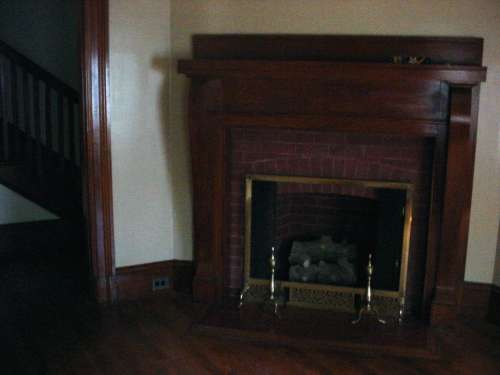
As you can see, all of the woodwork on the first floor of the house has never been overpainted. That’s the good news. The bad news is that the entire house is still using the original electrical wiring – the old bare wire on insulator stuff put in when the house was first built. That means there is one plug per room; nothing grounded anywhere in the place; and anemic service. Over the next month we are having a contractor completely rewire the house. I’ll be putting in sweat equity, too – mostly ripping out improperly installed fiberglass insulation that’s making the roof rot, and encouraging the growth of a truly spectacular mildew farm in the attic. Meaning the insulation is doing the encouraging. I’ll be doing the exterminating.
FILET KNITTING
I did have time to start playing with this last night. The Thomas method is daunting to look at in description, but once you start messing with it it’s pretty straightforward. Solid blocks are composed three knit stitches. Open blocks are done similar to a one-row buttonhole, starting with a double yarn over. Then two stitches are bound off by passing existing loops over and off the end of the needle. The last stitch remaining is then knit to finish out the block of three. Alternate rows are knitted back, with the second YOs purled to make a garter stitch base.
But here’s the kicker. To make the solid areas appear square, each block on the chart corresponds to FOUR rows of knitting. That’s two right side rows and two wrong side rows. This means that there’s an extra horizontal bar (aka bride) in the center of each block compared to filet crochet or darned net That makes the open areas far less open, and rather compromises the look – especially for very complex charts. Clearly, more work on this will need to be done as I don’t think this particular technique, even were I to work with tatting cotton on 000s, would look good for my chart.
I’m not giving up though. Tonight’s round of experimentation will include adding height to the solid blocks by Yoda-knitting them back and forth. Working each block as a tiny 3-stitch short-row should square off the units. More news tomorrow…
PS: If you see spurious question marks in these entries, please ignore them. It’s not that I’m more puzzled than normal. For some reason, as of this morning every double space in every has morphed into a question mark. I’ll investigate.
WORKING REPORT – SPRING LIGHTNING LACY SCARF
Hmmm. As I was writing today’s entry, I wanted to refer back to a post I remembered writing back in June of 2004. Apparently not all of the posts for that month imported correctly when we transferred our archives over. So the posts you’ll see today are hand-carried ports of the AWOL material. Apologies for the deja vu. True new content tomorrow. I promise.
Material originally appearing on June 14, 2004. For the record, the pattern for the Spring Lightning Lacy scarf is now in the main wiseNeedle pattern collection.
WORKING REPORT – SPRING LIGHTNING LACY SCARF
My lacy scarf is done!

As planned, the ribbed center section pulls in a little bit, making the two diamond panel ends flare out. Stretched and blocked, across the widest point of the edgings it measures 14 inches at the end and 12 inches at the center. It’s about 80 inches long. That’s big for a scarf and narrow for a stole, but I like the size. I really enjoyed this project. It was just the right combo of super-easy and super-exacting. The Greenwood Hill Farm 2-ply laceweight yarn was wonderful. I Can t say enough about it. It’s the softest, most buttery Merino I’ve ever worked with. It’s hand-spun look is unique. You can see the slightly whiter areas in the photo – those are spots where one of the plies of the two-ply yarn gets a bit fluffy. There’s a lot of variation skien to skein in the amount of the fluffy bits, so if you order it or buy it at a sheep and wool show, you may want to try to pick skeins that are similar (or not, as your taste and project needs dictate).
I’m not sure whether I’ll keep this scarf or give it as a gift. On one hand I really like it. On the other hand, while it would be an interesting contrast with my guy-style brown leather aviator jacket, I know several people who might appreciate it as much as I do. Plus I’m not tired of my Kombu Scarf yet. Good thing I have the summer to think about it before scarf season resumes.
FILET KNITTING
Here’s an obscure style. Mary Thomas in her Knitting Pattern Book mentions Filet Lace Knitting. It’s a style of knitting more or less equivalent to filet crochet, which is itself an adaptation of earlier lacis and other filled net or withdrawn thread style darned embroidery. In this set of styles, the needleworker follows a graphed pattern, working solid or “empty” squares. The pattern is built line by line by these blocks of squares. This butterfly insertion is a good example of filet crochet:

(Pix from http://www.knitting-crochet.com – attributed there to Star Needlework Journal, 1917)
On page 263 of her book, Thomas describes a way to do something like this using knitting. Solid blocks are formed by units of three stitches x four rows. Spaces look to be formed by a combo of yarn overs and bind-offs. I haven’t quite figured them out yet, but Thomas gives several illustrations and a couple of easy practice pieces.
I’m asking if anyone has ever actually tried this because I have never seen any lacy knitting that was done this way – not as a piece of actual knitting, nor in a photo either on the web or in any other book. I have never seen a lace pattern for a project done in this style either. So I’m asking. Have you done this? Do you know of any pix or other sources for the style?
The reason why I’m asking? I’m in the middle of one of those panting-and-eyes-wide moments of gotta-do-it-but-how? inspiration. Yesterday we closed on the new house. I am now the proud owner of a massive Arts and Crafts style front door, with a glass window that’s 30 inches wide by 18 inches tall. There’s mounting hardware there for a lace curtain panel, currently holding a dingy scrap of Woolworth’s best. The door cries out for a better curtain.
But not just any lace panel will do. I’ve **got** to make one, and not only do I want to make one, I want to make one from THIS panel from my book of embroidery patterns:

The ultimate source is a book published in Nuremberg Germany around 1597 by one of the more prolific and well-known makers of embroidery pattern books. Not only did Johan Siebmacher put out several (this pattern was in his Schon Neues Modelbuch vol allerly listigen Modeln naczunehen Zugurcken un Zusticke”), his books traveled all over Europe so they’re very well represented in museum collections. Many plates from them were copied and re-issued during the counted pattern “Renaissance” of the mid 1800s. This particular panel has cropped up several times over the years – often simplified or truncated. The most recent adaptation from it of which I know is a pattern for an cross stitched kitchen tablecloth and curtains set in an Anna magazine from the mid 1960s.
I haven’t a clue as to how I’d go about making my George and Dragon panel, but I’ve got the will, the how-to book, the cotton yarn (Crystal Palace Baby Georgia), and the blissful confidence born of total ignorance.
WORKING REPORT – SUMMER LIGHTNING LACY SCARF
Hmmm. As I was writing today’s entry, I wanted to refer back to a post I remembered writing back in June of 2004. Apparently not all of the posts for that month imported correctly when we transferred our archives over. So the posts you’ll see today are hand-carried ports of the AWOL material. Apologies for the deja vu. True new content tomorrow. I promise.
Material originally appearing on June 13, 2004. For the record, the pattern for the Spring Lightning Lacy scarf is now in the main wiseNeedle pattern collection.
WORKING REPORT – SUMMER LIGHTNING LACY SCARF
I’d hoped to be able to report this a done item, complete with in-block pictures, but life continues to intrude. Closing for our move is on Monday, and hectic does not begin to describe the household right now. At least we don’t move for another month. I’d have gone nuts if packing was loaded on top of everything else.
I can report a good deal of progress on the scarf, even if it isn’t done. Exactly as described, I ripped back to before the final panel, added around six inches of length, then reknit that part. I’ve added all but the last six inches of the edging, going completely around the new end.
One person has asked if I’m doing anything special where ends of the edging meet. I started the edging in the center along one side on the theory that the scarf’s center was most likely to be worn behind the neck. I’m hoping to make everything work out so that I end my edging knitting on the last row of the pattern. That way I’ll graft the live stitches of the last row to the half-hitch cast on I used when I began. That should make an almost-invisible seam. To make sure I end up at that spot I’ll have to plan ahead. My edging pattern is 8 rows long. Since I’m attaching at the rate of one attachment point per two rows (at the beginning of each right-side row), and since the scarf body was done with a slip stitched selvage edge things should be easy to calculate. That works out to one attachment point per slipped selvage chain.
Starting around now with six inches to go, the next time I am about to begin at Row #1, I’ll count the remaining selvage chains to see if the total count is divisible by four. If so, I’ll just work along merrily until the last row is complete. If not, I’ll figure out how to fudge by either adding an extra attachment point or two, spaced out over the six inches, or by skipping an attachment point at the very end. I’d prefer to fudge by adding rather than skipping attachment points because a little tiny bit of extra flutter is less noticeable in a fluttery scarf than would be a little bit of puckering.
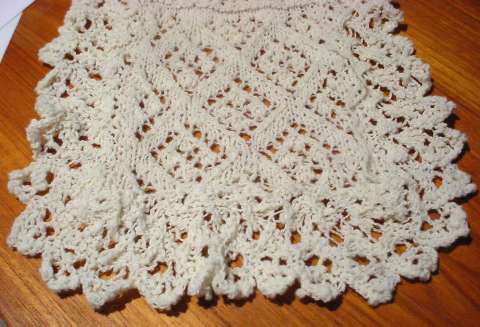
Another question I’ve gotten is how I went about edging the corners. At first I’d planned on mitering the corners, but that fell through. Instead I just eyeballed it, working three points worth of rows (that’s 24 rows or 12 attachment points) in each corner. I spread those pick-ups out just a little, starting them one stitch away from the corner, on the corner stitch itself, and continuing onto the stitch following the corner, but the bulk were lumped up as best I could in the corner stitch itself. Here’s the scarf end so you can see:
RED DOILY SHOW AND TELL
Taadaaah!
Here they are. Big doily first:
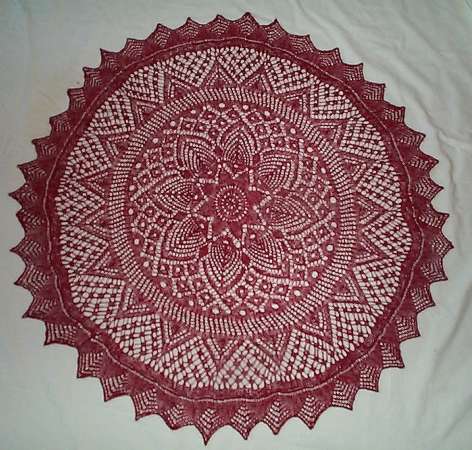
The blocking was a bit overaggressive on one side – you can see the distortion around the 3:15 position. Still, I’m quite pleased, and I can redo the block to an exact circle the next time it’s washed. Here’s the thing installed in its new home:

Aside: The vase is by potter Joseph McCaffery at Narrow Land Pottery in Wellfleet on Cape Cod. There are several more of his pieces in the hutch behind the table.
Now the smaller doily. Remember, it’s about half the diameter of the one above:

Important lesson learned. Don’t count your doily measurements until after everything has been well-blocked. It turns out that my smaller one is just right for its intended use:

While this means that I didn’t need to go on and make a second larger cloth to satisfy my original fear-of-wine-drips doily emergency, I’m happy I did. Now I have something spectacular to put underneath my favorite vase on the dining room table.
Roundup of patterns and specs – The smaller doily was knit from FANDUGEN, a pattern appearing on Nurhanne’s Yarn Over site. The larger one was done from a pattern in Patterns for the Art of Lace Knitting: The Complete Works of Rachel Schnelling, compiled by Gloria Penning. I modified the smaller doily by adjusting the placement of the arrowhead shapes around the perimeter so that they lined up better with the points and valleys of the previous motifs. I messed with the larger one by introducing the dark knit-on edging (the original used a crochet loop finish similar to that on the smaller doily).
I worked both from a cone of a unnamed faux-silk lace-weight rayon flake weaving yarn, bought for a song from the back room of Webs. I also made my Alcazar from the same cone, and still have a ton more left over. For the record – yes, the dark burgundy rayon behaved exactly as one would expect when wet: it shed lots of dye. Since I don’t plan on washing this with my regular load, I don’t find this to be a problem, but if you are contemplating making a lace blouse from this stuff, you may want to factor ease of care into your equation. I used the same needles for both – size 3.0mm, a Euro size that some US makers label 2, some label 2.5, and others don’t make at all.
WAVE SCARF – DEPARTING REALITY ON TRACK 7
My red doilies are still damp, so there’s no unpinning them for show and tell today, but I’m still working on the Wave Scarf, so I’ll report on that instead. I have taken yet another significant departure from reality as described by the original pattern.
First, I decided to dispense with knitting from the center out to make the two ends identical when worn. I didn’t like the visible seam-like line down the center of the back. So I just knit the piece end to end. Then I decided I wanted to make the thing longer, so I did. Which means that the carefully worked out in-pattern directions for picking up around the edge and working the small eyelet divider rows are all not going to work. I looked at the numbers of the original and working out the pattern row multiple vs. the available stitches for attachment. And then I winged it.
I ended up with more than 17 repeats of the 12 row cycle. I had about 20. Picking up stitches around the outside, I needed more than the original, so I ended up with 80 stitches per short end, plus 420 stitches per side (7×60), plus 8 more (2 for each corner). Then I worked one row of plain knit all the way around to confirm my stitch count (adding a YO on either side of each pair of corner stitches).
Now I’m doing something that’s a cognate for the eyelet row. Since my total is divisible by 4, I’m working (K2, k1, YO) units all the way around – ignoring those corner stitches for now. I’ll do another row of plain knit next, then look into whether or not I need to play with the row ratio for one of the several versions of the Print of the Wave family companion borders I have in the house (the variant supplied with the pattern, plus two in Heirloom Knitting, plus at least one other in yet another lace book on my shelf.)
How did I get all those stitches onto something manageable? I’m using the two-circ method. One circ holds one end and one side, the other holds the remaining stitches. I may not enjoy using that method for socks (for me DPNs are faster) but for flogging a zillion stitches into submission, it can’t be beat.
Do I recommend just winging it in lace knitting? Probably not if your constitution can’t take the searing realization that you’ve done something stupid and have to rip back miles of work. Since I don’t bother with lifelines, that ripping can be harrowing. Why do I do it? I can’t say. Maybe I just like living on the edge in this one tiny facet of my life. If you’ve been reading along for a while you have seen that whenever I am given two paths knitting-wise, I’ll always chose the more risky or more arduous option. Getting there may be half the fun, but I want to chug up craggy mountains and press on through jungle perils on the way.
BACK TO KNITTING – DOILY FINISHING
Putting the curtain project on the back burner to stew a while, I turned back to knitting this weekend past. First, having time, and Older Daughter around to do photography that requires extra hands, I was able to do the final graft/join on the larger red doily, uniting the final row of my edging with the cast-on edge.
Here you see the problem. The last row of the edging is still on the needle

I wanted to make as invisible a seam as possible. I used standard grafting to unite the live stitches on the needle with the half-hitch formed cast on row. Had I been paying attention to detail a bit better, I would have used some sort of provisional cast-on instead of half-hitch. So it goes. Here you see a sequence of three shots showing picking up live stitches, then taking a stitch through a cast-on row stitch, and so on:

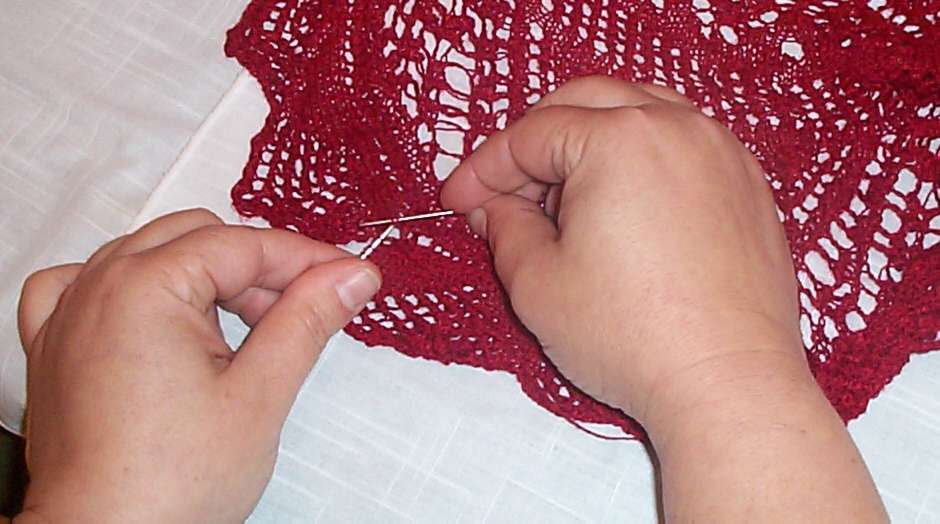

And the final product,with the graft indicated by the arrows.
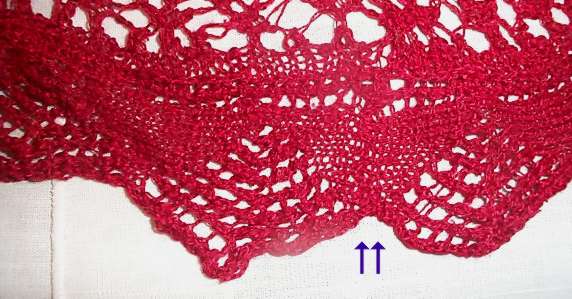
I admit that with a bit more patience and time, I could have done it a bit better, but this was good enough.
Of course now that I’ve finished off the piece, I had no excuse not to block it (and its smaller sister). The op-art effect made by the sheet is not my deliberate attempt to befuddle your sight. I found these rally check sheets years ago, and find the regular grid to be very helpful in keeping things straight.

Less eye-popping pix will be forthcoming once both are dry.
YARN REVIEWS AT WISENEEDLE
UPDATE – February 2023
The wiseNeedle yarn review collection here is long gone. Sorry. I did make a go of it for about 14 years, relying on a small number of general audience ads to subsidize the cost of hosting the site at the database-enabled level required.
As Ravelry gained in popularity, all traffic to independent knitting sites came to a dead stop. Visits to consult the review collection and volunteer-submitted reviews both fell to near zero. I continued on funding the thing on my own for about three years, but eventually threw in the towel.
In time I was approached by the owner of would-be Ravelry competitor NimbleSticks, and the database of reviews and yarn information went over there. Sadly, that site has disappeared as well.
There’s now no easy to consult independent index of basic yarn info, with reviews (including the bad ones) – and in truth I don’t have the capacity to resurrect wiseNeedle’s collection. You can find some info on Ravelry, but you have to dig for it. Many retailers include “reviews” but they purge unfavorable comments.
The moral of the story is that all the good intentions in the world won’t fund a shared resource if no one uses it.
Original post
I’ve gotten some more questions about wiseNeedle and the yarn review collection, so I’ll take some space here to clarify what it’s all about.
What we are and aren’t
The on-line yarn review collection hosted elsewhere on this site is the latest manifestation of a project I’ve kept going since 1994/1995. Back in the early days of the KnitList mailing list, (when there were fewer than 250 members) yarns would come up for discussion. Opinions and gauges achieved would be shared. Then a couple of weeks later the whole thread would be repeated because someone had another question or a new person had joined with similar questions. So I began asking people to “donate” their comments to a central list to preserve valuable info and cut down on repetition.
My list started out as a text file that we shared round-robin. In 1995 I posted that content on my first web site, in the form of one and later a series of interconnected static web pages. It grew to the point of unmanageability. The Resident Male saw a challenge, and volunteered to build the necessary infrastructure to make the thing into a fully searchable database with a web front end open for (vetted) public contribution. So in 2000 we did.
Since then the yarn review collection has grown to include basic data for over 5225 yarns, the names of over 490 yarn makers, and to contain over 2875 individual reviews from over 2000 knitters, worldwide. We have info on both current and discontinued yarns (very useful if you have an older pattern or yarn you wish to find substitutes for) as well as products off the beaten track or only regionally available. Aside from my looking over reviews to make sure they’re attached to the intended product, that products are not duplicated without need, and that comments are not blatant planted ads or spam/graffiti, there’s no censorship or editing of anything posted.
And it’s just me (plus The Resident Male as resident technical wizard). There’s no other staff here, nor is there a group of captive volunteers assigning yarns to be reviewed or performing assessments. I’m afraid that we can’t respond to requests to see reviews posted for specific products. We have to sit and wait for someone who has used a yarn to post a review.
We have absolutely no involvement with yarn makers, sellers, or distributors and do not rely on them for subsidies or placement income. Nor do we accept samples or other marketing-related inducements. Therefore you are not going to see breathless endorsements of whatever the latest fad is, posted prior to a yarn’s wide availability. Nor do we remove negative reviews because we fear a loss of relationship with a sponsoring vendor or diminution of click-through or ad revenue from retailers who are paying for the privilege of appearing on our pages (all ads that you do see are blind-placed through Google or Burst services. Income goes to defray the cost of maintaining the site without charging user fees).
What you are going to see are honest opinions both negative and positive from knitters of all levels of experience from beginner to advanced. For widely used yarns, you’ll see reports of many different projects, knitted at a variety of gauges. Some will have follow-ups that report on washing or durability problems that crop up long after the actual knitting was done. And you’ll find differences of opinion, with some people loving a yarn for particular properties, and others detesting it for those same (or different) reasons.
So it all adds up to this. If you find an independent, central repository of this kind of info to be of any value – one which retains info long after a yarn is discontinued, is independent and impartial, and provides the forum for everyone to voice an opinion – please consider adding a review for the yarn on your needles right now to our collection. Just because someone has reviewed it before doesn’t make your experience less valuable. Your knitting experience, your project, your gauge, your care/durability experience may either confirm and strengthen group consensus about that product, or may provide a valuable point of difference. In all cases, your opinions are most welcome here.
How to post a review
The easiest way to enter a review is to look up the yarn on the search page, then add your notes to its basic info page. With as many entries as we have, unless your yarn is very old, a small run product, or very new this season it’s likely that it’s in there. Like all databases, you need only enter the minimum info to call up an entry – usually just the first few letters of the yarn’s name, then hit search. That will bring up a list of similar entries. Click on the one you want, then on the “review this yarn” link on that basic info page.
If your yarn isn’t found, there’s a handy page on which you can add both basic data and your opinion at the same time. (If your entry duplicates data for something we already have but that you weren’t able to find easily, and I can’t confirm that it’s the same I may eMail you to ask if your product is in fact something new). And there’s a page to enter basic data for yarns without adding comments, even if you’re not ready to post an opinion yet.
So please consider posting an entry to the wiseNeedle yarn review collection. I can guarantee you that somewhere in the world another knitter will be grateful for your help.
DILEMMA – THREAD COUNT AND MOTIF SIZE
Special thanks to Judith and Emily who offered up valuable advice on the curtain project. I am still hoping to do this is some sort of economical manner, by achieving two side-by-side panels out of my fabric width, but I will heed their wisdom and maximize the width of my panels.

Although I really like the linens at the vendor I contacted, I might have to see if I can find something wider elsewhere because I don’t want to either seam or end up with gobs and gobs of left-over yardage. But then again, there’s shrinkage. I know linens shrink, some more in length than width, others evenly in both directions. I am going to have to experiment by washing a swatch prior to final planning just to confirm final ratios.
Then there’s fading – another caution from my experts. This may be a big problem because my windows are on the sunny south side of the house and I am planning on using high-contrast dark hunter green embroidery thread. I do have to take sun bleaching into account. Perhaps a well-washed cotton flannel or other 100% cotton with dense weave will be appropriate. For the record though, I am planning on losing the Colonial edge roller shades and putting up unobtrusive mini-honeycomb shades to control light and privacy. They will help considerably with the fading problem. (These curtains will be more decorative than functional.)
But I promised to describe how I’d choose among various thread count fabrics.Here’s the original list:
- Flax Canvas 28 x 24 – 52″ wide
- Craftsman Linen 20 x 18 – 55″ wide
- Osnaberg 40 x 45 – 58″ wide
- Irish linen 40 x 32 – 55″ wide
- Belgian linen 34 x 38 – 54″ wide
- Raw linen 34 x 38 -54″ wide
To figure out how large my motifs would be on each of these I do a bit of math, using my first choice design’s measurements – 53 units tall x 308 units long for one full repeat. Note that I’m figuring to do my stitching over blocks of 2×2 threads, so on 28 count, I would be performing 14 stitches per inch (and people whine that 7spi in knitting is too tiny to see!) Also note that I’m taking the variance between the warp thread count (the direction running the long way of the yardage) and the weft count (the direction from selvage to selvage).
| Fabric | Length | Width |
| Flax Canvas – 28×24 | 22″ |
4.4″ |
| Craftsman – 20×18 | 30.8″ |
5.9″ |
| Osanberg – 40×45 | 15.4″ |
2.4″ |
| Irish Linen – 40×32 | 15.4″ | 3.3″ |
| Belgian/Raw Linen – 34 x38 | 18.1″ |
2.8″ |
As much as I adore stitching at tiny gauges (50 thread count is normal for me), the thought of working these curtains at anything higher than 32 is – even for me – just plain nuts. Especially when you consider that in a curtain of about 71 inches long, I’m planning on producing a stitched piece that’s about 60 inches long, and I’m planning on making four identical panels. In 28 count, that’s a bit less than three full repeats of my 308-unit motif. At the same time, I don’t like embroidery at bigger gauges either. I’m too spoiled by the grace of these patterns done on finer scale. Using this yardstick, Flax Canvas comes out as the best choice – just at the borderline between too coarse (Craftsman) and too fine (Raw Linen/Belgian linen).
And ratio? Squareness or distortion of the final design, considering that I’d be working on non-evenweave stuff? By looking at the thread count ratios (warp count/weft count) I can see that the largest distortion would be using the Irish Linen (factor 1.25); and the least using Craftsman (1.11). The Flax Canvas works out at a 1.16 skew ratio. I’d have roughly almost 12 stitches across the fabric for every 10 up and down. Not great, but not horrible either.
But then we come to the last and first problem. Of the fabrics available from this source, Flax Canvas is the narrowest on the bolt at only 52 inches wide. And my Curtain Advisers have suggested that more fullness is better. As much as I like these fabrics, I may need to go back to the drawing board and find another source of beautiful, affordable, but wider linen. Suggestions would be very welcome.
 String-Or-Nothing