Greetings to all on the flip side of 2025. The year had its ups and downs, but ended with a sweet rush of family and friends, both visits and visiting. Thus fortified, I head forward into 2026.
First a couple of housekeeping details related to my books, broadsides, and posts.
- To the person who wrote to my address saying that they heard I was deathly ill, and asking if I had passed, so that my copyrights would all now be gone, I offer disappointment. I am now an official Cancer Survivor. Very much alive. And even if the worst had happened, copyrights do not expire with the author – they are assets transferred to the author’s estate, and remain valid for the full span of 95 years after publication.
- To the person or persons who without my permission, uploaded my free books to SCRIBD and other on-line download repositories. I have had them all taken down. Your accounts are now flagged by those entities, and I am sure your other activity on those sites will be scrutinized. The ONLY place I have given permission to repost any of my work is the Antique Pattern Library – and even at that site, only one of my works. I ask that if you see any of my pieces reposted anywhere else, in part or in their entirety, you please notify me. I share generously, but I do not condone theft – even of freely shared material.
- And or those who have made the accusation that I am paid to use certain products, I may be a bad influence, but I am not an “Influencer.” I wrote about the murky world of Buzz Marketing back in 2006, and I know of least one instructor who from site traffic appears to assign that piece as class reading every spring semester. Every product I mention I have bought at retail; been given as a gift by a family member or friend unaffiliated with the maker, distributor, or retailer; or found in a thrift store. I accept no freebies. All opinions I express on String-or-Nothing are genuine and entirely my own – unprompted.
Apologies for the harsh words, but the world is an increasingly harsh place, and I am losing patience with incivility.
Now for the fun stuff.
A special welcome to those new to this long-running blog. Not quite sure why, but traffic has been up quite a bit since late November. And not just folk hitting the latest entry. I’ve seen upticks in people searching for past knitting and stitching articles. You are most welcome! There’s over 26 years of spottily indexed material here to explore. Feel free to post questions. If I can I will point to relevant prior posts or try to answer new questions, if not, I will confess my limitations.
On the current embroidery project I have completed the frame around the outside edge, and have moved on to the wide stripe of patterning that flows across the center. As in the museum original, the wide stripe involved adapting the border strip for use as an all-over. I’ve done (more or less) the same fudges in the wide strip as appear on the Museum of Fine Arts original (MFA Accession 83.242), and am pleased with the results. Although the deep yellow lacy motif along the edge of the design when doubled in the all-over as the center of what emerges as round motifs, looks disturbingly like a B-movie robot.
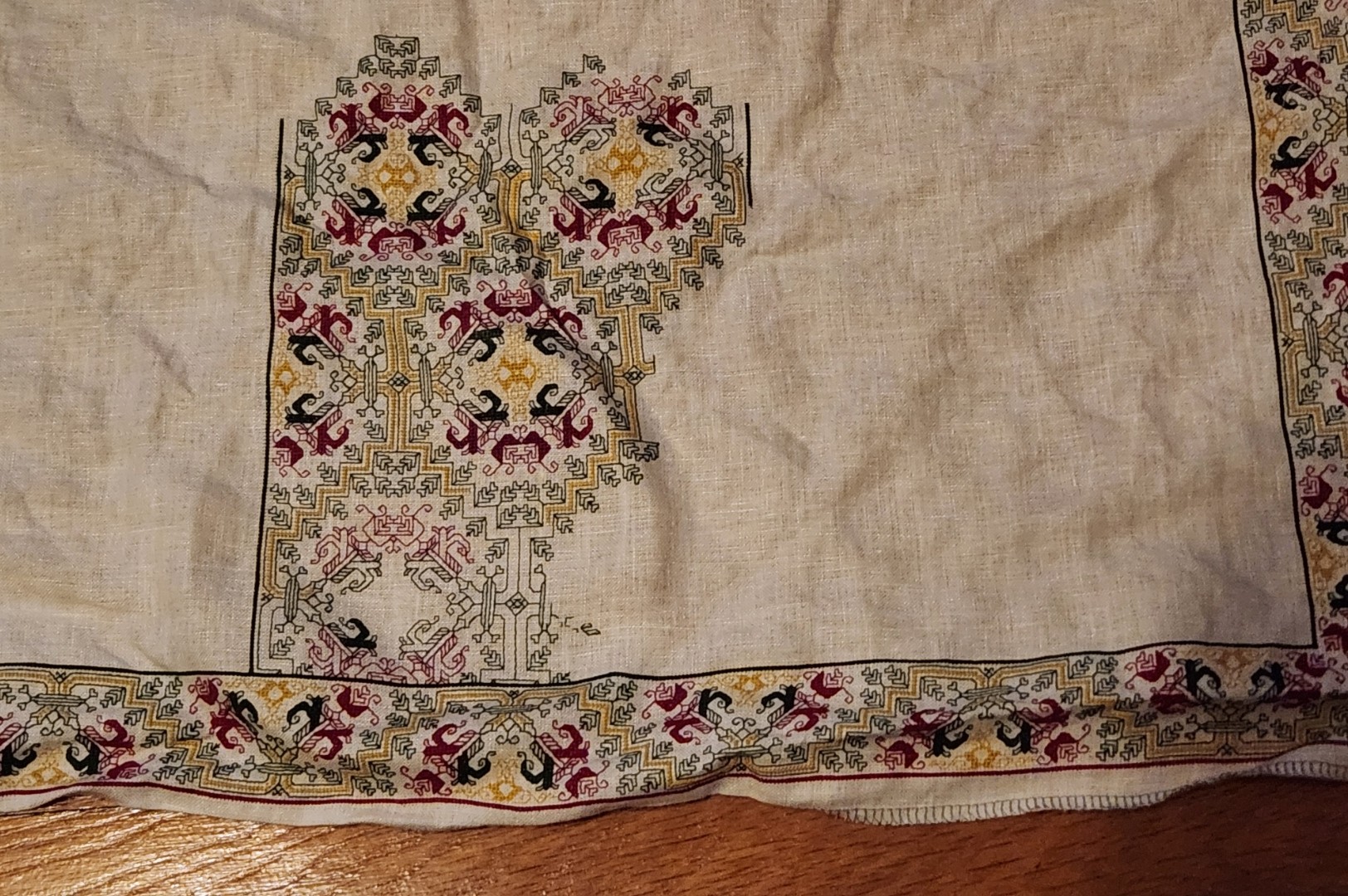
If you squint very hard you can just make out the pink basted centerline guides at the top of the photo, and at the right of the completed bit. That’s the only alignment help I needed. I am 100% sure that when I get to the other side of the span the truncation of the all-over will be happen exactly at the same spot in the cycle’s repeat.
After this wide bit I come to a decision point. Do I do two narrow bands parallel to it, evenly spaced between the center stripe and the edge? The original used multiple bands, but it was more than four times the size of mine. And I still want to add the edge sprigs around the inside borders that occur on the original. I did not do them at the time I did the border because I wanted them to be carefully spaced, and was too lazy to do the math needed prior to working the center stripe. Here’s a snippet of the original showing those single-color sprigs. Easy replication of the end element from the main flower.
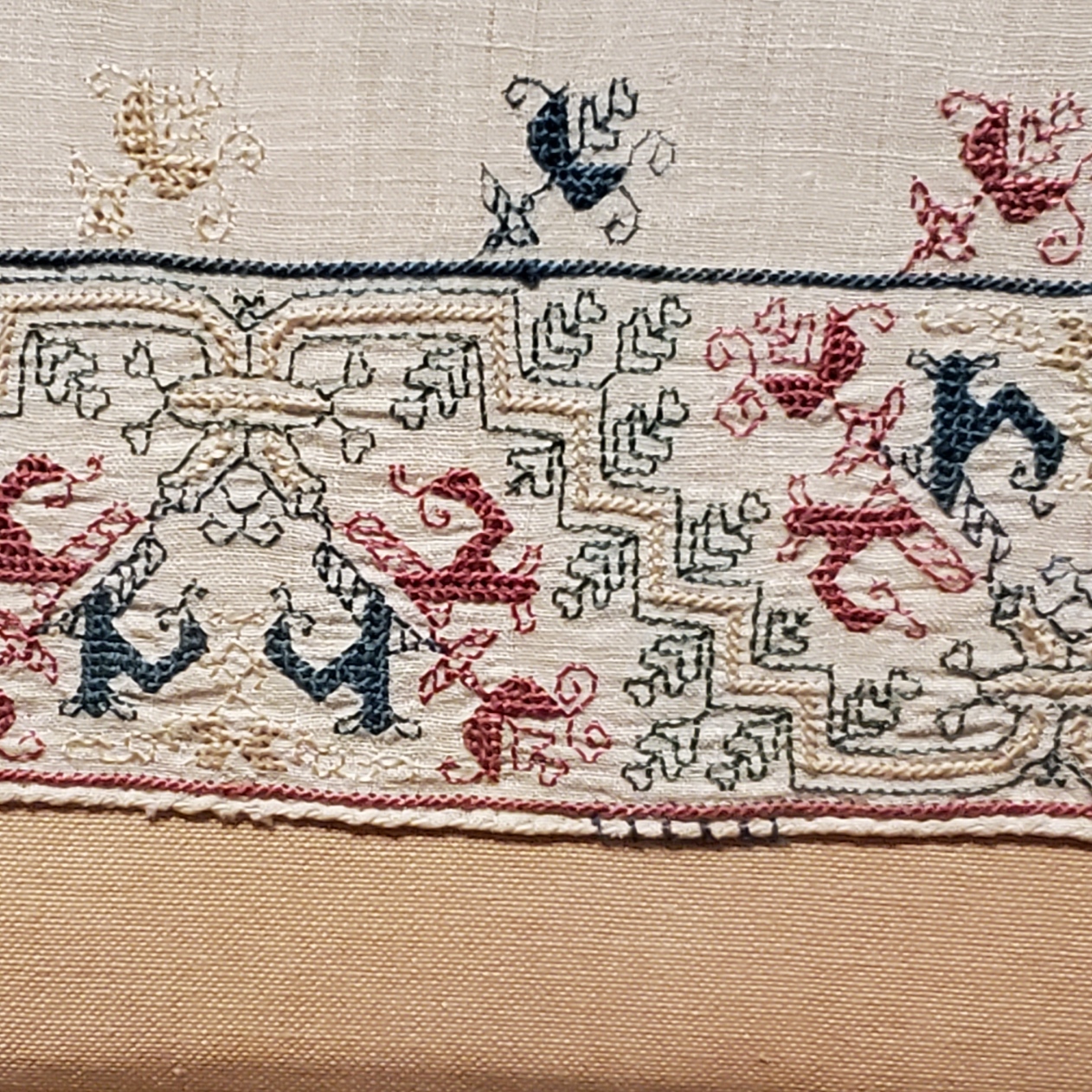
Comparing the museum photo to mine and noting some small differences in the curls that come off the ends of the red terminal flower buds? Yup. In this photo they are done differently than in mine. I charted the design from just one of the sides of the original, and stuck to it throughout.
I believe the museum piece was stitched by more than one person, which would make sense because of its size and the amount of labor involved. The variation in those curls from edge to edge along with the very chaotic treatment at the corners where the edges meet might be additional evidence for my multiple-stitcher proposition. In any case, being just one person and doing only a smaller quotation from the original, I have normed all four corners logical to the repeat and congruent to each other (a vanishingly rare treatment in a period textile), and used the same basic chart throughout rather than replicating all of the “committee-generated deviations and compromises.”
And after all this stitching is complete I will do a close-rolled hem, like the original. Possibly with the vertical ornamental elements in green also shown in the photo above. I haven’t decided on whether those are plain vertical stitches, buttonhole, or blanket stitches – the fragments are few and difficult to interpret from the museum photos and the ones I took at the 2023 MFA exhibit. In any case they are clearly decorative and not structural because there are very few hits of them scattered around the edges, and the hem is sewn and intact even where they are absent. The last step will be cheeky little red tassels on the corners.
 String-Or-Nothing