Yup! It’s done.
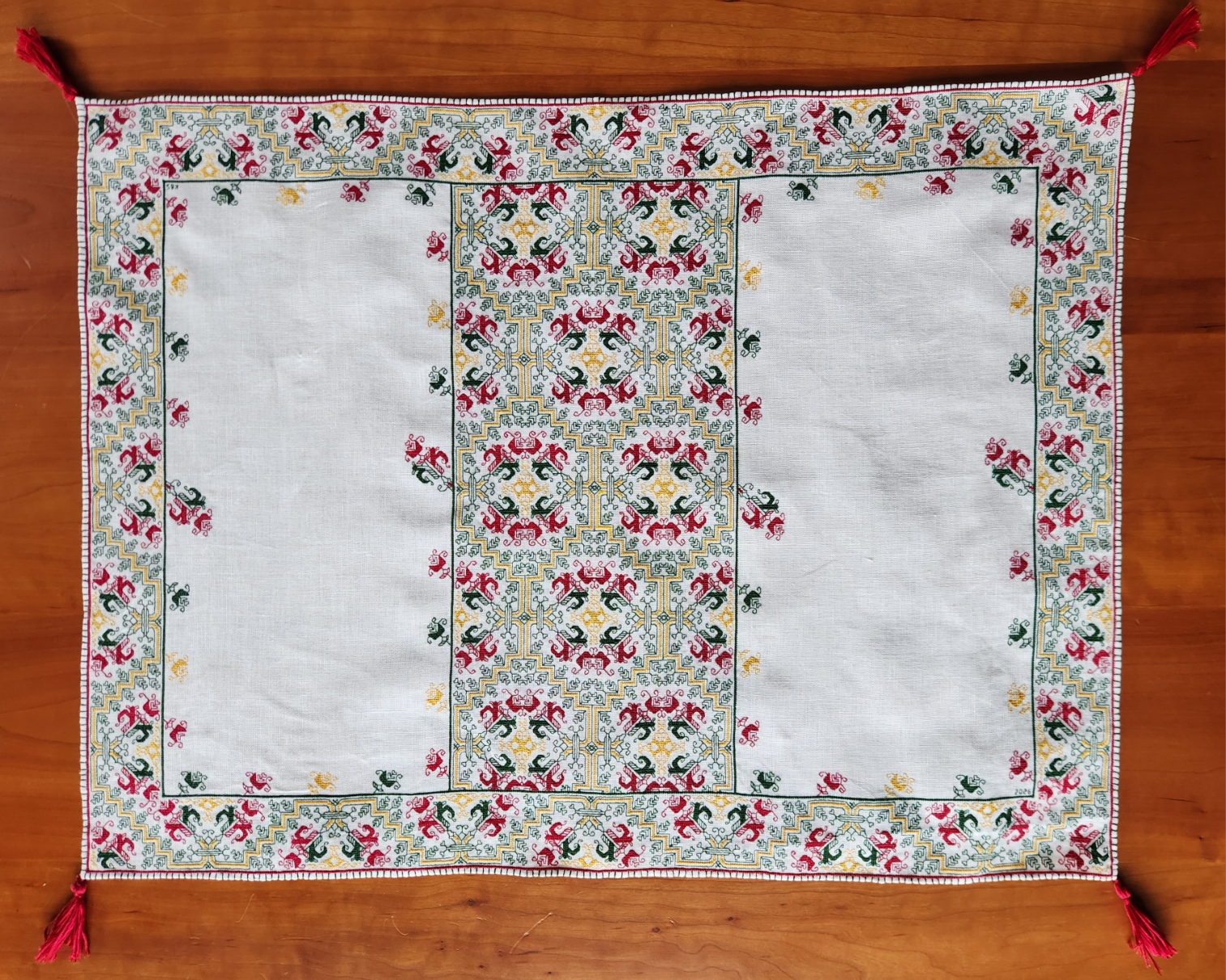
Final finished dimensions (not counting the tassels), are 60 cm wide x 45 cm tall (about 23.6 inches wide by 17.7 inches tall). It’s stitched using one thread of standard DMC cotton floss on 40 count linen. The stitches used are double running, Montenegrin, and two-sided Italian cross stitch. Although the thing is mostly double-sided, I did not take any special measures to hide ends.
I started on or about 13 September 2025, drafting out the design from photos taken at a 2023 Boston of Museum of Fine Arts visit, and from the museum’s own photo of the inspiring original. Prepping the ground – determining and basting centerlines and edge guides happened immediately after.
Actual stitching commenced on 19 September. At that point I had the edging drafted, but not the corner joins. I began at the bottom center and worked around the perimeter, and worked the corner out on the fly. (It doesn’t match any of the corners of the original.) Then I continued around, replicating that corner three more times. After I finished the frame, I did the wide center stripe, formed by doubling the framing meander, with a couple of small adaptations as in the original. Then I added the sprigs that circle the unembellished panels, left and right – more quotations from the main meander motif, with small adaptations congruent with the original.
The final step was a narrow rolled hem, ornamented with a rather odd buttonhole stitch variant. Instead of working it with the joining horizontal bar along the edge of the piece, I did it – backward – piercing the ground from the front, and catching the loop at the base of the stitch in the back. That made a single vertical loop around the rolled hem, with no whip-stitch style slant, and with the bar connecting the buttonhole stitches riding unseen across the back, tucked into the edge of the rolled hem itself. I have no historical source for this, just trial and error, trying to replicate the visual remains of the bar-ornamented hem of the original. And I did feel compelled to make the little red tassels in homage to the ones on the original.
It’s hard to estimate total hours for this. I tend to work 2-3 hours per evening, with an additional 3 hours in the afternoon on Saturday and Sunday. That adds up to about 23.5 hours per week, and 25 weeks from start to finish. Rounding down for holidays or travel days when nothing got done, I would estimate this piece took about 575 hours total. I’d call it moderate – far less intense and shorter than many I have completed. But a time commitment, none the less.
Now let’s compare mine to the 16th century original (Boston Museum of Fine Arts accession 83.242).

The Boston Museum of Fine Arts caption has been revised over the years. It now reads “Line stitch and tent stitch or long-legged cross stitch. A towel.” It is noted that the ground is linen, but the thread is not described (I assume it’s silk).
There is a bizarre discrepancy in the size listing. The description reads “970 x 1480 cm (381 7/8 x 582 11/16 in.); Legacy dimension: Height: x width: 58 5/16 x 38 3/16 in.” 582 inches wide would be 16 yards wide. When we saw it displayed in the MFA’s 2023 exhibit, it was certainly large, like a tablecloth for 6 to 8, but certainly not 16 yards long. Therefore I am going with the “legacy dimension” of 58 5/16 x 38 3/16 inches or 148.1 cm wide by 97 cm.
That means that the 148.1 cm x 97 cm original is about 2.5 times wider and 2.1 times taller than my 60 cm x 45 cm rendition. This to me makes sense when you look at the repeats. I posit that my work stitching 2×2 on my 40 count ground is not far from the gauge at which the original was worked, although it might have been done on finer linen over 3×3 threads. My photos and the museum photos are not sharp enough to make that determination. As to the stitches used, I do think I hit the nail on the head, although using cotton instead of silk restricted the amount of tension I was able to get on the meshy two-sided Italian cross stitch bits. I would have preferred that they be more open, but the cotton wasn’t up to the savage yanking needed to get that look. Still, you can see the meshy effect on mine.
I can also say that at more than four times larger than my piece, along with variances in execution of the design on each of the four sides, plus irregularities in the corners, that I believe the original was executed by a group, perhaps in a workshop or other communal working situation, with one or more individuals working on each side, simultaneously. Those original corners look like kludge mash-ups where folk resolved alignment problems on the fly. Tiny differences in execution seem to cluster on sides, and don’t appear randomly scattered about. That would argue for several people working at the same time, copying from a common source, but replicating their own individual “mistakes” within arms reach.
All in all I am quite pleased with my rendition. I have absolutely no idea what we will do with it, or on what surface we will display it, but I am pleased none the less.
Moral of the story – the Ancients did wonderful work. But they were not superhuman, and didn’t demand the icy perfection and merciless symmetry that Victorian and later stitchers have striven to achieve. Approaching the level of virtuosity seen in historical pieces is NOT outside of the realm of modern possibility. All it takes is time, practice, and attention to detail.
 String-Or-Nothing