My sort-of-weekly progress and lessons learned post about my Unstitched Coif entry. So you can see what’s new, I post the last general update photo alongside the new one:


I’ve added the rose, several bugs and a couple of leaves, a partial rose at the bottom edge, worked more of the stems and curls in gold, and seeded in more of the sequins once surrounding motifs were defined. I’m working on another leaf right now. And this means that I am almost finished with the first of the three tiled pattern print-outs. I’ll be moving onto the center sheet in the next day or so.
Obviously I am determined to make that completion deadline. I’ve been trying to stitch at least four hours per day, sometimes more if I can. Although we absconded to our place on Cape Cod for a long weekend, and I took my stitching with me. And there I had a grand time sitting out on our deck, working away in shaded sunshine and light airy breeze. Not too hot, and not too windy. (Thanks to the Resident Male for these live action photos).

It’s a bit easier to see in the following photo – I keep my left hand underneath and my right hand on top. I’m right hand dominant, but probably less so than many right-handers. My left is quite well trained at this point.

You can also see the magnifiers. I’ve found that they get less tangled in my hair if I wear them over a kerchief, rather than putting the headband directly over my pinned up braids. Yes, that’s one of the blackwork forehead cloths I stitched several years ago. It has worn like iron, surviving many washes, but I do now understand why forehead cloths are so often found bereft of their strings. This is the thing now, on its second set of strings (strips of linen, double folded and hand sewn), and this set is beginning to fray. Also note how the formerly crisp on grain right-angle triangle has changed shape under the stress of being worn. Another feature often seen in museum examples. More on the ones I made and the one I interrupted to do this blackwork project here.

In any case back to the Coif project.
As I’ve written before, stitching outside in bright but not direct light is amazingly better than stitching under the best available indoor lighting. A full spectrum lamp comes close, but even that can’t equal the absolute clarity evoked by outdoor ambient light. I will be working on my porches back at home, front or back, weather and heat willing for the best part of the day from now on.
The second thing is that hideous, tattered dark color pillowcase, pinned on to the top edge of my work, and hanging down behind. I have two – both way to destroyed for their original use. I use them as a double layer travel cover for this frame when I take it along with me. The travel cover I sewed is too small for this frame at max extension with lacing.
The reason it’s there is to limit light shining through the work. Unneeded light includes reflected light outdoors, light from the TV (often on while I stitch when I work indoors), or from other window or artificial sources when I am trying to stitch with my full spectrum light over my shoulder. Even outdoors with the sun behind me, having the dark “curtain” behind the work makes it just a tad easier to see the threads and aim accordingly.
I finish up with a detail shot of the creeping caterpillar. He’s my favorite insect on the piece, but he was surprisingly tough to do. There isn’t a lot of real estate in those heart-shaped body segments. I tried to find fill patterns that would contrast nicely both in tone and “spikey-ness”, and still be somewhat distinguishable in those tiny areas. I ended up using three – one for the face, and two alternating, for the rest of the body. The eyes are always fun. Where possible I’ve been using the same 2mm paillettes that spangle the ground for eyes, held on with French knots. Do you feel seen?
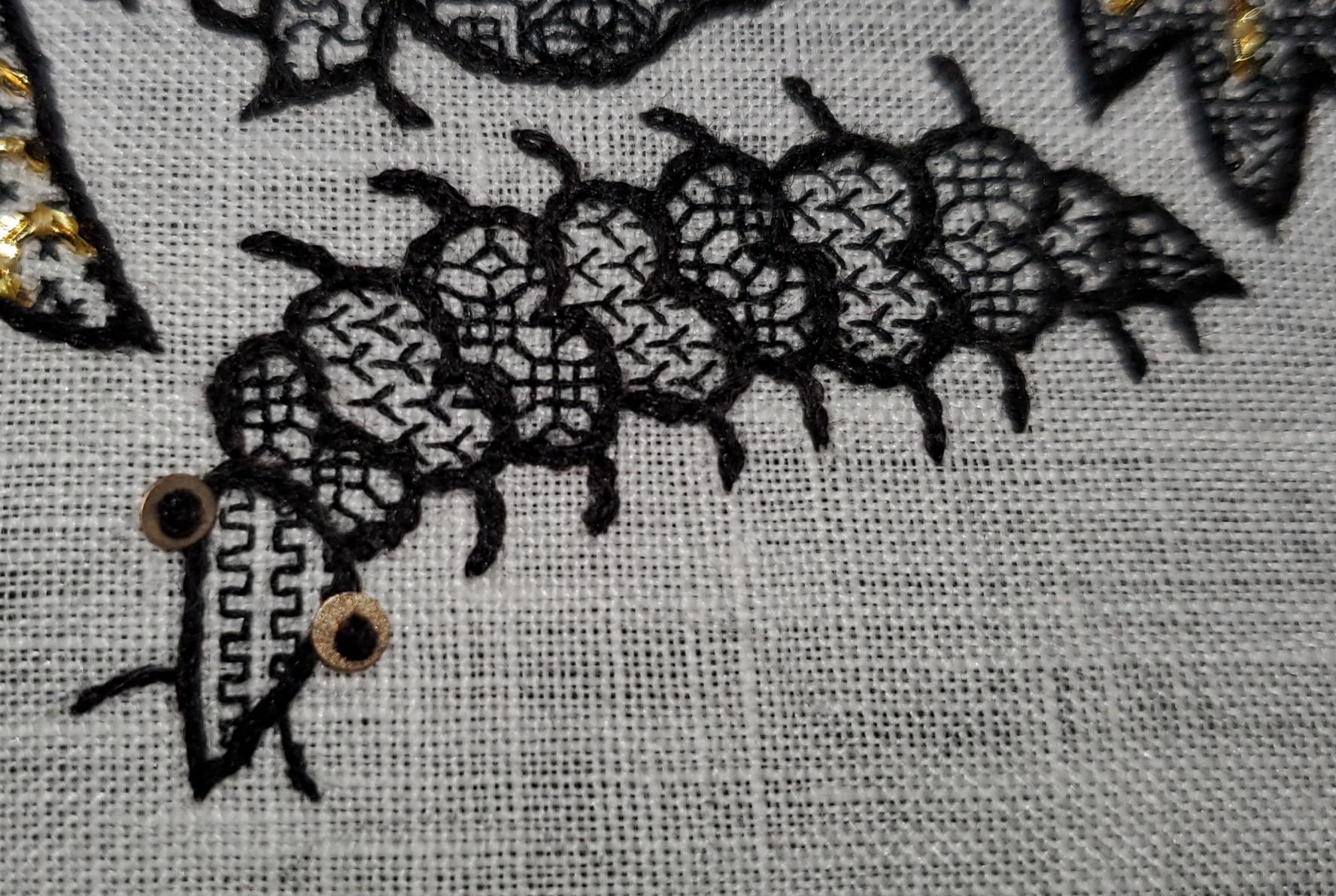
For the record, with one unconscious lapse (a repeat of plain squared fill in two tiny places), I have NOT yet duplicated a fill between design elements. A fill might appear twice in the same flower, creature, or leaf, but once that design element is done, I consider its fills “burned” and will try very hard not to use any of them again. That means even if a bug or flower repeats in the drawing, each iteration will have its own unique look. Or so I hope…
 String-Or-Nothing
Thank you for the observations about how the shape of an embroidered forehead cloth changes due to it being used. I had always wondered about the distortion on surviving ones. 🙂 It is also fascinating to see the “shade cloth” in action in your working setup.
Inadvertent experiential archaeology. 🙂
I think you’ve just explained how our ancestors could stitch as they did, as well as the change in shape in historically surviving forehead cloths!
Such beautiful stitching! Love the magnifier… need to get one. Really love the Kerchief. I just might have to see if I have a piece of linen to make one for myself. I’ve found with linen ties if I fold the outer edges in til they meet and then fold again, they are stronger and less apt to fray. Kind like the folds in double folded bias tape (which is something I often have used for ties and it lasts forever!).
One caution on the magnifier. I love it, but it has a weakness. The tiny lights mounted in the center are great for iffy light conditions , but they eat batteries with the appetite of an enthusiastic dog at dinner time. If I were to buy a magnifier with light now I would look at rechargeable models rather than ones that are battery powered.
I’m looking for the magnification, I have awesome lighting. Blind services for my hubby showed us a small LED light that folds up when not in use. it’s rechargeable. I bought one and I’ve had it for about 4 months now, daily use, and I’ve not even had to recharge it, yet. 🙂 Right now, I have a magnifier that is positionable and had two magnifiers. I’m having difficulty adjusting to having it between my eyes and the canvas. Thanks for the advice. I might ask Hubby’s caseworker what she suggests. She’s been so helpful to us.
And on the kerchief the fold and fold again (four thicknesses of cloth) is exactly what I did both times.
Oh, you really must wear it a lot. I don’t wear mine so much. It is a conundrum.
This is looking so good. Your caterpillar is delightful! And the change from gold to black for the bird legs is a definite improvement – are there degrees in perfection?
I love this piece. I am enjoying your progress on this beautiful piece. I forget what the count is on your linen.
Over 70. It’s skew, something like 72×74 but I haven’t gotten an exact count.
Over 70 ! Truly amazing and truly beautiful.
You are making huge progress for sitting by such a nice view! I can’t decide if caterpillar is wide eyed in terror or giving the “you see nothing” stare down. It’s so CUTE!
Oh for the eyesight of my youth, even though I was (still am) very nearsighted! Back then, I could simply take my glasses off and hold things a few inches away and it was better than any magnifier. And light wasn’t such an issue either. Now…ugh! Close vision range is different for both eyes. Often I wear readers over the bifocals, and have been known to add in yet another magnifier. I’ve seriously considered buying an arm-mounted stereo microscope, but no idea how I’d get it set up with my current stitching chair. That and the balance of how much I actually stitch on high count or dark color linen vs cost…that makes it a no-go. And light…now it’s at least 2 lights, one focused on the stitching area. And daylight bulbs are a must.
The head cloth is very pretty, I remember reading about you making them and thinking “all that work and she actually wears them?!” but why not enjoy your own work! Absolutely real-life wear makes those missing strings and odd shapes on antique cloths make sense. Fabric bias is the bane of quilters, and often garment sewers. And when it’s been set in by time and heat (whether from iron or head), returning it to the original shape is a bear if not impossible. But at least garment sewers can use it to advantage sometimes like the fluid bias cut dresses in old movies.
Whoa, how cool! That headcloth is beautiful and inspiring here to try. Silly question for you, how do you keep your neck from hurting? That’s my big problem with getting back into stitching right now. I’ve set myself up with a pillow for my back and a brace to prop up my stitching frame but it just feels like I’m doing something wrong LOL.
I don’t have any good advice here. I usually sit in a recliner looking like an astronaut as i stitch, but of late a lower back injury has precluded use of my favorite chair. I’ve taken to sitting upright in a kitchen chair instead. No neck problems but working along the center line of my frame requires a shoulder stretch that’s uncomfortable because the reach is so deep. We will see how that progresses. My only counsel would be frequent breaks, stretching, and either heat or cold, as recommended by your doctor. (Heat is good for muscle aches, but cold is better when inflammation accompanies discomfort.)