CONTINGENCY PLANNING IN ALL THINGS
Obviously I am still at it, working away on the current embroidery, and surfing the health issues management seas.
First, to present the size of the piece as a whole, here it is, fully unscrolled. No, that’s not discoloration at the bottom. Just an early morning light shadow.
At 28 threads per inch, these strips are gigantic. The actual margins of my stitched area are barely visible, marked in basting, roughly an inch inside the scroll bar mounts, so there’s not as much usable real estate here as I would normally prefer.
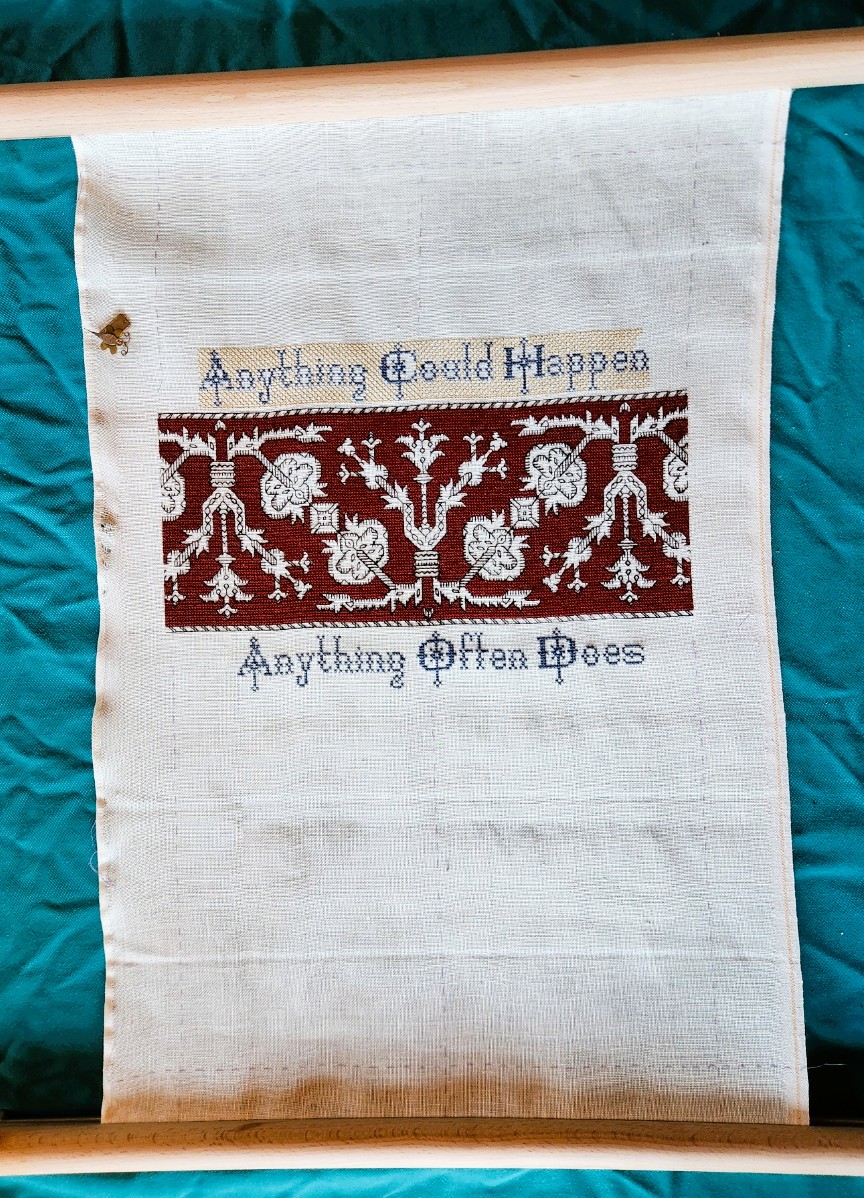
And note that I haven’t extended the yellow step voiding behind the top line of the motto to the margin. I may want to use those small left and right areas for a couple of supplemental motifs, or for signature blocks. I haven’t made that decision yet, so I am keeping my options open. I can always go back and extend that fill later.
But contingency planning here extends beyond the treatment of the ends of that upper text band. There is the possibility that I will face more visual challenges in the coming weeks as I get further into my treatments and as protocols change in the name of long-term efficacy. It being my nature both professionally and personally to always plan for exigencies, I have stepped up preparations to deal with such problems.
First, rather than leaping into the stepwise yellow behind the lower motto strip, I’ve put it off. It will happen, mirrored north south to the alignment of the yellow behind the upper lettering. But that’s easy to see, and super fast to stitch. I can save it for later.
Second, I still want to do some more of the Azemmour Cluster designs. I have a few already charted up in The Second Carolingian Modelbook, but with the broadening of identifications in museum collections, and greater recognition of the group as a cohesive design legacy, I thought I’d go hunting for some other examples – both of the familiar, like the pomegranate meander shown here, and with luck, possibly something new.
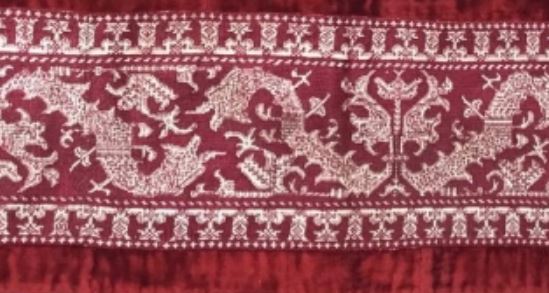
Well, I did find a few examples of things that were brand new to me, but clearly identified as belonging. First is this one – a fragment sold at a Bonham’s auction in 2023. They tag it as Azemmour, and 17th century.

I adore this parade of monsters. For one, I have not seen its like before, yet given the style, interior ornament, and execution, it belongs in the family. Second, it’s clear from the wild divergence of the detail that absolute precision repeat-to-repeat for the person or team who stitched it was rather optional. Those squares and “edge whiskers” that make replication easier to count are far from uniformly worked. And there are also some departures in larger elements of the design as well.
I had to graph it up immediately while I could still squint to do so, norming the repeat as best as I could for my own ease of stitching, even though there will be width for only one full iteration, plus some side bits left and right.
Because of the excessive amount of “design taming” needed to norm this one I have taken more liberties with fidelity than I usually do. I squeaked out my chart and have started laying in the base design. All of the major elements and placements of the original are in my rather broadly adapted version. It will be obvious, proportional and recognizable, but there will be departures, especially in the use of the small filler motifs between the monster bodies, in the placement of the interior decorations, and in minor deviations in the shape of some of the fins and projections. So close, but not exact.
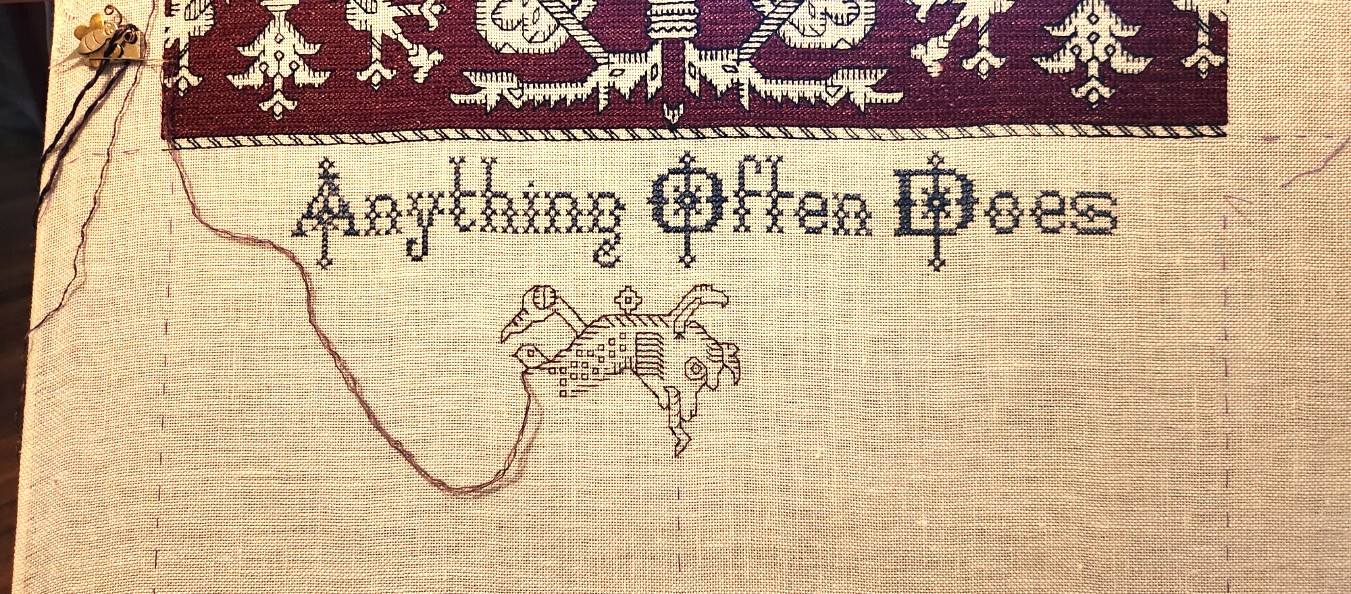
The working method for this one will be different from the claret red voided bit above, and also a departure from the original. The Bonham’s voiding was done in that heavily overstitched meshy treatment I have worked before. That would be a bit overambitious on the 28 count, so I will relax and just do more long-armed cross stitch. But I will stick to presenting the outlines, detail and voiding all in the same color as in the auction fragment. My goal is to lay down as much of the precision rendition as possible, saving the simple background stitching for later. Just in case.
Despite the morning-light color distortion, I am actually using a purple silk here. More of the legacy Tied to History Allori Bella from my stash, split down and finger spun to my desired thickness. Once the yellow goes behind the blue on “Anything Often Does,” I will enjoy having the color play between that color and the purple.
So between roughing in the monsters of certain menace (disclaimer – no actual monsters of this type in the Hungry Judges book, but on here they represent a deeply disturbing aura of major peril central to the plot); and doing the grounds behind the lower half of the motto, and behind the monsters, I feel I have at least three weeks of accomplishable stitching on my dance card, and can outlast any additional temporary visual hurdles.
What other strips am I considering for when these bits are done?
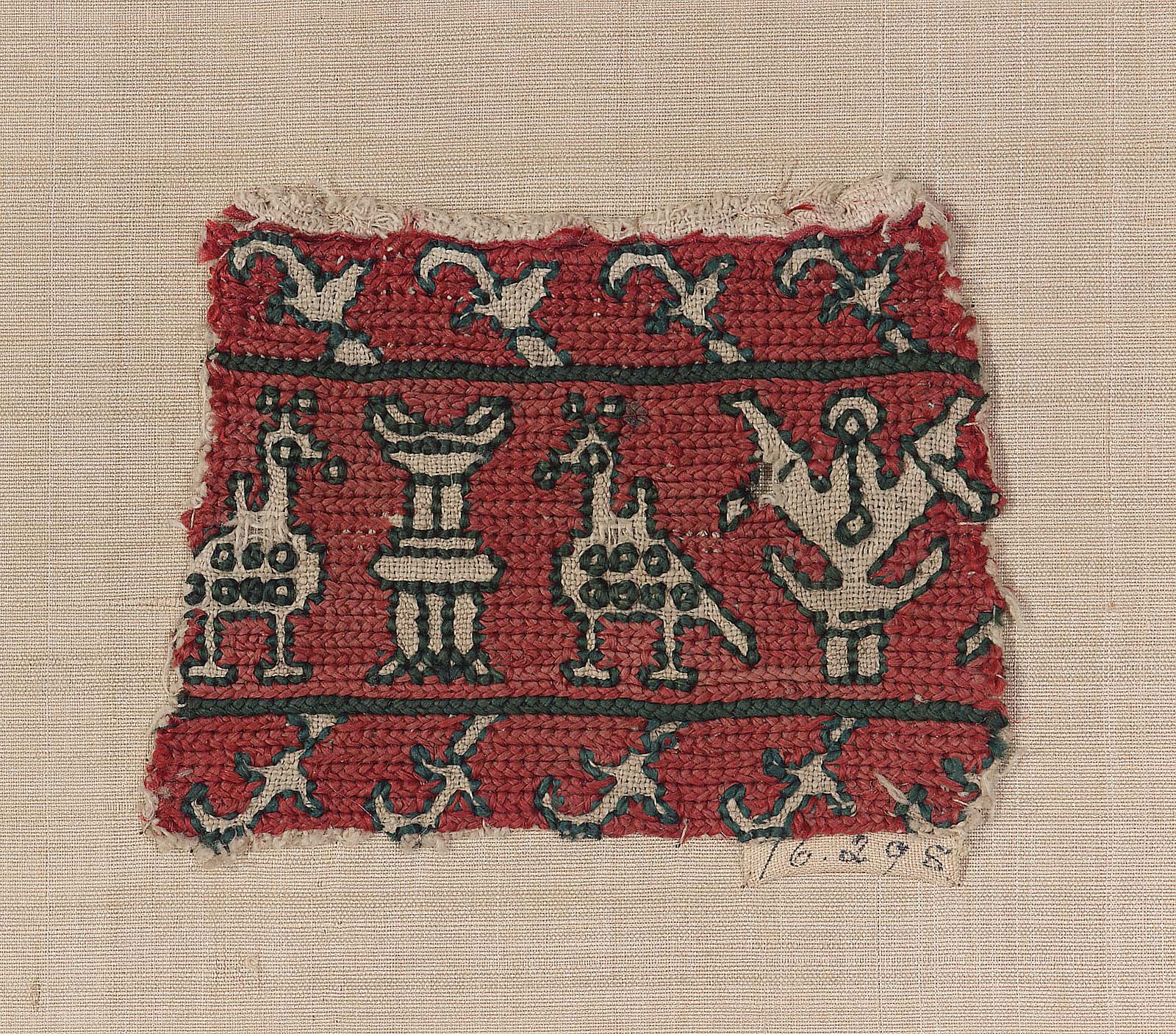
Here’s another auction find from 2019, and a unique composition that I haven’t seen before. Also claimed to be a 17th century representation of the Azemmour style. Not quite sure what is represented. Possibly camel-like unicorns at a fountain. I haven’t charted this one yet. The stitching style of the ground will make that challenging, and I may not have room for it on this piece.
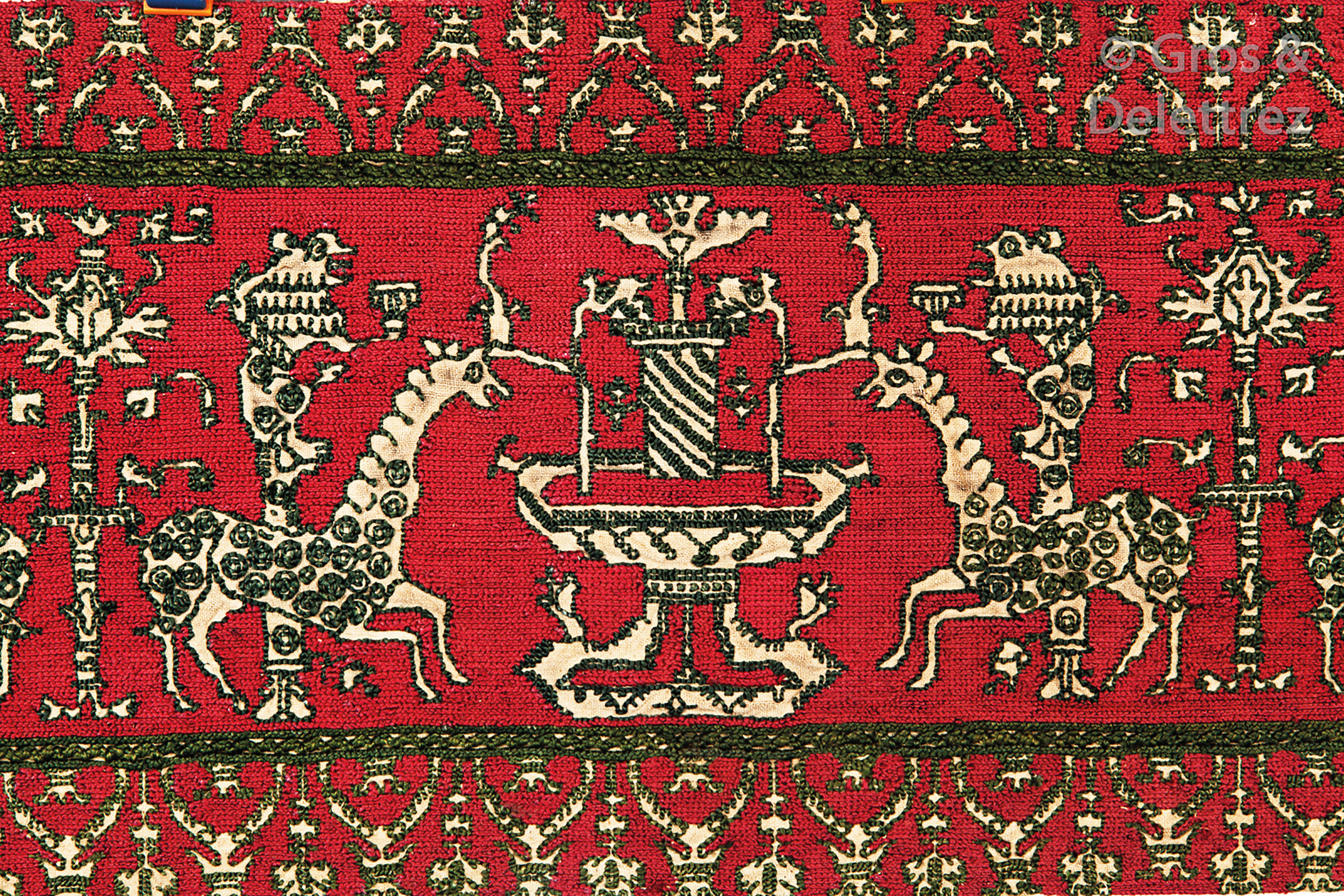
Of course there are the oh-so-well-represented bird panels, the cup sipping/flute playing harpies the fountain panels, the urns, and wide meanders. And more. So much to play with for just this limited space. I suspect that one or more variants of the bird panels will appear. They are narrow and easy to shoehorn in. And I will need to leave room for at least one band of companion border, top and bottom. Identification, selection, color, and execution of course are all open to whim.






Update
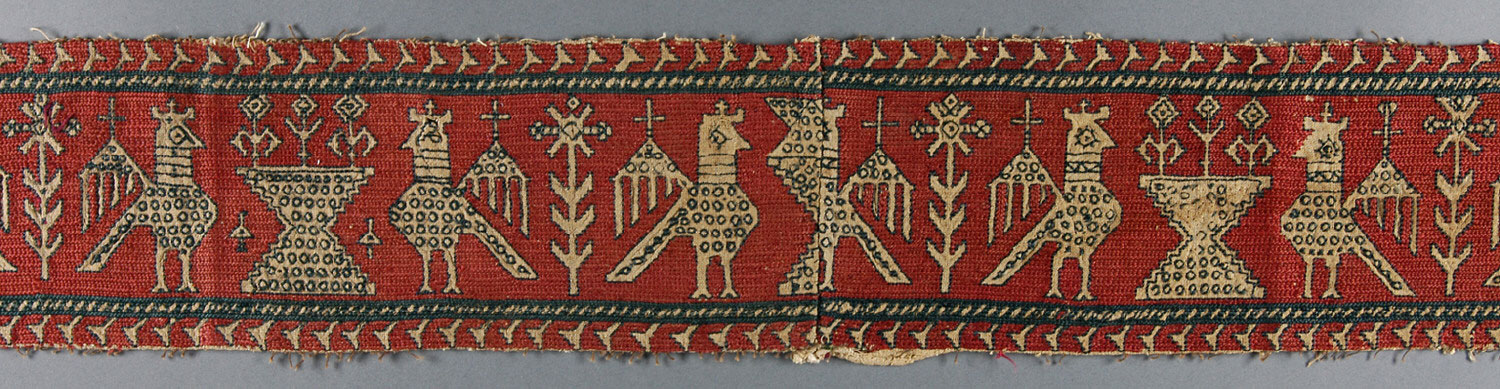
After I posted the photo of the strange camel/giraffe/unicorn beasties at their fountain, Stitch Pal Melinda chimed in with photos of a similar strip held at the Los Angeles County Museum of Art (LACMA). Here is the auction strip photo again, and a photo she provided, side by side for comparison (I am hoping she doesn’t mind the side by side). Auction sample on left, Melinda’s on right.
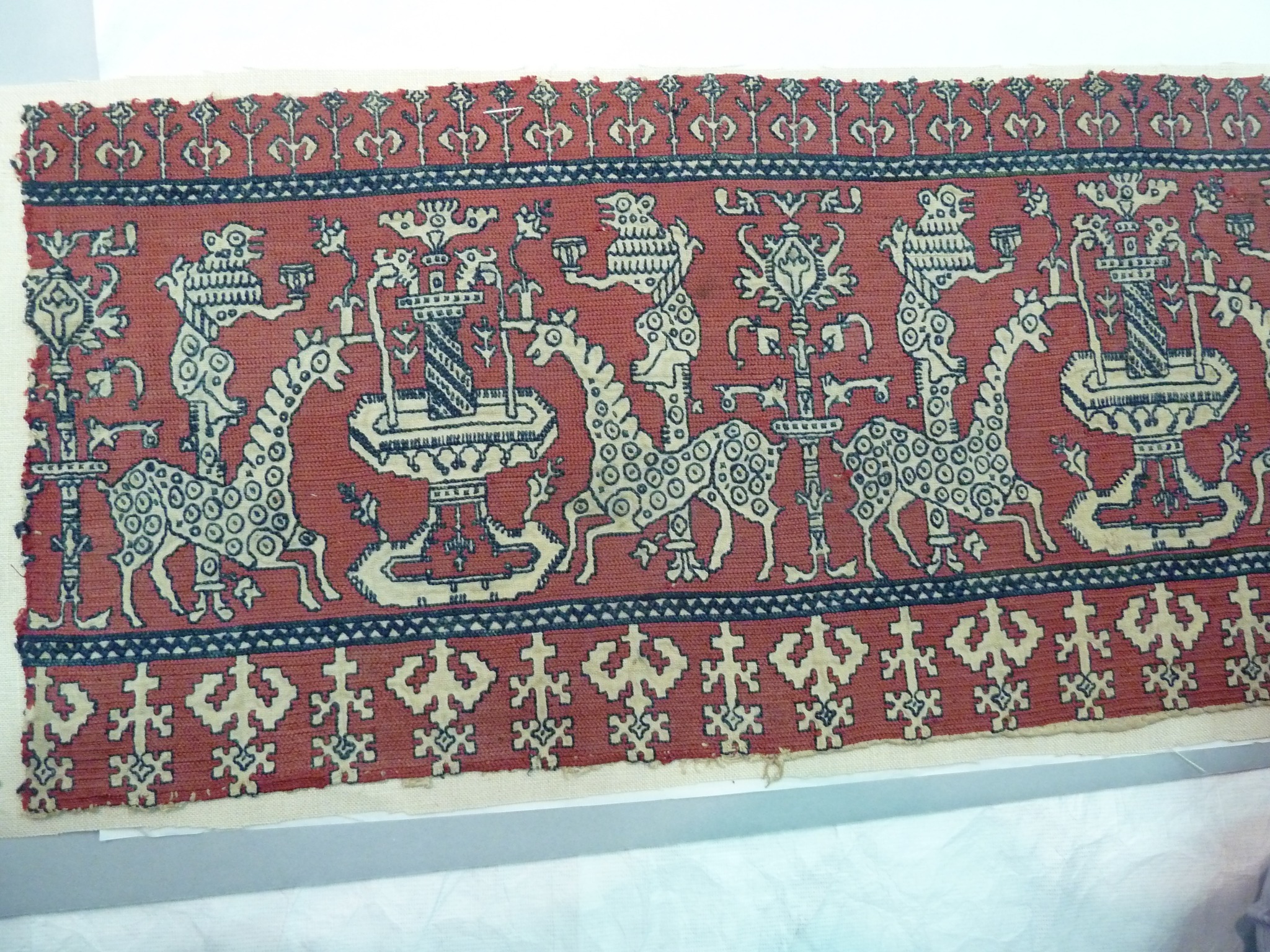
I did go wandering through that institution’s on line photo collection but could not find a citation or page. Even Melinda notes the lack of info on the piece other than the Italy or Spain 1700s notation, which we now now to be not entirely credible.
So for fun, let’s compare. First, it’s clear that there is commonality between the two. The rondel-decorated long neck beasties. The pillars behind them, each topped with a chalice-holding monkey. The central fountains and trees at the other end of the bounce repeat between the animals’ hindquarters. The modes of internal decoration on the design elements. They all do track across.
BUT there is considerable difference in the total representations. This isn’t a case of long-lost-twins where one can say “Oh, look! Someone sold two snippets of the same work to two different customers.” Details are different, with some simplified, some omitted entirely. Spacing between design elements, the proportions and widths/heights of the elements vary between the two. And of course the companion border treatments do not track at all. Particularly curious is the change in scale for the lower companion border in the LACMA sample. That is quite odd.
Can we take any clues here whatsoever from this set of similarities and differences? Posit relationships or dates? Not within my competence. I would guess that there are other examples of this general motif out there somewhere. And that for both of these someone eyeballed copies of the base concept rather than painstakingly transcribed some graphed or stitched “official” root source material. I further suspect that if we were to see a longer sample and follow along the repeats, just like the odd monster I’m working now, we will find that the individual iterations of the design are far from uniform (I can spot some even in the small pieces seen above). And as far as dating, we can’t assume that the change in border scale indicates some sort of later/less diligent manifestation of an earlier more detailed concept. Hard, chemical forensics would be needed to provide clues on which of these two might have been done first.
If my eyesight holds out I will try to chart this. Possibly as a melded average of the two representations. But there’s more stitching to be prepped for the coming few weeks, so it won’t be happening with anything remotely resembling urgency.
And thank you Melinda! Your clever eye and visual memory has made my day. I always enjoy a tumble down a research rabbit hole. All the joy of happy productivity, to you. May your threads stay untangled, and your stitches, true.
WORKING IT
And the latest piece continues to grow.
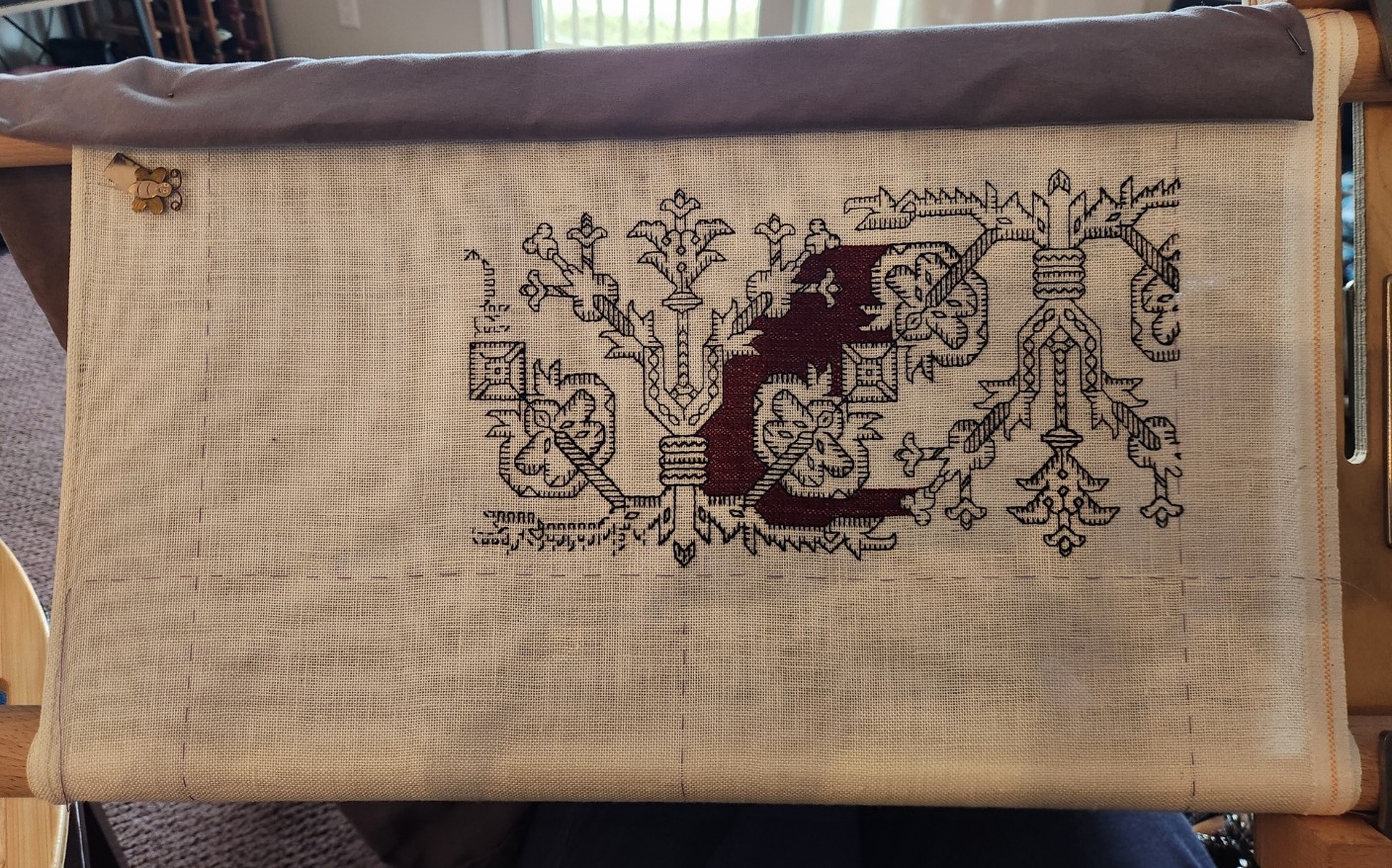
At this massive gauge – 28 threads per inch compared to my normal 40+, it’s mile a minute. All in all I am pleased. While the voiding is sparse (one strand of spun Au Ver a Soie’s Soie D’Alger – a thread economy measure), it is solid enough to be effective.
Another thread economy issue is in the black. The reeled long fiber Alori silk is divisible into four strands. Each of those strands is made up of three plies, not all of uniform thickness, although the thickness of each of the four officially divisible strands is very close. I am dividing each strand into a two ply, and a one ply, using the one ply doubled. No, this is not an advisable practice, and I would not suggest anyone else pursue it. But I am working from stash and want to eke out every inch possible.
As a result of my frugality there is a noticeable variation in the density of the black double running stitch lines. Some are heavier than others. To be fair, this is actually a look pretty common among museum artifacts, but in their it case was caused by the stitcher’s having to finger-spin each length of thread used from a clout of dyed, combed but unspun silk fiber. It’s especially evident on samplers worked by newer/younger stitches, where there is a marked difference in weights and even colors, since intermediate shades were achieved by marling together their parent hues. As with everything, practice helps. Some stitchers were more uniform in their thread thickness or color blending efforts than others. So I am doing my best, trying to mate or meld areas of similar weight so thick/thin dashes don’t occur in the same line of double-running.
In the helpful hacks department, note the old grey pillowcase pinned to the top edge of the work, and hanging down in back. That’s a light shade. I find that minimizing the ambient light shining through the work from windows, low lamps, and the television eases counting. In this case the pillowcase does double duty. This piece on my longest Millennium frame bars is too wide for the travel carrying case I made for on-frame projects. I suppose I could make another, but time does not stand still. I pop this one into that king size bed pillow slip, pin the top end closed, and it’s good to go.
Go we did. I packed up my upstairs Lowery stand (I keep a hex key in my stitching box for this very purpose), disassembling the thing into a heavy canvas tote bag, and bringing the frame, large frame extender, tool chatelaine, and pirate lunchbox of threads and other support materials/tools with us out to our place on Cape Cod. A welcome respite and restorative bayside sojourn. Nothing heals better than watching the tides march in and out.
As to health issues, I have bounced back from the dual biopsies in March – stamina and strength are back to where they were back in February. Findings are not universally great but neither are they dismal. My Danger Lentil might have been any number of tumor types that are far more dire than what was revealed. I do have a secondary chordoma site, at a location not previously documented for that very rare manifestation. But chordoma doesn’t eat brain. It eats bone and connective tissue, and responds well to radiation therapy. I meet with a rad oncology team soon to plan and embark on another round of proton treatments.
In the mean time I am in good spirits, optimistic and full of fight, along with the strength and stubbornness to win. And armed as I am with this easy to see project, plus working on Ensamplario Atlantio Volume 4, and a few pairs of socks to knit – equipped with ample amusements to keep that determination in high gear.
NOT QUITE EXACT, BUT GOOD ANYWAY
So. More examinations of the corners of the big towel from the MFA, and my first corner. Here are the four corners of the original
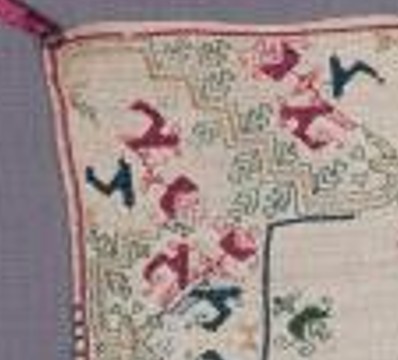
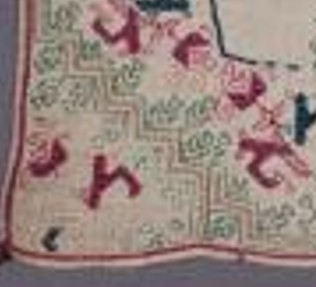

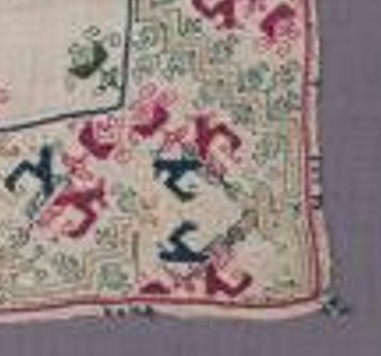
Not quite aligned but all there. Now my stitched corner as of this morning:

It’s closest to the one on the lower left, above. But not exactly. Look at this bit.
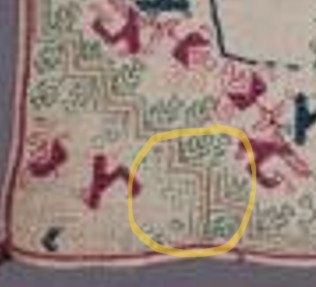
That’s a clear kludge. Not to brag, but my join is cleaner than this. I can’t deduce where the stitcher (or stitching team) began, but it’s clear that either the vertical bit on the left side of the photo, or the horizontal bit on the right was already laid down when that corner was rounded. The stitcher did their best, but the pattern doesn’t line up. For that matter, no two of the original corners ARE the same. But I bet you didn’t notice when you looked at the thing as a whole.
I will continue around on my mini-version. I haven’t decided yet if I will limit the width to multiples of the whole design, so I can replicate my corner exactly for the remaining three. Or if I will just make do, in a celebration of the heedless joy of the original.
And how far do I have to go to get to the next corner? Here’s my full cloth, so you can see the proportion of as-yet-not-done to the bit completed:
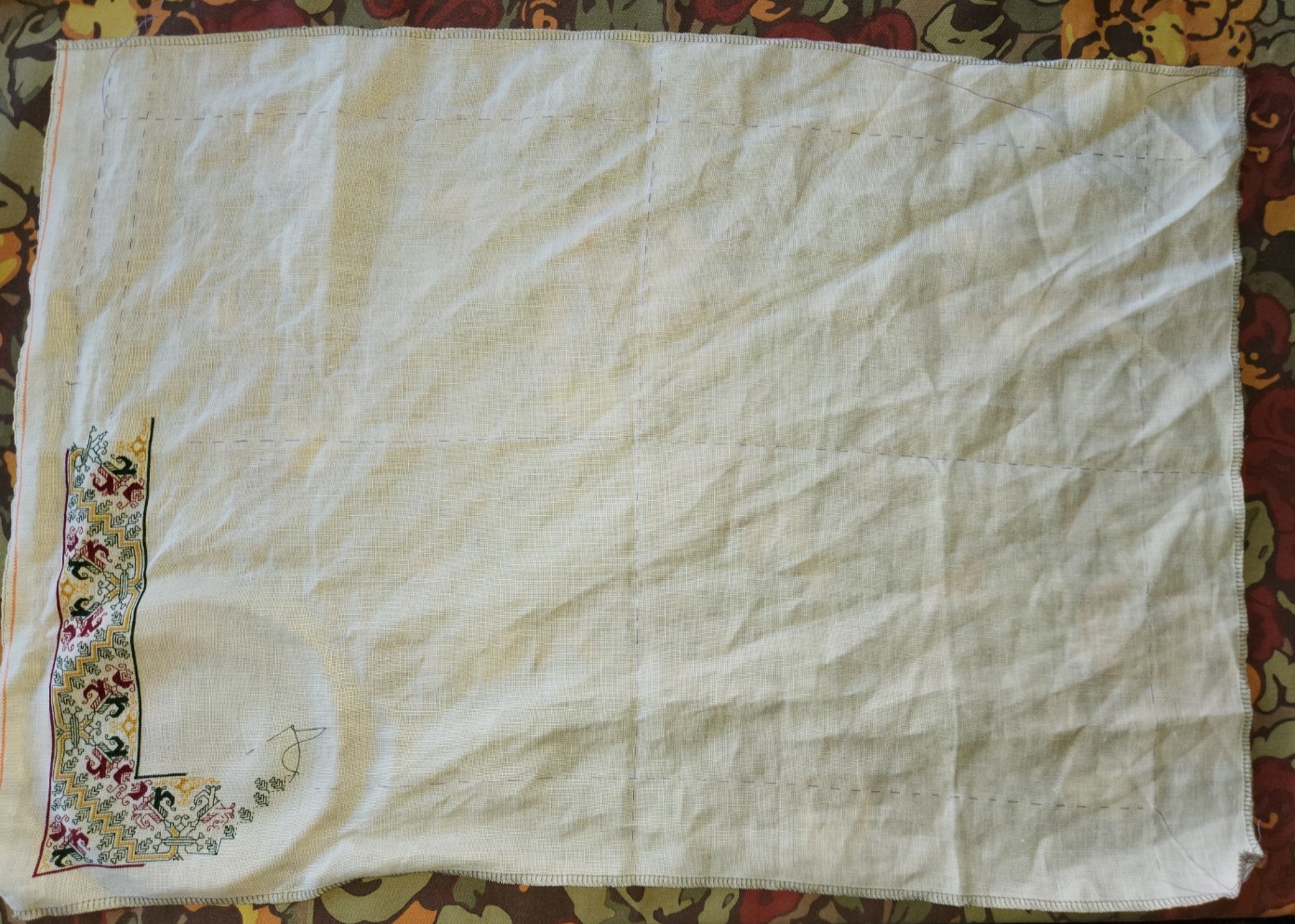
Quite a ways.
Aside from the corner challenge, upcoming decisions include a supplemental treatment spanning the center. Here’s the original again with two double width strips and two narrow single width ones across the center.

Examining those bars, I can conclude that they were done after the framing, and were aligned with the cloth’s horizontal centerpoint, because the band design is truncated (more or less) at the same point where it meets up with the frame, both north and south. But note that the centers of repeat along the long sides of the frame itself do NOT align with those bars, nor do they align with the measured center of the cloth. Again I bet you didn’t notice.
My smaller cloth may have enough room for one wide center bar; two narrow center bars; or one wide bar flanked with two narrow ones. Lots to think on there, but I won’t get to that part until after the frame around the edge is complete. And then there’s their alignment to consider. (I’m leaning towards filing them under Chaotic Neutral for the time being.)
On the healing front, I’ve completed Day 23 of radiation therapy. 17 more to go. No major perturbations, just the slog of rising before dawn to drive downtown and back before major traffic. Not that I’m counting or anything…
AND SO WE BEGIN AGAIN…
Never will I be someone who has a long hiatus between projects. Aside from the fact that I always have several concurrent ones, the final phases of any project are usually fueled by advance planning for the next one.
As I mentioned in the last post, I was prepping the ground for RELENTLESS FORWARD PROGRESS, the piece I am doing as a thank-you for the therapy and nursing staff at Vanderbilt Rehab/Newport Hospital. I’ve finished the truing, decided on a size, hemmed all the way around, and basted my centers and edge borders. I also completed the atypical (for me) task of plotting out 90% of the chart for the entire piece, and started in on the stitching:

I did the extreme layout because I wanted to center the motto properly, inside a surround that used as little fudging as possible. This meant working up corners, and making sure the repeat count was congruent with my usage, and with the available space. Oh, and the lettering. I didn’t find a vintage alphabet with the right flavor, so I decided to make the piece rather abstract, with a quasi-futuristic typeface, instead. I went looking for Just The Right Thing, and didn’t find it among charted alphabets, either. So I drafted up my own. Taking four or five different vaguely science-fiction-movie style typefaces, I rammed them together and drew up my own outline-only interpretation. Before you ask, I don’t have the whole alphabet – only the letters I needed for the motto. But except for an H and I, I have all of the top ten letters from the frequency table, and those two are easy extrapolations.
As the photo above shows, I’ve matched up the center of my chart with the center of my cloth, and started in on the stitching. If you look reaaalllly closely you will see the pink basting threads marking my center lines. And even just starting out I am loving the Pearsall’s. Smooth, sleek, easy to stitch – a dream to work with.
My intent is to do a narrow inner frame around the lettering. Inside that frame I will do very open voiding, possibly just diamonds in a complementary but lighter color. I might experiment with the Pearsall’s 6 ply floss. Each of the separable standard plies is clearly made up of two constituent strands. The silk itself is quite long staple and very strong. I may try to separate a standard ply and work those background diamonds with just one of those strands – what is in effect a half-ply of silk. That would stretch my limited supply, and keep the lettering in front as prominent as possible. Stay tuned for that experiment. I’m not there yet, and have to finish the motto first.
As for my continuing rehab from surgery – I am still improving. Every day a bit stronger and more capable. I can walk further, sit longer, and do far more things on my own than I could in May when I came home. At the end of this month I will start a program of Proton Beam Radiation aimed at eliminating any last possible but otherwise undetectable cancer precursor cells; to knock the chance of recolonization way down. It will run through October and be a daily appointment, Monday through Friday. An inconvenience for sure, but anything that tips the odds even more in my favor is most welcome. In the mean time, my job is to get as strong and as fit as possible prior to radiation commencement. I am taking that job VERY seriously.
PLAYING WITH TOYS
As I mentioned before, there’s no point in honoring a book called Forlorn Toys without showing some of the toys. So I drafted up a representative sample.

I’m still filling in the background stars, but that should not take long. Then another plain band of long armed cross stitch, and selecting the first of what will probably be the last two strips on this piece. The final touch will be to revisit the motto section, adding themed elements left and right of the lettering, and perhaps jazzing up JOY a bit so that it doesn’t look so pitiful against the darker typeface used for the rest of the lettering.
As to the remaining strips – I’m actually running out of material. I either have to spend more time drawing, or stitch slower. But in the interim I have decided that designs used on pieces I have given away, never to be seen again are now fair game for repetition. So if you see something that piques a sense of deja vu, you are exactly correct. Done before, but not precisely in this way. An old friend returning for a repeat visit.
After this one on to the next. No clue yet as to what that might be. I have a couple of outstanding promises in queue. Possibly one of those. And those teddy bears… I may doodle up a couple of strip variations featuring just them, for folk who want to do up birth commemoration samplers, or bibs and toddler clothing trims for particularly favored children. Provided there is interest, of course.
PROGRESS ON A WEALTH OF FRONTS
It’s been half a month since the last post, and all sorts of things have happened.
First, I’ve finished the wildly intricate interlace panel on my current sampler.

Second, as I was doing so I found an error in my chart for it as it appeared in the original edition of The New Carolingian Modelbook. The error was a minor one, a copyists/flip and mirror problem with two side by side crossings. It’s my guess that no one has attempted this particular design before, otherwise they would have either contacted me about it, or trumpeted my incompetence on social media. So of course I had to correct the problem. For a legible copy of the correction, including the original TNCM source attribution, and two chart versions – one for the border as shown, and one for a wider border or all-over design, please click here download a PDF file.

I have also been able to draft out a couple of tribute specific bands for this sampler, referencing the in-process novel Forlorn Toys in specific. They will be coming up after I finish the latest leafy strip. So stay tuned!
In other news, at long last, the Victoria and Albert Museum has updated all of the pages for the individual contributors under the Unstitched Coif Project. Again thanks to Fearless Leader Toni Buckby! My page can be found here, and has both the essay I did to accompany my work, plus ultra high resolution ZOOMABLE photographs of the back and front of the piece. For some reason the museum chose to lead with the photo of the backs of all of the pieces.

And for those of you who have asked about my personal health odyssey – I am improving. I’m in the middle of graduating from walker to cane. I can get around well with the cane, but I am still shaky with it over uneven terrain, so I mostly stick to it indoors, and continue to rack up practice distance. I have also been able to sit longer, as my stitching and blogging progress demonstrate.
There are still some hurdles to go, including a stint of proactive/preventive radiation to minimize any chance of chordoma recurrence, but I will take that in stride like all the rest. In the mean time, I’m feeling further along to being my old self than I have in months. No doubt due to the incessant care, coaching, and excellent cooking of my Resident Male.
OFF AND RUNNING!
On the ground, it’s more like walking slowly getting used to the transition from walker to cane, but in stitching, we’re galloping. Here is progress since the last post.

Several strips so far, a combo of reach-backs to my older books, and to the more recent Ensamplario Atlantio Volume III. I am still drafting up the custom bands that are specific references to the content of Forlorn Toys, the book that The Resident Male is writing right now. When you see them you will realize what’s taking so long (other than limits on how long I can stand at the computer in a day).
I do have to report an oops. One that dates back to the publication of The New Carolingian Modelbook in 1995. I hadn’t stitched the current strip before, mostly for reasons of size. It’s quite tall. But this being a very long piece of cloth, I thought it would work well on this piece. Lo and behold. There is a small crossings error in the original. It’s small enough to be an easy fix, but I will put redoing that page in queue and eventually publish it in here, and on the errata section on the “My Books” tab elsewhere on this site.
In the mean time I’m at the point in this complex interlace that I can go off-book. I’m just copying what I’ve stitched to date now, flipping/mirroring/inverting the crosses as required. Yes, it’s an eye-bender, but each subsection is logical, and if I keep the precision up so that all of the subsections meet up nicely, no where near as difficult as it looks.
AND FROM THE FLIP SIDE
Here I am. A bit less than I was, in terms of body parts, weight, and height, but overall what remains is whole and mostly functional.
I am not going to go into the all the details, but I will say that I am incredibly lucky. So many things can go wrong during and after a 12-hour surgical procedure that involves many tricky bits near major nerve centers. But I am happy to say that my chordoma tumor was removed successfully, along with my coccyx and more than half of my sacrum. I will have to have a deep survey next month for surety, then be on lifelong watch to make sure it doesn’t recur, but for now at least I am cancer-free.
The surgical team was able to avoid some nerve damage, and to install a rather elaborate truss system to support my spine and hold my pelvis together. Those two things let me walk again, and even climb stairs – things I had hoped to be able to do, but realistically was accepting that I might not. I’m wobbly with a walker, and need a spotter on the stairs, but each day brings new strength as I exercise and practice. I am hoping that by the holiday season I will be off the walker and on a cane, headed to unassisted ambling.
The one area that is lagging behind is sitting. As you would expect, with that much alteration to my fundament, sitting would pose challenges. So far I am able to sit on a special cushion for about 4-5 minutes. I continue to train for improvement.
Weight is an expected loss during cancer treatment, and that did happen. But height? In my case because my lower spine was amended, a certain degree of shrinkage has occurred. I used to be 5’8″. I’m now 5’7″. So it goes.
And as you can tell by the presence of this update, I have computer access again. I’m using it as an inducement to get out of bed and stand, above and beyond the various exercise routines recommended by my physical therapist. Time however is limited. I can do a couple of short sessions a day, but no more. That means posts here will continue to be few and far between, and that no substantive work will be happening on The Third Carolingian Modelbook, or on corrections to Ensamplario Atlantio III (or for that matter EnsAtl IV).
I can however stitch again. I can do it laying in bed, sort of. Like the computer work, sessions are limited by endurance, so progress is slow. But there has been progress.

Compared to the last post, the dragon square is finished, and I’ve begun the voiding on the top strip. Nice and mindless, simple work.
So there it is. I’m still here, slowly recuperating. I do thank my spawn, siblings, mom, inlaws, and everyone else who sent encouraging notes, showed off their work from my designs, phoned, sent gifts, memes and silly bits to cheer me up, or visited. Your sharing buoyed me through a very challenging two months.
I also want to thank my surgical team, attending specialists, nursing staff, therapy staff, cleanliness/safety staff, and everyone else I interacted with at Rhode Island/Brown University Hospital, and in Newport Hospital’s Vanderbilt Rehab wing. That I write this at all is testament to the quality of their handiwork and care.
And it goes without saying that he who is precious to me – my Resident Male – deserves major thanks for his constant presence and support, gentle nursing, firm coaching, and patience. He drove hundreds of miles back and forth to Rhode Island between 17 March and 29 April, and has catered to my every petulant wish since returning home.
Stay tuned. I intend to keep these posts coming, and pivot away from tedious health updates back to the needle arts.
EPIC FANDOM STITCH-ALONG NEWS
Just a quick post to let folk know that the Epic Fandom Stitch-Along from several years ago is still free, and available for download here at String-or-Nothing. AND I’ve made it much easier to do so.
I have consolidated all of the individual week by week releases along with the general info provided before the project began into a single 50-page PDF document. No more hunting for the single page you need in a forest of other pages! It’s now on the My Books tab, and I’ve added a link to the top of the SAL tab, as well.
Or you can click here to hop directly to the PDF.
As ever, enjoy! I do hope some folk are brave enough to try this one. And like always, nothing brings me more joy than seeing the pattern children out at play. Do the whole SAL, cherry pick the panel you want to do.
Same restrictions as my other offerings – personal use only, and please respect my copyright. Other than that, have fun. 🙂

ENSAMPLARIO ATLANTIO VOLUME III!
I am delighted to announce that the third volume in my free-to-download series of blackwork pattern booklets is now up and available here on String-or-Nothing.

Like the previous two volumes, Ensamplario Atlantio Volume III contains original (and a very few redacted) filling designs of the type used in inhabited blackwork. That’s the style that fills outlined shapes with fields of diapered fillings, as seen in my Unstitched Coif project submission, and in my current sampler. The new fills I created or redacted for the Coif are all in here (I had to do more – I actually ran out of suitable ones!)

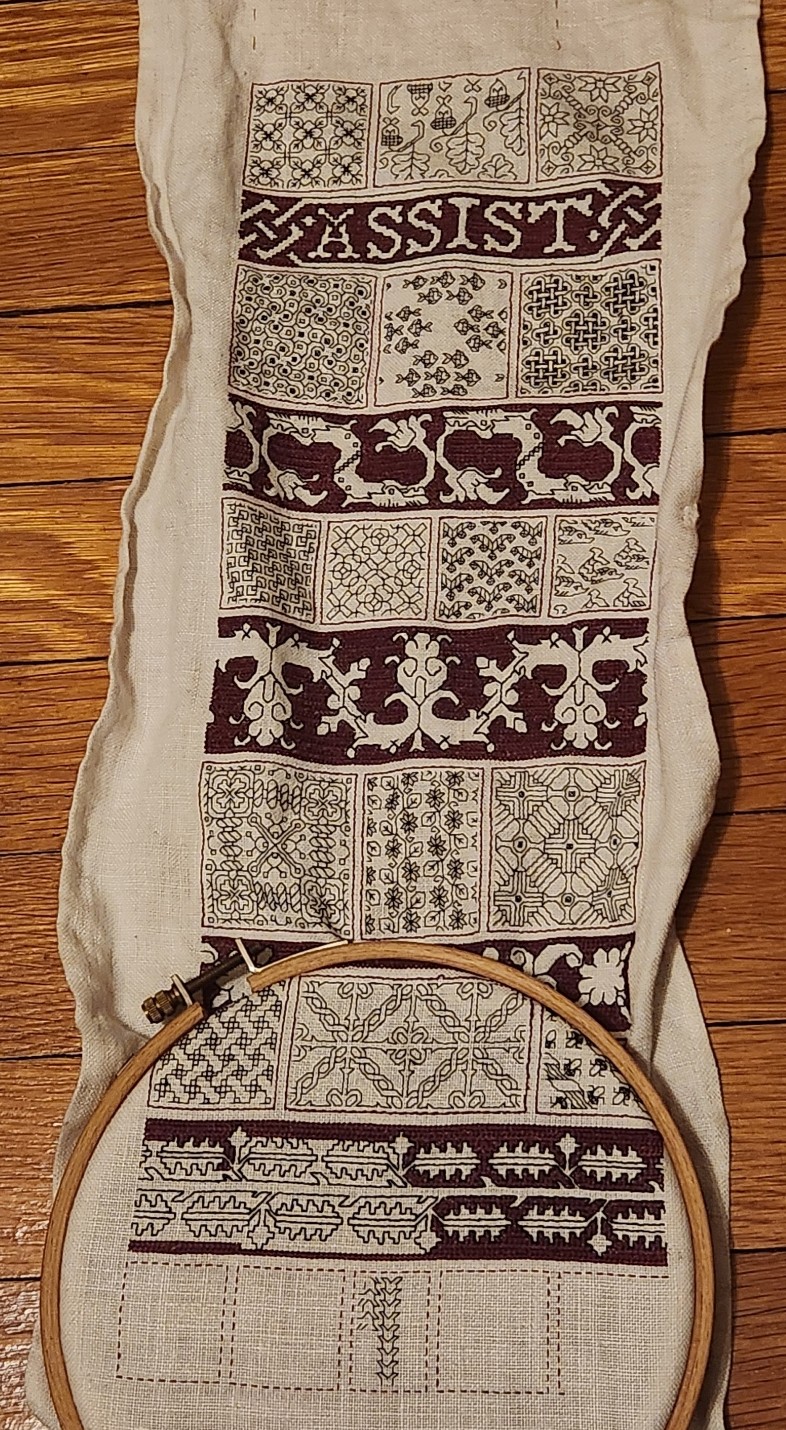
It also contains most of the strips found on the several tribute and protest samplers I’ve done over the past several months – the various mythical beasts, interlaces, swords, and other fantasies in thread. (The ones not found in here are from Ensamplario Atlantio II, The New Carolingian Modelbook, or The Second Carolingian Modelbook.)

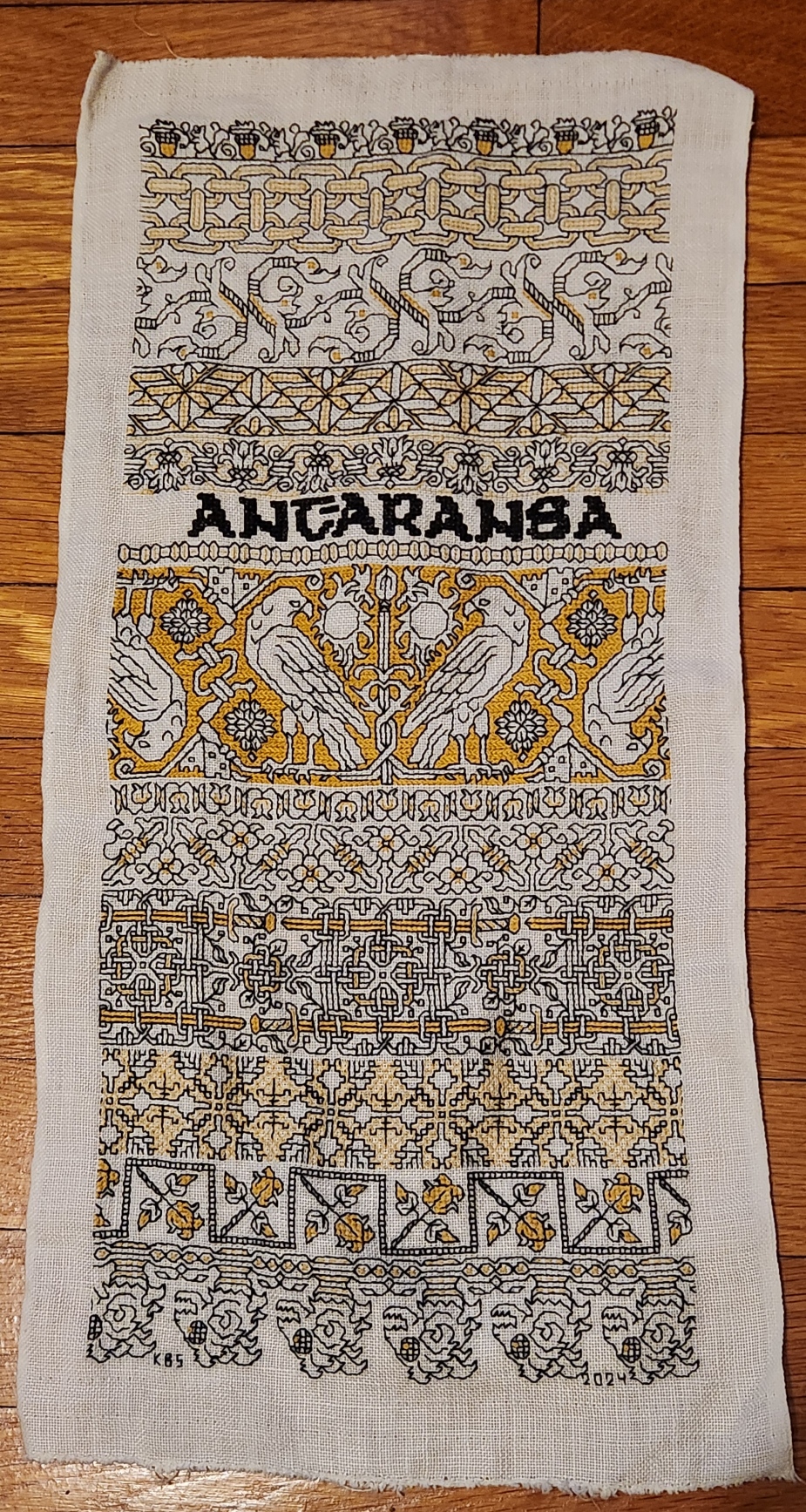

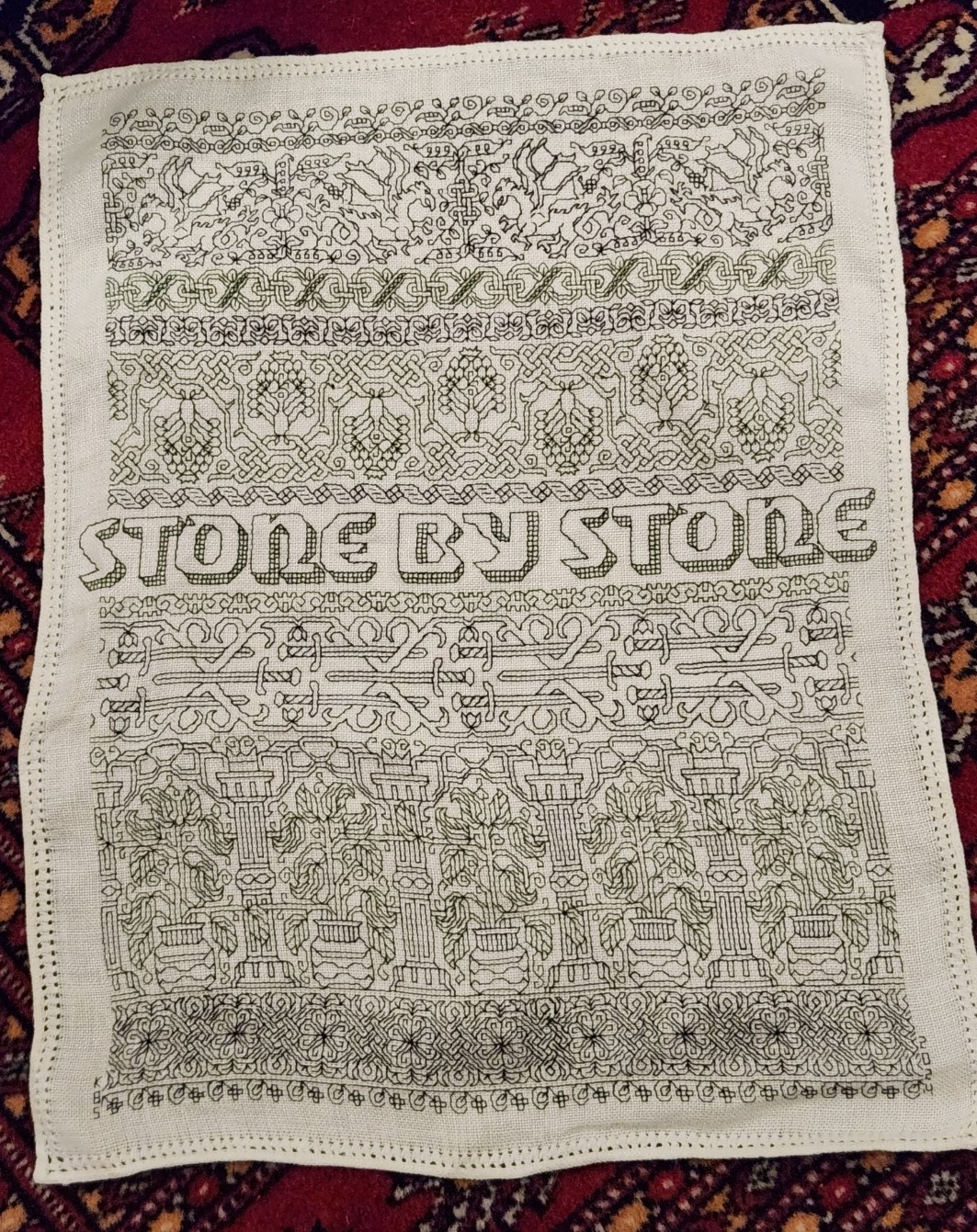
And to top that off, there are lots more designs in there I haven’t stitched yet, including tunic yokes and pieces with corners that could be used for framing necklines, or table linen. For SCA folk there are a few items of special interest – the populace badges of the East and Atlantia, and a belt motif that can be infilled with the colors that signify patronage relationships (squires, protegees, apprentices).
In truth, I’ve rushed this one to release. I apologize if there are errors or inconsistencies. I plead time pressure. If major errors turn up and I get a chance, I’ll go back and fix them. However, the very few source attributions in it have been thoroughly confirmed and are genuine. Except for those redactions, all of the other material in there is my original output.
Why free? Why not? My goal is to promulgate the spread of stitching, and to make it easy to do so. Yes, I could have bundled these books up and sold them on Amazon, like the Carolingian Modelbook series. But in truth, the yield is a pittance because I am under pressure to price the books low enough to discourage massive piracy. Higher pricing restricts access and defeats my goal of spreading the joy.
For the record, The Carolingian Modelbooks are the product of a lot of research, exacting redaction, writing, and indexing. The Ensamplario series is a lark. Largely just my doodle notebooks, produced with minimal effort. I felt justified in asking for recompense for them on the basis of labor alone. But EnsAtl books are candy to be shared just for the fun of it. You can pay me back by sharing photos of works you’ve done using these designs, teaching someone else to stitch, flaunting blackwork-embroidered garments or accessories in public to increase appreciation and awareness, or just by doing a good deed for someone in need (I release my pattern broadsides as Good Deed Ware, too.)
HOWEVER I retain copyright of my drawings, and release these designs for PERSONAL USE ONLY. For any other uses including including duplication, inclusion of the patterns on patterns or finished items for sale or charitable distribution, I request you contact me privately. I’m not an ogre, but neither do I want to see my goodwill answered with appropriation. My terms (if any) will be mild, and reasonable. Oh, and feeding them into AI for training is total anathema, and is expressly forbidden.
You can download Ensamplario Atlantio Volume III by clicking the link below, or by hopping to the MY BOOKS tab at the top of every page here on String. The earlier EnsAtl volumes are on MY BOOKS, too.
>>> CLICK TO DOWNLOAD THE PDF FILE OF ENSAMPLARIO ATLANTIO III <<<
Comments? Questions? Random remarks? Go right ahead.
 String-Or-Nothing