Moving right along on my latest. I’m just past the point of flipping the frame over.
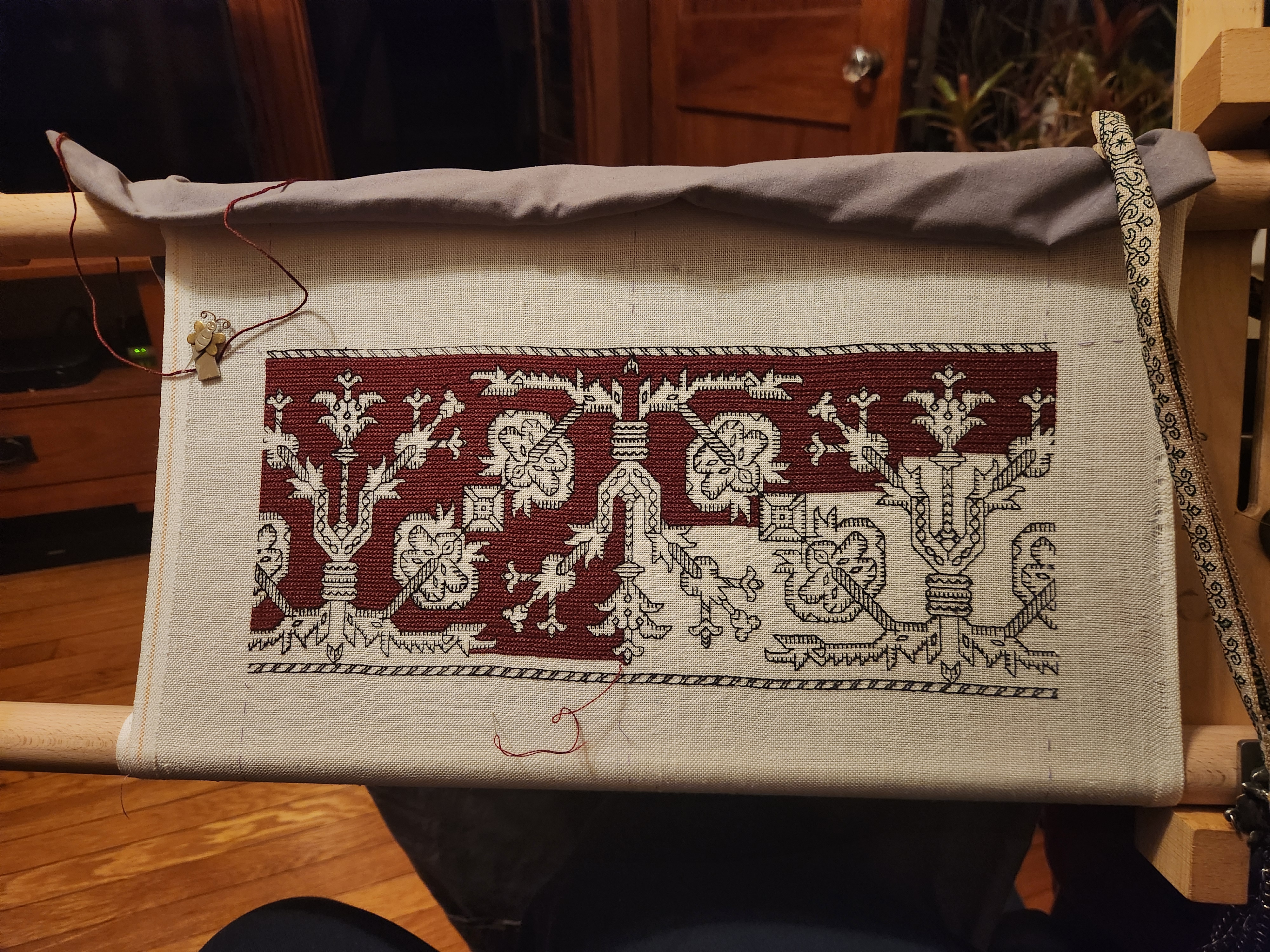
I’ve got all the black double running outlines for the main motif done. That’s not uncommon for Azemmour Cluster pieces, but is not a usual treatment for these larger ones. In the larger museum snippets they are usually outlined in the same color as the voided ground. In the later multicolor ones, anything goes. But it is more common for the smaller ones – especially the ones with birds and foliage or small urns. Since this is not intended to be a fully historically accurate piece, I feel free to take liberties. As for specific references for the pomegranate variants of the spider flower, I point you to these, both collected around the turn of the 20th century, and both formerly attributed as being Italian works of the 1600s.
Museum of Fine Arts Boston, Accession 11.2880, Newly attributed to Azemmour, 18th century.
https://collections.mfa.org/objects/68407/tent-stitch?ctx=4b923968-ddd5-426e-a76c-6afa55e9b949&idx=229
Cleveland Museum of Art, Accession 1929.843. Also newly reattributed and dated. Azemmour, 19th century
https://www.clevelandart.org/art/1929.843
A very similar motif also shows up on this late polychrome sampler.
Victoria and Albert Museum Accession T.35-1933 , Morocco, 19th century
https://collections.vam.ac.uk/item/O70740/sampler-unknown/
Flipping and Stitch Inversion
Why flip? Because I find it awkward to reach the entire area behind the frame for two-handed stitching. And the area of best access seems to be slightly different for each piece of work. But flipping long armed cross stitch (LACS) introduces a small variable that has to be dealt with. Inversion flips the direction of the interlace if the stitch is worked in the same way regardless of frame orientation. LACS is usually done in alternating rows, back and forth, to produce a plaited type appearance. While this is most evident when the thread offers better coverage than the sparse strand I am using, the effect is still there. I even take care to keep all rows across in the same left-right orientation, even if they are interrupted by a non-voided design element, so that when areas do meet up there isn’t a visible “seam” where two rows worked in the same direction abut.
Flipping however means that if I continue to work the same way, with the long arm originating along the top edge of the row and plunging back down at the bottom, slanted in the direction of travel, the spot where the voiding was laid down with the top of my stitching surface aligned at the top of my working area will be inverted compared to anything stitched after the flip. So to avoid those visible “seams” I have to mirror my stitching sequence along the vertical.
Now that I’m working with the side that was the bottom now at the top, my long arm stitches have to emerge at the bottom, proceed in the direction of travel, and re-enter the cloth at the top of my stitching line. Clear as mud? I thought so. This may help. the black arrows indicate direction of travel. And yes, the back side of this work presents mostly as vertical lines, with a bit of fudging at left and right, especially if a diagonal bit of non-voided area is encountered. And if that meet-up is not a diagonal, I do terminate my lines at each end with the equivalent of the missing plain old cross stitch leg, for a neater edge appearance.
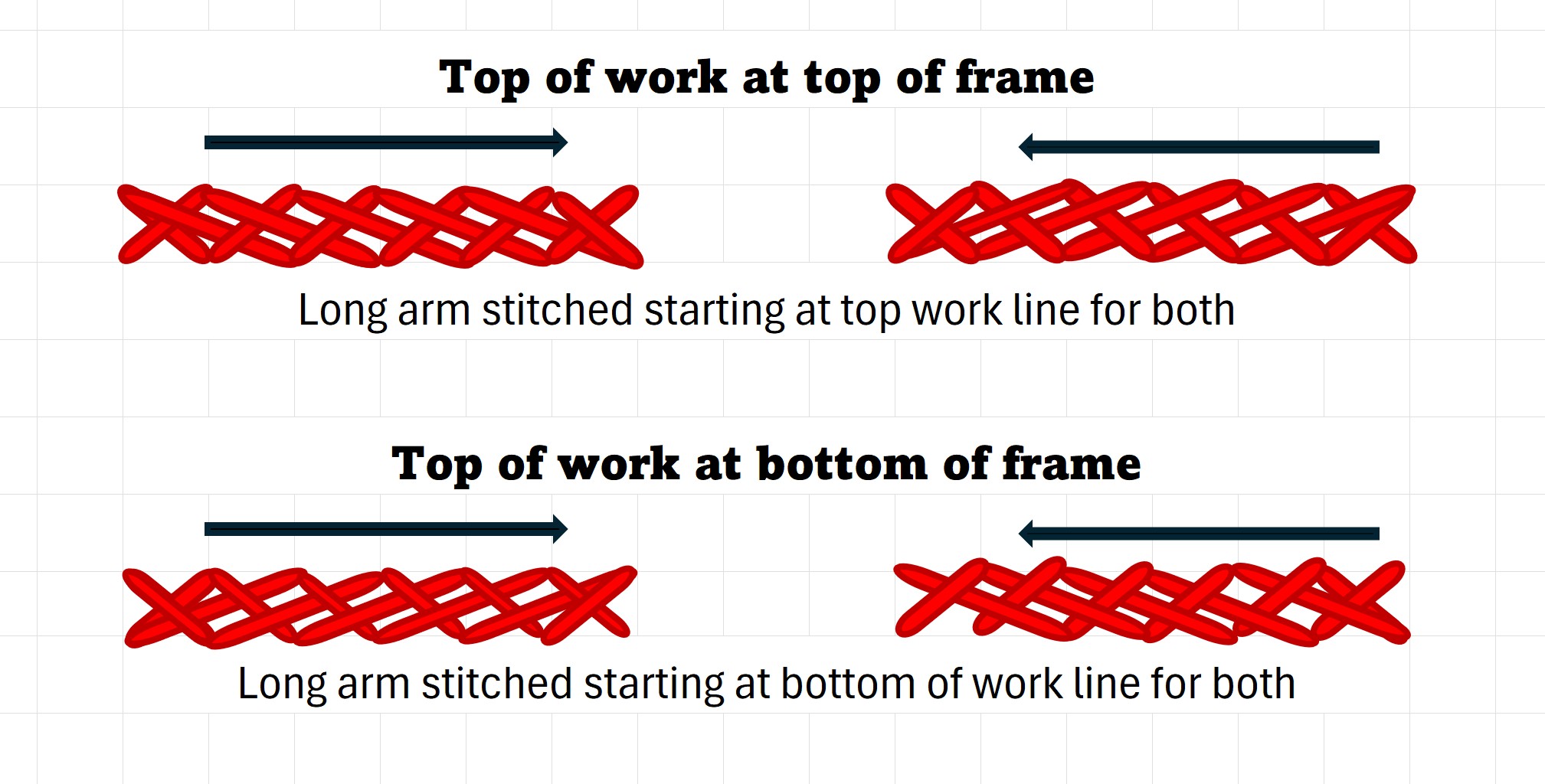
If you can visualize it while the direction of crossings look different when seen this way, once they are stitched they are identical, with no visible interruption in texture between them.
What’s Next?
It’s time to start thinking about the next strip. This one is just above the basted center line of my available ground. I am going to omit the traditional top and bottom framing motifs, often seen sprouting from or in addition to a divider like the rope edge I stitched, opting instead to just do a set top and bottom of the whole piece.
Next will probably be a narrower band, not voided. I think as a whole-piece theme, I will alternate voiding with plain double running bands. I am thinking about doing it in another color. I have some medium indigo color Alori silk, and some of the same stuff in purple. I’m considering one or both but probably not together, nor in combo with the black. Not enough contrast between them, and neither is in quantity enough for voiding. Have to ponder more on this.
And just for fun, in the photo at the top you can see the whole frame set-up. My widest Millennium, grasped on the right (just the tips of the jaws in camera range, by the Lowery Large Frame Extender. My chatelaine is draped over it, where I stow it between sessions. You can see the old pillowcase I have pinned to the back of the work. That limits light transmission through the cloth, both from the television (upper left, various vintage Star Trek series are comforting accompaniments to stitching); and the library window (upper right) during daylight hours. I have a couple of magnets stacked in the upper corner of my margin, to hold my needle threader and keep the cut length of thread I’m drawing strands from handy.
Health update
Needle threader? For work on 28 count? And 28 count at all? Yup. Although my fave is 40+, especially around 50, right now my health complications include a modicum of double vision and close detail fatigue caused by mechanical pressure on the nerve that controls the eye movements needed for binocular focus. I can see well enough to stitch, read, or knit out to about fingertip length, but much beyond that diverges – to the point where driving a car is neither feasible nor safe. But because I anticipated a visual challenge and throttled back, I still have my Emotional Support Stitching to fall back on. And it is most welcome.
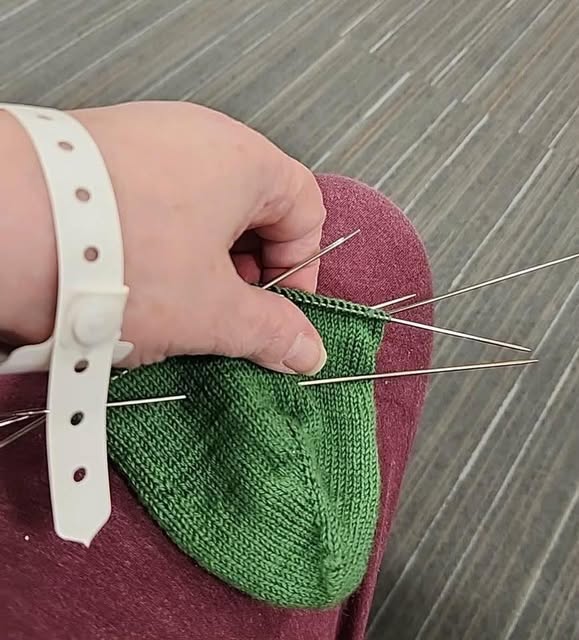
And I am happy to report that proton radiation therapy begins on Monday. We attack my cranial interloper aggressively, and I am optimistic for the outcome, and enduring the upcoming 40-odd days of treatment with minimal if any side effects. I did it last year and can do it again. Of course, I have other coping mechanisms. Knitting socks in waiting rooms, for example.


Beautiful work. And I’m glad you have that. It makes such a difference to be able to create, still.
-Alison
>
Striking and beautiful! May your 28-count last for as long as you need, and your return to 40-count be as rapid as is consistent with successful treatment.
The V&A sampler is interesting, with all those variants on the wingnut theme. The colours, though – maybe the stitcher was stashbusting, using up oddments?
All good wishes for the radiation therapy.