YES, IT HAS BEEN A WHILE
Lots of non-report-worthy stuff happening here. We redid Younger Spawn’s room as a guest room, replacing furniture that no longer fit our needs with items that do, and making it a more versatile set-up in general. The Resident Male underwent a much-delayed hip replacement, and has already healed up better than he was prior to the surgery. My last round of radiation was completed, and consensus was achieved that the pain I experience is in fact linked to a post-radiation sacral fracture, which appears to be healing on its own without further intervention. We’ll keep an eye on that one, just in case additional reinforcement is required. Younger Spawn came and stayed with us to do fetching and hauling earlier this month when neither of us was up to full capacity. (Much appreciated!) So it’s no wonder that blogging fell by the wayside.
I can report progress on several fronts. First, on the Anything Could Happen sampler. I am up to the narrow band of leaves voided in blue that mirrors the one at the bottom edge.
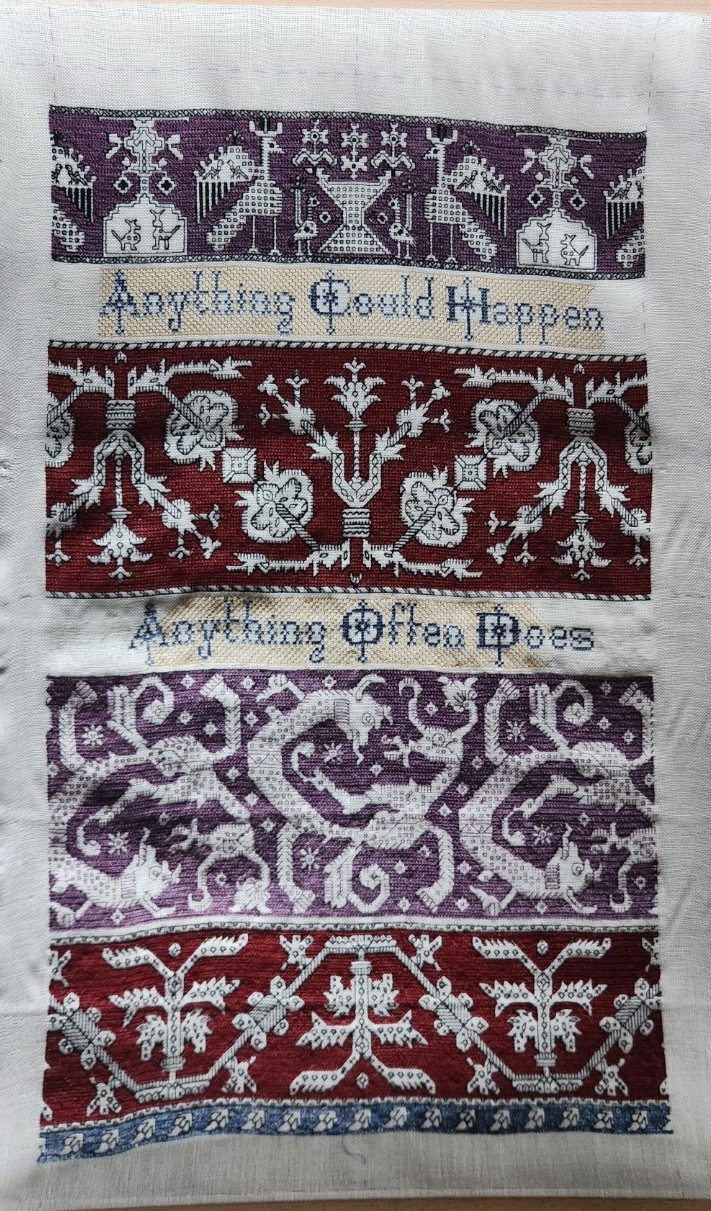
I also have to chart out the small motifs and signature/date squares that will go left and right of the two lines of the saying. Once I have those in place I will complete the yellow step-voiding on those panels. I have a good idea of what to put in there. My initials and year of completion, plus thumbnail sketches of a couple of items vital to the plot of The Hungry Judges – the as-yet unpublished book on which my Resident Male is now working.
And those in the know here will recognize that all of the major designs in this one are part of the Azemmour Cluster – a group of designs linked to Morocco which may have emerged as early as the 1500s, and continued on into the early 20th century. Lots of examples of this family were misclassified in museum collections for over 100 years. Fragments of these stitched designs carried the attributions attached when wealthy collectors doing their rounds on their Grand Tours of Europe bought them from dealers who probably thought that customers would pay more for Authentic Renaissance Era Embroidery Fragments than they would for bits of North African folk embroidery. And so they remained classified until advances in cataloging and communications, and the drive to photo-document these pieces brought them the attention they had lacked since they were first accessioned. Some bits with debatable attributions are still out there, but slowly and surely what is held and is in the public eye is being revisited and re-evaluated.
More progress. This time on my holiday socks for 2026:
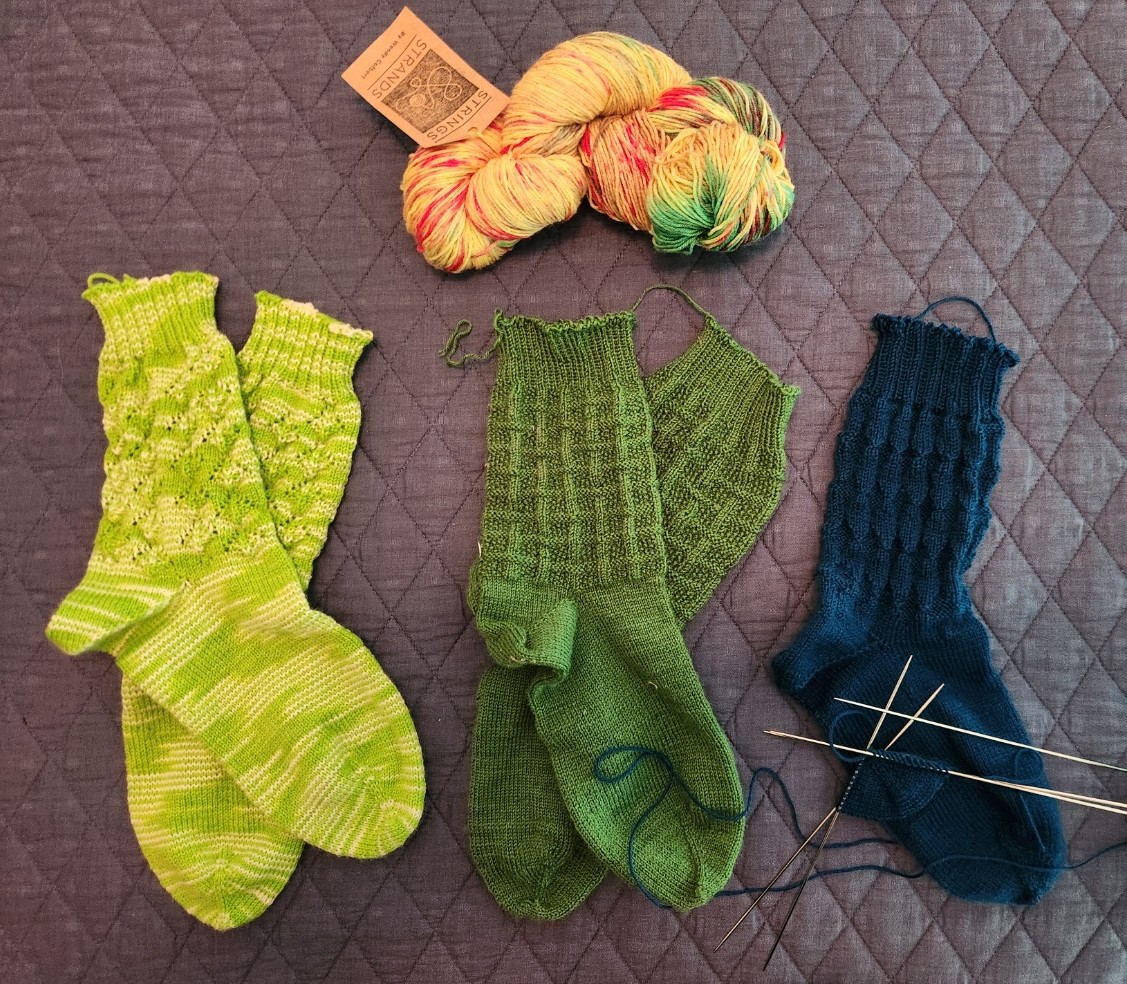
The three obligate pairs are either done or well begun. All three on the bottom row are knit from Cascade Heritage and Heritage Print. The as yet to knit skein above is Strings and Strands, a small and independent label, hand dyed, and a gift from a dear pal.
I try not to buy sock yarns at full price, since I go through them like popcorn. This yarn was on special at Webs. My cutoff price used to be $8.00 for 100g of sock yarn. Given the way of the world and the economy under the current occupying regime, that has had to move up to $10. per 100g. At the time both the solid color and print versions were under my ceiling. They aren’t anymore. Which is just as well. I found this yarn to be quite unruly for the traditional hard-spun wool/nylon blend sock yarn that it claims to be. Quite splitty, slubby, and prone to shredding. I think it will be ok in socks treated with tender loving care (as I have trained my spawn to do, they being the holiday recipients), but I also don’t think that this year’s output will last as long as that of other years.
That fancy one at the top? As I said, it was a present from a pal, so I feel entitled to use it to splurge on myself. When Blue Pair is completed, the next one up will be a pair for me. Probably combining that delightful multicolor with leftovers from all or some of the others. Maybe toes and/or heels in contrast. Possibly a few stripes on the ankle, or cuff ribbing. We will see what tickles my fancy when I get there.
As for the guest room – neat and clean, but nothing fancy. We donated the old twin size Captain’s bed to Household Goods in Acton, Massachusetts. It was in excellent shape, and they will find a family who could use it for another kid, grade school through high school. In its place we got a simple wooden queen size bed (no storage underneath); and a new nightstand to match. The old desk, dresser, and bookcase stayed. The desk, monitor and power source will be put in service when Younger Spawn visits. The perk of a 100% remote job is that remote can be anywhere, so we made sure to provide and anywhere against future need. You can’t see the dresser and bookcase, they are on the closet wall at the foot of the bed. But take my word for it, they are there. The matching nightstand is just to the cropped left edge of the photo.
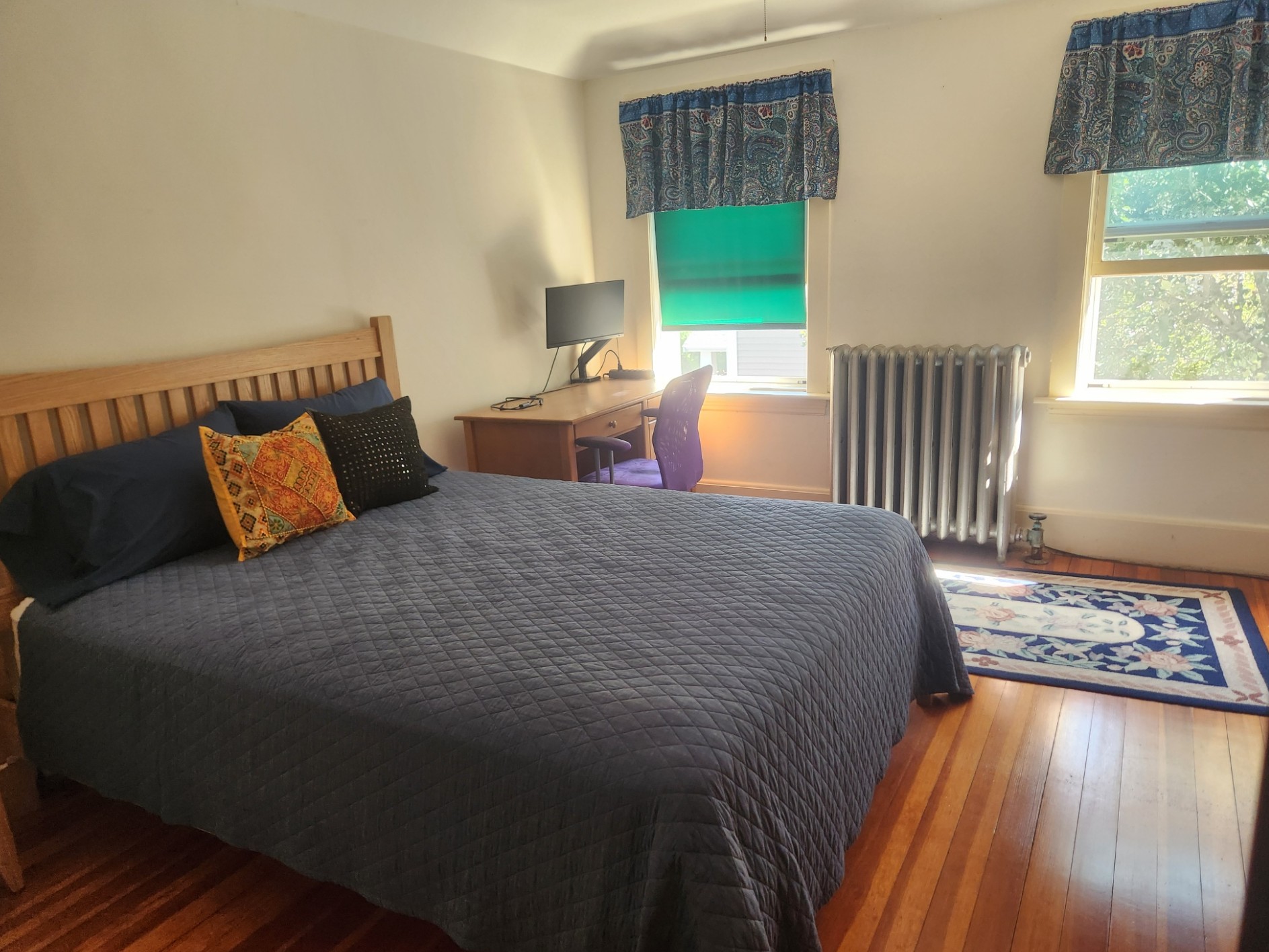
Items of special importance to the former resident have been carefully set aside, no rush to trash memories in the process. I also have some nice wall art to display over the bed, but I need to get those prints framed first.
So there you have it. A portion of what we have been up to, outside of healing, of course.
CONTINGENCY PLANNING IN ALL THINGS
Obviously I am still at it, working away on the current embroidery, and surfing the health issues management seas.
First, to present the size of the piece as a whole, here it is, fully unscrolled. No, that’s not discoloration at the bottom. Just an early morning light shadow.
At 28 threads per inch, these strips are gigantic. The actual margins of my stitched area are barely visible, marked in basting, roughly an inch inside the scroll bar mounts, so there’s not as much usable real estate here as I would normally prefer.
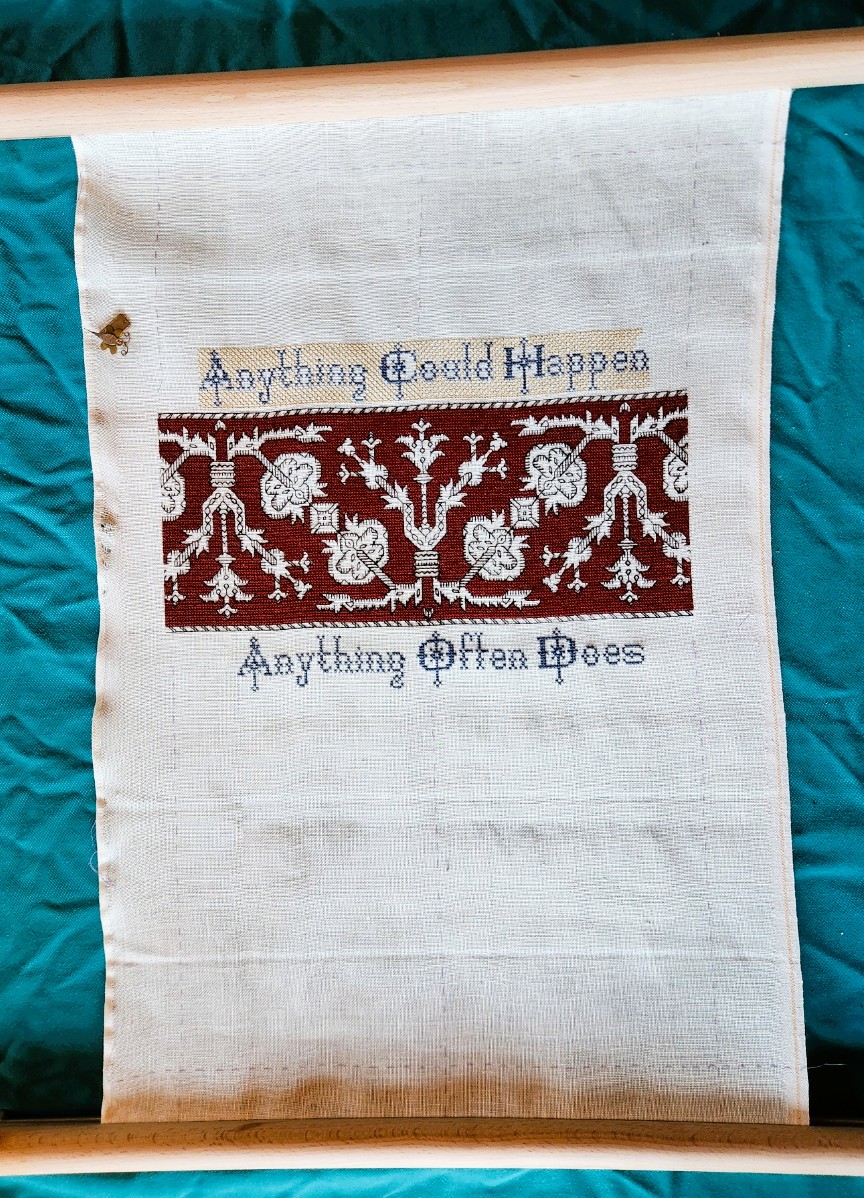
And note that I haven’t extended the yellow step voiding behind the top line of the motto to the margin. I may want to use those small left and right areas for a couple of supplemental motifs, or for signature blocks. I haven’t made that decision yet, so I am keeping my options open. I can always go back and extend that fill later.
But contingency planning here extends beyond the treatment of the ends of that upper text band. There is the possibility that I will face more visual challenges in the coming weeks as I get further into my treatments and as protocols change in the name of long-term efficacy. It being my nature both professionally and personally to always plan for exigencies, I have stepped up preparations to deal with such problems.
First, rather than leaping into the stepwise yellow behind the lower motto strip, I’ve put it off. It will happen, mirrored north south to the alignment of the yellow behind the upper lettering. But that’s easy to see, and super fast to stitch. I can save it for later.
Second, I still want to do some more of the Azemmour Cluster designs. I have a few already charted up in The Second Carolingian Modelbook, but with the broadening of identifications in museum collections, and greater recognition of the group as a cohesive design legacy, I thought I’d go hunting for some other examples – both of the familiar, like the pomegranate meander shown here, and with luck, possibly something new.
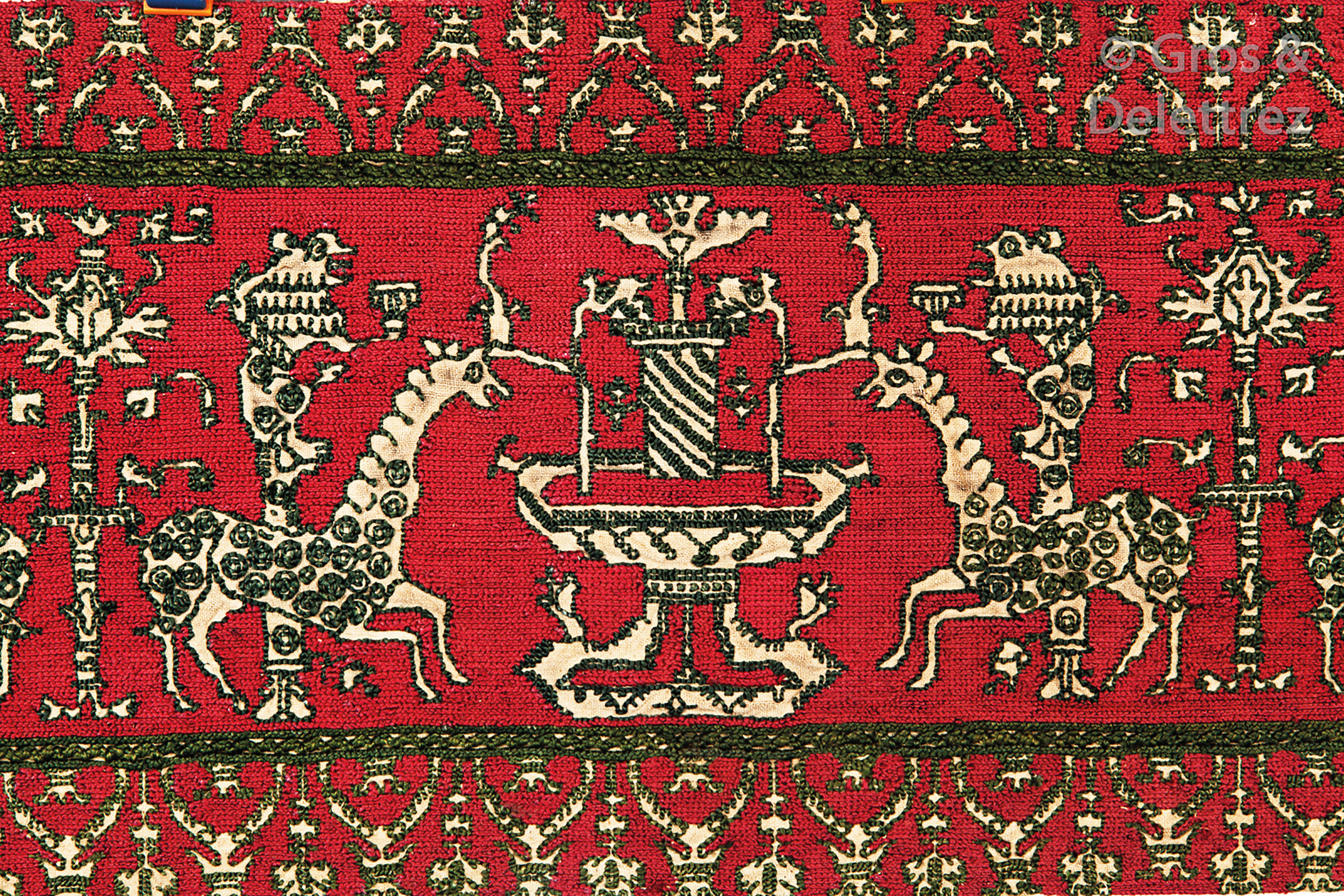
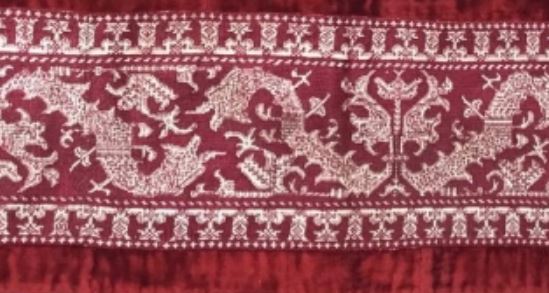
Well, I did find a few examples of things that were brand new to me, but clearly identified as belonging. First is this one – a fragment sold at a Bonham’s auction in 2023. They tag it as Azemmour, and 17th century.

I adore this parade of monsters. For one, I have not seen its like before, yet given the style, interior ornament, and execution, it belongs in the family. Second, it’s clear from the wild divergence of the detail that absolute precision repeat-to-repeat for the person or team who stitched it was rather optional. Those squares and “edge whiskers” that make replication easier to count are far from uniformly worked. And there are also some departures in larger elements of the design as well.
I had to graph it up immediately while I could still squint to do so, norming the repeat as best as I could for my own ease of stitching, even though there will be width for only one full iteration, plus some side bits left and right.
Because of the excessive amount of “design taming” needed to norm this one I have taken more liberties with fidelity than I usually do. I squeaked out my chart and have started laying in the base design. All of the major elements and placements of the original are in my rather broadly adapted version. It will be obvious, proportional and recognizable, but there will be departures, especially in the use of the small filler motifs between the monster bodies, in the placement of the interior decorations, and in minor deviations in the shape of some of the fins and projections. So close, but not exact.
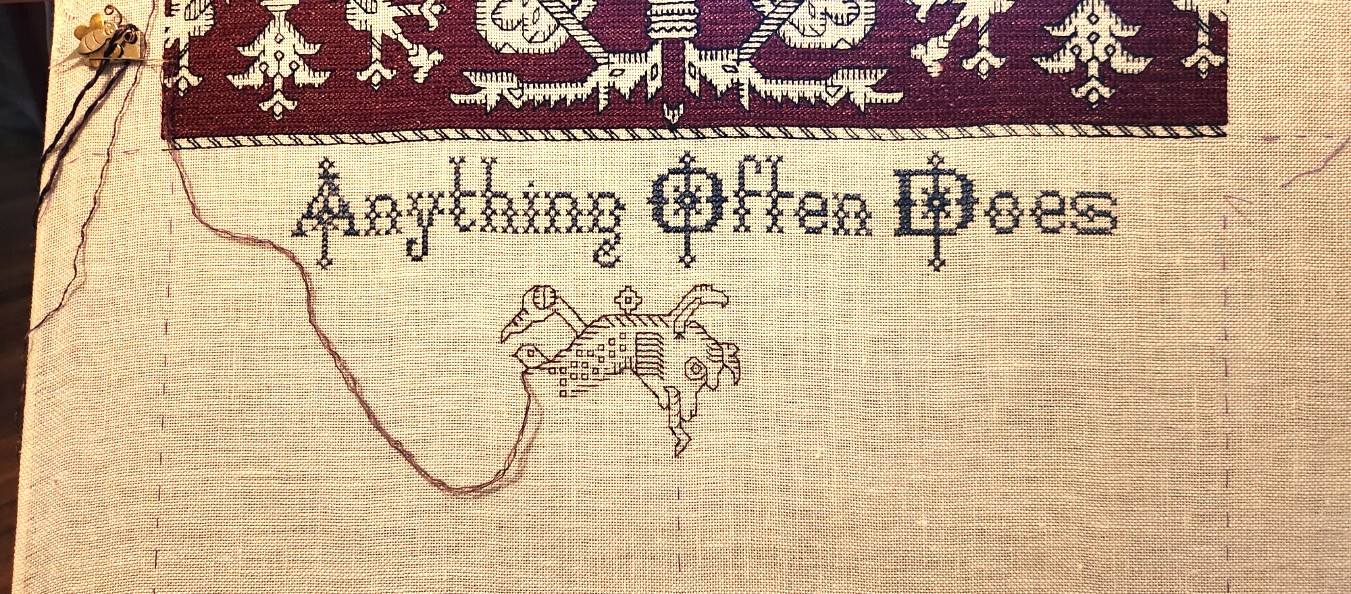
The working method for this one will be different from the claret red voided bit above, and also a departure from the original. The Bonham’s voiding was done in that heavily overstitched meshy treatment I have worked before. That would be a bit overambitious on the 28 count, so I will relax and just do more long-armed cross stitch. But I will stick to presenting the outlines, detail and voiding all in the same color as in the auction fragment. My goal is to lay down as much of the precision rendition as possible, saving the simple background stitching for later. Just in case.
Despite the morning-light color distortion, I am actually using a purple silk here. More of the legacy Tied to History Allori Bella from my stash, split down and finger spun to my desired thickness. Once the yellow goes behind the blue on “Anything Often Does,” I will enjoy having the color play between that color and the purple.
So between roughing in the monsters of certain menace (disclaimer – no actual monsters of this type in the Hungry Judges book, but on here they represent a deeply disturbing aura of major peril central to the plot); and doing the grounds behind the lower half of the motto, and behind the monsters, I feel I have at least three weeks of accomplishable stitching on my dance card, and can outlast any additional temporary visual hurdles.
What other strips am I considering for when these bits are done?
Here’s another auction find from 2019, and a unique composition that I haven’t seen before. Also claimed to be a 17th century representation of the Azemmour style. Not quite sure what is represented. Possibly camel-like unicorns at a fountain. I haven’t charted this one yet. The stitching style of the ground will make that challenging, and I may not have room for it on this piece.
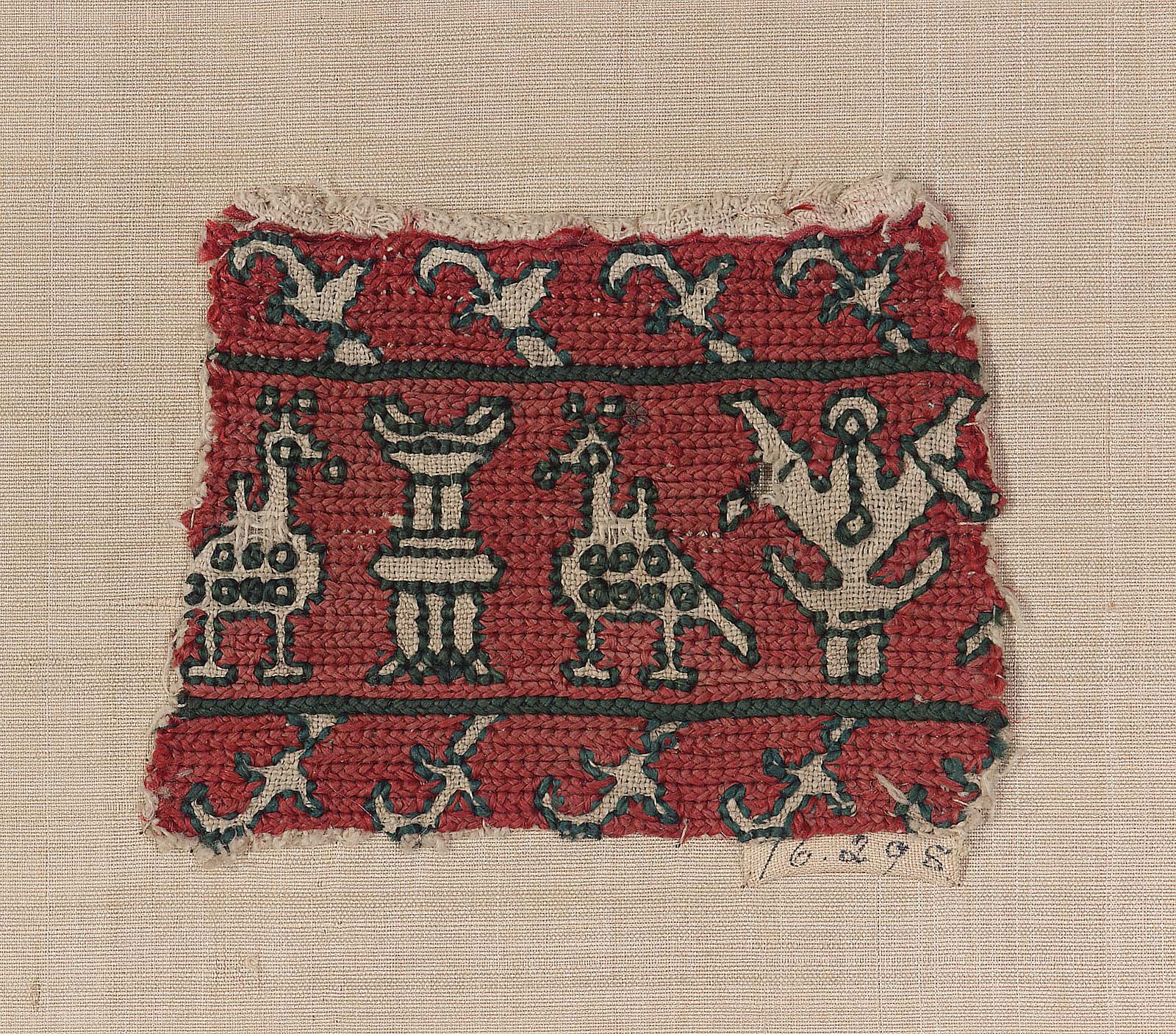
Of course there are the oh-so-well-represented bird panels, the cup sipping/flute playing harpies the fountain panels, the urns, and wide meanders. And more. So much to play with for just this limited space. I suspect that one or more variants of the bird panels will appear. They are narrow and easy to shoehorn in. And I will need to leave room for at least one band of companion border, top and bottom. Identification, selection, color, and execution of course are all open to whim.






Update
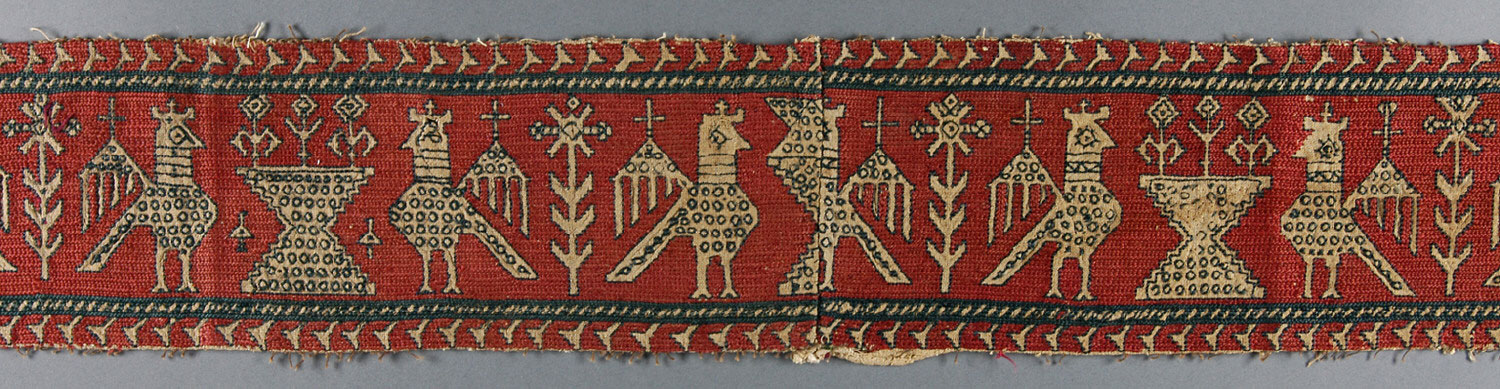
After I posted the photo of the strange camel/giraffe/unicorn beasties at their fountain, Stitch Pal Melinda chimed in with photos of a similar strip held at the Los Angeles County Museum of Art (LACMA). Here is the auction strip photo again, and a photo she provided, side by side for comparison (I am hoping she doesn’t mind the side by side). Auction sample on left, Melinda’s on right.
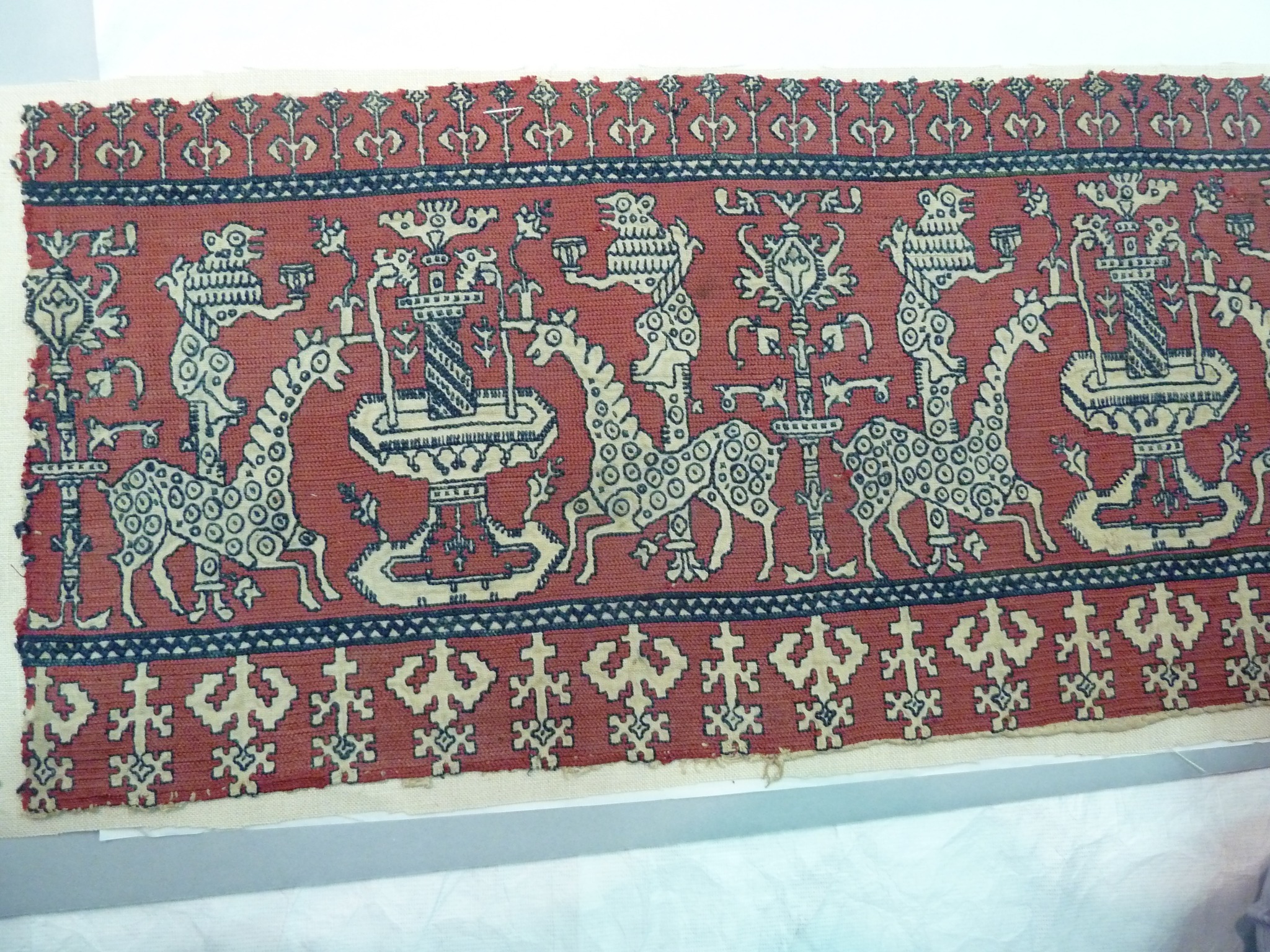
I did go wandering through that institution’s on line photo collection but could not find a citation or page. Even Melinda notes the lack of info on the piece other than the Italy or Spain 1700s notation, which we now now to be not entirely credible.
So for fun, let’s compare. First, it’s clear that there is commonality between the two. The rondel-decorated long neck beasties. The pillars behind them, each topped with a chalice-holding monkey. The central fountains and trees at the other end of the bounce repeat between the animals’ hindquarters. The modes of internal decoration on the design elements. They all do track across.
BUT there is considerable difference in the total representations. This isn’t a case of long-lost-twins where one can say “Oh, look! Someone sold two snippets of the same work to two different customers.” Details are different, with some simplified, some omitted entirely. Spacing between design elements, the proportions and widths/heights of the elements vary between the two. And of course the companion border treatments do not track at all. Particularly curious is the change in scale for the lower companion border in the LACMA sample. That is quite odd.
Can we take any clues here whatsoever from this set of similarities and differences? Posit relationships or dates? Not within my competence. I would guess that there are other examples of this general motif out there somewhere. And that for both of these someone eyeballed copies of the base concept rather than painstakingly transcribed some graphed or stitched “official” root source material. I further suspect that if we were to see a longer sample and follow along the repeats, just like the odd monster I’m working now, we will find that the individual iterations of the design are far from uniform (I can spot some even in the small pieces seen above). And as far as dating, we can’t assume that the change in border scale indicates some sort of later/less diligent manifestation of an earlier more detailed concept. Hard, chemical forensics would be needed to provide clues on which of these two might have been done first.
If my eyesight holds out I will try to chart this. Possibly as a melded average of the two representations. But there’s more stitching to be prepped for the coming few weeks, so it won’t be happening with anything remotely resembling urgency.
And thank you Melinda! Your clever eye and visual memory has made my day. I always enjoy a tumble down a research rabbit hole. All the joy of happy productivity, to you. May your threads stay untangled, and your stitches, true.
WORDS!
Moving right along, and answering questions.
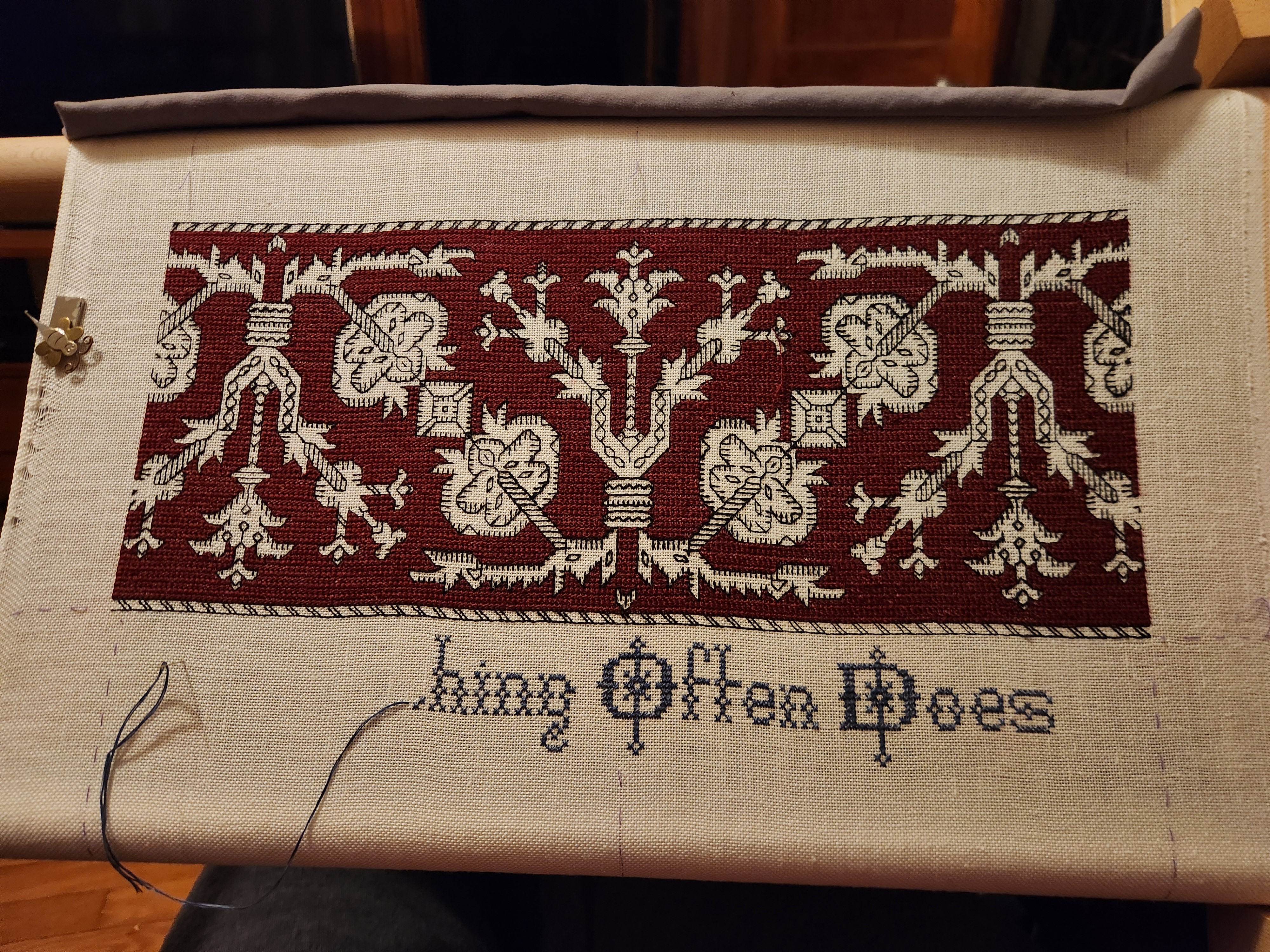
I’ve finished the first panel. I’ve drafted out the motto and it’s obviously in process, too. What you see here is just the second half of the phrase. The first half will go above the completed strip, but I have room to add this part without advancing the scroll, so I am doing it first. And here are some details which should help folk looking for more info.
I am using a combo of two alphabets available on the Patternmaker Charts blog site, established by Ramzi, and apparently now maintained by helpers as well. The bolder upper case letters are from Sajou Booklet #004, but I tweaked them slightly for greater twinkle and depth. I am after all honoring yet another science fiction book by my Resident Male is currently writing. Starlight is appropriate. The lower case alphabet does not line up exactly with the upper case one in terms of spacing and ornament, but again, it has twinkle. It’s from the same site, but appears in Sajou #007. The site has been up for a very long time, and the interface is clunky to navigate but the content is priceless. Booklets indicated by asterisks contain line drawn material. No asterisks means the content is charted.
How did I know to use these together? Guesswork, and reaching way back to being a little kid. My grandfather owned a contract print and engraving shop in the pre-photocopy era. He produced catalogs, advertising material, magazines, books, stock certificates, menus, and lots of other printed matter. While it’s obvious that I didn’t follow him into the family business, I was a curious little thing, and he was happy to show me the fun of type faces, font sizes, leading, kerning, and the way that different typesetting choices and physical presentation can change the way a message is perceived. With his paper samples and layout guides, I always had the wildest written report covers in grade school.
Maybe a little bit stuck from those chats, and from going through his printed examples because I still quest for just the right thing when I compose my motto-bearing pieces. Sometimes I hit the mark, sometimes not. But to this day I always learn from the hunt and the exercise.
What’s the next panel after the words are completed? Something totally new. I’m web-walking looking for Azammour Cluster pieces I haven’t seen before. There are more than there were just three years ago, because the fragments in museum and private hands are being re-evaluated, and the turn-of-the-1900s identifications as Renaissance era snippets sold to collector/tourists are being updated. I’ve found a couple of very interesting ones featuring motifs other than the usual meandering repeats or birds. Charting now. Slowly. Reveal when I have more to show, of course.
And what is the full text of the motto?
Anything Could Happen
Anything Often Does
This can be read in a few different ways. First and foremost is that it is a direct quotation from The Hungry Judges, the novel currently in development, and central to the plot stream.
Yet at the same time, I can see it as a summary statement of my former professional career in engineering/high-tech bids and proposals. That was an endless parade of short term crisis containment and contingency planning – managing overburdened teams striving to meet unrealistic deadlines, spiced with technical requirements that were not always feasible within performance constraints. But I never missed an on-time submission in 42 years, had an enviable win rate, and emerged without ulcers.
And lastly of course, it does echo my current medical predicament. My malady is not something pegged to known statistical associations with genetics, environmental or exposure factors, stress, or lifestyle. Chordoma is so rare that triggers are not understood, yet appears to be a totally random reactivation of the extremely small number of dormant stem cells that everyone retains along their spinal column, going back to our embryonic origins. What wakes them up is a medical mystery.
With my typical attack optimism, I am planning on outlasting this wack-a-mole recurrence, and with radiation and other modalities, continued vigilance and via several promising avenues of targeted antibody and other “lullaby” treatments, return them to secure slumber.

