As promised here’s the breakdown of the design, motif by motif – a guided tour of what I was thinking or not thinking about. This is turning out to be way longer than I expected. Feel free to scroll down to the eye candy and ignore the prose.
First, on the general aesthetics, I already confessed yesterday that this piece is a departure from the strictly historical, using stitches, materials, and fills that have no specific point source in a particular artifact contemporary (or near contemporary) with the original Victoria and Albert Museum piece of ink-drawn linen. But in spite of that I’ve tried to stick to general aesthetic. It was a time of “more is more.” Pieces like this coif were status items that proclaimed the wearer’s wealth. I heard Thistle Thread’s Tricia Wilson Nguyen lecture at Winterthur about how copious precious metal spangles, threads, and even lace served as walking bank accounts, shouting prosperity but still being available as liquid capital to an owner whose fortunes dipped so low that reaching for a scissors to snip off a bit for ready cash was a welcome option. To that end, I’ve doubled down on the gold accents. But not being as flush as landed gentry from the late 1500s, I’ve used imitation gold thread and gold tone mylar rounds.
I’ve also tried to emulate the more lush aspects of some historical blackwork pieces, that created depth and shaded nuance by using fills of different visual density, augmenting the effect with raised outlines. I would have liked to use a plaited stitch for the stems, but it’s clear that the original artisan didn’t leave room for them, so I settled on outlines that were markedly heavier than the fills, topped off by a whole-piece outline that was even thicker and more dimensional.
I also like the difference in blacks used. The fills in the thin modern-dyed spun silk single strand are dark enough to look lacy and contrast well with the ground. The outlines, done in the boutique, small batch historically dyed double strand (also spun) are a much softer black. In some places the black takes on a reddish or brownish tinge, or moderates to an even less dense charcoal. If they were as deeply toned as the fills I think that each leaf, petal, or wing would present more as a grey-scale visual mass rather than letting the fills speak louder than the outlines. Finally the deeply black modern dyed but glossier reeled filament silk used in the perimeter then echoes the black of the fills, and makes a world of difference to the piece, pulling it all together. All black, all different, and all contrasting with each other.
On planning and fill selection, I winged it. I didn’t sit down and plan anything. I picked fills on the fly, with only a vague idea of where I would put dense, sparse, and intermediate fills as I began each sprig or group. Some succeeded quite nicely, others I would re-do differently had I the chance. Would I ever sit down and plan an entire project’s density/darkness/shading map ahead of time to avoid this? Probably not. It’s more fun to bungee-jump stitch.
On to the piece. First a quick recap of the whole item:

On this whole coif shot I can see three center circles of motion in the design, one surrounding each rose, and one surrounding the two centermost unique motifs – the borage flower/strawberry pair. The rest of the flowers are surrounding those elements. Maybe I see them because I’ve been staring at the thing for so long, or maybe my admittedly ornate but heavily outlined rendition with the gold whipped stems sinking into the background pulls those surrounds forward. When the exhibit comes around and I can see all the other pieces it will be interesting to see what other symmetries they accentuate.
We’ll start at the upper left. Although I began at the lower right, it’s easier to walk across starting at this point. I give fill counts and cite the number of fills I used from the project’s official website. Now some of the ones in my doodle notebooks duplicate or near duplicate those (we were after all mining very similar sources), so I apologize if any double-listed ones ended up in the wrong pile.
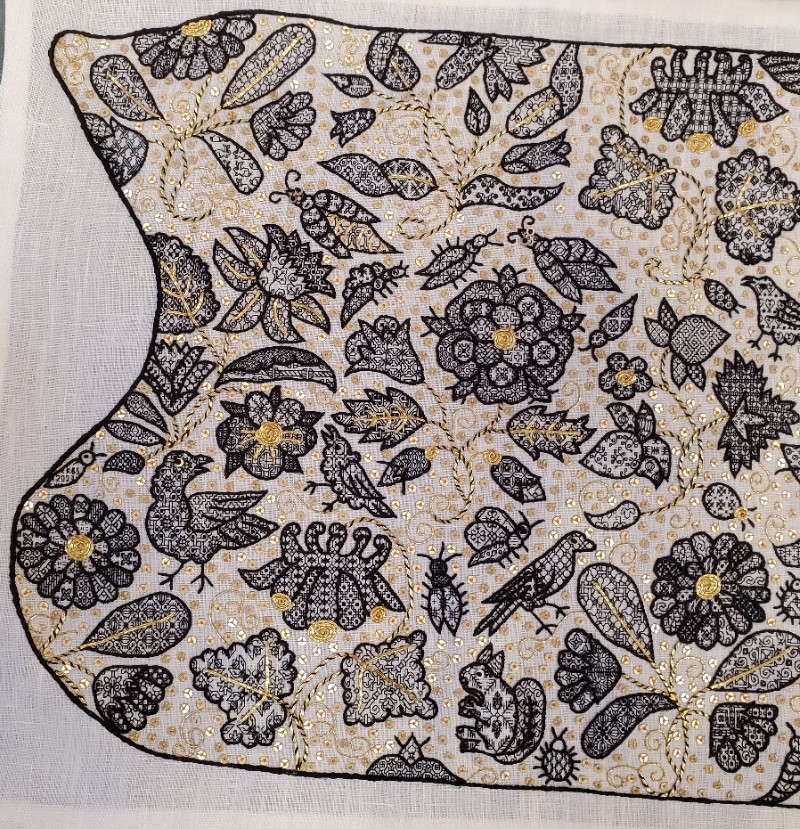
The first motif in the upper left I have been told is a marigold, one of six on the piece. It’s truncated at the edge by the indent. The marigolds were especially hard to work because those little jelly bean spaces of their petals were so tiny that most of the fills I had included repeats too large to be useful for them. I tended to use four repeats in the outer petal ring, repeating the sequence four times. The inner ring used different fills, usually two. Fourteen fills in this motif, twelve are mine, including the bunny rabbits. The other two are from the collections redacted by Toni Buckby, our Fearless Leader, and are available at the Unstitched Coif project website.
Immediately to right of the partial marigold in the corner is a truncated carnation or gillyflower (hard to tell them apart). Three of these are here, but only one isn’t cut by the perimeter. At this point, relatively late in my stitching I went out on the hunt for additional fills, and redacted a couple of pages of them for the upcoming third Ensamplario Atlantio volume. One of particular note is the leaf at the lower right, with that flying chevron shape, one of several I drafted up from a photo of a blackwork sampler, “Detached Geometric Patterns and Italianate Border Designs with Alphabet” 1697. National Trust Collections, Montacute House, Somerset, NT 597706. The twist and box of the sepal is from the same source. Yes, I know they are later than the coif’s original. Since by definition anything I doodle is even later still, I didn’t see the harm it using them. 18 fills total in this sprig, six from Toni’s redactions, two from mine, and ten of my own doodles.
Next to the right on this photo cut is a columbine. It’s barely snipped, and one of three on the piece. The large leaves made good showcases for some of the bigger repeats, even with the gold overstitching. As a result on this sprig we’ve got only five fills, two of which are from Toni’s pages. On this motif as on all of them, I tried to use fills of contrasting effect. Here in the flower we have the very strong linear grid of the main pattern, paired with the angular acorn spot motif. This flower is also an example of introducing movement or syncopation by NOT using the same grid for adjacent motifs.
Back to the left edge now. This sprig includes a narcissus or daffodil, plus a viola and something indeterminant, possibly a blossoming narcissus, all on one stem. Leaves are also of multiple forms. There are only two of this hybrid sprig on the piece, both nipped by their respective edges. All those little areas add up to 19 fills on this one. I’m particularly happy with the density effects I got on this one, with the narcissus throat, the leaf curl, and the viola sepals bringing darker depth. I did try to find two patterns of similar density for the lower petals on the narcissus, too. I have to look closely to remind myself that they are two petals of one design and three of another.
Next over is the rose. I’ll come back to the bugs that surround it. There are two roses on the coif, and two tiny partial bits on the lower edge. In truth, I’m not enthused about the way the big flower turned out. I like the sepals and the outer ring of petals (three fills, all of the same tone), but the inner rings aren’t well differentiated – although I used one fill for all five of the middle ring and that isn’t bad, that inner ring with its three fills is rather boring. Were I to do it over again I’d make some different choices here. I used sixteen fills in all for this sprig, including two of Toni’s set.
The creatures dancing “ring around the rosie” includes seven bugs and two birds. Visually they do make a circle around the rose, with one larger bug flying off above the narcissus. Here I spy a mistake, and the thing being in transit right now, it’s too late to fix. I meant to go back and add little gold stripes to the body of the bug to the upper right of the rose. Those tiny bits of couching were the ones I liked least to do. So it goes.
Like the marigold petals, the body parts of all the coif’s bugs were a challenge. Some are so tiny that it’s hard to squeeze anything resembling a pattern into them. I doodled on those, but I tried hard to make the doodles unique. In a couple of cases I found I had made a duplicate of a pattern stitched before, and went back to make modifications to one of the inadvertent pair. All of the large bugs with sequin eyes have a feature in common. Although it’s hard to see because of the stripes, I used the same pattern for both of their wings, but rotated it 90-degrees to give them extra movement. I have found no historical precedent for using directional fillings this way. Taken as a group, there are 27 fills among all of these bugs and birds, four of which are from Toni’s pages.
Reading across, the strawberries are next. (I’ll cover the bird to its right in the next post). There is only one strawberry sprig on the project, and it’s another challenge because of the small petal and sepal spaces. This is another motif I count as only a partial success. I like the top strawberry, flower, and leaf, but I think I should have chosen differently for the lower strawberry. Possibly working the sepals for the second one and that leafy whatever that terminates the sprig both darker. That would have made the lighter fill in the bottom bud a bit more congruent. Thirteen fills in all, four of them from Toni.
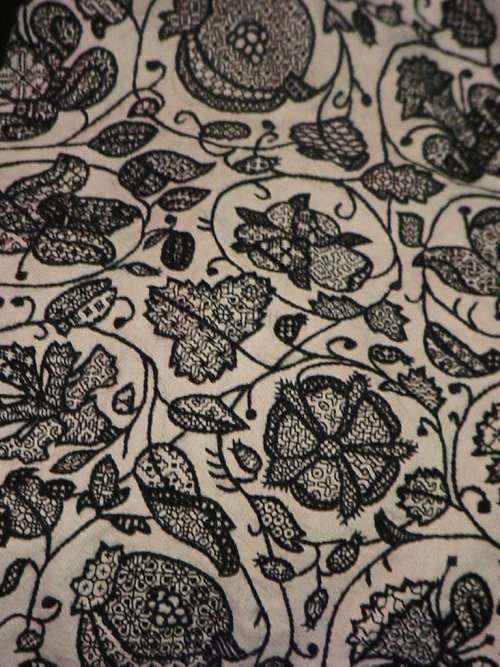
Back to the left hand edge of the photo, below the narcissus/viola stem are the large bird, and the second marigold (cut off at the edge). There’s also a tiny bug above the marigold in which I worked “KBS 2023” as my signature. This flower was my finishing point – the last one stitched. Most of the fills in the petals were improvised on the spot. The bird carries an interlace and star I remember doing on my first large piece of blackwork, an underskirt forepart, back in 1976. That piece however was worked on a ground that was about 28 count (14 stitches per inch), not 72 count (36 stitches per inch). You may even recognize some of the other fills I reused on the coif in the snippet below. Vital stats on Marigold #2 – 12 fills for the whole sprig including the large bird, one of which is Toni’s.
The second columbine, to the right of the bird, grows from the bottom edge of the coif. I wonder how many people will look closely enough at the leaf on the left to realize that it’s bugs. I was thinking bees, but I’ve been told they read more like flies, and “ick.” There are four fills in this sprig, one of which is Toni’s.
Adjacent to the right we find Needles the Squirrel, his friend the round bug, and one of those rose snippets. I group them together for convenience. Needles’ pine spray fill is mine, and came about during discussions on line and in the Unstitched Coif group’s Zoom meet-ups. Someone mentioned using an acorn fill for their squirrel, but UK folk were quick to point out that the indigenous Red Squirrel, who preferentially dines on pine nuts, was deeply endangered by the invasive Grey Squirrel, who prefers acorns. So I doodled up the spray, shared it with the group, and used it on mine, bestowing the appropriate name. I’ll find out in December if anyone else used this fill. I also did the directional shift in Needles’ ears. There are only six fills in this group.
Marigold #3 is in the right corner of this photo. He’s also rather a mess. I should have picked two dark and two light fills for the outer ring of petals, instead of one dark one and three intermediates. I did rotate the direction of the fills around the circumference. Oh, the snails? A variant of those snails with their wrong-way curled shell is on the majority of my blackwork pieces. Not quite a signature, but not far from one, either. There are 17 fills in this sprig, one from Toni.
On to the center of the piece.

Back up to the top of the center strip. Here we have the sadly bisected bird, with the fourth marigold to its right. Although the petals are a bit uneven, I did try something specific with this one, using two fills in of similar density in the center ring, and four also similarly sparse fills in the outer ring. I count this one as a success. Together these two motifs contain 13 fills, two of which come from Toni’s pages.
Below the marigold is the singular borage flower. There’s only the one, and he’s at the center of it all. I will cover the caterpillar later. He’s one of my favorites in the piece. I especially want to call out the tiny paisley at the bottom of the stem. The fill there is one that Toni redacted from a coif, V&A Accession T. 12.1948. It is very unusual fill, with the exception of a few that use a circle of stitches radiating from a center hole sunburst style, it is the ONLY historical fill I have seen that uses the “knight’s move” stitch – two units by one unit, to produce a 30-degree angle. Knight’s move stitches are very common in modern blackwork, but exceedingly rare in historical pieces. Knowing this I’ve drafted up hundreds of fills and in keeping with this paucity, have only included them on three or four of the most egregiously modern. The little stirrups in that paisley open up a whole new world of possibilities. Borage contains 11 fills. Five of them including the stirrups are Toni’s.
At the bottom below the borage is Carnation #2, attended by four insects. I am also fond of this one, especially the long skinny bud on the lower left. That striped lozenge filling is one of Toni’s and I adore it. With all the folded leaves there was ample space to play with density, and it was fun to pick these fills on the fly. All the more so because the combos worked. The insects, from lower left, a caterpillar or worm, an amply legged spider, a moth, and a beetle, are a playful way of rounding out the space between the center and the side areas, the latter being (mostly) mirrored near-repeats. This group holds a whopping 23 fills, nine of them from Toni’s redaction page.

And back up to the top we go. Carnation #3, another truncated motif. Like the last carnation this one had a lot of play for contrast. It was actually among the earlier sprigs I stitched because I began upside down in what is now the upper right hand corner. This is the motif on which I began to get a better feel for the size of the repeats in the fills and how that size related to the dimensions of the shape to be filled. There are 19 fills in this one, including two of Toni’s.
Below this last carnation is Rose #2 and its bug and bird armada. Don’t worry, I am not double counting the moth I included with Carnation #2. I like this rose slightly better than the other one, but don’t count either one as a stunning success. I may excerpt the rose and try again. In any case you can see that I’ve hit full stride here in using fills of various repeat sizes.
For the most part I stitch fills then go back and outline them when the motif is complete. I have always found that to be a forgiving way of working that allows fig-leafing of the fills’ often all to ragged edges. But on the caterpillar (my favorite insect on the coif) I started at the head, stitched its fill, and then outlined it. I continued in this manner segment by segment. I did this because I knew if I waited until the end, my divisions between the body segments would get muddy. I wanted to make sure that the little center divots that ran down his back were seen. I probably wouldn’t have attempted this if I hadn’t seen others in the Unstitched Coif group Zoom meetings working up all of their outlines, then going back and adding fills.
Rose #2 and accompanying critters used 31 fills, including six from Toni’s pages.
Below and a bit to the right of the rose is Columbine #3, and a partial rose. There’s also a lump from which the columbine sprouts, but that may be a mistaken interpretation on my part. Perhaps that was supposed to be an arched stem. Maybe yes, and maybe no. I spent a lot of time dithering about how to handle the columbines. Those curly narrow top protrusions in particular limited the size of the repeats that could fill them effectively, especially if I wanted to play up the contrast between the gold topped and plain petals. The circle fill (one of Toni’s) worked nicely and set the tone for my later choices. In this grouping there are nine fills, including Toni’s circles.
Back up to the top for Marigold #5, which happens to be the first bit I stitched. The leaf with the larger butterflies was the first fill I did. When I started I thought that stitching over 2×2 threads might be problematic, so I worked this one over 3×3. However my eye and hand are SO attuned to 2×2 that it was clear that the new count would drive me to distraction, so I quickly switched to my standard. But I didn’t pick out the errant leaf. I doubt if I hadn’t mentioned it you would have noticed. In any case you can see that I was very tentative on fill repeat size on this first flower. For example, I could have used much larger repeats in the leaves. Still this was the try-out. I beta tested using fills aligned in radial directions, the gold center coil (here only a half), veining and stems in couched gold double strand, and curls in couched single strand. And adding spangles. Once they were in I noted how the stems disappeared, so I went back and whipped them with black to make them stand out a bit from the background. This sprig uses 15 fills.
Below the marigold is the second Daffodil/Narcissus and Viola sprig. I’m generally pleased with it, although I wish I had saved the feather fill for one of the birds. You will note that I take no special care in always whipping the stems in the same direction. I did them in the most convenient/least awkward direction because needle manipulation to avoid catching previously laid down work was very important. As I went on I destroyed most of the sequin/French knot eyes and some of the smaller couched gold bits by snagging them with my needle tip or smashing them with ham-handed stitching. I ended the project by replacing all of the eyes. There are 19 fills in this motif, two of which are from Toni’s pages.
Last but not least we have yet another marigold, Marigold #6 with bird, bug, and bits. I confess that the marigold was my least favorite to work, even by the time I did this one – only the second one I stitched. That little intrusion below the bud may also be a vagrant bit of curl or stem, but I filled it in anyway. This bird has the first sequin/french knot eye I did. I also experimented with three sizes of little seed beads, but decided that they were too dimensional and/or just too big for this use (the paillettes I used are only 2mm across). Our final motif has 19 fills, including one from Toni’s page.
That ends the guided tour. The total count of unique fills on this piece is 274. 51 of them are from the pages of fills redacted by our Fearless Leader, Toni, and posted on the project’s home website. The remaining 223 are mine, mostly taken from my Ensamplario Atlantio series.
Would I ever attempt something like this again? In a heartbeat. BUT I will never do another piece of this size and stitch count to deadline. While it was intensely fun every minute of the roughly 900 hours I was stitching, I prefer to stretch those hours out over a longer time period. Intense thanks to Toni and my fellow Unstitched Coif participants, for the opportunity, the learning experience, the encouragement, and the camaraderie. I am looking forward to the December exhibit, and to meeting as many of you as possible, in person.
When the flyer for the exhibit is released I will post it here on String, on Facebook, Instagram, and Linked In. In the mean time, reserve the date – it will be on December 18 through the 24th, at the Bloc Gallery, Sheffield Museums, Sheffield, UK.
 String-Or-Nothing
Just WOW! Thank you so much for sharing this entire project.
WOW!
Absolutely beautiful and wonderful. Thanks for sharing and the explanations. I am in awe of your work.
So much thought going in to how to stitch each motif! The result is a beautiful harmonious whole.
I was quite impressed on the last post, but after reading all the considerations, thinking, looking for patterns, all on a short time schedule – Wow doesn’t cover it.
IIRC, there was an insect or two that you had done at the start, weren’t sure if you liked it or nor. Something about too much gold, lost in the pattern(?) and you were going to decide on re-doing it later. Did it get left as is, or did it get redone?
Thanks, Gail! I forgot to include that redo in the summary. When I started I was doing the insect antennae and the bird feet in couched gold. After I went back and touched up the stems with black silk whipping, I stood back and looked at the whole thing. The antennae and feet were still lost. So I picked those out and redid them in black reverse chain. It made a lot of difference. At the time all I had completed was the strip of patterns at the extreme right, plus one big bug and one bird, so it’s not like there was a lot to replace.
Goodness. Yes, something like this strikes me as more fun without the deadline – although I’ve had deadline stitching that was a lot of fun. Isn’t it interesting to see how very different black thread can be!
I thought I wanted to do this, but I had stitching to finish for items for some other re-enactors. Looking at yours, I _know_ I would only have finished in a decade or so. Absolutely amazing, my brain almost stalls at how much work – and such well-done work! – is in this.
My applause means little, but I wanted to let you know that THIS was a Shock and Awe campaign: you produced an overwhelming result.
Thanks! If I had not been under deadline I would have gone at a more sedate pace. This would probably have taken me 12 to 18 months, probably more if I were doing it while I was still employed. But I was on a mission and totally consumed. Happily, the Resident Male was very supportive, taking on my half of the chores in addition to his, and freeing my days for stitching.
Wonderful write up Kim! Just to note – the exhibition is at Bloc Gallery Sheffield, not the millennium. Toni x
Thanks! Will fix. And if there is the on line equivalent of a publicity flyer, I will be happy to spread it far and wide.
[…] Completed coif – discussion of my finish and fills. Close ups of the completed project, plus a motif by motif round up. […]