Starting 27 June and finishing yesterday evening, 25 October, I have cranked out three small samplers, one after another.

All three were inspired by books written by my Resident Male, although not all of the source books have been published. Here’s a better shot of the latest, fresh off the hoop. (Yes, I will eventually press and frame them all.)
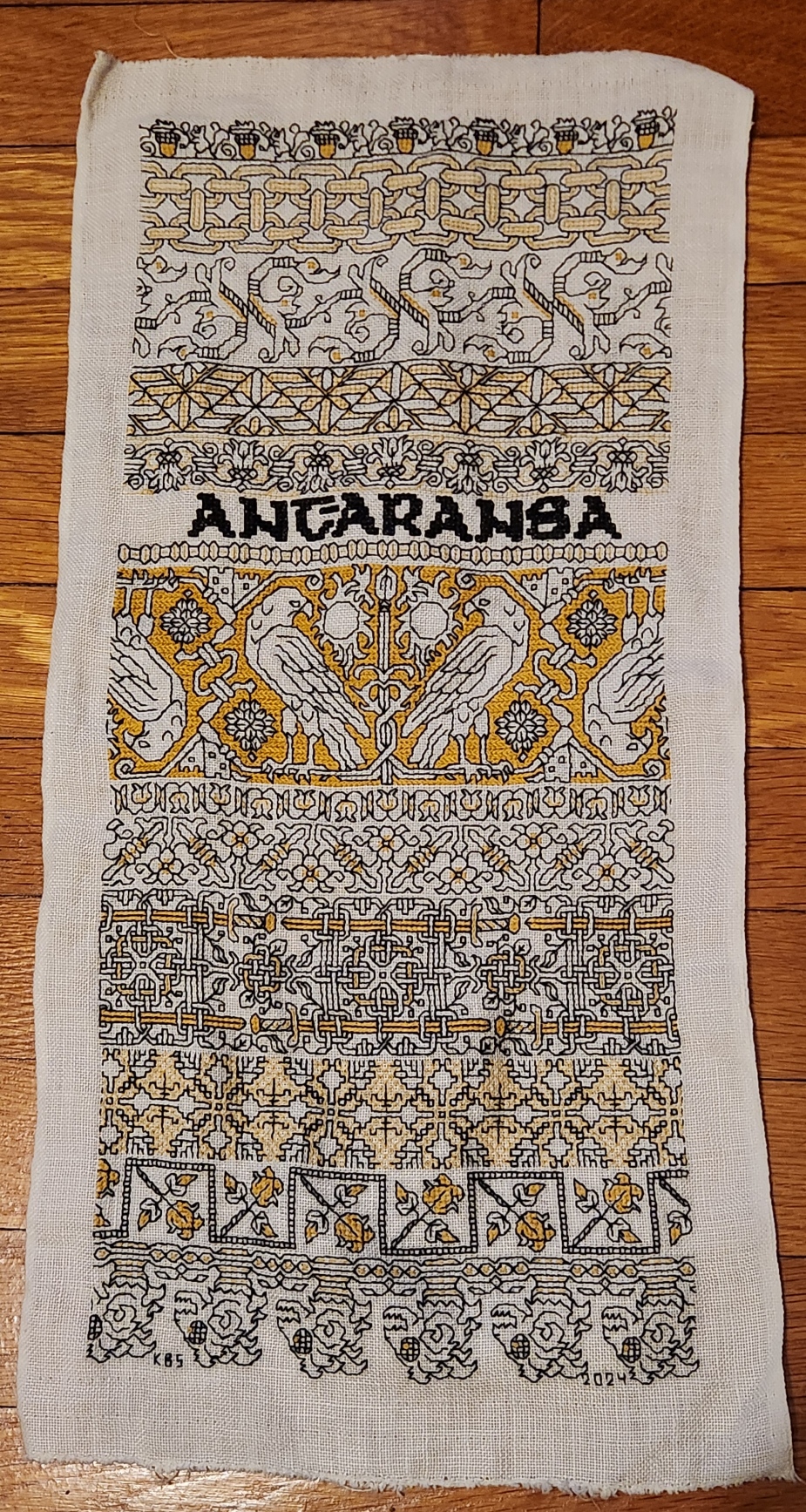
The last strip at the bottom is in the tradition of 16th and 17th century band edging patterns that often accompanied a wider main band design. While most of these narrow bands were floral, foliate or geometric, some of them featured creature heads, occasionally bird-like, lizard or dragon shaped, but all cropped and facing in the same direction. Those edgings would present with the baseline against the main design, so that ones below the main design were upside down, and dance around the corners. With those in mind, I have ended my Treyavir-inspired piece with the severed heads of lantern-eyed goblin monsters, gelnids, among the formidable foes of the novel’s hero Reignal.
To recap, I used black Sulky #30, double stranded. For the accent color I used standard DMC floss, #3820, sometimes two plies, sometimes one ply. All of the black foregrounds were done in double running stitch. Several treatments were used for the fills and accents. Here’s the list of accent treatments along with pattern sources:
- Acorns – plain old cross stitch (POCS), two plies. My own design.
- Chain – double running, two plies. My own design.
- Leafy meander – mix of double running and four sided cross stitch, two plies. My own redaction of a pattern appearing on a sampler dated 1687, accents are my own mods.
- Geometric triangles – simple boxed fill in double running, one ply. My own interpretation of an idle doodle done by J.R.R. Tolkein, more on this here.
- Flower meander – contour lines in double running, one ply. My own design.
- Motto – four sided cross stitch, two plies in the black Sulky. My own alphabet based on a mashup of several Uncial-derived pixel alphabets from the early Macintosh era.
- Narrow bead – double running and single stitches, one ply. My own design.
- Falcons – Long armed cross stitch (LACS), two plies. My own design.
- Tulip buds – double running, two plies. My own design.
- Flower and rod meander – POCS, my own design.
- Sword interlace – POCS, two plies. My own design.
- Step birds – simple diamond fill, one ply. My own redaction of a sleeve decoration on a portrait, circa 1500. It’s on the Patterns tab, here on String.
- Roses in boxes – POCS, two plies. An adaptation of a pattern appearing in my Second Carolingian Modelbook, plate 27:4 – my redaction of a border from a historical artifact.
- Monster heads – POCs, single running stitch, French knots – two plies.
Everything described as “my own design” above, will be in either my forthcoming books Ensamplario Atlantio Volume III, or The Third Carolingian Modelbook – both currently in process.
Now with this sampler done I can’t sit idle. Progress on the next might be a bit slower because I have various holiday deadline related projects to complete and ship out. And I have to decide if I am going to continue the series immediately, with the next bit of embroidery dedicated to either the Resident Male’s mixed SF/Fantasy short story collection The Temple of Beauty, or one of his other in process works; or if I’m going to go totally off script and do a piece entirely on whim.
But to be prepared, I’ve already selected a small stash remnant, hemmed it, and basted my edge and centerline guides, shown here between the completed pieces for scale:

It’s not as long as the last two, and significantly narrower than Stone by Stone. And the linen is higher count.
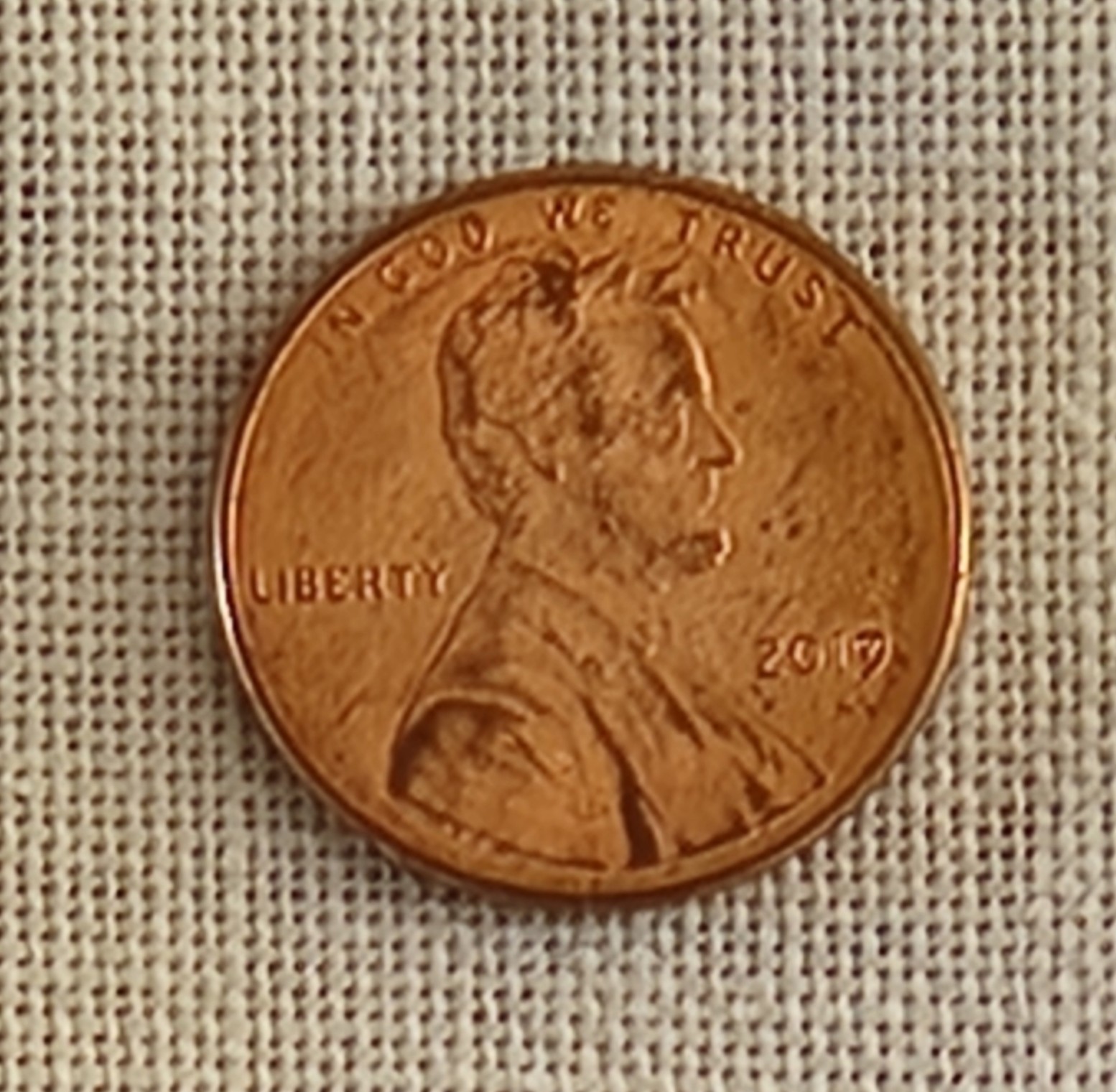
By my penny method, the coin covers 30 threads north-south, and 30 threads east-west. Multiply by 1.33 (a penny by definition is .75 inch) and we get an evenweave thread count of about 40 threads per inch. Green and black Stone by Stone was stitched on 33.25 thread per inch evenweave. The blue and red piece for Fractured Symmetry was on skew count 37.25 x 32 threads per inch linen, and the black and yellow Treyavir piece was on big-as-logs 26 threads per inch evenweave.
While this next piece will be physically smaller, the available “real estate” for pattern display will be roughly similar to the previous larger pieces that were worked on coarser grounds.
I haven’t decided on whether this one will also employ two colors. Right now I’m leaning to an all black piece, but one that uses multiple thread thicknesses. The reason is because I have come into a wealth of black threads in various weights, mostly rayon, but some cotton and silk as well.
Back in late summer when I was getting ready to go to Cape Cod for an extended stay I noted that I was rapidly eating into my spool of black Sulky #30. I was unsure if I would have enough to finish the yellow and black piece. Not having time enough for mail order, and not trusting that mail order would find me at our beach place (no street address delivery, you have to pick up mail and most UPS or Amazon sends at the post office), I went hunting in person. I started at the store where I had originally bought the Sulky, three years ago. They no longer stocked it, nor did several other local possibilities. But as I was chatting with one of the sales clerks and commiserating about mid-project disappointment, the next person in line said that she had the thread I needed in stash, and would be happy to share. We exchanged contact info, and she went home to stash-dive. I drove over to her house (just the next town over) and found a delightful bag of goodies awaiting me – several spools of black in assorted weights. I left my own thank-you present behind and scurried home with the goods. So my possibilities have multiplied. And on the finer ground, the elegantly fine faux silk rayons provided by my ever so generous benefactor will shine. (Oh, if you are reading this Kind Benefactor, ten thousand thanks again for helping me out of that jam!)
Don’t be surprised if I now segue to crocheted snowflakes, both production and blocking, or other crafts. I will be picking up this stitching either alongside those efforts, or after. But you can be sure that in terms of embroidery, I’m armed and dangerous, and I can’t be stopped.
 String-Or-Nothing