I am very glad that I didn’t focus on making this piece two-sided.
At the outset, I thought about it. Hiding the ends on both Montenegrin Stitch and Meshy (Two-Sided Italian Cross Stitch, pulled tightly) are easy. Lots of real estate overstitched in which both beginnings and endings can be camouflaged. Double running is a bit more difficult, especially when one strand is used. Yes, I know various termination methods to do so – one-strand loop start and waste knots to begin; back-trace stitching, and threading through the existing line to end – but they are annoying to do, especially on a large piece. I made a half-hearted stab at it, but abandoned double sided double running early on, But I never thought it would be the two solid techniques that would be giving me trouble.
Here’s the front:
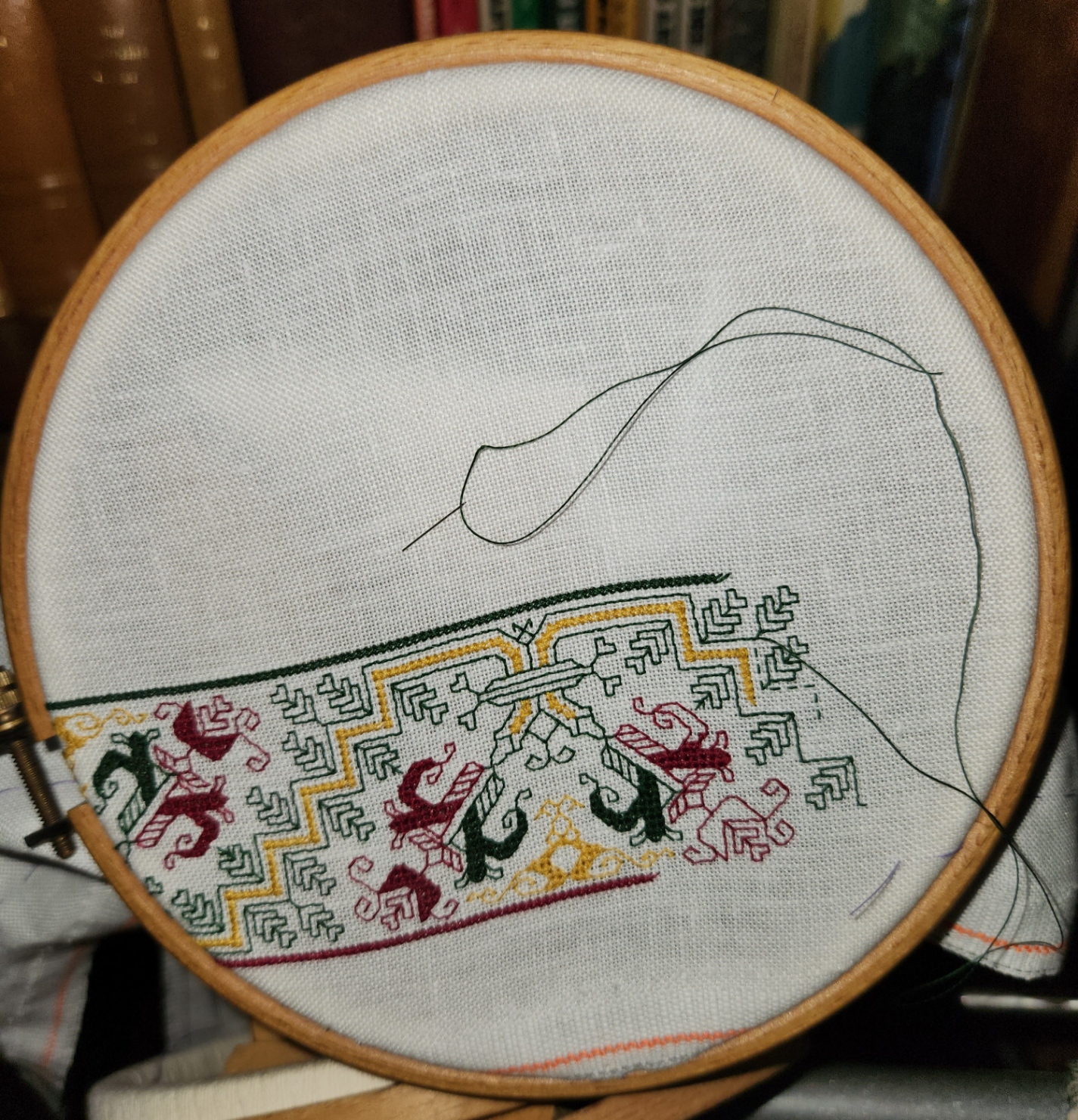
Here’s the back:

Montenegrin is working well. There are just a couple of bald spots where I lost track, mostly in angle changes. I blame resuming the habit of watching TV while I’m stitching. Occasionally I get caught up in the action, and miss a turn. Then don’t realize it until I am long past. Had I still been reverse-side-display focused, I would have done more diligent checking, and would have ripped back and redone the less than perfect bits.
Meshy on the other hand… Ouch.
The two-sided Italian cross stitch works best over large areas, like backgrounds in voided style pieces. It isn’t as cooperative when its playgrounds are small, as they are in these flower parts. It’s like working nothing but the bits where voided stitching bumps up against a foreground line, with no respite. Working these small parts I never quite get the rhythm – it’s all compensation stitches, with very little chance to display the openwork texture. That also means that coverage on the back gets slighted as working direction changes to adapt to the shape of the field being filled. Add to that the tension limitations of the cotton floss (more fragile than silk, believe it or not), and in spite of cotton’s fluffier nature, we have lots of bald spots on the back. Far from optimal for double sided display.
Finally then there’s my own general laziness. I’ve made a couple of mistakes that I’ve had to pick out. But instead of picking out large areas, I’ve mostly opted to pick out just the “broken” bits, tying off loose ends, or fastening them with overstitching on the back. Most of the fat or knotty looking spots above are from fixing mistakes. Sometimes the errors encroached on Meshy sections, and those are notoriously difficult to frog. Sometimes I ripped out small segments and replaced them because I didn’t feel like re-creating the large, accurate sections they were in, just to get at a couple of errant stitches.
So my back is a relative shambles. I will of course continue on, focusing on the front. But especially for those of you who tell me that my pieces are inhumanly perfect, please know that you usually only see the after photo, and lots of corrections and creative editing went into making the project look like that.
 String-Or-Nothing
I’m sitting here smiling, remembering the days when I used to sew nearly all my little kids’ clothes, and a friend exclaimed over how well done they were.
My response was, Have you ever heard of someone wearing out a seam ripper? I wore out a seam ripper.
Yup. That little razor sharp divot in the joint between the “thumb” and “pointer finger” of the ripper does go dull. I’ve discarded several over the years when they began to snag instead of cut.
But I don’t use them for ripping out errant embroidery stitches. Too dangerous because it’s way too easy to inadvertently nick the threads of the ground cloth.
I imagine! That would be the equivalent of trying to re-sew velour.