As folk following along here know, I like to keep busy. I need the comfort of fiddle-food for my fingers. Waiting is particularly annoying without it. Just before heading off for my second diagnostic procedure, I had started an experiment in Buratto, on a chance find bit of cloth that mimics the weave of that Renaissance era open mesh ground.
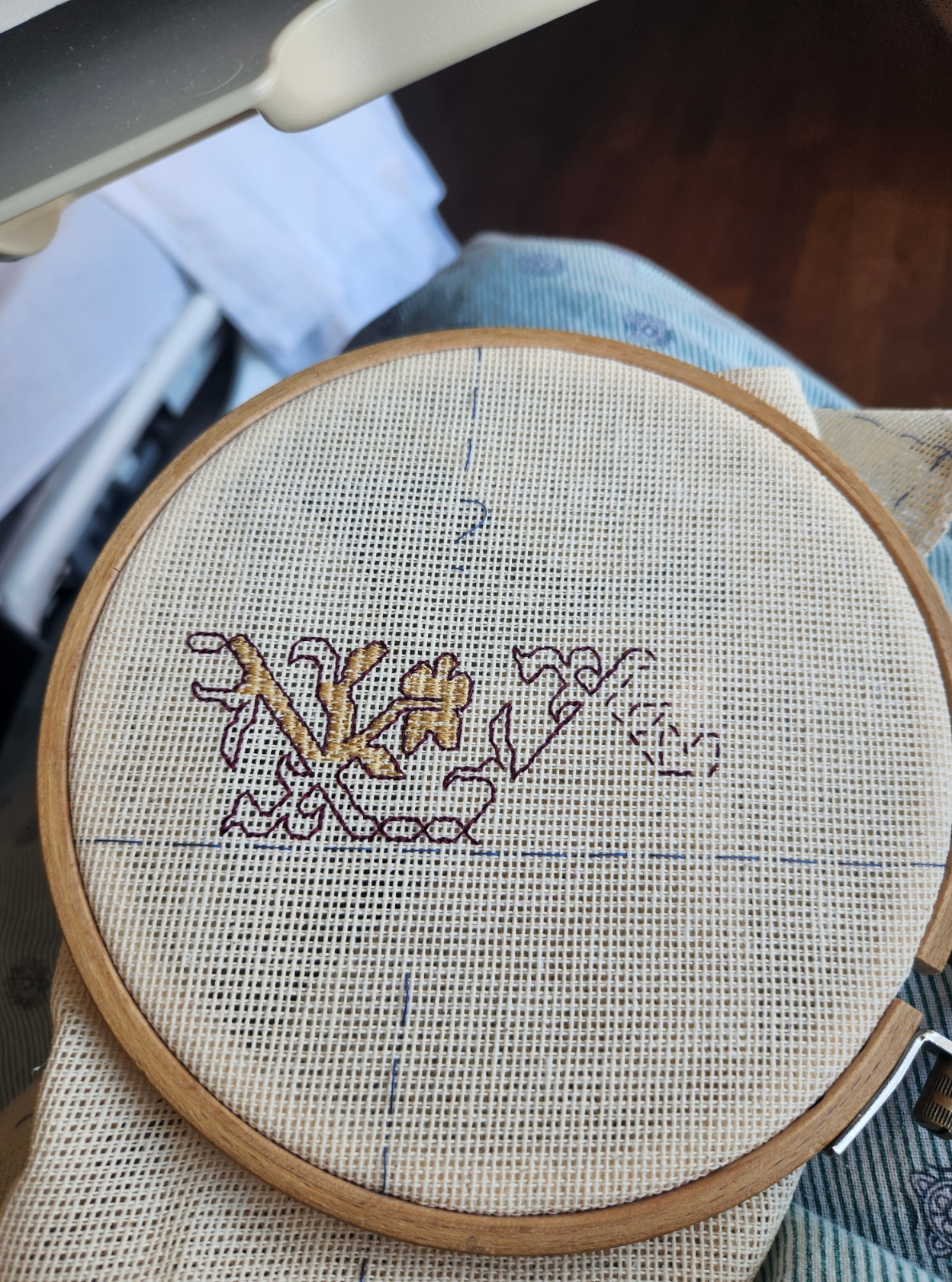
I am not pleased with it. I’m using some of the leftover Ciafonda faux silk I got in India. Nice enough thread, but not lofty enough for this. Even stacked, the double running stitch fill is too sparse. I supposed I could pick it all out and begin again, but right now I don’t have the patience to do that. I’m going to set this small wash-cloth size bit aside and get back to it later.
As you can tell from the bit of hospital tray shown, I had been working on this during my stay there. But I also brought knitting with me, and bargained with the various specialists installing the needed lines and monitors to leave my “bendy parts” clear, including inner elbows, wrists, backs of hands, and index finger tips. They were kind enough to work around all that. As a result, here’s last week’s finish. Yet another pair of socks cast on in pre-op, and finished during the ensuing week and a half of recuperation.
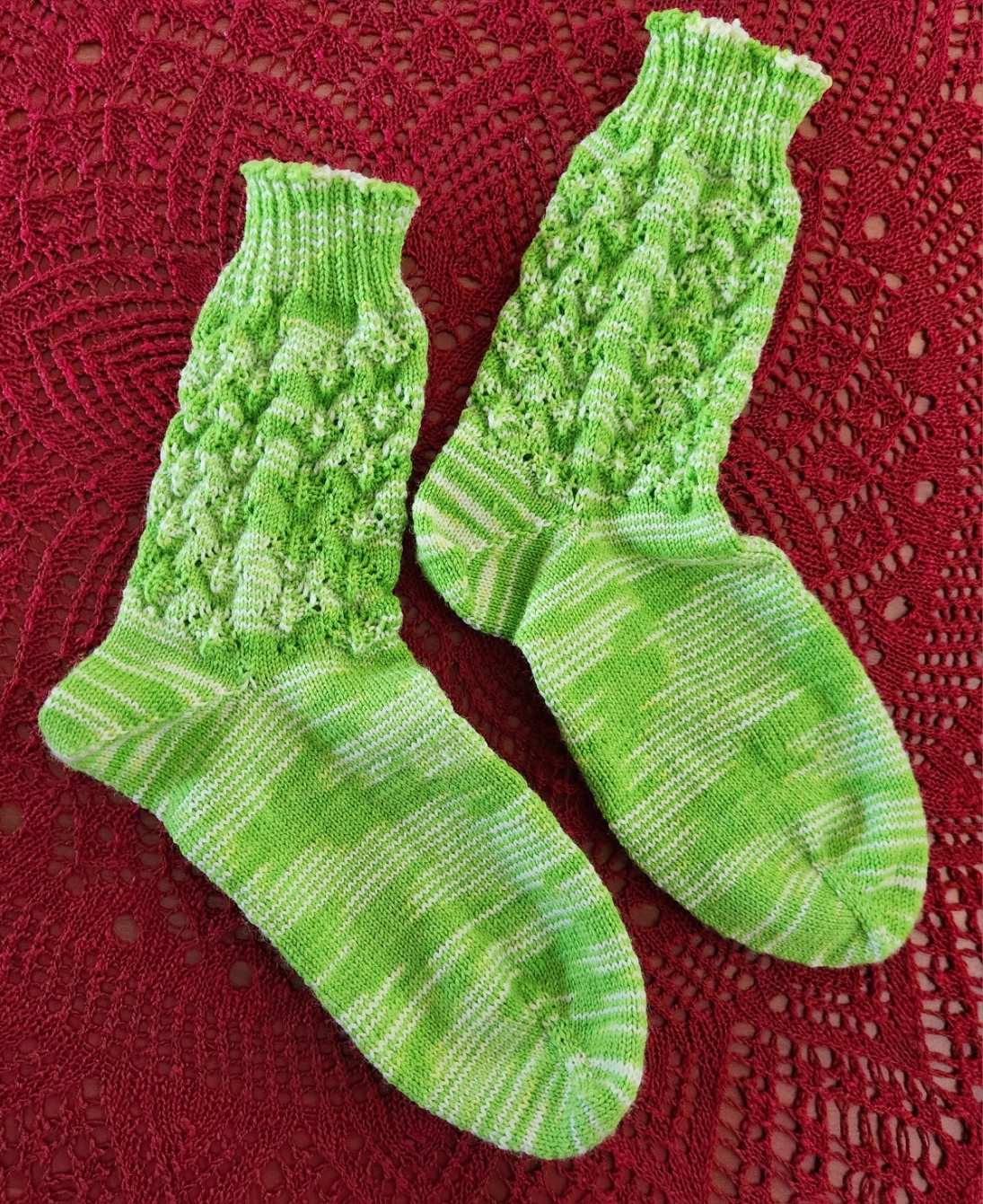
Since these are pretty much done on autopilot – toe up (Figure-8 toe), double wrap German short row heel, and something improvised on the ankle, such socks are “procrasti-knitting,” a fill-in project done while I contemplate other more involved efforts.
And I have arrived on the next one. It will eventually be fine-tuned to honor my Resident Male’s latest book-in-progress, but he’s at an early part of that journey. Themes and significant bits to be illustrated are still in the developmental phase. So I will do something of broader appeal, and add the book-specific bits as they become evident.
But what to do? And how to “future-proof” the project in case therapies affect short term acuity of vision? While such a thing is far from a probability, being a proposal manager has trained me to think in terms of identifying and managing possibilities, no matter how remote. Always.
Thank goodness for a deep stash. I vastly prefer stitching on finer count linens, and consider 40 to 70 threads per inch to be my sweet spot. But that doesn’t mean I don’t have linen of other counts squirreled away. I have unearthed a lovely piece of 28 count. Big as houses. Very easy to see. So I grabbed it, cut a healthy piece, hemmed the edges, basted my edge and center guidelines, and mounted it on my largest width Millennium scrolling frame.
And for thread – how about REAL silk? I adore the stuff. I have two large hanks of Au Ver a Soie’s Soie d’Alger in a lovely cranberry red just sitting there staring at me. And some Tied to History Alori Silk divisible in a couple of colors, also in a parking orbit. If I am going to indulge myself, why not?
The overall style of this one? I will take inspiration from the casual research I’ve done into the Azemmour Cluster. This is a well represented group of embroidered fragments that made their way into museums via wealthy donors who collected bits and bobs of what was sold to them as “Authentic Renaissance Embroidery” in the era of the European Grand Tour, roughly from the 1870s and ending around the time of Word War I. There are lots of snippets formerly labeled as being Greek, Italian, or Spanish that are now being reclassified to their true point and time of origin – Morocco in the late 1700s through 1900. I wrote about some of them in my Second Carolingian Modelbook, and in this 2018 blog post. And then I revisited the cluster in 2023, when a group of eye-popping multicolor pieces documenting concurrent usage of many of the style’s key design tropes was pointed out to me during the Zoom-based group meetings for participants in the Unstitched Coif Project. We had a lively discussion on the obvious Renaissance roots of some of those tropes, and why the museum attributions of so many of them are only now being updated.
I’ve stitched up a couple of the Azemmour group on previous pieces but I’ve never done a deep dive. Not sure which of them I will work with voided grounds, what colors or combos I will use, or what the rest of the piece will look like. But here’s the start. As I said – big as logs.
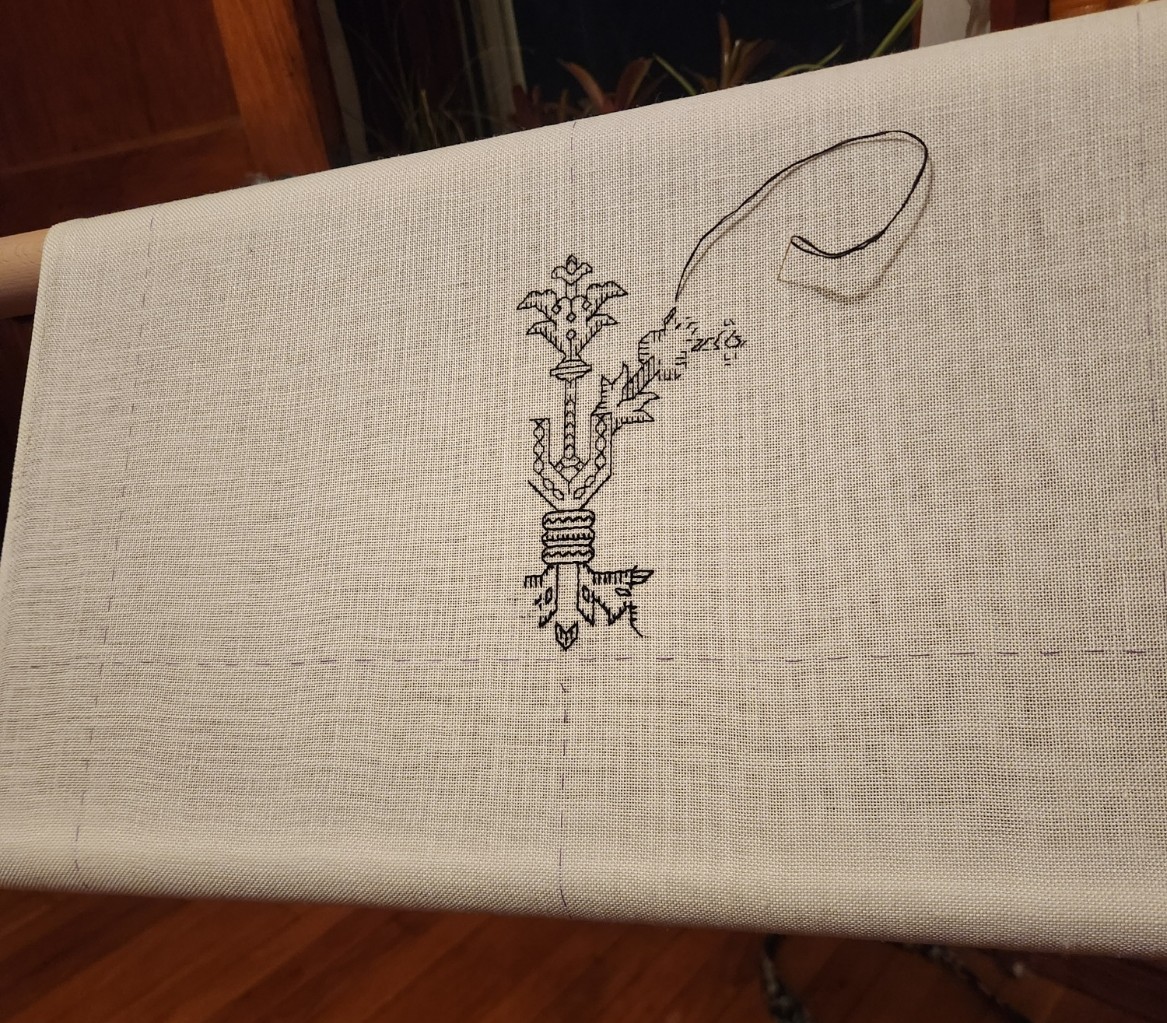
This armed against boredom and the as-yet-unknown, I march ahead.
 String-Or-Nothing