FRAMED
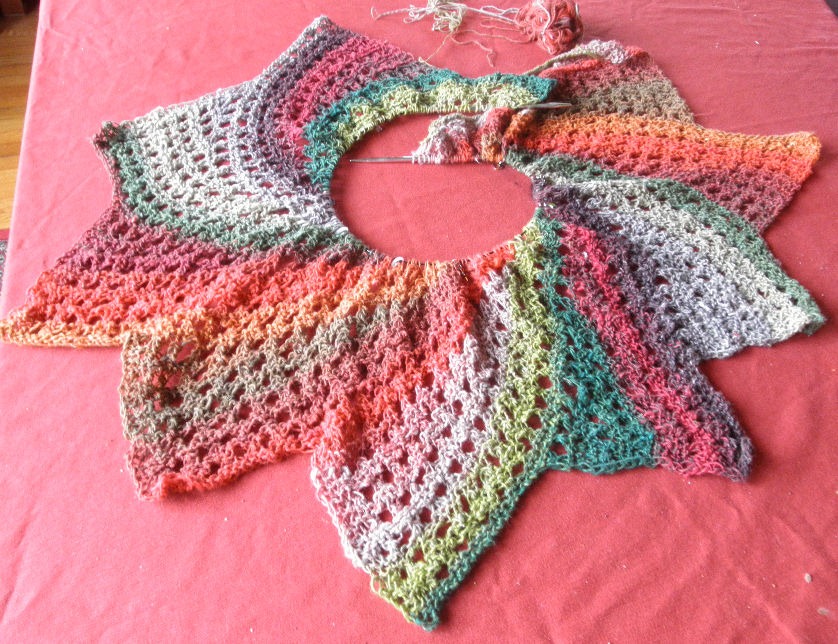
More progress on Motley. I am almost three quarters of the way done with the framing element. In this case, a Regia sock yarn in a deep charcoal grey.

I’m still on the first 50g ball of Regia, and you can just make out what has not yet been knit in the upper right of the photo (click on it to enlarge).
After this comes the multicolor edging, probably a plain saw-tooth, about as deep as the strips are wide. I’ll have to play around and see what looks best.
I’m flying by the seat of my pants here, and explaining exactly how I’m working the corners and filling in the edge triangles will be a challenge. When I post the final write-up of this project it will be more of a method description than a finished full pattern with explicit directions, quantities and the like.
Questions from the Mailbag
Nili asked a couple of thought provoking questions on my post about the difference blocking made in my Lattice Wingspan project. First she asked:
I bought some inexpensive acrylic yarn to play around with and am knitting a good sized sample of feather and fan stitch. If I keep going it could be a scarf. My question is, is there any value to blocking synthetic yarn? Will it respond to the blocking?
I attempt to answer.
There are as many answers to the question of blocking acrylic as there are types of acrylic yarns, multiplied by the uses to which it is put, and squared by the number of knitters, worldwide.
First, on fiber types:
Wools and high-wool-content blends have the memory/bounce-back property. The fibers have a natural elasticity and respond to changes in tensile stress and to a lesser extent, humidity. They return to their cozy, unstretched state upon washing (more or less). This is also what keeps the elasticity longer in ribbings knit from high content wool. Other protein fibers also display the stretch and bounce back property, although many are not as elastic as wool. Silk is the exception in that it doesn’t stretch very well.
Most acrylics on the other hand, do not have the same stretch and bounce back properties as wool and high-wool content blends. They can be stretched, but once set that way under heat and tension (aka “killed”), they will never return to their original shape. There are exceptions. High tech man made fibers are invented every day, and many acrylics contain a modicum of something elastic to keep ribbings true and offer a more “wool-like” experience.
Cottons, linens, ramie and other plant-derived fibers behave differently, with different shrinkage properties and performance characteristics under blocking.
Next, on blocking methods:
There are a zillion ways to block. Wet, dry, under tension vs. gentle pat out, with and without steam, and so on. Different methods are better suited for different fibers, or different uses. For example, the wet-block high tension set up used for lace to spread it out is not appropriate for a dense, cable knit sweater. A pat to measurements and non-contact steaming to relax it might be perfect for that Aran knit in wool.
What blocking does:
It evens out stitches, reduces (but does not totally eliminate) curl. It makes edges lay flatter and seaming easier. It coaxes the piece into the shape desired, although it cannot correct major size or proportion problems.
If a wash/wet block method is used, it removes hand grime any residual spinning oils from the yarn, and casual dirt from the piece. In general, it yields a more professional final appearance, and removes some of that “loving hands at home” look.
To answer in specific – blocking a lace scarf knit from acrylic:
How I’d proceed would depend on the acrylic I was using. You’re lucky because a lace scarf doesn’t need to end up being the exact dimensions that a garment body might require.
The best advice is to knit a small swatch that uses both the cast-on and cast off of your final project, and test out your method. You may find that damp block with blocking wires and pins, using non-contact steaming (an iron set to low heat) spreads out the lace and fixes it in that shape. Or you may find that doing so stretches the lace body a tremendous amount relative to the cast-on and cast-off edges, which end up looking cupped and puckered.
I’d probably attempt some sort of blocking on the thing, knowing that even if the ends puckered oddly, there are fall back positions. The most aggressive (and for knitters, controversial) way to fix that problem would be to toss the thing on a sewing machine and run three or four lines of machine stitching across the end, just before the cast-on or cast-off row. Then (horror of horrors) cut off the puckered end. The raw edge will be secured by the stitching, and can be made neater with a row of encapsulating crochet, or used as a base for fringe, or a knit-on edging.
Also what type of cast on creates a soft, loose base? I’ve found stretchy ones suitable for ribbing but I’m looking for one suitable for lace. I tried long tail with a larger needle as well as spacing the stitches out wider on the needle. It’s still pretty firm. What can I use instead?
I attempt to answer Nila’s second question without resorting to another indeterminate diatribe.
Lace cast-ons can be problematic. As you note many are too tight or are not stretchy enough for the wide spread of lace, or for the aggressive blocking that makes it look best. There are many simple and exotic cast-ons that can be used for knit from end to end lace. There’s another bunch that are great for center-out motif lace, but that’s for another post.
In general, for lace garments, the stretchy cast-ons are usually enough, especially when they are worked with a needle two or three sizes larger than the needle size that will be used for the bulk of the lace. But for things like shawls and scarves which are blocked until they scream, even a stretchy start is often not enough.
Simple lace cast-ons:
I won’t get into the really exotic methods, because most of the time the simple ones outlined here work well enough for me and my projects.
I usually work some sort of provisional cast-on because most of my scarf and shawl pieces are finished with an applied edging, which is quite easy to knit onto the loops that result when the initial edge is released from its provisional mooring. My favorite provisional start is crocheting on, which is easy to zip out for remounting the stitches on a new needle.
On the rare occasion when I want the edge to stand alone, and I need extra stretch, I will work the same crochet-on cast-cast on, but using a hook closer in size to my working knitting needle, AND working a crochet chain stitch BETWEEN each stitch mounted onto my knitting needle.
Another method I use is a variant of the cable cast-on. For this one I also use a knitting needle two sizes larger than my lace needle. Put a slip knot on the left hand needle. Insert the right hand needle into that stitch and draw a loop through it. Slide the new loop onto the end of the needle and before you snick the yarn up tight, insert the right hand needle into the new loop. Repeat drawing a new loop through the new stitch until you have enough stitches on the needle. If you were to insert the needle tip in between the old stitch and the new stitch, you’d be doing the classic cable cast-on – aka “knitting on”, but by making the new stitch in the loop of the previous one, you make a more airy and more stretchy edge.
Finally, on occasion the most convenient method for starting narrow lace pieces is the simplest one of all – the half hitch cast-on (aka “Looping On” or “Backward Loop Cast-On”). It’s the stretchiest of all, and can be made even more so by using a larger needle. It does however produce a very flimsy edge. I use it when I cast on stitches for a lace edging, when I intend on working the edging completely around something (scarf, baby blanket, etc.), and plan on joining my final row to my first row via grafting. Yes, I could use a provisional cast-on for this and end up grafting onto live stitches, but there are usually very few stitches at the start point of a narrow band of edging, and doing so wouldn’t be worth the effort. One caution on this – the stitches in the next row coming back HAVE to be regular knits or if they are purls, they need to be worked through the back of the loop. Otherwise the half hitches will collapse.
To sum up:
Lace cast-ons are largely a matter of personal preference. There is no one perfect method for every piece in every yarn. Knitters being passionate people, will each advocate their own favorite, and armed as they are with pointy objects – can be formidable in their discourse. The answer here is the same as every other answer in knitting. Give it a try, make a swatch and abuse it. See how you like the method for the piece at hand, with your chosen material. Preferences are as situational as they are personal, and there is no single correct answer.
STILL AMBITIOUS
Motley continues to grow. I’m just about done with the center area now:
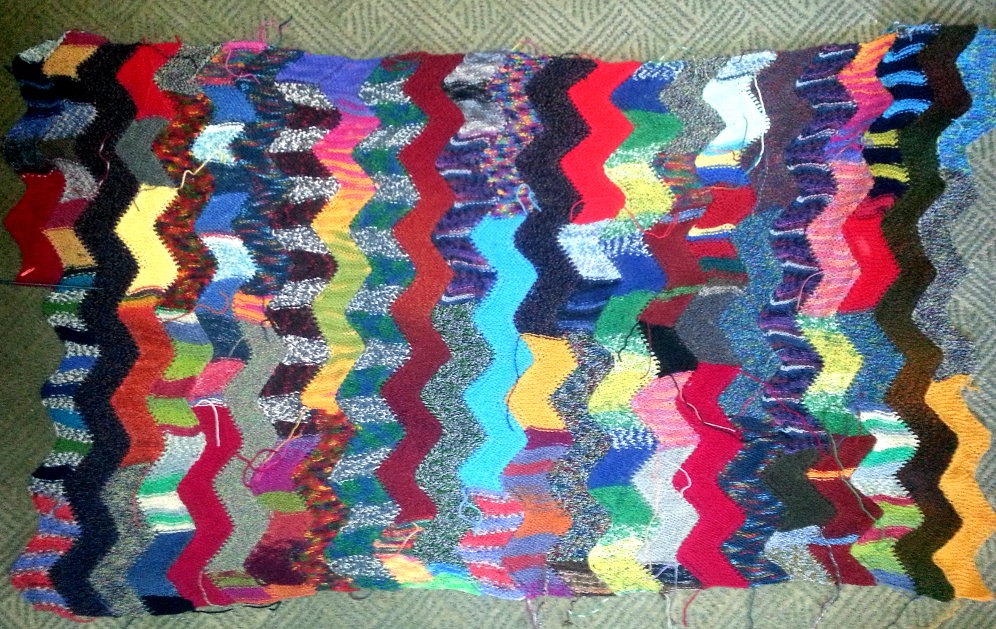
Some people have expressed incredulity that I’d consider working fingering weight on US #8s (5mm). However it’s working out just fine for this purpose. This is a blanket, not a sock that benefits from tight knitting, nor is it a garment on which a looser fabric would present show-through problems. Instead, even with the large needle size, thanks in part to garter stitch, I’m getting a nice, cozy and cushy thermal weave texture.
However the main reason I chose such a large needle size relative to the yarn is because I’m using up dribs and drabs of yarns in a variety of weights, from light 3-ply fingering like ancient Kroy 3-Ply and Wildfoote, to standard sock yarns (Regia, Opal, Fortissima) all the way through some of the heavier sock yarns that are almost sport weight (Marathon, Koigu). I even have a couple of small ends of lofty DKs that knit down to sport gauge. That means that the “native gauges” of the yarns in this piece range from about 32 to 24 stitches in 4 inches (10cm). Breaking the rules and working them all on what normally would be grossly large needles evens out differences in gauge and lets me use them all together. Yes, some of the stripes are denser (or more airy) than others. But they all present as uniform in width, and as a whole – work together.
I’ve got to finish out the current stripe (at far left) and add another at far right. Then I’ll be up to the next step – filling in the edge triangles left and right to achieve a nice, even rectangle.
There are two methods I could use to do this – either pick up one stitch and knit an isosceles triangle, joining the two shorter sides to the existing blanket, using the same method I employed to knit each strip onto the growing whole; or I could pick up stitches along the edge of each “zig” and knit out, using a center double decrease to achieve the triangle shape. I’ll probably experiment with both, although I am leaning to the first method for visual congruence with the rest of the piece.
Once I’ve filled in the edge triangles, I’ll probably work a narrow solid color strip all the way around the outside, using mitered corners, to unite the piece. After that all bets are off. I might stop there, or I might add some sort of zig-zag or dagged edging, also worked in multicolors. There’s only one problem though. I started with a bag of leftovers that was about the same size as half a standard pillowcase. I’ve used most of them, and don’t have a nice range of colors left. If I do a multicolor edging, I’ll have to BUY yarn to complete my stash-consuming Motley!
Whichever methods of framing and finishing off this piece I choose, I will be writing this up as a method description, complete with approximate square yardage per weight estimates (for fingering) so that those of us who happen to have a bag of leftovers the size of a 25-pound turkey can put them to good use on their own stash-busting scrap blanket.
GAUNTLET IS CAST
Two pairs, actually. Now winging their way cross country to the recipients:

Both are from patterns available on Ravelry. Left are Susie Roger’s Reading Mitts, and at right are Swirling Gauntlets by Susanna IC. Both are knit from Red Heart Shimmer, one skein of which (plus four evenings) was more than enough for both mini-projects.


I mailed these on Monday, but I’m posting this ahead so that the package has time to arrive without totally spoiling the surprise! Shh!
MORE MOTLEY, MUFFATTEES, MODIFICATION AND MUTT
Back from visiting Florida, my mom and sister (plus her family). We had a great time, feted like royalty on progress. Special thanks to all, especially my mom, and to Chef Terry who pulled out all the stops for the holiday meal.
Motley
Sitting and chatting with mom did allow Motley to grow. In order to keep color distribution even, I have been adding to both ends:

I’ve got some snippets of hers now in there, too. I’m about two thirds of the way through the center rectangle, and am very pleased at how it’s turning out.
Muffattees (Fingerless Mittens)
Also, while we were there my two nieces expressed a desire for fingerless mittens. I’m not quite sure why they’d need such a thing in Florida, but teenage fashion whims (when reasonable) can be indulged. Especially when they are a quick knit.
For the first pair, I’m using the Reading Mitts pattern from Susie Rogers, available on Ravelry:
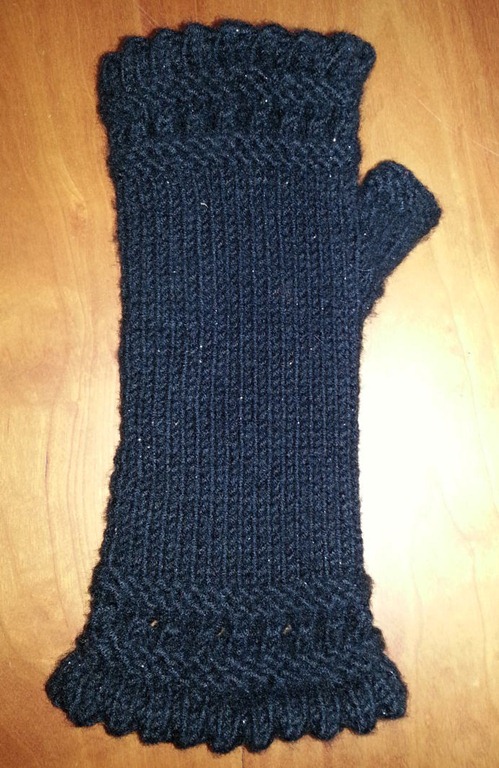
I’m about a third of the way through the other mitt of this pair. I’m still looking for a slightly different but equally interesting design for pair #2. Although I love luxe yarns, I’m no materials snob. The yarn for this one quite humble. It’s a very soft Red Heart acrylic worsted with a subtle shiny mylar thread running through it. Called Shimmer, it does, just a tiny bit, and has a very pleasing almost cashmere-like softness, which will feel nice on the hands. I chose a washable yarn because even in black, mitts get dirty quickly. The yarn is a bit splitty, but I’m happy with the result.
For the pattern, I knit the smallest size. With this yarn on US #5s, it’s plenty big enough (the medium was too big for me and I’ve got gorilla paws). The only modification I did to the pattern was to use a provisional cast-on, then knit the cast on stitches along with the live stitches to fuse the picot hem, just before the decrease row that sets count for the cuff pattern. That ended up adding one row of width to the edging before the first purl row of the cuff. Not noticeable. Also users should note that the lace pattern is set up for an even number of stitches, but two of the three sizes as presented yield an odd number in circumference after the decrease row. Just ignore the extra stitch and work it plain – on this item no one will ever notice. Finally, the method for picking up the thumb benefits from casting on two rather than one stitch on the side facing the mitt’s body. Even so, I advise leaving a nice long tail when you join the yarn to make the thumb. The excess will come in handy to close up the rather large gap at the “thumb crotch”.
This pattern is a sweet little project for a last-minute gift. Mitt #1 took two evenings. Mitt #2 bodes to take less, in part because I don’t need to start, then rip back the medium size.
Modifications – Vintage Yarn Chart Rehab
I know that lots of folks who visit here are looking for my chart of vintage needle sizes, historical yarns as plotted against gauge and modern needle sizes (with a few modern yarn recommendations). That chart was ported over in the Great Blog Migration, but arrived in less than readable condition. I’ve ironed it out now. To minimize confusion, I’ve modded the original post from 2005, rather than reproduce it here. But I’m opening it up again for additions. If you run across a pre 1930s pattern that calls for a specific yarn and vintage needle size, and you have made a successful modern substitution, toss a comment onto that page listing the original needle size and yarn specified, plus your modern substitutions. I’ll add them to that chart.
Mutt
Apologies for calling my mom’s companion, Honeybun, a mutt. Mom would classify her as a “designer dog” – a mix of Maltese and Yorkshire Terrier, sometimes referred to as a Mookie. But I needed the alliteration, and as long as I toss the toy or scratch behind the ears, I don’t think Honeybun would mind:

She’s a cute little bundle of fluff, and a very good apartment pal.
MOTLEY ON THE ROAD
My bag of orts hardly reduced by my progress, here’s more Motley:

It’s rather chaotic, but I like it. For the record, I’m using US #8 needles, which are quite large for fingering weight. But the odds and ends I’m knitting with are not all of uniform thickness. Some are regulation fingering weight sock yarns, like Regia, or Fortissima. Some are heavier, like Koigu, or Dale Baby. But all fall into the 9-6.5 stitches per inch range. Since this is a throw and not something like a sock or mitten that needs a sturdy fabric, using these finer yarns on larger needles is minimizing the gauge difference among them all.
I’m about a third of the way through the center rectangle. When that’s done, I’ll probably fill in the little triangle bits at the top or bottom, then do a narrow mitered edge around using a solid color. After the unifying band is on, I’ll finish off the thing with some sort of edging, also done in haphazard small quantity multicolor.
There’s no guarantee however that the current “bottom” edge will remain so. I can add stripes to either end, so long as I maintain the joining rhythm, with raised join edges appearing on every other seam. The other “rule” I’ve hit upon is that unless the quantity left when I get to the end of a stripe is very small, or the yarn’s color variations are giant, I am beginning a new color for each new stripe. I do note that my color selections are consistent. There are reds, purples, yellows and greens in there (and the occasional snippet of turquoise), but most are variations of those tones that harmonize well with deep blues. For example, there aren’t any baby pastels or desert tones in the thing.
Working on this is bringing up memories of the various projects that fed my bag of leftovers. Socks and baby projects knit at particular places, for specific people come to mind as I address each tiny remnant. Although I hope I’ve got a way to go to the Madame Defarge stage, coding the names of the damned next to the guillotine, I do remember details of conference presentations and lectures I knit through as their sock leftovers come to hand.
And finally the explanation for the cryptic “on the road” designation, and for the uncharacteristic bright photo of the piece. I’m in Florida, visiting my mom, and took the photo here in her bright and cheery marble-floored apartment, rather than our darker New England home. Here we are enjoying the view off her balcony and being spoiled rotten. Not necessarily in that order.

MOTLEY!
Things being rather unsettled here right now, but still in need of stress abatement, I looked around to see what evening needlework distraction I could find. I don’t want to start a forever project with only a limited amount of time before The Big Displacement. I’ve sent the embroidery floor stand on ahead to India, so working on Big Green is problematic. I’ve been doodling up knit scarves and socks – giving most of it away. Additional inspiration for this one came from the Resident Male, who always bemused by my yarn hoarding habit, forwarded this.
I’ve got a big bag of little bits of fingering weight – mostly left over from sock projects. I’ve dipped into it every now and again to make booties or to supply a stripe or toe for later socks, but for the most part, the bag has grown steadily larger in the 18+ years I’ve been knitting socks.
So. Given the need for totally mindless knitting, very few needles in the house (also mostly sent on ahead), and the guilt-induced constraint to use my stash yarn remnants, what could I come up with?
Motley!

This is ultra simple – 12 stitches across (10 plus 2 slipped edge stitches), knit in garter stitch; 10 ridges with each right side row beginning with an increase and ending with a decrease; followed by 10 ridges with the wrong side rows beginning with an increase and ending with a decrease. After the first ripple is done, subsequent ones are joined to the established chain selvedge edge with a simple pick up/pass last stitch over move, followed by purling that stitch on the next row. The basic zig-zag concept is Frankie Brown’s Ten Stitch Zigzag, which I’ve played with a bit.
Using relatively giant US #7 needles (giant for sock yarn, that is) I’m reaching into the big bag of leftovers, pulling out whatever I find, and adding it on. Eventually I’ll add little triangles to square out the piece to make a center golden ratio rectangle. Then I’ll figure out some sort of similarly chroma-chaotic edging, so that I end up with a little lap throw.
It’s a quick knit, and totally without thought. What you see above is the the consumption of nine mini-balls of leftovers over the course of three evenings.
GIMP CHARTING TUTORIAL 108 – THE TEMPLATES
Inspired in part by Hastings Sanderson over at Is That an Apres?, who is thinking of embarking on an extensive graphed needlework project, I went out web-walking to see if others were using GIMP for needlework graphs.
In addition to my own set of tutorials on using it for line unit patterns (backstitch, double running, punto scritto, Holbein stitch, etc.) I note this tutorial on using GIMP to transform photos into cross stitch graphs, and a GIMP plug in for that purpose. I’ve also adapted my method for use with square unit graphs (cross stitch, needlepoint, lacis, burato, knitting), but it’s not as elegant as the commercial programs designed in specific for needlepoint or cross stitch.
However, in all cases, I find very few folk have successfully used GIMP for needlework charting. The most prominent feedback on my method is that few people have the time or patience to establish the base templates. So, to give others a leg up on creating their own charts, I offer up my base pages. These are 8.5 x 11 (US letter size) pages, each set up with the layers needed for graphing. They are intended to be used with the grid spacings and brush sizes specified in my tutorial. They are based on the ones I’m using right now for T2CM, the sequel to my New Carolingian Modelbook.
Because of WordPress limitations I can’t post the GIMP *.XCF files, so I’ve bundled both the line unit and square unit templates into one standard Windows *.ZIP:
Remember – after opening these templates go back and change your grid spacing and brush sizes to those specified in the GIMP series here. Then have fun!
HECTIC!
It’s been a hectic several weeks here at String Central, encompassing major transitions and a very small crumb of Hurricane Sandy.
First on the transitions – I’ve left my job to concentrate on our India migration preparations. I’ve not made a secret of being a professional proposal manager, but I’ve avoided naming my former employer here to date. I will miss my colleagues at iRobot, where I worked on the defense and safety side of the house. I supported robotics research; and the various robots used for bomb disposal, infantry support, and nuclear clean-up. It’s hard to beat the combo of brilliance, passion, and creativity at a place like that, or knowing that the work you were doing helped people save lives on a daily basis.

In the midst of emotional upheaval of leaving, the recent storm provided a reality check.
We had it nowhere near as bad here as folks further south in New York and New Jersey. Shout-outs of support and sympathy to those in my childhood neighborhoods of Sheepshead Bay, Brooklyn and Teaneck, NJ (Bergen County); to Long Time Needlework Pal Kathryn in New Jersey and to Mathilde, also near the landfall area; and to all others suffering the storm’s aftermath.
AN ASIDE:
Please join me in offering assistance to those in need by donating to the charity of your choice, or to the American Red Cross: http://www.redcross.org/
Unfortunately, times like this bring out lots of bottom feeders. I strongly suggest heeding the advice here before unlimbering your wallet.
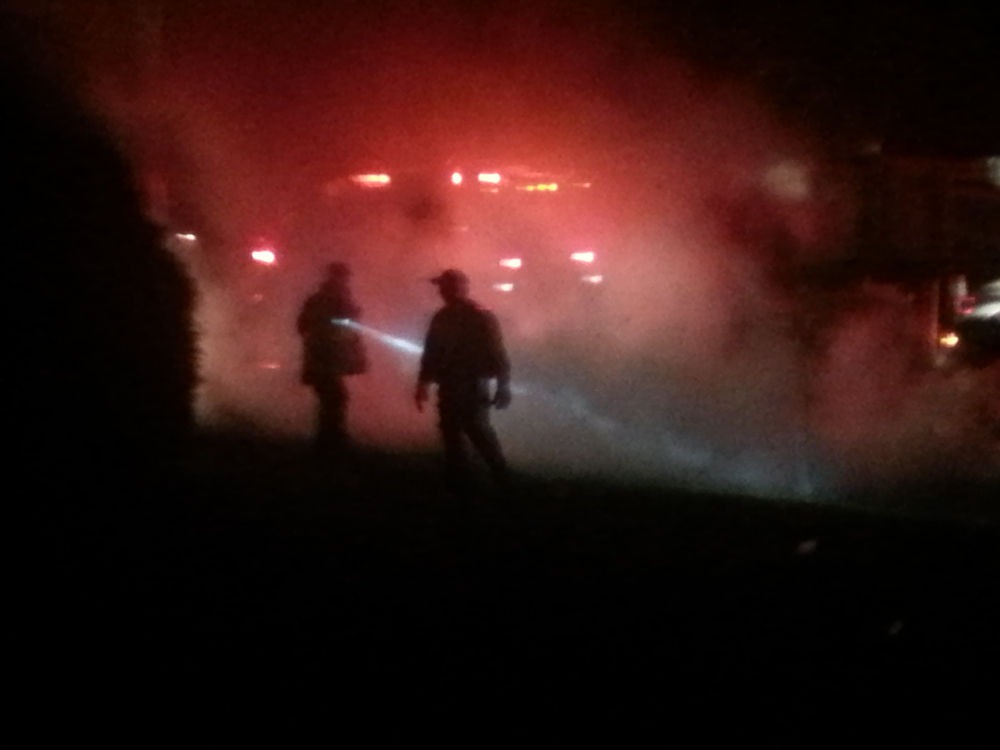
We were without power until Thursday here – the result of a small but spectacular power line fire in front of our house, that occurred at the height of the storm. It took about 2.5 hours before the utility had a truck free to turn off the electricity. In the mean time, we had a leaping, sparking power line; and a spreading turf fire. Luckily the ground was wet, so the fire burned down into the lawn instead of spreading the short distance to the house and cars, but it was so intense that the copper itself burned (green flames) and the turf vitrified into solid, red-hot masses. When the power was safely out, the fire department came to dig out and extinguish the blaze. The only casualties ended up being a swathe of grass, our collective nerves, and some refrigerator perishables that didn’t survive the lingering power outage.
Thanks to the first responders who came to shepherd the hazard and stayed with it through the worst of the wind, and to the crews that dealt with the fire and its aftermath.
We still have no land line phone, but that’s just a minor annoyance.
Halloween did happen here, although with a dark street, only the most intrepid and candy-hungry kids came to our door. But we were ready:

(Sadly, the head sensor gizmo on Younger Daughter’s pumpkin Dalek did not survive the first wave of trick-or-treaters).
And finally, after all this blather – report on what needlework progress I was able to manage by candlelight:
The finish of the cotton Kombu Scarf:

And most of yet another Lattice Wingspan:
I plan to invest my new found daylight hours in additional post-storm clean-up, attending to India related preparations, fixing the vintage yarn chart/needle size chart for reposting here, studying Hindi, and working to get T2CM out the door. In more or less that order.
WHAT WOULD YOU PACK?
I have sent off our second shipment of household goods. With luck they’ll arrive at the apartment in Pune, India by the end of November. The flat is furnished, so there was no need to send furniture, but it’s a spare and barren space. The Resident Male is fixing that, but it will take time.
In shipment #1 we sent pots and pans, some linens, a TV, and other items of immediate need. This second shipment is mostly clothing for Younger Daughter and me, plus linens for more beds, some bits of kitchenware that we forgot before, and most important of all – Survival Boxes. Younger Daughter and I each got one.
What’s a Survival Box? It’s a box full of the hobby, reading, or idle time amusement things intended for maintaining familiarity and sanity far away from home, where supplies might be difficult to come by. That’s not to say that we wouldn’t be able to find hobby things at our destination, but I rather suspect that selection and proximity will both be limited.
Younger Daughter packed painting and sketching supplies, including paints, pens, and paper. Also some selected books, and crochet yarn and hooks, along with a book on intro amigurumi (Japanese inspired small soft toys, usually knitted or crocheted).
What was in my box? Really – you have to ask?
In all truth, packing the thing was the hardest move task to date. What to take and what to leave behind? On one hand, I want to have a variety of things to do because I work on stuff at whim. It’s hard to predict flights of whimsy for the 18 months to come. On the other hand, there’s no point bringing a ton of stuff because whatever I bring, I have to schlep back.
Here’s what I settled on:
1. My unfinished North Truro Counterpane. It’s about 40% done right now, destined to be queen bed size when completed:

The pattern is here, if you’re interested.
2. My giant green sampler. I packed the frame stand, but not the sampler and stretcher frame. I’m still working on (albeit slowly) and it will accompany me in person.
3. Lace yarn. I’ve got a huge hank of black merino lace yarn, plus a big spool of hunter green, some blue, and some accent threads that go well with the hunter. Not sure what I’ll do with them yet, but I am bringing my copy of the Sharon Miller Princess Shawl, just in case I want to attempt an impossible project in an unconventional color.
4. Extra ground cloth and threads. I rounded up my stashed bits of cotton and linen even weave. They range from 26 to 50 threads per inch. I’m bringing white and black DMC linen floss, plus a pile of red, black and green cotton floss. Just in case inspiration strikes. I don’t have a stash of silk floss and didn’t buy any because of everything that I use, that’s the most likely thing to be available in India.
5. Sock yarns. About four pairs worth. The best in my stash, including some hand-dyed, and a ball of (near) solid Zauberball in deep emerald.
6. Lots of knitting needles, holders, embroidery needles, a pair of sewing shears, a couple of hand-hoops, my magnet board folder (thanks Kathryn!), my swift and ball winder (absolute necessity with the lace yarns) and other notions.
7. The stitching kit I picked up at Winterthur, to make a reproduction of the Sarah Collins sampler. Still not sure if I’ll do this myself, but it’s a self-contained project and easy to transport. Compared to the stuff I usually do it doesn’t look like it will take very long to stitch up.
8. Selected reference books. I can’t bring my whole library, but I did pack a few big-bang-for-the-volume pieces – my Duchrow trilogy, a German knitting stitch treasury, and TNCM. Plus some others on a thumb drive.
With the exception of a couple of balls of sock yarn and the accent threads, this is all from my stash, accumulated over the years. Which is why we have these hoards in the first place. Right?
So.
Given a trip for up to two years away from home, to a place where distraction would be appreciated and supplies might be hard to get, what would YOU pack?
BLOCKING MAKES ALL THE DIFFERENCE
Compare.


This is the same scarf. At the left, it’s fresh off the needles. On the right, it’s been through this torture:

All lace benefits from a savage blocking. Is your Wingspan looking flabby? It’s probably not your knitting technique. Try blocking it and see.
For the record, I used my visually horrific checked sheet and damp-blocked my finished Lattice Wingspan. First I dampened the thing and squeezed it out gently (no wringing). I patted the center curve into shape and pinned it first. Then I used a minimal number of pins – just one at each point – to pull the points out from the center. Finally, I let it dry overnight.
The ends? I don’t darn in ends until after I’ve blocked. Especially on lace. Finishing off the end may introduce a small area that does not stretch like the rest of the piece. Better to let them hang, then deal with them after blocking is over.
 String-Or-Nothing