ANCIENT KNITTING BOOKS ON THE WEB
Back to a series started long ago, I present more summaries of out of print knitting-related books. But instead of exhuming these from my local library system, I found the full text of these works on-line via a Google Book Search.
Directions for Knitting Socks and Stockings. Revised, Enlarged and Specially Adapted for use in Elementary Schools, by Mrs. Lewis, printed in London in 1883 is a pamphlet written in response to a bit of British educational legislation, mandating that all girls be required to learn to knit. Aside from pedagogical pedantry in service of this goal, it does provide some interesting bits, although there are no illustrations. Pages 12-14 contain a comprehensive “sock recipe” chart, listing numerical sizes and the numbers of stitches to be cast on, and the number of rows or stitches that compose other sock and stocking features (rib depth, length to heel, heel stitches, length of foot, etc.). This chart however does not present gauge or finished measurements. From the measurements however, it’s pretty clear that gauge is quite small by modern standards, with the smallest boy’s sock size starting off on a 49 stitch circumference, and the largest man’s sock size starting off with a 121 stitch cuff.
Prose directions to accompany the charts begin on page 15. They describe socks with Dutch style heels. I would not recommend this booklet for a modern knitter starting off on his or her first pair of socks because the description style used in the directions is obtuse by today’s standards, although for the time – the instructions are pretty clear. But if you have done a Dutch heel before and are familiar with it’s components and features, you will be able to follow along.
The leaflet goes on to present directions for Muffatees with Thumbs (page 24) – fingerless mittens, but knit flat rather than in the round, and are worked sideways rather than parallel to the bottom edge of the cuff and seamed up the center of the palm. Wrist ribbing is constructed from knit/purl welting. This pattern is a little bit more accessible, although the description of picking up and knitting the thumb is a bit of a stretch. (I’m thinking of quickly trying this pattern out and posting the redaction here if anyone is interested). There’s also a beginner’s scarf knit in the flat, featuring a simple fagoting detail running its length. The booklet finishes with a description of various historical yarns. Names and in-skein weights are given, but aside from an estimate that a certain weight should be ample to produce a pair of socks – no yardage is described.
The Lady’s Assistant for Executing Useful and Fancy Designs in Knitting, Netting and Crochet Work, by Mrs. Gaugain, London, 1847 is one of those Ur books that informed later generations of stitch pattern reference works. I’ve seen it mentioned in bibliographies, and was excited to find it on Google. Sadly, I was very disappointed. Although it is listed as containing over 220 pages, the scan cuts off around page 70 or so, and of the initial 70, quite a few are skewed, truncated, or flat out missing. None of the netting or crochet sections are included in the on-line version. Given the difficult notation and lack of illustrations, I’d need more patience and perseverance than I have to spare tonight to make much headway with the contents.
The Young Ladies’ Journal Complete Guide to the Work-Table: Containing Instruction for Berlin Work, Crochet, Drawn-Thread Work, Embroidery, Knitting, Knotting or Macrame, Lace, Netting, Poonah Painting and Tatting, London 1885. This one is a bit more promising, more along the lines of Weldons Encyclopedia volumes or the illustrated needlework sections of Godey’s Ladies’ Book. The crochet section includes some nicely done illustrations of basic techniques, including a basket pattern I’ve not seen before (p. 12); and excellent illustrated beginners’ guides to Guipre style darned netting. The knitting section is relatively advanced, with descriptions of gauge and its importance. There are a few texture patterns shown – nothing that hasn’t made its way to modern sources; plus counterpane edgings and motifs, stockings, knee-caps, baby shirts and other items. On page 52 theres an interesting shawl, knit using two weights of yarn to produce a honeycomb line effect with lacy infilling. There’s also an unusual welted insertion pattern similar to the pattern shown on the cover of Lewis Knitting Counterpanes, except that in this case there’s no bundling of stitches using wraps ( p. 61).
I also liked the point lace (needle lace) section. The first style shown would be familiar to most people today through the Battenberg lace style, it is rarely illustrated in contemporary works on stitching and needle lace. This book shows various infilling needle lace patterns for use inside of the outlines formed by the loops of purchased woven tape. Other forms of point lace are also shown,
Poonah painting apears to be some sort of stencil work done with enamels and varnishes, applied to both hard surfaces and textiles. I have to admit I wasn’t that interested. More interesting was the macrame and tatting section. This is macrame as in fancy finework fringes – not heavy cording tied into owls or plant hangers. I have used some of the simpler style fringe tying patterns on scarves and knit blankets. They add another layer of complexity to the designs, and look much more finished than do fringes attached and left otherwise untied.
The book finishes up with brief sections on drawn and withdrawn thread embroidery styles and on some of the fancier forms of knotted netting.
FUTURE HAT INVASION?
Yesterday I mentioned that I was working up two new projects. The second is still on the drawing board. While The Resident Male likes his crazed llama herder hat, he’s mentioned that it can be itchy, especially when wet. It’s also a bit tight on him. He’d like another that’s slightly larger, knit from softer wool than the first, but he still really likes the style and shape.
So I was thinking about what I could put on a hat for him, and what colors of sport and fingering I had on hand. I’ve got some small quantity leftovers from the rainbow scarf set. Not much, but enough for accents. Plus I really like the Camelia sport I’ve been using, which is about the same gauge but at my LYS is only available in very staid colors. So I began thinking about what would be mostly background with flashes of bright colors, yet would be guy-wearable. Then I saw the latest issue of Knitty. If someone can put Space Invader graphics on a sock, why not highly colorful Galaga spaceships on a hat?
For those of you born during or after Bush-the-Elder’s administration, Galaga was a very popular coin operated console video game of the Galaxian type – vintage 1981. You can play it here. It has been brought out for X-Box and some hand-helds (even phones!) but it’s not the same. It was also one of The Resident Male’s absolute favorites. (I preferred Tempest, but those vector based graphics wouldn’t chart up well for repro in knitting.)
So I set about graphing out the Galaga galaxy of sprites from screen shots preserved hither and yon. There are three enemies, each shown in two animation phases. One of the enemies repeats in a different color scheme. There’s also a separate sprite for the player’s ship, and a toggle that shows how many more player lives are available. Here’s one of the lower level enemies:

I’m not quite sure how I’ll fit these onto the hat, but I note that in my original, I buried all the decreases in the plain rounds in between the step-type pattern repeats. I had 10 decrease points per decrease round, and that the pattern repeats themselves were based on 10 stitch x 10 row units. Each decrease zone between bandings removed one entire repeat. That’s why I was able to repeat the pattern seamlessly as the hat narrowed.

I changed the rate of decrease as I moved along, narrowing the hat more steeply in the upper area not by increasing the number of decrease points, but by shortening the interval between them. You can see that the lower courses of the design are three pattern units tall, but the uppermost ones are only one unit tall. After that last unit was completed I didn’t have room to continue full design iterations, so I ended off with a solid color top.
My Galaga sprites are nine, thirteen and fifteen units wide, without background framing left and right. So I’m still on the drawing board for this one. Plus I can’t actually begin knitting until I finish my second Klein Bottle hat. Still, I’m armed and ready to begin.
SQUEAKY WHEELS GET SWEATERS
As I finish up the gray leaf pullover, and wander through the midpoint of a second Klein Bottle hat (solid navy, difficult to photograph), I plan my next set of two projects.
The first of these I’ve already begun. It’s a quick pullover for Smaller Daughter who has now outgrown the Regia Crazy Stripes raglan I made her two summers ago. I’ve mentioned her fascination with her favorite toy before.
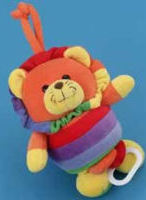

Squeaky is still with us, but he’s aged somewhat. His original colors are only a dim memory. The strings on his head were surgically reattached after a regrettable incident featuring scissors. His music box long ago gave up trying to play Born Free (a welcome change); and the retractable leg that triggered the play no longer draws back into the body. His shiny black nose was chipped back to its pink undercoat after being inadvertently slammed by in a closing car door. He’s going bald all over. More suspicious stains than I care to remember have added to his decoration. But he still is a source of comfort and inspiration.
Smaller daughter wants yet another striped Squeaky sweater. I had some Classic Elite Star stashed away, a skein or two in each of a bunch of crayon colors. It’s a cotton bound with lycra. Although the recommended gauge and fiber percentages are a bit different, it’s visually similar to the old Silk City Softball – a nubbly and cozy machine washable cotton boucle that knits up into a soft and interesting texture. In a departure for something I find buried in stash, Star is still in the current CE line. Armed with Sweater Wizard, I’ve noodled up a quick roll neck pullover, knit in the round, sized for a tall 8-year old who wants something with a generous, boxy fit. As you can see, I’m off to a quick start.
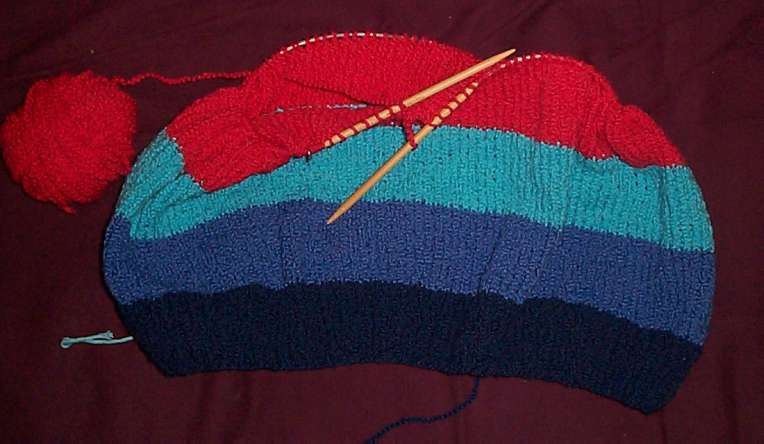
Orange, yellow and light green are next (I have no purple on hand). Stars being a lycra-enabled cotton is not necessarily a quick knit though. Care must be taken to always knit it with the same amount of stretch, or gauge can be affected. Also, it’s texture makes counting rows very difficult – something pointed out by the person who posted the Star yarn review. Since my stripes are each 20 rows deep, and it’s a pain to keep track on a separate piece of paper, I’m relying on a little trick to stay on track.
Every five rows (an easily grasped smaller unit), I flip a yarn color change tail to the front or back of the work.

These big “basting stitches” make counting simple – four groups of five and I’m ready to grab the next color. Later when I finish this piece it will be equally simple to tease these ends out to their points of origin and end them off inside.
One caution – this isn’t a yarn that crocks (sheds color on hands and needles). Were it so, I would not use the dangling tails for this purpose. Instead I might use a length of plain white smooth cotton string. That would give me something easy to remove later that would not run the risk of leaving contrasting color marks on the lighter areas.
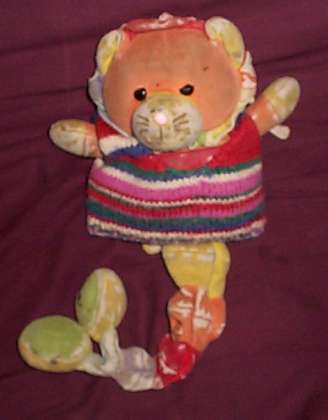
And Squeaky himself? In a bit of art-imitating-life-imitating-art, the toy that inspired the Regia Crazy Color sweater for the child has his own Regia Crazy Color sweater.

OMNIBUS
I’d like to announce some small improvements at wiseNeedle. We’ve added to the search capability in response to user requests.
First, we’ve added a simplified search page to the on-line yarn review collection in addition to the previously existing search capability (which I’ll refer to from now on as the advanced search page). Apparently many people were confused by the number of fields, and tried entering data in all of them every time they searched. This led to a large number of false negative results and some complaints that the page was too difficult to use.
The yarn search link (available in several places on the site) will now take you to this form:

You can type in as much or as little info as you like – yarn name, the first few letters of the maker’s name, some keywords (this searches the fiber and comments fields). You can still get to the old search page by clicking on the “advanced” link in the corner of the new search page.

In addition, should you wish to shortcut the entire process, we’ve added a Google site search box to every page of wiseNeedle, including the front. It appears in the gray bar just under the top banner. Typing a yarn name into that box will bring up every mention of it anywhere on the site – in its original review, in comments tagged to another yarn, on the question/answer board, or even in the commentary here on String.
The simple search page will be most useful to people who want to quickly look up stats or reviews of a known yarn by entering its name or maker; or who are looking for some info likely to be contained in previous comments. The Advanced search page will be of more use to people who are looking for substitutes, or who wish to search on fiber type, yarn weight, an approximate date of the review, or any of the value, suitability, or quality aggregate scores.
We’ve also activated an additional link on the Recently Entered Yarns and Recently Entered Reviews pages. Previously you could retrieve the detail page for each yarn by clicking on the yarn names listed on them. You can now also click on the maker/distributor field to call up all yarns under the listed label. (For the record, the label with the most entries in the collection is Katia, with 142 different yarns.)
In my own knitting, I am finishing up the dropped leaf pullover. I’ve ended collar, using a tubular cast-off. I tried the standard issue one shown on My Fashionable Life, but I didn’t like doing it. Instead I followed June Oshiro’s method, described at TwoSheep. By slipping the available stitches of the ribbing onto two needles (one holding just the knits, and the other just the purls), the cast-off can be treated like any other exercise in simple grafting. The two needle method let me make short work of finishing my collar. I’m now up to sewing the dropped shoulder sleeves onto the body, prior ending off the interior ends and doing the last two finishing seams from bottom hem to cuff.

TRAVELS OF MY SCARF; COLLARED
The Kureopatora scarf I noodled up last winter appears to have taken on a life of its own. It gathered a small bit of interest here in the US around the time I posted the pattern, but no big splash. Then over the summer and fall knitters in Japan found the thing and made it a real knit-fad. A rainbow of finished snakes began crawling through blogs over there. The range of different Noro-type long repeat dyed yarns there is spectacular, and I’ve been delighted to see the color and texture ranges people have used to make their own snake scarves. Now the pattern appears to have been discovered in Germany and the Netherlands. Blogs and discussion boards there are beginning to post pix of finished pieces, and I’m getting lots of referral hits from them.
If you’ve discovered this blog by looking for the Kureopatora’s Snake scarf pattern, welcome! I’m having lots of fun via this vicarious visiting. For the record, the top non-US, non-spider sources of wiseNeedle visitors Canada, China, the UK, Germany, France, Japan, the Ukraine, Spain, Australia, the Netherlands, Finland and Sweden. Many of those visitors are hopping over to the International Glossary of Knitting Terms. Others come mostly for the yarn reviews and patterns both here on the blog and on wiseNeedle proper. Predictably, non-US visitors to the String or Nothing blog site are predominantly from English as a first language countries, although Japan, France, and Germany are also well represented. For the record, my own blog reading travels often find me on French, German and Japanese pages. I can eke out meaning from written French, but to read other two I have to rely on machine translation, which can be almost as incomprehensible to me as the original.
Ribbed Leaf Pullover
I’m up to the collar of my pullover. I feel rather foolish because last night I missed an excellent opportunity for a photo-illustrated blog piece – neatly picking up stitches around a neck edge. In this case, I followed the stitch count suggestions of the pattern exactly, even though the total count looked a bit low. But I ended up being quite pleased with the result. The neck area on this sweater is a bit large, and needs to be pulled in by the deep ribbing around the collar. While I might rip back, reducing the three rows of purl welting to only two, I like the way the collar is shaping up. This shot is also the best I’ve taken so far of the all-over texture.

My guess is that if deadlines and after-hours assignments allow, I’ll finish up the collar tonight. I’d like to do a tubular cast-off to match my tubular cast-on edges, but I haven’t found one yet that I really like. That should lead to lots of fiddling around and possibly even some interesting blog fodder for a change.
SHOULDERS
I’m up to finishing the big gray ribbed leaf pullover now. In the best of all worlds, I would have blocked it first. Yes, I know this is heresy, but I’m short on blocking space right now (the aftermath of a minor basement flood in last week’s mega-rain), and the texture pattern is relatively well behaved. I have only minor curling, so I thought I’d finish out the collar first. Then if I were to be feeling less lazy and more accepting of playing with moisture, I’d block out the piece before setting the sleeves.
In the mean time, here’s one of the shoulders:
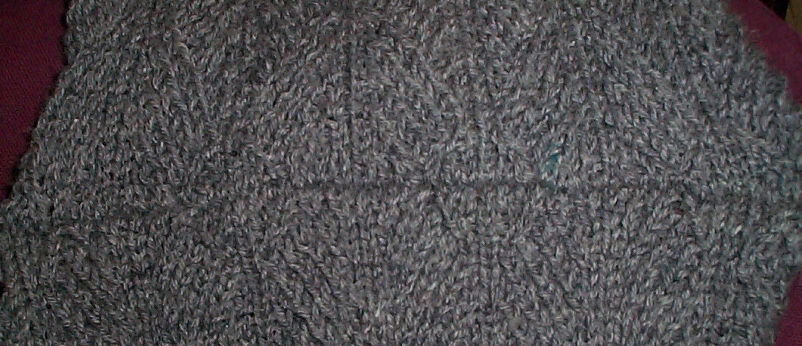
I know the pix are blurry, but I’m hoping you can make out that I’ve managed to match the design elements on either side of the seam. My ribbed leaf texture has a distinct center line for each repeat. Also the front and back ended on the same row of the texture pattern, making direct matching a bit easier. Each piece was bound off at the shoulder. I then butted the two shoulders up against each other and did a stitch-for-stitch-style seam into the stitch immediately under the bound-off edge. The two edges ended up being turned back like selvages. They are however useful, providing seam stability and resistance to stretch. Grafting the two shoulders together as live stitches without the reinforcement of the shoulder seam could lead to distortion of the shoulder region, as the weight of the garment pulled it down. Plus, as a modified dropped shoulder piece, the weight of the sleeve would also tend to distort that area.
Now, why don’t I use three-needle bind-off? Bulk. I find that treatment effective, but heavier than my chosen seaming method. The same goes for back stitch.
Tonight I pick up stitches around the neck edge and begin working the collar.
In other knitting news, I finished the rainbow scarf that matches the rainbow hat. Again, quick and easy to knit, but a bit fiddly to finish. As in the hat, the ends are left super long, then crocheted in chain stitch to make tendril-like fringes. Additional lengths of yarn are cut and added to the opposite end of the scarf to make fringes on it, too. I had one skein of Frog Tree in each color, and had ample yarn left over after making both pieces.

All in all a good project for autopilot knitting. Switching colors meant that progress was easy to see, the bright colors made me happy, the yarn was soft and easy to knit quickly, and the recipient is delighted. My next piece of autopilot knitting is another Klein Bottle hat – yet another special request. This one in conservative Navy blue, with a touch of yellow here and there. I am using a yarn that’s new to me – Garnstudio Drops Camelia Superwash Sport. It’s a very smooth true sport weight, quite soft and with a good hand-feel for a superwash. I’ll probably cannibalize my bright yellow Frog Tree leftovers to do the yellow highlights. What they will be, I haven’t a clue.
And the “gotta make something” bug here isn’t limited to adults. Smaller daughter is in the midst of bead lizard mania right now. I’ve got more geckos in the house today than can be found on a warm Florida lanai at sunset.

WORKING AT THE SAME TIME
I had started this post back when I was up to the shoulders of my ribbed leaf pullover, but life intervened and it languished. Also, the diagrams ended up taking more time than I thought they would. For the record, I write these entries mostly in the half-hour I steal in the morning after breakfast, while my kids are getting dressed for school. Some of the longer and more illustrated ones can take a couple of days to pull together. Yet another reason why my blogging rate has fallen back since leaving the world of consulting for full-time employment.
For the record, I’m now just a couple of rows away from completing the sleeves of the ribbed leaf pullover. I’ll use the piece to do some assembly and finishing posts later this week and next.
————————
Some deadlines have passed, others remain. I did have an hour or so of knitting time last night, which I used to excellent effect, both for some much needed relaxation, and to advance my leaf pullover. I am now finishing up the front, at the point where the centermost stitches are set aside and the shoulders are completed.
Now this stage of production is one that has inspired a huge number of wiseNeedle advice board questions. The directions to join in a second ball of yarn and knit both shoulders at the same time tend to confuse people who are new to knitting. Here’s the basic concept. My postulated directions say something like
Work across 25 in pattern, place center 20 on holder, attach second ball of yarn and work remaining stitches; continue in pattern and commencing on the next wrong-side row, working both sides at the same time, decreasing 3 stitches at each neck edge 2 times, then 1 stitch at neck edge three times. Continue until piece measures 20 inches from bottom and bind off.
Here you see a basic sweater front (or back), knit in green yarn bearing a big R in the center so we can keep track of the right (read public) side. You see all 70 stitches on one needle, ready to commence a right side row.

At this point, I’ve followed the direction to “Work across 25 in pattern, place center 20 on holder”. Note that the stitches on my right hand needle have been completed.

Now I’m beginning the part that confuses many beginners, “attach second ball of yarn and work remaining stitches.” It’s not difficult. We’re going to do the left and right shoulders simultaneously, mirroring all shaping so that they are symmetrical. The stitches on the holder form the bottom of the neck opening. Sometimes the pattern specifies that they be bound off, other times it asks that they be placed on a holder so that they can be used “live” to form the collar. In either case, they are now parked and won’t be touched again until the pattern revisits collar production and finishing.
Take another ball of the same yarn and starting with the stitches on the far side of the stitch holder, finish out the row. Leave enough tail at the neck edge for easy finishing later. This next diagram shows the work after I’ve completed the “work remaining stitches” bit. I’ve finished my right side row.
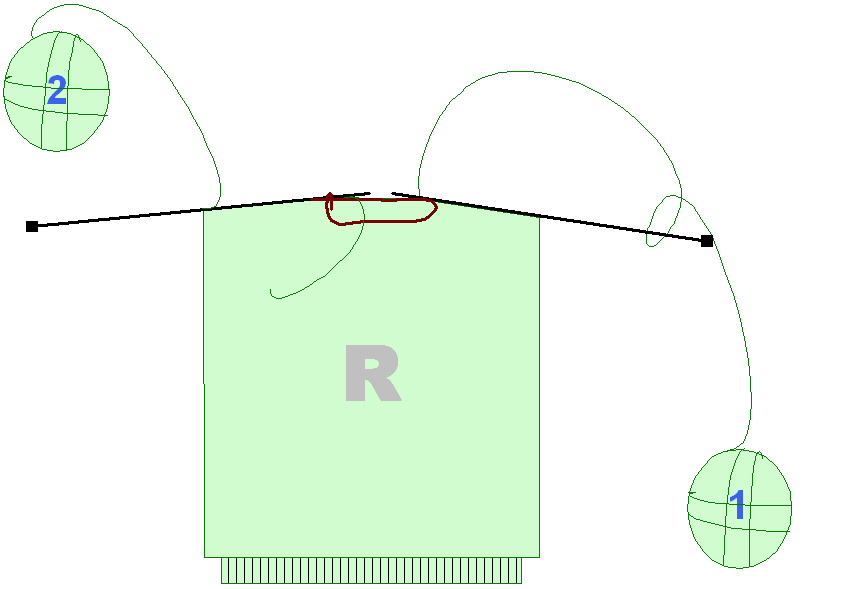
The diagram below shows the work flipped over to work back across the wrong side (the non-public side). I’ve got my two balls of yarn set up, one for each shoulder area, and I’ve indicated the spots where the decreases should happen.
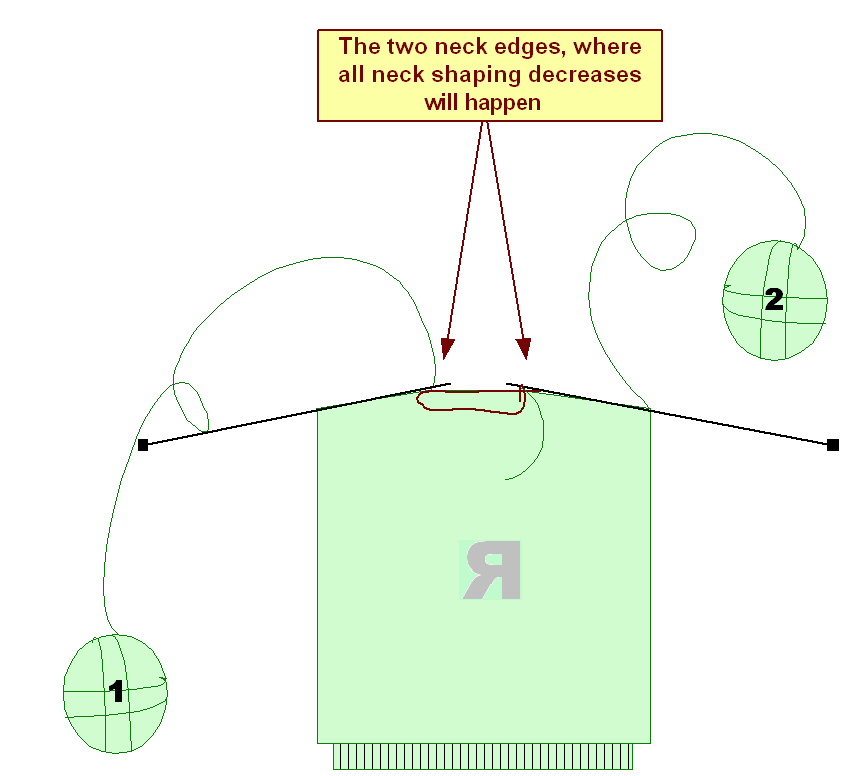
We’re up to continue in pattern, working both sides at the same time, decreasing 3 stitches at each neck edge 2 times.” The pattern is now directing the shaping of the neckline. When a pattern calls for decreasing more than one stitch at an edge I usually bind off at the beginning of a row. Yes, that makes a stepwise decrease, but as you’ll see I minimize the jaggedness a bit. The only exception to this is if I’m working in a giant superbulky (3 stitches to the inch or fewer). In a yarn that big, the steps can be quite noticeable. But back to 99.99% of all knitting.
To accomplish my first set of bind offs I have to remember to work my rows in pairs beginning on a wrong-side row- two rows each with stitches bound off at the beginning yields symmetrical decreases at the right and left edge of the work. In the diagram above, I am poised to begin my initial shoulder decrease. I have worked back across the first bunch of shoulder stitches, ending at the neck edge. No bind-offs yet. But as I begin the second set of shoulder stitches I bind off the first three, then continue across the row. Then I flip the work over to begin my right-side row, work across the shoulder side I just decreased, and perform a similar decrease on the other shoulder
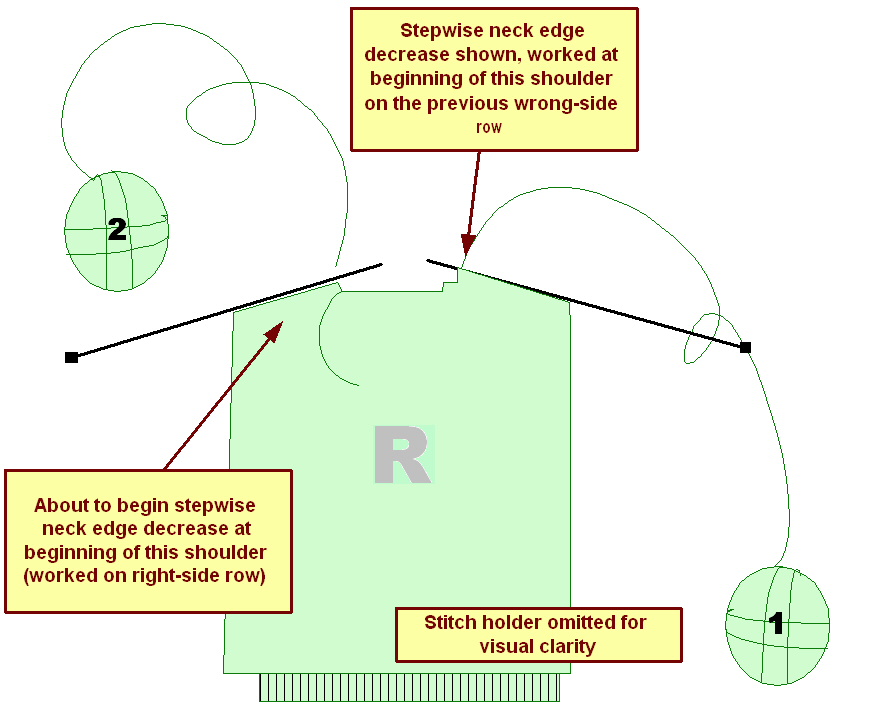
At the end of my second decrease row (in this case, a public side row) I finally have symmetrical decreases on either side of my neck edge, formed by binding off stitches at the commencement of two successive rows. My bind offs are a bit jagged and step like, but that can be diminished somewhat by slipping rather than working the first stitch bound off prior to ending it off.

I am ready to go on to the next direction in my instructions. It says to decrease “1 stitch at neck edge three times”. It doesn’t say to do this by binding off. I could do it that way, and many patterns say so. But I don’t like the jaggies formed by binding off. If I’ve got only one stitch to get rid of, I’ll use plain old K2tog and SSK decreases. Depending on the pattern, I might work them in the edgemost stitches, or in the next-to-edgemost stitches, allowing them to form some sort of decorative detail. Also unlike the bind-off style decrease, there’s no logical reason to separate these between two successive rows. I generally work them on the same row. Most of the time that’s a right-side (public side) row, but in my current project – a piece with heavy texture patterning – it’s easier to do them on the plain purl worked wrong side, using P2tog and P2tog through the back of the loop so as to produce the same effect on the public side as K2tog and SSK. In any case, I place them on either side of the neck edge, creating the curve that is the foundation for whatever collar treatment is specified by the pattern in hand.
An aside: It’s interesting to note that older patterns more commonly suggested completion of one shoulder and then the other rather than knitting them in parallel. Most often those pattens gave directions for the first shoulder, and then said something like “repeat for second shoulder, reversing shaping as necessary.” (A direction that caused me to blink in wide-eyed terror while knitting my very first sweater.) There’s no reason why patterns written in that style can’t be worked in the “at the same time” method. I prefer the two-together method because it’s how I idiot-proof my own knitting to ensure that my shoulders end up being exact cognates of each other. But not everyone likes working this way.
Reasons to stick with the older method might include the unavailability of a second ball (if for example you are working off one immense cone of yarn and don’t want to break it to create a second ball); or the need to concentrate on one set of shaping directions at a time. So long as the you take care to make sure that row counts are the same and that placement of the decreases is a parallel as possible, working one shoulder at a time is a perfectly legitimate way to go. There’s no shame in working the one at a time method, it’s just a matter of mental wiring and personal comfort.
MORE RAINBOW, RETURN OF A FRIEND
Having successfully beaten back yet another deadline storm, and having survived the annual school year February break, some semblance of normalcy returns to the String household. I spent a dreary but strangely relaxing weekend catching up on house maintenance – one that finally allowed me time to knit.
And what did I knit?
I continued my two dueling projects – the dropped leaf sweater, the two side-by-side knit sleeves of which are now approaching the 60% completed mark. There’s no point in showing a blurry picture of yet another pair of indistinct gray objects, larger but still not much differentiated from the last. I am also only four stripes short of finishing the Rainbow Scarf that matches the hat shown off last week. That at least has color and drama, even if the knitting is very mundane:

You can see the long tails at the right hand edge. These will be crocheted into tendrils. Similar strands will be added to the left hand edge after the knitting is done, also to be crocheted into tendrils. I am happy to report that one skein each of seven colors of Frog Tree Alpaca is enough to complete the scarf and hat project. Also that I like the Frog Tree. I’ve met with some minor knots and a couple of unevenly spun spots, but nothing drastic. I haven’t washed the stuff yet so I can’t report on whether or not those Crayola-intense colors hold up. I am already looking on to my next mindless project. I’ve gotten a request for another Klein Bottle Hat. I am thinking of getting more Frog Tree in navy blue to do it.
In other news, I can report a miracle of modern commerce and customer satisfaction.
I have had a small Coach bag for years. I splurged on it when I was gravid with Elder Daughter – so that’s something like 16 years ago. So long ago that Coach no longer includes it in their inventory. It’s a good size, just big enough to hold a wallet,keys, and a phone, and not so large that stuffing it into a backpack or briefcase is inconvenient. Although I have a larger bag and a dressier bag for occasions that demand them, my little Coach has been the default handbag of choice for over a decade and a half. Needless to say that much daily wear took its toll. The binding around the edges was worn through at several spots, and the clasp had given up all hope of fulfilling its function. My bag was well loved, and looked it.
Now Coach has tried to go a bit more trendy in styling and moved more upscale, expanding beyond the “do you want that in black, brown, or camel” mindset of my bag’s day. You’d be hard pressed to find anything similar on their shelves now. But Coach bags are guaranteed for life. So I took my friend to a nearby stand-alone Coach store just after the holidays. My bag was so old that no one in the store recognized the style – not even the manager. I asked if they still repaired bags, and only the manager had an inkling of what I was talking about. But they verified the pedigree of my little guy via the serial number stamped into the inside pocket, and taking a shipping and handling fee (plus issuing a lot of “I don’t know if it’s fixable” type comments), sent it off for repair.
Lo and behold, my little bag returned to me on Friday. Cleaned and somewhat refinished, with a new clasp, new edge bindings all the way around, and a new shoulder strap. All for the handling fee. My friend is back, and I’m very happy.

Moral of the story: That $80 that was so exorbitant 16 years ago was very well spent, and my expensive bag ended up being a better value than any number of cheaper ones I might have bought and worn to death since. You’re always better off buying fewer things of classic style from vendors known for quality and service.
RAINBOWS, SLEEVES AND HATS
Still tooling to deadlines at work, even over the holiday weekend. Which leaves less time for blogging than I prefer. But I can report some project progress.
First, on the perpetual ribbed leaf sweater. Done with the back and front, I now have two sleeves on the needles. As always, I’m knitting them side by side so that the shaping on both is dead uniform. If you look closely you’ll see two things happening with the markers. One is that because this is a wide and easily confused repeat, I’ve got one small silver jump ring marking off each repeat, even though I’ve long since memorized the stitch design. Even so, mistakes can creep in. This helps me keep oriented, and allows me to proof my knitting one repeat at a time. The second is that red marker at the beginning of my row. That’s a counting marker.


My pattern says “Increase one stitch at both sleeve edges every 4th row, 24 times.” I’ve chosen to make that increase on a reverse side row (all purls) because it’s less confusing than trying to do it on the texture pattern side. It really doesn’t make a difference in this pattern, so long as the placement is consistent. I’ve got enough of a headache remembering to do it every fourth row (that’s every other purl row), so keeping track of exactly how many times I’ve done an increase row can become a headache, especially because I only get to knit in short spurts. Pencil and paper would get away from me. Instead, I placed a marker immediately before the last stitch on my purl side row the very first time I did one of the increases. When I began my pattern-side row it was sitting there one stitch in from the edge. On every subsequent increase row I did a make one, one stitch in from the edge. That meant that the new stitch happened between the red counting marker and the edge of the work. After that first row, it’s pretty much automatic because the increase point moves further and further away from the static counting marker as the piece grows. I’ve got six sitting between the red marker and the edge now. That’s six increase rows completed. I’ll continue until I’ve got 24 stitches between the red marker and the edge. Problem solved, so long as I don’t forget to increase at both ends of each increase row, on both sleeves.
The other project I’m working is a more mindless piece. We like to play PS2 games as a family after homework and dinner – the exploration/quest type rather than straight shoot-em-ups or race games. That’s excellent sit and knit time, but because all eyes are needed to spot clues or treasures, not optimal for exacting texture knitting. So that’s when I do socks, hats or other easy pieces. This weekend’s fit the bill quite nicely – Dovetail Design’s Rainbow Hat and Scarf. My LYS kitted the pattern up with Frog Tree Alpaca sport weight – the recommended yarn for the project. I’ve finished the hat and am on the first orange stripe of the scarf.
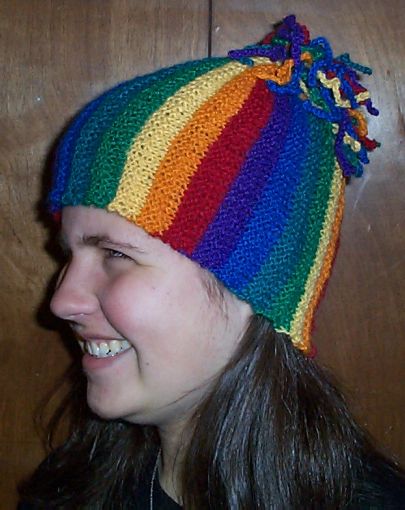
Modeled here by a slightly deranged looking Older Daughter, the hat is a very simple project to knit, but a rather fussy one to finish. It’s knit sideways. Each color is introduced leaving a very long dangling tail, and ended in the same way. There is no shaping, just welts formed by alternating bands of stockinette and reverse stockinette to make a wide rectangle. After the rectangle is finished, the cast on row is joined to the cast-off row. The dangling strands are knotted two by two, then all are twisted and gathered to make a very big single top-knot, forming the closed end of the hat. Finally, using a crochet hook the dangling ends are dealt with, turning them into the crocheted chains that make up the mass of tentacles tassel at the top.
While the basic idea is ultra simple and very easy to knit, there are a couple of refinements that enhance the hat that aren’t covered in the basic pattern. First, the logic of the pattern dictates that some kind of long-tail cast-on be used so that the starting tail is on the same side as end-off tail. but that isn’t called out. In spite of that logic, I used a half-hitch cast-on, deliberately leaving a super long tail. I then used that tail (now on the side of the work opposite that of the zillion dangling long ends) to graft the final row of purple live stitches to the cast-on row of the red. When I was done I treated the dangling end of the grafting yarn just like the other tassel strands. The resulting seam is totally invisible, without much bulk. Second, just tying the tails into a very tightly twisted knot doesn’t close up the hole adequately. Some of the strips stick out like gaping pockets. Others are pleated back inside the hat. I took another strand of yarn and took some carefully placed tacking stitches across the hat just beneath my dense knot, fastening down the tops of the stripes and making the closed end more uniform in appearance. Third, the pattern directs the user to make a slip knot in each strand close to the origin point of the dangling ends near the hat’s closing topknot, and work each one in a crochet chain for as many stitches as possible, ending off the final bit neatly by weaving it back into the crocheted chain. Well and good, but it’s very difficult to work that slip knot in closely. I ended up starting in the center, grabbing a strand and drawing it over one of the others close by in order to make that first foundation loop. After that, I sort of scrummed around, catching the first loop of each new strand somewhere in the mounting foundation created by previous squiggles. It worked out well. The tassel is nice and dense at its base and I skipped the “nurse the slip knot into position” annoyance.
My final criticism is one of yarn choice. I really liked working with the Frog Tree. It’s soft, without the stabbing guard hairs present on many coarser alpaca yarns. The colors are radiant, especially for alpaca which seems to be offered in bright colors less often than other fibers. So far I’ve found some knots in my seven 50-gram balls (one of each color), and some bits where the spinning is a bit uneven, tending to two-inch clumps where the yarn is quite noticeably thicker. But not so many of either that cutting them out was a major problem. So the yarn is fine. But in my opinion this hat should not be made from a sport or even a DK. If you click on the picture above and look closer, you’ll see that the stitches are very leggy, and the fabric is no where near as tightly made as is optimal for a sport or DK weight yarn. The recommended gauge is 4 stitches per inch. The best I could achieve with the Frog Tree was 4.25 (I added a few stitches to the hat to compensate). But I am disappointed in the open, loopy texture. If I were to do this hat again, I’d use a worsted, or heavy worsted (5-4.75 stitches per inch native gauge). Or possibly even one of the most airy and open of the Aran weight yarns (4.5 stitches per inch). I do think that a true 4 stitch per inch yarn would make a hat that’s too heavy.
But sometimes heavy hats are exactly what’s warranted. Older Daughter’s price for modeling her new hat was to show off her own production – a standard issue rolled brim Gusto 10 42-stitch hat.

YEASTY DOINGS
A quiet weekend here at String. Work made some inroads into it, but I had enough time to catch up on some much-needed household maintenance, and even to shovel out a little bit of family-spoiling. To that end, I baked homemade bread, and made flour/salt dough for Younger Daughter to play with. Older Daughter wasn’t interested, but appreciated that Younger Daughter was otherwise occupied for most of the weekend. And both ate the bread.
The immediate inspiration for the bread adventure was Rose Levy Birnbaum’s Real Baking blog. In particular – her recipe for Baby Hot Pot Bread. I’ve made bread before, but I’ve always been very disappointed in the result. To date my breads have been cakey and crumbly, with none of the crunchy crust or stretchy, chewy goodness/hole-filled interior that I like. I got the closest with various Challah recipes. Although good they weren’t what I was looking for.
Rosie’s bread looked too good and too easy not to try. I admit I mercilessly slaughtered her recipe. I did all sorts of things that should have totally sabotaged it. I doubled the recipe because my in-house bread vultures would scarf down one tiny loaf in one meal. Not a good thing to do because in baking ingredient proportions don’t always scale. I substituted a half a cup of whole wheat flour for some of the flour in the recipe because I had it in the house and wanted to use it up. Again not an ideal practice as different flours have different properties. And for that matter, I didn’t use the flour specified. I used King Arthur all purpose, which again is what I had in the house. I didn’t have a Silpat baker’s mat, but I did have a flexible plastic cutting board that served the same purpose, and I only had one cast-iron Dutch oven, so I used a Le Creuset 5.5 quart lidded pot for the second loaf.
But none of these were my biggest challenge. That was the ambient temperature of my house. It’s far too cool here for optimal rising. The usual solution for this is to put the rising dough in the oven with just the oven light turned on. My oven light doesn’t heat the oven enough. I investigated all sorts of alternatives – even writing to Rose for advice. Since I didn’t have the time or resources to build a proofing box, I ended up doing a combo of things, depending on the time of day and what heat resources were available. I turned the oven on very low and put the bowl on top of the stove, covered with a towel. Later I moved it next one of our hot water radiators, again tented with towels. My last resort would have been putting it (well wrapped against dust) on top of our furnace in the basement. To make up for the borderline temperatures, I ended up letting the thing sit for longer than suggested. My first rise lasted more like 24 hours than 18. The second rise was also temperature-challenged. It went very slowly. I don’t think my loaves ever achieved their potential full volume.
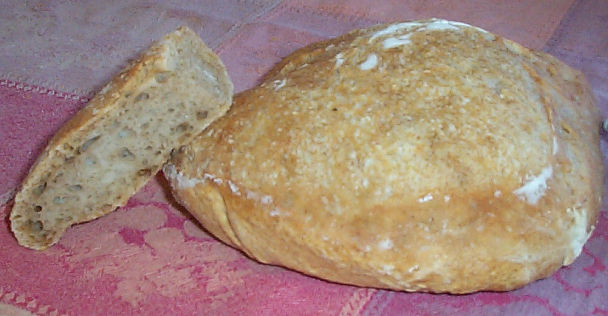
My warmth seeking machinations, the wrong combo of flours, messing with the rise times and other aberrations did not leave me with a high level of confidence when I dumped my two misshapen mini-loaves into their respective pots for final baking. But the recipe is a robust one, able to survive even me. My loaves were perhaps a bit more dense than optimal, but lovely. A very firm, crisp crust; a stretchy, strongly flavored interior, full of holes; no scorching (I was afraid of this given the heat of the pots). And no baking stone full of corn meal, flour, or other burnt crumbs to clean up.
I present the less photogenic of my two efforts. We ate the prettier loaf last night. The sliver of the heel off the narrowest part of my poorly formed bread is just enough to barely make out the airy holes.
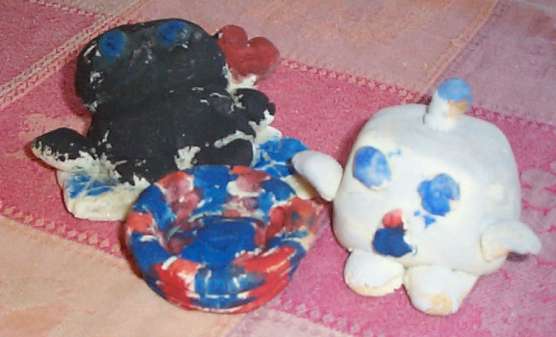
The play dough we made was of the uncooked flour and salt variety: About 2 cups of flour, 1 cup of salt, .25 cup of cooking oil, and about 1 cup of water (we started with 3/4 of a cup but found we needed more). We didn’t bother to color it, knowing that the final product would be baked along with the bread and painted when cool. Here are some of the results. Smaller Daughter saw this entry in the Craft magazine blog, and went on to make her much larger Ninja Valentine statue:
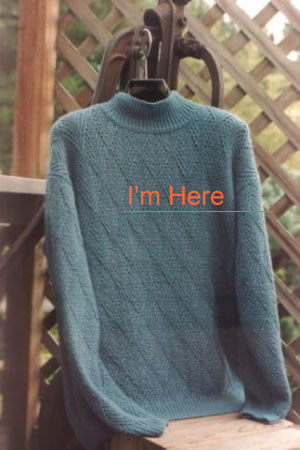
Knitting? I did some of that, too. My Sarah James Ribbed Leaf Sweater back is long complete, and the front is finished to about three inches above the bottom of the armholes.
Rather than give you yet another poorly photographed misshapen object to contemplate, I mark my progress using a visual of the sweater pattern’s own illustration, with a convenient line of demarcation.
Now it’s back to work. The forecast this week is “heavy deadlines, with the possibility of a mid-week blizzard.” February is such a joy.
 String-Or-Nothing