BACK FROM LIMBO – ENTRELAC FUZZY BLANKET
Here I am. Remember me?
I’ve managed to survive a perfect storm of deadlines at work – about 3 months of +80 hour weeks, odd improvised snacks instead of meals, and barely seeing the Resident Male and the kids. Then I collapsed into our week long escape to Cape Cod family vacation. Seven blissful days with no TV, no computers, no cell phones. Just watching the tide reclaim and surrender the strand, reading, playing golf, knitting, playing Killer Bunnies, cooking on the beach, and paddling Feckless II – our replacement kayak. (Feckless I was swept away during a storm last summer).
I’m now back, facing a double whammy here at String. Not only am I months behind on wiseNeedle and String-related mail and maintenance, plus my personal eMail inbox, I also find that I was hit by the dread Comcast Port 25 block outgoing mail problem, which appears to have started out as an intermittent nuisance before hardening into impenetrability. If you’ve been looking for a note from me starting around early May, deepest apologies. I think we’ve got the thing licked now, switching to a different outgoing port, and mail both in and out should be flowing again.
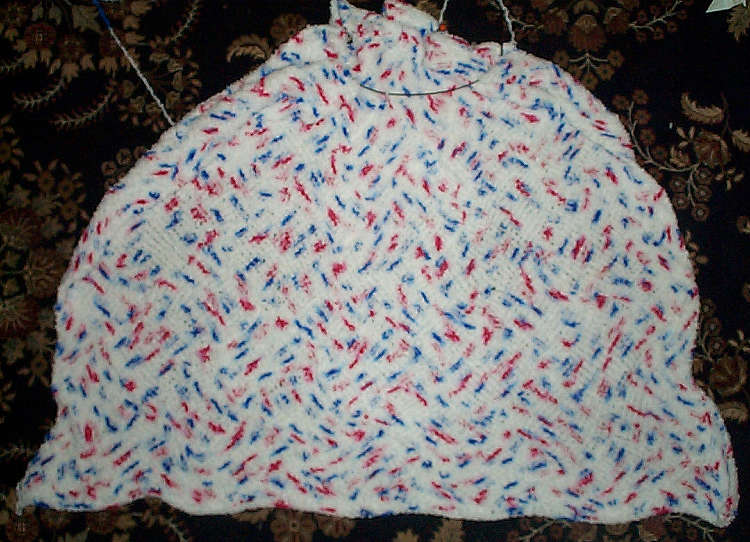
Now, what did I knit on the beach? Nothing exciting. I didn’t take my green lace piece. I’ve tried to knit lace yarn in windy dampness before and haven’t been happy. I didn’t take my North Truro counterpane. I had intended on doing so, but I came home late on Friday and we had to be in the car and on the road before breakfast on Saturday. I didn’t have time to dig it out, and make sure that all was ready to go. Instead I opted for something new, quick and near-mindless. I took a bag of yarn I got at my LYS’ annual sale with the intention of figuring out a baby blanket to do with it.
The yarn is a bit unusual. It’s Lana Grossa Bambino, machine washable acrylic/polyester blend worsted weight novelty yarn. It’s a short plush/fuzzy, with splotches of contrasting color. It knits up into an extremely soft, terry-like fabric. However the heavy plush obscures almost all stitch texture, and the spots of color compound the problem. About all you can do with this stuff is stockinette, garter or very wide ribs (think k5, p5 at the least). Anything else is totally lost.
So what to do?
First I considered something very flat and very plain. But the thought of knitting all that garter or stockinette was too boring for words. Plus the spots would have that loving-hands-at home look. Not fun. So I played a bit and came up with something simple that puts more movement into the color splotches.
I cast on for the width of the piece and knit four rows, to make two garter ridges, then I began working out in garter stitch Entrelac, on squares of 16 stitches (yes, I cast on a multiple of 16). It’s still all knit, and not the most exciting thing in the world to produce, but it’s more interesting that working the piece plain and flat. And the movement of stitch direction stirs the color splotches a jaunty jig. Compare the very first couple of rows at the bottom to the body and you’ll see what I mean. For once it’s my subject that’s fuzzy and not my photography.
[If pix above aren’t showing, we’re experiencing technical difficulties. Apologies! Will work on resolving them tonight.]
Not an exciting project, but a simple and satisfying one. Plus it’s only two courses of squares away from being done.
2008 GORE PLACE SHEEP SHEARING FESTIVAL
I took the kids today out on one of our now traditional Spring jaunts – the Gore Place Sheep Shearing Festival in Waltham, Massachusetts. We’ve been there most years since we moved here in 1996, missing only a couple of the rainiest days.
This year I am of mixed feelings about the day. To be fair, there are far more activities and displays now than there ever were. The festival has grown quite a bit over the years. They’ve added a magic show, expanded the food offerings, added more animal exhibits (oxen, chickens, sheep, goats, vicunas); they’ve added an equestrian demonstration, and now feature a Revolutionary War era re-enactment bivouac. The day is full of things to see and do. Attendance is way up, especially among those with kids under the age of 10. But sadly what fiber arts focus there was in the past appears to be on the way out.
Sheep are still being shorn, both with mechanical clippers and hand-operated snips. The family that does the sheepdog demonstrations still does its fascinating display. The lacemakers are still there, working their exacting way through spectacular pillow lace patterns. There are some beautiful vicunas on display, and one fiber-related exhibit tent remains. Four out of six slots were filled in the fiber tent. One was local shop stalwart Minds Eye Yarns. It was an excellent booth, filled with lots of yarn, but most of it was commercial product that I can buy in the shop itself, or in my local yarn store. Minds Eye did have a display of their own hand-dyed – mostly sock and worsted weight. Bartlett Yarns also had stock of their rustic Maine style worsteds and heavy worsteds. There were two other yarn vendors there, too. One selling rovings and combed/dyed fleeces, and one selling spun hand-dyed worsted.
There were a couple of other yarn sellers scattered through the crafts fair and historical display areas. One was a vendor offering reclaimed cashmere yarn – she buys discarded sweaters, unravels them, washes the yardage, and plies it into sock and DK weight. Interesting but short yardage, and I would have preferred non-pastels, and something that was lace weight. The other two were hand spinners offering a variety of their own products. One was nice enough but in short quantity and plied to worsted weight. The other had mostly yarns whose unevenness, color combos, and overtwist plying were appealing to some, but left me cold.
I miss the booths of some of the other smaller producers – Moorehouse Merinos, Nicks Meadow Farm, and several other concerns that have offered beautiful hand-spun or dyed sport weight and finer yarns. I also missed the fiber/textile facts tent sponsored in previous years by the Boston Area Spinners and Dyers Guild. That one had hands-on activities for the kids, and was something they looked forward to, too.
Maybe the early date of the event posed problems for the Guild and the other fiber tent regulars. It’s usually around mid-May. Maybe for the small suppliers the cost of attending wasn’t covered by income earned at previous events, or travel expense is prohibitive given current gas prices. Who knows… But I can say that this is the first year I tried hard to find something interesting, preferably unique but well made, in a color that sang to me, and came up with nothing.
Yes, it’s true. I came home from fiber festival without a single bit of yarn.
WOMEN IN ENGINEERING – THE FUTURE?
UPDATE: THE PANEL INSERTION PATTERN BELOW HAS BEEN ADDED TO THE PDF COLLECTION AT THE KNITTING PATTERNS LINK, ABOVE.
Like most parents, I spend a lot of time rolling my eyes at what passes for homework and school assignments. There are way too many feel-good tasks – making posters and collages, even well into high school. Where are the analytical reading pieces? Where is learning how to write a convincing essay? But every once and a while something engaging and creative is requested.
This month Smaller Daughter (now 9) had to construct a Rube Goldberg device, with a goal of popping a balloon. I sat on my hands and watched her experiment for the better part of a week. She scribbled out her designs and went down several possible paths before settling on her device components. She constructed (and re-constructed) each station scrounged from toys and oddments at hand, testing out each one individually, then assembled them into her final chain reaction. Eventually, after much tinkering she got it just right, and the whole thing worked as intended.
I wish I had a video camera, but you’ll have to use your imagination. Especially the part where the balloon makes a satisfying pop, and she leaps up in triumph.
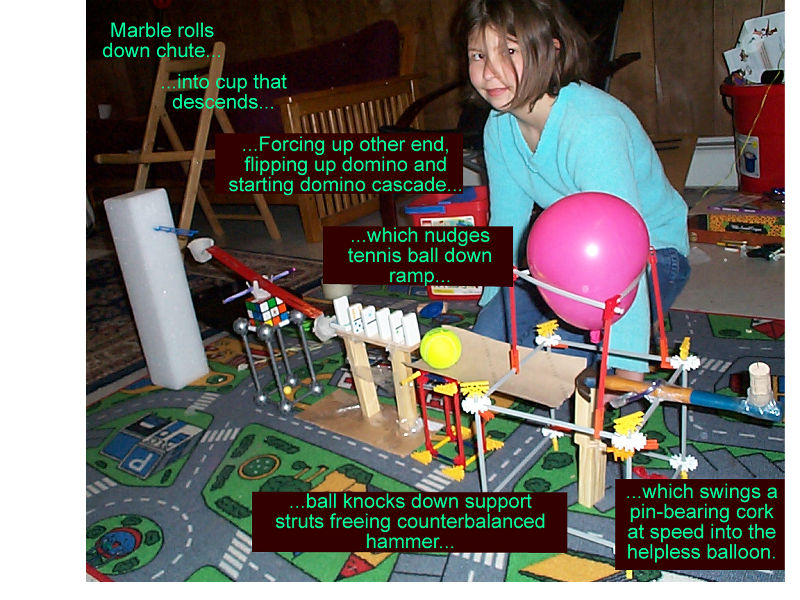 Click on any thumbnail on this website to see detailed pix.
Someday I will loose this proto-engineer on the world. I hope the world will be ready.
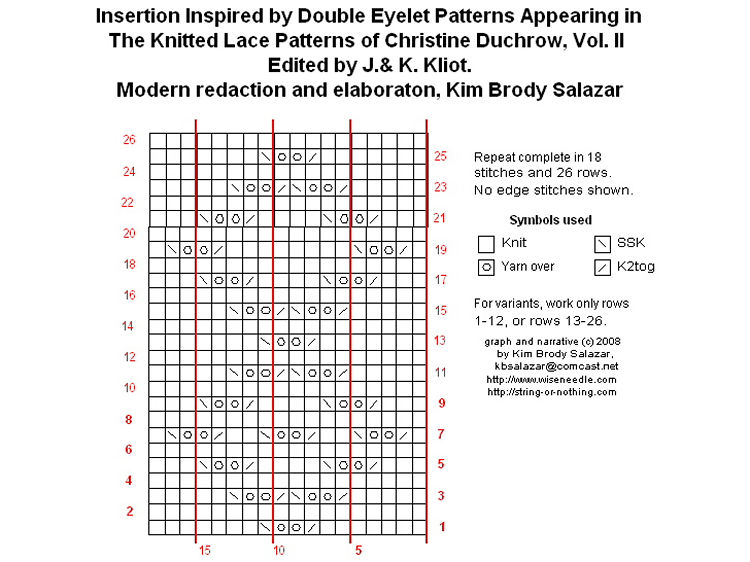
In knitting news – not much. I’ve been working like a demon. All I’ve had time to do over the past two weeks is one mindless sock. For me to take two weeks to knit one sock says a lot. This one is a standard 72 stitch sock with a figure-8 toe and short rowed heel, worked using five DPNs. That calculates out to 18 stitches per needle. My insertion strip is 18 stitches wide as graphed below, so I do the pattern in its entirety once on each of the four working needles. I’ve stuffed a piece of white paper inside the sock so you can see the diamond patterning. and provided a chart for the simple design .
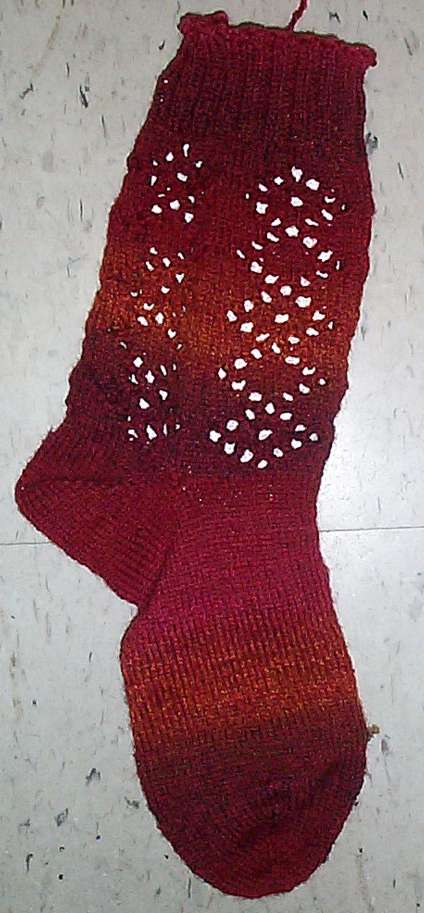
I used Meilenweit Mega Boot Stretch, knit at about 9spi. The shaded reds with the touch of orange is color #709. I’m not wild about this yarn. It feels nice and cushy knit up, but I don’t enjoy tensioning it. The stretch is throwing my gauge off a bit, especially on my heel’s purl rows. It also is rather lofty unstretched, and prone to catch and split on needle tips. I’ll post a review of the stuff when the pair is finished.
THINKING AND WAKER’S LEARN TO KNIT AFGHAN
I’m not sure what the next challenge should be. I really should finish the Galaga hat. I’m still working on the Kyoto (finished with the body pieces, now about a quarter of the way through the two sleeves). But having partially finished things has never stopped be from beginning something new before.
One possibility is to do something lacy taking advantage of the color properties of Noro’s Kureyon sock yarn. I couldn’t leave Wild & Woolly (in Lexington, MA – my favorite yarn shop) without it because these colors latched on to my magpie self and refused to let go.
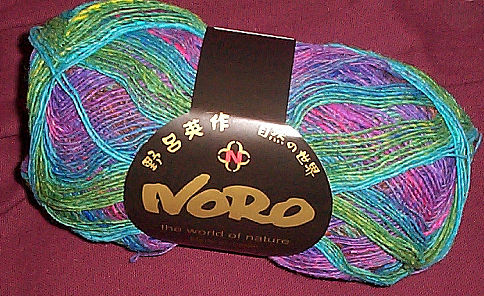
I’ve been told that some folk think this yarn is too twisted and just a little bit harsh for socks. While not Regia smooth, it’s not particularly harsh to me. I suspect that like most Noro yarns, while they never achieve Merino softness, washing will make a tremendous difference. And for my purposes, rewinding to reduce twist and in the process increasing loft, isn’t optimal. I like my lace yarns to be tightly twisted.
But there remains the question of what to do with it. Something directional might work well with the repeat lengths, but so many other people have done Entrelac in these yarns. The same method I used for the Kureopatora’s Snake might be an idea – upping the number of stitches across to yield the same finished dimensions in the smaller gauge – but I want to do something else that’s more airy. Mating lacy stitches with the riot of hues is always a big challenge because textures tend to fight with the patterns produced by the yarn’s transition among colors. I’ll have to do more thinking on this one.
My other looming temptation is one of two tightly twisted little knots of Malabrigio Merino laceweight. I bought two – one in Emerald Blue (blues and teals) and one in Amoroso (a stunning garnet/cherry blend). I wound the blue into a ball last night.
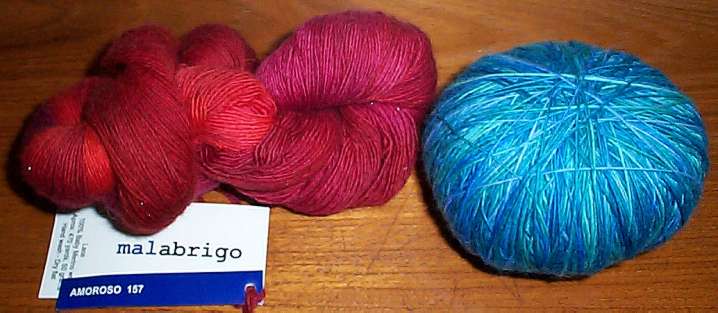
The super-soft single-ply yarn relaxed and got considerably more lofty in the process – a bit of a disappointment for me, but not fatal. It just means I will have to use a much larger needle than I originally anticipated. Also some teasing apart was necessary because the thin strands were in the process of mating with each other, and some were slightly fulled into their neighbors. Thankfully I did not have to break the yarn to tame it. This slightly variegated yarn presents a smaller color challenge than the Noro, but a larger one due to skein length. 470 yards should be more than enough for a small scarf. To be sure that I will not run out mid-project, I will need to work it differently than the pieces I’ve been doing. I would revert to the method I used for Kombu – first knitting a narrow width of edging (the bottom), picking up stitches along the top and then knitting both the body and the left and right edgings at the same time. That way I could see how much I had left at all times, and maximize the scarf’s length by continuing until I had just enough yarn left to do the small strip of edging at the top. Or perhaps I’d chart out something with two decorative ends and included borders…
In the mean time, going back to a single color world – I can report that Elder Daughter is making excellent progress on her Walker Learn to Knit Afghan Book project. She’s using Cascade 220, all various greens and creams, bought one skein at at time from the orphan end of dyelot bin. She is going more or less in order, with skips ahead dictated by how much of what color she has on hand at any one time. I suspect that she’ll soon start improvising because she’s beginning to accumulate a stash of little leftover balls too small to use even for the book’s two-tone squares. Here’s the collection to date:

and a few close-ups (unblocked):
1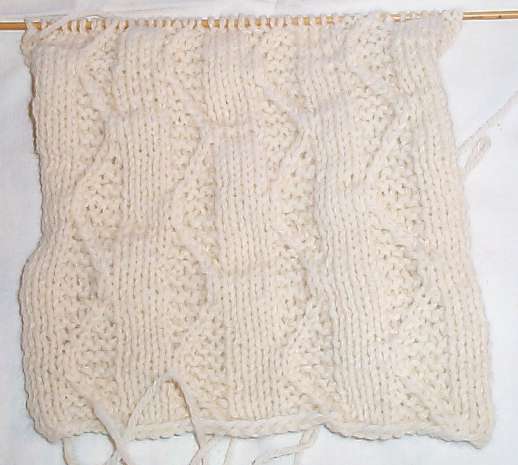 2
2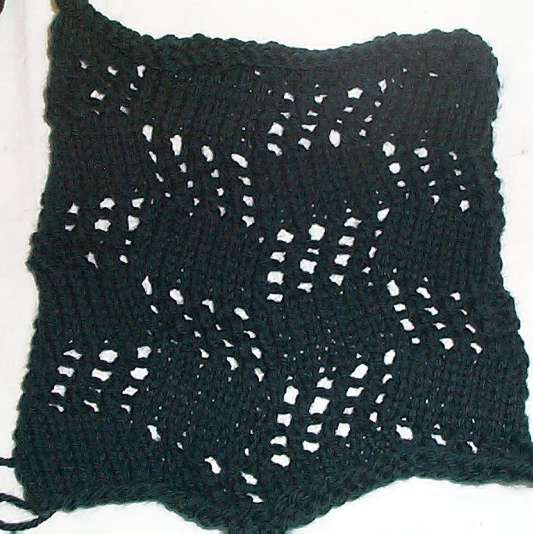 3
3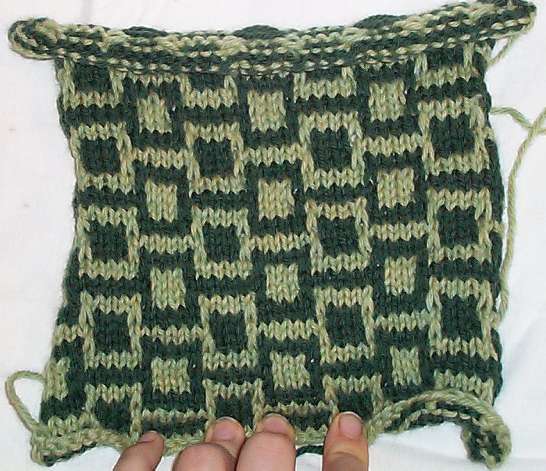
4 5
5 6
6 
So far she’s covered basic knit and purl (4 above), twisted stitches (1), simple directional decreases (2), yarn-overs (2), simple increases, cables (5), mosaic knitting (3,6). All in easy to digest aliquots and explained well enough that she’s been able to noodle it out all on her own. To be fair, I did show her a couple of tricks for 1×1 twisted stitch cables, but that was just a hands-on for the same methods described in her book. If you’re an experiential learner and you’re looking for a nice survey course in basic knitting, you might benefit from this classic bit of instruction. My only criticism of it is that it was written before Walker moved to charting – a vital skill these days as more and more resources rely heavily on that technique.
Needless to say, I’m quite proud of Elder Daughter and her ongoing project.
WHAT BIRD?
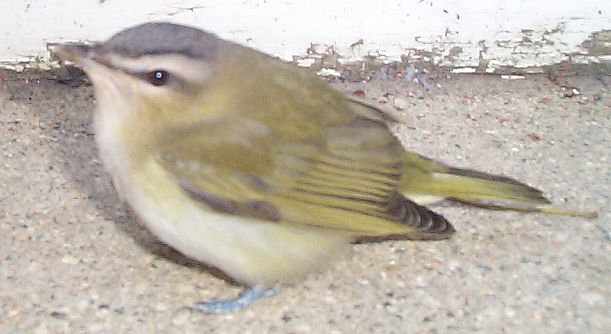
This little fellow is fluttering in distress on my back porch. He doesn’t appear to be injured, but his behavior is that of a bird that’s been hurt – tolerating people walking close by, and flat out panting in fear.
He’s small – smaller than a house sparrow, and distinctly greenish above. The eye stripe and the crown are sharply defined gray with a faint black line around it. The eye is brown, and the bill is something like a sparrow or tiny vireo. And the feet are sort of blueish.
We’ve got no place to bring him, nor do we wish to cause further harm, so we’re leaving him alone for now. But I’ve not seen a bird like this around here before. For the record, we’re in the Metro Boston area, a close-in suburb to the northwest; inside Route 128.
Leafing through bird books and on-line references, but I don’t see anything that has the gray hat and mask, brown eye, olive upper part and cream breast. But this might be an immature bird not yet displaying its final colors. Any birders have an idea on what our little refugee might be?
UPDATE
Special thanks to Sally, who identified our little flutterer as a Philadelphia Vireo. We kept watch against cats (from a distance), but otherwise didn’t bother him or go near him. About an hour and a half after he was first spotted on the ground he shook out his wings and zipped up into the trees. Given the range reported on the bird ID link page Sally provided, he’s just passing through on his way down to the tropics somewhere. I hope he makes it.
SECRET PAL, AND CONSTANT PROGRESS
On the baby blanket, I decided to rip back the entire edging (about half-finished at the point of decision). I decided I wanted to re-do corner #1, plus I didn’t like the way that the joins along the first edge looked. I’d been reducing along the body, working roughly every six rows of edging onto four live body stitches. While the points were lying flat, the yarn I’m using is heavy enough to make the necessary decreases along the body look clunky. (You can get away with this in a fine lace, but not in the almost DK weight I’m using). Instead I’ve opted for a bit fuller edge with (perhaps) a bit of ruffle. I’d post pix, but they pretty much show the same blanket body as the last post, but with an arrow that says “edging used to be here.” More on this later this week.
In other news, I finally got to the post office to pick up the mail I had on hold over vacation week. There, perched on top of the pile was my July No Sheep secret pal package. The formerly mysterious (but now known) Melanie was kind enough to send this:

That’s two skeins of Schachenmayr Denim in a sunshiny yellow/orange, plus two tins of killer tea. I dance a dance of thanks! I’m looking forward to trying it all. On the downstream end, I finally made contact with my secret pal recipient, and am busy picking out the goodies for her.
And finally – progress on the bathroom front. Which is a good thing because washing one’s hair in the sink can get old after five weeks. The tile is now (mostly) up and grouted. Vanity, storage cabinet, fixtures and finish work are left:


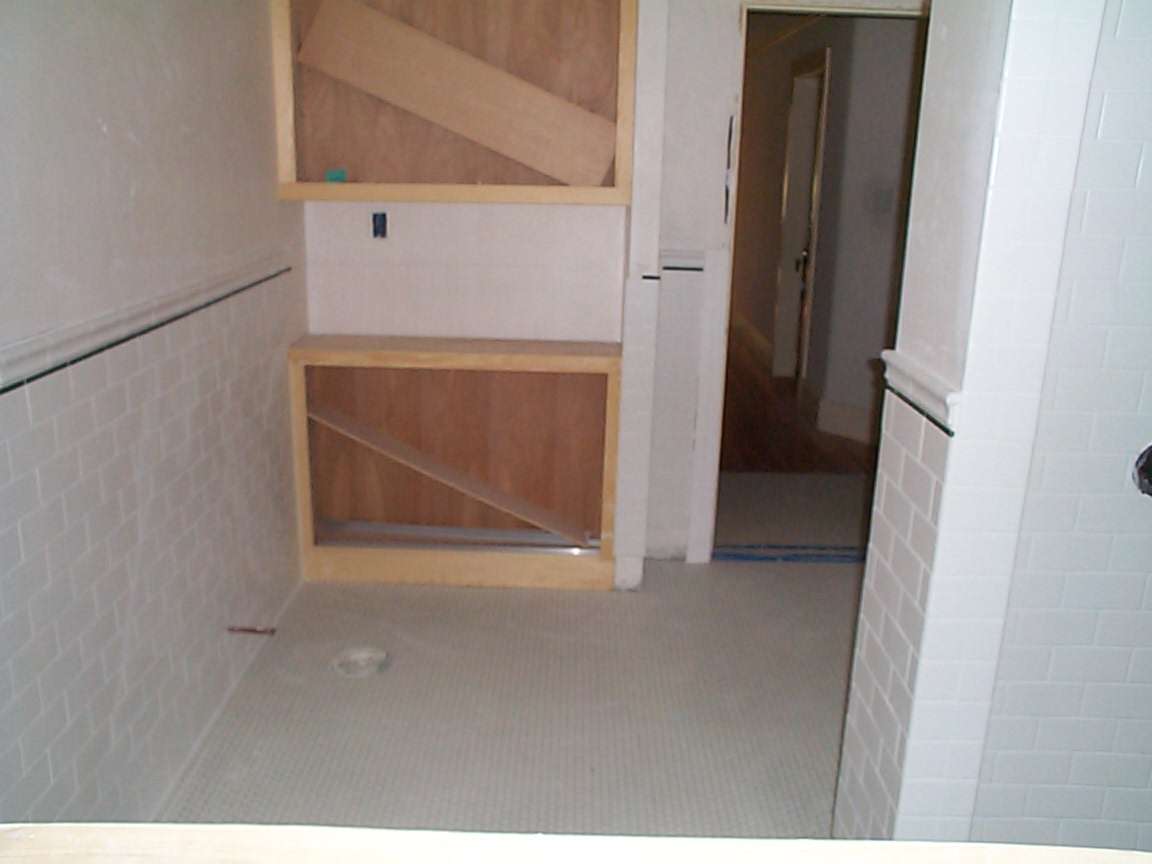
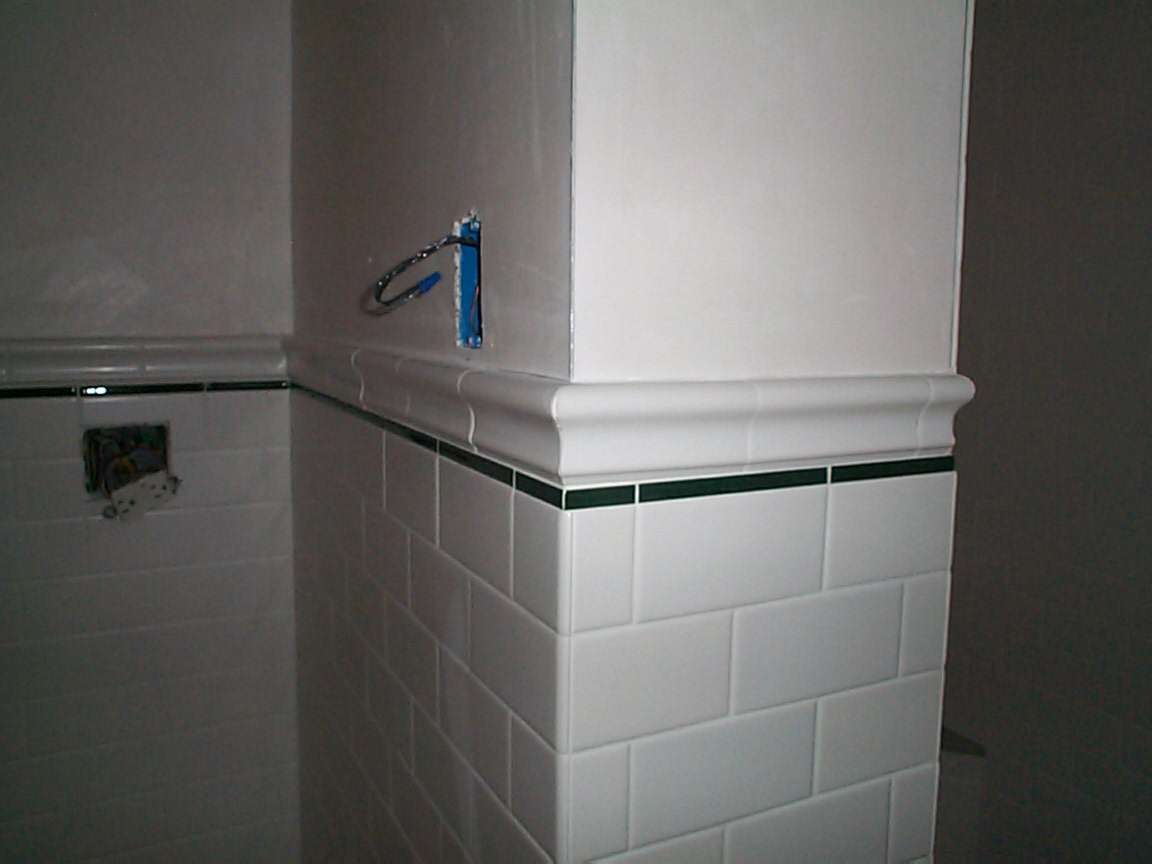
From the top – the view from the hall door. You can see the cleaned, repaired and repainted radiator, the pipes for the bathtub, and the new window frame into which the original stained glass will be fitted. Next is the shower, followed by the view from the window. No I didn’t crawl out on the roof to take this – there’s a sleeping porch on the other side of the window. And finally, a close-up of the tilework’s green pencil line and chair rail – just for Kathryn, who has confessed to extreme bath envy.
If you’ve written to me in the past two weeks and haven’t had a response – apologies. I’m still munching my way through my inbox.
UPS AND DOWNS OF VACATION WEEK
Back from our annual no-computer vacation on Cape Cod. Seven days of blissful nothing in North Truro.
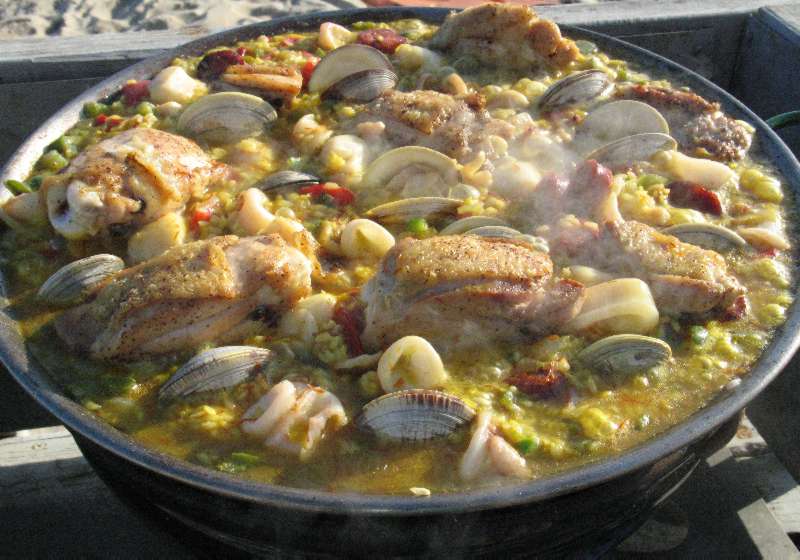
This year’s round of nothing included lots of knitting and reading time, a whale watch, some golf, watching the opening night of a thoroughly enjoyable Much Ado About Nothing, a couple of excellent dinners out, plus several equally excellent ones we prepared ourselves. Including paella on the beach – cooked on the grill against a Provincetown sunset:
The only less than ideal moment of the week was the last voyage of the Feckless, seen here in happier days:

Our Gannet II model two-person open cockpit kayak was swept away from the beach behind the Top Mast Hotel in North Truro by a pre-dawn storm on 5 July. We searched Beach Point, and the Provincetown area surf and mud flats for two days, but never found it. The loss has been reported to the Harbor Masters at Truro and Provincetown, and to the police in North Truro. In the remote chance that there’s anyone on the bay side of the Outer Cape reading this, there’s a finder’s reward out for the Feckless, please keep an eye out for it.
In knitting news, I spent the week working on a small baby blanket. I’m using Lana Grossa Merino 2000 (aka Cool Wool) – an extremely soft multi-strand machine washable Merino, in a weight somewhat between sport and DK. It’s well twisted although like any yarn made up of huge number of tiny plies, it can split. Stitch definition is superior thanks to its spring and almost tubular construction. I’ve adapted yet another pattern from the Duchrow series. This garter stitch based double zig-zag pattern has particularly nice eyelet roses in the center of each diamond. It was meant as a strip insertion. I’ve used it three times across my blanket, separated and framed by plain stockinette. For the edging, I added a garter stitch adaptation of a large eyelet border, shamelessly plucked from Heirloom Knitting, but altered a bit to better match the garter stitch all SSK eyelet texture of the main body. Also, I’m attempting to miter my corners on the fly. So far I like the second one I did, but not the first (I may rip back the edging to that point and re-do #1 now that I understand how to do it better. Second corner is shown in detail below:
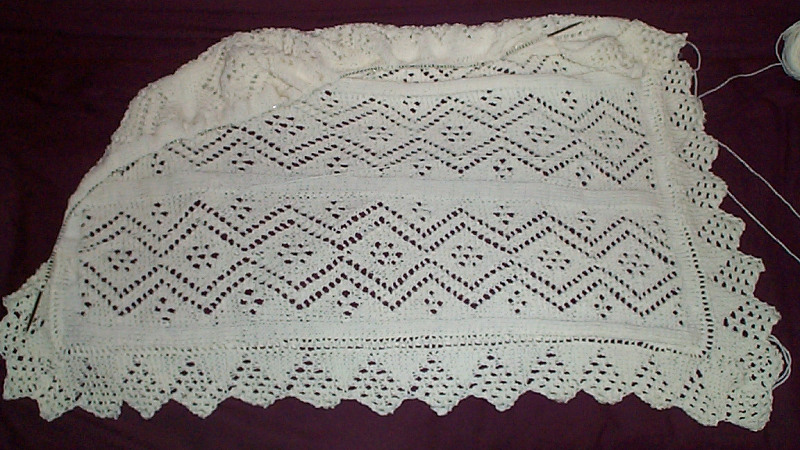
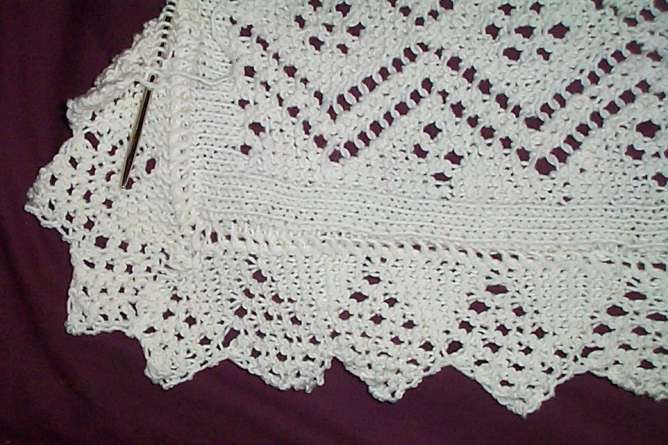
I probably won’t be posting this pattern here because there hasn’t been very much interest in my recent pattern posts, and also because I’ve been working without making notes. The corners in particular would be difficult to explain.
So there you have it. Where I’ve been and what I’ve been doing. Standard post vacation let-down here, contemplating the 51 weeks before I get to do it again.
THINKING BLOGGER
It looks like I’ve been tagged as a “Thinking Blogger” by several people, including Jenna at Girl from Auntie, and Swapna. I’m flattered, also delighted to be food for thought for someone out there.
Although I don’t do memes, I’ll bend the rule and tag some other websites that make me think. But they’re not necessarily knitting blogs. Believe it or not, I don’t think about knitting all the time. Besides almost all of the knitting-related sites I would have tagged have been touched over the last month. That’s a basic problem with referential memes in special interest communities – they loop back on themselves quickly, like big ripples in a small pool.
- Things Magazine – Wandering compendium of fascinating links to explore. Most have a tie to architecture or art (but not all do). Some are departure points for contemplation, some are just plain neat. Others are immediately useful. Today’s for example has a link to an international dress size converter.
- Chocolate and Zucchini – What’s it like to be 20-something, food-smart with a participatory bent, an analytical mind, and living in Paris? Go through the archives here and melt with envy. The author has issued a cookbook, which is the first and only blog-related book I’ve ever bought.
- Bibliodyssey – This author combs through on-line libraries looking for masterpieces of illustration. What’s presented is a jumble of everything from Medieval manuscript illumination and incunabula, to early 20th century childrens’ books, with detours through academic illustration, Japanese and Chinese scrolls, natural history compendiums, Islamic calligraphy, and early mechanical drawings.
And two knitting blogs that (to my knowledge) haven’t been tagged yet:
- Twosheep – June “DNA Scarf” Oshiro is playing in her garden right now, but when she turns to spinning and knitting, all sorts of explorations happen. If I ever pick up spinning, it will be her fault. As it is, I’m looking at worms differently this morning.
- TECHknitting – How-tos, presented by a far better illustrator, tech writer, and indexer than I’ll ever be.
PRESENTS!
My self-awarded belated birthday present has arrived! I ordered three specialty books on lace knitting, only one of which is in English. They’re not out of print, but I don’t have a separate blog category for current works, so they’ve ended up under that classification:
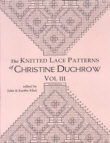


My first present to me is The Knitted Lace Patterns of Christine Duchrow, Vol. III, edited by Jules and Kaethe Kliot. It’s 144 pages in German, with an English foreword and symbol glossary. The patterns are presented in the same graphed format as the Volume I book I am knitting from now. This collection is a bit larger, and is mostly home-decorative items (doilies, tablecloths, tea cloths, and a smattering of counterpanes), although a few caps, stoles, collars, jabots, and a blouse are presented, too. These 100+ patterns are also quite a bit more complex than the ones in Vol. I. I’m especially interested in the large oval shaped doilies, and in a a curious appendix of hand-drawn charts, in another somewhat related notation set, but unaccompanied by as-knit photos. Plus there’s one unusual geometric insertion strip (p 86) and a photo of a lace edging (p.2 but no graph or English pattern provided), both of which may end up on my current very geometric stole. I’m very pleased with this one. The hand-drawn appendix is an appreciated lagniappe, but it is haunting me. I’m too much of a Pandora not to want to discover how those charts knit up.
Old World Treasures is 35-page leaflet in English, presenting patterns entirely in prose notation in a relatively large 12-point font (fellow bifocal victims, take heed!). The 21 patterns mostly for small motifs knit in the round (in the 40-75 row range), useful for doilies, insertions, cap backs, and the like. Three of the patterns are much larger, with one going up to just over 200 rows, and another appearing to be composed of eight smaller doilies stitched onto a larger separately made complementary center. There are motifs with 4, 6, and 8 sided symmetry. Stitch counts at the end of significant rows are given, which is a help. I’m not a big fan of prose directions, so my first step in working from this book would be to graph up anything I knit from this leaflet. Still, I am sorely tempted to attempt a “flower garden” sampler throw based on the centers of the various motifs presented. To do that I’d select either the 6-side or 8-side symmetry patterns and work them all up to the same row, then stitch them together with some plain (or simple leaf-bearing) motifs to complement their mixed complexity. There’s ample food for thought here.
The last book is Knitted Lace (Kunst-Stricken), also edited by Jules and Kaethe Kliot – a 71-page collection of patterns by Marie Niedner. This is another collection of lacy knitting patterns of German origin, and using another early charting system unique to this particular original author. The designs presented are considerably less complex than the Duchrow ones, and includes a fair number of less-lacy textures. The charts are relatively small, and are not always near the text and illustrations they accompany. The collection includes edgings and insertions (many of which are closely related to patterns in the Walker treasuries), plus a strip sampler collection, several long-armed lace fingerless mittens, a couple of counterpanes, the expected flock of doilies and table spreads, plus bonnets, a couple of lace stoles and lace/beaded drawstring purses, and a couple of blouses/jackets – one of which may be intended for a baby or toddler. One quick idea gleaned from this book is an interesting way to finish out scallop shell motif counterpanes using half-motifs to eke out the left and right edges. While there are some interesting pieces here, this book is of as immediate inspiration as are the other two. Had I been able to browse the contents prior to purchase, I might have opted for the second Duchrow volume, or two more of the Penning-edited leaflets in its place. Still, I am not disappointed, and will be working something from this book. Someday.
On an entirely different front – I’ve mailed off my No Sheep Swap package. I included a ball of one of my favorite non-wool blends, a couple of beaded stitch markers of personal significance, and a vintage pattern magazine from my collection. I hope the package gets where it is going because my downstream swap partner never wrote back to confirm her address or preferences.
BATHROOM INSPIRATION
I’ve gotten a couple of questions about the bathroom project – in specific, what we’re aiming for. While we’re not doing a historical restoration type true-to-period room, we are taking inspiration from the downstairs bathroom. It’s been less meddled with than the upstairs horror:

The downstairs bath has one-inch white hex tile on the floor, white railroad tile (with high rail detail) on the walls, a very similar stained glass window to the one upstairs, and pedestal fixtures. I especially like the little sitzbath – it’s great for kids’ bird baths or foot washing when you don’t want to fill a bigger tub. Along the way this bathroom has lost its original sink faucets and high tank toilet, but in addition to the mini-tub it still has an extra long full size tub (not in the photo); and a simple built-in wooden storage cabinet. We’ll be replacing the toilet again as part of the current work due to some unfixable slow leaks on the one that’s there. Someday we’ll also do the sink hardware, but that’s small peanuts compared to the awful upstairs. The rest of the downstairs bath works well enough, and is perfect for the house.
The upstairs bath will pick up the white hex floor and railroad tile with high rail look, with the addition of a green pencil line tile just under the rail. That should accent the green in the window. The upper walls will be painted white. We didn’t want to go the restored tub route (weight, mostly plus some cautionary experiences from my earlier days working for an architectural antiquarian), and couldn’t find a new pedestal tub in our price range, so we opted for the plainest white with-feet new tub we could find.
The other big departure from historical accuracy is a vanity stand that’s natural oak color rather than one that’s painted white. It’s a free-standing furniture type piece rather than cabinetry, and will be topped with green stone and an underset white porcelain sink. Since the storage cabinet downstairs is original to the house and has never been painted, maybe the “only white painted woodwork in a bathroom restoration” rule isn’t hard and fast.. Plain brushed nickel finish fixtures with white porcelain butterfly handles round it all out. And we’ve opted to keep the separate shower stall rather than combining the shower with the tub. The new shower will be the same depth but a bit wider than the old one (taking up some of the room previously wasted on the double sink vanity), with a very plain frosted glass door instead of a billowy curtain. We’ll also keep the mini-radiator, but clean it and paint it white.
That’s it. No over the top fancy fixtures, no bowl-mount waterfall sinks or spring rain experiences, no criminally expensive imported tile or lighting, no sybaritic soaking tubs or sauna showers. Just classic stuff, relatively unfussy and congruent with the style of the (mostly) untouched 1912 house. And with luck it will all work well together nicely, be easy to keep clean, and enjoyable to live with.
 String-Or-Nothing