INUNDATION, DEMOLITION AND TRADING
A hectic past couple of days here at String. First, the website itself was attacked by spammer ‘bots. Between Sunday afternoon and Monday night, they posted over 2,300 individual pingbacks to a collection of specious websites. I’ve been trolling through all past pages here, deleting the references. I think I’ve got them all now, but if you see one, please don’t click on it – let me know instead and I’ll deal with the blasted thing.
The other major event has been the kickoff of our long-awaited upstairs bathroom renovation. We’ve been in this house now about 2.5 years. All that time our upstairs family bath was only partly functional, with poorly functioning plumbing, 1960s-vintage yellow, clammy plastic paneling (impossible to get or keep clean), patched vinyl flooring, hideous pizza parlor hills-of-Tuscany wallpaper, crumbling laminate over particle board cabinetry, and awful mustard fixtures with gold tone faucets. The only nice thing about it was a stained glass window (partly visible in the first shot):



We’ve been plotting and planning to replace the whole lot with something functional, clean, and historical in mood. Yesterday the project began in earnest, with the contractor carefully removing the antique window and door, then gutting the rest. I promise not to make this a home-improvement blog, but if anything interesting happens, I might report it here.
And finally, just before the aforementioned chaos hit I had a happy not-so-surprise. I signed up for the No Sheep Swap. I generally don’t participate in swaps or knit-alongs, but this one sounded like fun. My gracious and generous upstream swap partner (and all-around fascinating person) sent me this package of goodies:
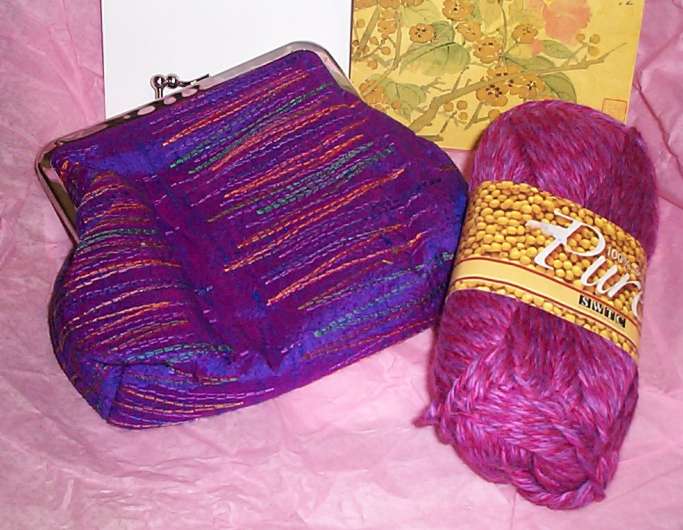
It’s a skein of South West Trading Company’s Pure, a 100% soy silk yarn in happy berry colors, plus an embroidered purse big enough to be used for knitting accessory wrangling. Thank you, Melanie! I’ll post back here after I’ve tried it out.
On the downstream end, I have been waiting to hear back from my assigned recipient, but my notes and card have gone unanswered. I can’t wait any longer because to abide within the rules of the swap, I have to have her package in the mail shortly. I’ll have to pick something out without guidance on color or yarn weight preference, and hope 1) she’s there; and 2) she likes it.
[Aside: Apologies to Dena, who inadvertently was awarded an extra E when I was spelling her name. It stands for “excellent” and being obvious, intruded itself smack in the middle of my orthography. Thanks again for the fantastic lace-weight. I’m pretty sure I have enough, but if I do run out, I will resort to all sorts of begging, pleading, groveling, offering, trading, negotiating and bribery to secure some more.]
POSTING FROM THE ROAD
Not sure if this will work o.k., but I’ll give it a try.
I’m away from home base this week – attending a professional proposal managers’ conference in Savannah, Georgia. (There is no activity too obscure not to have its own professional association.) Posting will be severely hampered by lack of time and camera until I return.
In the mean time I can say I brought a couple of things to work on. One is a pair of standard socks. The other is the beginnigs of a more or less original lace shawl (more because I’m working it out on the fly, less because the patterns in it will be adapted from existing sources.) I’ve started with an unusual large repeat lacy pattern from a Rachel Schnelling pattern compendium, published in German. I’m using a magnificent tobacco color cashmere light laceweight given to me by long time knitpal Friend Deena. (Hi, Deena!) Pix upon my return. I promise.
COLONIALS INVADE
Life continues to intrude on my knitting time. Besides the regular flock of work-related obligations last week, I was surprised by Smaller Daughter. Thursday morning, rummaging in her backpack looking for her lunchbox, I found a notice for her elementary school’s Colonial Day. It’s an interactive festival sort of day, but one that requires all of the kids to dress in some attempt at a historical costume. (To be fair, I had heard about it long ago but forgotten.) So with a costume needed within 7 days, but my being away on a business trip starting Monday, my Memorial day weekend activities now included a close huddle with my ancient Elna sewing machine.
I wanted to make something relatively early – closer to first encounter than the Revolutionary War so that target child had a chance of wearing her outfit again. I pelted over to the fabric store during lunch hour on Friday and picked up a couple of remnants – 2.75 yards of a soft green twill whatever (plus matching thread), and one yard of a linen-look in white, all for about $10.00. The price was right.
Then I came home and thought about what to make. I had already made her a puffy white pirate shirt that could double as a chemise, and I have a small white cap and coif set. A skirt, a bodice of some sort, plus an apron would be enough. Drawstring skirts are easy enough, but the bodice part was tougher. Front lacing (instead of buttons) would do. Thankfully the topography of an 8-year old is easier to accommodate than that of a post-pubescent. I took measurements and drafted out a simple tab-bottom bodice with short sleeves. To make it substantial enough, I cut two of everything, so that the whole thing is self-lined. Here are the resulting pattern pieces, snipped from Red Sox coverage in the Boston Globe, plus all of the pieces sewn and assembled into the final bodice/jacket.
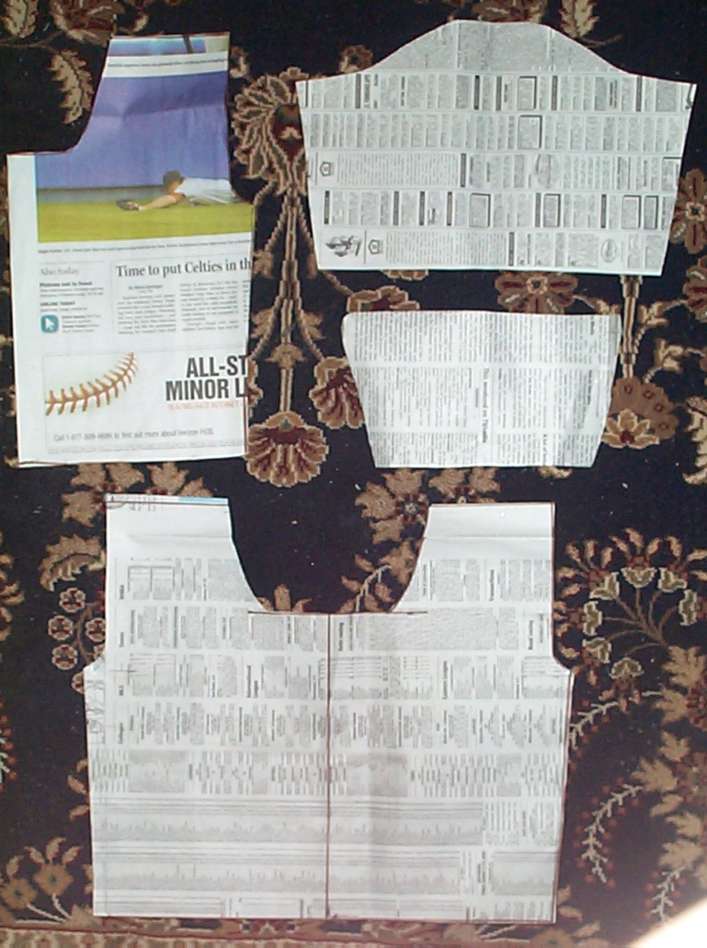
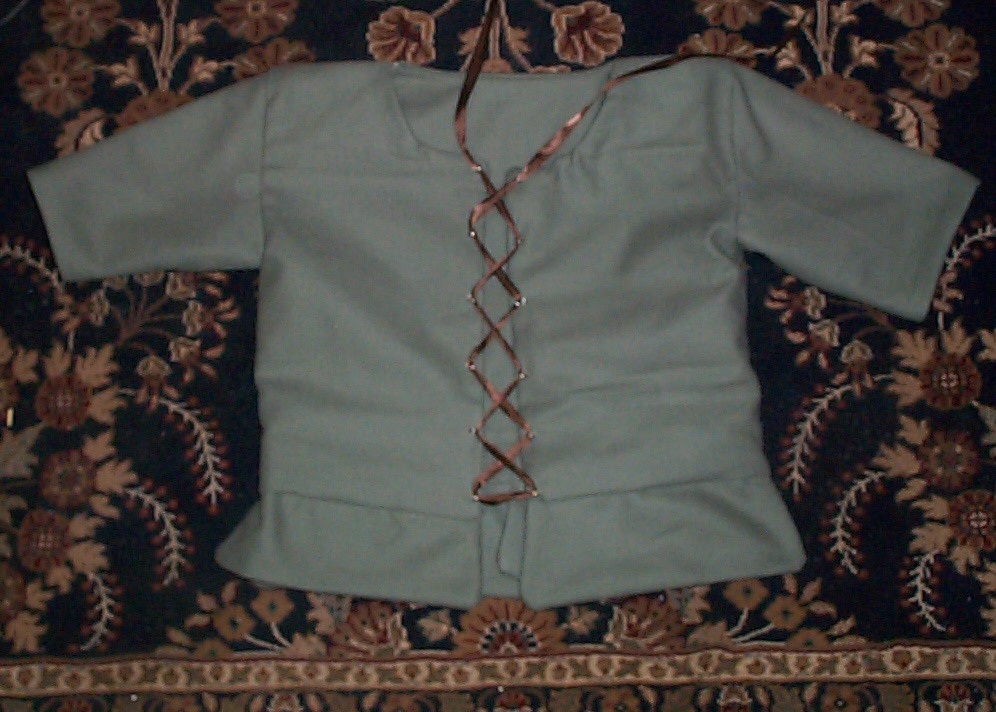
Things went pretty smoothly. I started by sewing the shoulder seams of the outer and inner shells, then uniting them along the neckline by sewing them together up the center front closure and around the neck. Then I sewed the side seams of the inner and outer shell, inverted the inner lining and pressed everything flat. The sleeves went together quickly, too. I sewed the inner and outer sleeve along the bottom edge, then did the underarm seam for the united unit all at once. I inverted the inner linings and pressed my sleeves. Once the sleeves were together, I set them in the bodice. Then I sewed together the inner and outer side of the tabs (that odd shaped piece below the sleeve) – making one for each quadrant of the garment. I turned them inside out and seamed them to the bottom edge of the outer shell. Last, I folded the inner shell’s lower edge down to cover the raw edges of the tabs, and hemstitched it down by hand (too may layers for my sewing machine to cope with).
Since I didn’t have much time, I didn’t go with a zillion buttons or hand-made lacing holes. There’s little if any tension on a little girl’s bodice, so I didn’t bother with reinforcing the lacing edge. I opted for the not very historical but really quick stage option – small rings sewn along the lacing edge to hold the fastening ribbon. Sacrificing a dozen split rings, formerly in use as place markers for lace knitting, I stitched them down by hand.
The apron was also easy. I cut two strips off the top of my yardage and lapping them end to end, pressed the seam lines for the apron’s band and strings. Then I sewed the edges of the remaining piece (again doing it double-sided for additional body), gathered the raw edge and encapsulated it in the center of the apron. Time from taking the first measurements to final hemming – approximately 16 hours of work.
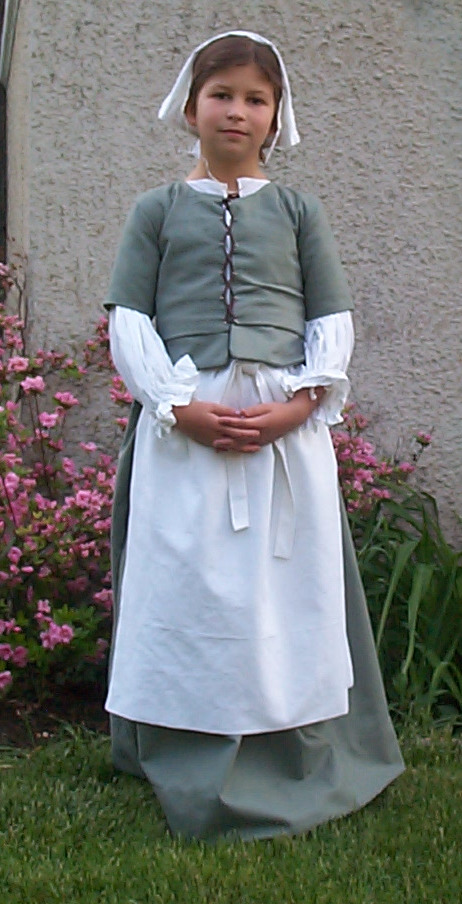
Here’s the end result: one semi-historical kid-suit, inspiration from the 1620s. And yes, Target Child did help, learning how to use the sewing machine and working it for long, straight seams, tracing the pattern pieces with chalk, and doing a bit of the hand-work.
Knitting? I finished my vintage lace scarf. Blocking was postponed on account of Colonial Day.
SURE SIGN OF SUMMER’S INEVITABLE APPROACH
Mailing off the kids’ summer camp registration forms means summer is edging ever closer.
For the past 6 summers, Older Daughter has gone to sleep-away camp in New Hampshire. Last year Smaller Daughter joined her for a couple of weeks. They adore the place.
Roads End Farm is a small, horsemanship camp in Chesterfield, not far from Keene. It’s approximately 50 girls at a time, 15 staffers from around the world, and a herd of around 75 horses – mostly farm-bred Morgans, with a sprinkling of rescues and donated horses. Roads End has been around for 35 years, always run by the the Woodman family. It’s a rustic place, sort of summer-on-grandpa’s farm for kids who have no relatives in the country.
The girls do a lot of riding (of course) – all non-competitive English flat, with small group ring instruction and/or trail rides 6 days a week. Here’s Elder Daughter on Ides, and Smaller Daughter on Goldie, both showing off their new-learned abilities on pick-up day. Note that two weeks before this picture was taken, Smaller Daughter knew horses only from picture books and TV.
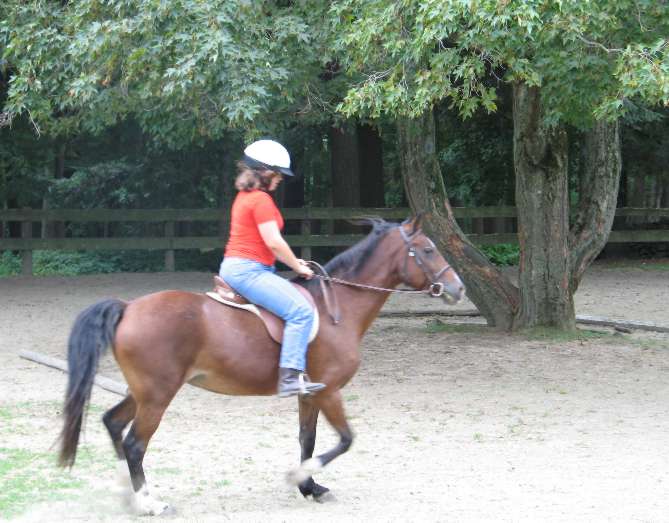

Riders of all ability levels are welcome, from kids who arrive with their own mounts right down to kids who have never seen a horse up close and personal before. The girls are matched in teams of two with a horse of suitable level. Beginners for example are teamed with geriatric animals of sweet disposition (Goldie, last summer was well into her equine senior citizen years). There’s no jumping, and techniques are more geared to riding for pleasure. Safety is a prime concern, both for the campers and the horses. The fact that so many of the horses are still in good condition and working with campers at advanced horse-ages is testament to the high level of animal care at the farm.
The girls provide all the care for their shared mounts – feeding, grooming, AND shoveling. Each girl gets to ride for half the morning, the other half being devoted to farm type chores in the barns, paddocks, vegetable gardens, kitchen or dorms. The afternoons include swimming instruction or free swim in a nearby lake, arts and crafts, and other typical camp-type activities. Hair dryers, TVs and electronics are banned (except for small MP3 players used during quiet times), but my own video gaming/Anime rats don’t long for a single pixel while they are there.
All in all, it’s a small, and very companionable place that’s so much fun the participants don’t realize they are learning big lessons about responsibility and teamwork. I hear that Roads End still has spots open for this summer. If you are looking for a good place for pony-crazy girls ages 8-high school – I strongly recommend the experience.
Oh. Knitting content. My kids bring their knitting to camp with them. That’s where Alex works on her B. Walker Learn to Knit afghan project. She’s accumulated small knitting circles around her each summer.
WHERE’S STRING?
Deadlines. Evil deadlines have eaten my life.
Some knitting is happening in the small bits of time in between the deadlines. Not much though. The Squeaky Sweater is inching toward completion, although what should have taken just a couple of days has stretched into two weeks; the gray leaf sweater sits in a pile, waiting for final finishing; and the blue Klein bottle hat languishes, waiting for time to do the final grafting.
I long for May, when this spate of chaos abates somewhat. In the mean time, web presence and blogging in general will be sporadic at best, although I’ll try to keep up with answering private mail.
PROBLEMS WITH TRACKBACK
We here at String or Nothing are getting hammered by spam trackback requests. We are turning off the trackback feature in its entirety until this wave of annoyance has passed. Since we get almost no legitimate trackbacks, this shouldn’t be much of an inconvenience to the few readers here. Apologies if it is.
TRAVELS OF MY SCARF; COLLARED
The Kureopatora scarf I noodled up last winter appears to have taken on a life of its own. It gathered a small bit of interest here in the US around the time I posted the pattern, but no big splash. Then over the summer and fall knitters in Japan found the thing and made it a real knit-fad. A rainbow of finished snakes began crawling through blogs over there. The range of different Noro-type long repeat dyed yarns there is spectacular, and I’ve been delighted to see the color and texture ranges people have used to make their own snake scarves. Now the pattern appears to have been discovered in Germany and the Netherlands. Blogs and discussion boards there are beginning to post pix of finished pieces, and I’m getting lots of referral hits from them.
If you’ve discovered this blog by looking for the Kureopatora’s Snake scarf pattern, welcome! I’m having lots of fun via this vicarious visiting. For the record, the top non-US, non-spider sources of wiseNeedle visitors Canada, China, the UK, Germany, France, Japan, the Ukraine, Spain, Australia, the Netherlands, Finland and Sweden. Many of those visitors are hopping over to the International Glossary of Knitting Terms. Others come mostly for the yarn reviews and patterns both here on the blog and on wiseNeedle proper. Predictably, non-US visitors to the String or Nothing blog site are predominantly from English as a first language countries, although Japan, France, and Germany are also well represented. For the record, my own blog reading travels often find me on French, German and Japanese pages. I can eke out meaning from written French, but to read other two I have to rely on machine translation, which can be almost as incomprehensible to me as the original.
Ribbed Leaf Pullover
I’m up to the collar of my pullover. I feel rather foolish because last night I missed an excellent opportunity for a photo-illustrated blog piece – neatly picking up stitches around a neck edge. In this case, I followed the stitch count suggestions of the pattern exactly, even though the total count looked a bit low. But I ended up being quite pleased with the result. The neck area on this sweater is a bit large, and needs to be pulled in by the deep ribbing around the collar. While I might rip back, reducing the three rows of purl welting to only two, I like the way the collar is shaping up. This shot is also the best I’ve taken so far of the all-over texture.

My guess is that if deadlines and after-hours assignments allow, I’ll finish up the collar tonight. I’d like to do a tubular cast-off to match my tubular cast-on edges, but I haven’t found one yet that I really like. That should lead to lots of fiddling around and possibly even some interesting blog fodder for a change.
MORE RAINBOW, RETURN OF A FRIEND
Having successfully beaten back yet another deadline storm, and having survived the annual school year February break, some semblance of normalcy returns to the String household. I spent a dreary but strangely relaxing weekend catching up on house maintenance – one that finally allowed me time to knit.
And what did I knit?
I continued my two dueling projects – the dropped leaf sweater, the two side-by-side knit sleeves of which are now approaching the 60% completed mark. There’s no point in showing a blurry picture of yet another pair of indistinct gray objects, larger but still not much differentiated from the last. I am also only four stripes short of finishing the Rainbow Scarf that matches the hat shown off last week. That at least has color and drama, even if the knitting is very mundane:

You can see the long tails at the right hand edge. These will be crocheted into tendrils. Similar strands will be added to the left hand edge after the knitting is done, also to be crocheted into tendrils. I am happy to report that one skein each of seven colors of Frog Tree Alpaca is enough to complete the scarf and hat project. Also that I like the Frog Tree. I’ve met with some minor knots and a couple of unevenly spun spots, but nothing drastic. I haven’t washed the stuff yet so I can’t report on whether or not those Crayola-intense colors hold up. I am already looking on to my next mindless project. I’ve gotten a request for another Klein Bottle Hat. I am thinking of getting more Frog Tree in navy blue to do it.
In other news, I can report a miracle of modern commerce and customer satisfaction.
I have had a small Coach bag for years. I splurged on it when I was gravid with Elder Daughter – so that’s something like 16 years ago. So long ago that Coach no longer includes it in their inventory. It’s a good size, just big enough to hold a wallet,keys, and a phone, and not so large that stuffing it into a backpack or briefcase is inconvenient. Although I have a larger bag and a dressier bag for occasions that demand them, my little Coach has been the default handbag of choice for over a decade and a half. Needless to say that much daily wear took its toll. The binding around the edges was worn through at several spots, and the clasp had given up all hope of fulfilling its function. My bag was well loved, and looked it.
Now Coach has tried to go a bit more trendy in styling and moved more upscale, expanding beyond the “do you want that in black, brown, or camel” mindset of my bag’s day. You’d be hard pressed to find anything similar on their shelves now. But Coach bags are guaranteed for life. So I took my friend to a nearby stand-alone Coach store just after the holidays. My bag was so old that no one in the store recognized the style – not even the manager. I asked if they still repaired bags, and only the manager had an inkling of what I was talking about. But they verified the pedigree of my little guy via the serial number stamped into the inside pocket, and taking a shipping and handling fee (plus issuing a lot of “I don’t know if it’s fixable” type comments), sent it off for repair.
Lo and behold, my little bag returned to me on Friday. Cleaned and somewhat refinished, with a new clasp, new edge bindings all the way around, and a new shoulder strap. All for the handling fee. My friend is back, and I’m very happy.

Moral of the story: That $80 that was so exorbitant 16 years ago was very well spent, and my expensive bag ended up being a better value than any number of cheaper ones I might have bought and worn to death since. You’re always better off buying fewer things of classic style from vendors known for quality and service.
YEASTY DOINGS
A quiet weekend here at String. Work made some inroads into it, but I had enough time to catch up on some much-needed household maintenance, and even to shovel out a little bit of family-spoiling. To that end, I baked homemade bread, and made flour/salt dough for Younger Daughter to play with. Older Daughter wasn’t interested, but appreciated that Younger Daughter was otherwise occupied for most of the weekend. And both ate the bread.
The immediate inspiration for the bread adventure was Rose Levy Birnbaum’s Real Baking blog. In particular – her recipe for Baby Hot Pot Bread. I’ve made bread before, but I’ve always been very disappointed in the result. To date my breads have been cakey and crumbly, with none of the crunchy crust or stretchy, chewy goodness/hole-filled interior that I like. I got the closest with various Challah recipes. Although good they weren’t what I was looking for.
Rosie’s bread looked too good and too easy not to try. I admit I mercilessly slaughtered her recipe. I did all sorts of things that should have totally sabotaged it. I doubled the recipe because my in-house bread vultures would scarf down one tiny loaf in one meal. Not a good thing to do because in baking ingredient proportions don’t always scale. I substituted a half a cup of whole wheat flour for some of the flour in the recipe because I had it in the house and wanted to use it up. Again not an ideal practice as different flours have different properties. And for that matter, I didn’t use the flour specified. I used King Arthur all purpose, which again is what I had in the house. I didn’t have a Silpat baker’s mat, but I did have a flexible plastic cutting board that served the same purpose, and I only had one cast-iron Dutch oven, so I used a Le Creuset 5.5 quart lidded pot for the second loaf.
But none of these were my biggest challenge. That was the ambient temperature of my house. It’s far too cool here for optimal rising. The usual solution for this is to put the rising dough in the oven with just the oven light turned on. My oven light doesn’t heat the oven enough. I investigated all sorts of alternatives – even writing to Rose for advice. Since I didn’t have the time or resources to build a proofing box, I ended up doing a combo of things, depending on the time of day and what heat resources were available. I turned the oven on very low and put the bowl on top of the stove, covered with a towel. Later I moved it next one of our hot water radiators, again tented with towels. My last resort would have been putting it (well wrapped against dust) on top of our furnace in the basement. To make up for the borderline temperatures, I ended up letting the thing sit for longer than suggested. My first rise lasted more like 24 hours than 18. The second rise was also temperature-challenged. It went very slowly. I don’t think my loaves ever achieved their potential full volume.
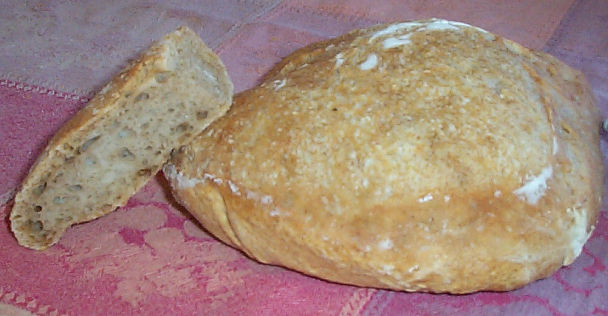
My warmth seeking machinations, the wrong combo of flours, messing with the rise times and other aberrations did not leave me with a high level of confidence when I dumped my two misshapen mini-loaves into their respective pots for final baking. But the recipe is a robust one, able to survive even me. My loaves were perhaps a bit more dense than optimal, but lovely. A very firm, crisp crust; a stretchy, strongly flavored interior, full of holes; no scorching (I was afraid of this given the heat of the pots). And no baking stone full of corn meal, flour, or other burnt crumbs to clean up.
I present the less photogenic of my two efforts. We ate the prettier loaf last night. The sliver of the heel off the narrowest part of my poorly formed bread is just enough to barely make out the airy holes.
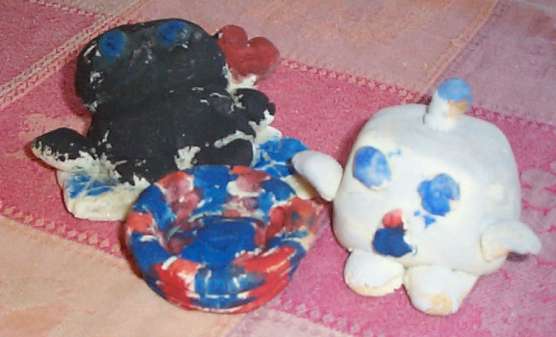
The play dough we made was of the uncooked flour and salt variety: About 2 cups of flour, 1 cup of salt, .25 cup of cooking oil, and about 1 cup of water (we started with 3/4 of a cup but found we needed more). We didn’t bother to color it, knowing that the final product would be baked along with the bread and painted when cool. Here are some of the results. Smaller Daughter saw this entry in the Craft magazine blog, and went on to make her much larger Ninja Valentine statue:
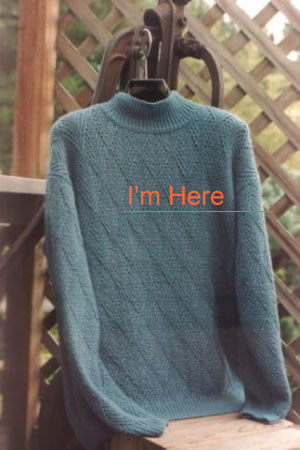
Knitting? I did some of that, too. My Sarah James Ribbed Leaf Sweater back is long complete, and the front is finished to about three inches above the bottom of the armholes.
Rather than give you yet another poorly photographed misshapen object to contemplate, I mark my progress using a visual of the sweater pattern’s own illustration, with a convenient line of demarcation.
Now it’s back to work. The forecast this week is “heavy deadlines, with the possibility of a mid-week blizzard.” February is such a joy.
BRAIN DEAD IN THE BOOK AISLE; KLEIN BOTTLE HAT FINISHED
Count me in with the Curmudgeon and Lisa at Rosieblogs on their stance on disparaging knitting books “dumbed down” for today’s chix. I detest the majority of knitting books published over the last three years. I don’t like the attitude, the contents, the presentation, or the base assumptions behind them. Lisa’s rant is spot-on. Knitting isn’t difficult. It is exacting, and does require a fair bit of patience and perseverance to master. But there’s no mystery, and it’s been accomplished very successfully for hundreds of years by people with no formal math education whatsoever.
You could probably argue that the most recent crop of books was not written with my demographic in mind – the grumpy intermediate to experienced knitter looking to learn more. But even if I were nineteen and holding yarn for the first time, I’d be offended. The only thing that differentiates the vast majority of these hip, trendy little no-attention-span patterns from the stuff aimed at teaching Kindergarteners to knit is the absence of wiggly doll eyes on the projects. Cell phone cozies? Let’s forget for a moment that a team of engineers labored for months on achieving the rate of heat dissipation required for a small-footprint electronic device to function properly, and that someone now wants to put a sweater on the damned thing. If I were a novice knitter given a book whose diet of beginners projects ran the gamut of items you could make from a square folded in half, I’d toss the thing aside and dismiss the whole craft as being brain dead.
Now there are intelligent, well-written books out there for beginners. You can usually find them by avoiding key words in the titles. Lisa nominates “Easy.” I nominate “hip”, and “simple.” Stanfield and Griffith’s Encyclopedia of Knitting is a good one. It’s full of inspirational photos, describes lots of techniques in an accessible manner. As a “Knitting 101” type overview it’s broad but not particularly deep – a good gate to further exploration that doesn’t overwhelm a beginner with every knitting fact known to the universe. The only thing its lacking is a bunch of intro projects.
This glut of useless books follows in the footsteps of any hobby fad. It happened to needlepoint, cross stitch, and quilting in the ’70s, ’80s and ’90s respectively. Publishers see people stampeding to a new interest and retool their offerings accordingly. More substantive books are put on hold, general references of interest to all levels go out the window, and minimalist splashy intros soak up every available publishing dollar. In knitting’s case as Lisa and the Curmudgeon point out, this fad-following focus is compounded by a whole flock of wildly patronizing and denigrating attitudes. So count me in with them. I’m not interested in simple, hip, trendy, urban-gritty, easy, shortcuts, weekend, boxy, cropped, giant-gauge, flash, dummies, or quick. I don’t even want books of expensively photographed patterns for clothing that will look dated in a year. I want challenges, complexity, techniques, resources, tailoring, fine gauges, and if I’m going to spend months creating the object – long term wearability.
Perhaps I’ll get more of it. Knitting’s recent expansion is poised for a crash as the majority of the fad knitters move on to the next big, non-challenging thing. I’m delighted to note that a minority (although a healthy minority) of recent learners has the interest and perseverance to move beyond these dumbed-down books. Perhaps in the flotsam of the post-fad knitting environment between them and those of us who knit before it was trendy there will be enough demand to spur the publication of more substantive and useful resources. But more likely the publishers will lemming on after the next self-affirming fad. Scrapbooking anyone? I hear most people had some exposure to scissors, paper and glue in grade school.
Enough ranting. The few folk who come here aren’t scouring the web for editorials. Back to knitting content.
Klein Bottle Hat – Finished
Here’s the finished Klein Bottle Hat, once more ably modeled by Smaller Daughter (the only one still home in the before-school hour I steal for blogging).


I can say that I followed the schematic in the pattern far more than I followed the pattern itself. I found the original to be too big – not big around the head, too long in length. I shortened up the run of plain full-width knitting before the slit is made, and conflated the narrowing and the slit itself (winging it on the rate of decrease) working both the decrease and the slit at the same time. I’m not entirely pleased with the graft. If I were to do this again, I’d knit some small K2P2 swatches and practice grafting them before I tackled the hat itself. But it will do for a quick gift.
My only problem is that I’ve run out of small project before I’ve run out of deadlines. Mittens next? Perhaps.
 String-Or-Nothing