DPN AIRLIFT
I sheepishly admit I whined in public and was so pitiful that someone took pity on me.
I’ve mentioned here many times that I am probably the last person on earth who enjoys using DPNs, and adores the extra-long DPNs more commonly found overseas than here in the US. The whining was that extra-long DPNs are hard to find here. Judith from the UK had a stash of them, collected over many years of happy knitting. She recently moved over to circs, and her collection of long DPNs languished. So she packed them up and sent them to me!

Here you see her collection, ranging from 4 to 6.5mm (US#6 to #10.5), displayed on the converted-from-jeans denim skirt I’m sewing with and for my daughter. Since no good deed should go unpunished, a suitably splendid gift in return is being boxed up for shipment back to Judith. Ten thousand thanks to her again. I’ll have lots of fun with my new needle library!
On the skirt, who knew they’d come back into style? I wore them in the mid-1970s, and made dozens for my friends. I even have a bit of blurry, faded photographic proof from that era (let’s just say my lack of camera skills runs in my family):

Now I find my skills are in demand again as converted skirts seem to be the rage with my daughter and her set. Even though it’s not knitting, if anyone is interested, I’ll diagram out how to go about doing it. With the top, and jean jacket I described before, the ensemble reaches counterculture nostalgia critical mass, just in time for cold weather.
HALLOWEEN APPROACHES
Quick aside: I don’t know about you, but a small window onto a whole new universe of costume options just opened up for me and mine today. Too funny!
CAUGHT UP
Finally.
I’ve caught up on the by-hand port of last month’s entries from the Blog City incarnation of String or Nothing. I’ve copied over comments, too. It was much easier to do this for the months prior to June. In June BC changed their blog back-up methods, and stopped offering XML exports. Earlier stuff we were able to (mostly) automate, although there will probably be some links here and there that need to be replaced. My premium Blog City account will expire at the end of November. At that time all of the photos there will disappear. Shortly after that BC will probably pull the plug on the account proper, as I will no longer be posting anything new over there. If you have links that point to entries there, please take a moment and use the search page here to hunt up the comparable entry in this location. Otherwise your links will go dead. I’m afraid I can’t contact each of you individually (Google says there are thousands of links to String pages out there), so apologies on this blast notification.
I’ve also caught up on entering the backlog of yarn reviews and advice board questions on wiseNeedle proper, although there are lots and lots of advice board answers that remain to be written. Feel free to pitch in and answer fellow knitters in distress. Even though in some cases the questions themselves are no longer “shelf fresh” future knitters with similar queries will benefit from our assembled knowledge on file.
Aside from getting back to a semi-regular schedule of semi-regular postings here and updating the yarns database with as many new season products as I can find in catalogs and on-line listings, the biggest rock remaining to roll is our KnitWiki. I’ll be dividing my time between blogging and structuring that resource. Lots of reference material that I have posted on String will end up over there Plus there are books and books worth of other articles to create. But first I have to do the basic tree structure type index that ties the whole thing together. Everyone needs a hobby…
Doily progress? Here it is (click on pix below to enlarge):
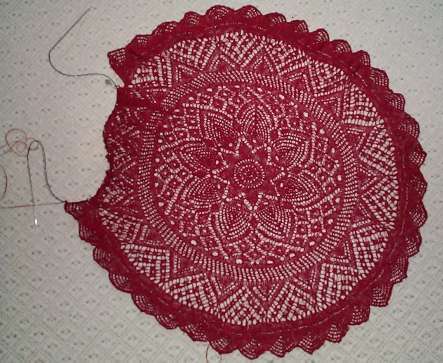
As you can see I’m pretty close to finishing my edging. I estimate that by mid-week I’ll have completed it and grafted the seam.
Other than that, a hearty welcome to the ten people who have followed me here from Blog City. With luck and time (plus getting the word about our relocation out), the rest of String’s regular audience will find this spot, too.
DPN DILEMMA
[Repost of material appearing on 15 August 2006]
I think I’ve hit on one of the reasons so many people despise DPNs: insufficiency of length.
I love DPNs. I use them happily with no problems whatsoever. I have employed up to 15 or so at a time on larger projects for which I had no equivalent circ. And that’s what I thought was going to happen with my red doily. I have about three sets of the unusual 2.5mm size. Give or take for previous losses. 2.5mm sits somewhere between a standard US #1 and US#2. Addi Turbo’s standard equivalent of a US # is 2.5mm (that’s what these are), while most other makers label 2.25mm as a 1. Needle size comparisons across makers here.
My problem is that my 2.5mm needles are stubby, little six-inchers. They’re the only needles I have of that diminutive length, probably bought for glove projects long ago. I normally consider eight-inchers to be the absolutely minimum usable size. I routinely seek out longer ones when I can find them.
My problem with the teeny needles on this project is that I have large hands for a fem. That coupled with too many stitches has meant that I knock the stitches off the butt ends as I work. Yes, I know I could use needle end protectors, or introduce more needles, but I don’t have time to fiddle with point protectors on both ends of 12 needles (I’m up to 12 now). This a new empathy-building experience for me, as I never have this problem. Last night I spent as much time recovering dropped stitches as I did creating new ones. If only I were using needles of my favored length, I wouldn’t be having this ultra-frustrating problem!
Now on to the second half of my dilemma. I don’t have a 2.5mm circ of any length. Nor the time or inclination to track one down. But I do know that I knit more loosely on DPNs than I don on a circ, and i do have an overly long 2.75mm circ. So tonight I knit all my stitches off those little DPNs and onto something safer.
A quick answer to the question about that silver stitch marker in yesterday’s photo. It’s marking the beginning of the round. With 6 or more needles in the work and tiny stitches, plus a pattern that migrates left a stitch or two as it progresses, I find it convenient to idiot-proof my beginning point. Aside from assorting stitches so that the round begins mid-needle it’s impossible to use a standard marker on the end of a DPN round. So I use something slightly different.
When I was on a business trip a while back I happened on the Tucson Gem and Mineral Show. I went into a booth selling silver fittings, pieces, and beads imported from India. There I got a bunch of tiny dangles all set with semiprecious stones, plus a half-dozen tiny little silver earrings. The kind that people wear by the half dozen, marching up along the edge of their ears, or through an eyebrow piercing. The whole lot was amazingly inexpensive, even considering that neither the silver nor the gems used are the highest grade. The result:
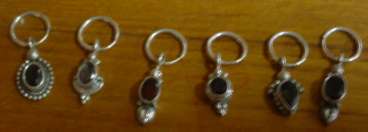
Stitch markers that can be clipped anywhere I need them. The one shown yesterday is the leftmost of this lot, and one of only three I have left. The others have all gone out into the world as gifts. If I ever get to the gem show again I’m heading back to that tent and stocking up. With luck I’ll help subsidize a village of people who spend their days working on these tiny bits of filigree, and not just the middlemen who haul it across oceans to sell in the desert in January.
SEPARATED AT BIRTH
[ported repost of material appearing on 12 June 2006]
My version of Joan McGowan-Michael’s White Lies Shapely Tee – a semi fitted tee shape with a shaped waste and bust darts, used with the optional set-in sleeves (excellent pattern, and most graciously on Joan’s part – available free). Completed April 24th, 2004 and blogged about extensively here. Berroco Suede ribbon yarn, featuring two rounds of B. Walker’s Indian Cross Stitch around the gently contoured bottom hem, one turn of it around the scoop neck collar, and one at the bottom edge of the short sleeves:
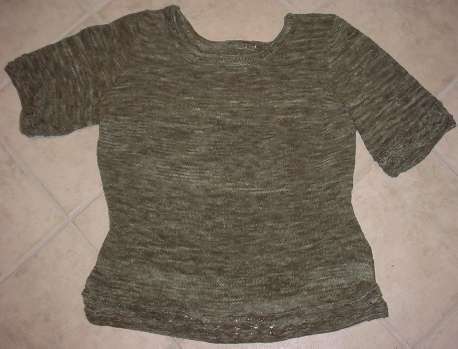
Compare this from the latest issue of Knitters. Tee shape, ribbon yarn, two rounds of B. Walker’s Indian Stitch around the hem, one around the crew neck, and one around the sleeve hems. Plus a texture stitch in the body that’s almost invisible in the photos.
Mine fits better.
YARDS PER MILE
[Repost of materail appearing on 16 July 2006]
No, not a knitting-related math question (for a change), but an idle query. Check out this – a UK art student has knit hersef a car. I hope she gets a good grade on the project!
CATCHING UP
With great joy I announce the end of my most recent death-march deadline at work. The one that has eaten up nearly every day since Halloween (including weekends). I spent this past weekend catching up on a belated birthday celebration, exhuming some parts of my house from clutter, and returning at last to knitting.
One half of the birthday was a memorable dinner with The Resident Male at Blue Ginger restaurant in Wellsley, MA. Not being as eloquent on the subject as Chocolate and Zucchini (one of my favorite reads) I won’t bore you with a dissection of the meal beyond saying it was a leisurely evening of fine food and wine. The company wasn’t bad, either.
The other half of my celebration was a day of personal indulgence, including a visit to the local yarn shop to take advantage of their semi-annual clearance sale. I bought some Encore and a pattern (see below), a couple skeins of sock yarn, a kit to make Dovetail Design’s Rainbow Hat and Scarf (with a full spectrum of Frog Tree alpaca) and two full bags of Jaeger Matchmaker DK in an intense charcoal gray heather. The Matchmaker is destined to become the Sarah James Ribbed Leaf pullover.

On the knitting front, I’ve started winding the tie-dyed cotton. I made the mistake of washing and drying it in the machine. While in concept doing so wasn’t particularly wrong, I could have used more ties to secure the yarn. I ended up with quite a tangle which I am slowly deconstructing back into a ball. It’s not difficult or knotted, but it is tedious. I’m very pleased however with the result. Knitting it however will have to wait for another time, as I am wildly behind on other projects and need to finish them first.
On that Encore – I’ve got a pal at work who has two little girls, with a third on the way. Everyone always knits for the new baby, so I decided to do something different. I’m making two "Big Sister" sweaters in the girls’ two favorite colors for the older two. Since there will be ample laundry in that household, I’ve chosen an easy-care acrylic wool blend. The two sweaters will be identical except for color. One is kid’s size 6 in screaming pink, the other is a size 4 in eggplant purple.
As I mentioned before, I’m woefully behind in knitting so I am using the short-cut of a purchased pattern. A quick to knit, ultra-simple purchased pattern. I’m working Cabin Fever’s 1,2,3, Top Down (#609). It’s a unisex simple knitting pullover, worked top down. The pattern covers kids’ sizes 4-8, and is worked in standard worsted. As you can see, having started on Saturday, I’ve gotten about a quarter of the way through the larger size. I’m past the point where the sleeves split off, and am now well into the body tube. The pattern itself is quite simple and easy to follow. I’d recommend this as being a design that a newer knitter would enjoy. So far the skills needed to accomplish it have been casting on, knitting in the round, and yarn overs. A small bit of purling is introduced in the ribbing and (optional) welt at the base of the collar.

ETHICS OF BUZZ MARKETING
A weighty topic for String.
I’ve been contacted recently by several publishers and manufacturers. Each has offered advance copies of books or free product samples, with the hope of seeing a review of those items posted here or on wiseNeedle. This to me smacks of buzz marketing. I have turned them all down.
Buzz marketing is yet another "latest thing." In buzz marketing a vendor engineers a campaign that seeds mention of their product such that the word seems to come spontaneously from unaffiliated individuals – all talking (or writing) about the product in their own words. One of the ways to start a buzz campaign is to seed the product out to influential (or prolific) people who know lots of other people interested in new items or ideas. Prolific bloggers or podcasters are excellent pipelines for getting the word out. Giving them goodies for free is one low cost way to spread buzz to other leading-edge consumers. At this point I suppose I should be flattered to be considered either prolific or influential.
So. What’s the catch? Why not accept freebies, try them out and then post the results, good or bad?
Mostly because I am uncomfortable with the ethics of the base idea. When does accepting free samples begin to color one’s thoughts? At what point are one’s opinions compromised? At what point does one become a mouth organ for others rather than oneself? Yes, I know there are magazines that accept freebies and test samples – even paid ads, then turn around and totally blast bad or defective products, regardless of prior considerations. Computer Gaming World is known for having dissed the deserving on the page opposite an ad for the product being criticized. But there are far more specialty coverage venues that avoid any semblance of criticism of advertisers or sample providers.
Plus, once this practice becomes widely known the whole issue of trust surfaces. Paid endorsements are something else again – everyone knows Tiger Woods gets megabucks from Nike. His integrity isn’t an issue because the link between them is so public. Formal public endorsements aside – can you trust the opinions of someone who even with the best of intentions may be an unpaid shill? Isn’t entering into this sort of arrangement both a bit exploitative on the part of the marketer, and duplicitous on the part of the shiller? I see a slippery slope here. Accepting freebies to me is the first baby step on a continuum of ethical compromise – the same continuum that in its most egregious manifestations pops up in bribery, kickback, and blackmail scandals.
Where does that leave our little world of knitting and knit blogging? Good question.
Is accepting freebies for the purpose of (perhaps) writing something about them an ethical challenge for other people? Is it any different than wearing a branded item – an Izod shirt, or carrying a Louis Vuitton handbag? Your thoughts?
SPORT AND GANSEY WEIGHT; FRONT END WASHERS
More questions from the inbox.
Sport weight = 5 ply gansey weight?
Not really. As the "5 ply" weight designator implies, Gansey/Guernsey is in between sport weight (6 ply) and fingering (4 ply). There are yarns labeled as sport that are on the thin side that work up nicely at the 6.5 spi Gansey target as well as yarns labeled fingering that are thick and also cover that gauge. But not every sport or fingering can be used as a sub for it. Plus Gansey weight usually imples a classic smooth finish, dense yarn that supports superior stitch definition. Wendy/Peter Pan still makes traditional Guernsey 5-Ply, now a superwash. It is labeled at 7spi, but is denser than fingering/sock yarn at that gauge.
Washing yarn in a front loader washing machine with a wool cycle?
Front loaders are known for gentle action compared to aggressive water-hogging top loaders, so I suspect that you’ll be able to wash the spinning oil from loosely wound hanks using one. I know people who complain about the flip side of this problem, that it’s impossible to get their front loader to full yarn for felted projects. BUT there are caveats. The machine has to have settings that control water temperature in both the wash and rinse cycles, so that you can set the same temperature for both. It has to have the ability to retain water for soaking (some use very little water and getting a a pool for the yarn to sit in may be problematic).
One other challenge: it also has to have controls that let you either eliminate agitation, or that let you advance the cycle past the agitation stage of the wash to plain old drain then spin. If the machine relies on side-mounted flanges on the inside of the drum to churn the contents as the drum spins, it will be impossible to eliminate agitation-like movement of the stuff being washed. I don’t have a front loader, so I can’t speak to whether or not the agitation inherent in that type of action would allow washing yarn with no risk of fulling.
As for pre-programmed wool cycles on all machines, I’m very skeptical about them. My own top-loader has an alleged wool cycle that’s pretty much useless. All it does is put the wash through a shorter (though not less vicious) agitation cycle. It does nothing to govern water temperature, and the rough treatment although shorter is still enough to induce fulling. I wouldn’t risk using my machine’s wool cycle for finished items, and especially not for more vulnerable un-knit hanked yarn. I know some of the more expensive European washers handle wool extremely well. Experimentation here is warranted. Since seeking reliability of results in knitting always leads to a pile of swatches somewhere, here’s a chance to put them to constructive use. If you want to determine the usefulness of your washer’s wool cycle, gather up a bunch of swatches then put them through a cycle and observe the result.
MORE YARN
It’s been a week of yarny goodness here at String. Not only did I go on a shopping expedition on my own, but The Resident Male went on a trip to Arizona and brought me back a present. Now this is a Big Thing because althogh he’s been supportive of my needlework obsessions over the years, he’s never before been a direct enabler of them.
So I am picturing him at the knit shop he found out in Scottsdale, Arizona. He says he went in and asked the committee sitting around the back project table for help selecting something unusual. He was shown a pile of various foofy/fuzzy/overadorned novelty yarns, and being observant knowing that I rarely use them, insisted on something less "demonstrative" but still unique.
The committee came through. He ended up buying this:

It’s a hank of mercerized 100% cotton, hand-painted in blues, teals, and greens, with a touch of a mauved brown. The effect when wound is a ball reads "camoflage." It’s got a house label on it (no brand name), stating that it knits to Aran gauge (4.5spi on a US #8), and that it’s got 997 yards total.
Looking at the stuff though it reminded me of Rainbow Mills Crayons Lite, the yarn included in their "Grandma’s Little Darling" toddler sweater kits (shown here on Younger Daughter when she was three):

Sure enough, a side by side comparison of my leftovers from the sweater above and my new yarn shows that they’re near identical. Amazingly enough not only are they structurally the same, the wind-off hank diameter is the same, and the hues of the teal, brown and khaki in the two are spot on identical (the toddler leftovers includes magenta and orange in addition to all the colors in the new stuff). I wrote to the yarn shop, and they confirmed that the base stock for this yarn is the same as the Rainbow Mills product. I haven’t seen Crayons Lite sold outside the toddler kits, and having a known weakness for variegated yarns, I’ve always wanted to use it again.
For the record, to make the yarn flash in the toddler pullover, I needed to get 5spi on US #7s, and predicated the circumference on a factor of about 12.5 inches, then steek the armholes. This sweater is done on 125 stitches (about 25 inches around). I think that I’ll try to use my hank to make a short tee on 250 stitches, and see if I can get the same kind of flash. I’ll use a provisional cast-on so that I can go back and add ribbing or edging later so I can maximize use of the yarn I’ve got on the body itself. I even have enough of my coordinating (but brighter mix) leftovers to do the rib or edging, should I so desire. If that doesn’t work and I come up short, I’ll see if I can do something on the same narrow strip principle as my Typeset Tee.
The upshot of all this is that Resident Male came back with just about the perfect choice: a yarn that isn’t available locally, in colors that I enjoy, and in quantity that’s just right.
Keepers, both!
 String-Or-Nothing