YARN CRAWL – QUESTIONS
I’ve gotten some questions via eMail about yesterday’s yarn crawl.
How do you know what to buy? Do you go with a list?
Some people do. My pal Kathryn did. She had a prepared list of patterns and requirements, and went looking for yarns specific to those needs. I don’t. When I go to an "exotic" yarn shop I look for things that aren’t available at my local yarn store. Most of the stuff in the front retail store area at Webs is available in my own neighborhood. (I am lucky enough to live in one of the most yarn-shop-dense areas in in the US.) I went looking for back room bargains, off labels, mill ends, and other oddiments that I am leery of purchasing sight-unseen over the ‘net.
In terms of what I was looking for, I do admit that experience with yarns is a plus. I know a bit about different types of yarns and their properties. Not as much as a spinner – but enough to know what yarns are likely to improve with washing, and which ones will remain prickly for their entire life. I’ve got a rough grasp of what both yards per pound figures and the number system of yarn descriptors used for woolen and cotton yarns translate to in standard hand-knitters terms and gauge. I’ve played with wraps per inch (though I admit I didn’t use that measure this trip). I’ve got a calculator and know how to convert pounds to grams, so I can figure out a rough equivalent cost per mythical 50-gram skein. Plus I have a good idea of what colors appeal to me, look well on me (or my target), have classic appeal, and would be fun to knit.
So what I did was wander the back aisles in the walk in warehouse, looking for goodies on special. The goodies had to be of excellent quality, in an appealing color that will transcend trends, of versatile type or construction (not a novelty yarn that will look dated in a fortnight), and represent a significant cost savings. If any "spoke to me" (inspired a particular creative idea upon first sight) all the better. But I was not buying for immediate consumption and went with no particular projects in mind.
Have you ever bought "the wrong yarn"?
Yes and no. I’ve got all sorts of things that have sat in my stash for extended periods of time, but I’ve never bought anything I wished I could return. For example, right now I’ve got two bags of well-aged Classic Elite Artisan in a deep green somewhere between khaki and hunter. At the time I bought it (circa ’99) I had an idea that I’d use it for a cabled sweater. But since then I’ve reconsidered. It’s a bulky weight (3.5spi) and has alpaca in it. A cabled thing in it would end up being both weighty and ultra-warm. Too warm to wear as an indoor/outdoor sweater. Plus I’ve found I prefer knitting in smaller gauges. So it sits, awaiting inspiration, but I wouldn’t say it was a bad purchase or it was "the wrong yarn." Eventually I’ll figure out what to do with it, or I’ll swap it for something else.
How much did Webs pay you to post yesterday’s ad?
Nobody pays me nothin’. I go where I want, and I write what I want on String – bad or good. Please send my greetings to the other conspiracy theorists whose company you must enjoy.
So what are those number system/yards per pound bits you mentioned?
(This wasn’t actually asked, but I’m sure it will be if I don’t address it here). There are several very cogent explanations of the number system and how it’s calculated elsewhere on the Web, but here’s a quick cheat sheet of equivalents for wool. Remember that although this chart makes it look like there are absolute definitions of size, these are approximate average numbers. There is considerable overlap with the values shown above and below each category, dependent on all sorts of things including fiber blends, texture, or how tightly the stuff is twisted (how dense the yarn is).
| Weight (ply weight descriptor equivalent) |
Most Common Gauge |
Approx. Average Yards/Pound (Wool) |
Approx. Average Wraps/ Inch |
Some Count Numbers* For This Weight (100% Wool) |
| Fingering (4-ply) | 7 spi | 1,920 wool |
16 | 4/30, 2/15, 4/24 |
| Sport (6-ply) | 6 spi | 1,500 wool | 14 | 6/24, 2/16, 3/9, 3/11 |
| DK (8-ply) | 5.5 spi | 1,400 wool | 12-13 | 3/8, |
| Worsted (10 ply) | 5 spi | 1,280 wool | 11-12 | 2/10, 10/24, 4/8 |
| Aran (12 ply) | 4.5 spi | 850 wool | 10-11 | 12/24, 2/4, |
| Bulky (14 ply) | 3-4 spi | 680 wool |
9-10 | |
| Super Bulky (16 ply+) | 3 spi or fewer | 500 or fewer | 8 or fewer | 2/2 |
*In wool the first number refers to the number of plies (physical construction, not "ply weight equivalence"), in cotton, the second number refers to the number of physical plies
Please feel free to send me corrections and additions. I’ll be adding to this chart as time goes on, and possibly supplementing it with one for cotton when I get a chance.
YARN CRAWL
I’m catching up on lots of things this week – appointments, activities, deliveries – plus I’m regaining equilibrium. As part of my stress dissipation strategy I went to Webs. Actually I went with my houseguest – long-time needlework buddy Kathryn (she of "too many centries, too little time.").
Of course no trip to Webs would be complete without an acquisition report.

The garnet yarn on the right is the 2/4 Highland Tweed 100% wool currently on special. The website lists it as an Aran weight at 4.5spi, but to me it seems a bit light for that. I have this cone plus a partial – in total a sqidge more than 2.5 pounds total at 992 yards per pound, roughly 2,511 yards. Thats way more than enough for a sweater for me at any gauge down to Gansey. The twist is a bit soft. It’s a nice deep color (not as tomato as the picture), accented with flecks of emerald, sapphire, turquoise, and topaz. On the cone it’s a soft wool, but not Merino-gentle and is imbuded with a touch of spinning oil. It’s possible that the spinning oil has flattened the stuff out and is making it look more like a DK, so I need to either wind off some and wash it then knit up a swatch, or knit a swatch and then wash it so I can determine final gauge. Based on the texture though, I am expecting this yarn to soften up considerably once it has been washed. 2.54 pounds is about 1,152 grams or roughly 23 50 gram balls. My purchase works out to the equivalent of about $1.33 per equivalent 50 gram ball. This stuff is listed on the Webs site. Mine is the cardinal color pictured there..
The yarn at the left is another back room bargain bin find. It’s a 80% silk, 20% wool blend, in a fingering weight with a slight boucle texture, about 2,400 yards per pound. It’s a nice denim blue. I bought two cones, again just under 2.5 pounds total. That’s a mind-boggling 5,928 yards. Again using the 50-gram skein as a standard, my purchase works out to 1120 grams, about 22.4 skeins. Rounding down, my 50-gram skein equivalent cost was about $1.12 per skein. My color isn’t shown on line although there was lots of it on the shelf.
Now. What am I going to do with all of this?
The red should be pretty simple to use regardless of gauge. It’s light enough in color and weight and not so busy that it can’t handle a bit of texture pattern knititng. I’ve got enough that if I wanted to go hog wild with cables, I could. I’ll be stashing it until a perfect idea emerges, although that Gansey idea is beginning to have a bit of appeal.
The blue however may be closer in terms of actual use. Remember past musings on the compatibility between crochet and knitting? About how crochet needs to be worked in finer yarns to produce a fabric comparable to knitting? Here’s a chance for me to experiment with that. I’m thinking of doing a summer top that combines both. I’d use this stuff single-strand for a classic crocheted yoke, adapted from an antique chemise or nightgown pattern, then using the same thread doubled, knit the body of the garment. The weight of the products of the two should match much better than trying to use both techniques with the same thickness yarn. My only handicap here is that I prefer not to wear sleeveless things, so some additional adaptation may be in order if I wish to wear the final result myself. Anything leftwover would make a nifty lace shawl.
I also got a bag of Rowan Rowanspun 4-Ply in Holly – an intense blued deep green. I’ve been collecting colors of this stuff for a while, all in the jewel family. (notice a theme here?) I finally have enough to do something spectaular. What exactly, I haven’t a clue.
So there you have it. Skid marks on the old Visa, and depending on the sizes/gauges used – most or major parts of 3-5 adult size garments, all for about $80. I’m stoked, I’m de-stressed. Now on to the knitting!
PROBLEMS WITH THE LETTER L
Corrections made
J Scholes is absolutely correct! The book I mentioned two days ago is Odham’s Encyclopaedia, not Oldham’s Encyclopaedia. I plead an absent title page, a rubbed spine, and bifocals. Of course I have no excuse about missing the obvious on the various Internet sites I looked at to document the probable date of origin. I’ve fixed Sunday’s entry accordingly.
An evening with Christine Duchrow
In other news, in an idle l moment I took up a book I bought a couple of years ago and tried to decipher the knitting instructions. It’s The Knitted Lace Patterns of Christine Duchrow, Volume I, edited by Jules and Kaethe Kliot (Lacis, 1993).
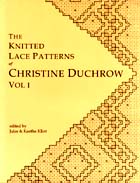
Duchrow wrote in Germany in the early 1900s. She’s one of the early proponents of charted instructions for lace knitting. The editors do say that some of the book’s patterns contain errors or are incomplete or damaged. To top it off the text is very sketchy and in German, and the symbol set used is a difficult one. For example, purls are represented by a lower case L and YOs are represented by the number 1. The printers didn’t always get the distinction correct, and even when they did – the blackletter font style l and the 1 are perilously close in appearance in the photo-reproductions presented in the book.
But not to be daunted, I try any way.
I started out with a relatively straightforward scarf/jabot pattern named "Muschelschal" (Mussel Shell). The photo isn’t very good, but the pattern looked simple. After wrestling with it for a couple of hours, I retrenched and went back to the basic edgings shown at the beginning of the book. I am ashamed to admit that I didn’t make much headway with them, either.
I’ve got the easy stuff down pat – that the patterns only show right side rows (wrong side rows are plain knit); that there is potential confusion between 1 and l (compounded because it looks like many patterns frame YOs with purls), and that I do need to rely as much on the picture as I do on the directions to figure out what’s going on. But I can’t make the stitch count numbers work. The cast-on value is clearly stated for each design, with each pattern starting off with a row of plain knitting. However, when I count up the stitches consumed by the first patterned row, I never come out with the number currently on the needle. Sometimes I’m one short, sometimes I’m one over. If I were always one short, I’d make the assumption that the slipped edge stitch isn’t calculated into the cast on number – but I’m not. Clearly more experimentation is needed as I am missing something here that’s very fundamental.
In the mean time, more on reading Duchrow’s patterns can be found on Judy Gibson’s site (thank you Judy!). Additional advice is always appreciated. If you’ve ever worked from this book successfully, please feel free to chime in with tips.
SHORT ROW HEELS
Turtlegirl asks what patterns I use for fingering weight socks. I shamelessly answer – my own. New readers here (and there appear to be many of them) may not know that I also am the keeper of wiseNeedle. wiseNeedle is the original yarn review site, active on the web as an all volunteer consumer to consumer, unsponsored service since 1995. In addition to the yarn review collection and a searchable glossary of knitting terms in 14 languages, I keep some patterns there, too. Among them is a slew of toe-up, short row heel socks in several yarn weights. There are three patterns there for fingering weight, and any of them can be used as-is, or by elimination (or substitution) of patterning on the ankle parts, made as simple or as complex as the knitter desires.
And in response to other requests, here’s a close-up of the short row sock heel, showing the mitering you can achieve with a little advance planning and a modicum of luck:
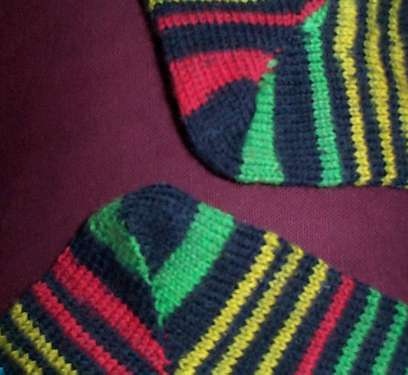
Why do they not match exactly? Because I didn’t take the time to make my socks identical twins. I started each sock off its own ball of yarn at the exact start of the ball. The repeats were slightly skew. I don’t have a problem with making these self stripers into fraternal rather than identical pairs.
Now, how to finagle this effect using a self striper? Lots depends on the width of the striped section. The narrower the stripe, the easier this is to do. You can better see what I did in the top sock, above. I knit the foot (on the left, heading up towards the top of the photo), ending it in synch with the completion of a red stripe. Then I began the back and forth short rowed section with the following section of black. I ended the decrease section of my short rows roughly half way through the black bit that followed the red, finishing up the black on the part of the short row section that re-awakens dormant stitches. Then I finished out my heel. This synch of the pattern to the printed repeat required that I fudge a bit on foot length. In a sock of this type, a row or two extra in the foot, combined with a heel a row shorter than normal isn’t going to make a major difference in fit. Since the repeat pattern is so narrow, I can get pretty close to perfect miters. On wider patterns it’s harder. In a wider pattern I do still try to end the foot at the completion of a stripe (or if it’s a VERY wide stripe, half way through a repeat). I let the short rowed section fall out as it may, hoping more for serendipity rather than planned perfection. Most of the time things work out well enough.
STILL SWAMPED
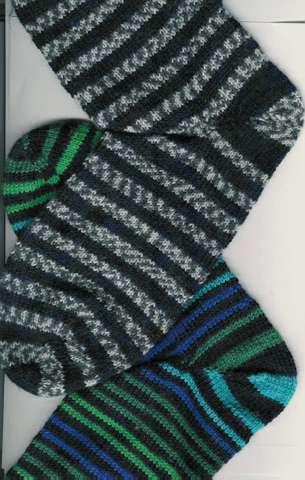
Yes, I’m still alive, but I’m swamped at work and haven’t had a moment to spare for updates here, or even for blog-wandering of my own. I have been knitting though. Nice non-challenging things like stockinette stitch socks, mostly in eye popping stash-remnant color combos. What is it about January that makes me hunger for color, and every year – leads me to make things that would normally cause me to twitch from the jarring contrasts and strange combos used?
In any case, something knitworthy, yet interestingly nerdy crossed my desk this morning. I present for your delectation a knitting machine made from Legos. Actually it’s more like a chainette maker, or a super-sized automated knitting Nancy (spool knitter), but it is a bona fide member of the knitting machine family. And it likes Red Heart.
WHERE HAVE I BEEN?
On vacation. Actually consumed by pre-holiday preparations and work responsibilities, THEN on vacation. January as well bodes to be a bit hectic, so postings here may be sporadic in the new year. We can report these accomplishments:
- 11 kinds of cookies baked, and distributed or consumed by the family
- 2 panforte, complete with dried cherries, toasted hazelnuts and almonds prepared, one brought to a group party
- Sumptuous small Christmas eve dinner prepared for the family, featuring squab in juniper berry sauce
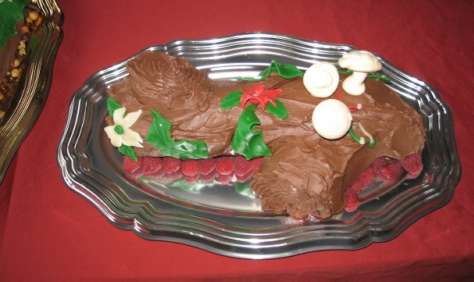
- 2 bouche de Noel cakes prepared, one filled with hazelnut pastry cream, one with raspberry jam, brought to a group party
- Latkes, latkes and more latkes
- Blintzes, too – home made of course (my recipe’s in Elizabeth’s The Knitting Bloggers Cookbook)
- New Years cassoulet, including the duck confit we put up back in the spring
- Holiday shopping for friends and family
- Tree decorating (and un-decorating)
- Wrapping (and un-wrapping) presents. Mine included a small silk pouch for knitting accessories, a nifty new driver (too bad I can’t golf until spring), a thermos jug teapot, Yiddish with Dick and Jane, and a hand-made calendar.

- Hannukah candles, songs and games duly performed
- Attending the midwinter Revels performance in Cambridge, MA
- Kicking off three huge life-consuming projects at work
- Four additional pairs of socks knit, mostly from very much appreciated gifts of sock yarn I received over the past year (thanks again guys!)
- Family time spent messing around with the kids, playing PS2games, watching InuYasha DVDs, going to a movie, cooking, doing holiday preparations, and playing games together
- FINALLY shelving the books that have sat in boxes since we moved in last year, this event triggered by the delivery of our much anticipated library bookcases, and receipt of our Vance Integral Edition
- Major behind-the-scenes work on a facelift, feature expansion, and functionality upgrade of wiseNeedle
So even if I was away, the whole String family and I weren’t exactly idle.
As far as this year’s gift knitting, I can report an excellent reception all the way around. Both shawls I knit this year went as gifts, and both very VERY appreciated. The screaming school bus yellow scarf was loved by it’s recipient – the cheerful and watchful school crossing guard who is in the middle of her 23rd year on our corner. My annual flock of socks was greeted well. The luxuriously soft and lush curly mohair scarf and Juliet cap were loved by the person I gave it to – someone for whom texture is paramount. And my kids’ teachers enjoyed the various scarves I knit for them.
On the sock front, I can report that I don’t really like toe-up socks in self-stripers when they’re done with heel flap variants. I much prefer the look of a neatly mitered short-row heel with those yarns. I’ve reverted back to my old stand-by heel for socks for me, especially if I’m using Regia or one of the other auto-patterned sock yarns. The only exception will be if I make socks for someone who requires the looser fit of the heel flap heel. In that case should I want to use a self-striper, I’ll pick a complementary solid color for the heels and toes, and reserve the printed yarn for the parts that remain stable in width.
HOUSEKEEPING AND STARTING BEGINNERS
Some questions recently posed:
What happened to the list of recent referrers that used to be on the right?
It’s gone. I had been using a free service to report the places that people had been coming from. That service is no longer available. What’s there now is the native referral reporting feature offered by Blog City. Not very informative.
Of minor interest and on sort of a tangent to the where folk come from data point, the single largest thing people visit String to see is the pattern/report/working method for my Waterspun poncho. That page is the most viewed on the whole site, by an overwhelmingly huge margin. After that comes Stupid Stitch Marker Tricks. Lots of other posts from the general reference and pattern headers follow. All are understandable, as they contain how-tos or other info that I thought people would find useful. The only anomaly is the post I did about the name frequency web toy. For some reason, that post was picked up far and wide, and is in the top ten visited list.
Am I going to change the referrer reporting tool? Probably not. We’re plotting big things here for both String and wiseNeedle, so there are not a lot of spare moments to spend on redecorating what’s in each spot right now. I will continue to post here though – sporadic as it has become.
So? How were the fingerless mitts received?
Tickled! The recipient was absolutely tickled. It’s always fun to give a gift that’s appreciated.
What’s the next gift?
I’m now working on one of those standard issue fancy yarn garter stitch scarves. While I’m not fond of making them, this new deserving recipient saw one worn by another person and went googly over it. I was lurking nearby and took notice.
I’m using US #13s and plain old Eros and ColorLash – an oft-mixed pair to be sure. While the result is striking looking and no doubt tempting for beginners to knit, I despair at the number of people who have probalby given up knitting because of this stuff. Others have noted how unruly both yarns are, how they slither off the needle and off the ball; how easy it is to drop or inadvertently increase a stitch; and how annoying it can be when a needle tip snags in the interstices of the railroad ribbon. I know in my hanging out at the LYS days, I must have rescued a half-dozen of these scarves for distraught beginners, reseating the stitches on the needles after their inevitable escape. Which brings me to a discussion thread that doesn’t have an externally posed question to cue it. So I supply one just for fun:
What’s makes a good beginners’ project?
I’m of two minds on this one. First, the best thing for a beginner to knit is something that a beginner wants to knit. Telling someone that something is beyond them is a "one size fits all" defeatist strategy. Some people learn better when faced with a challenge. Others get discouraged if they’re told something is hard before they even try it.
At the same time, not every knitter can leap in and make a complex bit of lace, a fitted Fair Isle or an elaborate Aran sweater as their first-ever piece. There’s a balance here to strike among well-behaved materials in comfortable sizes, project scale that provides the best mix of achievablity and challenge, and skill requirements that stretch the knitter without frustration. If I have to recommend something as a first project, I tend to look for these factors:
- Smooth, classic finish yarn rather than texture
- Worsted or Aran weight (20 or 19 stitches = 10 cm or 4 inches)
- Size US #6 to #8 needles (depending on yarn weight used)
- Light color to make stitch identification easier
What size project and whether it’s knit flat or in the round depends on the knitter. I’ve started people out on everything from small swatch sized mug rug squares, to scarves, hats, even socks. Full sweaters (unless they are ultra simple dropped sleeve ones in little kid sizes) I tend to recommend for a second or subsequent project. But again, desire to knit is the strongest motivator of all. If someone REALLY wants to use an unruly yarn for a first project, or begin with an adult size cardigan, hot desire can trump cooler considerations.
My own first project was a Dr. Who length scarf that started out in garter stitch and quickly took off on a tangent as I tried out all the stitch texture patterns in my book on it. My second was a Penny Straker trinity stitch baseball jacket.
Are you someone who started out on the classic track, or are you someone who did the knitting equivalent of jumping off the end of a pier to learn how to swim? Would you encourage a beginner to embark on what you know will be a challenge, hoping that perseverence will see the newbie through the difficulties ahead? Or would you try to gently redirect that person to something that’s easier, more in line with the classic progression from first swatch through scarf, flat knit drop shoulder pullover, and so on? Inquiring knitters want to know…
TOPS UP AND DOWN
My convertible mittens are done. I have to admit, the joy of ending off ten fingers wasn’t a pleasure of the ages – but they’re finished.
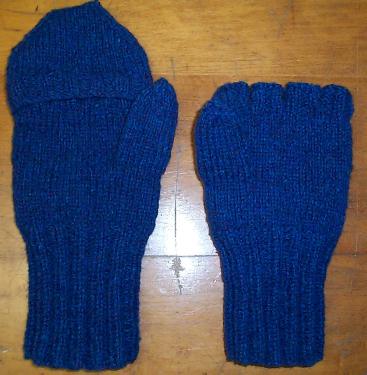
The rustic wool I used for these isn’t as soft and non-itchy as I would have preferred, but in this case the intended use trumps that problem. It’s my understanding that the recipient would be wearing ultrathin silk gloves inside these. Liners do away with itch.
If I were to make another pair of these mittens, I’d probably use a shaped thumb gusset instead of the afterthought thumb. While these do fit nicely, I find a shaped thumb area to be more comfortable. Award to recipient is this afternoon. I’m sure he’ll be pleased.
Next up in the gift parade is problematic. I had a Very Strong Hint shared with me yesterday. I don’t have the special materials on hand, so compliance will entail a lunch-time raid on my LYS. Now not everyone around me can get goodies just by idle hint. Hints must be 1) shared innocently, with little expectation that they will lead to the desired object; and 2) must be given by the deserving, and I get to decide who’s deserving. If I didn’t impose limits, I’d be chest deep in special requests.
Other items on parade include another pair of socks (probably not going to happen), and some ear warmers and hats. Plus some additional crocheted snowflakes for the tree. We’ll see what further stash excavation expeditions unearth.
Cookie report:
Rum balls this year turned into Scotch balls, as a last minute dearth of rum foiled my original plans. I’ve used bourbon before, but found the result too strong, so we’ll see how this year’s crop mellows. Peanut butter cookies are also finished. I’m happy to say that the spice cookies turned out exceptionally well. Thin, light, and gently spiced. A delicate cookie compared to many heavier riffs on the spice cookie theme.
HALF-BAKED HOLIDAYS
Between work, holiday preparations and other commitments, my updates to String have gotten very spotty. For that I apologize.
Right now I’m consumed by deadlines of various flavors. Not the least of which is our annual cookie fest. I’ve mentioned before that holidays are not allowed to happen here until we’ve got at least ten kinds of cookies baked and ready. Ten batches of cookies makes far too many for a family of four to consume, so I always share the bounty, giving cookies to neighbors, friends and co-workers. (If family lived closer, they’d get some, too.)
This year’s list includes both things I can’t NOT make, some repeats of special favorites, plus a couple of experiments:
- Chocolate chip cookies – the classic, but made with mini chips and pecans instead of walnuts, slightly smaller than their non-holiday brothers
- Mexican wedding cakes – a very rich, pecan-dense shortbread cookie, rolled in powdered sugar
- Peanut butter cookies – my kids would shudder in horror if I left these off the list. Done with crunchy peanut butter
- Buffalo Rum Balls – a version of the classic crushed cookie bourbon ball, done with rum and cocoa, rolled in cocoa. Our variation comes from a recipe published in the Buffalo NY evening newspaper some time in the 1960s
- Sugar cut-outs – the iconic holiday cookie. This year we get to use the Hannukah cookie cutters. Also I put lemon zest in the batter, and mix the icing with lemon juice instead of milk or water
- Oysters – a family invention. A hazelnut spritz sandwich cookie, filled with dark chocolate ganache
- Earthquakes – another classic, renamed by the kids. This one’s a chocolate crinkle cookie, rolled in powdered sugar before baking. We use additional bitter cocoa in the place of the coffee in the recipe. The expansion of the cookie creates chocolate rupture fault lines in the white exterior
- Cinnamon maple rings – a rolled, layered refrigerator cookie. Very thin and delicate.
- Elephant Tongues – Like last year’s ears, this one is a quickie that uses store-bought puff pastry for more effect than effort. I’ll be posting the how-to here.
- Cocoa amaretti – Barely cocoa, very almondy and very biscotti-crunchy. New this year from a cookbook
- Spice cookies – Also new this year, but from a recipe on the King Arthur website.
- Panforte – Chocolate/nut/fruit heaven on earth new last year. A must-repeat from last year. This is so good we may NOT share it.
In the midst of all of the holiday knitting continues. Again apologies if you visit looking for more yarn goodies. Other goodies right now are taking precedence.
STILL ALIVE
I’m doing fine, but my base station computer is lying on the dining
room table, completely gutted. A new motherboard, new power
supply, and a new video card are arrayed nearby. But you didn’t
come here to read about my digital woes.
I’m working up a follow-on to the charting articles – a set of
thumbnail reviews of the knitting pattern books on my shelves.
I’ve got most of the standards, plus a couple of the harder to find
items. But that’s much easier to do when I’m working in the same
room the books are.
In the mean time, I’ve been working on various small projects – mostly
holiday related. I’ve finished off several more pairs of booties
(there must be something in the water, as there appears to be spike up
in the local numbers of the gravid). Socks march on, with the
latest pair being toe-ups in a very conservative gray, possibly with an
inverted flap heel and the placement of a spot motif on the
ankle. Those bits may yield something of interest to write
about. Plus a quick stitched piece that is destined to be given
to an unsung hero at work. More on that tomorrow.
In the mean time, I present with a bit of sadness, the knit fake chain
mail coif and hauberk I made for Older Daughter when she was five:
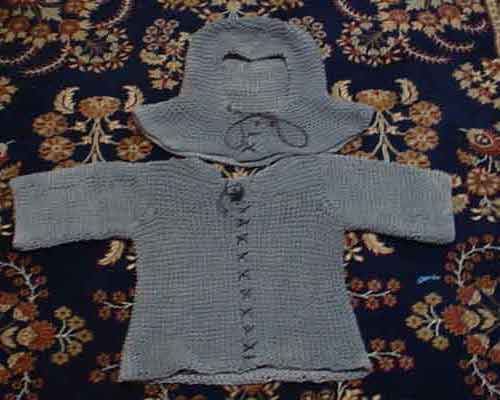
Apologies for the even lousier than normal picture quality. I don’t have access to the photo editing tools I normally use.
This is the knight costume that was featured in the note I wrote that
ended up in the first volume of KnitLit. I made it for Elder
Daughter in 1996, when she was in Kindergarten. The sadness
creeps in because Younger Daughter just wore it for Halloween, and it
was clear that this is the last year that she will be able to do
so. The coif will still figure in fantasy play for or a while,
but the mail shirt is ready for The Box of Knitting That No Longer Fits.
In the mean time, if you want to knit up some play armor for your own miniature warrior, the method description is on wiseNeedle.
 String-Or-Nothing