WHERE AM I?
Sorry guys. No substantive post today. I’m busy lugging my stash back from the storage cubby to install it in the new house. Nothing will get in the way of this reunion. Not blogs, not lunch, not children (well, if they whine enough, I’ll stop to feed them).
Stash count: six Rubbermaid-style storage containers of assorted left-overs and conserved yarns, plus one plastic traveling file bucket full of socks-to-be.
Aside: Through mailing mix-ups, I find myself posessed of one extra copy of this past summer’s Piecework Magazine. If you live somewhere that Piecework isn’t common (say, in another country); and wish to trade a local knitting or needlework magazine for it, please let me know. The local mag needn’t be in English. LATE BREAKING NEWS: The mag has been claimed and will be winging its way to Belgium by the end of the week.
WORKING REPORT – DRAGON’S RETURN
It seems like I can’t please everyone. Either people write and ask to ask why I’m ignoring knitting, or people write to ask if I’m still working on the crocheted dragon panel. I am – and here are my results to date:
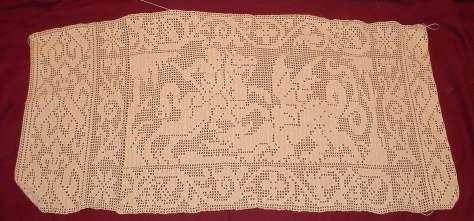
I’m chugging along through the right hand border, still not quite sure how I’m going to manage attaching the top and bottom strip. I have however gotten several notes of encouragement, not the least of which was from my old friend (and crochet expert) Kathryn Goodwyn. I’ll keep plugging along and report what tangled thought processes I encounter along the way.
Ugly Ducks and Eye Candy Avalanche
Other questions have come in about my needlework and my duck confit. A couple of people have asked when I get all of this done. I point out that I’ve got the advantage of being able to dig up stuff I’ve done over many years. You see it all tossed up here now, but much of what I’ve shown isn’t recent production. The red yoke is from the mid-70s. The strip sampler is about 10 years younger than that. The blackwork sampler is from 1983. The putter cover is from the late ’80s. The lobster sweater is three years old now. Eventually I’ll run out of this type of stuff and things to write about it all, but for now I’m still armed and dangerous.
On the duck, we’ve done it several times now. Usually some time in the spring or summer we’ll stumble across a special on fresh ducks. We’ll bring two home and plan our Ugly Duck Dinner. Why Ugly? Because we take the brace of ducks and remove the thighs and legs, leaving ugly, partially hacked carcasses. We heavily salt and pepper the lower extremities and put them in the fridge for a day or two. Meanwhile, we cook the rest of the duck. Depending on the season and what we feel like doing, we either leave the hacked carcasses whole, steam them then roast them tofinish; or we split them, steam them, then barbeque them. The steaming serves two purposes – first, it’s a great way to melt off tons of fat. If you didn’t steam them first, barbequeing would end up as a general invitation for the fire department because all that fat would lead to severe flare-ups and burned meat. Second, it makes the ducks – usually not as tender as chicken – meltingly soft.
Once the fat is steamed off the ducks, we save it for the confit. To do this right, we usually end up using all the fat from the two ducks, plus a bit renderedfrom previous ducks or geese that we’ve stored in clean jars at the back of the fridge. We take the legs and thighs and pat off some of the salt. Then we put a little bit of fat in a cast-iron Dutch oven, and lightly brown them in a single layer, skin side down. After that we completelycover them with the reserved fat, turn down the heat and let them simmer in the barely bubbling fat for about an hour and a half, until they are soft. While they’re still warm, we put the legs and thighs into scalded jars (dried off, off course), then pour in the fat to cover.
The resulting jars of duck and fat then sit in the back of the fridge (or freezer) until mid-winter. Some time in the cold months we get a yen for cassoulet, which is nothing more than a fancy version of beans and hot dogs. In our case it’s small white beans, tasty smoked sausage, and some of our preserved duck. Add friends, a crusty crumb topping, some crunchy bread, and several bottles of wine and I guarantee you’ll find the effort well worth the trouble. This year we’ll be toasting to Julia, without whom we would never have attempted such nonsense, nor have learned how much fun it can all be.
OTHER PROJECTS – MYSTERY OBJECT
Reaching back into time (and into the bottom of a box that surfaced during unpacking yesterday) I come up with my first-ever attempt at both knitting in the round on DPNs, and at stranded colorwork in the round:
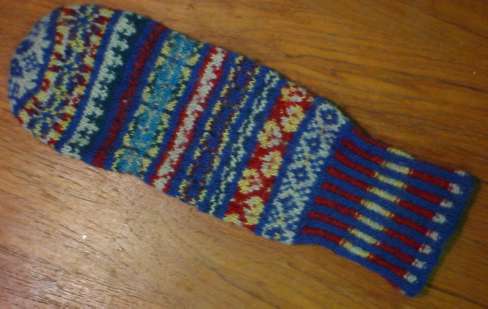
I did ita couple of yearsafter I started knitting, about the same time I began becoming rabid about knitting in general. I used a bunch of Shetland scraps raided from my mother’s stash. Like most samplers I do, I didn’t bother planning or charting anything out before hand, I just did it on the fly, experimenting with technique, color, size of floats, number of DPNs (I tried out everything from 3-6 on this piece), and pattern.
Now. Have you guessed what this thing is? It’s not a mitten or glove. It’s not a sock. It’s not a piece of gentleman’s intimate apparel, either (were it so, the size alone would make it pretty spectacular, athough the itch-factor might be somewhat limiting).
It’s a putter cover I made for The Resident Male. He took up serious golfing around the same time as I picked up serious knitting. No connection between the two pursuits other than this item.
There’s a social history lesson connected with this cover, too. I knit on this mostly at lunch hour at work, and on a couple of business trips because I wanted it to be a surprise gift. My boss at the time saw me knitting away on the thing in the airport, and upon our return to D.C., called me into his office.
He gave me a long lecture on why I should **never** let anyone who knew me in a professional capacity **ever** see me doing needlework. He went on to say that I should **never** wear or display my own products at work, because no one would take me seriously in the world of work if they connected me with domestic pursuits.
To be fair, even though it was the mid ’80s, I was working in a big-time construction/project management firm – in an extremely conservative industry largely devoid of women. But this particular workplace was backwards-thinking in the extreme. To illustrate the mindset there – I once got an employee recognition award given to me in public,with the introduction "And here’s the little lady who put the lie into the statement that you can’t have boobs and brains both."[shudder]
Back to knitting, I can report that I
- blissfully ignored his advice and kept knitting,
- moved on to another employer after it was explained to me that my promotion track as a fem was nil; and
- to this day, proudlywear and display my products everywhere I work.
For those of you born after the Carter administration, the attitude displayed by my former boss was common. Another oft-heard diatribe was that women shouldn’t do needlework, because all forms of needlework were artificesthat restricted women’s sphere of interest and creativity. This attitude was more hurtful, as it largely came from other women. (If you think I’m kidding about this, look into the book The Subversive Stitch by Rozsika Parker.) For a long time this attitude wasin part responsible for the decline in interest in knitting and stitching among younger women.
I am delighted today that things are on the upswing. I can be an aging grrlnerd, and have interests and accomplishments as diverse as fine embroidery, lace knitting, computer gaming,and SCA heavy list fighting, and no one will think the less of me for doing or having done any of them in particular. Now if only I could do something about that "aging" part, as it is having a real drag effect on employability…
EVEN MORE QUESTIONS
Apparently the redbit of stitching I posted yesterday piqued a bit of interest. I received some questions on it:
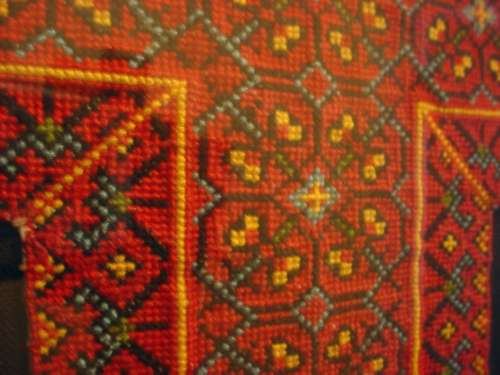
I can’t see the pattern you describe. Can you post a detail shot?
Here’s the best I can do:
Where did you get red muslin?
I didn’t. As you can see in the detail shot, the ground isn’t red. In fact you can’t see the ground fabric at all – the entire piece is completely overstitched in red, black, yellow, green and light blue.
What thread did you use, what stitches, how big is the piece?
Thinking back to ’75 or so when I made this, and hoping I remember it all – I used two strands teased from standard DMC embroidery floss. The entire piece is done in plain old cross stitch, nothing fancy. The muslin was a remnant from the discount table of a neighborhood fabric store, back in the days before big box crafts stores. Iworked mycross stitchover 2×2 threads of my muslin ground. And yes – all the top legs are crossing in the same direction.
The entire thing is about 11 inches wide and 14 inches deep, both measurements taken at its widest points. As far as gauge or stitches per inch, the weave of the muslin wasn’t square, so my cross stitches aren’t square. The flower motifs themselves graph out exactly square, but because of the weave-induced distortion, they end up looking like rectangles. Across the motif (the stretched dimension) it measures out to about16-17 cross stitch units per inch. Up and down the motif (the squished dimension) it measures out to about 21-22 cross stitch units per inch. The imprecision is there because I have the piece mounted in a frame, and it’s tough to hold a ruler close enough to get an accurate count.
The mounting glass is also why this is photographed at an angle. I hoped to bounce the flash so I didn’t get a glare or – like yesterday – a ghost image of me taking the picture reflected by the frame.
What’s the design source for this one? Why is it a funny shape?
I started with a couple of traditional Ukranian counted thread patterns, most notablyan illustration in Mary Gostelow’s Complete International Book of Embroidery, then played with them a bit. What I ended up with was a yoke for a blouse or dress. I did wear this yoke, appliqued onto two garments. The first was a very thick linen peasant-style blouse, smockedjust beneath the panel and finished with gathered and tied cuffs. After that blouse met an untimely soy sauce/bleach-related death, the second was a black straighttunic-type linen top, rather North African in shape. Thankfully the embroidery itself was unharmed by the soy sauce and subsequent attempt to clean it. Another thing – this is the piece that was recognized with the Nellie Custis Lewis prize at the Woodlawn Plantation Needlework exhibition in ’93. That year the special prize was given for garment trim or accessories.
So, what relevance does all this have to knitting anyway?
One thing that gets me fired up is the possibility of cross-pollination among needlecrafts. Why can’t I take a 16th century pattern intended for lacis, counted embroidery or weaving, and use it in filet crochet or knitting? Why do I have to stick to traditional Scandanavian, North Sea island, and Baltic motifs for stranded colorwork? For example, why not mess with this red bit of stitching, adapting its motifs for knitting?
Why for that matter do I have to stick to any one type of needlework? I’ve done that. I’ve made the repro historical pieces.It’s virtuoso work when done to the nth level, but it’s also limiting. I want to do more. What gets me trulyinvolvedis moving away fromstaid verbatimreproductionin one of two directions, either –
- Making an entirely original and new piece, but doing it in such a way that were it transported back in time it would be accepted as yet another contemporary example of its type.
- Taking motifs, designs, or aesthetics from one branch of traditional needle arts and using them either in combo with another form, or for use entirely in another form.
Thisattitude one of the things that makes me a Rogue Laurel in the SCA. Yes, making an exacting reproduction of a meticulously researched and documented artifact is a manifestation of skill (and perseverence) on a high order, but I don’t see it as the ultimate expression of the deepest level of understanding.
Believe it or not, I seethe elusive goal of true mastery of a needlework formas having parallels in martial arts. It’s one thing to learn fencing, Judo, Karate or Aikido exercises perfectly and to perform them with grace and precision when required. It’s another thing to abstract the principles behind the exercises, and be able to summon them up to defend oneself from someone who doesn’t know the otherside of the script. It’s the inner form of these arts, the part that you can recognize at a visceral level, internalize, and use as a point of spontaneousapplicationthat is the goal of practicing the outer form of the techniques.
So from street fighting, I cycle back to stitching and knitting. I have donemany of these other things amd tried out many different needle artsbecause I see deeper parallels among them; because the lessons I learn in onepursuit inform my investigations of others. And bogus pseudo-philosophy aside – mostly I do these things because they make me happy.
Footnotes: SCA = Society for Creative Anachronism. Laurel = SCA’s kindgom-level award for achievement in the arts – one of the highest achievements possible withing the group, and an ardently sought-after goal. Iam honored to have been recognized in the East Kingdom in ’79 for fostering the practice of historically accurate embroidery, in specific – blackwork and related styles. Rogue Laurel = one so honored whose opinions differ from the established consensus, who ends up being in the minority on most arts-related issues, see related entries under "pain in the butt," and "gadfly." I’m mostly retired from active participation in the SCA these days, but I can still be found on occasion at events in Carolingia (greater Boston, Massachusetts area branch).
THE DRAGON’S VALUES
Elissa wrote to me to ask how I could tell what graphed patterns might go together well as I was looking for more borders to eke out the edges of the dragon panel. I am not quite sure I can answer, in part because I’m not quite sure I’ve made successful picks yet. I do a fair bit of this type of composing in the course of stitching up monochrome embroideries. The best way I can discuss this is to show a blackwork sampler I did a while ago:

I stitched this upwhile I was working on my book of embroidery patterns. Some of the patterns on this piece made it into the book, others didn’t. The ones I left out were ones that turned out to be too late in origin for inclusion in the book, or whose documentation and provenanceweren’t complete or accurate as the rest.
You can see several things on this mostly-blackwork piece. First, even though I was working exclusively in double running stitch (aka Spanish Stitch, Holbein Stitch) and cross stitch, there is a tremendous variation in density and the depth of tonal values among the various patterns. There is also variation in the delicacy of line, even comparing the airy double running stitch patterns. The highly geometric bit in a similar style to Jane Seymour’s cuffs (center top) presents a very different look than the curled plume-like leaves in the bottommost left.
Now this piece is far from entirely successful for several reasons, design by accretion being the leading one. Like my dragon curtain it was done "bungee jump" style. I took my ground cloth and just began stitching, picking my patterns one by one as I finished the last. The first bit I did was the sorrel leaf stripin the upper left (looks like clovers). I worked more or less across and then down from there, leaving the center blank until I hit upon something to put there. That happened to be my father’s favorite saying, and a large yale, but I certainly didn’t plan on them being there when I started. (A yaleis a heraldic goat with skewed horns, although someheraldicspecialistswill debate whether this is a goat or a yale.) The last bit to be filled in was the small rectangular area just below the yale, which I patched in with several smaller scale fillings commonly used in inhabited blackwork, finishing up with my sig strip at the center bottom (KBS ’83). I used a couple of these in my blackwork underskirt and Forever Coif, too.
Had I actually sat down and planned the piece, I would have better balanced the placement of light and dark areas, and the apportionment of delicate curved lines with harsher block geometrics would have been more pleasing. Those sorrel leaves for example are way out of place. They’re too light and too leggy sitting as they are on top of the darker knot strip. The large double star motif beneath the yale’s back hoof is also out of place. While it balances nicely with the English acorns on top of "Worth Doing" and the star and fleur de lyse at the center right edge, in combo with the Chinese peonies just above it theheavyvisual densityweighs down thecomposition along the left edge.
All this is a long way to go to answer Elissa’s question. In a piece as small as the dragon curtain, with a limited number of patterns, I wanted to call attention first to the center panel. To that end, I framed it with a strip repeat lighter in value than the average tone of the dragon and knight unit. I tried not to "fight" with the center panel, picking a repeat that was rather delicate in line rather than a heavier one to avoid the the overpowering effect demonstrated on my Anything sampler. However, once that frame was completed and I wanted to add more width, I decided to usestrips of aheavier, more geometric border around the whole piece. With luck, now that the lighter inner area has been established (sort of like matting a painting), the denser second border will serve the same purpose as a dark carved wood frame on a painting – defining the inner space inside the frame and accenting the center, by contrasting with both the mat and the piece’s focus.
ANOTHER HELPING OF FILET OF DRAGON
More progress. Here’s the beginnings of the second border strip on the left:
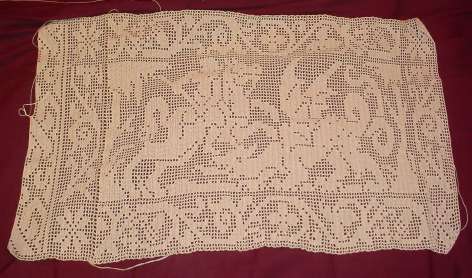
It’s denser and less delicate than the central motif or inner frame. With luck the contrast should work out. What you’re seeing is a bit more than half of theoriginalmotif. Remember that I’m doubling the width, so this works out to a bit more than a quarter of the final as I will be working it. Note the upside down curlique along the edge. When I mirror the strip longitudinally that curlique will be right-side up down the center, and will merge its left and right halves to become a sort of fleur de lys.
Found in Russia
Thank you to Kate from Somerset in the UK and to Lisa (blogdogblog) Young, both who sent me to the Russian website I was searching for (best viewed with your sound off). The English translation is probably machine-generated, but the mitten designs speak for themselves (click on the Knitting link in that site’s left margin).
One thing I remember that’s not there anymore (and I may be conflating two different Russian websites) was a series of traditional counted patterns for cross stitch and pattern darning, done in black and red. While the bulk of this site is a commercial one dedicated to cross stitch, machine and punch-needle embroidery, the site I remember offered these traditional motifs free for the download.
A feature of this site that’s worth visiting though is the recipe section. Click on the "I invite you to dinner" link and be prepared, both for foods enticing (anda fewa bit suspect), and for the trip into a world of amusing translations. While I won’t be making "Pancakes with Liver" any time soon, "Meat in Pots"and Beshbarmak bothlook good. Think puzzle/creative though to decode the translations. For example, "laurel sheet" = bay leaf.
STRAKER PATTERNS, TORONTO STAR
Straker Patterns
Catching up on some blog reading I noticed that Knitting Curmudgeon mentioned cutting her teeth on Penny Straker patterns. Add me to the list! Strakers were what I learned on, too.
They were among the first "yarn independent" patterns published. Even the black and white cover pix went a long way to encouraging knitters to make the things up in their own choice of colors. Like KC, as a new knitter I found the Straker patterns to be great learning aids, because most of them had little fold-down knitting tips and tricks panels on the side. One I especially remember was a how-to on tubular cast-on. I use that technique as described on the Straker panel to this day. That’s not to say the patterns are spelled out completely -instructions like "make left side to correspond to right, reversing shaping" were used, but as a beginner, I found them to beclear and easy to follow.
My first complete sweater was a Straker. I don’t see it in her new on-line catalogthough. It was sort of a collared baseball jacket shape, done entirely in a bumpy raspberry texture (trinity stitch?). My reasoning went that even if my stitches were uneven, no one would notice in that bumpy surface. It worked. I wore my raspberry sweater (knit in a mulberry purple) for years and no one ever noticed it as being a first attempt. After that I went on to make a couple Eye of the Partridge sweaters, a couple of Fair Isle yoke sweaters (there used to be a pullover in addition to this cardigan. (I did the first chart as-is, then created my own chart for the second). Over the years I’ve also done her Shalor Aran, Gretel, Innisfree, but none recently until the Inverness Gansey I did last year.That project was the most fun I’ve had with a commercial sweater pattern in a long, long, time.
If you’ve never tried a Straker, I’d encourage you to take a look at the line. You can still find the older editions lurking in local yarn shops, including patterns that are not in the current line of updated reprints. My only caution on the older editions is that armholes fit far more tightly when these patterns first came out, and the earlier editions only range in size up to about a 12/14. I’m delighted to see the new website, and hope that in addition to rehashed older (but timeless) patterns, we’ll see some new designs as well.
Toronto Star from 1945
In other Web-walking I zipped through Boing-Boing. You never know what will turn up there. I found a link to the Toronto Star’s 1945 edition. The entire year’srun is now full-text searchable: http://www.pagesofthepast.ca/Default.asp.
Being an insomniac by nature, I decided to search on "knitting."
Page loading is very slow, but hits abound. I had hoped to find detailed descriptions of war-related knitting efforts, perhaps even some patterns. Instead I found lots of ads for imitation leather knitting bags and yarn (Angora, 59 cents per ball); classfied employment ads (apparently there were several knitting mills in and around Toronto at this time); and many, many passing mentions of knitting in other articles. The Star also had its own needlework department(!), and many of the ads were for patterns that were available for a fee by mail from the paper’s own offices.
The most frequent mention was of course troop knitting, mostly in a recurring column entitled "Women’s War Work." Every ethnic-membership service club, religious or church/synagoguegroup, civic association, recreational club and school had at least one charitable knitting and sewing circle. Sometimes more. Meeting notices included reports on shipment schedules, places where yarn and/or instruction could be obtained, and kudos to specific chapters or groups that had sent off exceptionally large donations. Women’s obituaries were another leading source of knitting mentions, with many mentioning exceptional skill or prolific generousity even in the face of lingering illnesses or extreme age.
In the news pages, I noticed thatknitting was used as a metaphor for domesticity. I came across mention of a woman elected to office. She was shown knitting as she waited for the election returns (early May?), perhaps to show that she was still a real woman in spite of her political ambitions.Grating in toneto be sure, but itwas 1945. There was also a human interest story on a returning wounded soldier – an unmarried manwho adopted an orphaned baby he rescued. Again to illustrate his commitment to hearth and home, he was shown awkwardly knitting booties for the little guy. (some time in April)
I did find one letter to the editor around April that bemoaned the fact that for all the effort expended by women on the home front covering home and work responsibilities, and doing tremendous volunteer work (especially knitting and sewing for troops and refugees), that very little recognition of that effort was taking place. Looking over the paper as a whole, I’d have to agree. Mentions outside the group reports are rare, and even the Women’s War Work column has a distinctly patronizing tone.
Other mini-articles include reports that the former Vichy Chief of Government, Pierre Laval fled to Spain after the fall of Germany’s occupation of France, and a depressed and broken man was spending his time knitting to quiet his nerves (7/24); the wife Clement Attlee,the newBritish Prime Minister whiling away her time waiting to meet the King by knitting (and worrying about how to run 10 Downing Street)(7/27); andcustoms of a local Hutterite community that forewent use of modern conveniences, citing their women’s quaint custom of knitting socks in any idle moment, using tin pails suspended from the wrist to hold their yarn (8/20).
I have to admit I bottomed out around the end of August and didn’t go any further. So if you’re interested in combing through for more bits, that’s a good place to start. The most interesting mentions are listed as News or Editorial. Local News is mostly reports of group meetings, Life/Fashion/Family mentions are almost always ads for mail order patterns. Business mentions are the goings on at the local knitting mills.
The most touching mention to me? Not the obits or the other reports of group efforts. The many small classified ads for lost knitting were the most immediate to me. Stuff like "Lost near [insert street] paper bag containing knitting, a brown sock half-finished;" "Near [another street] basket with baby’s jumper in white, both fronts done and back on the needles." Were those projects ever found and returned? I wonder.
WORKSPACE
Another quiet day here at String Central. Yesterday we had no power in the house because the electricans were installing the new whole-house panel. Today power is up and down, as they do punchlist things around the place.
Progress proceeds on Filet of Dragon. I’ve started the left hand edge panel, but have not yet decided on the whole-piece frame. There’s not enough yet to make an interesting picture, so I’ll spare you.
Instead I post this:
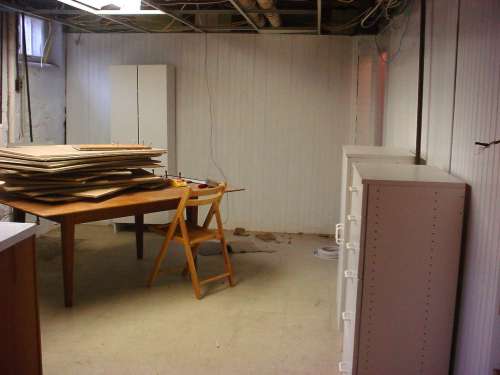
This is the spare room in the basement. It’s a former summer kitchen/laundry room. There’s a plastic?tub sink just to the left of the work table. There’s also a recycled kitchen countertop?with a?shallow dish sink, the corner of which you can see just peeking out on the right. The three white storage cabinets are Home Depot $19.99 specials that (miracle of miracles) managed to survive our move. The table is a legacy from the former occupants. There are two gas lines – one on each wall. Plus some dismal dropped ceiling panels (stacked on the table but shortly to go back up), grungy linoleum flooring, and ancient beadboard paneling, painted sloppy white to cover pea green some time during the Eisenhower administration.
This utopia, this palace, this vast expanse will be my sewing/knitting studio and the family’s laundry room. Eventually. Once we’re done re-wiring, I’ll be able to clean it out. Then I get to relocate my stash of six Rubbermaid storage tubs. Some time when we can afford it we’ll be redoing the room completely, moving the washer/dryer back downstairs from the kitchen (I hate listening to?them upstairs). ETA on the greater rehab plan:? plus or minus 6-8 years from now.Until then, we have to make do with what we’ve got.
I know there are all sorts of great re-do suggestions on HGTV. Ellyn’s studio transformation was incredibly nifty, but way beyond my price range. Plus it seems so wasteful when we’re planning on gutting the entire basement in the future. So my question is – given the space at hand; the three cabinets and the table, plus six Rubbermaid containers; and a budget of as close to $0.00 as possible – ?does anyone have suggestions for making this a useful, creative space?
BEE VEWY, VEWY QUIET…
Some of you asked about my de-beeing. Here’s a photo summary of what happened.
The problem – an active honeybee hive of unknown age, in the walls and floor of a stucco-finish sleeping porch:
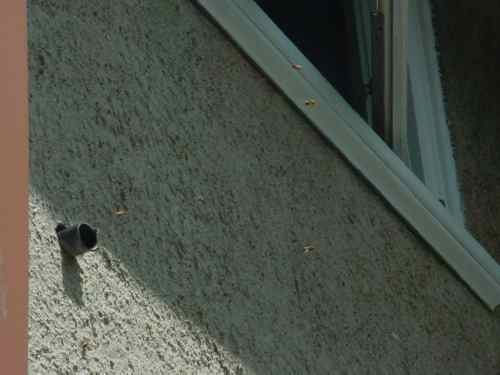
The solution – Jeff from Bee Busters – a company in Acton, MA. Jeff is seen here about to cut a one-foot square hole in the porch floor to get to the hive’s probable location:

It turns out we were lucky in most respects. The hive was relatively new (in a 95-year old house anything is possible). It was mostly in the wall as opposed to being in the floor. While that was unlucky in that it required knocking an additional three foot square hole in the stucco, the hive was easy to remove. Here’s one large piece. The queen is under the scrum of bees at the bottom corner:
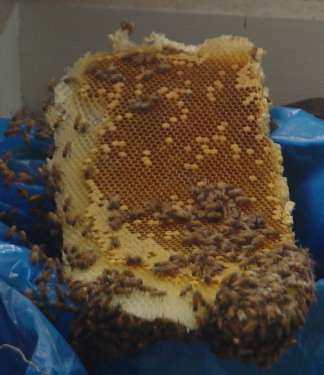
The overwhelming majority of the bees were captured, including the queen. Some of the stragglers?were caught using a bee-vac, a juryrigged crate fitted out with a dust-buster engine and a three-inch wide flexible hose. The hummers are now?off to quarrantine to make sure they harbor no parastites, then after that – to work as productive little droners working away in local orchards and fields.
I’m delighted that no giant comb system existed. If it had, we’d have to go through a ton more demolition and restoration to get at the hive. The down side of it being a young colony is that I didn’t end up with honey. Honeycombs are two-sided. If a comb has honey stored on both sides it can be harvested for extraction. These combs had bee larvae on one side and honey on the other, typical for newer hives but not suitable for people-use.
The gaping holes in my porch now sit open for several days to dry out. A few foragers out shopping when the hive was removed remain, but Bee Jeff assures me that they’ll load up with pollen and follow another bee home to a new hive. He said that if they arrive "with groceries" they’ll be accpeted by their new foster family.
All in all the experience was interesting, highly educational, but expensive. Now of course we have to repair those gaping holes…
FO – FULLED PILLOW
As I noted before, life around here is about to get REALLY interesting. I can’t guarantee that I’ll be able to post much over the next two weeks. Complications have arisen in the house rehab/move cycle and in our family schedule. We have to take down our main machines tonight or tomorrow, so I’ll be relying on an unreliable laptop for the near future. Plus once we head over to the new house it’s not entirely clear that we’ll have electricity and/or connectivity right away; and once we do there’s the minor problem of getting everything hooked back up again. Although things seem to be taking forever, progress is being made on many fronts. I hope…
In the mean time, I’ll report on some TANGIBLE knitting progress:
Fulled Pillow
It’s done!? All shrunken, stuffed, and sewn. I had put it on temporary hold until I could retrieve the pillow form I knew was lurking in the storage cubby (it’s the one that used to stuff The Smallest One’s crib pillow, the target child for this effort). Form retrieved, pillow done. I’m even pleased with the from-memory color match to her comforter and sheets.
Taaa daah:
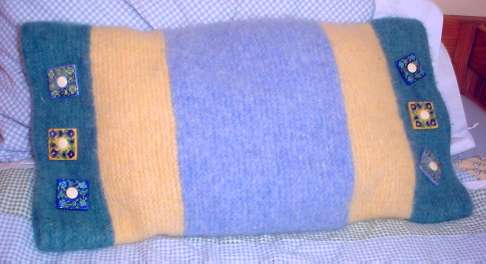
It’s not much, but there’s not much time to work on anything, so please bear with me.
Where are the reports on the other projects?? I decided to use the deadman switch option. I’ve broken them up into a couple of separate entries, and posted them with future dates. That way something will appear in this space over the next week or so. If I get lucky and can regain control of the helm here at String Central ahead of the date I anticipate I’ll?intercept and rewrite?those forward-stored posts. In the mean time at least this space won’t become a total dead zone until mid-July.
 String-Or-Nothing
