CHEST OF KNITTING HORRORSTM – TATANIA
I mentioned my experience with this project before. Tatania is a pattern by Berroco, written for now discontinued SensuWool. Berroco probably won’t like to hear this, but I used a different yarn – the confusingly named King Australian Merinos/Rosina Stampata. That was the yarn with the ambiguous label I wrote about in March.
Tatania has had two visits in the Chest of Knitting HorrorsTM. The first happened while I was knitting. The Berroco pattern has a glaring error in it. The piece has a neckline of unusual shape, although it’s hard to see here:
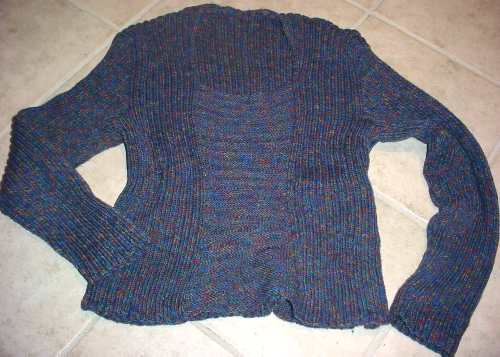
It’s sort of a squared off reverse Vee. It’s a neckline found in late Renaissance gowns, and one that looks quite good on me, so I bit and made the thing. But if you read through the pattern, you’ll discover that the directions say to DECREASE during neckline shaping. That leaves too few stitches on the needles to make the shoulder join, and inverts the shaping of the neckline. Here’san excerpt fromletter I wrote about it to Berroco:
Dear Berroco,
Thank you for making your website so complete, informative, entertaining
and easy to use. I especially like the way you have associated your
patterns and yarns.I am in the middle of working up your Tatania pattern. I am
enjoying it immensely and am looking forward to wearing the final product.
I did however find what I believe to be a rather serious typo in the
version available at this URL:http://www.berroco.com/188/188_tatania.html
The problem is in the front, at the point just after the bodice stitches
are bound off across the front of the squared neckline, as you are
beginning to work the sides of the neck opening.Here is the problem statement:
DEC ROW (RS): Work in ribbing to 2 sts before marker (dec 1, k2,
p3). Working in ribbing as established, dec 1 st before marker every 4th
row 4 times, then every other row 8 times…I did this, and ended up with far too few stitches to mate the front and
back shoulders properly. Plus, the piece I ended up with reversed the
angles of shaping for the neckline – with the two shoulder parts sloping
outwards instead of inwards.When I did the computation of stitch count by gauge it became obvious that
I should have INCREASED instead of DECREASING each time "dec" is specified
in the pattern.I am now proceeding to finish my Tatania, using increases in place of the
decreases in the pattern.I thought you might like to know about this problem so you can correct your
on-line pattern. The design is striking and it shows off the yarn to good
effect. It would be a shame for knitters to get so far into the thing only
to face frustration. I am sure you would not want that frustration to attach
itself to your sterling reputation.
I’m afraid I never heard back from Berroco, and the pattern is still uncorrected on their website. (I’ve since learned that the hard copy edition in Book #188 – Holiday also sports the same error.)
As you can see, I did muddle on through and produce the final piece. As expected, the welted center panel does draw up a bit in the center. That’s probably why the model was posed with her hands covering that spot. Even so, it’s a striking, form-fitting and very flattering piece.
O.K. So why did it go back to the Chest of Knitting HorrorsTM?
The yarnI used isjunk.The color is beautiful – a combo of deep blue with a ragg-type strand of brights twisted in. It’s wear-against-the skin soft and luxurious. But since knitting it has begun disintegrating. Without provocation (no moths, no mold, no laundry stress, no rough handling, no careless storage, and after only two wearings), spots here and there have broken. I’ve got a half-dozen safety pins in the piece right now, holding stitches to prevent them from laddering down. I need to find my leftovers and do some aggressive duplicate-stitch style darning, in effect Kitchener grafting the broken bits together. I’m especially annoyed because I had no clue this would happen as I was knitting. Grrrr.
More on Yarn Names
In response to yesterday’s rant about yarn names I got one note that pointed out something I didn’t know. It was from someone who works for a yarn manufacturer. That person pointed out that there are very few ways for a committee thinking up yarn names to check to be sure that the name they pick hasn’t been used recently. One way is to look in the index of Valuable Knitting Information, a twice-yearly spiral bound volume listing yarns going back abouta decade or so (the recent 40th edition goes back all 20 years). VKI although large does not list all yarn manufacturers, and does not associate yarns with any sort of date, so it’s tough to see how old an entry might be unless one checks through back issues to spot when it appears.
Another way they’ve been using lately is to look up the name on wiseNeedle. Although our list is smaller and dates aren’t precise, they do exist and can give a clue as to whether or not the name under investigation might still be on the shelves. Interesting! This is a use for wiseNeedle I didn’t consider. The note went on to say that the maker the author works for does check the yarn reviews for their products and greatly appreciates both positiveAND negative comments.
YOUR FRIENDLY KNITTED-UP SPIDERMAN
Somewhere out in the dark of nightlurks Mark Newport; a fiber artist with time, imagination, and a fullattic of vintage comic books.
Mr. Newportknits head-to-toe superhero suits. You canpurchase his one-of-a-kindSpiderman; Mid ’60s Batman; Daredevil (with nifty ribbed hood) or Mr. Fantasticoutfits. If he selected a nice, springy wool,he’s probably figured out what I never could as a kid – howReed Richards wasable to stretch his arm to ten feet long butneverburst out of his suit. (Later when I got older I thought of the implications of being his wife Sue Storm, but that’s another speculation left over from a more innocent time.) My embroiderer and comic-collector selves also really appreciate the oddity ofMr. Newport’s embroidery on papercomic book samplers, too.
Mr. Newport’s work is being gathered into an upcoming exhibit at the Greg Kucera Gallery in Seattle, Washington. Be warned however – he overembroiders or embellishes many types of printed matter in addition to comic pages, including what in a more genteel era would have been called "French Postcards." The gallery’s site does explore those materials as well.
Yarn Reviews at wiseNeedle
Thank you, thank you, thank you!
Since yesterday 24 new reviews have been logged in. That’sthe most reviews received in one day since early ’95, when the collection was just starting out! Knitters everywhere will be extremely grateful as they find your comments on all those yarns. I’m particularly impressed with the blog community, and the way that it’s rallied behind this project. I feel like I’m back in ’94,part ofa happy band of knitting zealotsspreading their shared banner throughthe electronic ether. Thanks also to the folk from the KnitList who slogged on over to the site to add their experiences to the pile. I also really appreciate all the people who took time to say they’d miss the yarn review collection if it disappeared.
I’ve still not decided what to do to make the collection self-supporting, but I did get a couple of good ideas to chase down, both left as comments on yesterday’s page and mailed to me directly. I notice that other people don’t have the ethical/editorial independence problem I see with accepting ads from yarn makers or retailers. One person wrote to suggest that I offer a "buy me" sidebar, with a list of vendors appearing whenever a review is pulled up. The logistics on that might not be feasible, especially considering that many individual yarns have the half-life of a mayfly, and the indexing would have to be done by manufacturer’s line rather than individual offering. Plus, I’m afraid that if I become dependent on money from industry sources, the collection will become less impartial as people become hesitant to criticize the same stuff they see advertised. Also I might be swayed (even unconsciously) to favor advertisers over non-advertisers. Perhaps I’m too much a stickler here. More thought is needed.
Another intriguingidea was to see if sellers of knitting inventory software might be interested in licensing the database. Another was to sell bags or tee-shirts with knitting-related stuff on them. If anyone has had experience with Cafe Press or similar collateral services, could I beg a little guidance? (You can send me an eMail off-blog at using the "contact" link at the right.)I also got a suggestionto add a line of for-pay patterns to the free ones already there. I’m not convinced though that anyone would pay for these as the more complex ones are working descriptions rather than stitch-exact direction sets; and the less complex ones are so intuitive that I can’t believe people would plunk down a fee for them. Then again, there are people selling other simple patterns on the web and on eBay at surprisingly large prices…
Buttons?
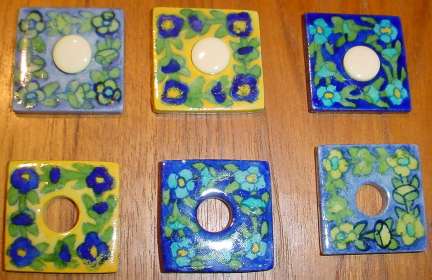
Some people asked for a closer view of the ceramicbuttons I’ll be using on the fulled pillow. Here they are, both with and without the little yellowplastic onesI’ll be using to hold them on.
DIPPED IN CHOCOLATE
Monday the kids asked me what I wanted for my birthday. Igave the standard Mom reply: "Good children."
Then the little one piped up "…dipped in chocolate."
Sothis eveningthe big one gave me my present:

Too cute.
REQUEST FOR SUPPORT
As most of you know,I’m the person responsible for wiseNeedleand its on-line yarn review collection. That collection is now nine years old. It began in 1995 as a round-robin text file I collected then circulated among members of the old KnitList mailing list (back in its pre-Yahoo days).The databasehas grown to fully searchable index of basic info on more than 4,800 different yarns, and contains around 2,000 reviews detailing more than 1,300 products (many yarns have more than one review).

I provide the forum, knitters world-wide write in to report their experiences on real knitting projects. No yarn maker or distributer subsidizes the site in any way, nor is it backed by any magazine, publisher or yarn retailer. It’s a 100% volunteer consumer-to-consumer info sharing effort in the best tradition of the early Internet.
It’s been fun, but now I am wondering if this all-volunteer effort has outlived its usefulness. There are now other commercial forums that provide yarn reviews. While foot traffic through the site has remained more or less on the same level, the number of reviews being submitted is way, way down. Plus the majority of the visitors are now coming for free patterns rather than to the yarn review collection. People just don’t seem to be interested in providing info, although there still seems to be limited interest in obtaining it.
So, I’m in a quandry. Do I continue to shell out to support the tenth year of an effort that isn’t earning hearts and minds in the greater community? Do I pull the plug? Do I muddlethrough for another year or sohoping that the idea will someday catch on?
Or do mutatewiseNeedle in some way so that it becomes self-supporting? If the last option is pursued, what can be done? Charging for membership? Accepting paid advertising from the yarn industry? Selling patterns or collateral material? Flogging the whole site to an interested buyer, providing some entity could be found?
Ideas and suggestions are greatly appreciated.
WORKING REPORT – ENTRE DEUX LACS TEE
A retrograde forwards-and-back type progress continues to be made on my tee. I’ve decided that I want to use a series of vertical strips, joined with something other than entrelac (more experimentation needed). I’ll bury increases and decreases in the join areas to give the garment a bit more shape. Here’s how I envision placement of the strips. Don’t worry. I’ll fill in the missing parts, like the bulk of the arms and add some kind of neck and bottom edge treatment. Possibly I-cord, possibly ribbing, depending on how I feel.

And here’s the first completed strip:

To answer the people who have written to ask why I’m not doing a knit-along or other shared project, I’d have to say I’ve always been a lone wolf knitter. Sometimes I do things inspired by others, but very rarely do I jump in when everyone else is doing them. There was a good five year lag time between the time I read the first Dale Lillehammer feeding frenzy on line, and the time I decided to knit one. I can’t say why this is. Perhaps there are always more things I want to try than I have time to try them so new ideas need to get in queue before they’re addressed.
Today is my birthday. Or rather it’s the day on which I celebrate the anniversary of my 21st birthday. I have no plans in particular, other than taking advantage of the day off to get as much as possible done in preparation for our upcoming move. We’re also suffering birthday cake exhaustion in the house, as both of my kids had birthdays last week. But if you’re itching to pony up good wishes, I would ask you to share that good will with the rest of the on-lineknitting world instead of with me.Consider adding a yarn reviewto the yarn review collection at wiseNeedle. The easiest way to do this is to look up your yarn by name on the search page, then click on the "review this yarn" link.
And for the few of you who may not have heard about this yet (and in honor of the US holiday of Memorial Day), I point out that the Red Cross is currently selling commemorative WWII knitting kits. This offering is paired with an on-line museum exhibit, and a historical article. Their assistance toservice people. and for civilians caught in both man-made and natural disasters deservesrecognition and support.
JUSTICE (AND KNITTING) FOR ALL (ALSO WORKING REPORT-LACY SCARF)
Yesterday’s visit to the halls of jurisprudence was at the same time, quite dull and quite interesting. Although I was not among the impaneled and got to leave early, watching the process up-close-and-personal was enlightening. I metthree other knitters among those waiting in the jury pool, and got lots of edging done in the hours I sat there:

Two of the people I chatted with were quite nice. Both were women who had knit years ago and who were thinking of getting back into it after reading that the hobby has grown in popularity. Both mentioned "fancy scarf yarn," so I’m guessing that the scarf craze hasn’t exhausted the pool of late adopters yet.
The third was a pain, a pest, an annoyance, and I spent part of the morning trying to dodge her. The problem was that she insisted that what I was doing couldn’t be knitting. It was crochet because it was white, lacy looking, had holes, and wasn’t being worked on long needles with buttons at the ends (I was using two DPNs). After all, everyone knows there’s no such thing as knitted lace.
She wandered over and gushed a bit. I kept working, giving short but (mostly) patient answers. "Gorgeous crochet!"
"Thank you. It’s knitting, not crochet."
"It can’t be. It’s crochet. I can tell."
"Sorry. As you can see, I’m knitting."
"Thats not knitting. I know knitting and you aren’t doing that.
You’re making holes. You NEVER make holes in knitting.
It’s wrong. This is crochet. Don’t tell me what I know."
This went on and on, all in a voice that the entire room could hear. I excused myself, picked up and resettled in another waiting room. After a little while my tormenter followed, commencing whereshe left off. I moved again. She followed. I was ever so grateful when they announced the lunch break. I watched to make sure she left the building, then popped down to the cafeteria for a stale tuna sandwich and a half-hour of relative quiet.
On the edging, I’m about 85% sure that I won’t run out of yarn. I’m also not entirely pleased with the two corners. I did try to miter them, but wasn’t able to manage it in the face of constant interruption. They are more or less symmetrical in stitch count and pattern iteration, but they look clunky to me. I’m also not entirely sure that this project will be successful enough to make it to the write-me-up-for-wiseNeedle stage, or to deserve a name other than its current generic descriptor. So it goes.

If any lace mavens out there can offer up advice (or sympathy for ripping back), I’ll listen with eyes wide.
ABSENT, BUT WITH LEAVE
Today’s entry will be rather short, and posted in advance. I’m off to jury duty, to assist in the dispensation of justice here in the Commonwealth of Massachusetts, USA.
Heaven help Massachusetts.
If you see a tall gal with glasses knitting on a lacy white scarf in the Cambridge courthouse, or at the Cambridgeside Galleria Mall around lunch time, stop by and say hello.
Department of Goofing Off
I was out Web-walking and stumbled arcoss these little frighteners:
 |
 |
 |
Don’t worry. They’re not recent projects – they’relittle knit "pets" from a set of promotional eCards put out by GGH. You can send these or one of theirseven siblings with your own message. If you live in Germany (or have a cooperative penpal) you canbuy a packet of paper postcards showing the entire set.
Back tomorrow with more tangled knitting thoughts. Unless of course the Commonwealth intervenes.
CHARTING SOFTWARE – GRAPHIC BUT NOT VIOLENT
Some people have sent in questions about how I am charting up the patterns I intend to use in the lacy scarf. In specific, they wanted to know if I am using one of the commercially available dedicated charting program.
I’ve tried demos for almost all of them. Alsoabout four years agoI broke down and bought Garment Styler Goldand Stitch Painter. I was sorely dissapointed in the usability of themodules and the quality of support available for both of those programs. Fewer than half of GS’s features worked and repeated requests for help were answered by "Sorry. It’s your machine and not our problem," in spite of the fact that I was able to replicate the failures on five more machines running an assortment of video cards and operating system versions. On top of that, Stitch Painter was primitive at best, and interfaced very poorly with the GS main program. Both may have gotten better since then, but I didn’t want to throw good money after bad.
Since2002 I’ve beenusing Sweater Wizardfor garment design assistancewith no problems. I didn’t get the companion Stitch and Motif Maker program.AlthoughI was a beta tester for the new version of SMM, andfound theprogramto beextremely handy,it’s not a major improvement over what I’m using now.What I really want is acombo program that truly integrates both garment design and motif design, producing shaped charts based on actual garment dimensions, or can superimpose garment outlines on a larger charted piece (like in Rowan and Jaeger magazines).
I’ve also fooled around with AranPaint. It’s a shareware program that produces custom graphs of texture patterns. The registered user version is the same as the demo, but restores the ability to print. AP does a nice job of charting simple cable and twisted-stitch texture pattern repeats. It’s able to produce a visual mock-up of what the design will look like, a chart with (more or less) standard symbols, and a prose printout of the directions. It’s biggest limitation is the small number of different symbols/stitches it can represent. AP can display/chartK, P, bobble, and 2 to 6 stitch cable crossings, not including most of the more eccentric ones (biggest lack – no YO). It also has a space limitation on the area. 50×50 stitches isbig enough for most people, but not big enough for many of the things I do. If an update of this one ever comes out and it includes more stitches, I’ll cheerfully pay for an upgrade.
My interim motif/stitch solution is to use Microsoft Visio Professionalas a stand-alone charting program. I regularly useit in my real-world work – answering Requests for Proposal (RFPs) for engineering and telecom companies.Visio isnot cheap. I certainly wouldn’t recommend anyone run out and buy a $400+ pro-grade drafting program just for graphing up knits when Stitch and Motif Maker can be had for less than a quarter of that. ButI couldn’t justify spending more on aboutique program (no matter how good) when the big boy could be tweaked to serve the same purpose.
I’ve concocted a series of stencils that contain all of the symbols I use, plus line and stitch numbers and 10×10 and 5×5 master grids. Each symbol is a small graphic unit, and all are predicated on little squares. I assemble my graphs square by square, building them like a little kid builds a wall of alphabet blocks by dragging over the symbols I need. Here’s a screen shot:

I used this to make all my graphs, including the extremely large one that accompanies the Raiisa lacy T on wiseNeedle. The screen shot shows just the basic knitting symbol shapes on the first stencil. Additional shapes are available on the cables and increases/decreases stencils (seen at the bottom of the green column). I built each shape myself, using plain oldsquares and rectanglesand the standard Arial font. While I haven’t incorporated any rules-based properties formy stitch shapesyet, each one does have a pop-up help window that gives a how-to for that particular stitch for both right-side and wrong-side implementation.
I can create more symbols as I please, adding them to the stencils if necessary. For example, if I’m charting colorwork, I’ll create a contrast color block for each color I intend on using, then store them on a separate stencil to re-use as needed. I even use stencils to store commonly used motifs, like the quaternary star that shows up as snowflake in so many Scandinavian patterns:
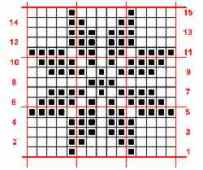
Symbols can be grouped, rotated, mirrored or arranged in layers.There are limitations:
- I can’t select all the squares of one color and change them to another unless I’ve placedor senteach color on its own drawing layer (think stacked transparencies, each bearing just one color of the design). If I’ve sorted my motifs this way into layers, I can flood-fill all of the boxes on one layer with the same new color.
- The *.jpgs produced by Visio are very large. I need to run them through something like Macromedia Fireworks to reduce resolution and size so that they’re not unwieldy for Web placement. The star above was 552 KB, which I slimmed down to 12 kb using Fireworks.
- There’s no "flood fill" with a chosen symbol. I can’t draw just the foreground, then flood the background with purls unless I create an all-purl layer and superimpose a layer bearing my motif upon it.
There’s no particular reason why any other drafting/drawing program with a stamp or stencil feature and layers can’t be tweaked this way. One final warning – Visio drawings and stencils in their native format are difficult to export to other drawing/drafting programs. They can be viewed by anyone using the free Visio viewer provided by Microsoft. Visio can export to many formats, including *.jpg, *.gif and several specific to various commonly used CADD platforms. But those are one-way solutions that send over images of the final product, not components that can be further manipulated. I work inside Visio, then export to *.jpgor print via Acrobat if I need to post a graph on the Web.
I’ve offered up my stencils before, but so far no one has been interested. I’ve got templates for Visio 5 and Visio 2000. The 2000 set should also work in Visio 2003. If sufficient demand is seen, I’ll postboth setson wiseNeedle in the tools section.
Math! Knitting! Math!
Here’s an article that rises above the usual run of cutesy "ain’t your gramma’s knittin’" drivel:
http://news.scotsman.com/scitech.cfm?id=627352003
It’s wildly immodest to quote oneself, but it’s an "I told you so" moment. I posted this to the KnitList back around ’95: "Knitting is at its fundamentals, a binary code featuring top-down design, standardized submodules, and recursive logic that relies on ratios, mathematical principles, and an intuitive grasp of three-dimensional geometry."
So all knitters should hold their heads high. Even the most math-anxious among usare using neurons that have atrophied among the population as a whole.
TOO CUTE
O.k. I don’t do ‘cute,’ and as a rule I refrain from domestic blather. But this weekend past was Mothers’ Day and I believe that gives me license.
My Kindergartner gave me a hand-drawn Mom Book as a present. In it I discovered this page:

What I really liked was the self-portrait in the rainbow sweater (extra big, just so you know the relative importance of the individuals involved); and the knitting needles heldlike picadors’ lances by the drab mom (implied threat negated by big smile). Yarn though is curiously absent, so my guess is that process is less important than product to the average self-absorbed 5-year old. Especially when she or he is to betherecipient of a custom-made present.
Good thing I’d just finished her poncho or the book would have ended with the page captioned "My mom is old." That one I leave to your imagination.
 String-Or-Nothing