INVASION CONTINUES
This is going to be a STRANGE sampler, to be sure!

(I do have to pick out and redo the mother ship and invaders on the right side, they’re one unit too far from the center block). Not sure what goes underneath the phoenix. Probably something in brick or chocolate cross stitch to maintain balance, then on to fill up the rest of the cloth with various double running patterns. Maybe some more heraldic/mythical beasties in the corners… We’ll see.
MAN THE BATTLEMENTS!
Invaders!
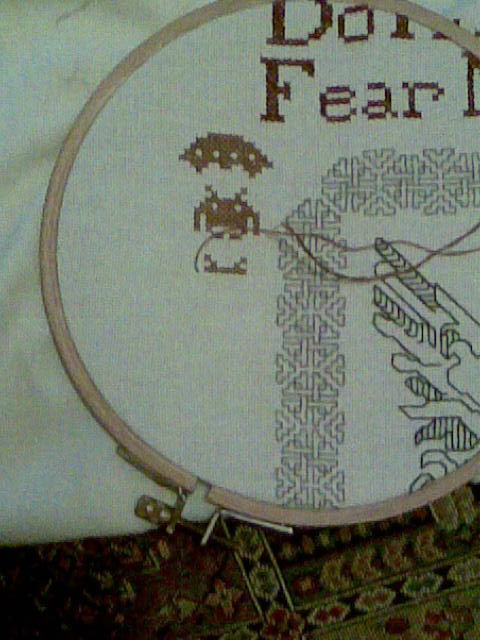
I never claimed this was going to be a period piece, or a compendium of solely historical stitching. And what better thing to give a gamrchx than something ornamented with sprites?
In other news, the best season of all is creeping up on New England. The tops of the sugar maples are beginning to go red; the air is crisp and clear; kids are headed back to school; and lobster is reasonably priced. What’s not to like?
DO RIGHT (BUT NOT OF THE MOUNTIES)
Not much to report here on the knitting end, but I have been stitching. The Do Right sampler for Eldest Daughter continues to grow:
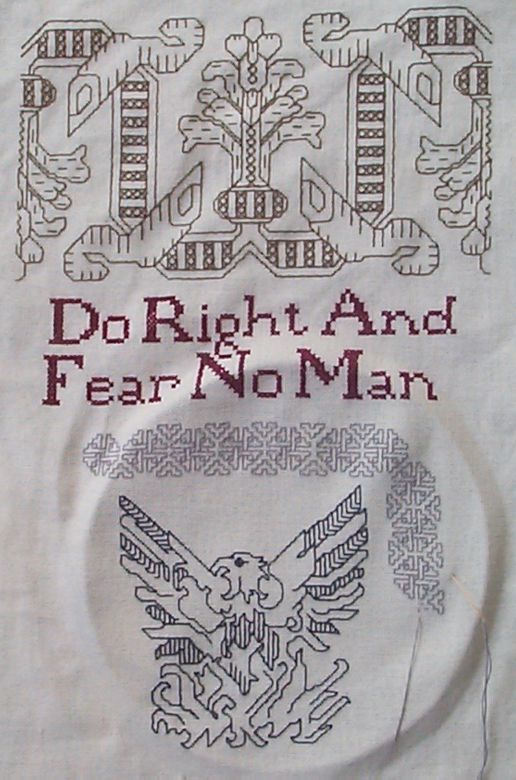
In answer to a question, I’m probably going to use the two stitch styles shown (cross stitch and Spanish Stitch – aka double running, Holbein stitch) and possibly long-armed cross stitch. The jury is still out on the latter because it’s dense and heavy compared to these lighter styles, and I don’t want to overwhelm the piece with it. No, this isn’t all that will be, there’s ample blank cloth surrounding this center part that I am going to defile with additional stitching.
The large green ribbon motif and the gray frame around the phoenix can both be found in my book The New Carolingian Modelbook. The ribbon is shown in plate 63:2, adapted from an early Spanish sampler; and the frame is adapted from the strip motif in plate 52:3 (it’s original, but inspired by historical motifs). The phoenix is new. I drew it up this week past just for this project. If there’s interest, I can post it here, along with another Visio stencil optimized for the production of line unit patterns.
Do Right and Fear No Man
Knitpals please bear with me, I’m taking an excursion into counted embroidery.
As reported here before, Eldest Daughter has gone off to college. Nagging has gotten considerably harder to do, being parceled out via eMail and texting, so I decided to invest all that correctional energy in a more tangible reminder. I’m doing a stitched piece for her wall. I’m still wrestling with this camera, but you can see the beginnings here:

I’m working on 32 count linen, using discontinued DMC Flower Thread (I’ve got a stitching stash, too). The mark of the tambour frame is very evident, although I took it off so you could see the words. The astute may note that the alphabets used for the first and second lines are slightly different, with the top line being compressed by one unit. That and the non-standard, non-lockstep alignment of the words (including the g encroaching on the N) were done on purpose, to give the thing a less rigid look.
This piece will be multicolor, but in subdued ashen hues, and aside from the motto, mostly in linear stitching like double running. If you’ve got a copy of my book The New Carolingian Modelbook, you may recognize the snippet above “Right” as being from Plate 63:2, a meandering repeat I charted from a late 16th/early 17th century Spanish sampler photographed in Drysdale’s Art of Blackwork Embroidery.
I’m not sure what I will do to fill the cloth. This like so many other of my embroidery pieces is going to grow through accretion rather than planning, but I will not be constraining myself to historical motifs only. Expect some surprises as I find them.
What will target Elder Daughter think of all this? Probably that she’s being nagged in front of the whole Internet…
MORE SUBVERSIVE STITCHERY FROM THE ’70s
As I mentioned a couple of days ago, I’ve stumbled across a box of unfinished stitching, packed away in a prior move and long unseen.
This piece I can date pretty accurately. I was working on it just before I joined the SCA, in January-February 1975. The counted thread patterns are from a mix of historical sources, mostly pix of antique band samplers, and illustrations in embroidery books. The composition was (of course) my own. The bottom panel was going to sport an Adam holding the apple, and an Eve rolling her eyes. They were going to be surrounded by an assortment of standard fauna and flora. I had just started the snake on the tree when I put my needle down. The brown thread for the tree’s trunk is coiled on top of the snake in the center.

My color choices on “Eve Was Framed” weren’t very good. I was working from a student’s stash of small quantities of floss, and never actually sat down and planned layout or color coordination. “Clashing haphazard” however was a common color set of the time. The faux linen butler’s tray cloth I was using as a ground was even weave, but rather coarse, about 24 threads per inch (12 stitches per inch). I stopped working on it when I realized that although many of the patterns had precedents, the work as a whole was a sad mish-mash. I wanted to spend my time doing more historically accurate pieces. So I shelved my subversive sentiment, rather than finishing it to hang on my dorm wall.
I will say that many of these styles and patterns are better known today than they were when I was doing this piece. You can buy pattern leaflets, design books and even full commercial kits today to make reproductions of historical band samplers, and patterns from period pieces have informed the work of many contemporary stitching designers. But back in ’75 there were very few people doing this type of stitching. And certainly even fewer using it to make trite political statements.
NEEDING A JUMP START
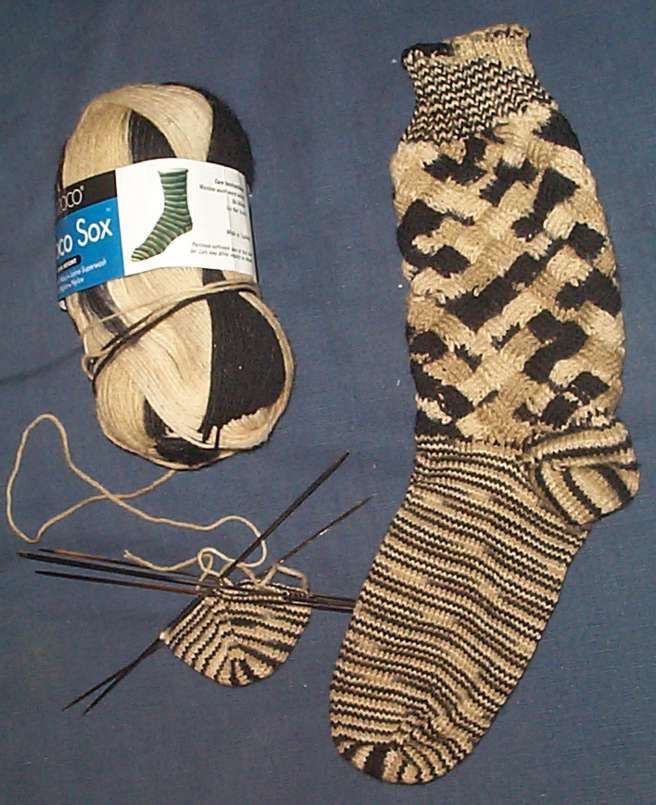
Another week of low inspiration here. I’m half way through the brown/tan/ecru entrelac socks. They’re working up nicely, but as I mentioned last week, the yarn has had lots of knots in it, one or two interrupting the color progression, but most clearly knotted before the stuff was dyed. I’m not pleased and will consider greatly before buying Berroco Sock again, even though I like its other properties that are so similar to more expensive European label sock yarns.
I’ve also picked up my olive tablecloth again. Rounds are still interminable, and nothing much interesting has happened since I put it aside last year. I’m still in the spiderweb section, with at least eight more rows of that two-row pattern before I have enough width to consider moving on to the final design element. I share my last olive picture again. The piece now looks the same, except the spiderweb around the outer edge is now about twice as deep.
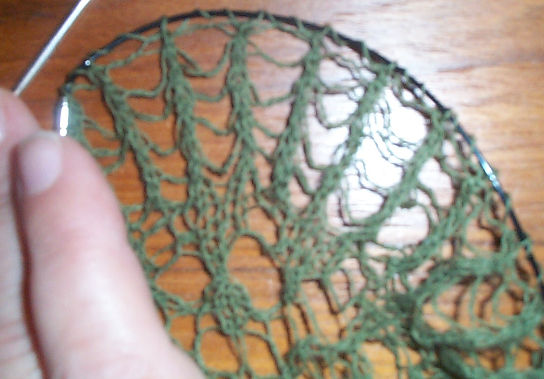
And finally, in yet another traditional blurry String picture, I show off a partially completed embroidery. This one is a true sampler – a piece that exits only to try out random counted patterns. I had no particular goal in stitching it, it wasn’t intended to be displayed and remained a work in progress. The super long repeat in maroon shown separately is one of the design candidates for my curtain project mentioned here before. That work is still in the larval planning stages, mostly pending finding an affordable close to even weave linen or linen look alike.


Gauge on this sampler is approximately 15 stitches per inch on 30 count linen, in DMC Danish Flower Thread. Stitches used are cross stitch (green at top left), double running (grapes down center of piece and the two-tone framed flowers bit), and long-armed cross stitch (the extra long repeat). At this gauge the red repeat is just under 3.25 inches wide. To make my curtains less of an aeons project and to achieve the heft I want for my curtains, I’m looking for a plain weave even weave of about 12-15 threads per inch. That would make my stitched ribbon about six inches wide. Considering that I would need four panels to cover my windows, each 71 inches long x 35 inches wide, the six inch strip width would be in proportion to the rest of the project. But I haven’t found the linen yet, and certainly haven’t had the time to start, so my embroidered curtains remain a mental exercise for now.

Graphs for all of the patterns on this piece except for the small bans of field filling squaring out the area immediately to the left of the frame flowers can be found in The New Carolingian Modelbook. DMC DFT is now discontinued, which is one of the reasons why my play sampler ended up in my Chest of Knitting Horrors(tm).
ONCE A SMART ASS, ALWAYS A SMART ASS
More nostalgia. I was digging through an old trunk the other day and I came upon a stack of my old embroideries, mostly unfinished. The majority of my finished work got given away as gifts. The completed pieces I still have I’ve posted here on String already, so this stash is in fact my “Chest of Embroidery Horrors,” a precursor to my “Chest of Knitting Horrors.” The first item in my stack was this odd little object, about 4 inches wide by 7 inches tall.
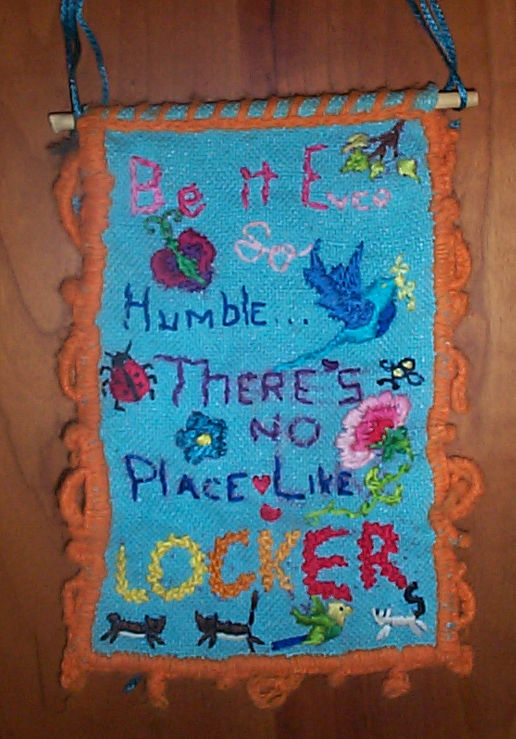
I doodled it up one weekend while I was in 7th grade (age 12 or so), obviously to hang in my middle school locker, picots and all. There was quite a fad for locker interior decorating among the other girls at Teaneck, NJ’s Benjamin Franklin JHS at the time. They did up elaborate confections of varying degrees of utility using contact paper, ruffles, shelf liner, sweet little color-coordinated pouches and shelves, magnetic mirrors, beads, decorative buttons and the like, trying to out-cheery or out-trendy each other. Many did whole themes in the school’s colors, or paeans to favorite bands or actors. Others copied design tips from hot teen magazines. I suppose it’s not shock to see that this same generation grew up to worship at the shrine of Martha Stewart.
I stitched my sad little sampler partly for fun, and partly to poke fun at the overly elaborate, overly girly, just plain over done lockers of my peers. I don’t remember if the other girls thought much of my embroidered commentary, but I do remember a couple of teachers coming by and asking to see the thing, then convulsing with laughter. And seeing it each day jump-started my mornings with much-needed sarcasm. Subversive stitching in 1968 from a sardonic pre-teen.
As to the various animals and plants on the sampler, there’s no deeper symbolism behind them, except for the cats and the budgie at the bottom. When I was a kid we had a couple of cats. The white one with the black tail was named Pixie. The Manx was Cola, from his rain-soaked tabby color and the Spanish for “tail” – an attribute he lacked. The other tabby and the bird belonged to friends. It happens that my severe allergies disappeared when I went off to college, away from home and the cats. I still miss their antics, but I’ll never live with a cat again. Breathing is much more fun.
I’ll post pix of some of the other pieces. At least one of them also qualifies for the subversive label.
NOT-SO-ANTIQUE SAMPLER
I was rooting around in some boxes last weekend as I searched for left-over batting to stuff the chicken hat. I ran across a truly ancient one, full of dawn of time artifacts. Among them was this.

This sad little sampler is the second thing I ever embroidered. It’s a pattern stamped on linen, stitched in whatever leftovers were in my grandmother’s thread basket. I must have been around 5 when I did it because I remember bringing it finished into my first grade class show and tell during the first week of school.
I also remember picking it out. My grandmother and I went to a small, dark shop somewhere in a neighborhood in Brooklyn, NY. It was a hot summer day, and even though the sun was out, the street was heavily shadowed by an elevated subway track. The store specialized in needlework supplies. I remember there being a tabletop display of sorts, one of those elevated shallow wooden bins, slopping over with small squares of this type. Thinking back, most were probably iron-ons that the shop applied to their own yardage, but there were also pre-printed strips for applique onto other items, plus toaster cozies and pillowcases. I remember Sunbonnet Sues and lots of flowers, but not that many with mottoes, and none with alphabets. That last point sticks with me because I wanted to stitch an alphabet sampler. And I remember taking the subway back home, anxious to sit down with my grandmother and start sewing.
The stitches are oddly leggy and none too precise. The inopportune colors have faded (the pale pink now was a very dark carnation when new). Thread coverage is spindly, – a haphazard mix of Perle cotton and stranded floss. The French knots are knobby growths, and the tension on the detached chains makes them look like squinty little eyes. The back is a horror.
But I can see the spots that I did last are neater, and by the end of the project I had learned to make all my top legs lie in the same direction. But most of all – I finished the thing.
It may be an ugly little artifact, but I’m proud of it.
AMAZING ON-LINE REFERENCE LIBRARY
Out web-walking again, I’ve stumbled across a treasure trove of books on spinning, weaving, and other textile arts. It includes historical and recent works on lacemaking, embroidery, tatting, knitting, crochet and some other less practiced crafts, as well as ethnographic material, periodicals, and academic papers. I’m sure I’m the last to find out about it, but I share the reference all the same.
This textile-related archive is maintained by the University of Arizona. Its collections are available on-line, with the individual works so distributed either aged out of copyright, or presented with the authors’ permission. There are thousands of items – mostly geared to industry and manufacture, but with a healthy smattering of works detailing hand production. Scans are available as PDFs, with the larger books broken out into smaller segments of under 15MB. Not all are in English.
Among the works I found that are of greatest interest to me in specific are:
Whiting, Olive. Khaki Knitting Book, Allies Special Aid, 1917, 58 pages. PDF
This compendium of knitting patterns presents sweaters, wristlets, socks, scarves, mittens, hats, caps, and baby clothes intended in part for troops overseas during WWI, and for the comfort of refugee families displaced by the war. Patterns for knitting and crochet are both included. The socks shown mostly knit top-down, some have a gradually decreased instead of grafted toe. Some of the socks are worked on two needles and seamed. One pair in particular (marked as a pattern from the American Red Cross, p. 13) seems to include a written description of a grafted toe, but it does not name the technique. Directions are a bit more detailed than is usual for pre 1940 knitting booklets. Fewer than a quarter of the patterns are illustrated with finished item photos. Aside from a list of abbreviations in the front, there are no how-to or technique illustrations.
Nicoll, Maud Churchill. Knitting and Sewing. How to Make Seventy Useful Articles for Men in the Army and Navy, George H. Doran Company, New York, 1918, 209 pages. PDF
This book is a bit more detailed than the previous one. It also contains a rundown of standard troop knitting patterns – hats, mufflers, balaclavas (called helmets), mittens, socks and the like. Every project is illustrated either with a photo or a line drawing of the finished product. Instructions are written out in a fuller format than in the Khaki Knitting Book. It also has some valuable bits of instruction including a list of yarn substitutions, plus two full size color plates showing the wools used, identified by name; a small stitch dictionary section,
Of special note are some unusual mittens (including a mitten with truncated thumbs and index fingers – p.68), half-mittens – p. 77, “doddies” or mittens with an open thumb, p. 80, and double heavy mittens intended for seamen or mine sweepers hauling cables – p. 94). The grafting method of closing up sock toes is clearly described AND illustrated, but it is called “Swiss darning” (p.131). I’ve heard that term used for duplicate stitch embroidery on knitting, especially when the decorative stitches are sewn in rows mimicking actual knitting, rather than being stitched vertically, but I have never before seen it applied to actual grafting. The entire section on socks and stockings is particularly clear and useful. There are even a couple of crocheted and knit mens’ ties in the sewing section.
Finally, the sewing section (about a quarter of the book) might be useful to people doing historical costuming or regimental re-creators who are looking to augment their kit. The one drawback is that most of the sewing patterns are predicated on Butterick printed patterns, and the schematics are not provided in the book. Among the offerings are money belts, a chamois leather body protector and waistcoat, various types of shirts and undergarments, pajamas made from heavy blanket fabric, and a book bag (like a messenger’s bag).
Egenolf, Christian. Modelbuch aller art Nehewercks un Strickens, George Gilbers, 1880, 75 pages. Note: Reprint of 1527 book. PDF
Ostaus, Giovanni. La Vera Perfezione del Disegno [True Perfection in Design], 1561, 92 pages. Note: 1909 facsimile. PDF
These are two modelbooks of the 1500s. There are several others in the collection, but they are mostly books of needle lace designs. Ostaus also offers up mostly patterns for the various forms of needle lace, plus some patterns that can be adapted to free-hand (as opposed to counted) embroidery, plus a large section of allegorical plates to inspire stitched medallions, slips, and cabinets. One thing I’ve always liked are some of his negative/positive patterns. These are designs that if laid out on a strip of thin leather or paper and cut can be separated longitudinally into two identical pieces. There are several of these scattered around the middle of the book.
Starting around page 73 or so there is a section of graphed patterns, a number of which landed in my New Carolingian Modelbook collection.
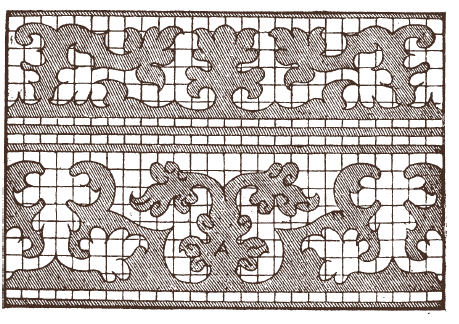
The Egenolf book also is mostly line drawing suitable for freehand embroidery. Some are pretty cluttered, but some are very graceful. The oak border on p. 32 has always been one of my favorites. There’s one plate with a counted pattern, on p. 72.
—. Priscilla Cotton Knitting Book, Priscilla Publishing Co., 51 pages. PDF1, PDF2, PDF3, PDF4, PDF5, PDF6.
This books is obviously a seminal source behind many of today’s reference books on knitting technique and patterns. Notation is sparse and “antique” with n (narrow) being used for k2tog, and o for yarn over, and other oddities. There’s a fair bit of circular doily knitting, but it is of the knit radially and seamed variety seen also in Abbey’s Knitting Lace. In fact many of the doilies appearing in Abbey appear to have been adapted directly from this work. You’ll also recognize many Walker treasury edging patterns in these pages.
In addition to the stitch texture and lacy knitting sections, there’s a bit on “cameo knitting” which appears to be another name for stranding (in PDF2). The section on filet knitting (in PDF3) is relatively extensive, and clearly shows both the strengths and weaknesses of this rarely described style.
—. Priscilla Irish Crochet Book No. 2, Priscilla Publishing Co., 52 pages. PDF1, PDF2, PDF3, PDF4, PDF5, PDF6, PDF7, PDF8.
This has got to be the single most complete and eye-popping source I’ve ever seen on Irish crochet. Not only does this contain an amazing amount of eye candy, it also gives directions on how to create it, offering up pattern descriptions for the individual motifs, the joining brides and grounds, and the working method of fastening the motifs to a temporary backing while the grounds are being worked.
—. Egyptisch Vlechtwerk [Sprang], Holkema & Warendorf, 36 pages.PDF1, PDF2
As an example of the depth of the collection, here’s a work on Sprang, one of the lesser known fiber manipulation crafts sometimes mistaken for early knitting. It is in Dutch and appears to be from before WWI, but it is illustrated with photos of finished pieces and works in progress.
These are just a small sample of the hundreds of works available at the University’s website. Again, most are on the industrial aspects of the textile arts, from fiber acquisition (including sericulture and sheep raising) through spinning, and weaving, but a goodly number are of direct interest to hand-crafters. Topic lists exist for knitting, crochet, embroidery, cross stitch, lace, tatting, and a multitude of other subjects. Support this valuable resource by visiting and using it. I know I’ll be combing through here for years…
ETERNITY AS A FUNCTION OF AVAILABLE WALL SPACE
My list of future (someday) projects keeps getting longer.
Contemplating our living room, The Resident Male and I have decided that the perfect thing for over the fireplace would be a tapestry. So we went looking at various tapestry reproductions sold on-line. The ones in our price range are pretty uniformly horrible – bad cartoons (the drawing on which the weaving is based), cheap looking materials/bad drape, and garish color choices predominate. I won’t even mention the awful chenille surface type and printed things that look more like stuff that along with 8-foot tall inflatable teddy bears are normally sold out of the back of vans parked at busy intersections in the summer.
As we were looking we also saw some of the painted canvases intended for needlepoint. Big ones that encompass scenes or details of historical woven tapestries. The better ones imported from France seem to offer more faithful reproductions of their inspiring works than do all of the modern woven reinterpretations.
Now I’ve done needlepoint before. It’s not my favorite, but technical implementation of the style is not a barrier. Plus I know exactly how long (read forever) it takes to do one of these. My mother did a a needlepoint tapestry reproduction in the early 1970s, working a rendition of this classic bit of canvas:

She did it in DMC embroidery floss, stitching the details including the hunter’s face, gloves and tassels, plus the hound, songbird, and hawk all in petite point. It’s heavy from all that cotton, but substantial enough (and mounted well enough) to resist distortion or curl. That she did most of it in basketweave rather than tent stitch has helped it keep its shape. The thing is a bit less than a yard wide and a bit more than 4 feet tall. It took her the better part of a year. Maybe a bit more. It’s roughly the same size as the one that caught our eye – a reproduction of a French woven tapestry from the mid 1500s (the clothing style is early 1500s, but the weavers may have been deliberately trying to imitate earlier works):

In canvas, even with the full thread kit, this one would be within my price range. Not counting a year or more to stitch it, of course. Will I end up doing this? Will the curtains I described yesterday come first? Will I stay true to knitting, and deaf to the enticements of other needle arts? Only time will tell…
 String-Or-Nothing