ROGUE – PROGRESS; SOCK CLASS
UPDATE: FLEUR DE LYS DESIGN BELOW HAS BEEN ADDED TO THE PDF COLLECTION UNDER THE EMBROIDERY PATTERNS LINK, ABOVE.
Well, I did make some progress on Rogue over the past several days. I’ve finally gotten past the grief of the pocket (my fault); finished the equivalent depth of the body behind the pocket, and fused the two together.

Here you see the area adjacent to the nifty pretzel-terminated side panel, showing off the contrast between that knotwork design and the Little Dragon Skin patterning.
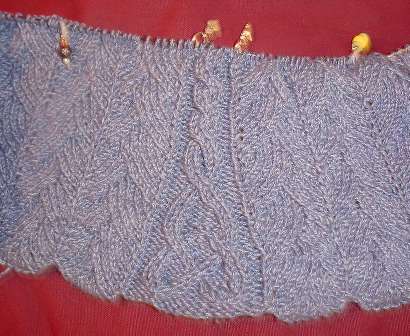
The pocket fusing step went off without a hitch. I remembered to bind off four stitches of the body at either side of the pocket fusing row, again to leave a notch inside which the zipper will be installed. Here’s a process shot, with the pocket stitches held on the pink needle, and the body on the silver circ. Because my right-side rows have so much shaping, I made sure to do the fusing on a wrong-side row – all purls in the patterned part.

Progress however has been somewhat less than it might have been because I’ve gotten two new needlework assignments since Thursday.
First, my mother has asked me to design a needlepoint pillow top for her that incorporates multiple Fleur de Lys motifs in wine, an off white background, and some sort of framing mechanism. She’s looking to make a piece on 16-count canvas. This is pretty much a “bring me a rock” assignment (one of those in which your efforts are greeted by the response “Wrong rock. Try again.”) Here’s my first attempt at just a single motif:

The second was a last-minute request from Wild & Woolly in Lexington, MA to cover a class in sock making. They has a workshop scheduled for March 20th that covers cuff-down socks on two circs and one oversized circ (aka “Magic Loop”), and the original instructor has had a last-minute conflict. I’m the designated hitter for this one. Which means that because my own favored method for socks is toe-up on DPNs, I have to do a bit of brushing up before I can demo and explain those methods to others. If you’ve signed up for this class, please don’t worry. I guarantee that in two weeks I’ll be fully confident in the material to be covered.
MORE BLACKWORK
Katherine asks what subtitled movie I was watching the other day that had me so engrossed I fell into multiple errors on my Rogue. It was Red Beard, the Kurosawa movie starring Toshiro Mifune.
Since Rogue is going so slowly, here’s another side trip. This time into the past.
The dress itself is Melton wool, and weighs a ton. Overall it’s a rather poor example of SCA costuming, but the underskirt is something I’ve enjoyed for a long time. It’s a blackwork panel I stitched a good [mumblefratz] years ago. It was inspired by a piece from the Art Institute of Chicago pictured in Embroidery Masterworks (Virginia Churchill Bath, 1972). That book was a birthday present from my then and present pal and needlework buddy, Kathryn -?she of the motto "Too many centuries, too little time."
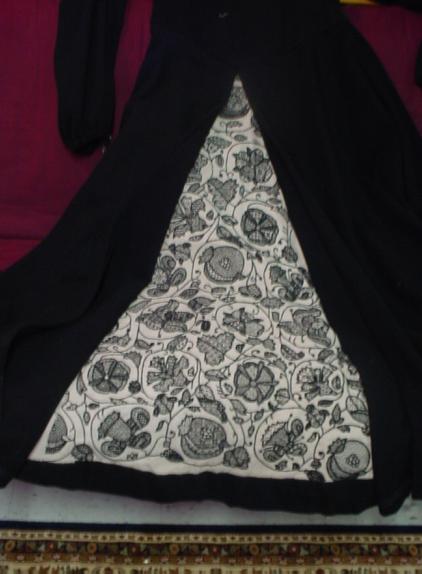
This didn’t start out as being an underskirt. When I began the piece, I intended it to be a tablecloth. I was uncertain whether or not I’d just edge around the outside of the rectangle with the motifs, or I’d cover the whole surface with them. As a result, the stitched area is larger than the skirt’s opening shows. Some motifs were done as partials to eke out the space.There’s a truncated pomegranate at the lower left. The total stitched area is about 20% larger? than what you can see and is hidden by the edges of the dress. I never trimmed the back of the piece, it’s still a large white linen rectangle. My assumption was that I’d eventually go back and finish out the stitching as a wall panel. As you note I haven’t done that yet.
Instead this?panel has gone on to inhabit four SCA costumes, and was one of the very few pieces I kept during the 13 years I was totally absent from that organization. (When you’ve got something like this, you can’t toss it or let it languish in a drawer when you have need of a nifty outfit). It’s the piece I intend to complement with my Forever Coif.
For needlework enthusiasts, this?panel is about 33 inches from point to hem, about 25 inches wide at its widest visible point, and about 28 inches wide at its widest stitched point, counting the motif parts you can’t see. The stitching is rather big, especially compared to my coif. The ground is a linen blend tablecloth, with a weave of about 24 threads per inch, and the stitches are worked over 2×2 threads (about 12 stitches per inch). The threads used are perle cotton for the chain stitched outlines, and cotton embroidery floss for the infillings and solid padded satin stitch bud details. The detail shot is rather large. Click on the thumbnail if you want to take the time to download a larger image.
 ?
?I started stitching on a Monday in mid-October. That Friday The Resident Male and I plus a carload of other friends drove down from Boston to the Baltimore/Washington D.C. area to enter the East Kingdom‘s fall Crown Tournament (see Footnote). He was carrying my favor- another blackwork bit. I’ve got a picture somewhere that shows the two of us at that tourney, him in armor and me carrying the cloth in an embroidery frame, with only the pomegranate at the lower right finished.
After he won the Crown Tourney and we were slated for an April coronation, I decided I had to wear the panel at that event. I finished the piece out enough for that purpose, meeting my deadline and installing it in the first of many dresses. Don’t worry. I didn’t lavish all my sewing time on me. I made a linen shirt with a black silk?needle lace edging, and an extremely short black velvet?doublet/tunic thing for The Resident Male to wear over it. Very fetching.One amusing aside -? I got a college research paper on embroidery out of the blackwork?piece, and so received academic credits for the time I spent stitching. We were both still in school, and I was taking sophomore-level Renaissance art history. )
It turns out I was one of the first to introduce the blackwork embroidery style to the East’s populace at large. I encouraged embroidery (and women fighting) during the reign and after, writing how-to booklets and teaching classes and workshops. Blackwork became quite popular because of the richness of the finished look, coupled with the ease with which beginners’ pieces can be done. Soon it was showing up everywhere. About a year later I was recognized by the Order of the Laurel for counted thread embroidery in general, and blackwork in specific.
Footnote: For those of you familiar with the SCA, that was back in the Five Kingdoms era (AS XI-XII), when Atlantia was a brand-new principality, and the East stretched from Maine to North Carolina. A very long time ago, indeed.
For those of you unfamiliar with the SCA, twice a year the East Kingdom selects a (mostly) ceremonial leader by conferring that honor on the winner of a very big sword fighting competition (other weapons are used, too). The winner becomes King or Queen by right of arms, sitting first as Prince or Princess for five months before ascending the throne for the six months after that. That winner is accompanied by a counterpart or consort on the throne – the person in whose name and honor the fighter fought, and whose favor they carried through the tournament (designated beforehand, of course).
EXCUSE? “IT WAS THE ’70S”
I found a box of stuff I’ve?been carting around forever. (At least it seems like forever). In it were mouldering reminders of decades past. Including this little doodle sampler I did to hang on my dorm wall:
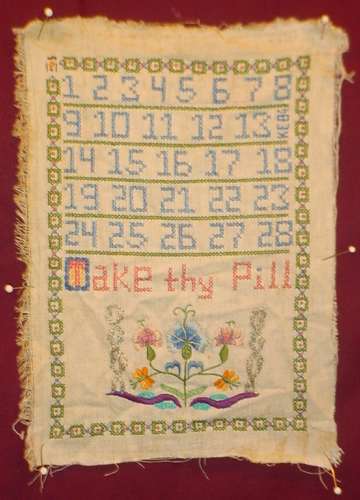
From the stitching standpoint, I can say it’s unremarkable – cross stitch and crewel type stitches, done on muslin ground in standard-issue DMC floss. There’s a bit of couched silk ribbon, too. The turquoise ribbon has faded, leaving only the little turquoise fastening stitches, and the bits of matching color cotton down below. It’s signed "KEB ’74."
As to the sentiment. Like the title says. It was the ’70s.
I?stitched it up?over a weekend and had it on the wall by Monday. I think I did it mostly to annoy my first roommate: a gal who managed to arrive at college with calcified attitudes, white kid gloves, and a life-long desire to take two years of college at the most to?find a husband and then drop out. She did manage to do just that and start a family, although not necessarily in the order she would have preferred. I guess she never quite took the sampler seriously…
More on Sontags
My friend Kathryn the costume doyenne, tells me that?the original?sontag isn’t really exactly like a poncho. Sort of, but not quite. It’s more like a scarf or fichu meant to cover the front of the upper torso that fastened behind the neck. They were usually buttoned or tied in the back. The idea was to avoid shawl points or dangling ends that could pose a danger in the era of open fires. Think of "Gone with the Wind" costumes, with the long shawl-like thing criss-crossed over the front of the body, with the ends tied behind the waist.
That makes sense. Looking at the item in the page from the NYPL it may be pictured from the back. The wearer would be facing away from the viewer, and the spot where the two sides meet would be at the lower back. It still looks like?a capelet/shawl hybrid to me, but worn backwards from the way that seems logical today.
THE UNSEEN AND MORE HERESY
More distraction while I accumulate enough progress on my dragon panel to be worth displaying.
As promised, after much fiddling with the frame and expenditure of batteries (still close-ups are difficult with a two-bit digital camera) I present the reverse of my red embroidered yoke:

Sort of neat, but not compulsively so. And yes – Heresy #1 – I use knots on one-sided pieces. My knots however are well formed and placed, and do not pull through to the front of the work.
Heresy #2 – Blackwork in Color
Like I said the other day, there’s a time to be absolutely historically accurate, and there’s a time to burst out in a fit of playfulness. Yes, the patterns on this piece are (mostly) from historical sources. No, the fabric (Hardanger cloth); color choices;and mode of employing these colors have zero reason toexist besides the fact that I felt like doodling with them at the time. I started this piece as a wedding present for a couple whose engagement did not last longer than the stitching. Blame the bride for the insipid country-kitchen colors.
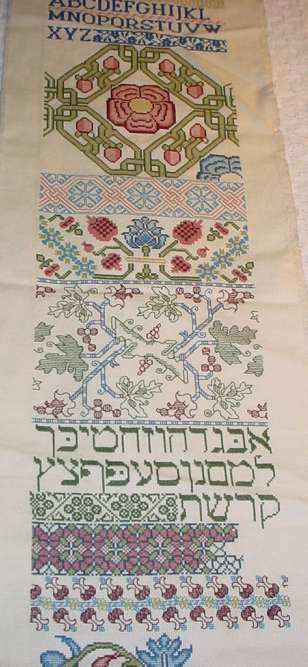
You see about a third of the total length. The rest of the piece includes a bit of inhabited blackwork; plus another standard Roman alphabet; and lots more cross stitch and strapwork patterns. Some day I might finish it. Or maybe not.
Recognize the squash/lily-form tulipflowers (bottom-most whole strip)? Yup. They were on my Anything Worth Doing sampler, too. The framing strawberry chain here done in pinks and greens also shows upin blackworkonmy Forever Coif. Think of it as pattern recycling.
EVEN MORE QUESTIONS
Apparently the redbit of stitching I posted yesterday piqued a bit of interest. I received some questions on it:
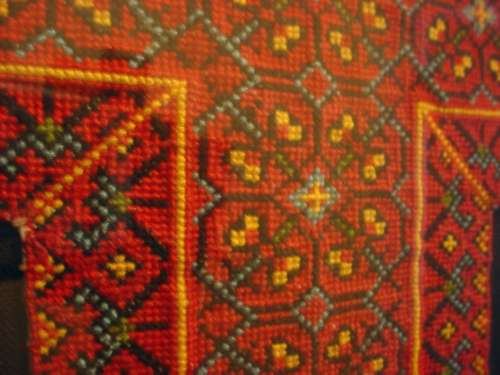
I can’t see the pattern you describe. Can you post a detail shot?
Here’s the best I can do:
Where did you get red muslin?
I didn’t. As you can see in the detail shot, the ground isn’t red. In fact you can’t see the ground fabric at all – the entire piece is completely overstitched in red, black, yellow, green and light blue.
What thread did you use, what stitches, how big is the piece?
Thinking back to ’75 or so when I made this, and hoping I remember it all – I used two strands teased from standard DMC embroidery floss. The entire piece is done in plain old cross stitch, nothing fancy. The muslin was a remnant from the discount table of a neighborhood fabric store, back in the days before big box crafts stores. Iworked mycross stitchover 2×2 threads of my muslin ground. And yes – all the top legs are crossing in the same direction.
The entire thing is about 11 inches wide and 14 inches deep, both measurements taken at its widest points. As far as gauge or stitches per inch, the weave of the muslin wasn’t square, so my cross stitches aren’t square. The flower motifs themselves graph out exactly square, but because of the weave-induced distortion, they end up looking like rectangles. Across the motif (the stretched dimension) it measures out to about16-17 cross stitch units per inch. Up and down the motif (the squished dimension) it measures out to about 21-22 cross stitch units per inch. The imprecision is there because I have the piece mounted in a frame, and it’s tough to hold a ruler close enough to get an accurate count.
The mounting glass is also why this is photographed at an angle. I hoped to bounce the flash so I didn’t get a glare or – like yesterday – a ghost image of me taking the picture reflected by the frame.
What’s the design source for this one? Why is it a funny shape?
I started with a couple of traditional Ukranian counted thread patterns, most notablyan illustration in Mary Gostelow’s Complete International Book of Embroidery, then played with them a bit. What I ended up with was a yoke for a blouse or dress. I did wear this yoke, appliqued onto two garments. The first was a very thick linen peasant-style blouse, smockedjust beneath the panel and finished with gathered and tied cuffs. After that blouse met an untimely soy sauce/bleach-related death, the second was a black straighttunic-type linen top, rather North African in shape. Thankfully the embroidery itself was unharmed by the soy sauce and subsequent attempt to clean it. Another thing – this is the piece that was recognized with the Nellie Custis Lewis prize at the Woodlawn Plantation Needlework exhibition in ’93. That year the special prize was given for garment trim or accessories.
So, what relevance does all this have to knitting anyway?
One thing that gets me fired up is the possibility of cross-pollination among needlecrafts. Why can’t I take a 16th century pattern intended for lacis, counted embroidery or weaving, and use it in filet crochet or knitting? Why do I have to stick to traditional Scandanavian, North Sea island, and Baltic motifs for stranded colorwork? For example, why not mess with this red bit of stitching, adapting its motifs for knitting?
Why for that matter do I have to stick to any one type of needlework? I’ve done that. I’ve made the repro historical pieces.It’s virtuoso work when done to the nth level, but it’s also limiting. I want to do more. What gets me trulyinvolvedis moving away fromstaid verbatimreproductionin one of two directions, either –
- Making an entirely original and new piece, but doing it in such a way that were it transported back in time it would be accepted as yet another contemporary example of its type.
- Taking motifs, designs, or aesthetics from one branch of traditional needle arts and using them either in combo with another form, or for use entirely in another form.
Thisattitude one of the things that makes me a Rogue Laurel in the SCA. Yes, making an exacting reproduction of a meticulously researched and documented artifact is a manifestation of skill (and perseverence) on a high order, but I don’t see it as the ultimate expression of the deepest level of understanding.
Believe it or not, I seethe elusive goal of true mastery of a needlework formas having parallels in martial arts. It’s one thing to learn fencing, Judo, Karate or Aikido exercises perfectly and to perform them with grace and precision when required. It’s another thing to abstract the principles behind the exercises, and be able to summon them up to defend oneself from someone who doesn’t know the otherside of the script. It’s the inner form of these arts, the part that you can recognize at a visceral level, internalize, and use as a point of spontaneousapplicationthat is the goal of practicing the outer form of the techniques.
So from street fighting, I cycle back to stitching and knitting. I have donemany of these other things amd tried out many different needle artsbecause I see deeper parallels among them; because the lessons I learn in onepursuit inform my investigations of others. And bogus pseudo-philosophy aside – mostly I do these things because they make me happy.
Footnotes: SCA = Society for Creative Anachronism. Laurel = SCA’s kindgom-level award for achievement in the arts – one of the highest achievements possible withing the group, and an ardently sought-after goal. Iam honored to have been recognized in the East Kingdom in ’79 for fostering the practice of historically accurate embroidery, in specific – blackwork and related styles. Rogue Laurel = one so honored whose opinions differ from the established consensus, who ends up being in the minority on most arts-related issues, see related entries under "pain in the butt," and "gadfly." I’m mostly retired from active participation in the SCA these days, but I can still be found on occasion at events in Carolingia (greater Boston, Massachusetts area branch).
FILET OF DRAGON – MORE QUESTIONS
More questions from my inbox:
Can you use the same type ofchartedpattern for knitting?
Why not? It’s a plain graph. You can use anycharted pattern for knitting, darned net, embroidery, colorwork or filet crochet so long as you understand the proportions of the units your chosen craft employs. Even though the original was graphed in square units, my units are rectangles. As a result, my piece is a bit squashed left to right because my units are wider than they are tall, and I worked across the piece’s short dimension. Had I worked the long way across, my dragon and George would have been squashed top to bottom instead.
By carefully choosing the direction of one’s work one can either minimize the effect of non-square units, or employ it as a design feature. Here’s a cross-stitch embroidery I did on white muslin. The original graph was square. The muslin’s weave wasn’t. The flower units end up being squashed top to bottom, but that turned into a design feature.

There are some ways around the problem if you want to work a square graph on a non-square medium but want to preserve the original height:width ratio. Depending on their gauge, some knitters replicate every third or fourth row when working from a square unit chart. This practice is built on the premise that knitting stitches are usually wider than they are tall (more rows than stitches per inch). Others use drafting software with layering capabilities, importing the original chart, then overlaying a custom grid built to their stitch height:width ratio, finally knitting or crocheting off the new gridding. Finally, some people manipulate their craft to produce units that are more square. For example, I’ve seen some knitters take graphs and translate each box unit into a unit of 2 stitches x 3 rows. While that "blows up" the design, making it a much larger piece than would working one stitch per one charted square, it usually does produce a result that is more visually true to the original.
Me? I don’t bother regraphing. I play with the ratios and pattern placement instead. For example, the Knot A Hat headband on wiseNeedle is worked from a square unit graph (available as a *.pdf via link on the pattern page).

My knitted version is elongated along the length because my stitches are like most stockinette – wider than they are tall. But I don’t care. I think the design’s stretch isn’t out of place and until I pointed it out, you probably wouldn’t have noticed.
How did you get your mesh to look so even?
The same way you get to Carnagie Hall – practice, practice, practice. [grin] Seriously, in crochet just like inknitting one gets used to the hand motions of making a stitch, and providing the optimal tension on the thread becomes second nature. I find if I concentrate on keeping things even, they go all to hell, but if I relax and just do the work – my stitches are all the same size. Some crochet beginnersstrangle the hook, pulling the loops way too tight and making the formation of stitches more difficult than it should be. Others make their stitches waaaay up the needle’s shaft where the shank gets wider to accommodate gripping. Those folks often end up with loose, irregularstitches as their too-big loops are distorted by the actions of making a stitch. Again, not to be a smart-ass – but practice and patience are key.
Filet looks nifty. I didn’t know crochet did more than granny square blankets. What other types are there? Where can I learn more?
There are all sorts of crochet books out there. Not as many as there are knitting books, it’s true, but there are quite a few. Some are pattern collections, some are technique instruction books, and some are toss-the-rules and be creative sources of general inspiration and encouragement. Crochet history however is harder to come by.
The best source of info on crochet history and styles I’ve got is Lis Paludan’s Crochet: History and Technique. It’s a fair size tome that details not only crochet’s murky historical beginnings, also covers how the craft developed over time. It gives copious illustrations of various styles, mostly fromengravings and other period sources,and even has a nifty how-to section in the back. Unfortunately it appears to be in rather limited supply, although I still see copies at the original retail price on bookstore and needlework specialty store shelves. It’s also pretty well represented on library shelves. [Reminder to self: Add rider to homeowner’s insurance to cover out of print needlework book collection!]
WORKING REPORT – EVEN MORE DRAGON
Progress continues. Here’s the latest:
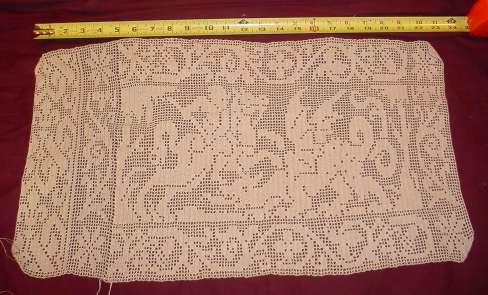
I’ve included the tape measure because a couple of people who have seen the thing in person thought it was much larger, and were surprised by how small the individual meshes were. It’s not exactly teeny, but at around 8×6 meshes per inch, it’s not exatly honking huge, either.
You can see the edge frame, now well developed along the left. In the original (and in my book) it appears as a single-wide. Here I’ve mirrored it along the long side. There will be another block of the same at the right edge,but the top and bottom (right now) look like they’re going to be single-wide. I have to say I like the piece, and I’m quite pleased. It will be killer on the door.
Inhouse-related news, String Central is mostly put back together. We’ve completed the network wiring on the basement and first floor, and I’ve been able to unpack and set up my base station machine and comfy chair. Goodbye laptop! Goodbye typing on top of the oil tank! Slowly but surely I’m making a dent in the Continental Divide of boxes that separates room from room. Yesterday’s find was the long-lost lid to my spaghetti pot. At this point I’m truly thankful for similar small points of progress.
Other questions that have come in via eMail:
How is crochet to do for long periods compared to knitting?
I find crochet slightly more tiring. The way I hold my hook and thread involves a good deal of wrist rotation to form stitches. By contrast, my knitting requires almost no wrist movement. Also at the small gauge I’m working, my overripe eyes need a fair bit of light, otherwise I end up squinting and workng by feel. Stab. Ouch. Got it? Nope. Re-stab. Ouch. Got it! Grab loop, loop, loop. Repeat. That’s hard on both the eyes and fingertips. As a result, I can knit happily with no ill effects for long stretches of time, but I can only crochet for a couple of hours before eyes, fingers, and wrists all demand stopping for a glass of wine.
What thread and hook size are you using again?
I’m using Coats & Clark Royale, size 30; and a recently made Bates US #10/1.5mm. I posted a short discussion of hook sizes several digests back. So far I’ve used 1.8 balls, but don’t anticipate using more than three total.
Where did you buy the pattern for your curtain/please send me the pattern.
If you’ve been reading along, you’ll know there is no pattern. I’m feeling this one out as I go along. As for sending out the graph for the dragon or the edgings I’ve used, I might consider posting one or more of them on wiseNeedle some time in the future, but other than that, I am not sending any of them out. If you’ve got access to my book on embroidery, all three are in there. If you’ve got access to other needlework resources, including microfilm and other repro collections of early pattern books, here are the citations:
- Dragon panel – Siebmacher, Johann. Schon Neues Modelbuch von allerly lustigen Modeln naczunehen Zuqurcken un Zusticke. Nurnburg, 1597(?), 1602/3/4. (Plate 30:1 in my book)
- Acorn, Leaf, and Flower Meandering Repeat – Pagano, Matteo. Honesto Essemplo del Vertuoso desiderio che hanno le donne di nobil ingegno, cira lo imparare i punti tagliati a fogliami. Venice, 1550. (Plate 27:3 in my book).
- Framed Twist and Flower Border or All-Over Repeat – Troveon, Jean. Patrons de diverse manieres inventez tressubtilement Duysans a brodeurs et lingieres et a ceulx lequelz vrayment veullent par bon entendement User Dantique et Roboesque frize et moderne proprement en comprenant aussi Moresque. Lyons, 1533. (Plate 28:4 in my book).
Of course, looking these up in a research library will entail actual work. It’s been my experience that people who idly ask for free patterns are rarely disposed to bestirring themselves to expend the effort. However if there is sufficient interest, I’ll considerpublishing my graphs on-line.
THE DRAGON’S VALUES
Elissa wrote to me to ask how I could tell what graphed patterns might go together well as I was looking for more borders to eke out the edges of the dragon panel. I am not quite sure I can answer, in part because I’m not quite sure I’ve made successful picks yet. I do a fair bit of this type of composing in the course of stitching up monochrome embroideries. The best way I can discuss this is to show a blackwork sampler I did a while ago:

I stitched this upwhile I was working on my book of embroidery patterns. Some of the patterns on this piece made it into the book, others didn’t. The ones I left out were ones that turned out to be too late in origin for inclusion in the book, or whose documentation and provenanceweren’t complete or accurate as the rest.
You can see several things on this mostly-blackwork piece. First, even though I was working exclusively in double running stitch (aka Spanish Stitch, Holbein Stitch) and cross stitch, there is a tremendous variation in density and the depth of tonal values among the various patterns. There is also variation in the delicacy of line, even comparing the airy double running stitch patterns. The highly geometric bit in a similar style to Jane Seymour’s cuffs (center top) presents a very different look than the curled plume-like leaves in the bottommost left.
Now this piece is far from entirely successful for several reasons, design by accretion being the leading one. Like my dragon curtain it was done "bungee jump" style. I took my ground cloth and just began stitching, picking my patterns one by one as I finished the last. The first bit I did was the sorrel leaf stripin the upper left (looks like clovers). I worked more or less across and then down from there, leaving the center blank until I hit upon something to put there. That happened to be my father’s favorite saying, and a large yale, but I certainly didn’t plan on them being there when I started. (A yaleis a heraldic goat with skewed horns, although someheraldicspecialistswill debate whether this is a goat or a yale.) The last bit to be filled in was the small rectangular area just below the yale, which I patched in with several smaller scale fillings commonly used in inhabited blackwork, finishing up with my sig strip at the center bottom (KBS ’83). I used a couple of these in my blackwork underskirt and Forever Coif, too.
Had I actually sat down and planned the piece, I would have better balanced the placement of light and dark areas, and the apportionment of delicate curved lines with harsher block geometrics would have been more pleasing. Those sorrel leaves for example are way out of place. They’re too light and too leggy sitting as they are on top of the darker knot strip. The large double star motif beneath the yale’s back hoof is also out of place. While it balances nicely with the English acorns on top of "Worth Doing" and the star and fleur de lyse at the center right edge, in combo with the Chinese peonies just above it theheavyvisual densityweighs down thecomposition along the left edge.
All this is a long way to go to answer Elissa’s question. In a piece as small as the dragon curtain, with a limited number of patterns, I wanted to call attention first to the center panel. To that end, I framed it with a strip repeat lighter in value than the average tone of the dragon and knight unit. I tried not to "fight" with the center panel, picking a repeat that was rather delicate in line rather than a heavier one to avoid the the overpowering effect demonstrated on my Anything sampler. However, once that frame was completed and I wanted to add more width, I decided to usestrips of aheavier, more geometric border around the whole piece. With luck, now that the lighter inner area has been established (sort of like matting a painting), the denser second border will serve the same purpose as a dark carved wood frame on a painting – defining the inner space inside the frame and accenting the center, by contrasting with both the mat and the piece’s focus.
FUN WITH ODONATA
UPDATE: THIS DESIGN IS NOW AVAILABLE AS AN EASY TO PRINT PDF DOWNLOAD UNDER THE EMBROIDERY PATTERNS LINK, ABOVE.
A short post today on a time-stressed weekend day.
Buzzing in on the hopping heels of last week’s bunny, here’s another small graph from my embroidery book. This super-simple one is original. One dragonfly can be spot-placed, or they can be done in series using stranding. A strip of dragonflies can bealigned either katywumpus as I show here, or all facing the in same direction. In knitting, I think that these would be particularly fun to accent with shiny beads or duplicate stitching on the body or wings. They’d also be a killer trim if done in bead knitting.
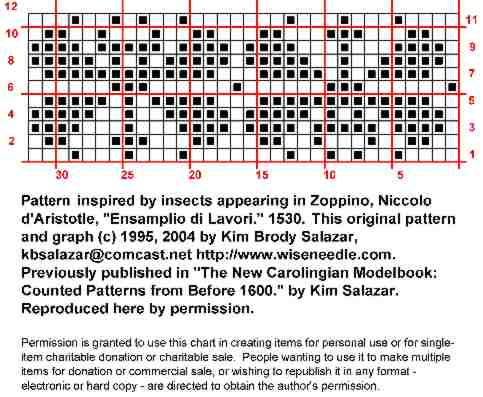
Other uses for simple graphs include filet crochet (Mary Thomas’ Knitting Book describes filet knitting, too); all types of cross stitching; needlepoint; and lacis or pattern darning. I’ve even heard from people using TNCM patterns for wood marquetry and tile mosaics!
FUN WITH LAGOMORPHS
UPDATE: THIS DESIGN IS AVAILABLE ON THE EMBROIDERY PATTERNS LINK ABOVE, IN EASY-TO-PRINT PDF FORMAT.
SECOND UPDATE:
The source for this is under re-evaluation. I’ve found it in Bernhard Jobin’s New kuenstlichs Modelbuch von allerhand artlichen und gerechten Moedeln auff der Laden zuwircken oder mit der Zopffnot Creutz und Judenstich und anderer gewonlicher weisz zumachen, published in 1596. I believe that when I first transcribed this from microfiche in the early ’70s there was a mixup in the labeling of the fiches I consulted. If TNCM gets reissued, I will insert the correction.
I was re-graphing this rabbit from my book of embroidery patterns, and I thought angora-fanciers might like to work it into a headband or sweater front.
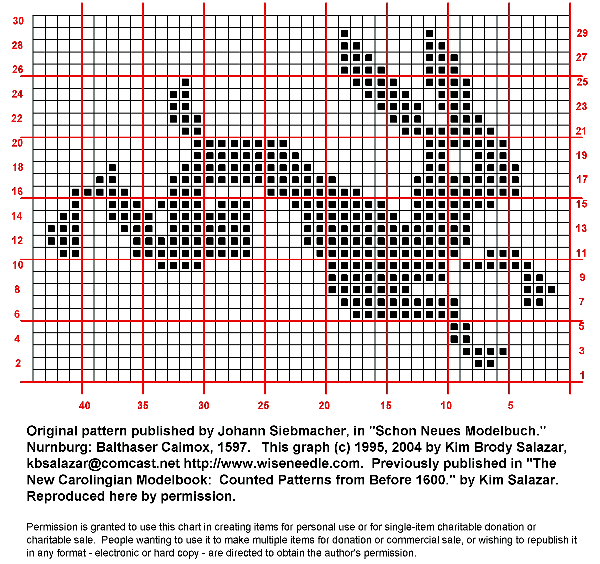
The original plate from 1597 showed a large group of animal motifs clustered together to save space. It included this one, two coursing dogs (possibly greyhounds) a squirrel, an owl, a stag, a unicorn,a parrot, a yale, and the lion I previously shared for Gryffindor pullovers.
 String-Or-Nothing
