WOOLY FOOD
An adorable link, found courtesy of someone who posted it in a LiveJournal knitting community. The thing is in Japanese, but you can enjoy the pictures and objects without reading along.
From what I can gather using the Google language tools, while most of these items are crocheted, the strawberry shortcake (minus the berries) is machine knit. The fruit trifle tart is a box that opens up. The pear purse is trimmed with metallic beads. The chocolates are fridge magnets, and the artist suggests using the cherry topped ice cream bon-bons, the cup of cocoa and the hamburger as pincushions. The moon pie looking thing (two cookies with white filling) hides a tape measure, and the component pieces of the hamburger can be used as coasters – except for the sunny side up egg, which the author notes is too bumpy in the center for stability.
Very clever.
JAPANESE PATTERNS AND MORE
Japanese Patterns On-Line
Veronik from Canada was kind enough to send us a link to a site offering Japanese patterns on-line. She points out that the most recent collections are for sale, but the earlier patterns are free. She says that these aren’t the most fashionable of the ones out there, but they’re interesting and should be useful for illustrating what graphical patterns look like.
Go to this page. (Don’t worry if the characters display as gibberish in English.)
Select the pattern you want to view by clicking on one of the thumbnail photos.
A page will appear that contains an enlarged photo. The writing next to the picture of the yarn balls will give yarn and yardage info (clicking on the link will usually take you to a page to buy the yarn). Ditto for the picture of the needle (needle size in mm, plus a link to a purchase page); and the button (notions for this piece, if any). The picture of the little page at the bottom of the stack is the one you want. Take a deep breath, and click on the linked text next to it. You’ll be asked to download the Acrobat file containing the pattern page (some but not all of these PDFs produce download errors on my machine).
Ahh. I can sense everyone looking at the result and hyperventilating…
It’s not that hard to interpret. Really.
The garment is presented in one size (a weakness of Japanese patterns) as a series of annotated schematics. Cast on numbers are given, along with lengths to work in pattern. Decreases and increases are described as a series of numbers (like 3-1-2, meaning every third row, decrease (or increase) one stitch. Do this twice). Texture and colorwork patterns are shown graphed. Other info is presented on the charts, like stitch counts both before and after major shaping has occurred; circumferences and depths, both in rows and centimeters, and the spots in which the graphed patterns or other special features are to commence.
Now there are limitations here to be sure. Not offering a range of sizes isn’t acceptable in the US. The format does assume far more knowledge of knitting than do text-based instructions. Most US knitters would find working exclusively from graphical patterns to be difficult. But the idea of using the schematics to present additional shaping or production notes is a good one, and one I’d like to see used more often to supplement written instructions.
Worth of Certifications
Lots of people wrote both on and off-list to say that I’m very wrong about certifications; that they really got a lot out of [insert name of program]. But lots of others wrote to say that they weren’t interested in accumulating merit badges, and didn’t see the value of a formal course of study. Still others wrote to say that they’d only take knitting classes from certified instructors; or conversely that they didn’t care what piece of paper the person did or did not have – so long as they imparted accurate info in a cogent, helpful, and useful manner.
I’m of the "We don’t need no stinking badges" mentality myself, but hey. Opinions, learning styles, and teaching styles differ. I respect yours if you do me the favor of respecting mine. (Notes that start out with a variant of "Jane, you ignorant slut" will be cheerfully deleted at no extra charge.)
Project Progress
Socks continue. One looks much like the other, so photos at this point would be redundant.
I’ve also finally been able to overcome Paypal’s obstinacy and pay for a copy of Rogue. I’m reading through it right now and am very impressed with the thing’s completeness (it’s 19 pages long!). I planning on how to compensate for the gauge difference, incorporate the cardigan modifications (available onthe Rogue home page cited above, via the "mods" link at the bottom of that page), and possibly even re-work the Dragon Skin texture pattern for use with it.
At the same time I’m thinking of taking another graphed pattern from my book, and adapting it for use as a double-sided double-knit scarf. All in my copious spare time, of course….
THAT BICYCLE
In late breaking news, Elizabeth from Norway has provided us with a translation of the blurb under the knitted bicycle picture I mentioned yesterday. Here are her words:
Here is a translation of the blurb under the picture:
"I haven’t finished anything I started last week. On the other hand, I have finished knitting a bicycle.
It ended up with balloon tires, and it is probably pretty heavy to pedal, especially since I took the pictures before putting on the chain (which by the way is not knit, but crocheted!)"
So the piece is even more spectacular than I thought. It’s not just a bicycle cozy. It’s an art-knitting interpretation of a functional bicycle!
Amazing.
OOP BOOK REVIEW – TEENAGE KNITTING BOOK
Here’s another review of a knitting book that time forgot. This one is The Teenage Knitting Book by Betty Cornell. New York: Prentice Hall, 1953.
Intro to knitting books weren’t invented with Yarn Girl’s Guide to Simple Knitsor any of the other ten thousand beginner books that have recently flooded the market Nor is the retargeting of knitting at a younger group of knitters something new. Yes, books are better illustrated now, yarns are heavier, and the level of knitting skill expected from beginners has decreased somewhat; but the basic idea – writing trendy patterns in a chirpy styleto encourage new knitters and enable them to learn new skills – hasn’t changed.
This book is a case in point. It’s by a woman whose other credits include a large number of girl’s grooming and fashion books. My mother says that her name would have been recognized at the time. She touts all the familiar stuff: knitting is wonderfully relaxing, it’s great to fill up time and/or keep your fingers busy, it presents a grand sense of accomplishment, it fills tactile needs, and it’s fun to get together and knit in groups. As one would expect it also asks "whynot make that ultra-trendy stole in the exact color you want instead of buying what’s available at the store" just likeits recent descendents.
After a brief intro, the book is off and running presenting several dozen patterns for blouses, sweaters, stoles, socks, hats, and dresses. Patterns range from dead simple (a dropped stitch stole flat out identical in concept to the "magic scarf" pattern floating around the Web right now); to severalpullovers that sport some nice shaping and tailored details. Yarns are small. Most pieces are knit in fingering or sport weight yarns. Sizes are also small. Although they’re labeled as being sizes 14-18, those sizes are peggedto finished sizes ranging from 34-36 inches finished chest measurement for the 14 to 36-38 inches finished chest measurement for the 18, depending on how tightly they fit. Remember – this was the sweater girl era, and fit is generally quite sleek, so I’d estimate these as being the equivalent of modern size 8-10-12. In spite of that, there are several pieces in the book that are very interesting. Here’s one of the more unusual:
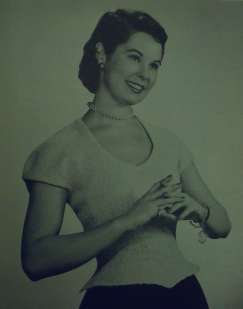
If you get past the strange yearbook pose and black and white presentation, you’ll see a piece with complex waist shaping, an interesting neckline, and set-in cap sleeves. It could be worn today. Not necessarily with pearls and a Pepsodent smile, but could be quite interesting and depending on the yarn choice – could compliment anything from jeans to velvet.
Here’s another – a classic cable sweater. This one has shoulder pads inside and the model is probably wearing a girdle to create extra waist shaping.
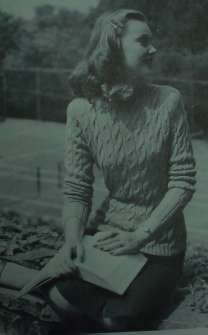
Not a boxy rendition of the standard cable, but a tailored piece featuring two different stitch patterns. Note the push-up sleeves. You don’t get that kind of fit from a bulky yarn. I especially like the way the cables flow down without interruption to the ribbing at the cuff. This piece is knit in fingering weight. Wearable now as a classic? You bet.
There are several cardigan patterns, ranging from little cropped length pearl-button cap sleeve ones to longer stylespaired with knit skirts. Very retro, yet again – wearable today. There are some men’s patterns. The one I like best is a seaman-style sweater with a very long ribbed sections at waist and cuffs – both meant to be worn folded up. It looks like something to be worn ina remake ofOn the Waterfront:
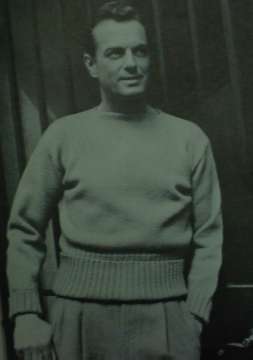
I think that QueerJoe would look killer in this simple piece.
There are also patterns for golf club covers (woefully small for today’s oversized drivers)and a couple of easy tomake afghans. A bonus in all knitting books of this vintage, there are sock, hat, glove and mitten patterns, including a very nice plain anklet, andthe hot, hotmust-have item of the day – the argyle:
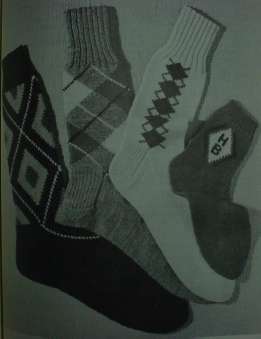
The patterns are more completely written up than most patterns of similar vintage. Colorwork is charted, but except for that all instructions are offered in prose. They don’t use the arcane shorthand common to most late 1940s/early 1950s patterns, instead directions areare presented in complete sentences. There are some major assumptions made – like the entire direction on shaping the waist frill in the top photo reads "Block peplum, then face with taffeta leaving approximately 2 inches free at each side seam to allow stretch and tacking top loosely." It may be a beginner knitting book, but some sewing skills here are clearly expected from the knitter.
The book finishes up with an 8-page how to knit and crochet section, illustrated with line drawings. Unlike most American-made books of its time, it shows Continental style instead of throwing. It’s prose-heavy compared to modern how to books, but the info it offers is succinct and well-written, covering all of the basics needed for the preceding pattern sections.
So like many of the knitting books time forgot, this one is interesting and deserves a second look in spite of its dated black and white pix, aged and plain library binding, and 1953 copyright date. Many local public libraries have vintage books that you may have skipped past in your search for newer stuff. Go back and revisit the older volumes. Not only are they knitting history, they’re an excellent source of inspiration for knitters today. Besides, if they sit on the shelf idletoo long the library staff might cull them from the collection, and we’ll lose valuable info that can be supplanted, but can never be replaced.
CHEAPER THAN JAL
Today bodes to be a chaotic day, with Real Life intruding on the time I usually squander on blogging, eMailand wiseNeedle maintenance. There’s a Family Event in the works for this weekend, so there are obligations that need to be met that require setting disorder aright, the creation of foods, and dressing/attending the actual group activity. Therefore do no be surprised if little gets posted here over the next 48 hours.
In the mean time, I can report on last night’s midnight ramblings. Some of it is knitting-related, some not.
First, I went off web-walking through Japan again. No I don’t read Japanese, but I do read Picture. Even if the text is beyond me, I always find tons of inspiration (and not an inconsiderable bit of whimsey) in what turns up. Of course I visited my standardsources of Japanese knitting fun- The Hand Knit Lab and the ABCs of Knitting – neither one of which has been updated in a long time. But I did find new stuff, too.
On the inspiration end is the Motif-Motif website. As far as I can tell, it’s a retail site offering finished knitted garments. Quite a few sport interesting features, including asymmetrical closures and a freshuse of textures – including crochetand crochet used in combo with knitting. Some of the crochet might be a little over the top for my tastes, but even done at the scale of these pieces, it has a better drape and flow than the clunky wool stuff I blogged about before. Click on the thumbnails to go to that offering’s page, then click on the gray bar with the little magnifying glass in it for multiple views, close-up. I especially like the button-use idea in this piece.
On the whimsey end, there’s this illustrated story of learning to spin, weave and knit. Again, I haven’t a clue as to what’s actually going on here, but I can (sort of) follow along with the story from the adorable illustrations. Click on the little hand illustration to page through the whole thing, or on the text link below it for a quick dose.
Finally, this has nothing to do withyarn. I was visiting Boing-Boing,always a source of the unexpected. There I found a link to ZoomQuilt. Be VERY VERY patient.ZoomQuilt takes a long time to load, and you may time-out. If you get the plain-text white intro page, click on the link at the bottom, then use your up and down arrows to follow along.
Enjoy!
CROCHET – CRITICISM AND DEFENSE
I’ve been having discussions with folks on other blogs, and in eMail about crochet and its strengths and weaknesses. I’d posted about this before.
My objection to most contemporary crochet patterns is that they try to take advantage of crochet’s strengths but ignore it’s shortcomings. For example, they try to present easy to make/quick to finish projects. That plays on two of crochet’s strengths – namely how easy it is to learn, and how quickly it can be worked. But in doing so, they scale up textures and stitches to use with DK and heavier weight yarns. That leads to the lumpen, potato-bag, refugee-from-grandma’s-sofa look, a good example of which is the skirt on the cover of IK Crochet:

This same texture pattern would be exquisite in a much thinner yarn, done up in panels in a sweater or blouse. You may disagree with me and say that I’ve got no taste, but to me this skirt is heavy and unattractive, there’s nothing about it – not drape, not fit, not texture that flatters the wearer.
Now crochet in heavier yarns can be quite attractive. Crocheted fabrics are thick and warm, and resist stretch better than some knitted ones. A dense crochet in a heavier yarn is perfect for a coat or outdoor jacket. Even a hat or bag will benefit from the body and thickness. But not an indoor/outdoor or indoor garment.
What do I like in crochet?? Here’s an example.

The thread size/texture pattern are graceful and in proportion to the garment. I also l ike the style. Sleeves are fitted, and there’s some evidence of a bit of body shaping, even though this cropped pullover is boxy in general shape. Please don’t write to ask for the pattern or provenance. A friend eMailed me this photo, and other than her say-so that it’s from a French-language crochet magazine, I haven’t a clue as to when/where it’s from.
Even the usually dreadful granny square motif can be attractive if it’s scaled in relation to its usage. Here’s a nifty example from the UK’s Knitting and Crochet Guild on-line collection pages:

The caption page attributes this piece to the 1950s. It’s done in 3-ply – a yarn that’s would be considerd light fingering in the US, and would probably knit up at between 8 and 9 stitches per inch on US #1s. The sweater’s multicolor?motifs are crocheted, but?the rest of the sweater is knitting. Be sure to go to the caption page to visit the sweater’s detail shot, so you can see the fineness of both the knitted and crocheted sections, and how the gauge of the two compare. (Also if you want to support this nifty collection, there are notecards illustrating some of their most spectacular pieces for sale at the end of the collection.)? [/End shameless plug of worthy cause.]
WORKING REPORT – FILET OF DRAGON
More progress.
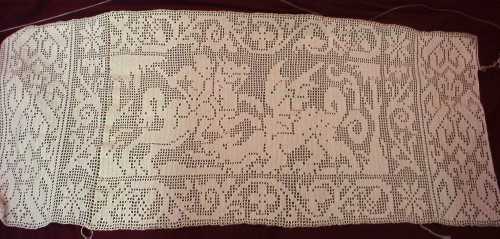
I’m only three rows from being done with this side panel, so I turned my attention to figuring out how to join the top and bottom strips. I think I’ll end up doing something like this:

I’ll be working this strip the long-narrow direction, joining it to the side of the existing piece. I think the joins will be visible if you know to look for them, but they shouldn’t be too distracting because except for the first two and last two rows of the piece, the column of meshes thatis being attached are all filled in, and any additional heaviness should be visually lost in that solid line.
In the mailbag I had a couple of questions on why I thought that filet crochet is clunky and heavy looking. The people whowrote thought my piece was anything but. However, to me filet isheavy by comparison to Lacis – the style it emulates.
Lacis is worked by darning in the meshes on a hand-knotted net background. You start with a netted ground, then with needle and thread, weave in the meshes that need to be worked solidly. There’s a wonderfully arcane logic to designing one’s path of stitching so as to minimize ends. If you like themental excerciseof working double-sided blackwork or cross stitch, you’d really enjoy Lacis. For delicacy though, filet crochet just can’t compare:
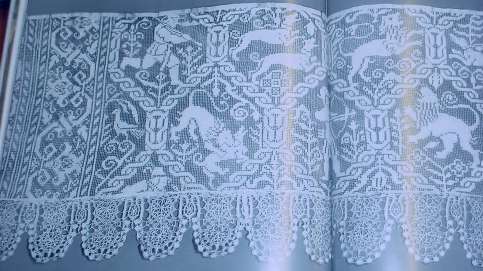
This photo is froma photo catalog of household and decorative arts held by the Hermitage Museum in St. Petersburg, Russia. The book is in Russian and French, published in 1974. It identifies this piece as being Italian, 16th century, but says very little beyond that.
To my amateur eyes, it looks like this piece of lace was cut down for re-use, because not only are motif roundels rudely interrupted, both the tape at the top and the applied needle lace lappet edge at the bottom are sewn on to roughly cut edges that in some places slash meshes in half. Even so, look at the extreme contrast between the darned solid bits and the spiderlike open areas formed by ever-so-thin single thread mesh ground. Now THAT’S delicate! You can also see yet that the use of the borders and centralpanel areais yet another bit of inspiration that stewed around beforethe idea for mydragon curtain was birthed.
This designs in this particular pieceare on my "to-do" list to graph up for Ensamplio Atlantaea. My postulated but not yet realized sequel to The New Carolingian Modelbook. Little things are holding up that production – like the lack of a good graphing platform, not having a publisher, that so many other people are now plowing the same turf and I don’t want to repeat material others have issued.
How did I lay hands on the Russian decorative arts catalog? It’s amazing what you can findin the damaged goods deep-discount boxes at some Cambridge, Massachusetts used book stores.
MELTING
It’s hot and I’m melting. I’m glad I’m working with cotton on my filet project, as the thought of even the lightest, smallest woolen project in 90-degree F humidity makes me twitch. Work continues on several fronts. I’ll have more Dragon postings tomorrow or Tuesday.
Lightning Strikes
Right now though, I’m busy writing up the Summer Lightning lace scarf pattern for inclusion on wiseNeedle. Here it is again:
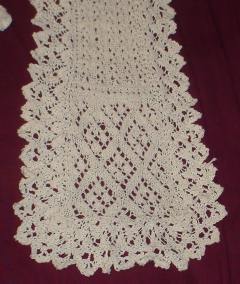
If I miss an odd day or two here and there on the blog, it will be because my web-time quota is being used up drafting out this pattern. I’ll post again when it goes "prime time." Once it’s up, I’ll enjoy hearing from people who try it.
Since I’m (obviously) not in this for the massive bucks,readingabout the fun people have with my stuff is my prime reward.Seeing pix of it is even morenifty.I was ultra tickled to see this hat adapted from Knot a Hat by Australia’s ZenKnits, back in June. There’s a nifty armwarmer on I’d Rather be Knitting, also back in June that used the doodle cable I posted here on String. I’ve also heard from a couple of people who have used the Mountain Laurel counterpane pattern and my various sock patterns. In fact, if you’ve knit something from one of my designs I’d be delighted to show off your work. Feel free to write to meso we can discuss file formats and the like.
Eye Candy
In the general eye candy department, I stumbled across this knitted pin ball. It’s an egg-shaped pincushion, knit in silk and dated 1801. It’s offered for sale by an antiques dealer specializing in samplers. Given the excellent condition I’m not surprised at the high price, but it makes me wonder. Did Elizabeth Searle ever envision her humble gift of friendship lasting out the years? 200 years from now will any of our works be offered up to avid collectors?
GOODIE ALERT – TRADITIONAL SCANDANAVIAN COLORWORK
Each week Dover books sends out several sample pages of (mostly) kids’ books as come-hither advertising. This week’s freebies include four pages of illlustrations from Sheila McGregor’s Traditional Scandanavian Knitting. They offer up two pages of colorwork photos, and two pages of small graphed patterns for Setesdal jerseys. You canleaf through all four image sets here.
These samples only stay up for about a week, so if you’re tuning in later than the beginning of September, you’re out of luck.
ROMILLY AND NOT (GADGETS – BREAD TAGS)
Firefighters Socks
Several people wrote to ask where they could buy my Firefighters Socks pattern. You can’t buy it. No one can. It’s not for salebecause I give it away free at my wiseNeedle website. The links here (and in yesterday’spost) will take you directly to it. It’s written for worsted/heavy worsted yarn, and if you’ve never done toe-up socks with a Figure-8 toe or short-rowed heel, being at such a large gauge is a good pattern for a first attempt.
Romilly-les-Chaussettes
Thank you to everyone who wrote to say that thepostcards I posted yesterday were printed around WWI. I thought that was rather obvious, so I didn’t bother to note it. Most of the others on the site I mentioned were of the same vintage, with a smattering of earlier and later cards.
And a BIG thank-you to Spinnity, who was intriged enough by the sock card to comb through history sites (in French) to find out more about Romilly and its curious link to socks. She left a nifty comment. I’ll summarize her theories:
Romilly was a center of sock manufacture, with at least two large factories nearby producing socks and stockings. This line of regional specialty continues to at least March of this year, when Jacquemard, a major sock factory, closed. The town apparently has had the name “Romilly-les-Chaussettes” (Sock Romilly) for a very long time. Here’s her link detailing the passing of Jacquemard mills(for some reason it didn’t come through on her comment post): in French; in machine-mangled English.
Here’s another Romilly-les-Chaussettes postcard:
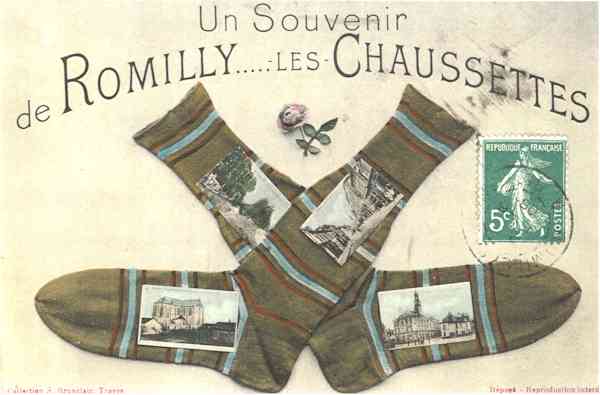
Again we see the stripes passing north and south of the heel. But the heel isn’t a short-rowed one of the type often seen on machine-made socks. It has a wide heel flap that wraps around the entire back of the foot, then a cupped bottom area. It looks like after the heel unit is finished, stitches are picked up along the heel’s foot-side edge, and the foot is continued tube-like from that point, incorporating live stitches from the top of the foot.
Apparently the tradition continues. I found mention of at leasttwo more sock factoriesstill in operation in the area around Romilly surSeine (Olympia, Aube Chaussettes); plus in true French fashion – a regulatory board or committee overseeing standards of manufacture and appelation.
Not in France Anymore
Having had a brief whirl through France, I turn to something that causes shudders of horror in every visitor I’ve ever had from that land: American packaged bread. Well, not the bread itself, but the little plastic tags used to close the bags. Continuing the series on indispensible but free knitting gadgets, I put forth the humble bread tag:

What use are they? Well, you can write on them then clip them onto things.
Have you ever been working on a garter stitch piece and forgotten which is the front? While you could remember that the front is the side that has the cast-on tail at the right or left (depending on your method of casting on), I for one can never get that straight. A bread tag with an “F” on it, placed on the front of the work can be a lifesaver.
Need to track the point where something tricky has happened? Bread tags can mark armhole decreases, sleeve increases, buttonhole locations, and the like. They attach firmly to your work, and rarely fall off. Safety pins work well, too but the coils of standard safety pins can get tangled in the knitting yarn, and not all of us have the fancy coil-less safety pins sold in knitting and quilting shops to hand.
I’ve used them for marking yarns in my stash. If I’ve swatched, I’ll scrawl the acheived gauge and needle size on a tag and affix it to the ball. I’ve used them to identify or otherwise mark swatches submitted to pattern publishers as part ofmy designproposals.
Bread tags arefree and completely disposable. You can break them to remove them from your knitting, and not feel you’re tossing away a good tool. (In my house at least they are a constantly-renewing resource and rank up there with wire hangers and AOL CDs.) They also come in lots of colors – good for any color coding scheme you wish to devise.
In a non-knitting mode, I’ve also found them very useful for marking the cables that plug into my routers. I know know exactly whom I am disconnecting when one gets unplugged, even if the shout of dismay wasn’t audible.
Finally, I know people who use them to mate socks before laundering. A bread tag through the toe keeps the pair together, andavoids thatdreaded One Sock Syndrome.
So if you’re looking for a way to make in-work/on-work notations, don’t pass up this humble resource. After all, it’s not like you have to rush out to buy some.
 String-Or-Nothing