PATTERNS PLATE 3
And Page 3:
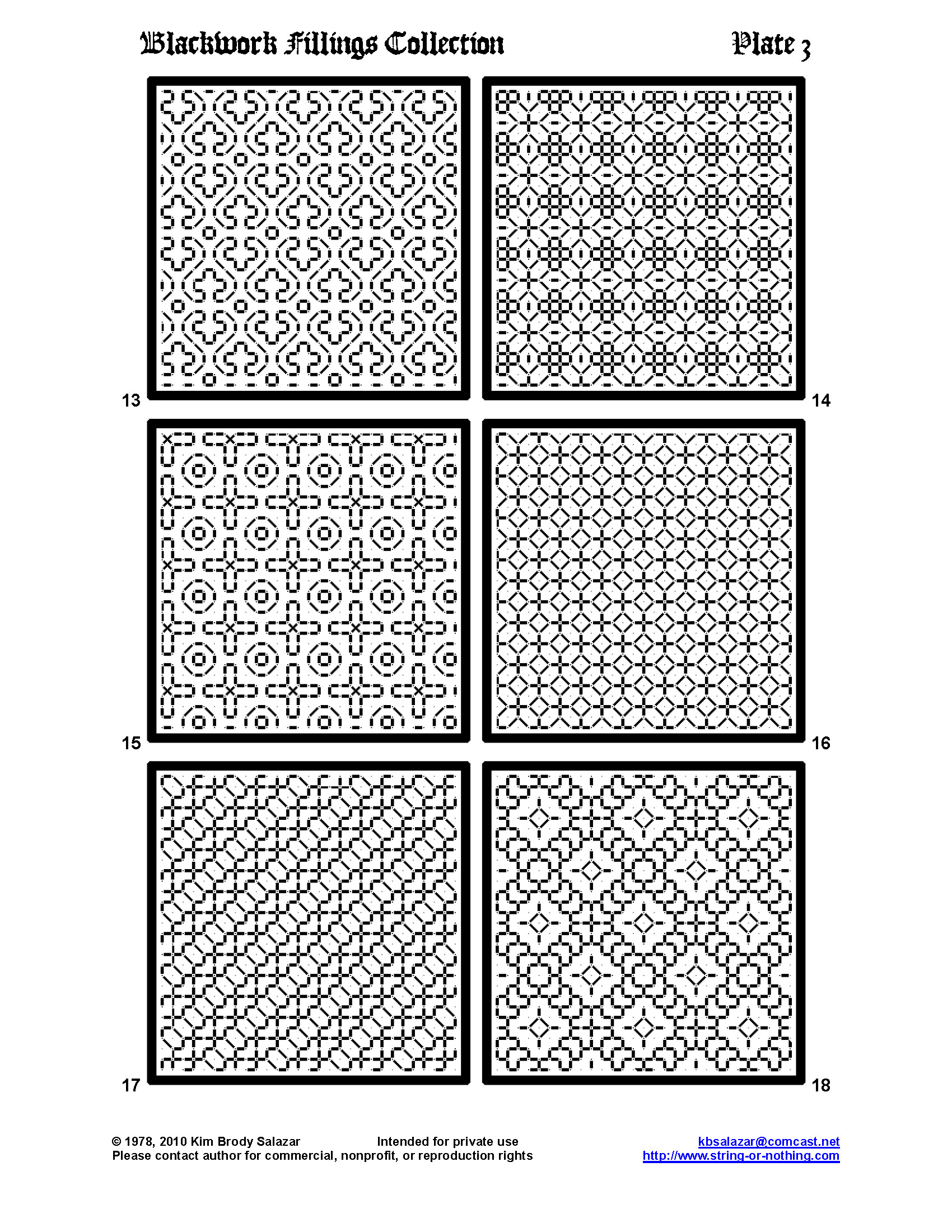
Again, these are patterns that I published in my first booklet back in 1978, and that are stitched into the piece that became my blackwork underskirt. I am going to take a Blog Vacation this coming week. Look for more pages after the holiday. I’ve got roughly 15 more in queue for publication. At least.
Again thanks to all who posted or emailed me encouragement or who have lent inspiration over the years. Like Pal of Pal Mathilde. Great stuff at her site!
PATTERNS PLATE 2
And here’s the second page:
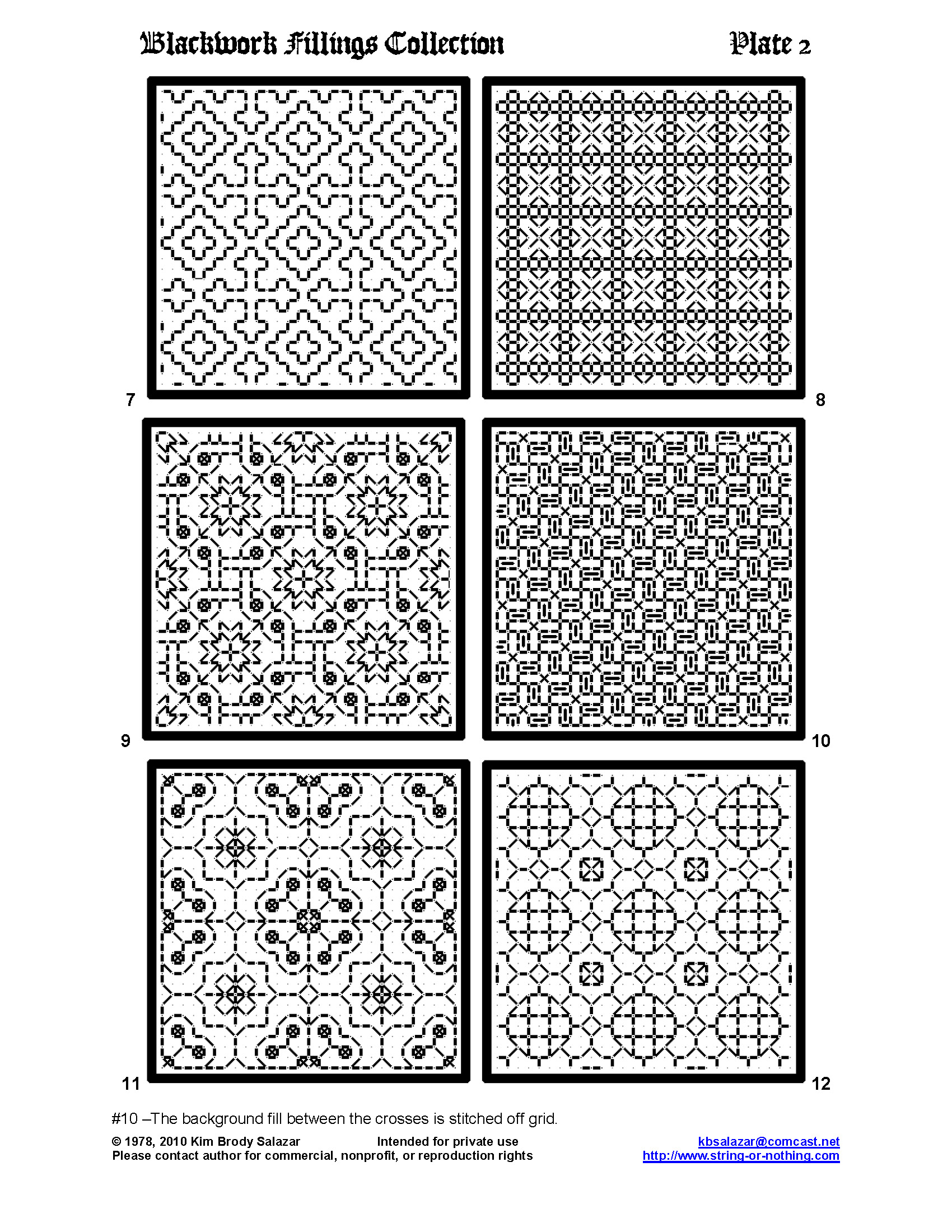
#10 is unusual in that the little isolated straight stitches that fill in the “background” area behind the large cross shapes are not stitched on the same grid as the rest of the pattern. But if you’re working on even weave you’ll see immediately and clearly where that stitch belongs.
The sharp-eyed will be able to pick out #9 and #7 in the detail shot of my underskirt. I assure you that #10 is there too, but it’s shown in a very small snippet. (I’m going to have to take more detail shots of this piece and of my Forever Coif for this series).
Which brings me to an obvious observation. You’ll note that some of these patterns offer small repeats – like #10. Others like #11 are larger, covering more ground before the design cycles. Smaller repeats work well in smaller design areas. Larger repeats show better when used in larger areas. But that doesn’t mean that either scale pattern should reserved exclusively for one use or another. Sometimes “zooming in” on a sub-unit of a larger design is a perfect fill choice. And sometimes the uniformity and regularity of a fine-grain pattern is what’s needed to fill a larger area, especially if it’s near other areas with fussy or complex fills.
Thanks again to all who have encouraged this project. Not the least of whom is Long Term Needlework Pal Kathryn Goodwyn (author of Stalking the Wild Assisi). Oh. That reminds me! ** Hi Fred! **
PATTERNS PLATE 1
Here’s the first page of the Blackwork FillingsCollection, as discussed in my last post. I intend to publish a page each day or so until I run out of pages. (I may take some time off over the upcoming US holiday week though.)
The doc below is a full page JPG (click on it to view/download it at full scale). Eventually, when all the pages have been shown here (and I expect that to be in the neighborhood of 20 or so), I intend to also offer the entire collection as a single PDF, for home printing or viewing on any PDF-capable reader.
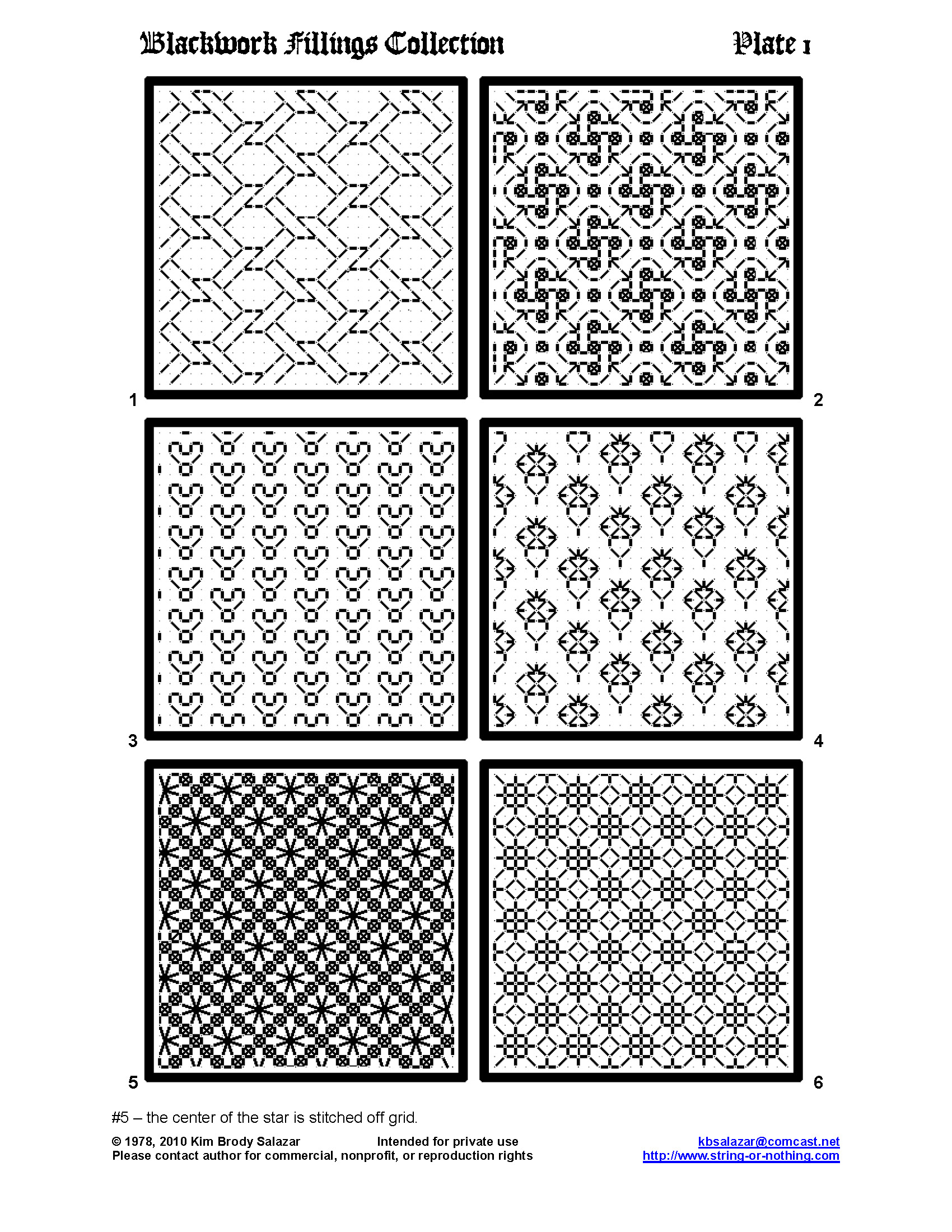
As far as the provenance for these patterns – my notes from 1978 aren’t complete. Some I found by examining historical blackwork samples. Others I doodled up as I worked on what became my underdress. And a few (though none on this page) are fresh, invented as I played with graphing up the others.
I did try to constrain the angles employed in all of my filling patterns to 90 and 45 degrees in order to maintain a visual symmetry among all of the geometrics used, and to restrict all lines to the native grid of the fabric (no half stitches or stitches displaced one thread over from the standard 2×2 thread matrix). However, there are a couple of exceptions. One is Pattern #5 on today’s plate. The stitching logic for that one is to work the diagonals of squared cross stitches; then take the long stitches from each of the “shoulders” of the stairstep diamonds formed by the intersecting lines of cross stitches into the centermost point of each diamond. It’s easy if you’re using plain even weave linen – that center hole is very evident. But if you’re using Aida, or another ground cloth a bit of fiddling may be in order.
As to what I mean by the copyright restriction on the page – if you’re working up your own sampler, have at these patterns. Enjoy! If you’re planning on making works for sale or donation based on these fillings – either finished stitched pieces or published designs, please contact me. In all probability I’ll freely grant permission, but the courtesy of notification and formality of reply is respectful to all parties involved. And if you’re looking to republish or reproduce these pages or the patterns on them, please contact me for specific license to do so before reposting, reprinting, or republishing my work.
Thanks to all who voiced support for this venture. I hope the forthcoming pages prove useful, and whet everyone’s appetite for other full scale works to come. Questions, comments, criticisms and other feedback is most welcome.
SQUARES!
Given Chris Laning’s confirmation of our independently devised charting method, and my own impatience to get started, I’ve decided that using GIMP in the multi-layer mode is the way to meet my graphing challenge. That means one layer for background grid, one for pattern, and a “mask” layer of little white donuts around each grid point to separate the solid pattern lines into stitch units. Thanks also to Ariel who had a very innovative suggestion about using MetaPost, but the complexity of some of the patterns I will be doing will quickly exceed the practicality of her solution.
To practice up for these more complex designs I decided to regraph the collection of 72 blackwork fillings I published back in 1978, plus some more from my own notebooks that didn’t make it into that booklet. These are the fillings I used in the blackwork underskirt I stitched back in 1976-1977.


Not being able to resist a doodle-capable medium, I’ve done up a few more, too. I’ve got about 100 of these fillings now graphed out in neat little squares and ready to share, but I’ve not decided on the most efficient sharing method. I’m leaning to composing them into pages, and sharing the pages one by one, so that they can be seen before they’re downloaded. An alternative would be making a new PDF booklet and post that. In either case, my intent is to publish them here for free download under my own copyright, rather than try to sell the thing.
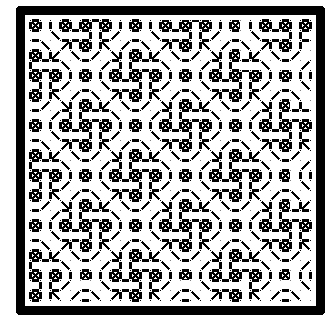
Here are two samples to whet your appetite. Any feedback? Suggestions?

And special thanks again to Chris, who has asked that I spread the word among both SCA and non-SCA stitchers about a valuable embroidery resource. The SCA’s West Kingdom’s Needleworkers’ Guild maintains a very useful on-line library of articles on historical stitching – all from the hands-on perspective. You can find it here. I guarantee hours of fascinating reading and inspiration!
FLOWER SPOT MOTIF
UPDATE: An easy-to-print PDF page of this pattern is now available at the Embroidery Patterns link, above.
Still crunching along on my strawberries band on the Clarke’s Law sampler. But last night I stumbled across this simple and sweet little pattern while web-walking through various museums’ on line collections, and I had to graph it up.

This chart was inspired by a photo detail shot of a coif and forehead cloth in the Manchester Art Gallery’s collection (thanks to Needleprint for calling my attention to their website). If you head over to the Manchester Art Gallery website and search on item 2003.63/2 you’ll find it. The photo itself is copyright and can’t be reproduced here.
The description cites the original as being linen, embroidered with silk, with the stitching being worked in back, buttonhole and knot stitches. It also notes that the original was worked on the diagonal. I particularly liked the one unit offset in the repeat arrangement of the sprigs. It brings life and movement what might otherwise be a very static pattern.
It’s unclear in the original where the stitches cited are placed. From the photo it looks like little accent dot to the lower right of each flower is a group of four knot stitches as shown in the upper row of my charted repeat. The holes in the cloth where the stitches have eroded seem to support this (if the dots were formed by straight stitches, there would be a fifth stitching hole in the center of the dot unit). Still, I present an alternate interpretation in the lower row, using a group of 8 straight stitches in a diamond shape to define the dot unit. This pattern would also look nifty if spangles were sewn on in place of either the knots or the straight stitch diamonds.
Enjoy!
BABY HAT TO MATCH ANN KRECKEL’S BABY BOOTIES
UPDATE: THIS PATTERN IS NOW AVAILABLE IN AN EASY-TO-PRINT PDF FORMAT, AT THE KNITTING PATTERNS LINK, ABOVE.
Yes, it’s been dark here longer than usual at String. My life has not been my own, with raging work-related deadlines consuming every inch of me. But in spite of those, I had a special commission from The Resident Male. He asked me to do some baby knitting for a workpal of his, whose wife is expecting. So I whipped out my needles and made up a pair of standard booties, from the Ann Kreckel pattern I favor, and improvised a matching hat. I’ve posted about the booties many times before, including an illustrated tutorial.
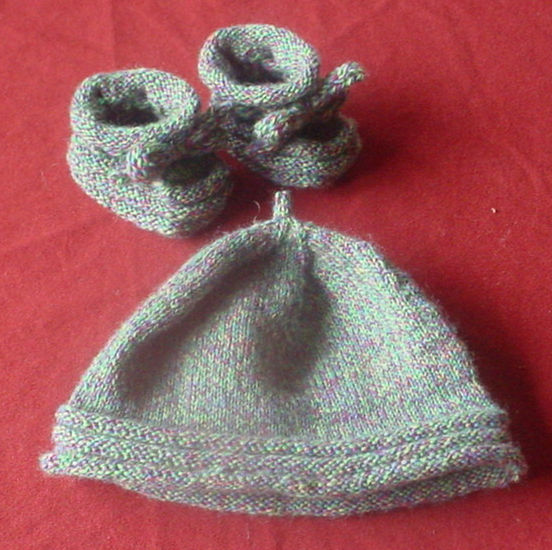
My matching hat is a simple beanie shape knit in the round, with three welts around the bottom edge to match the three welts that run around the sides of the stay-on bootie. I know that many other people enjoy making these booties, so I share the matching hat pattern here.
Baby Beanie to Match Jane’s Stay-On Booties
Materials:
50g fingering weight or sock yarn
1.5 mm (US #000) double pointed knitting needles (can be worked on 1 or two circs if preferred)
4 or 5 stitch markers
Tapestry needle for darning in ends
Gauge
9 stitches = 1 inch on 1.5mm needles
Finished dimensions
Measured across the opening, unstretched = approx. 7 inches
Notes
For the record, my hat is on the small side and should fit a petite newborn. I haven’t tried it yet, but using a 1.75mm (US #00) or a 2mm (US #0) at a slightly less extreme gauge should produce a hat for a larger newborn and 3 month size, respectively. If you want to work this at a standard gauge of 7 stitches per inch but end up with the same size hat as I made, cast on 100 stitches, and place your markers every 20 stitches. Follow the instructions as written EXCEPT that instead of following the (K23, K2tog), (K22, K2tog) or (K21,K2tog) directions instead ALWAYS knit until two stitches remain before your marker, then knit those two stitches together. I had plenty of yarn left over from my hat and booties from my one 50 gram skein of sock yarn, you shouldn’t run out even if you knit a larger hat or a hat at a less extreme gauge.
Directions
Using a very stretchy cast on (I used half-hitch) cast on 120 stitches and divide among your needles. If you are using one or more circs, mark the beginning of the row with a stitch marker for convenience.
Knit 12 rounds. Purl 4 rounds. Knit 4 rounds. Purl 4 rounds. At the end of this, counting the self-rolling bit of stockinette around the hat’s edge, you should have the appearance of three welts at the hat’s bottom edge.
Continue knitting until the hat measures 2.5 inches from the bottom. (Measure this with the curling edge curled. Don’t flatten it out.) On the next row knit 24 stitches, place a marker, then repeat. If you’re using DPNs, you’ll have 4 markers in your work, with the division point for the last one being the break between needles that aligns with the dangly cast-on end. If you’re using circs, you’ll have five markers in your work.
On the next round, (knit 23, K2tog). Do this five times total to complete out the round. Each decrease will occur JUST BEFORE a marker. Knit 4 rounds.
On the next round (knit 22, K2tog). Do this five times total to complete out the round. Knit 3 rounds.
On the next round (knit 21, K2tog). Do this five times total to complete out the round. Again each decrease will occur just before a marker. Knit 2 rounds.
On the next round knit to two stitches before the marker, then knit 2 tog. Do this five times total to complete out the round. Knit 1 round.
From here on in every round is the same – Knit until two stitches before a marker, knit those two stitches together. Repeat to complete out the round. Keep doing this until only five stitches remain on your needles. When only five stitches remain, work them I-Cord style for five rounds, then end off. Darn in both ends.
SUBTLE AND QUICK TO ANGER
While my current work languishes, here’s a picture of another past sampler. This one I stitched in 1996. It hangs in my husband’s office:
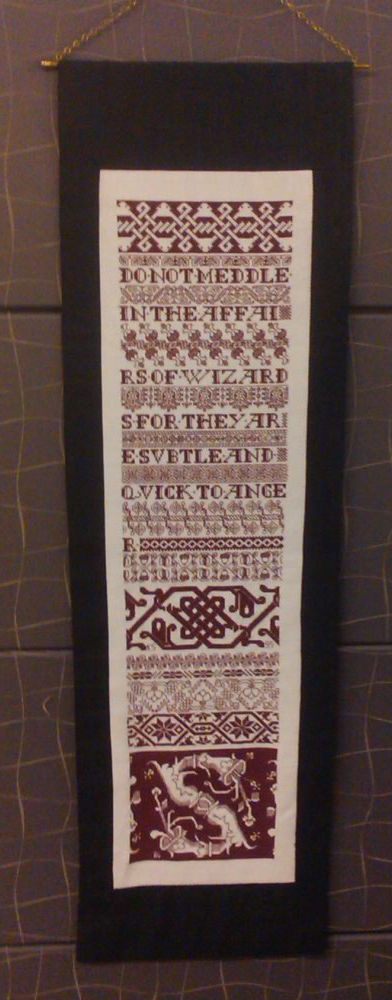
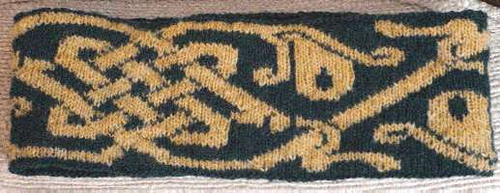
Again most of the patterns are from The New Carolingian Modelbook, and the piece is a mix of plain old cross stitch, long armed cross stitch, and double running stitch, worked in DMC embroidery floss on 36 threads per inch linen (18 stitches per inch). The center twist is the same one I used on the knitted Knot a Hat earwarmer band. (It’s also pictured on Ravelry.) You can see the difference in proportion between square unit based long-armed cross stitch, and the not quite square knitting stitch units. More rows to the inch than stitches across to the inch gives the knit version the slightly squashed appearance.
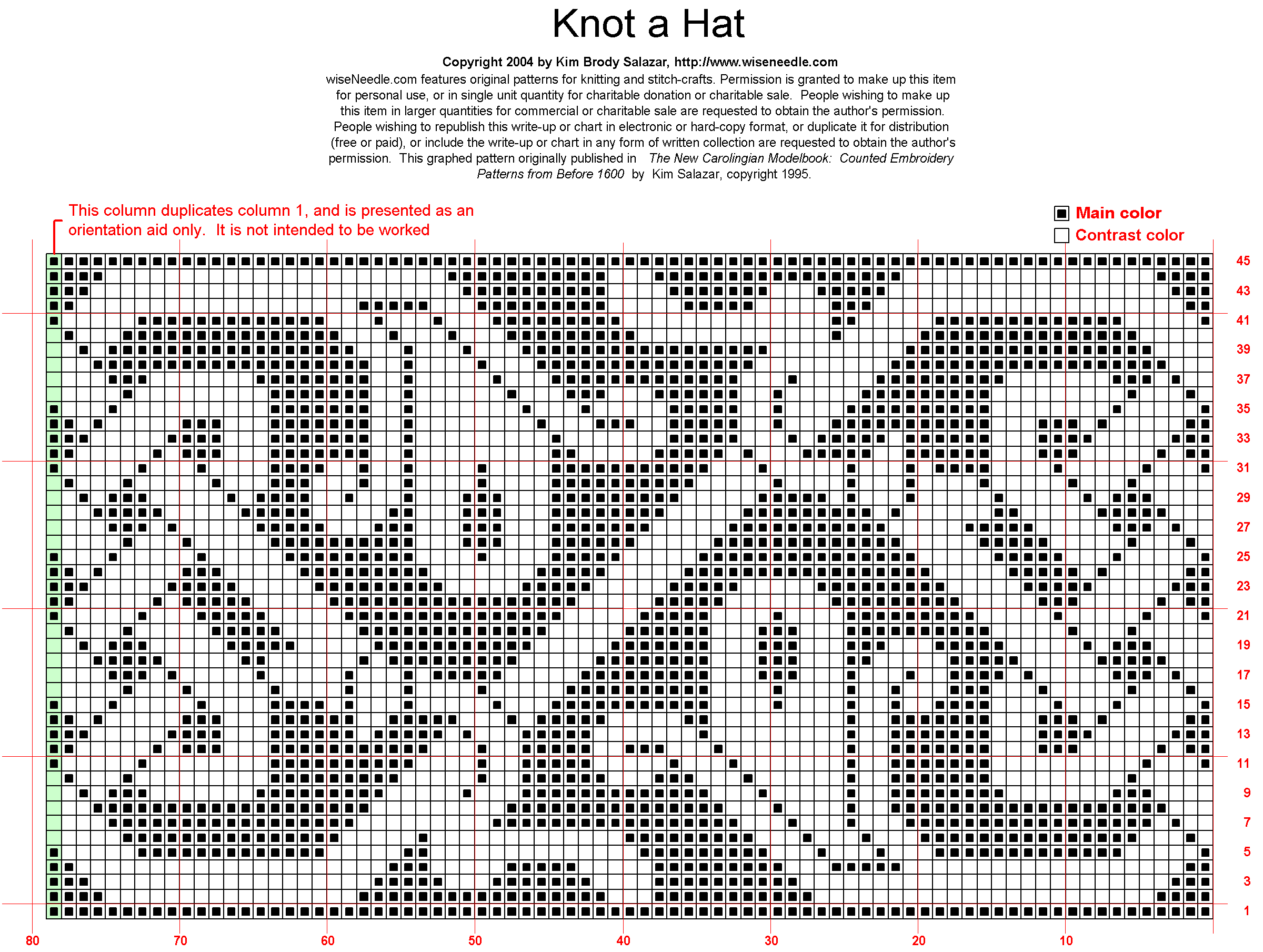
UPDATES: THE CHARTED PATTERN BELOW IS ALSO AVAILABLE IN AN EASY-TO-PRINT PDF DOWNLOAD ON MY EMBROIDERY PATTERNS PAGE, LINK ABOVE. AND THE KNOT-A-HAT KNIT EARWARMER PATTERN IS AVAILABLE ON THE KNITTING PATTERNS PAGE, ALSO LINK ABOVE.
The quotation on this sampler is “Do not meddle in the affairs of wizards, for the are subtle and quick to anger.” From JRR Tolkien’s Lord of the Rings, and totally appropriate for a software developer.
THE OLD CASTLE
UPDATE: THE OLD CASTLE GRAPH IS NOW AVAILABLE AS AN EASY TO PRINT PDF AT THE EMBROIDERY PATTERNS LINK, ABOVE.
Wandering around looking for designs to add to my growing Clarke’s Law sampler I stumbled across the needlework photo collection oft the State Hermitage Museum in St. Petersburg, Russia.
They have all sorts of fabulous things there including several items that may provide fodder for more bands on my current work.
But as I leafed through the collection one item in particular struck me. It’s no secret that I’ve had a long association with the Society for Creative Anachronism. Among my long time and dear friends I count many members of Clan Oldcastle. Their device (shamelessly borrowed from their website) is:

I was amazed to find a historical embroidery oh-so similar to that device. The original is a fragment of a larger piece, done in drawn thread embroidery. The museum’s accession info dates it to the late 16th/early 17th century, and gives it an Italian provenance. There’s a companion piece, too, with a boat, some rather blocky lions.
But it was the castle that excited me. Here’s a graph adapted from the museum artifact. Click on the thumbnail below to print a useful size.

I’ve made some minor changes but kept most of the imperfections of the original. My count is the same. The original looks a bit taller because its constituent units are not square. I’ve kept the not-quite symmetrical center tower, with the ornaments below the tower’s embattled top offered up skew to the rest of the count. I’ve substituted stars for the crosses on the original flags, and added two more of them for good measure. (Estoiles being of special heraldic importance in conjunction with the Oldcastle edifice). I’ve left the one at the top of the left hand tower closer to the original in shape for those who prefer them accurate, but added a bit of twinkle to the others. I also took the liberty of mentally fixing a bit of wear on the original on the open portcullis. But the rest is spot on.
I’d love to see anything made up from this pattern. It would be especially nifty in any of a dozen styles of counted thread embroidery, in Lacis, Burrato, or Filet Crochet; or in knit or tapestry crochet. Other non-textile applications include mosaic work and marquetry. And if you do use this pattern, please consider visiting the Clan Oldcastle link above, and using the address there to make a donation to the American Diabetes Association.
This one is going into Ensamplio Atlantaea (my growing sequel to The New Carolingian Modelbook) for sure, but I share it here first.
UPDATE, 6 APRIL 2020:
Spotted in the wild, another example of the Old Castle. This one is on a piece in the collection of the St. Gallen Textilmuseum, Accession 00671. Their listing cites it as being from Sicily, dated 1590-1610.

Technorati : crochet, embroidery, knitting
PANIC BUTTONS
UPDATE: THE BORDER DESIGN BELOW HAS BEEN ADDED TO THE PDF COLLECTION AT THE EMBROIDERY PATTERNS LINK, ABOVE.
Well, I’ve decided to do a border around Don’t Panic. Again it’s one from TNCM, or rather, two that are presented together in the book. The first one is a very narrow geometric strip, the second is a bead (I think it looks like a march of panic buttons). The pattern is one of my originals, heavily inspired by historical sources, but not a literal transcription of any one design. The book doesn’t present a corner, but in this pattern one is very easy to improvise.
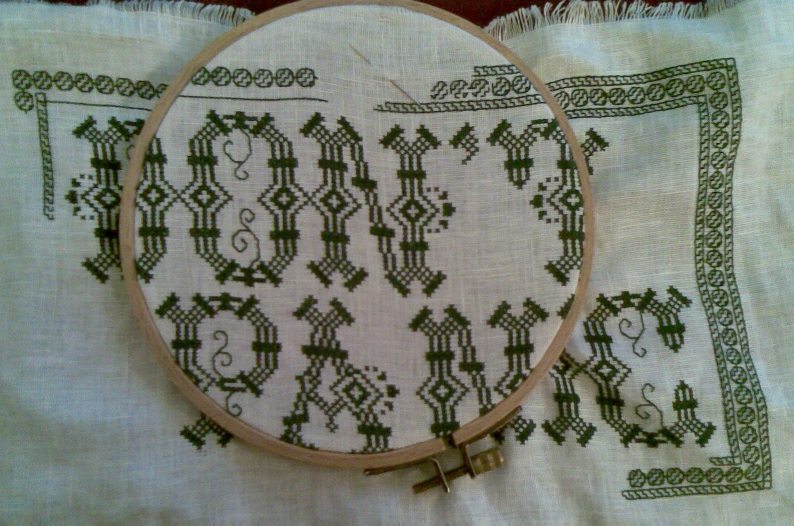
As an early holiday present, I share it and the corner elaboration here:

The astute will note that the repeats of the strip edging and the bead unit are different, and that a span of this pattern will not necessarily work out even, with all four corners identical. Because the step strip edging is so narrow this isn’t a problem. It looks fine ending it at the squared off corner with either the little L unit shown above, or truncating it one step earlier so that there is a little square next to the larger corner block (shown on the photo above, in the upper left corner). The key is to make both ends that terminate at the corner block the same so that each corner displays logical consistency. The four actual corners of the work are so far apart that any minor difference in the strip among them won’t be noticed.
It is however important to keep the bead units as near complete as possible. My north-south border strip works out to be an exact multiple of my repeat. You can see the happy march of whole bead units on the right. But what about the longer east-west panels?
I suppose I could be **perfect** and count them out, or plot the whole thing on graph paper first. But I’m a leap-off-the-pier problem solver. My solution is to work an even number of beads on each side, starting at the east and west corners. When the two sets met in the center if the count is off, I’ll either work a centered elongated bead, or I’ll figure out some other bit of complimenting ornament to fill the center space. I might for example choose the centers to sign and date the work.
The narrow strip then presents its own problems. I’ve established the repeat sequence on the right hand side. If I were to start it again from the left, I might run into a similar conundrum in its center. Instead, once I handle the bead problem I’ll continue working the narrow step strip from left to right, letting it end wherever it chooses to at my upper right hand corner. I might have to pick out the little bit of vertical strip already worked at the inner left so I can make it match the horizontal where both strips abut the box corner, but that’s life.
PHOENIX CHART
As promised, here’s the chart for my double running stitch phoenix


Click on the chart thumbnail to see a larger version. Apologies to those with slow connections – it’s big.
LATE ADDITION: For those of you who would like a larger, clearer version of the chart, it’s available at the Embroidery Patterns link, above
Enjoy!
 String-Or-Nothing

