LETTUCE
And so on to the next strip:

(With a gratuitous shot of the last strip finished out, for good measure.)
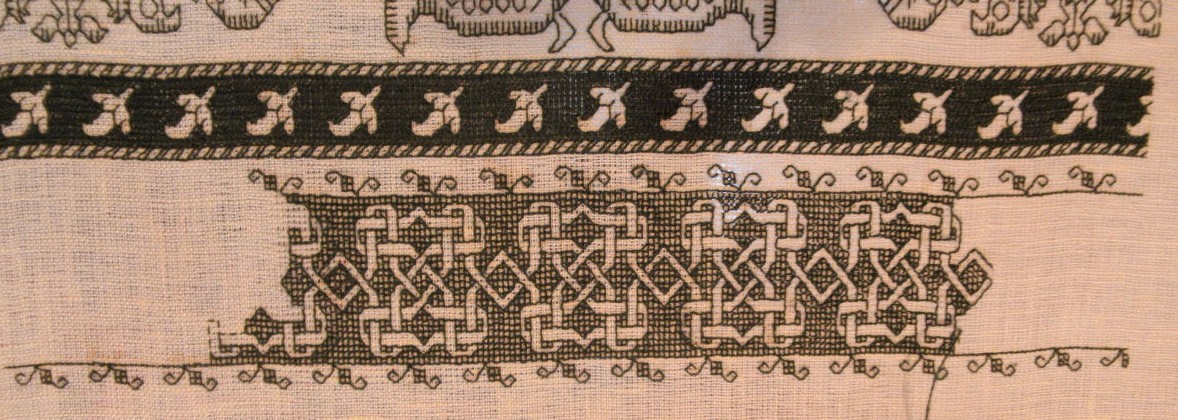
This latest pattern is rather wide, with an interesting companion edging. You can also see that the double running foreground is quite quick to work up. This is less than five days stitching, and a very short five days at that thanks to the standard run of work related deadlines. Progress will slow down now because I’m beginning to work in the background. I’m doing it in Italian two-sided framed cross stitch, pulled tightly to achieve a mesh-like effect. I’d be happier with a more profound “draw” and a more meshy presentation. I could probably get that if I were working over 3×3 threads, but I’m stitching over 2×2 here, a stitch size chosen to present as much of this large pattern as possible. But the mesh is still very evident:

There are several examples of this pattern family in museum collections, but I don’t have time to pull them up right now. I’ll save them for a future post in our “Long Lost Twins” series. Here’s the one I’m using for this stitching: Punto di Milano, Museum of Fine Arts, Boston Accession #99.176. They tentatively identify it as Spanish, from the 1600s. I’ve seen similarly lettuce-like over foliate patterns identified as being North African or Italian, from around this time and persisting (in simplified form) for the following 100 years or so. But remember – these patterns are from an area in which scholarship is still developing from its Indiana Jones/Avid 19th Century Collector roots. With the paucity of provenance and documentation left by the original collectors, I’d expect to see attributions wander a bit over the next few decades, before modern methods make temporal and location points of origin more clear.
DRIVE BY POSTING
I’ve been a bit lax of late, not posting progress on my long, green sampler. In spite of steampunk outfits, work deadlines, and other craziness, slow progress is being made. As you can see, I finished the last pattern, and I’m almost done with the latest strip:

This latest one is of a particularly long repeat. So long in fact that only a portion of it fits across this space. I’ve chosen to do it foreground style, in long-armed cross stitch. The ultimate source is one of Domenico da Sera’s modelbooks, published in Lyons, in 1532. I found a single page from Lotz 69b reproduced, and charted it up from that. This pattern will be in TNCM2.
PROGRESS
We’re quite busy these days at String Central. I continue to work on the long green sampler. Here’s the latest strip, photographed in early dawn light. This pattern is also in TNCM2, albeit without the gridded voiding. The little complementing border was stolen from a different TNCM2 pair.
TNCM2 as a whole also progresses. And to top it off, Younger Daughter and I are hard at work on an outfit for her to wear to the Waltham Watch City Festival steampunk gala.
Long time readers here may remember that last year at this time, Younger Daughter spent quite a bit of April and May in Children’s Hospital, in the throes of an argument with her burst appendix. She had wanted to attend the festival last year, and was very disappointed to have missed it. As a distraction, we planned out the outfit she would have liked to have worn. Being on the young side, what we designed for her was more steampunk than steamy-punk (no exterior corsets, hip high hemlines, or fishnet stockings). As incentive for cooperation with often uncomfortable hospital requests, I promised to make said outfit.
Now a year later, she’s totally better and my promise has been called in. We’re about halfway through the venture. A blouse/waist has been obtained (an antique barn bargain retread). We’re just finishing up a camel wool walking skirt, and will be trimming it next week with black and brown point folded ribbon. She’ll be decorating a brown suede bolero with copious brass buttons, plus a watch, a compass and a magnifying glass. The bolero and buttons were also flea market finds. Pix of all of these as they near completion. But I can present her hat:
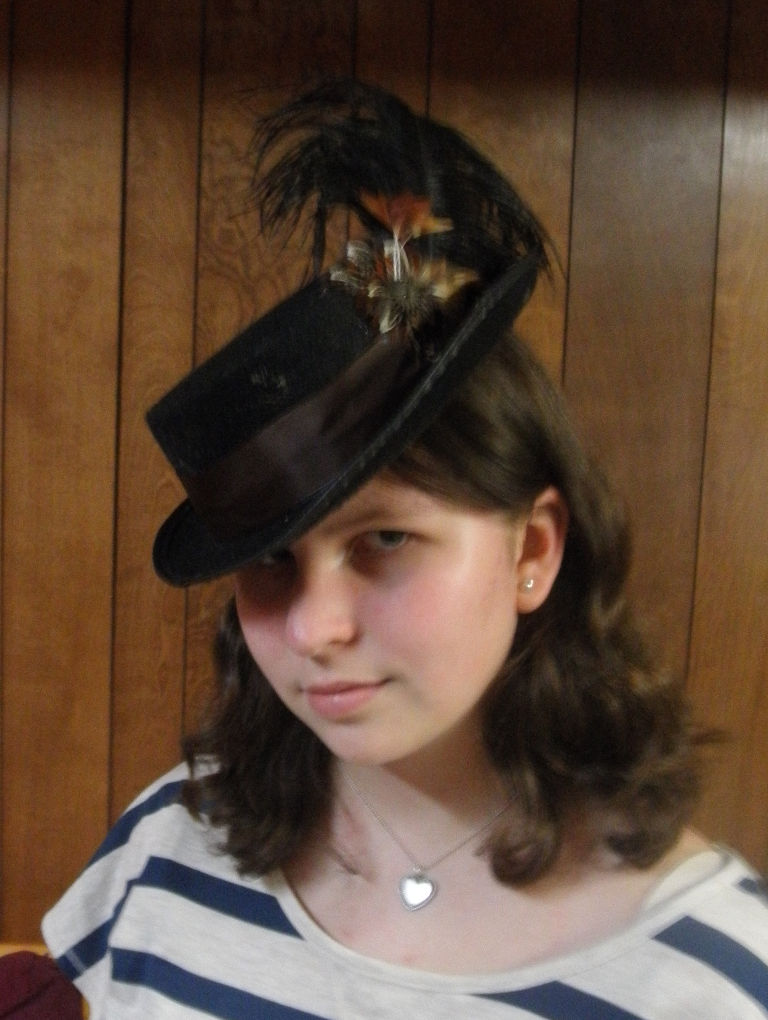
She started with an costume top hat, and excised about 2 inches of height. She covered the surgical scar with a brown ribbon, complete with a bow and streamers in the back; then added feathers and gears.
Cute, no?
URNS DONE
Done with this strip, on to the next!
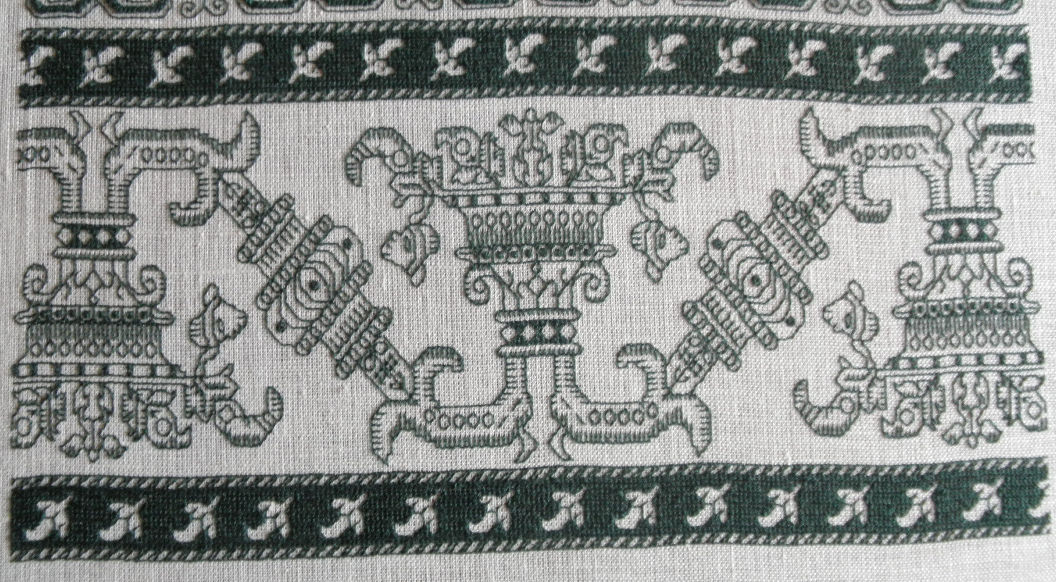
I spent some time noodling out what the next one will be. I tried out some complex Punto Spina Pesce patterns – the ones that use either Montenegrin or a Montenegrin-like long armed cross stitch variant to trace interlaces and intersecting lines, to make a linear design that’s fairly heavy. Unfortunately more experimentation is warranted. I’ve got a basic understanding of these stitches and how they merge horizontal, vertical and diagonal elements, but the designs I’m looking at make those changes very quickly, sometimes after a run of only one graph unit. The methods I’ve learned from the Autopsy of the Montenegrin Stitch Exhumed book take two or three units to complete directional transitions. I’ll have to play with these more off line to figure out “speed changes” and triple line conjunctions.
What am I working as the next strip instead? Stay tuned!
URNS AND PEPPERS
Yes, I’m still chugging along on the long green sampler. Here’s the progress on the latest strip, and an “on the edge” view of the last one, so you can see the dimensionality of the Montenegrin stitch accents in the last one:
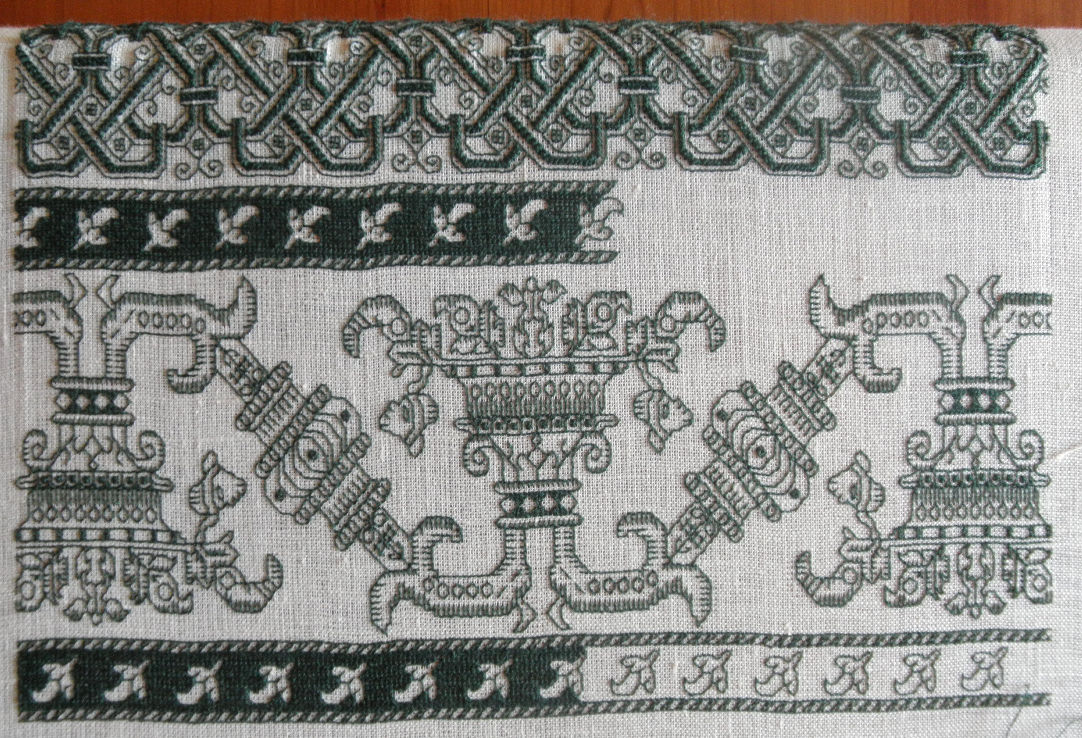
I was originally going to work the entire background of the center urn motif voided in long-armed cross stitch, just like the pepper-sporting companion edge strips. I’m still thinking on that one. That much green might overwhelm the piece. It’s hard to judge visual balance when the previously completed parts are rolled on the scroll bar, but here are all the strips to date, in order (apologies for varying lighting, angles, etc. – a photographer, I’m not).


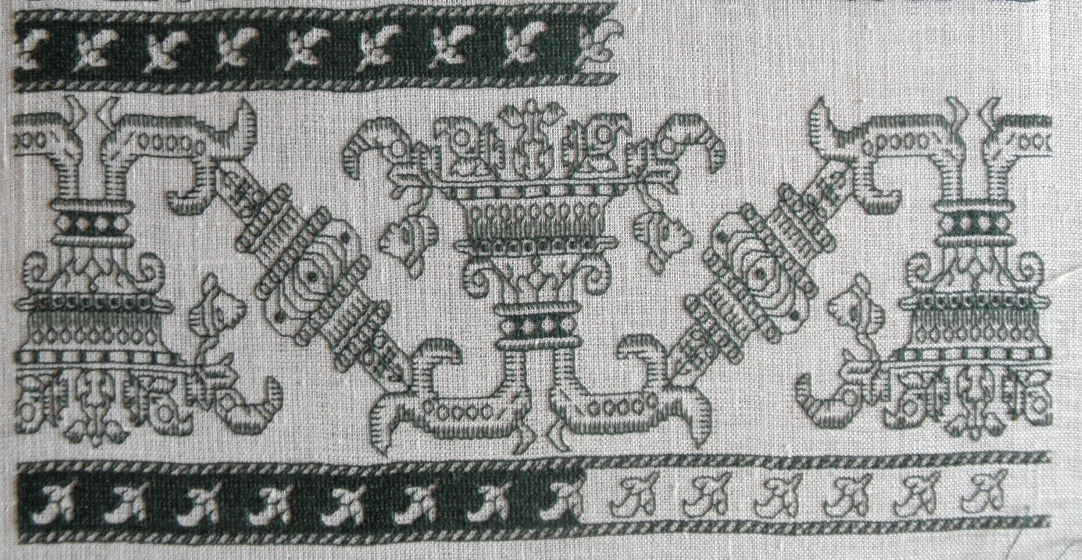
Opinions on working the urn section voided would be gratefully accepted.
Finally – are these odd bud shapes really peppers? I haven’t a clue. New World peppers would have been a recent introduction when this design was new. They might be, or they might be some other vegetation as yet unknown to me.
INTERLACED!
Yes, I’m still working on my long green sampler. Both of the patterns below will be in TNCM2:

Thanks to the Montenegrin book I’ve been able to do all those twisty, bendy parts where diagonals meet horizontals or verticals. It was a lifesaver! I really like this interlace. You’ll note by comparing my piece with the original below that my ground cloth is off square – not quite even weave. So it goes. I’m working that distortion into my pattern selection and placement.
“Strip,” Metropolitan Museum of Art, Accession 79.1.13. 17th century, Italy, possibly Sicily

It’s very hard to see, but it looks like there might have been spangles in the empty spaces between the internal curlicues. There may be a spangle in the upper left (better seen at the full photo at the link), where the work is the least damaged, plus some evidence of now empty holding stitches, and some corrosion aligning with where the spangles would have been. This pattern would make a killer coif or all-over sleeve panel with spangles there, and maybe a few more replacing the little four box free floating squares. I’m thinking of working it in black and gold with spangles for a modern envelope clutch style evening bag.
In any case, that strip is now done and I’m on to the next – a rather complex urn and branch with a very dark and solid background. It’s going to take a lot of stitching to cover all that real estate in long armed cross stitch, so progress on the piece, once the double running foreground is all laid in will be very dull to watch for a while. Good thing I have other content lined up.
I am however less than pleased with the Zoundry Raven blogging composition software I’ve been using. The last few posts have killed it. I can get them composed and loaded if I do all the work in one session, but I can’t call up a previously started piece for additional work – not even to copy out text and recompose in a new post. That means that I’ll have to re-draft the next several Long Lost Twins pieces. Stay tuned!
GREENS BOTH DARK AND LIVID
Laying down the double running outlines for the latest strip, with the intent of going back and filling in the Montenegrin cross stitch spines along them in a second pass:

I’ll probably do the long straight runs first, while waiting for the Montenegrin stitch book to arrive. I don’t particularly like the way I handled the bent spines and am hoping that Autopsy of the Montenegrin Stitch will help.
In other news, I spent the weekend knitting a hat. An outrageous black earflap cap, encrusted with a lime green crest. Bespoken, of course:

I started with Interweave Knits Army Girl Earflap cap – unisex despite its name (available in the IKE 7 Free Knitted Hats booklet). I added a bit more height just above the forehead, before the crown decreases because the recipient is a tall guy with a slightly longer head than average. I’m using Brown Sheep Lambs’ Pride Bulky. If you want to make this hat as published, one skein of it is more than enough for the whole thing. My green crest adds about half of a second skein, in that screaming color.
I’ve got some more of the ruff to add, then I have to snip it back, barbering it from floppy/sloppy to a uniform and threatening length. But all is on schedule for a hat-ETA of later this week.
MIXED STITCH INTERLACE
Another strip well started. This one is a mixed stitch interlace, graphed out from yet another museum artifact, and another pattern that will be appearing in TNCM2:
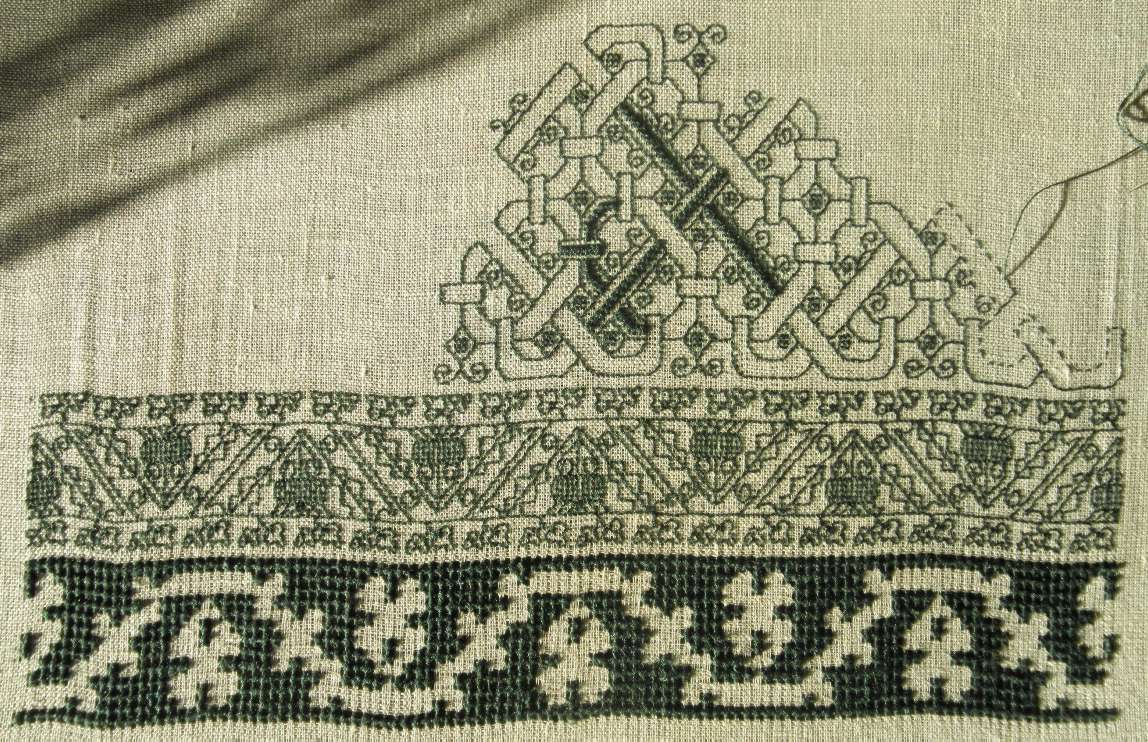
As my dawn-lighted picture reveals, I’m working it in two passes – first setting up the double running stitch outlines, then going back and filling in the dark center stripes. After some initial experimentation, I’ve settled on using Montenegrin stitch for those stripes. Although it’s a legitimate historical stitch contemporary with this style, and is spot on in terms of raised texture and density, I’m not entirely convinced that all artifacts labeled “punto spina pesce” use it (or in fact- employ the same stitch).
Contemporary work of that name more commonly refers to plain old long-armed cross stitch (LACS) but LACS doesn’t give the raised, tightly plaited appearance of the older pieces. Plaited – yes, but the angles in LACS are more acute than those in the museum artifacts. Montenegrin is closer in terms of texture, but is also not spot on. I’ll continue to experiment, but I will finish out this band using Montenegrin, and play further on later band.
To answer Ellen, this is done on 40 count using one strand of Soie d’Alger in color 1846. As you can see from the proportions of the work however, the ground is not exactly square. The 3×8 rectangles used to “bind” the interlaces together clearly show the skew. The bottom band of pulled thread work was done over units that are 4×4 threads. The double running band above it and the one I’m working now are done over 2×2 threads – approximately 20 stitches per inch.
To answer Rachel, yes – holding large frames is a pain. I much prefer working with my small round frame. But I don’t want to compromise the silk I’m using. I use my frame stand as that extra “third hand” to hold my frame, and then stitch with one hand above and one below it. If I can get a comfortable angle, it’s actually faster than stitching using the round frame, where one hand holds the frame and the other does all the work. The round frame does provide a more even tension in all directions. I suppose I could seam on a carrying cloth edge and then lace my piece left and right to improve side to side tension on the flat frame. I’ve done that before on others. But the Millennium provides much better overall tension than my old scroll frame, and I like being able to advance work at a whim, or collapse it for transport. I would not have been able to do this type of work on my old frame without lashing the sides.
To answer Anne, I don’t as a rule endorse retail outlets, I don’t accept recompense in money or kind for anything mentioned in String, and I don’t accept “review copies” or gifts from makers/sellers hoping for positive exposure. However I will say that the source for the frame was Needle Needs in the UK. I bought my silk from Needle in a Haystack in California, and the ultimate source of my ground cloth was Hand Dyed Fibers (I bought it from the original purchaser). The needlework stand I’m using is a Grip-It, which I bought about 20 years ago at The Yarn Shop in College Park, Maryland – long out of business. I altered the Grip-It to accommodate the Millennium by replacing the original jaw bolts with longer ones. It appears that the Grip-It is no longer being made.
THISTLEATION
Marching along. As you can see, I advanced the piece on my rollers. Due to the orientation of my chair and frame stand, I’m most comfortable stitching in the lower third of the available area. Plus, being a new gizmo, I wanted to see how full slack, restacking the bars and tightening worked.

My working thread is marking the center point for the next band. That one will probably be in long armed cross stitch, worked both horizontal or vertical, and on the diagonal to create the foreground. Some museums call this “Punto Spina Pesce.” Modern stitchers probably know it better under the name Montenegrin stitch.
I’ve been having a lively discussion in another forum on useful needlework tools. In addition to the standards, I can offer up this:

Tweezers! Not just any dime store pair. I saw some specifically made for electronics assembly at work. They were so perfect, I went out and bought myself something similar. Electronics tweezers are long and pointy, with precision grip ends. The final half inch or so is nicely rounded, and is a good stand-in for a laying tool (for those who like the economy of a minimal tool set). Further up the shaft the profile switches to more of a D. On mine the 90-degree sides of the D are just sharp enough to cut through thread, so inserting the rounded end into a stitch and pushing ever so slightly will break the stitch without harming the ground cloth. Then the fine grip tweezers can be use to remove any thread detritus left over from ripping back. Electronics tweezers are available in many price ranges. Since nonmagnetic/non-conductive isn’t important for stitching, the least expensive pairs work just fine for my purposes.
I also made a blindingly obvious discovery about needles. I usually use fine tapestry style needles on ground cloth that’s 40+ threads per inch. But I often stitch those finer cloths with one strand of embroidery floss. One strand of floss has the annoying habit of falling out of the needle’s eye, something that drives me batty. But over the weekend I found these:
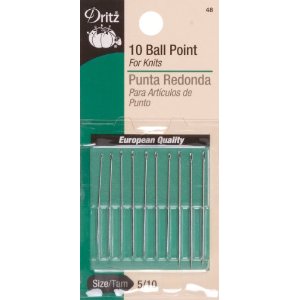
Ball point hand sewing needles, made for use on tricots and fine knit fabrics. You can see in the un-thumbnailed photo above that the eyes are tiny – just big enough for one strand of floss. The points are not quite as blunt as tapestry needles, but they are far less pointy than embroidery or plain-sewing sharps. They slide nicely between the threads of my ground cloth. And the small eye retains the single strand, reducing the time and annoyance of re-threading mid-work. Not orthodox perhaps, but effective.
MESHY AND THISTLES
More progress on Long Green.
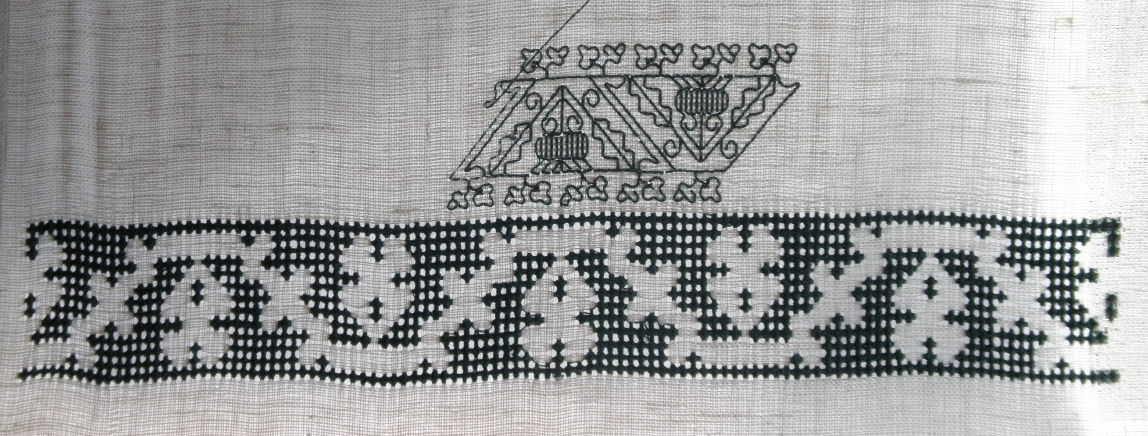
You can see that I finished the mesh strip and have started on a simple double running band. The thickness of the darning on the mesh varies because I was trying out several stitching logics. I’m still working on the illustrations for the best of them, more on that to come. Also, there will be more on how these mesh styles were achieved in historical works. There look to have been several ways to do it – there is no “This is the only right way” method.
Here’s a close-up for Kathryn, who wanted to see the mesh more clearly. This photo is back-illuminated by the sun, and was taken with a piece of printer paper held behind the stitching:

Today’s double running band is yet another pattern that will be appearing in TNCM2.
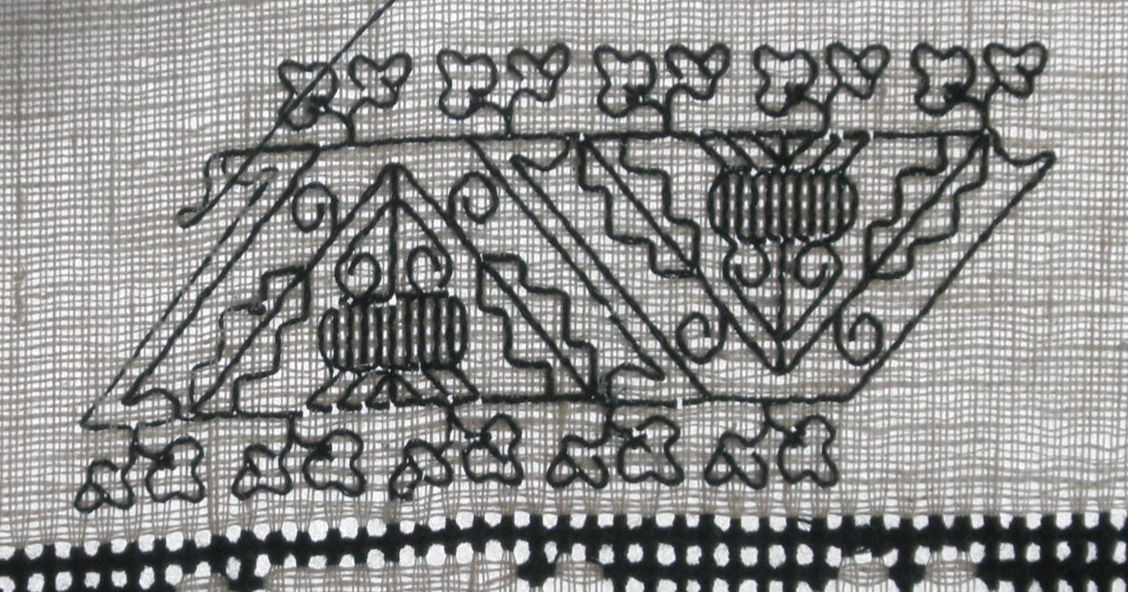
It’s adapted from a drawn (rather than graphed) strip pattern appearing in Egenolff. The drawing however is clearly intended to be geometrical, and as you can see – translates easily to linear counted stitching. I will say that this gauzy linen is far better for the mesh darning and possibly solid voided work than it is for delicate double running. It’s tough to NOT distort the threads when stitching, which may be optimal for the pulled thread mesh, but is problematic for the other styles.
 String-Or-Nothing