MORE RAINBOW, RETURN OF A FRIEND
Having successfully beaten back yet another deadline storm, and having survived the annual school year February break, some semblance of normalcy returns to the String household. I spent a dreary but strangely relaxing weekend catching up on house maintenance – one that finally allowed me time to knit.
And what did I knit?
I continued my two dueling projects – the dropped leaf sweater, the two side-by-side knit sleeves of which are now approaching the 60% completed mark. There’s no point in showing a blurry picture of yet another pair of indistinct gray objects, larger but still not much differentiated from the last. I am also only four stripes short of finishing the Rainbow Scarf that matches the hat shown off last week. That at least has color and drama, even if the knitting is very mundane:

You can see the long tails at the right hand edge. These will be crocheted into tendrils. Similar strands will be added to the left hand edge after the knitting is done, also to be crocheted into tendrils. I am happy to report that one skein each of seven colors of Frog Tree Alpaca is enough to complete the scarf and hat project. Also that I like the Frog Tree. I’ve met with some minor knots and a couple of unevenly spun spots, but nothing drastic. I haven’t washed the stuff yet so I can’t report on whether or not those Crayola-intense colors hold up. I am already looking on to my next mindless project. I’ve gotten a request for another Klein Bottle Hat. I am thinking of getting more Frog Tree in navy blue to do it.
In other news, I can report a miracle of modern commerce and customer satisfaction.
I have had a small Coach bag for years. I splurged on it when I was gravid with Elder Daughter – so that’s something like 16 years ago. So long ago that Coach no longer includes it in their inventory. It’s a good size, just big enough to hold a wallet,keys, and a phone, and not so large that stuffing it into a backpack or briefcase is inconvenient. Although I have a larger bag and a dressier bag for occasions that demand them, my little Coach has been the default handbag of choice for over a decade and a half. Needless to say that much daily wear took its toll. The binding around the edges was worn through at several spots, and the clasp had given up all hope of fulfilling its function. My bag was well loved, and looked it.
Now Coach has tried to go a bit more trendy in styling and moved more upscale, expanding beyond the “do you want that in black, brown, or camel” mindset of my bag’s day. You’d be hard pressed to find anything similar on their shelves now. But Coach bags are guaranteed for life. So I took my friend to a nearby stand-alone Coach store just after the holidays. My bag was so old that no one in the store recognized the style – not even the manager. I asked if they still repaired bags, and only the manager had an inkling of what I was talking about. But they verified the pedigree of my little guy via the serial number stamped into the inside pocket, and taking a shipping and handling fee (plus issuing a lot of “I don’t know if it’s fixable” type comments), sent it off for repair.
Lo and behold, my little bag returned to me on Friday. Cleaned and somewhat refinished, with a new clasp, new edge bindings all the way around, and a new shoulder strap. All for the handling fee. My friend is back, and I’m very happy.

Moral of the story: That $80 that was so exorbitant 16 years ago was very well spent, and my expensive bag ended up being a better value than any number of cheaper ones I might have bought and worn to death since. You’re always better off buying fewer things of classic style from vendors known for quality and service.
RAINBOWS, SLEEVES AND HATS
Still tooling to deadlines at work, even over the holiday weekend. Which leaves less time for blogging than I prefer. But I can report some project progress.
First, on the perpetual ribbed leaf sweater. Done with the back and front, I now have two sleeves on the needles. As always, I’m knitting them side by side so that the shaping on both is dead uniform. If you look closely you’ll see two things happening with the markers. One is that because this is a wide and easily confused repeat, I’ve got one small silver jump ring marking off each repeat, even though I’ve long since memorized the stitch design. Even so, mistakes can creep in. This helps me keep oriented, and allows me to proof my knitting one repeat at a time. The second is that red marker at the beginning of my row. That’s a counting marker.


My pattern says “Increase one stitch at both sleeve edges every 4th row, 24 times.” I’ve chosen to make that increase on a reverse side row (all purls) because it’s less confusing than trying to do it on the texture pattern side. It really doesn’t make a difference in this pattern, so long as the placement is consistent. I’ve got enough of a headache remembering to do it every fourth row (that’s every other purl row), so keeping track of exactly how many times I’ve done an increase row can become a headache, especially because I only get to knit in short spurts. Pencil and paper would get away from me. Instead, I placed a marker immediately before the last stitch on my purl side row the very first time I did one of the increases. When I began my pattern-side row it was sitting there one stitch in from the edge. On every subsequent increase row I did a make one, one stitch in from the edge. That meant that the new stitch happened between the red counting marker and the edge of the work. After that first row, it’s pretty much automatic because the increase point moves further and further away from the static counting marker as the piece grows. I’ve got six sitting between the red marker and the edge now. That’s six increase rows completed. I’ll continue until I’ve got 24 stitches between the red marker and the edge. Problem solved, so long as I don’t forget to increase at both ends of each increase row, on both sleeves.
The other project I’m working is a more mindless piece. We like to play PS2 games as a family after homework and dinner – the exploration/quest type rather than straight shoot-em-ups or race games. That’s excellent sit and knit time, but because all eyes are needed to spot clues or treasures, not optimal for exacting texture knitting. So that’s when I do socks, hats or other easy pieces. This weekend’s fit the bill quite nicely – Dovetail Design’s Rainbow Hat and Scarf. My LYS kitted the pattern up with Frog Tree Alpaca sport weight – the recommended yarn for the project. I’ve finished the hat and am on the first orange stripe of the scarf.
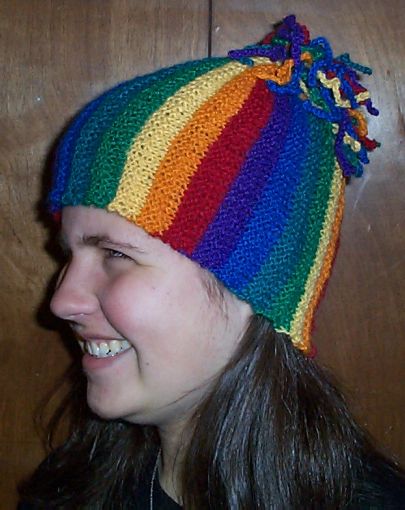
Modeled here by a slightly deranged looking Older Daughter, the hat is a very simple project to knit, but a rather fussy one to finish. It’s knit sideways. Each color is introduced leaving a very long dangling tail, and ended in the same way. There is no shaping, just welts formed by alternating bands of stockinette and reverse stockinette to make a wide rectangle. After the rectangle is finished, the cast on row is joined to the cast-off row. The dangling strands are knotted two by two, then all are twisted and gathered to make a very big single top-knot, forming the closed end of the hat. Finally, using a crochet hook the dangling ends are dealt with, turning them into the crocheted chains that make up the mass of tentacles tassel at the top.
While the basic idea is ultra simple and very easy to knit, there are a couple of refinements that enhance the hat that aren’t covered in the basic pattern. First, the logic of the pattern dictates that some kind of long-tail cast-on be used so that the starting tail is on the same side as end-off tail. but that isn’t called out. In spite of that logic, I used a half-hitch cast-on, deliberately leaving a super long tail. I then used that tail (now on the side of the work opposite that of the zillion dangling long ends) to graft the final row of purple live stitches to the cast-on row of the red. When I was done I treated the dangling end of the grafting yarn just like the other tassel strands. The resulting seam is totally invisible, without much bulk. Second, just tying the tails into a very tightly twisted knot doesn’t close up the hole adequately. Some of the strips stick out like gaping pockets. Others are pleated back inside the hat. I took another strand of yarn and took some carefully placed tacking stitches across the hat just beneath my dense knot, fastening down the tops of the stripes and making the closed end more uniform in appearance. Third, the pattern directs the user to make a slip knot in each strand close to the origin point of the dangling ends near the hat’s closing topknot, and work each one in a crochet chain for as many stitches as possible, ending off the final bit neatly by weaving it back into the crocheted chain. Well and good, but it’s very difficult to work that slip knot in closely. I ended up starting in the center, grabbing a strand and drawing it over one of the others close by in order to make that first foundation loop. After that, I sort of scrummed around, catching the first loop of each new strand somewhere in the mounting foundation created by previous squiggles. It worked out well. The tassel is nice and dense at its base and I skipped the “nurse the slip knot into position” annoyance.
My final criticism is one of yarn choice. I really liked working with the Frog Tree. It’s soft, without the stabbing guard hairs present on many coarser alpaca yarns. The colors are radiant, especially for alpaca which seems to be offered in bright colors less often than other fibers. So far I’ve found some knots in my seven 50-gram balls (one of each color), and some bits where the spinning is a bit uneven, tending to two-inch clumps where the yarn is quite noticeably thicker. But not so many of either that cutting them out was a major problem. So the yarn is fine. But in my opinion this hat should not be made from a sport or even a DK. If you click on the picture above and look closer, you’ll see that the stitches are very leggy, and the fabric is no where near as tightly made as is optimal for a sport or DK weight yarn. The recommended gauge is 4 stitches per inch. The best I could achieve with the Frog Tree was 4.25 (I added a few stitches to the hat to compensate). But I am disappointed in the open, loopy texture. If I were to do this hat again, I’d use a worsted, or heavy worsted (5-4.75 stitches per inch native gauge). Or possibly even one of the most airy and open of the Aran weight yarns (4.5 stitches per inch). I do think that a true 4 stitch per inch yarn would make a hat that’s too heavy.
But sometimes heavy hats are exactly what’s warranted. Older Daughter’s price for modeling her new hat was to show off her own production – a standard issue rolled brim Gusto 10 42-stitch hat.

MAILBOX AND HERO
A couple bits from my mailbox today, plus a long-lost toy.
Yards, grams, and ounces
A reader wrote to ask how to convert ounces and grams to yards, because she’d found a pattern and wanted to buy enough yarn to knit it. I answered with this:
You can’t convert ounces and grams to yards. Yards measures length. Ounces and grams measure weight. One ounce equals 28.35 grams (give or take). One gram equals roughly 0.35 ounces. There are dozens of conversion calculators on the web that can help you flip between the two if you don’t have a calculator or pencil and paper to hand.
Let’s say you had 1.75 ounces (roughly 50 grams) of a 100% wool. You could have about 250 yards of fine fingering weight yarn, or around 135 yards of sport weight wool, or around 120 yards of DK weight wool, or around 100 yards of worsted, or about 80 yards of bulky. And that’s without factoring in stuff like how lofty or dense the yarn is, whether or not it’s made up of multiple strands tightly twisted, or one giant fluffy strand. One five stitch per inch worsted for example might be about 110 yards for 50 grams, but another might be only 90, all depending on the denseness of the strand.
This is further complicated by fiber blends. 1.75 ounces of acrylic at 5 stitches per inch (the textbook definition of worsted) might have significantly higher yardage than 1.75 ounces of 5 stitch per inch wool because the acrylic fiber is in and of itself less massy.
All this being said, there are very loose guidelines of roughly how much yardage a pound of yarn might contain. But remember – use these numbers as a rough guideline only, and only for the fiber type and gauge specified. If you’re planning a yarn purchase and are going on only this type of info – buy at least 25% more than you think you need. I can guarantee that three times out of four, you’ll end up using more yarn than you originally planned. Here’s one set of rough yards per pound figures. Remember – it’s for hand-spun 100% wool only.
Why post patterns for free?
Another person wrote to ask why I post patterns for free. She specifically asked if I was doing it to undercut the people who charged, and wondered why I didn’t write for magazines or other publishers. I wrote back:
I’m flattered that you think my patterns are good enough for professional publication. I think they’re borderline. I don’t do lots of multiple sizes, they tend to be pretty sketchy. Some are more like method descriptions than hard and fast patterns with set yarn quantities.
I post patterns because I find the process of working out the problems they present to be fascinating. My patterns are posted more as a by-product of that exploration rather than the cumulative product. I want to share the fun of both inquiry and production.
I have dabbled in writing patterns for a yarn maker and an on-line magazine. I’m a proposal writer by trade. I spend my professional life running the gauntlet of multiple concurrent hard-stop deadlines. Knitting is an area where my only deadline is “whenever.” I found out that harnessing the creative process to a fixed delivery framework squeezed all the fun (and much of the creativity) out of it. I can’t work under a mandate that inspiration will occur between Thursday next and the 30th of the month, will involve one particular technique and one particular yarn in a color not of my choosing; or that the finished object and full proofed pattern in five sizes will be delivered without delay within 15 days of yarn receipt. Even the web-based magazines brook no delay. So I retreat to my own deadline-free tenth-of-never world, doing whatever the heck I want, when I want to do it.
Why not self-publish and sell the result? Because the burden of handling the business end of the thing (payments, refunds, shipments or downloads, record keeping for taxes) is not commensurate with the pocket change income the effort would bring. I’m re-thinking this in reference to my embroidery book, but to do it for lots of little knitting patterns would be a big pain. Also because patterns people pay for are held to a higher standard than are give-aways. To be competitive, I’d have to knit the trial in a color that photographs well (opposed to the color I want to use), figure out that range of sizes, and use a much higher standard of test knitting than I currently do. While I don’t put out junk as a rule, errors are there. I get to them when I can. But I don’t want to knit everything twice or more – once to create it and at least once more to test the directions, possibly trying out every size offered.
Long Lost Toy
Well, not lost. It’s been sitting in a corner for a while. I made it for Larger Daughter when she was four. Now that Smaller Daughter is out of the hobby horse years, poor Hero isn’t seeing much action. But he’s one of my favorite projects, out of all the things I have ever made.
I had no pattern, some black and green Melton wool scraps left over from some SCA outfits, stuffing, a stick, two brass rings, plus a bit of trim, glue-on jewels, a couple of and bells left over from making holiday ornaments. I improvised and here’s the result.

A stick horse menacing enough for a Nazgul’s child. Needless to say Hero will be spending his retirement here, and not getting passed down to anyone else.
JUSTIN’S COUNTERPANE; BLOCKING BOARDS
A couple items from my inbox.
Question on Justin’s Counterpane
Cindy wrote to say she was having problems conceptualizing how the pieces to make my Justin’s Counterpane pieced blanket fit together. This particular blanket is a large scale intro to white cotton/lacy knitting. Only twelve main units are needed to complete it – six keyhole shaped motifs, and six whole octagons. Ten triangles are used to eke out the sides and make them straight. An optional edging finishes the thing. They’re put together like this:

I did not use additional triangles at the corners to make a true rectangle because it’s easier to go around a more gentle angle without mitering than it is to go around a 90-degree turn. And I didn’t want to go through the bother of mitering my corners.
Because of the relatively few units used and the simplicity of the classic pinwheel motif, I think that people wanting to make a first item in this style might find the pattern useful. Being a blanket, it doesn’t have to fit anybody so gauge is a guideline, not a mandate. It can be worked in any cotton or cotton blend yarn you like. The yarn I chose was a very inexpensive DK weight, but by using the appropriate size needles, a piece of usable dimensions could be made in anything from sport to worsted. Much heavier than that though and you’ll get into weight issues, cotton being quite a bit massive than its equivalent thickness in acrylic or wool. (You could even work this in standard wool or acrylic, but I think the design will be crisper in cotton.)
In any case, some basic guidelines for knitting and seaming together pieced counterpanes include binding the motifs off especially loosely; blocking the units before assembly, by wetting them down and pinning them out while stretching them to their maximum extent; and using whip stitch or when possible, mattress stitch done in half of the edge most stitch to sew them together. Back stitch or mattress stitch done further into the motifs will make the seams too dense and rigid, and may introduce cupping.
Bargain Hunters’ Blocking Boards
Rachel and I had an eMail chat recently. I think it was over on one of the knitting-related boards at Live Journal. She was looking for advice on blocking. In specific, she was looking for low-cost alternatives for blocking. We went through the standards – pinning out on carpet covered with towels or on a padded table or bed, but she wanted a rigid surface that was easy to stow in addition to being inexpensive.
I recommended getting a half-sheet of drywall from the hardware store, taped around the edges to reduce crumble, and topped with a flat sheet through which the pinning happens. I also suggested scouring yard sales or opportunity shops for the squishy/spongy foam pattern/alphabet block floor tiles or play mats favored by the parents of toddlers. They’re indestructible and often outlast the toddler years, landing at second-hand venues. Top those with a sheet and pin away, happy that you’ve found a modular, easy to store solution that as a creative recycle, nibbles away at the waste stream.
Rachel decided to go with the play mat idea. She sent me a note of thanks, and included this shot of her shawl blocking:

(Photo is hers, used with permission). She also notes that she got her mat at WalMart, and it was less than $20. Love the shawl, Rachel, and as ever – I’m delighted to have been useful.
HACKING THE HOLIDAYS
Not much knitting here beyond finishing up the gift socks mentioned yesterday, which later today will be given to the target recipient. I also posted a yarn review for the Schoeller/Stahl sock yarn I used.

(Please consider leaving reviews of your current yarn yourself, as a holiday present to fellow knitters worldwide).
I can in the spirit of ecumenicism born of our happy, culturally jumbled household recommend two non-knitting related holiday hacks.
First for Hanukkah (and Kwanzaa): Every kid is fascinated by the candles used in menorahs and other holiday candle holders. They burn quickly, and often being close together, act on each other to make strange melting patterns and drips – especially when “encouraged” by the viewer. And every kid who grew up with a menorah in the house will either admit to performing said encouragements, or by virtue of being watched constantly, not having the chance to do what he or she really wanted to do. But not every parent can hover over the candles for the entire time they are lit for eight nights straight.
Now devices are no substitute for parental supervision, but accidents happen in even the most careful household. Place your menorah on a shallow lipped pan (like an inexpensive jellyroll pan or in my case – the liner pan that came with a now defunct toaster oven) and fill the pan with about a quarter inch of water. Drips will fall into the water, and won’t weld the menorah to the table or counter top. Should your offspring be too helpful and a candle come loose from its moorings – it will fall harmlessly into your mini-reflecting pool and be extinguished.
Second for Christmas trees: Fighting one’s way underneath the lower branches to water the thing is a major pain. I cheat. I float some packing peanuts or crumpled aluminum foil on top of the water so I can see the level while still standing. I also take a tube or pipe (in this house, the unobtrusive brown extension tubes from our upright vacuum cleaner) and wedge them into the tree holder’s bucket area. I use some twist-ties to anchor the tube against a branch. The tube remains there as long as the tree is in the house. Then when watering time comes, I take a watering can and pour into the tube until I see my floating markers rise. No bending, no needles in my hair, no overflows.
PEARLS AND PURLS (BUT NO SWINE)
We celebrated Hanukkah this weekend past in our own style. Fried foods are traditional. We did crab cakes. Not traditional by a long shot, but tasty none the less.
The Resident Male, finding himself at the fish shop buying the crab was tempted by some beautiful Bluepoint oysters. So he brought home four as a special grownups-only treat.
So there we were, happily slurping down our excellent oysters, when I thought I found a bit of shell. Not uncommon in oysters opened by amateurs*. But it wasn’t shell.
It was a pearl.
A natural pearl. Far from gem grade, but round and pearly enough to qualify, even though you can see a bit of the gravel that inspired it sticking out from one end.
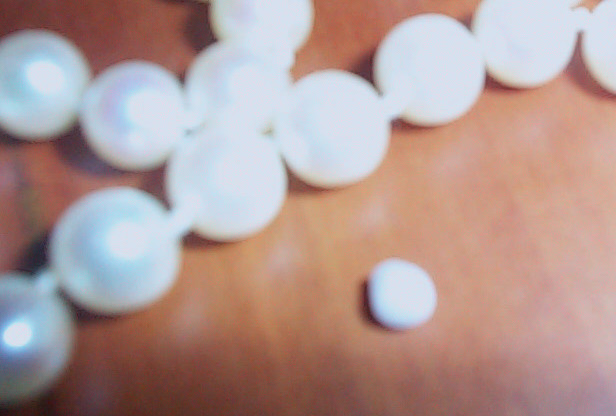
I’ve put my tiny pearl next to a strand of cultured pearls for size comparison. I’ve joked about finding a pearl, and have known it was remotely possible. But I’d never heard of anyone actually finding one. So what to do with my inferior but extremely lucky pearl? Wear it for luck, of course. I’m thinking of getting a tiny silver charm in the shape of a cage to keep it in.
And I’ll probably make the traditional latkes tonight.
As far as knitting goes, I’m trying to zip through the remainder of a pair of socks, plus get a start on the foraging cap (in the style of a Liberty or voyageur’s cap) for my re-enactor friend. I’ve got a nice hand-spun wool fingering weight single, in a color sort of between forest and teal, with a touch of black. I would have preferred a barn red, but the red I had was heathered with too much white and from a distance read “pink.” Shown here are my larval beginnings (I’m working on the area that when finished will be the facing in the earband, plus the too-pink yarn. Gauge here is between 5.75 and 6 stitches per inch. I’ve got 130 on the needles, and am getting a band big enough to fit a 23″ circumference head. There’s some allowance for stretch and the hat will be double thick at the earband, but I don’t want to make it so tight that the wearer will get a headache. You can see just a bit of provisional cast-on peeking out at the bottom of that dark green wiggle:

Other than that, I am finishing up yet another pair of gift socks. This one from Schoeller+Stahl Fortissma Colori/Socka Color, color #5.

* We follow the safer Julia Child oyster method (learned while watching her on TV). It involves identifying the hinge and using the pointy end of a bottle opener to dislocate it. Then using a thin, sharp knife – winkling it into the opening made by the unhinging and running it around the oyster inside to scrape it top and bottom from its shell.
LEAVES AND COTTON SOCKS
As promised, here’s my knitting progress. First, the leaf pullover:
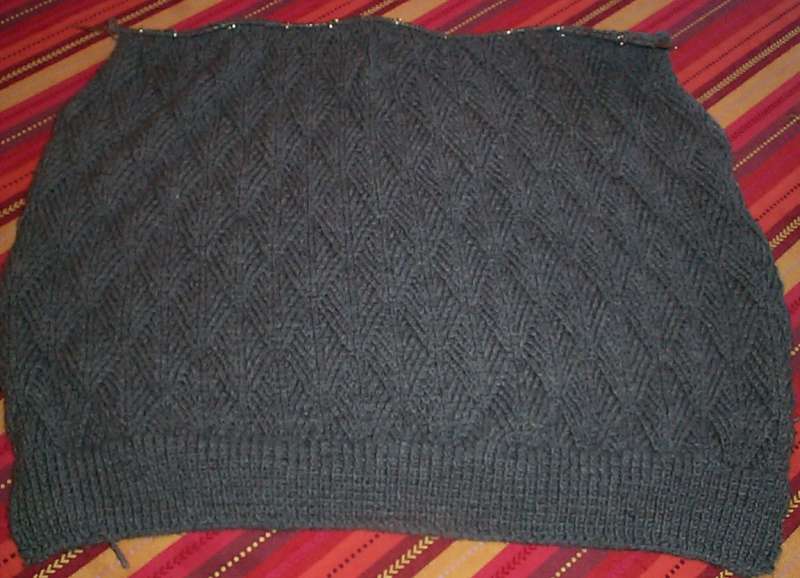
As you can barely see, I’m now well past the underarm narrowing, about half-way from that point to the beginning of the neckline. It’s still very slow going because of all the 1×1 twists, but I’m very pleased with the effect, in spite of the thing being a bit off gauge and an inch too wide (I like loose fitting sweaters in mid-winter). Although I’m mired in holiday gift knitting right now I’m making a point of NOT putting this down in its entirety. I want to avoid what I now (thanks to blogging) see as a familiar pattern – the sidelining of my October/November project due to gifts leading to its eventual consignment to my Chest of Knitting Horrors ™.
And in gift knitting, here is a mostly done sock worked in a combo of black Cascade Fixation and raspberry Elann Sock it To Me Collection Esprit. Both yarns are 98.3% cotton, 1.7% elastic. Both are marked with the same yardage (186 yards stretched or 100 yards relaxed), and same gauge 25st and 40 rows = 4 inches or 10 cm. Fixation also carries a crochet gauge of 29 double crochets and 12 rows = 4 inches or 10 cm. As far as I can tell, they look like exactly the same yarn. While the yarn review collection reports Fixation as a worsted based on its initially reported gauge, current labeling moves it down to the sport yarn realm in line with Esprit’s labeling. I say neither is spot on, and would call both yarns DKs.
My own gauge using 3mm needles at a reasonable sock gauge is 6.5 stitches and 12 rows = 1 inch. The fabric is markedly stretchy, even more so than a comparable weight wool yarn knit at the same tight gauge. Now I know many people who have reason to avoid wool socks swear by this stuff, but I’m less enchanted. I selected it because I am knitting socks for someone who is both wool sensitive and diabetic, who requested very stretchy cotton socks with a specific wide ankle measurement in comparison to the foot area. I am working my standard toe-up sock on a foot circumference of 48 stitches, moving up to 52 stitches just prior to the short rowed heel, and then 54 stitches immediately after. I add another four stitches at the uppermost black stripe for an ankle part stitch count of 60 stitches. Based on progress so far I predict I’ll use one ball of raspberry on each sock, plus most of one ball of black between the two. I bought 4 raspberry and two black, so I’ll have enough left over to make another pair, should I so desire.
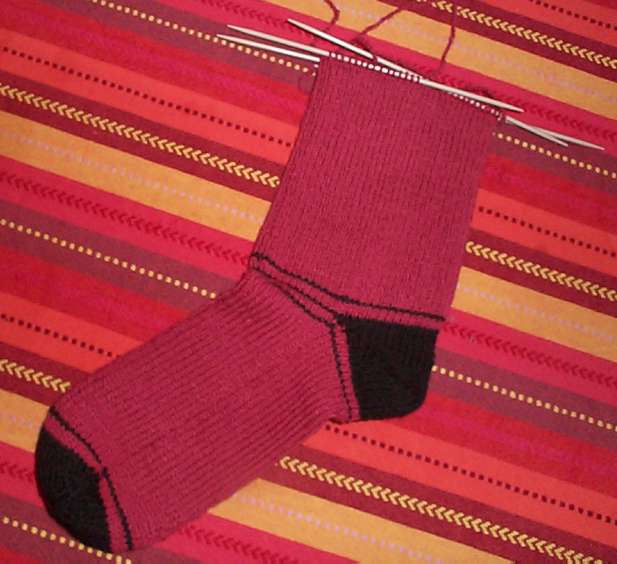
But I’m not sure I so desire. Although this sock is suitably uber-stretchy, and the cotton yarn is relatively lofty, I don’t like the feel of cotton socks for myself. I find them cold and hard compared to wool, and walking in them feels like walking in a massage sandal studded with thousands of little pebbles. But I don’t have problems with wool. If you do, this yarn is an acceptable substitute, although at its weight you’re going to end up with nice, thick hiking socks, not fingering weight socks that are wearable in a wider range of shoes.
I was also disappointed in the color of the raspberry bought via the Web from Elann. Standard cautions on buying based on color displayed on a computer monitor apply. Remember – no color monitor displays true color fidelity, and lighting conditions at the photographer’s end can add complications (to demonstrate this, call up different photos of the same color card at multiple retailers’ websites, and/or view the exact same color card photo on different monitors). On line the stuff looked much deeper, almost wine in hue (which was the color requested by the recipient). In person the raspberry is closer to an unexciting mauve. Color fidelity is another reason I vastly prefer to buy yarn in person rather than by mail order. Color cards help, but since I have so many excellent local yarn source options, and am always looking for new yarns rather than repeaters, I do not buy by mail often enough to invest in them.
My next bit of gift knitting will be a wool foraging cap for a historical re-enactor friend. It’s mid to late 1700s or so in target, and will be based on Voyageur’s Caps and Liberty Caps. I’ll take notes as I create that hat in case the thing catches on with his re-enactor regiment. Second cotton sock will probably take me through Thursday or Friday, so I won’t be beginning his hat until later this week.
HALF BAKED HOLIDAYS REDUX
If you’ve been reading along here for a while, you might remember I’ve mentioned this family’s holiday cookie fixation before. Ten kinds. Every year. (I do give most away to co-workers and friends rather than let us eat them all ourselves). This year’s list is a mix of first time experiments and family favorites. It includes:
- Chocolate chip cookies – the classic, but made with mini chips and pecans instead of walnuts, slightly smaller than their non-holiday brothers. Mostly from the official Toll House recipe printed each year on the bag of chips (although I do cheat and use non-official chocolate).
- Peanut butter cookies – my kids would shudder in horror if I left these off the list. Done with crunchy peanut butter, just for fun. Otherwise it’s the standard from Joy of Cooking
- Buffalo rum balls – a version of the classic crushed cookie bourbon ball, but done with rum and cocoa, rolled in cocoa. Our variation comes from a recipe published in the Buffalo, NY evening newspaper some time in the 1960s
- Sugar cut-outs – the iconic holiday cookie. This year we get to use the Hannukah cookie cutters. Also I put lemon zest in the batter, and mix the icing with lemon juice instead of milk or water
- Oysters – a family invention. A hazelnut spritz sandwich cookie, filled with dark chocolate ganache
- Linzer cookies – New this year, from the King Arthur website recipe collection. Mine have little leaf shaped holes, that being the smallest cookie cutter I had on hand to do the center hole.
- Chocolate crinkles – Also from the King Arthur website. Killer chocolate flavor, fantastic texture. We use extra cocoa instead of espresso powder. My kids call these “Earthquakes” because the white sugar outside flaws and cracks in baking to reveal chocolate fault lines. I made these the first time two years ago from a very similar recipe sent by a friend and they’ve become favorites. (Hi, Kathryn!)
- Almond/cherry biscotti – Another new one. I’m cribbing this recipe together from several sources, including a basic biscotti recipe in the always wonderful Baking with Julia book. This is instead of the Panforte which although excellent deserves a break after a two years running appearance
- Lime cookies – Again a new experiment. This one depends on my finding sour salt (citric acid) locally. My grandmother used it to make her stuffed cabbage and to restore the shine to aluminum pots and pans (boiling them in a bath of water and sour salt). Another King Arthur website find.
- Pecan sandies – A family recipe, basically a nut-rich shortbread, rolled in granulated sugar and topped with a pecan half. These tend to alternate appearances with Mexican Wedding Cakes in our roster, as both are pecan shortbread type cookies.
I made a lot of progress this weekend past. I’ve got two cookies left to bake – the biscotti and the lime cookies. Plus I have to fill the oysters and Linzer cookies, and the kids get to ice the cut outs.
In other news, knitting did get done. Here you see the second of my two emergency baby shower gifts blocking on a balloon. The Regia 6-ply Crazy Colors has a relatively long repeat, so it makes wide stripes on both booties and hat. The white sections and broad yellow welting (including the tips of the I-cord bootie laces and hat bow) however are done in another well-aged leftover.

I also managed to get another couple of inches done on my ribbed leaf pullover, and complete about half a sock of other holiday gift knitting. But more on those tomorrow.
FRANKLIN’S GHOST OF CHRISTMAST KNITTING
I’m with Franklin all the way on this. I’ve been visited by his Ghost of Christmas Knitting, but that specter couldn’t force his way into the room, crowded as it already was by the Ghost of Hastily Announced Baby Shower Knitting, the Ghost of Birthdays Come and Gone Knitting, and the amorphous yet omnipresent-in-December Ghost of Holiday Preparations. The whole spooky committee then voted and consigned me to wherever procrastinators end up, when they remember that they have to be somewhere.
But tamales, cookies (cocoa rum balls and peanut butters both done and lagered away), work, and routine family support tasks aside, I did manage to whack into the baby shower backlog. Which is a good thing because today is the first of several.

The white with speckles hat and white booties are knit in Sirdar Snuggly Snowflake DK. I believe it’s now discontinued, but these are leftovers from a Oat Couture Curlique Coverlet done about six years ago for a niece. It’s a spectacular pattern and I had a great time with the blanket, although (like everything else) I did play with it a bit. It’s difficult to see in the official cover photo, but the thing is a round blanket, knit in garter stitch paisley-type slices, with the shaping formed by short rows and picking up along an edge. I wouldn’t quite call it modular knitting, but if you’re familiar with that style, this blanket will be easier for you than for someone who has never done short-rowing before. What I did was notice that the pattern had a logic that would enable the use of two colors. I knit all of the segments radiating from the center in a white-with-speckles Snowflake, and all of the other segments in plain white Snowflake. What I ended up with was subtle, but effective – a center swirled star with speckles surrounded by a plain white field.
One caveat – because I used the loopy Snowflake, my final texture was sort of reminiscent of a supple light terry cloth towel, with less distinct garter ridges than the pattern’s own photo. I wish I had pictures of that blanket to share, but I made it BS (Before String), and never got a snap back of the target baby with her present. I’d do the blanket again but not in this yarn. In any case, Snowflake worked just fine for my no-pattern hat and standard issue booties, although again, I’ve played with the pattern. I did the Ann Kreckel baby bootie, but because this is DK weight, I worked it on a sole of 8 stitches x 16 rows, and adjusted the rest of the pattern accordingly.
The multicolor hat is knit in other stash-dwelling odds and ends. The multi part is clearly Regia Crazy Color, left over from the Crazy Raglan I made for Smallest Daughter. The solid white and yellow used on the welting and stockinette edge are ancient bits of Baruffa/Lane Borgosesia 7 Settembre DK, shamelessly stolen from my mother’s stash. Both colors are remnants of a project she did around 1993 or so. 7 Settembre was a particularly nice machine wash textbook-standard DK weight 100% wool that came in a wide range of colors, including brights; now long since discontinued. There will be booties to accompany this no-pattern hat, too.
Moral of today’s post – Those half-ball or less odds and ends left over after a project come in handy if you need to do up a quick, small gift; don’t throw them away! Think of it as bonus investment in future gifts. Oh, and that holiday knitting thing? Boo, humbug! There are still 9 knitting days to Hanukkah (which thankfully lasts until the 23rd), and 18 knitting days until Christmas.
KNIT REPAIR
Today I document a Good Deed.
A co-worker, all puppy eyes and pleading, brought his favorite sweater to me yesterday. He bought it in Ireland, and practically lives in it all winter. He’d caught the elbow on something sharp, and cut a strand. And then the snag started to run. He asked me if I could fix it.
The sweater is of good quality, rustic finish wool. It looks like it was knit from two strands of sport or guernsey weight. The seams are machine-sewn, and there’s a nice “commando collar” – double thick ribbing, inset in a V, with a low turtleneck finish and center zipper. I’m not a machine knitter, so I’m not really up on what can and cannot be done using one, but the cables are not deeply embossed. They’re all formed by traveling stitches rather than multiple-stitch cable crossings.
Still, it’s a particularly nice and obviously beloved item. So I brought it home to fix.
Fixing hand knits with runs in them should be second nature to most knitters. First, you want to identify the break. Then if a run or ladder has developed, you want to spot the bottom-most good stitch that sits below the run. That’s the one that needs to be secured, and the one that you’ll use later in the repair. In this case, I secured it temporarily with a safety pin so it wouldn’t ladder down any farther.
If the yarn has broken, the ends need to be secured. Since this is a nice, sticky, traditional finish wool, the stitches left and right of the broken one hadn’t raveled side to side. (A plus for working with real wool). I reinforced them gently on the wrong side with some darning yarn of the same color, taking care not to let my repair show through to the front. Then I smoothed out the lumpy ladder, separating the rungs. Obviously there was one rung missing – the one that would have been formed by the broken strand. I laid some long stitches across that spot with my matching darning yarn until I had approximately the thickness of the original yarn built up.
Then I took a crochet hook and starting with that stitch at the base of the run, I re-formed the knitting stitches. I did this by pulling each rung through the stitch below it. Luckily this particular repair occurred in a plain stockinette area. I didn’t have to deal with crossed stitches or purls.
Once I had re-built all of the stitches, I had one top stitch that needed to be secured. Again I was lucky. This particular column of stitches “dead ended” at a traveling stitch cable. I used my darning yarn to take a tiny stitch, securing the loose loop to the side of the cable at the point where it would have been eaten by the decrease that formed the cable’s movement.
Here’s the result (not that my lousy photography skills and a charcoal gray subject make it any easier to see):
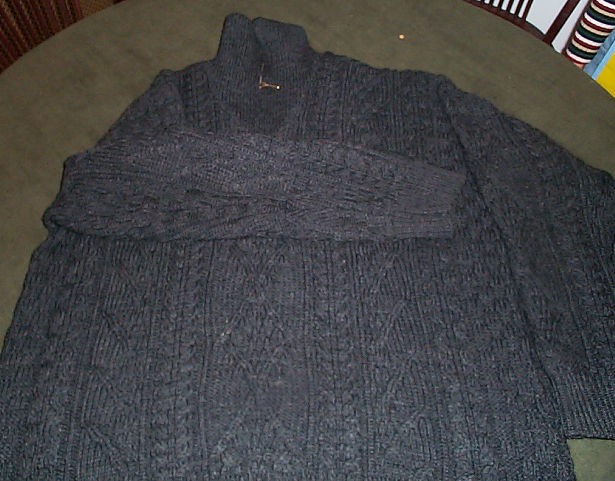
The formerly broken bit is in the top center of the sleeve that lies across the body, roughly below the zipper slider. You can’t see it, but take my word for it – the repair is totally invisible.
So, today’s morals are:
-
Don’t toss damaged hand-knits in a corner in despair. You can use your knitting-developed skills to rescue some of them. and
-
Ease of repair down the road is yet another reason to use the best quality materials you can afford.
 String-Or-Nothing