CONTINUING THE ILLUSION
The OpArt baby blanket continues to grow. Being all garter stitch with very obvious markers to wake the fingers up when the four increase points are reached, it’s an autopilot project, ideal for knitting while watching subtitled movies:

Right now it’s approximately 22 inches across, and I’m not finished with the second 6-ridge (12 row) set of stripes. The pattern continues on for four more stripes, one each of 7, 8, 9, and 10 ridges, alternating colors (a larger size goes on for two more stripes of 11 and 12 ridges respectively). I’ll keep going until I either run out of yarn, or I feel the thing is big enough to be a lap/basket/car seat blanket – at least another two stripes. The jury is still out on whether or not I’ll end off with one last stripe of orange. The Record 210 yarn is holding out fine. I’m on my third skein of each color, and have at least two more of each as yet untouched. I did hit a couple of poorly plied spots in one skein of the yellow. They were bad enough to excise rather than work in, although that made even more ends.
For the record, given the vast number of ends, I’ve been finishing them off as I go rather than waiting until the knitting is complete. I strongly recommend doing it that way, unless you’ve got a “finishing party” to go to.
What subtitled movie was I watching? Sansho the Bailiff. It’s from famous Japanese director Kenji Mizoguchi, made in 1954. It’s bout the development of compassion in a brutal time. In the movie the family of a noble minded official is torn apart, and the children grow up in the most wretched of circumstances, yet maintain their absent father’s ideals. An excellent film, but very affecting. Bring a box of tissues.
ILLUSION
The amazing flood of fecundity exhibited by my friends and co-workers has not yet crested. More baby gifts are required. Being at this moment long on leftover yarn but short on inspiration and time I was delighted to notice something simple and clever in Knitty. Melissa Dominguez’ OpArt baby blanket fits the bill. It’s similar in principle to the Centerpiece Treasure pattern offered by Lion Brand, which I believe was a licensed outgrowth of a square published in the first Knitters Magazine Afghan competition in the spring of 1995. All are squares knit center out, relying on a simple non-eyelet increase in the corners to create a spiraling effect, and stripes in multiple colors to magnify the visual spiral effect. Melissa’s very successful bit of cleverness is to graduate the width of the stripes in the spiral throughout the piece, and limit the colors used to two. That takes the pleasing but static swirl and gives it depth and a striking appearance very true to her Op Art inspiration.
Diving into the stash of remnants, knowing that exact gauge doesn’t matter in this type of project, I came up with some Austermann Record 210 – a non-mercerized cotton. It’s listed on the label as Aran weight (18 stitches/27 rows =4 inches or 10cm), but I found in the past that it knits up closer to Worsted (20 stitches = 4 inches). I used it before to make my citrus-color Ridged Raglan pullover from another pre-2000 issue of Knitters, back before they fell into their current self-referential rut.

210 is a durable matte-finish cotton that holds its color and shape through repeated washings, after a small bit of shrinkage in the first wash. It’s biggest drawback is that it’s composed of lots of small plies and isn’t very tightly twisted, so it splits like crazy while being worked. I’m using US #6s (4mm) and am getting a gauge of 5spi in garter stitch.
I’m pretty sure I have enough of the lemon and lime to make up a small crib or travel size throw. If not, I’ll figure out a way to introduce the orange. Perhaps as a framing stripe around the outside. In any case, the thing is already on its way:
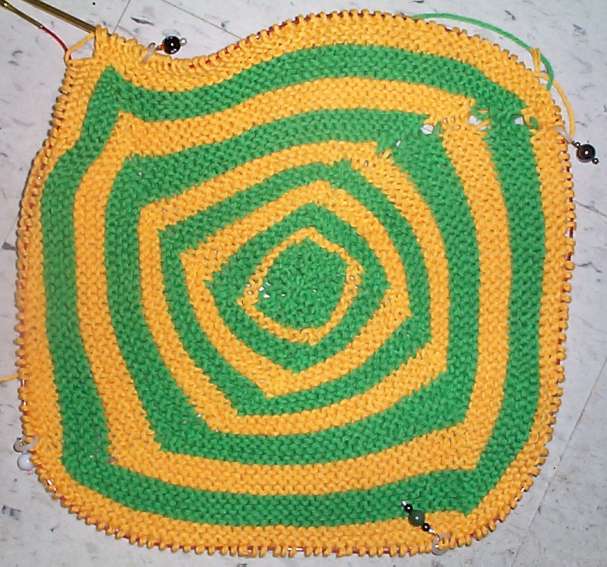
You can see Melissa’s spiral effect and illusion of depth already starting. You’ll also note the one bit of annoyance inherent in this type of pattern. Each stripe means two ends to finish off. I’ve ended off the first four stripe’s worth so I could see the joins would look, but you can see the chain of holes at 2:00 – each one signaling two more strands to tame.
I’ll keep going on this one until I run out of yarn. At that point, it will be big enough. Thank you Melissa!
MORE PROGRESS AND STORE CLOSURE RANT
Elder daughter’s Walker Learn to Knit book afghan continues to grow. She’s working in Cascade 220, in assorted greens gleaned from the orphan skein shelf at Wild & Woolly in Lexington (our local yarn shop).
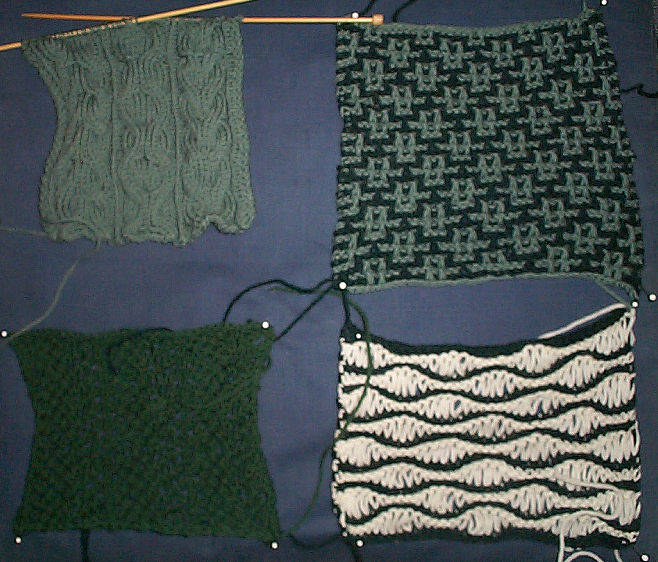
Her goal is to have enough finished by next fall to furnish herself with an off-to-college blanket. Younger daughter has decided that crochet is easier for her to handle than knitting, and armed with books from my library and yarn from my stash, is making a stab at a zig-zag blanket for her favorite stuffed animal. So the transmission of obsession is prospering here at String.
On my own knitting – I am making good albeit slow progress on the olive green tablecloth. The section I’m working now is rather spider-webby. It’s an eternity of rows alternating between [S2-k1-PSSO, (YO)2] and [K (K1,P1)] to make an infinitude of center double decrease columns with large eyelets between them. Given that the piece has something close to 1,200 stitches per round at this point, each row takes forever. Especially the double decrease row. The last thing I want to do is miss a loop. So progress is slow to accumulate, especially because I want this spider web area to be at least six to eight inches deep (yes I do have the play in the linking brides to accommodate the fixed stitch count of this patten and corresponding total diameter increase of the round cloth over the added depth).

In other news, I heard that a local yarn source is closing. Not my favorite shop (thank goodness), but a two-outlet big-box store that focused mostly on fabric and decorating, that greatly expanded and then shrank its yarn department in response to the scarf knitting fad of a couple of years ago. I was always ambivalent about it. Although I did buy fabric there on occasion, didn’t buy their yarn because I wasn’t fond of that store’s effect on other area yarn shops. At one point they absorbed several of the better mid-range suppliers’ products, then using their volume purchase to engineer discounts from the makers, sold those yarns at prices significantly lower than smaller stores could manage. Doing this they cornered the market on (for example) Plymouth Lopi. Small knitshops could no longer afford to stock it and lost significant foot traffic as a result. Now the big box store is closing. No more yarn, no more fabric.
Now the reversal of yarn sales wasn’t the cause. I suspect rising rents (the mall in which it is located has expanded considerably in the past two years), the general decrease in discretionary spending (much of their revenue was from their home decoration department), and a decrease in interest in quilting and home sewing in general. Most of the times I hit the fabric department, I was the youngest person shopping, and being a Boomer, I’m no longer a sweet, young thing. Changes in the economy, changing customer demographics, crashes in the popularity of multiple hobbies, rising infrastructure costs all add up to the loss.
Now there’s a new problem. Where to buy fabric? What’s left in the inner/outer suburb belt here is woefully inadequate – shops that have scaled back their sewing departments in favor of scrapbooking and other low-investment/low skill hobbies. There are a couple of small stores scattered around, useful but with very limited stocks. I haven’t been downtown to what used to be the garment district in Boston in years. It used to be the home of several stores where bolts went to die – remnant shops and mill end type places. But that was long ago, and that neighborhood has gone upscale.
In the mean time, I note the store’s passing, plus the closing of a couple of the smaller yarn shops that opened up at the crest of the scarf knitting fad, and hope that retrenchment will leave us with local yarn stores. I for one need to see and feel yarn for inspiration – the texture, the drape, the weight, the loft, and most of all – the color. I can’t buy blind off the web, based on photos, descriptions, and reviews – even those on wiseNeedle. I value the expertise and help available at local shops, and am willing to pay a small surcharge per skein to support that help (rather than spending it on shipping). And most of all, I like the experience of seeing and evaluating alternatives in person, being able to take leaps of inspiration based on the stock of yarns and patterns at hand.
Perhaps the rise in Internet yarn shopping is part of the stampede towards sameness I see across many knitters’ projects reported on line. Someone knits something, and it turns out quite well. Other well-connected knitters see the success and want to duplicate it. So they too buy the same pattern and same yarn. Both being known entities, purchase sight-unseen is a viable option. Now there’s absolutely nothing wrong with doing any of that, knitting up something that’s a proven winner, or using the exact yarns (or even colors) specified in a pattern or that someone else has used. It’s safe. It’s proven, and the chances of success are magnified. But it’s not the way I knit. And I’m guessing that there are other “bungie jumping” knitters out there that find the proliferation of the latest got-to-knit item stifling, and yearn for a wander through a warren of tactile and visual inspiration. If you’re out there, please speak up. And visit your local yarn shop before it’s gone, too.
END OF SUMMER
It’s official. There may be a week and a half to go before school in this area starts up again, but summer is now officially over. This weekend past we retrieved the offspring from Roads End Farm:

Now it’s the double-time quick slide back to lunch boxes, homework, and maternal nagging.
On the olive green tablecloth – progress continues. I decided to add width by continuing to knit center out rather than adding an edging knit around the circumference. I did some planned increases in a solid strip to bring the stitch count up to a multiple suitable for working an extended pattern I found on another cloth in the same Duchrow volume. It’s a wide panel of [K3tog, (yo)2x] ground, with all of the triples aligning to make prominent radial ridges. Sort of close-in spiderwebby. I’ll work them though as center double decreases to increase the effect. When the panel is about 5 inches wider (about 10 inches total in diameter for the entire cloth), I’ll branch out into the plume-like/peacock final pattern from the Duchrow instructions. My only concern is that I may have to rip back a bit and start again. I think that the new area is a bit rippled. I probably should have continued for a couple more rows of plain stockinette before launching my chosen ridge and terminal frond pattern. I’ll know for sure after the next row. If anyone is keeping track, my circumference is now something like 960 stitches around.
And from the wide-wide world – I was surprised to see this illustration in the fashion column in this weekend past’s Boston Globe magazine section:
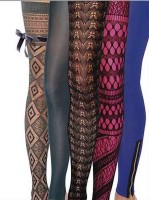
Knitted lace high stockings. I can do that! Perhaps I will. Elder Daughter would probably have a fit of delight to receive a pair.
For the record, some look like they have stirrup bottoms rather than full feet, and some are listed as tights, meaning they have a pantyhose style integrated top rather than just a stocking and garter tie like the leftmost offering in the pix above.
RETURN TO OLIVE
To take a break from baby gifts, I picked up my green lace tablecloth this weekend past. I’ve now made my way to the end of the charted patterns.

The last two rows of the second chart are a bit confusing for non-German speaking users. I finally figured out that they refer to a crocheted bind-off. The lower row symbol (either the number 2 or 3) indicates how many knit stitches are to be gathered up in a fastening single crochet, and the upper row number symbols indicate how many chain stitches are to be created between those single crochets. But I didn’t do the indicated bind-off.
I estimate that if bound off now, my piece would be about 45-48 inches across. I wanted a piece that was 52 inches or more around. That means I now am off in the land of improvisation. I did the penultimate charted row by working k3-tog or k2-tog as indicated, but adding the “subtracted” stitches via yarn-overs, trusting that I could get away with one row that didn’t add a ton of stitches to increase total piece diameter.
Now comes the problem of what to do next. I do have to add a considerable bit of depth. I don’t think that an edging strip knit around the circumference will be deep enough all by itself. I think I’ll have to work another coordinating segment, knit center-out before launching into any as-yet-unspecified pointy or dagged edging. Unless I can find one of the particularly deep edgings that sports “collar properties” – that is significantly wider along the free side compared to the attachment side, so that it naturally conforms to a collar-like, graceful curve. Now I know there are quite a few of those out there, but whether their repeat length, increase ratio, and motifs work well with the stitch count and pattern of the base cloth will all contribute to my final decision.
BABY GIFT #3 FINISHED
Just before the fourth of July week, I got some yarn to make baby gifts. One of the items was this cleverly packaged kit from Plymouth:

It contains a ball of Cotton Kisses yarn, three little ducky buttons, and two patterns – one for a three button cardigan (below), and one for a three button placket pullover (shown on the yarn ball). Both patterns are given for three sizes, from newborn through 1 year. The entire thing was $14. at my favorite local yarn store in Lexington, MA. This weekend past I went on a small kid-free vacation, and while away, knit it up while sitting on the beach.

I did the cardigan in the 6 month size. It’s finished except for sewing on the buttons. I made buttonholes on both sides of the button band. When I find out the sex of the target baby, I’ll sew the buttons onto the appropriate spot, covering up the unneeded set of buttonholes. I had ample yarn left over – probably enough to do matching socklets, so there should be plenty of yarn to make the largest size.
This was a very inexpensive and quick project. The directions are clear and simple. There is minimal shaping, and interest is provided by a double welt garter ridge detail at the bottom of the body and ends of the sleeves. The only vague bit was the direction to make three evenly spaced buttonholes. I substituted two stitch one-row buttonholes for the K2tog/yo ones written up. All in all a new knitter could handle the creation and assembly of this project with ease.
My only caution is a very mild one on the yarn itself. Cotton Kisses is a loosely plied multi-strand cotton blend. One of the strands is fuzzy cotton, slubby and puffy, the other three are thin binder strands of the blend fibers. All are very inelastic, as one would expect from a yarn of this composition. While the resulting texture is extremely soft and pleasingly random, hiding any imperfections in stockinette stitch formation, working with it does take a tiny bit of concentration to avoid splitting the strands. (The variegated color I was using also camouflages any stitch irregularities.) People who don’t like the inelasticity of cotton would also probably not like working with this one. Still – for a very economical quick knit baby project that’s cute and easy to do, with a yarn that with a tiny bit of patience gives an excellent result even for new knitters struggling for stitch evenness – this one is a go.
BABY GIFT #2 (MOSTLY) DONE
The yellow baby blanket is mostly done. All that’s left is to graft the beginning of the edging to its end, and darn in the dangling ends. Here it is patted out and pinned to the back of the sofa, which accounts for the strange dimensional distortion.
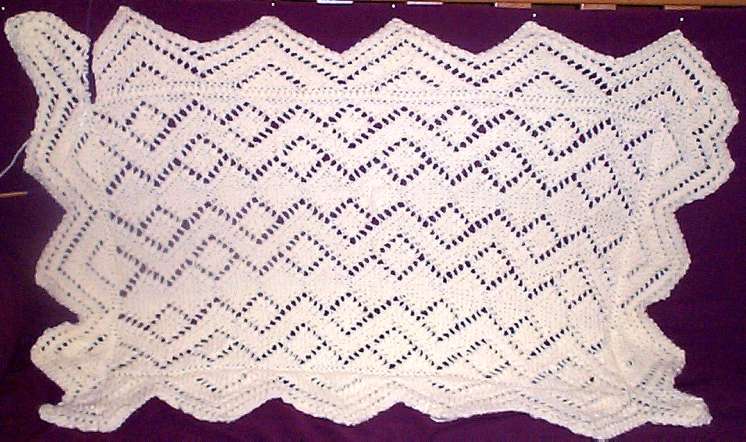
I’m 80% satisfied with it. It’s small, more like basket or car seat size than crib size. I only had four skeins and used all but about ten yards of it. I’m only halfway pleased with the corners. The math worked out to be a multiple of a half repeat. That means that two corners were mitered starting at the narrowest point of the repeat, and two were mitered starting at the widest point. I will say that mitering at the narrowest point for this symmetrical edging worked better. That corner is in the upper left of the photo. Its opposite at the upper right looks clunky by comparison. If I had the thing to do over again (with more yarn) I’d work another three inches of the center panel so that all four corners could begin at the narrowest spot on the edging repeat.
The stitch patterns for this one also came from the the first Duchrow book. The center is pretty much verbatim, and can be found on page 35. The edging is inspired by the companion edging presented on the same page. My version is truncated by about a third of the original width. I arbitrarily cut off about eleven right hand side stitches, turning what were diamonds framed by a zig zag on the dagged side and triangles on the join side into plain old triangles, and eliminating a column of fagoting. Along the way I noticed that a smaller “junior” version of the same thing could be worked by using only a portion of my rows. I present both in the pattern graph below (click on it for full size version).
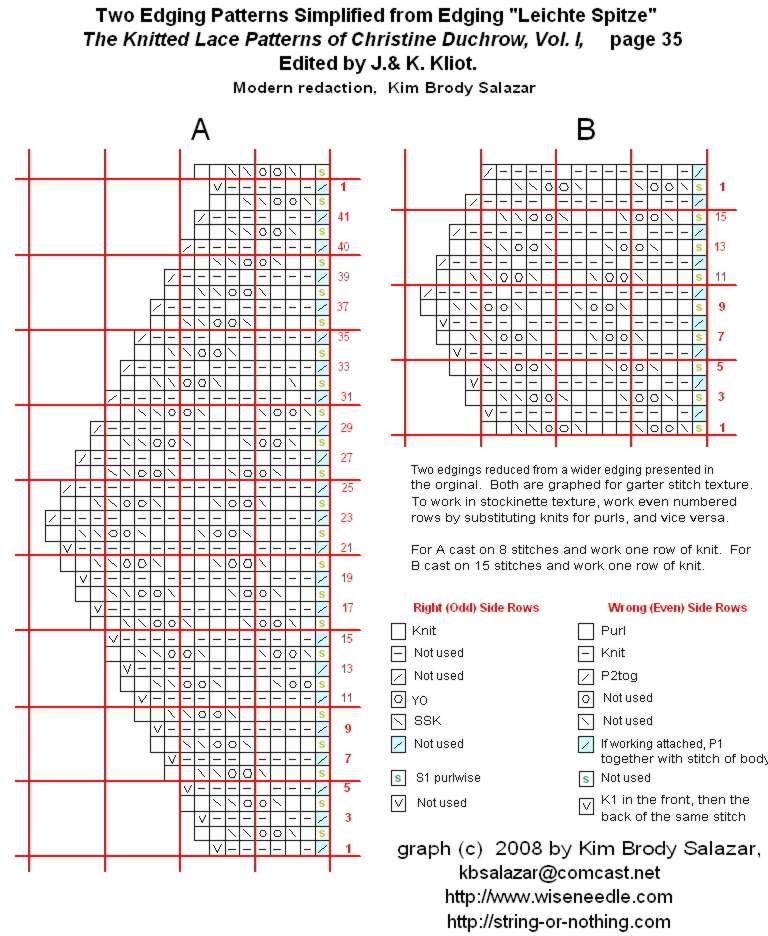
How to miter the corners? It’s easier than you think on a symmetrical pattern like this. I do them on the wrong-side rows, working one stitch fewer each wrong side row and wrapping the last stitch I work in each wrong side row until I reach the reflection point of the repeat (the shortest or tallest point depending on where I start), then I reverse the process, re-incorporating one previously wrapped stitch (along with the wrap at its base) on each wrong side row until I’ve reclaimed my full width and returned to the same point in the repeat where I started. Sounds confusing, but give it at try.
Now on to Baby Gift #3 – the little sweater kit. It turns out that there’s yet another in queue, after the sweater it looks like I’ll be knitting at least one more small blanket, plus some other thing to be determined when inspiration strikes.
BLANKET REBORN
I ended up ripping out the entire yellow blanket and restarting it. But I made the central part narrower – only three instead of four repeats. I slimmed it down based on yarn consumption estimates, and because I decided to trim it out with an edging rather than leaving it plain. I haven’t done much thinking about the edging’s corners. I’m winging it when I get to each. Photography is hard right now, so I present the traditional String photo of something wadded up into a mega-snood on a circ:

One of the things I find most comforting about knitting is that mistakes are not forever. Unlike say woodworking in which once your lumber is cut, it’s cut, with some minor exceptions, it’s always possible to rip out knitting and begin again. Since I’m one of the process rather than end-product oriented knitters, and deplore deadlines of any kind outside of my professional life, having to rip back isn’t a major burden. Of course, I do sometimes get annoyed at wasted effort and sometimes am frustrated enough to consign a project to Chest of Knitting Horrors(tm) limbo, most of the time it’s just grab the end and rewind.
Work schedule willing, I should have this blanket finished by next week. That will be Baby Gift #2 done, and I’ll be on to #3.
NOT PAYING ATTENTION
In the name of expediency I started on Baby Gift #2, but instead of working in the fingering weight wool I had bought on sale, I dipped into my pile of recently received gift yarn for an Aran weight acrylic in baby yellow. It’s unstretchy and slightly fuzzy, but very soft. I figured that on US #10 needles, I’d make short work of a quick blanket. And it looked to be heading that way:

Can you see the problem? Takes a while if you’re not looking for it.
See the zig-zag on the left? In the first four repeats, it’s flanked by little diamonds on alternate sides. That’s how the repeat is SUPPOSED to look. Those other zig-zags with the diamonds soldiering up one side or the other? Nope. That’s wrong. My first 1.5 repeats across are correct, after that all goes to hell.
Now why did this happen?
Because I was too cocky and wasn’t paying attention. I can usually memorize a pattern this simple in a pass or two. I thought I had it licked, and continued to knit away on autopilot, without checking the Duchrow book pattern chart I was following or looking at my work. In fact, I didn’t notice the problem until I patted the blanket out for this morning’s photo.
What next?
Ripping back the one and a half skein of knitting you see above. The good thing is that I cast on for this only on Friday. That’s just three evenings worth above. The bad thing is that this yarn is surface fuzzy, and taking it out will be a pain. But if I go back to the very beginning I’ll get to do some minor engineering. I think that I’ll do something deliberate with the repeat, possibly with some mirroring or (on purpose and symmetrical) distortion.
Idiot me….
FLOOD OF BABY GIFTS – ROUND 1 DONE
Finished the fuzzy Entrelac blanket.

Because I began it with a cast on row plus two garter ridges all the way across before starting the foundation triangle row, I finished it in parallel by picking up stitches across the top and working two more garter ridges and the cast off row. Now all that remains is to wash it and darn in the ends. For some reason I never do that until just before I am ready to give the gift.
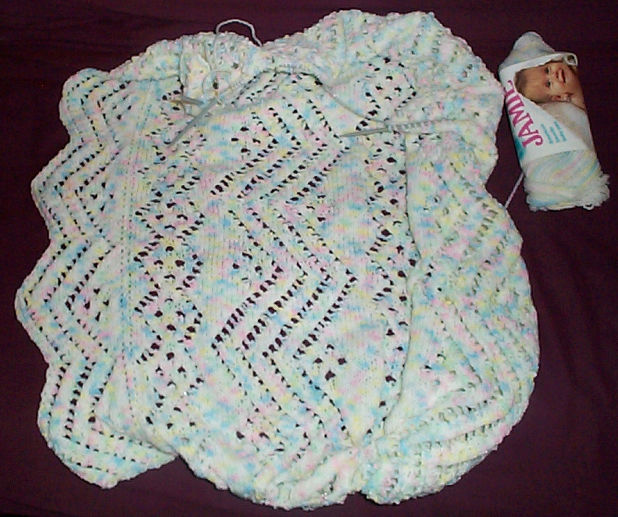
On to the next baby gift – #2 of 4. At the same LYS mega-sale where I got the fuzzy, I also picked up some Asa Gjestal Spinneri Baby Superwash in a light turquoise. It’s marked at 28 st = 10 cm, about 7 spi, but feels comparable to Dale Baby Ull. I could do a strip or medallion blanket throw out of it, or I could work up a sweater and hat set. Not sure. I’ve also got a couple of lots of soft acrylic at worsted weight given to me by a friend. There’s enough there to make a couple of blankets, too – one pale yellow, one pale blue, and another white with flecks one similar to the one I did back in the early Spring:
The other thing I bought was not on sale. It’s a cleverly packaged kit from Plymouth Yarns. It contains one large ball of Cotton Kisses yarn (mine is a baby multicolor), four duck-shaped buttons, and instructions to make one of two sweaters – either a v-neck cardigan or a placket pull-over, both knit on US #5s and #7s. There’s enough yarn in the kit to make one item in one of three sizes – newborn, 3-6mos, and 6-9mos. If you figure a leaflet is usually two or three dollars, and four buttons of this type would run two bucks, too, this all-except-needles pack was very reasonably priced at $14.00 for the whole thing. I’m holding off starting it until I know the sex of the target baby. Although there’s no real reason to differentiate, I think I’d make the placket for a boy and the cardigan for a girl.
So, I’m off to experiment, not quite sure which of these projects I’ll start tonight.
 String-Or-Nothing