ROUND THE CORNER
You guessed it! More Motley:

The framing in charcoal is now complete, and I’m more than half way done with the edging. I looked through all the books that I haven’t shipped ahead, and various on-line sources, hunting for an edging that looked right. I wanted something not too lacy, with design elements that echoed the zig-zag of the center, but that was not just a duplicate of that simple point pattern. I didn’t find anything I liked in particular, so I tossed all of it into my cranial Cuisinart, and came up with my own. It’s very simple, and likely as not, I’m not the first to hit on it. Still, I like the look, and it’s quick to knit. Two evenings has marched me around almost three sides. Eventually I’ll be posting the pattern for this, including how to miter it for a neat 90-degree corner.
I’m happy with how Motely is turning out. It has a certain folkloric, rustic look. I’m sure however that I’ll think less of it once I begin working in all those ends.
On the Knowledge Base and Beginners
I’ve been having an enjoyable comments-chat with Nila. She asked a couple of questions I answered in my last post, then she posted a hint of her own. She was surprised that as a (relative) beginner, she could add onto the common knowledge pile. I think she needn’t be surprised.
Knitting, like many crafts, is simultaneously ancient and evolving. Bright people take up needles and learn. Some, infested with the how-why bug, look at their lessons with fresh perspectives, and bring insights of their own. Yes, sometimes in a limited environment their insights are rediscoveries, but that does not make those insights less valuable.
A hundred years ago, grafting sock toes was a revolutionary new technique. As late as 60 years ago slip-slip-knit instead of K1-slip one- pass slip stitch over was not universally known (reading lace instructions from books printed before the 50s turns up far more of the latter than the former). Using two circulars as giant DPNs and the using one giant circular (aka Magic Loop) are relatively new tricks, gaining wide popularity only in the last 12 years or so.
We have inherited a huge, shared tool chest of techniques, from anonymous and named innovators over the past 500 or so years of knitting history. But that doesn’t mean that the inherited ways are the ONLY ways or the ONLY CORRECT ways to produce pieces.
My point is even in a limited craft like knitting, there is a wealth of alternatives that can be pursued, and even today, a steady stream of healthy innovation. There are only so many ways to form a flat sequential multiple loop based fabric, and only so many ways to manipulate or deform stitches, yet even within those bounds, EVERYONE – beginner, intermediate, or advanced knitter – has the potential to have that flash of insight, to see some new technique or method; one that saves time, effort, money, or aggravation, or that leads to a new method of expression. Beginners can bring unspoiled eyes to annoyances more experienced knitters take in stride. More advanced knitters can blend techniques and come up with alternate ways to get things done. And everyone can cross-pollinate – bringing in inspiration, methods, and concepts from experiences outside the world of knitting.
I encourage you to try something new, to think on other or better ways to do something, or to add to your own personal toolsets with the goal of gaining inspiration through broadening your own skills. You never know – an “Aha! moment” could strike at any time, and the next inventor could well be you!
FRAMED
More progress on Motley. I am almost three quarters of the way done with the framing element. In this case, a Regia sock yarn in a deep charcoal grey.

I’m still on the first 50g ball of Regia, and you can just make out what has not yet been knit in the upper right of the photo (click on it to enlarge).
After this comes the multicolor edging, probably a plain saw-tooth, about as deep as the strips are wide. I’ll have to play around and see what looks best.
I’m flying by the seat of my pants here, and explaining exactly how I’m working the corners and filling in the edge triangles will be a challenge. When I post the final write-up of this project it will be more of a method description than a finished full pattern with explicit directions, quantities and the like.
Questions from the Mailbag
Nili asked a couple of thought provoking questions on my post about the difference blocking made in my Lattice Wingspan project. First she asked:
I bought some inexpensive acrylic yarn to play around with and am knitting a good sized sample of feather and fan stitch. If I keep going it could be a scarf. My question is, is there any value to blocking synthetic yarn? Will it respond to the blocking?
I attempt to answer.
There are as many answers to the question of blocking acrylic as there are types of acrylic yarns, multiplied by the uses to which it is put, and squared by the number of knitters, worldwide.
First, on fiber types:
Wools and high-wool-content blends have the memory/bounce-back property. The fibers have a natural elasticity and respond to changes in tensile stress and to a lesser extent, humidity. They return to their cozy, unstretched state upon washing (more or less). This is also what keeps the elasticity longer in ribbings knit from high content wool. Other protein fibers also display the stretch and bounce back property, although many are not as elastic as wool. Silk is the exception in that it doesn’t stretch very well.
Most acrylics on the other hand, do not have the same stretch and bounce back properties as wool and high-wool content blends. They can be stretched, but once set that way under heat and tension (aka “killed”), they will never return to their original shape. There are exceptions. High tech man made fibers are invented every day, and many acrylics contain a modicum of something elastic to keep ribbings true and offer a more “wool-like” experience.
Cottons, linens, ramie and other plant-derived fibers behave differently, with different shrinkage properties and performance characteristics under blocking.
Next, on blocking methods:
There are a zillion ways to block. Wet, dry, under tension vs. gentle pat out, with and without steam, and so on. Different methods are better suited for different fibers, or different uses. For example, the wet-block high tension set up used for lace to spread it out is not appropriate for a dense, cable knit sweater. A pat to measurements and non-contact steaming to relax it might be perfect for that Aran knit in wool.
What blocking does:
It evens out stitches, reduces (but does not totally eliminate) curl. It makes edges lay flatter and seaming easier. It coaxes the piece into the shape desired, although it cannot correct major size or proportion problems.
If a wash/wet block method is used, it removes hand grime any residual spinning oils from the yarn, and casual dirt from the piece. In general, it yields a more professional final appearance, and removes some of that “loving hands at home” look.
To answer in specific – blocking a lace scarf knit from acrylic:
How I’d proceed would depend on the acrylic I was using. You’re lucky because a lace scarf doesn’t need to end up being the exact dimensions that a garment body might require.
The best advice is to knit a small swatch that uses both the cast-on and cast off of your final project, and test out your method. You may find that damp block with blocking wires and pins, using non-contact steaming (an iron set to low heat) spreads out the lace and fixes it in that shape. Or you may find that doing so stretches the lace body a tremendous amount relative to the cast-on and cast-off edges, which end up looking cupped and puckered.
I’d probably attempt some sort of blocking on the thing, knowing that even if the ends puckered oddly, there are fall back positions. The most aggressive (and for knitters, controversial) way to fix that problem would be to toss the thing on a sewing machine and run three or four lines of machine stitching across the end, just before the cast-on or cast-off row. Then (horror of horrors) cut off the puckered end. The raw edge will be secured by the stitching, and can be made neater with a row of encapsulating crochet, or used as a base for fringe, or a knit-on edging.
Also what type of cast on creates a soft, loose base? I’ve found stretchy ones suitable for ribbing but I’m looking for one suitable for lace. I tried long tail with a larger needle as well as spacing the stitches out wider on the needle. It’s still pretty firm. What can I use instead?
I attempt to answer Nila’s second question without resorting to another indeterminate diatribe.
Lace cast-ons can be problematic. As you note many are too tight or are not stretchy enough for the wide spread of lace, or for the aggressive blocking that makes it look best. There are many simple and exotic cast-ons that can be used for knit from end to end lace. There’s another bunch that are great for center-out motif lace, but that’s for another post.
In general, for lace garments, the stretchy cast-ons are usually enough, especially when they are worked with a needle two or three sizes larger than the needle size that will be used for the bulk of the lace. But for things like shawls and scarves which are blocked until they scream, even a stretchy start is often not enough.
Simple lace cast-ons:
I won’t get into the really exotic methods, because most of the time the simple ones outlined here work well enough for me and my projects.
I usually work some sort of provisional cast-on because most of my scarf and shawl pieces are finished with an applied edging, which is quite easy to knit onto the loops that result when the initial edge is released from its provisional mooring. My favorite provisional start is crocheting on, which is easy to zip out for remounting the stitches on a new needle.
On the rare occasion when I want the edge to stand alone, and I need extra stretch, I will work the same crochet-on cast-cast on, but using a hook closer in size to my working knitting needle, AND working a crochet chain stitch BETWEEN each stitch mounted onto my knitting needle.
Another method I use is a variant of the cable cast-on. For this one I also use a knitting needle two sizes larger than my lace needle. Put a slip knot on the left hand needle. Insert the right hand needle into that stitch and draw a loop through it. Slide the new loop onto the end of the needle and before you snick the yarn up tight, insert the right hand needle into the new loop. Repeat drawing a new loop through the new stitch until you have enough stitches on the needle. If you were to insert the needle tip in between the old stitch and the new stitch, you’d be doing the classic cable cast-on – aka “knitting on”, but by making the new stitch in the loop of the previous one, you make a more airy and more stretchy edge.
Finally, on occasion the most convenient method for starting narrow lace pieces is the simplest one of all – the half hitch cast-on (aka “Looping On” or “Backward Loop Cast-On”). It’s the stretchiest of all, and can be made even more so by using a larger needle. It does however produce a very flimsy edge. I use it when I cast on stitches for a lace edging, when I intend on working the edging completely around something (scarf, baby blanket, etc.), and plan on joining my final row to my first row via grafting. Yes, I could use a provisional cast-on for this and end up grafting onto live stitches, but there are usually very few stitches at the start point of a narrow band of edging, and doing so wouldn’t be worth the effort. One caution on this – the stitches in the next row coming back HAVE to be regular knits or if they are purls, they need to be worked through the back of the loop. Otherwise the half hitches will collapse.
To sum up:
Lace cast-ons are largely a matter of personal preference. There is no one perfect method for every piece in every yarn. Knitters being passionate people, will each advocate their own favorite, and armed as they are with pointy objects – can be formidable in their discourse. The answer here is the same as every other answer in knitting. Give it a try, make a swatch and abuse it. See how you like the method for the piece at hand, with your chosen material. Preferences are as situational as they are personal, and there is no single correct answer.
STILL AMBITIOUS
Motley continues to grow. I’m just about done with the center area now:
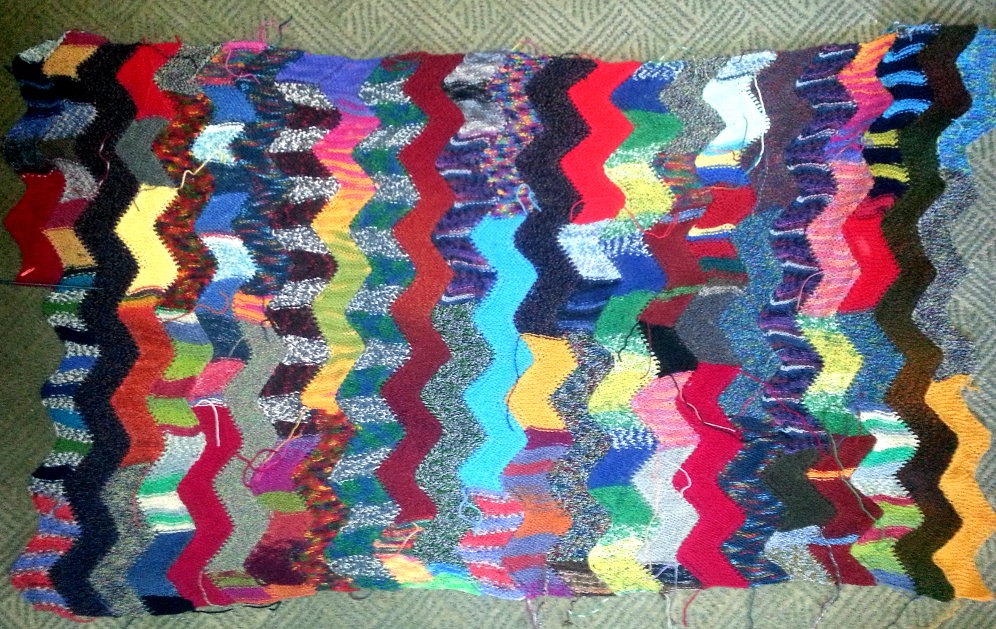
Some people have expressed incredulity that I’d consider working fingering weight on US #8s (5mm). However it’s working out just fine for this purpose. This is a blanket, not a sock that benefits from tight knitting, nor is it a garment on which a looser fabric would present show-through problems. Instead, even with the large needle size, thanks in part to garter stitch, I’m getting a nice, cozy and cushy thermal weave texture.
However the main reason I chose such a large needle size relative to the yarn is because I’m using up dribs and drabs of yarns in a variety of weights, from light 3-ply fingering like ancient Kroy 3-Ply and Wildfoote, to standard sock yarns (Regia, Opal, Fortissima) all the way through some of the heavier sock yarns that are almost sport weight (Marathon, Koigu). I even have a couple of small ends of lofty DKs that knit down to sport gauge. That means that the “native gauges” of the yarns in this piece range from about 32 to 24 stitches in 4 inches (10cm). Breaking the rules and working them all on what normally would be grossly large needles evens out differences in gauge and lets me use them all together. Yes, some of the stripes are denser (or more airy) than others. But they all present as uniform in width, and as a whole – work together.
I’ve got to finish out the current stripe (at far left) and add another at far right. Then I’ll be up to the next step – filling in the edge triangles left and right to achieve a nice, even rectangle.
There are two methods I could use to do this – either pick up one stitch and knit an isosceles triangle, joining the two shorter sides to the existing blanket, using the same method I employed to knit each strip onto the growing whole; or I could pick up stitches along the edge of each “zig” and knit out, using a center double decrease to achieve the triangle shape. I’ll probably experiment with both, although I am leaning to the first method for visual congruence with the rest of the piece.
Once I’ve filled in the edge triangles, I’ll probably work a narrow solid color strip all the way around the outside, using mitered corners, to unite the piece. After that all bets are off. I might stop there, or I might add some sort of zig-zag or dagged edging, also worked in multicolors. There’s only one problem though. I started with a bag of leftovers that was about the same size as half a standard pillowcase. I’ve used most of them, and don’t have a nice range of colors left. If I do a multicolor edging, I’ll have to BUY yarn to complete my stash-consuming Motley!
Whichever methods of framing and finishing off this piece I choose, I will be writing this up as a method description, complete with approximate square yardage per weight estimates (for fingering) so that those of us who happen to have a bag of leftovers the size of a 25-pound turkey can put them to good use on their own stash-busting scrap blanket.
GAUNTLET IS CAST
Two pairs, actually. Now winging their way cross country to the recipients:

Both are from patterns available on Ravelry. Left are Susie Roger’s Reading Mitts, and at right are Swirling Gauntlets by Susanna IC. Both are knit from Red Heart Shimmer, one skein of which (plus four evenings) was more than enough for both mini-projects.


I mailed these on Monday, but I’m posting this ahead so that the package has time to arrive without totally spoiling the surprise! Shh!
MORE MOTLEY, MUFFATTEES, MODIFICATION AND MUTT
Back from visiting Florida, my mom and sister (plus her family). We had a great time, feted like royalty on progress. Special thanks to all, especially my mom, and to Chef Terry who pulled out all the stops for the holiday meal.
Motley
Sitting and chatting with mom did allow Motley to grow. In order to keep color distribution even, I have been adding to both ends:

I’ve got some snippets of hers now in there, too. I’m about two thirds of the way through the center rectangle, and am very pleased at how it’s turning out.
Muffattees (Fingerless Mittens)
Also, while we were there my two nieces expressed a desire for fingerless mittens. I’m not quite sure why they’d need such a thing in Florida, but teenage fashion whims (when reasonable) can be indulged. Especially when they are a quick knit.
For the first pair, I’m using the Reading Mitts pattern from Susie Rogers, available on Ravelry:
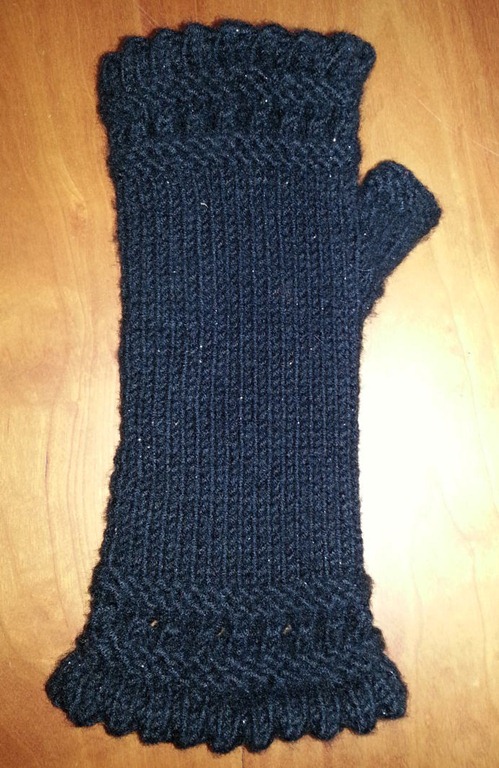
I’m about a third of the way through the other mitt of this pair. I’m still looking for a slightly different but equally interesting design for pair #2. Although I love luxe yarns, I’m no materials snob. The yarn for this one quite humble. It’s a very soft Red Heart acrylic worsted with a subtle shiny mylar thread running through it. Called Shimmer, it does, just a tiny bit, and has a very pleasing almost cashmere-like softness, which will feel nice on the hands. I chose a washable yarn because even in black, mitts get dirty quickly. The yarn is a bit splitty, but I’m happy with the result.
For the pattern, I knit the smallest size. With this yarn on US #5s, it’s plenty big enough (the medium was too big for me and I’ve got gorilla paws). The only modification I did to the pattern was to use a provisional cast-on, then knit the cast on stitches along with the live stitches to fuse the picot hem, just before the decrease row that sets count for the cuff pattern. That ended up adding one row of width to the edging before the first purl row of the cuff. Not noticeable. Also users should note that the lace pattern is set up for an even number of stitches, but two of the three sizes as presented yield an odd number in circumference after the decrease row. Just ignore the extra stitch and work it plain – on this item no one will ever notice. Finally, the method for picking up the thumb benefits from casting on two rather than one stitch on the side facing the mitt’s body. Even so, I advise leaving a nice long tail when you join the yarn to make the thumb. The excess will come in handy to close up the rather large gap at the “thumb crotch”.
This pattern is a sweet little project for a last-minute gift. Mitt #1 took two evenings. Mitt #2 bodes to take less, in part because I don’t need to start, then rip back the medium size.
Modifications – Vintage Yarn Chart Rehab
I know that lots of folks who visit here are looking for my chart of vintage needle sizes, historical yarns as plotted against gauge and modern needle sizes (with a few modern yarn recommendations). That chart was ported over in the Great Blog Migration, but arrived in less than readable condition. I’ve ironed it out now. To minimize confusion, I’ve modded the original post from 2005, rather than reproduce it here. But I’m opening it up again for additions. If you run across a pre 1930s pattern that calls for a specific yarn and vintage needle size, and you have made a successful modern substitution, toss a comment onto that page listing the original needle size and yarn specified, plus your modern substitutions. I’ll add them to that chart.
Mutt
Apologies for calling my mom’s companion, Honeybun, a mutt. Mom would classify her as a “designer dog” – a mix of Maltese and Yorkshire Terrier, sometimes referred to as a Mookie. But I needed the alliteration, and as long as I toss the toy or scratch behind the ears, I don’t think Honeybun would mind:

She’s a cute little bundle of fluff, and a very good apartment pal.
MOTLEY ON THE ROAD
My bag of orts hardly reduced by my progress, here’s more Motley:

It’s rather chaotic, but I like it. For the record, I’m using US #8 needles, which are quite large for fingering weight. But the odds and ends I’m knitting with are not all of uniform thickness. Some are regulation fingering weight sock yarns, like Regia, or Fortissima. Some are heavier, like Koigu, or Dale Baby. But all fall into the 9-6.5 stitches per inch range. Since this is a throw and not something like a sock or mitten that needs a sturdy fabric, using these finer yarns on larger needles is minimizing the gauge difference among them all.
I’m about a third of the way through the center rectangle. When that’s done, I’ll probably fill in the little triangle bits at the top or bottom, then do a narrow mitered edge around using a solid color. After the unifying band is on, I’ll finish off the thing with some sort of edging, also done in haphazard small quantity multicolor.
There’s no guarantee however that the current “bottom” edge will remain so. I can add stripes to either end, so long as I maintain the joining rhythm, with raised join edges appearing on every other seam. The other “rule” I’ve hit upon is that unless the quantity left when I get to the end of a stripe is very small, or the yarn’s color variations are giant, I am beginning a new color for each new stripe. I do note that my color selections are consistent. There are reds, purples, yellows and greens in there (and the occasional snippet of turquoise), but most are variations of those tones that harmonize well with deep blues. For example, there aren’t any baby pastels or desert tones in the thing.
Working on this is bringing up memories of the various projects that fed my bag of leftovers. Socks and baby projects knit at particular places, for specific people come to mind as I address each tiny remnant. Although I hope I’ve got a way to go to the Madame Defarge stage, coding the names of the damned next to the guillotine, I do remember details of conference presentations and lectures I knit through as their sock leftovers come to hand.
And finally the explanation for the cryptic “on the road” designation, and for the uncharacteristic bright photo of the piece. I’m in Florida, visiting my mom, and took the photo here in her bright and cheery marble-floored apartment, rather than our darker New England home. Here we are enjoying the view off her balcony and being spoiled rotten. Not necessarily in that order.

MOTLEY!
Things being rather unsettled here right now, but still in need of stress abatement, I looked around to see what evening needlework distraction I could find. I don’t want to start a forever project with only a limited amount of time before The Big Displacement. I’ve sent the embroidery floor stand on ahead to India, so working on Big Green is problematic. I’ve been doodling up knit scarves and socks – giving most of it away. Additional inspiration for this one came from the Resident Male, who always bemused by my yarn hoarding habit, forwarded this.
I’ve got a big bag of little bits of fingering weight – mostly left over from sock projects. I’ve dipped into it every now and again to make booties or to supply a stripe or toe for later socks, but for the most part, the bag has grown steadily larger in the 18+ years I’ve been knitting socks.
So. Given the need for totally mindless knitting, very few needles in the house (also mostly sent on ahead), and the guilt-induced constraint to use my stash yarn remnants, what could I come up with?
Motley!

This is ultra simple – 12 stitches across (10 plus 2 slipped edge stitches), knit in garter stitch; 10 ridges with each right side row beginning with an increase and ending with a decrease; followed by 10 ridges with the wrong side rows beginning with an increase and ending with a decrease. After the first ripple is done, subsequent ones are joined to the established chain selvedge edge with a simple pick up/pass last stitch over move, followed by purling that stitch on the next row. The basic zig-zag concept is Frankie Brown’s Ten Stitch Zigzag, which I’ve played with a bit.
Using relatively giant US #7 needles (giant for sock yarn, that is) I’m reaching into the big bag of leftovers, pulling out whatever I find, and adding it on. Eventually I’ll add little triangles to square out the piece to make a center golden ratio rectangle. Then I’ll figure out some sort of similarly chroma-chaotic edging, so that I end up with a little lap throw.
It’s a quick knit, and totally without thought. What you see above is the the consumption of nine mini-balls of leftovers over the course of three evenings.
BLOCKING MAKES ALL THE DIFFERENCE
Compare.


This is the same scarf. At the left, it’s fresh off the needles. On the right, it’s been through this torture:

All lace benefits from a savage blocking. Is your Wingspan looking flabby? It’s probably not your knitting technique. Try blocking it and see.
For the record, I used my visually horrific checked sheet and damp-blocked my finished Lattice Wingspan. First I dampened the thing and squeezed it out gently (no wringing). I patted the center curve into shape and pinned it first. Then I used a minimal number of pins – just one at each point – to pull the points out from the center. Finally, I let it dry overnight.
The ends? I don’t darn in ends until after I’ve blocked. Especially on lace. Finishing off the end may introduce a small area that does not stretch like the rest of the piece. Better to let them hang, then deal with them after blocking is over.
GALAXY OF WINGSPANS, MORE KOMBU
Where have I been? Busy, mostly.
I’ve been getting our India-bound household goods shipment organized – buying what’s needful, and sorting the rest out from our domestic inventory. There are tons of details that have to be settled before we go, and not enough time to do them, of course.
But that doesn’t mean that stress abatement isn’t happening. I’ve taken to watching Dr. Who with Younger Daughter, after dinner is picked up and homework is complete. I’ve worked a bit on stitching, but mostly knitting. Holidays are coming up after all, and there are gifts to be stockpiled. Plus in all of the rushing around there’s a fair amount of “hurry up and wait.” I don’t do that well, so I always go armed with some sort of handwork. My big frame isn’t portable at all, so small knitting projects have been accompanying me on my rounds.
So far the tally for September/October is two pairs of socks, four Wingspan scarves (three were my variant on the basic pattern), and two pairs of booties. The socks below – finished yesterday – are my standard 72 stitch circumference short-row heel/figure-8 cast on toe-ups, with an improvised Old Shale/Feather and Fan variant on the cuff. The other pair of socks is making its way cross country to Elder Daughter (chasing the first Wingspan, sent several weeks ago), and the booties have been distributed. The two remaining Wingspans will be blocked this weekend.


Last night and this morning in the splendor of the Sears auto repair shop waiting room I worked on an old friend – my Kombu Scarf.
I’ve knit a few of these since first posting the pattern in 2004. The initial one was in Schaefer Little Lola, a space dyed mix of greens and browns, that combined with the undulating shape of the center, gave the scarf it’s kelp name. Since then I’ve done it up in other yarns, ranging from sport to worsted weight.
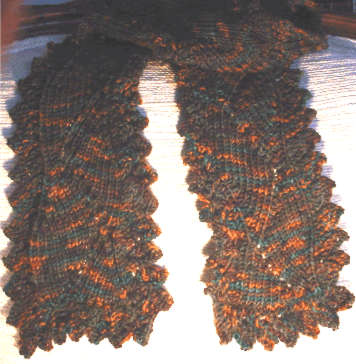
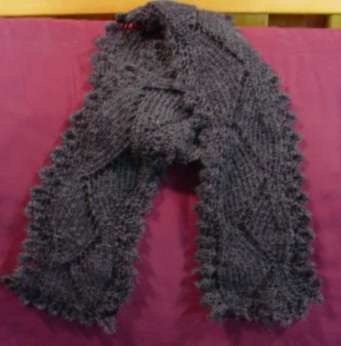

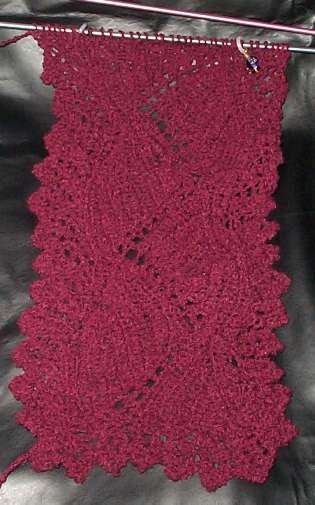

Kombu is a graceful, narrow scarf that can be made from as little as around 280 yards of yarn. The design is both bold and a bit fluttery. The pattern knits up well in every fiber I’ve tried (cotton, wool, acrylic, alpaca, cashmere blend). It’s reversible, attractive on both front and back. There’s no seaming – the bottom edging is knit as a narrow strip, then the scarf body is picked up and knit north from there, with the side borders worked at the same time as the scarf center. At the end, the final bit of edging at the top is worked across as a finish on the remaining live stitches, right from the needle. There’s no need to sew on or pick up and knit an edging, and if done from a large ball of yarn – there are only two ends to darn in when it’s done.
Here’s the latest. It’s in Marks & Kattens Indigo Jeansgarn – leftovers from one of my all time favorite projects.
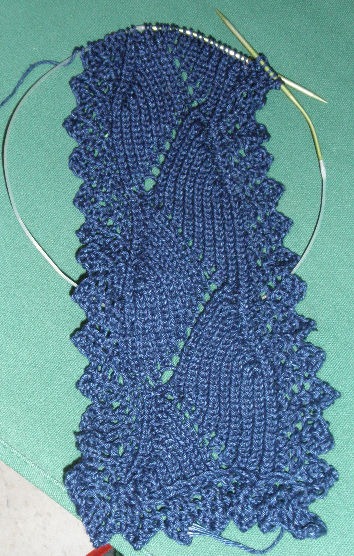
I started this one in part because I needed something on the needles, and I wanted to add to my pile of presents-to-be. But also I got a shout out from a Ravelry reader who was wrestling with her own Kombu project and needed help. It’s been a while since I knit one of these, I had to cast on in order to lend a hand. Happy to say, she appears to be over her problem, and is now knitting away again.
If you’re interested in the Kombu pattern, it’s available as a free PDF download, at the “Knitting Patterns” link at the top of the page. There’s a German language version there, too.
LATTICE WINGSPAN VARIANT
LATE BREAKING UPDATE: The Lattice Wingspan Variant instructions are now available as an easy-to-download PDF, at the Knitting Patterns link, above.
Another Wingspan. I’m trying to codify what I have been doing because I wanted to post it as yet another enhancement to the pattern, hence the multiple iterations. UPDATE: Test knitting complete, pattern corrections are now in!
Before and After (pre-blocking):
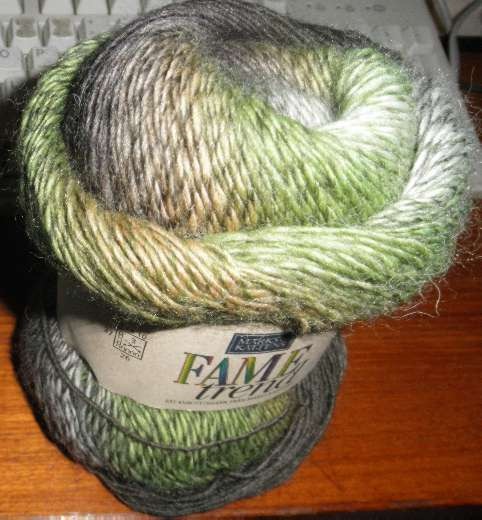
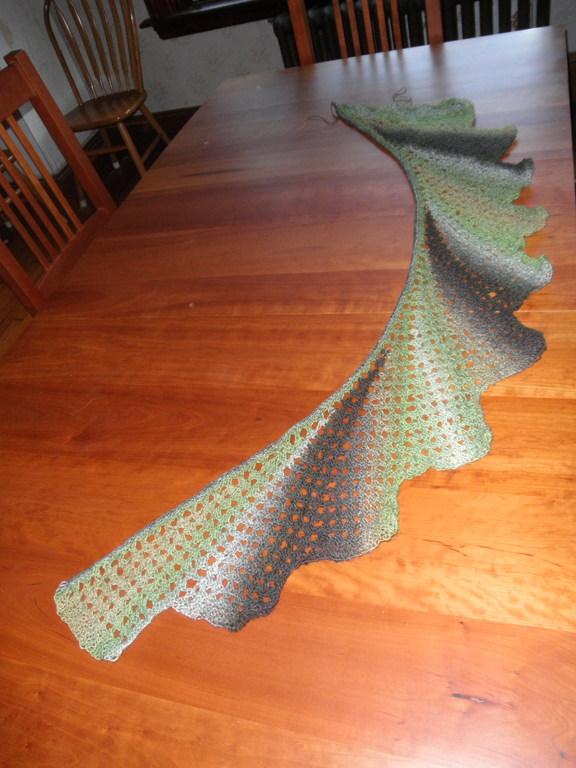
This one was knit from Marks & Kattens Fame Trend. Its labeled as a heavy sock yarn to be knit on 3mm needles, at 26 stitches = 10 cm, but it’s really somewhere between sport and DK, with some thick-thin variability. What drew me to it was the very long repeat – evident in the skein. I like the way extra long color gradations play out in this project, and the slow progression from green through olive, warm chocolate and tans played well. Because this yarn is heavier than the original recommended yarns, I used a 5mm needle, instead of the recommended 3.5mm.
I knit my Fame Trend Wingspan starting with a cast-on row of 75 because I wanted my piece longer and more scarf-like than Maylin’s Tri’Coterie shoulderette mini-shawl original. Here are my mods. I was inspired by Lenora’s Angel Wingspan variant, and decided to take the eyelet idea to the extreme, using larger eyelets and lots more of them, plus adjusting stitch count to work better with the project’s natural tendency to “clump” into three-stitch units. I also transposed this to all garter stitch because I liked the way the welts framed the double eyelets.
Again, the basic concept and shape here is Maylin’s. Click on the link above to retrieve her free pattern (free Ravelry sign-in required). You’ll need it to use my supplement, below. And the idea of piercing it with holes came from Lenora. I just took their concepts and ran with them.
LATTICE WINGSPAN
If you are using standard fingering weight yarn, use a needle larger than the 3.5mm needle recommended for the original, in order to increase laciness and yield a softer more fluid drape. For my Zauberball Crazy edition of this variant (true fingering weight), I used a US #5 (3.75mm). For the Marks & Kattens Fame Trend I had to go up to a US #8 (5mm) before I got the result I liked.
Triangle 1:
Rows 1-4: Work as per original instructions, rows 1-4
Row 5: Sl1p, K2, YO, *SS-K1-PSSsO, YO2*, until 6 stitches remain before the marker. Finish last 6 stitches by SS-K1-PSSsO, YO, k3, remove marker. Turn. (If you like any other double decrease may be used instead of the slip-slip-knit one-pass-both-slipped-stitches-over, I’ve experimented with K3tog and SSSK, and both look fine)
Rows 6 and 7: Work as per original instructions, row 3-4, but knit instead of purl – working a K,P in each double yarn over and a K in each single yarn over when you encounter them. Advance the traveling marker as described in the original on each wrong side row, until you work a final wrong side row with only 3 stitches, and have no place to put it.
Triangle 2:
Row 1: Sl1p, YO, *SS-K1-PSSsO, YO2*, until 6 stitches remain before the marker. Finish last 6 stitches by SS-K1-PSSsO, YO, K3. Turn
Row 2: Sl1p, K2, place non-traveling marker. K3, place traveling marker, knit to end, working a K,P in each double YO, and a single K in each single YO. Cast on 18 stitches.
Row 3 and 5: Work as per triangle 2, row 3 of the original.
Row 4 and 6: Work as per triangle 2, row 4 of the original, but do it in all knit rather than purling.
Repeat rows 1-6 until the traveling marker walks all the way back to the starting edge.
Triangle 3 and all subsequent triangles:
Row 1: Work as per Triangle 2, Row 1 above, until 24 stitches remain before the marker. Finish last 6 stitches by SS-K1-PSSsO, YO, K3. Place a new non-traveling marker, and turn. After you place the non-traveling marker, there should be 18 stitches between it and the previous non-traveling marker.
Row 2: Work as per Triangle 2, Row 2 above.
Continue working Triangle 3 (and subsequent triangles) in the method established for Triangle 2, following the original pattern’s logic. Because my version of the Tri’Coterie pattern is narrower and uses big eyelets, you should get 9-10 triangles out of a 420+ meter skein of fingering weight or sport weight yarn, instead of the pattern’s described eight.
Finishing:
After the completion of a triangle, when you decide your piece is long enough, and you still have about a third of a triangle’s worth of yarn left, it’s time to finish.
Row 1: Repeat Triangle 1, Row 5 above across the entire backbone of the piece, removing all markers as you encounter them.
Rows 2-4: Sl1p, knit to end. AT THE END OF EACH ROW OF GARTER STITCH REASSESS YOUR REMAINING YARN. Depending on available yardage, needle size and gauge, I’ve been able to knit at least one row of garter stitch prior to the bind-off row. You will need approximately 4 times total project width for that final bind-off row. The Marks & Kattens had enough for me to work four rows of garter prior to bind-off. Noro Taiyo had enough for two rows of garter prior to binding off.
Bind off loosely. Because of the big eyelets, damp block this piece to within an inch of its life to make them spread. Try to do it following the design’s natural helix for best effect.
Hope someone else is tempted by this project in my variant or in the original. It’s dramatic, quick, and not as difficult as all those abbreviations make it look. It’s a great one-skein holiday gift project that uses yarns that are tempting/beautiful in the ball, but are a true challenge to use effectively. And like the best of those, is as addictive as potato chips.
Next post will muse on the changing nature of the on-line knitting community, with sincere appreciation to some old coteries who helped me think it through, and who wrote to me to express support. Stay tuned!
 String-Or-Nothing