TUBULAR CAST-ON; LEAF SWEATER PROGRESS
June over at Twosheep recently wrote about a tubular cast on. That sent me off looking up various ones. June recommends the one from Montse Stanley’s Readers’ Digest Knitters’ Handbook, although she notes that doing it in stockinette is not as stretchy as doing a ribbed tubular cast-on. She gives links to a couple of nicely photographed instructions at My Fashionable Life, and Little Purl of the Orient. I don’t have that particular Stanley book on my shelf, but I use an entirely different tubular cast on than the one described at those sites and in the book.
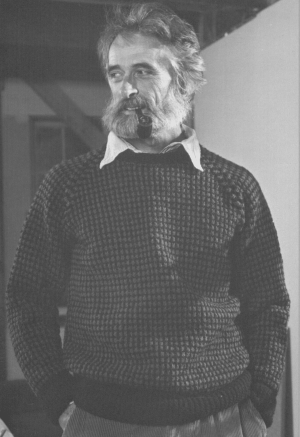
I learned an at once more fiddly and simpler method for a ribbed tubular cast-on during the second sweater I ever knit – Penny Straker’s Eye of the Partridge unisex raglan. Straker’s pattern format included a side bar with helpful advice or bonus illustrations of techniques and tricks. This one included instructions for the cast-on I did Partridge as a gift for one of my sisters. I knit it in Germantown worsted (very much like Cascade 220), in an dusty antique rose and a deeper, almost blood rose for the darker complementing color. It’s long gone now otherwise I’d put a photo here instead of the sample photo from the pattern, shamelessly lifted from a web-based retailer (the pattern itself is still available, and also comes in a kids’ version).
Straker’s method calls for using a provisional cast-on, and casting on half of the stitches called for in the pattern. If for example, the pattern asks for 100 stitches, I cast on 50. Then I knit in plain stockinette for four to ten rows (usually 6). At the completion of the last row, I unzip my provisional cast-on, and place all the newly freed stitches along the bottom edge onto a second needle. I often use a needle one size smaller than I used for the stockinette piece to make this easier.
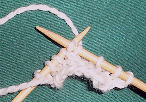
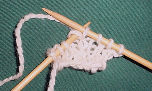
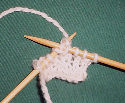
I now have a long, skinny snake of knitting, suspended like a hammock between two active needles. I hold the needles so that the strip is folded in half, with the purl side on the inside. Then I take a third needle and alternately knit one stitch off the needle closer to me:

and purl one stitch from the needle that’s further away:

(Pictures courtesy of Younger Daughter, already at 8 as good a photographer as her mother will ever be)
When I’m done, I have a nice, neat, stretchy tubular edge in K1, P1 rib that can be made wide enough to accommodate a drawstring. I use this routinely for almost all of my hem edges – even for circular knitting. I’ve made the small divot at the join into a design feature on some pieces where I’ve started my cast-on at the neckline. On others, I’ve used the dangling tail to snick it up and make the starting point invisible.

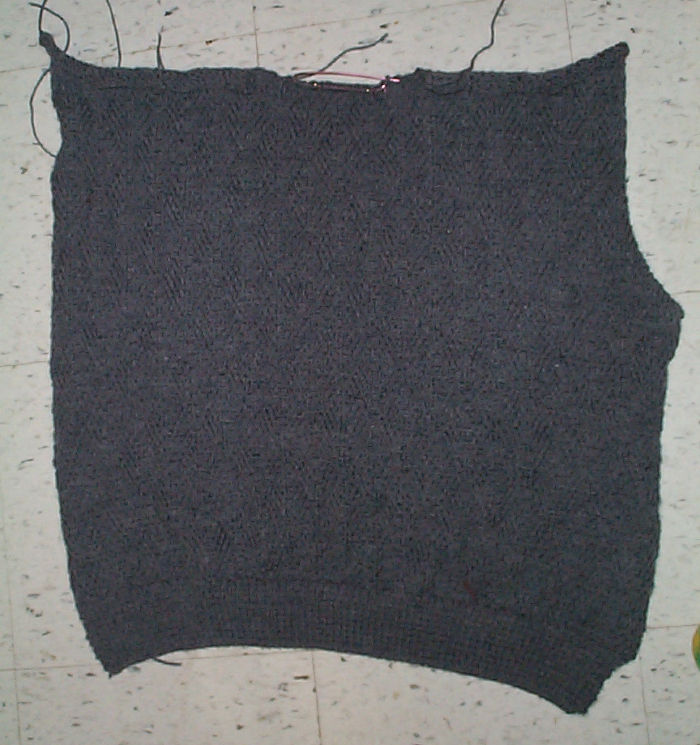
In this case, I broke into twisted rib the row immediately following the cast-on row. How’s the leaf sweater coming? The front of it is starring in the cast-on photos, above. Here’s the back – blurry and hard to see, but proof that I’m done with it. Also proof that yes – a texture pattern that’s mostly stockinette will also curl.
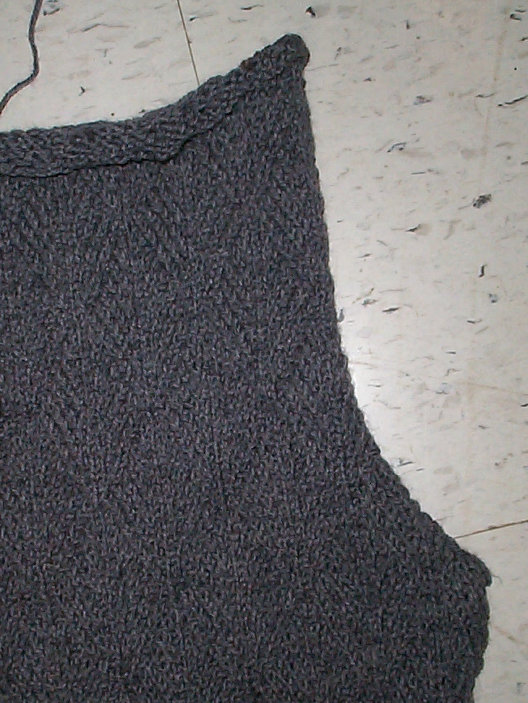
For the record, here’s a bit of detail in which you can barely make out the texture pattern and the armhole decrease area (click on this for a close-up):
And because I’m still sniffing around for a small project to run in parallel with my leaf sweater, plus I’m having fun with my ancient Unger Britania– I’ll take another lead from June. It’s mittens next. The shape of a traditional Norwegian mitten looks pretty simple, yet with ample scope for fun. Hello Yarn offers a PDF of a blank mitten graph. I think I’ll take that idea and run with it – redrafting the template for a smaller gauge, and using some of the historical graphed charts from my book on embroidery. If nothing else, I’ll enjoy the doodle time.
JUSTIN’S COUNTERPANE; BLOCKING BOARDS
A couple items from my inbox.
Question on Justin’s Counterpane
Cindy wrote to say she was having problems conceptualizing how the pieces to make my Justin’s Counterpane pieced blanket fit together. This particular blanket is a large scale intro to white cotton/lacy knitting. Only twelve main units are needed to complete it – six keyhole shaped motifs, and six whole octagons. Ten triangles are used to eke out the sides and make them straight. An optional edging finishes the thing. They’re put together like this:

I did not use additional triangles at the corners to make a true rectangle because it’s easier to go around a more gentle angle without mitering than it is to go around a 90-degree turn. And I didn’t want to go through the bother of mitering my corners.
Because of the relatively few units used and the simplicity of the classic pinwheel motif, I think that people wanting to make a first item in this style might find the pattern useful. Being a blanket, it doesn’t have to fit anybody so gauge is a guideline, not a mandate. It can be worked in any cotton or cotton blend yarn you like. The yarn I chose was a very inexpensive DK weight, but by using the appropriate size needles, a piece of usable dimensions could be made in anything from sport to worsted. Much heavier than that though and you’ll get into weight issues, cotton being quite a bit massive than its equivalent thickness in acrylic or wool. (You could even work this in standard wool or acrylic, but I think the design will be crisper in cotton.)
In any case, some basic guidelines for knitting and seaming together pieced counterpanes include binding the motifs off especially loosely; blocking the units before assembly, by wetting them down and pinning them out while stretching them to their maximum extent; and using whip stitch or when possible, mattress stitch done in half of the edge most stitch to sew them together. Back stitch or mattress stitch done further into the motifs will make the seams too dense and rigid, and may introduce cupping.
Bargain Hunters’ Blocking Boards
Rachel and I had an eMail chat recently. I think it was over on one of the knitting-related boards at Live Journal. She was looking for advice on blocking. In specific, she was looking for low-cost alternatives for blocking. We went through the standards – pinning out on carpet covered with towels or on a padded table or bed, but she wanted a rigid surface that was easy to stow in addition to being inexpensive.
I recommended getting a half-sheet of drywall from the hardware store, taped around the edges to reduce crumble, and topped with a flat sheet through which the pinning happens. I also suggested scouring yard sales or opportunity shops for the squishy/spongy foam pattern/alphabet block floor tiles or play mats favored by the parents of toddlers. They’re indestructible and often outlast the toddler years, landing at second-hand venues. Top those with a sheet and pin away, happy that you’ve found a modular, easy to store solution that as a creative recycle, nibbles away at the waste stream.
Rachel decided to go with the play mat idea. She sent me a note of thanks, and included this shot of her shawl blocking:

(Photo is hers, used with permission). She also notes that she got her mat at WalMart, and it was less than $20. Love the shawl, Rachel, and as ever – I’m delighted to have been useful.
STUPID I-CORD (AND EDGING) TRICKS, PART II
A quickie today.
There have been a few times when I’ve wanted to work I-cord (or a knit edging) onto the perimeter of something, completely encircling it, and ending up by grafting the final live stitches onto the original cast-on row with the hope of creating as near seamless a join as possible. Here’s an example:

To date when I’ve needed to do this, I’ve either knit several rows extra of the I-cord “free” prior to beginning to apply it to the edging, or I’ve used a provisional cast-on with waste yarn for wider knit trims. Working several rows of extra I-cord gives me a snip zone I can cut and then ravel back to produce the cast-on edge live loops I need for grafting. I suppose for narrow trims, I could do a similar thing – knitting several rows of plain garter or stockinette prior to beginning simultaneous application to the thing being trimmed and commencement of my trim pattern. A judicious snip and ravel back will reveal those live loops just as nicely as working sacrificial to-be-cut I-cord does.
But I had a “doh!” moment last night. Why not just cast those few first stitches directly onto a large safety pin or small stitch holder? Unclasp, transfer stitches onto a live needle, and go! To do this, I’d use the simplest of provisional cast-ons, starting out by holding my strand behind my stitch holder and picking one stitch up knitwise, then I’d shunt the yarn to the front of the holder and with my needle tip in back of it, pick up one stitch purlwise, and so on.
Here are seven stitches picked up on a stitch holder:

It looks kind of like the figure-8 cast-on I favor for toe-up socks:

EXCEPT that by picking up the stitches instead of winding the yarn around the needles I’ve managed to mount every other stitch with the leading leg in back. Not a problem. I’d work one corrective row of purls back before beginning my edging, and on that row, I’d purl into that back leading leg to eliminate any inadvertently twisted stitches. Or I could reverse the direction of the stitch holder and wind the yarn on exactly the same way as I do for my fig-8 cast-on, eliminating the problem entirely.
LEFT TWIST AND RIGHT TWIST
I got a note yesterday from someone who commiserated at the slow going doing a piece so full of left twist and right twist 1×1 cables, and who wanted to know if there were other ways to do them.
There are several ways to go about it. Some are documented in B. Walker’s stitch treasuries, others elsewhere. The first and most obvious is to do a plain old 1×1 cable, slipping the stitch that needs to go in back onto a cable needle or spare DPN, working the one that needs to land on top, then returning the slipped stitch to the active needle and working it, too. Nice and neat, but time consuming.
Some people have a knack for working these small cable crossings without using a cable needle or other aid to hold any stitches. This works best in a nice, cooperative and slightly sticky wool, but with practice can be employed in most other materials, too. Famous Wendy is especially good at it, and has a nice tutorial on no-needle cables on her website. Although it is employed there for a 3×3 cable, the same principle holds for a simple 1×1 twist. Grumperina also has an illustrated no-cable-needle tutorial. Her method is slightly different and works well, too.
But being a klutz and prone to dropping stitches, I prefer some of the other less adventurous methods. My irrational preference here is sort of like people who prefer to keep their fingers on the keyboard while using a word processing program, disdaining use of the mouse in favor of key command sequences.
Here are a couple of other ways to make 1×1 twists. B. Walker advocates the second method described below for each (the ones I attempted to illustrate). As with most cases in which there are several ways to accomplish the same thing, experimentation is always a good idea. Different methods will give different gauges and depending on the materials used, may have an effect on fabric drape and loft. If you’ve got a pattern that’s heavily dependent on LT and RT, take a moment to play with the various ways to accomplish them when you are swatching. You may find that one of the many ways to produce them works best for your project in hand.
Left Twist (LT) Methods – Rightmost stitch ends up on top
- Identify your two-stitch unit. Skip the first stitch and knit into the back of the second, then knit the skipped stitch through the back of the loop and slide the entire unit off your needle.
- Identify your two-stitch unit. Skip the first stitch and knit into the back of the second, then knit BOTH stitches together through the back of the loop and slide the entire unit off your needle
Knitting into the back of the second stitch
Knitting both together
Completed twist unit


Right Twist Methods – Leftmost stitch ends up on top
- Identify your two-stitch unit. Skip the first stitch and knit into the front of the second, then knit the skipped stitch and slide the entire unit off your needle.
- Identify your two-stitch unit. Knit both stitches together, but do not remove them from the left needle. Knit the first stitch again, and slide the entire unit off your needle.
Knitting both stitches together
Knitting the first stitch again
Both completed twists (placed a couple of rows apart, they make up the C shape in the center of the mini-swatch)

INTERESTING 18TH CENTURY CAP – ORNAMENTAL WRAPPING
A person posting on one of the historical knitting lists asked a question yesterday about this 18th century Spanish knitted cap. I’ve poked around the Victoria and Albert Museum’s on line photo collection, but I hadn’t taken the time to zoom in and look closely at this particular item.
At first glance the cap appears to be covered with knit-purl texture patterning, but if you zoom in (and especially if you have the ability to get an even closer look at the image) you’ll see that the texture isn’t formed by knits and purls. Instead, the design is made up of some sort of stranding that floats over a stockinette background. The question was about how this might have been done. Unfortunately, we can’t see the back of the work. So I got to thinking…
The most obvious way would be for someone to work up a plain stockinette cap, then hand-stitch the floats over counted stitches, to produce a diapered or pattern darned effect. This would certainly work, but lacks elegance. If I were making a hat like this, I’d much rather do the decoration at the same time as the base knitting, rather than going back later.
This leaves two methods – some sort of in-row wrapping, or slipping stitches with the yarn in front of the work.
Let’s look at slipping first. If you knit a row, then holding yarn in front, slip several stitches, and then resume knitting, you make a fabric that has a base row of normal height, then a distended area where stitches were slipped. If you continue to do this on subsequent rows without rows of intervening plain knit, you pull those stretched stitches up even further, creating a vertical column with a grossly distorted base structure. It doesn’t look like the knitter of this cap made the floats by slipping with yarn in front because if you zoom in and examine the long vertical bars of the ornamentation, a float seems to happens on every row, and there is no evidence of vertical distortion.
This leaves the wrap method. Wrapping stitches for ornamental effect isn’t widely practiced any more although it still survives almost as a curiosity in some cotton knitting. You can see an example of wrapped stitches in the cover pattern on the Lewis Knitting Counterpanes book published by Taunton Press. In this case the wrapping is pulled very tightly to magnify the gathered effect of the pattern. The wraps are peeking out beneath the bellies of the scallops:

I’ve also seen texture designs in European pattern collections that use wrapped stitches. There are a couple of the tight-wraps-as-gathers type at the end of Omas Strickgeheimnisse, a German-language knitting texture pattern dictionary. I thought there was at least one in the Bauerliches Stricken series (another 3-volume German stitch dictionary), but thumbing through, I can’t find it now. Some of the on-line Russian language stitch collections also show wrapped stitches I found these by searching for which may mean pattern or stitch in Russian. It also seems to transliterate to the letters “uzori or uzor” in Western alphabets, which are also good starting points for searches. (No I don’t speak or read Russian, I’ve stumbled across this bit of trivia while web-walking.) I don’t have time this morning to fish up the citations for these dimly remembered Russian texture patterns. I’ll have to leave that for tomorrow.
However, none of the contemporary sources for these wrapped stitches employ them in the way I envision that the Red Cap Knitter did.
I don’t think it would be difficult to do this, just a bit fiddly. I like fiddly. Remember that this is a thought experiment. I haven’t tried the method out yet. Perhaps over the weekend I’ll have time to do so. Here goes.
Let’s say you want to lay a ladder across four stitches. You knit the four as usual. Then you take your yarn and move it to the back of the work. You transfer four stitches from your right hand needle back to the left hand needle, then you move the yarn strand to the front of the work, laying it in the “ditch” between the first stitch to be wrapped and the ones that came before it. Then you slip those four stitches back to the right hand needle. You draw the yarn strand across the front of the work over the four, then return it to the back. You have now “lassoed” your four stitches. Give the thing a slight tug to maintain tension, and knit the next stitch as usual.
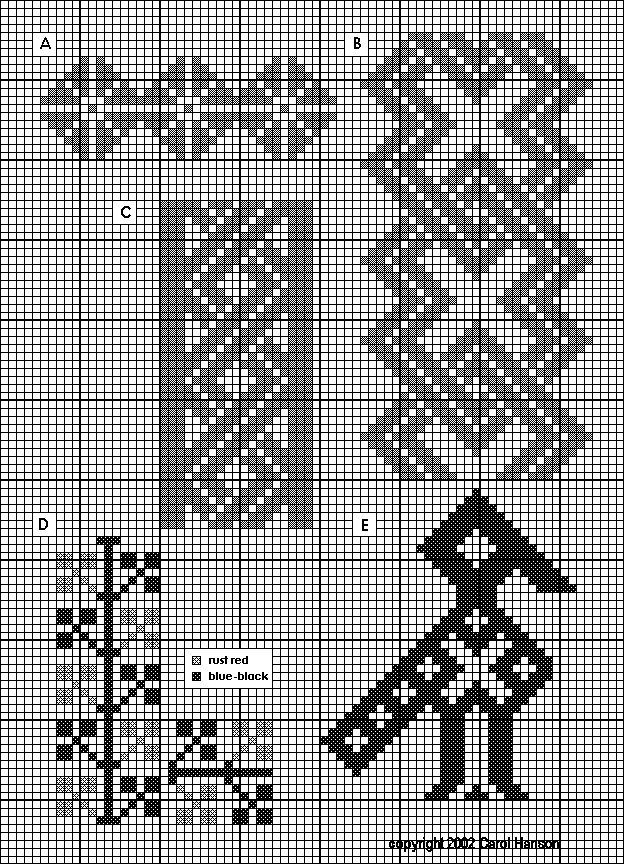
Now all you need is a suitable graph, and you’re set. (Credit: This particular graph has been researched by SCA pal Carol.)
MORE ON ATTACHING AN EDGING – DRAWN LOOP METHOD
Yesterday I described two of the more usual methods for attaching edgings to project bodies – plain old mattress stitch seaming, and knitting onto a live stitch or finished edge. Today I continue with a third method. I’m not quite sure what it’s called, so I’ll call it the drawn loop method for now.
I learned this while doing the Forest Path Shawl (Interweave Knits, Summer 2003). If you plan on finding a copy of IK and working the Path, be aware that it appears to be sold out from the back issue collection on the IK website, and that there’s a correction posted in the magazine’s errata pages.

Drawn loop is intended for working a knitted trim onto a finished edge, and seems to be the least bulky of the three methods when used for that purpose. Like plain knitting on, the attachment is worked row by row as the knitting proceeds. Many patterns that use plain knitting on include directions to pick up an endless number of stitches prior to working the attached edging so that the trim is applied to live stitches rather than the original finished edge. The drawn loop method avoids that annoying exercise in endless counting although it does work best when done on a slip-stitch selvage. Unlike knitting on, there’s no column of double stitch thickness decreases formed where the edging meets the main body. As such, it’s particularly airy. It is however a bit fiddly to do, and works more easily with a smooth finish yarn than with a hairy mohairy type lace yarn.
To use drawn loop, you cast on much as for knitting on. If you use half-hitch, knitting on or a cable cast on to add your edging’s worth of stitches, you do so to your right hand needle, but instead of making a slip-knot for the first, you establish that first stitch by picking up a stitch in the edge-most loop of your main body, then work back a wrong side row to return the yarn strand to the rightmost side of your edging (and point of attachment). If you had the foresight to have incorporated a slip stitch edge in your main piece this will be easy. Otherwise you’ll have to eyeball where to pick up. Difficult (which is why many patterns want you to pick up stitches along finished sides) but with practice this is do-able.
If you use a provisional cast-on like a crocheted chain, you’ll put those new stitches onto the left hand needle, then work a wrong side row using your good yarn to return the rightmost side of the edging (and point of attachment).
Once you’re back at that rightmost edge, you use your needle tip to draw another stitch up through the next selvage loop of the main body. Here’s where it gets tricky. Enlarge that “stitch” until it’s a loop of about 18 inches or so diameter (how big to make it will become clear after you’ve done a couple of iterations). That loop will have two “ends” – one firmly attached to the knitting, the other sliding free trailing back to your yarn ball. Grab the fixed end and give it a gentle tug to make sure there’s no extra slack, then using the loop, work across the right side row of your edging. Flip the work over as usual, and work the wrong side row back, again using the giant loop. When you get back to the point of attachment, give another slight tug to the strand coming from the yarn ball to pull out any excess left over from your giant loop. Then repeat the process, drawing up another giant “stitch” in the next selvage loop and using it to knit a pair of edging rows. All of this sliding of the yarn back and forth as the large loops are made is the reason why this method works better with smooth rather than hairy finish yarns.
Again, like any attachment method that involves butting two pieces of perpendicular knitting, some adjustment of the ratio between rows worked to selvage stitches may be necessary. If the newly done edging is beginning to get too ruffly and fluttery, you may need to rip back a row or two and skip a selvage stitch. If the edging is drawing up and the body is beginning to gather, you may need to work an additional pair of edging rows without attachment.
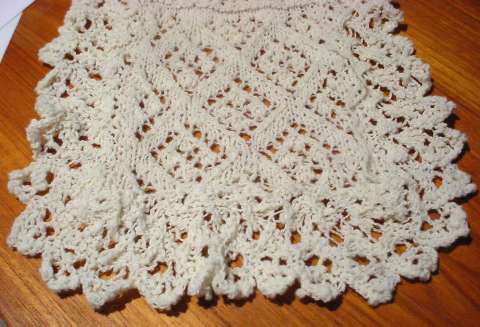
Like I said, it’s fiddly but effective, creating the lightest possible line of attachment between an edging and a live-stitch-lacking main piece, and avoiding pain-in-the-neck sessions picking up a zillion stitches around a piece’s perimeter. I used drawn loop to good advantage on my Spring Lighting Lacy Scarf pattern, and plan on using it again on future designs.

KNITTING AN EDGING ONTO LIVE STITCHES
Now. Back to the present.
Sallyknitter sends an eMail asking how one goes about attaching an edging to a row of live stitches. I’ll try my best to answer.
First, there are several ways of doing it. The simplest but most fussy is to knit the edging entirely separate, as a long strip – then sew it on using mattress stitch. Effective, but boring. Plus even using mattress stitch you can end up with a relatively bulky seam on the reverse compared to the rest of a gossamer-fine lace piece. I used this method on the two counterpane patterns in the wiseNeedle pattern collection, and on the tragic pink blanket now awaiting repair.
Having had my fill of producing an endless roll of edging, then an eternity sewing it on neatly, I now prefer knit-on edgings. They have the advantage of keeping one’s stitches securely on the needles until they are both edged and bound off in the same pass. Knitting them on is relatively easy. Let’s use an edging pattern I’ve described here before:
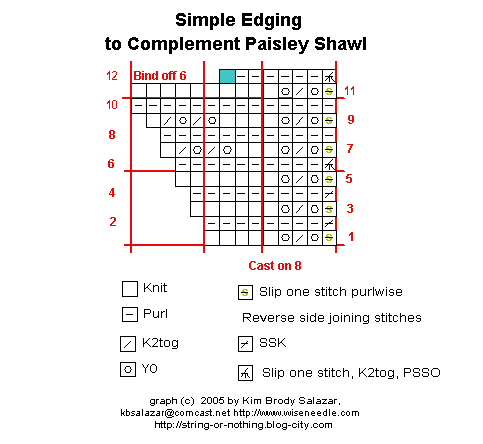
To work this onto the edge of a row of live stitches, I wouldn’t even need to break my yarn off after completing the last round of my main piece. Using a half hitch I’d cast 8 stitches onto my right-hand needle, adjacent to the last stitch worked in the main body. If I started with half hitch, I’d purl 8 back, working row 12 of the pattern, with the exception that the blue box would be a plain purl instead of the “artifact” stitch left over after binding off 6. If I were to use a provisional cast-on employing waste yarn, I’d cast on 8 onto a DPN or the left-hand needle, then work across starting with row #1, but working the first stitch as a plain knit.
I’d then work the rows of my chart as directed. You’ll note that on the final stitch of the even numbered (wrong side) rows, I purl the last edging stitch along with a live stitch from the existing edge. In the case of this particular pattern, given the row and stitch gauge difference, I found I had to “eat” additional live stitches as I attached, in order to prevent ruffling (which on some pieces can be a design feature rather than a bug). So on rows 6 and 12, I purl one stitch from my charted edging along with two live stitches from the piece’s body.
Now. What do you do if there aren’t live stitches? You pick them up. To knit the edging above onto a FINISHED edge, instead of purling the last even row stitch together with one stitch from the live body, I’d finish the even rows by picking a stitch up along the body of my finished piece. My odd numbered rows would then begin with a K2tog, knitting that new stitch together with the first stitch of my edging pattern.
Using these method, any edging from dead simple I-cord to elaborate lace can be attached to a live stitch edge or a finished piece. You can even use an edging to both finish and seam together TWO edges. I did that on these pillows.
I recently learned another slightly more involved method of knitting an edging onto a finished piece. It’s the one I use in the Spring Lightning lacy scarf (pattern elsewhere on wiseNeedle). More on that tomorrow.
WORKING REPORT- CRAZY RAGALAN
This was the entry that I was hunting for when I discovered my missing month. It describes crocheting onto a needle to start a provisional cast-on instead of just making a crocheted chain and picking up stitches along the back ridge of bumps. This was originally posted on 22 June 2004.
WORKING REPORT – CRAZY RAGLAN
Enough boring everyone with rehab junk. You came here to read about knitting, and not to visit This Old House.
I’ve ripped out the entire mindless knitting raglan and started again. This time I’m doing it in the flat, and working both pieces side by side. Because I hate seaming ribbing I’ve decided to add it later in the round, after I’ve sewn the sweater body, so I’ve started out with a provisional cast-on. I favor the crochet chain method of provisional cast-on, but I detest fiddling with the crocheted chain, picking up the bumps along the chain’s back. Instead I crochet my chain directly onto my knitting needle. Here’s how:
First I pick a nice smooth cotton string-type yarn, and a crochet needle a size or two larger than I’d use with it for a crochet project. In this case, I raided the Baby Georgia I was using for the filet knitting project, and grabbed a Bates F size crochet hook (more on hook sizing another day).
To start, I chain up about five stitches, just to have a stable spot to begin and an end to hold as I do so. Then I take my knitting needle and hold it like this:
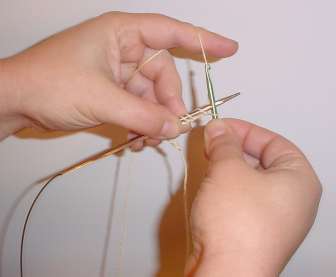
Holding the yarn in the back of the knitting needle, I reach up across the front of the knitting needle to grab the strand and form my crochet stitch. This lays a loop around the knitting needle itself, with the leading leg of the loop correctly oriented. After the stitch is formed, I use my left forefinger to flick the yarn around to the back of the knitting needle again:

Once the yarn is in the back of the needle, I’m ready to crochet on my next stitch.
I usually crochet on several more stitches than I need, just to be sure I have enough, and end off with five or six plain chains as insurance. Once the stitches are on the needle, I can switch to my knitting yarn and begin my first row of knitting. If I have more stitches cast on the needle than I need, I just slip off the excess. They become normal crochet chain stitches and sit quietly until the end of the project. No worries.
When it’s time to awaken the provisional stitches and begin knitting in the other direction, I find the last chain stitch I did (tie a knot in the dangling end if you think you might not remember which is which), carefully unpick that last stitch, then pull the strand to zip out the crochet stitch by stitch. As each knit loop is freed, I slip it onto a waiting needle.
Here’s my newly re-started raglan. Note that I’m knitting the back and the front at the same time. That way I am guaranteed that they match row for row and decrease placement for decrease placement.

I’ve done something here with the crocheted provisional cast-on that helps me keep life straight when working two pieces side by side. I’ve crocheted all of the stitches I need for both back and front in one long strand. First, following the procedure above, I made enough stitches for the back. Then I crocheted about ten free stitches without making loops on the needle. After that I made the stitches for the front, ending with a few extra chains. Using a different ball of yarn for each piece, I knit across first the front and then the back. The little bar of crochet anchors my two pieces together in the center and helps me remember which direction I’m going so that I don’t get to the half-way mark, then head back across the same piece instead of working the other one. (As the work gets longer I’ll safety pin the two pieces together closer to the top for the same reason.)
How did I manage to take the photos above? Not by growing extra arms, that’s for sure. So far all of the “hands working” shots on this blog have been taken by Alex, my 8th grade daughter. She may not knit, but she handles a mean digital camera.
QUESTIONS AND SOURCES ON MEDALLION KNITTING
[Repost of material originally appearing on 8 August 2006]
More questions and comments today via eMail.
Do you always use the half-hitch cast-on on two needles for medallions?
No. For octagonal or square medallions predicated on a starting stitch count of 4, or for triangular or hex medallions that start out with 3 stitches, I tend to use an I-cord beginning, working one round of I-cord, then introducing more needles as the work grows. But my I-cord also starts out with half-hitches rather than another, firmer cast-on. I often use the cast-on tail to thread through the half hitch “spine,” drawing up the center purse-string style to make it nice and solid, but not lumpy. The only exception to this is if the center of the medallion is a large hole rather than a solid bit. If the edge of the cast on will be on display because it frames a central hole and structural integrity is key to a neat hole, then I use something more solid – either long-tail or one of the knit-on cast-on family.
I see several sources for learning how to knit lace in the flat, how about a source for the basics on inventing your own in-the-round medallions?
It’s true that analyzing and inventing medallions aren’t as widely addressed as flat lace. Some of the shawl books and specialized Shetland Knitting do go into a quite bit of detail on using lace patterns for center-out, radial increase pieces, but they mostly stick to squares. The most recent edition of Interweave Knits (Fall ’06) has an informative article on what to do if your lacy pattern is interrupted by changing stitch counts – again very useful, but only part of the story. The Lewis Knitting Counterpanes book put out by Taunton gives lots of patterns for medallions, but is rather less useful as a source of hints for designing your own.
In spite of all these great sources, my at-the-elbow source for medallion knitting tips remains the venerable Mary Thomas Book of Knitting Patterns. It’s the companion volume to her Knitting Book. Thomas is one of my personal heroes, both for these books and for her embroidery series. Judith in Oxon in the UK tells me that Mary Thomas grew up in her town, but is now forgotten there. What a shame.
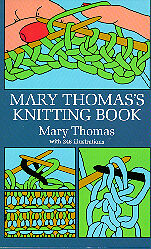
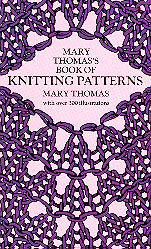
Knitting Pattterns was first published in 1943, and has been in print ever since – most recently in an inexpensive Dover re-issue (pictured above). There’s an extensive on-the-web preview of some content at Google Books if you’re unfamiliar with it (the 1938 Knitting Book preview is also available, current inexpensive Dover edition shown above). For two slim volumes I am constantly amazed at how much info they contain.
The Thomas books bridge the Victorian and post-Victorian era ladies’ pattern magazines, compendiums and encyclopedias of needlework (Weldon’s, de Dillmont) and modern knitting guides (Vogue, Principles of Knitting). Thomas tried to seek out what was offered in conteporary scholarly info on textile history, and to explain some of the more esoteric aspects of craft execution in a non-ambiguous way – targeting an audience interested in process and technique rather than in devised patterns. For example, she was one of the first to use a system of standard block symbols to represent knitting texture and colorwork patterns in graphed format.
Of course nothing is perfect. Her knitting history reflects the state of research at the time she was writing, and is not as devoid of folk myth as is R. Rutt’s, but it’s not bad either. The biggest criticism people have of the Thomas books is of the small illustrations sprinkled throughout. The drawings are by “Miss H. Lyon-Wood, Miss Dorothy Dunmore and Miss Margaret Agutter” and reflect a rather colonial world view (especially of non-Europeans) that today would be considered culturally and racially insensitive. Of all the books, the Knitting Patterns (her last) has the least of these little cartoons, and her earlier works on embroidery, the most. As an aside, it’s also worth noting that Agutter wrote books on cross stitch, crochet and patchwork quilting, and as a respected knitting expert, worked with James Norbury on Odham’s Encyclopaedia of Knitting. I’ve heard rumors that the other two seem to have provided small illustrations and marginalia for several other contemporary books, plus some childrens’ book illustrations, but haven’t been able to confirm them.
Overlooking these flaws, things that recommend Knitting Patterns include sections on all sorts of lesser seen esoterica, including Filet Knitting (knitting in imitation of fliet crochet); picot point knitting (an amazingly fiddly bit of freeform scrumwork to make petal and flower-shaped bits of detached knitting for edgings or raised decoration); and basic steps in medallion knitting geometries. On the whole, given the ubiquity and extreme inexpensiveness of the Thomas books (both can be found used for under $2.00 each), they are useful additions to anyone’s knitting library.
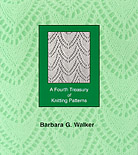
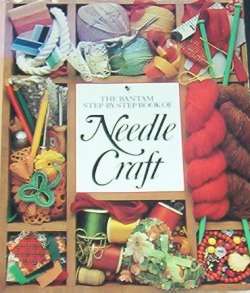
Other sources that delve into the mysteries of knitting medallions in the round include B. Walker’s recently compiled Fourth Treasury of Knitting Patterns, in which a non-traditional approach to medallion knititng is addressed as an offshoot of directional knitting; and unlikely as it sounds – in the standard center-out method, inJudy Brittain’s Bantam Step by Step Book of Needlecraft. I’ve written about the Bantam book before.
TRANSLATING BETWEEN KNITTING IN THE ROUND AND KNITTING FLAT – Part IV
[Repost of material originally appearing on 14 June 2006]
If you are translating between knitting in the round and knitting flat you may run into a direction to perform something on the right side of the work that you now need to do on a wrong side row (or vice versa).
The absolute best source for this info are the symbol key charts at the start of B. Walker’s Charted Knitting Designs, and A Fourth Treasury of Knitting Patterns (and possibly several of her other smaller books, though not Walker I or II). It’s the most complete, listing a huge number of stitch manipulations and giving directions – sometimes more than one set of directions – for ways in which that same manipulation can be achieved on both right side and wrong side rows. Other books of charted patterns including L. Stanfield’s New Knitting Stitch Library give right side and wrong side equivalents, but I find the Walker set the most complete and the easiest to use as a ready reference.
The info below is abstracted from a small portion of her charts, but without her specific how-to write-ups. Items with asterisks are ones for which Walker gives multiple variants that should be subject to experiment before the optimal one is chosen. Her write-ups are excellent and should fuel countess hours of yarn-y tinkering.
| Right Side Row | Wrong Side Row |
| K – Knit | P – Purl |
| P – Purl | K – Knit |
| (K1-b, K1) – Center double increase into one stitch | (P1b, p1) – Center double increase into one stitch |
| K2tog – Knit 2 together | P2 tog – Purl 2 together |
| SSK – Slip, slip knit | P2 tog b – Purl 2 together through the back of the stitch |
| P2 tog – Purl 2 together | K 2 tog – Knit 2 together |
| (S1, K2tog, PSSO) – Left slanting double decrease | (S1 WYIF, P2tog-b, PSSO) – Right slanting double decrease* |
| K3tog – Knit 3 together, a right slanting double decrease | P3 tog – Purl 3 together, a left slanting double decrease* |
| K3 tog b – Knit 3 together back, a left slanting double decrease* | P3 tog b – Purl 3 together, a right slanting double decrease* |
| (S2, K1, P2SSO) – Slip 2, knit one, pass 2 slipped stitches over, a center double decrease | (S2, P1, P2SSO) – Slip 2, knit one, pass 2 slipped stitches over (Specific method of slipping desribed*) |
 String-Or-Nothing