VINTAGE LACE SCARF; ATTACHING LACY EDGINGS
Where have I been? Well, first there was another spate of chaos deadlines at work. Then it was the beginning of Birthday Week here in the String household (they’re 7 years and four days apart, with mine shortly thereafter). And to no one’s surprise, I came down with a nasty flu. I’m not yet over that, but it was severe enough for me to stay home from work – something I’ve done only once or twice in the last decade.
For her birthday Smaller Daughter specified a volcano cake with a dragon on it. She’d seen something like this in a kiddie cookbook – a bundt with a lava-like frosting poured on, surmounted by some clever marzipan decorations. So we made it a group project. I provided the almond bundt with chocolate fudge filling and frosting; Older Daughter molded the marzipan dragon with dried apricot wings; and Smaller Daughter made the strange red prey creatures fleeing from the dragon:
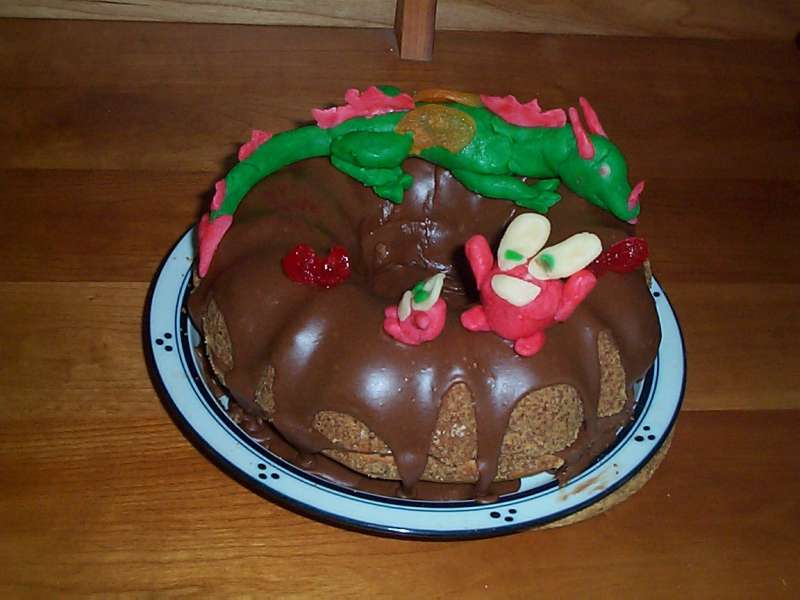
We were hard pressed to find enough room for the obligatory birthday candles. The cake and decorations however were delicious.
I did manage to make some progress on the lace scarf over the last week. I’ve finished the center section, and am working on the edging. It looks like I’ll have to nip into my third skein of Prescott, so I’m thinking of pausing on the edging to go back and add some length to the center section before lapping all the way around that last end. I’m not doing anything fancy here – no mitered corners. I’m just working an extra repeat of the pattern into the cornermost stitch, and hoping that all blocks out evenly later.
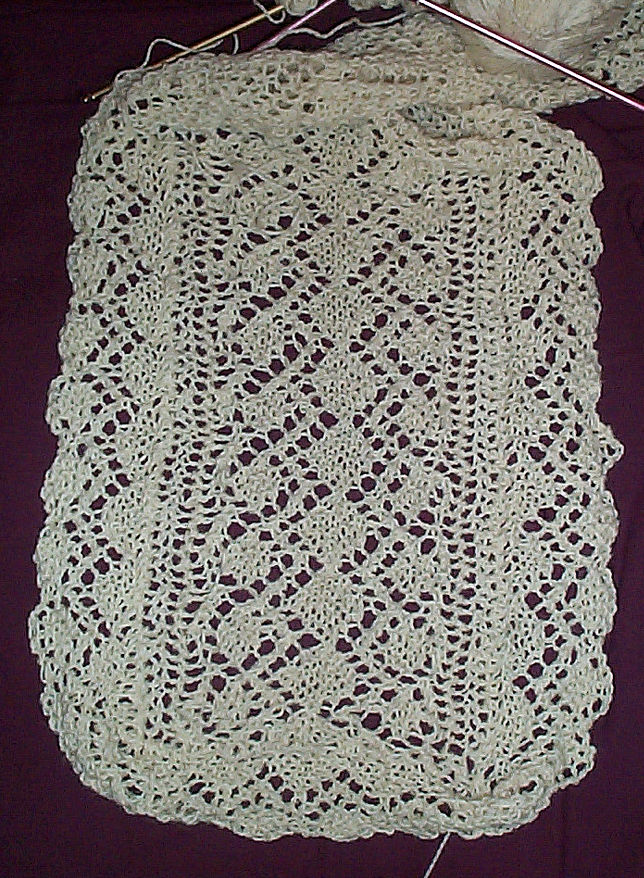
UPDATE: THE LACY EDGING BELOW IS NOW AVAILABLE AS A SINGLE PATTERN DOWNLOAD UNDER THE KNITTING PATTERNS LINK, ABOVE.
I played with quite a few edging patterns for this piece, finally settling on the “Doris Edging” from Miller’s Heirloom Lace. It has framed diamonds that exactly complement the center strip. Along the way I noodled up another simple triangle-based edging. This is an out-take, and didn’t end up on the scarf. I won’t violate copyright by sharing Miller’s edging (which I used more or less verbatim), but I will share this one:
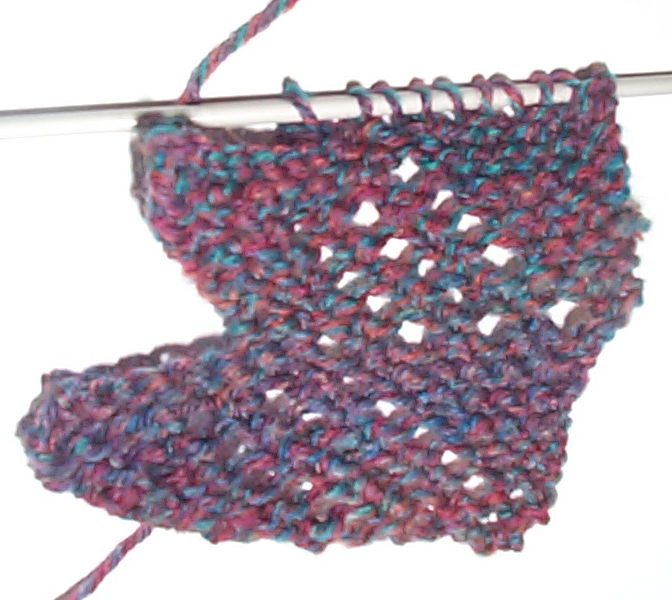

Knitting an edging onto a piece isn’t difficult. It helps if your base item was worked with a slip stitch selvage edge, but that’s not mandatory. I’ve knit edgings onto all sorts of things, including finished fulled/felted items, fabric, and leather (some caveats on this, below). The slip stitch selvage just makes it easier. Your chosen trim will have one edge intended to hang free. Most often that will be dagged, serrated, scalloped or otherwise fancified. It will also have one (more or less) straight edge. This straight edge is intended to be sewn or knit onto something else. I like to work in the orientation shown in the knit sample and pattern, above – with my straight edge on the right, and the fancy edge on the left. My right-side rows commence from my main piece outward, and my wrong-side rows return from the fancy edge back to the main piece.
Sometimes I use a provisional cast-on and start my lace rows immediately after it. Other times I use a half hitch cast on, then work one row back in knits before starting my lace patterns. There’s no real rhyme or reason here. It’s just what I felt like doing at the time. In this case, I cast on using half-hitch, and worked a row of knits back, working my first join on that “back from cast-on” non-repeated row. The join itself is quite simple. When I get to the last stitch of my wrong side row, I pick up one stitch in the edge of my established body piece. Then, for the first stitch of my right-side lace row, I either knit or purl that newly created stitch along with the next stitch after it on my needle.
If I knit those two together I end up with a neat column of stitches that makes a visual line between the lace edge and the main body. While this can be desirable in some cases, it does present a different appearance on the front and reverse of the work. Because the lace center of this piece is garter, and the edging is also presented in garter, I used a P2tog to make the join. The front and back of the work look less different from each other if I purl the join instead of knit it. Once the join is made, I work out the remainder of my right-side lacy row, and the return row. So long as I remember to pick up one stitch at the end of every wrong-side/return row, then work that stitch together with the next one as I begin the right side row, my edging will be firmly united with my main body.
Sometimes you don’t want to do a row-for-row join. Occasionally the stretch of the lace edging or the ratio of the edging rows to body rows isn’t 1:1. This might happen if you are working the edging on smaller needles; or if you are working the edging across a row of live stitches (or across the top or bottom cast-on or bound-off edge) rather than along the “long side” of the work, parallel to the main body’s knitting. In that case you may need to either work additional non-attached lace rows every so often, or pick up at the end of the wrong-side/return rows by knitting two body stitches together, again every so often. The former adds more length to the lace, the latter subtracts width from the body. Which method is used depends on the stretch of the body.
The biggest caveat in attaching knitting by knitting on rather than by seaming is that if you do so, the lace is no longer “portable.” Let’s say in a fit of Suzy Homemaker frenzy, you edged out a set of exquisite hand towels. It’s now some years later, and your children have stained those towels beyond recognition, but the edging still looked good. If you had knit the edging separately and seamed it on it would be very easy to remove and re-apply to new towels. But even if you had run a band of slip stitch crochet down the edge of the towel to provide an easy edge for attachment first, if you had knit that edging onto the towel, removing the fancy lace from the towel will be …problematic.
As far as knitting onto fabric, fulled material or leather – it CAN be done. If the edge can be pierced by a needle tip (or was conveniently punched beforehand), you can knit right onto the edge of anything. BUT the warning about not being able to take the lace off again or adjust it later is strongly in effect. If you want to attach a lace edging to any of these substrates, it’s worth it to work one row of slip stitch or single crochet along the item first, then knit (or seam) your knitted edging onto that crocheted foundation row. The foundation row of crochet gives you a stable, evenly placed line of stitches for the joins, and stabilizes the base item’s edge somewhat. It also (in the case of leather) makes working into previously punched holes easier (a crochet hook is much easier to thread through and grab a strand than is a knitting needle’s tip). Plus, if you think the item being trimmed might shrink, consider seaming rather than knitting on so you can make adjustments later.
So. If you plan on using a lace edging again on another item, or you think your base item might shrink – take the time to seam (collars, cuffs, bed or bath linens). If the edging will remain on that piece, living and dying with the item that bears it – consider knitting on instead (knit counterpanes, scarves). To illustrate this post I wish I still had the denim jacket I trimmed out in knitted lace, or the baseball jacket that used strips of recycled fur interposed with white Aran style heavy cables…
In any case, back to sniffling and a nice lie-down.
CHARTING 107 – WORKING FROM ANTIQUE KNITTING PATTERNS
Apparently my post on knitting patterns from books published prior to 1920 or so has struck a chord. I’ve gotten a couple of requests on how to go about translating these older knitting patterns to modern notation. I did a six part section on how to graph up patterns from written notation before (Charting 101, 102, 103, 104, 105 and 106 ), so this sort of follows as optional post-lesson workshop.
This time I’ll start with a web-available pattern. K. Harris at Vintage Connection has posted a transcription of a knitted insertion pattern that first appeared in The Delineator magazine, in June 1896. I’ll be producing a modern notation graph for that lace panel. Before we begin, it’s worth noting some common features of turn-of-the-century knitting. Not every technique known today was widely used, and terms varied a bit – even more widely than they do now. I’ll try to cover some of the most common notations.
Knit and purl – k, p
Not much difference. Basic knits and purls were pretty much as we know them. There were however a couple of associated usages that are less common today. Knit plain usually meant work in knit stitch only. One complication – it follows then that for things knit in the round knit plain came to mean “work in stockinette.” Occasionally by extension knit plain was used to indicate stockinette done in the flat rather than in the round, even though intervening rows of purl by necessity exist. I’ve also seen it used very infrequently to mean “continue working in established pattern,” but that’s rare. More often the term work even was used in that context.
Another alternate usage – purls were sometimes referred to by the term seam, as in the instruction “knit two, seam two” to produce k2 p2 rib. This is probably a hold-over from early sock making, in which a column of purls on the back of the leg was used in imitation of a seam line.
Narrow – n, k. 2t, t,
The modern equivalent of narrow is K2tog – the standard right leaning decrease. Sometimes this is written up as K2, with the “tog” part of K2tog being left out entirely. Older patterns did not use SSK. Occasionally they call out a SSK equivalent of “slip one, knit one, pass slip stitch over” (see below) but most often they don’t bother with a left leaning decrease, and use K2tog, even when the cognate would be visually more balanced or appealing. Close inspection of accompanying illustrations reveals that the knitters did employ K2tog for almost all decreases. Less frequently this decrease is referred to as together (t) or knit 2 together (k. 2t.).
One unusual notation on narrow – a couple of patterns I’ve seen use n followed by the note “by slipping the needle through the back of the stitches.” This does sound a bit like a proto-SSK. But unless otherwise modified or explained, it’s pretty safe to assume that any n means k2tog.
Slip – s
Another movement that’s pretty standard. Unless otherwise modified, slip in historical context means slip purlwise – transferring the stitch from the left to the right hand needle without changing its orientation.
Slip and bind off – sb, sbo, sl&b,
Another historical way of referring to the left leaning decrease or SSK equivalent, this refers to the s1-k1-psso unit.
Over – o, th, w, tho, th. o,
Yarn overs or eyelet producing increases – still a source of multiple terms today – have even more names if you go back through time. I’ve seen YO referred to as over (o), throw (th), throw over needle (tho or thn) eyelet (e), widen (w), make (m), put over (po), yarn on needle aka yarn over needle (yon), wool round needle (wo, wrn, won).
Special note on double YOs. Most of the time modern patterns use a multiple-unit YO if a really big eyelet is needed. But in historical patterns when YOs were used to make columns of fagot-stitch lace, it was common for the YO that formed them to be specified as a double yarn over, probably because of the yarn manipulation used to create them needed to allow for a subsequent p2tog. If a pattern with fagoting calls for a double yarn over but the stitch count on the subsequent row doesn’t account for the additional new stitch (or doesn’t mention dropping it), it’s a good indication that a modern redaction will call for only one YO and not two.
Make – m
This can be problematic. It’s on the previous list as a euphemism for YO, but it is also used in historical patterns for invisible increases – where an additional stitch is added without creating the eyelet hole formed by a YO. Modern “make” is usually interpreted as a raised bar increase, although other forms of adding a stitch like knitting into a stitch on the row below are also sometimes used. A bit of close examination of any illustrations or even experimentation may be called for here. The term made stitch is also sometimes used to indicate the new stitch formed by a YO in a previous row – especially when more than one YO created multiple adjacent loops on the needle.
Purl two together – p. 2 t., p2to, pto
Purl two together was a very common instruction, especially when columns of fagoting style lacy knitting were used.
Crossed knit – c, t, b, tw
Crossed knits are modern twisted knit stitches, produced by knitting into the back of a stitch (ktbl). I haven’t seen a historical pattern that includes a purl through the back of the loop (ptbl), but that doesn’t mean that one doesn’t exist.
Now with all this set out, I can graph up the diamond insertion from the Delineator. It starts out with a cast-on of 23 stitches. It includes double YOs, but all double YOs are followed by p2tog units, producing the columns of fagoting in either side of the center design. I’ll show the progression from as-described rows through modern notation.
First, as written, preserving the double YOs; without flipping the wrong-side rows in accordance with the modern charting convention of showing the work as it appears on the front (public) side; and without centering the rows or norming the chart to have parallel edges we get this: (click on images below for larger versions):

We quickly see that stitch counts vary from row to row, although the pattern is more or less internally proofed because wrong side rows do contain the same number of stitches as the right side rows that preceded them. We also see that the double YO followed by P2tog problem is here. Were those YOs to each be “real” each following wrong side row would need to be two stitches longer, and the lacy effect would not be achieved.
Other features of this pattern are pretty straightforward. YOs are YOs, whether they appear on the front or reverse side rows. The K3tog unit only shows up on front (even) side rows. P2tog when seen from the back is a plain old k2tog, so that’s also easy to flip.
So. Norming the presentation so that wrong-side rows are shown using the correct right-side row equivalent symbol, and isolating the side columns of fagot stitch, and consolidating the YOs we get:
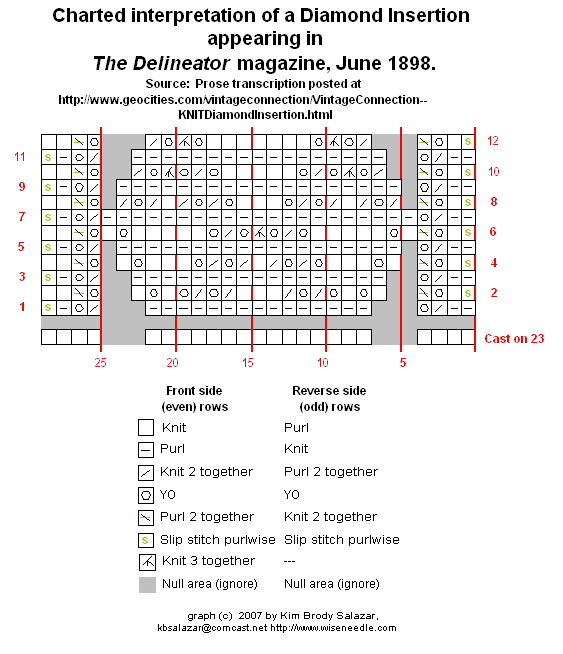
I’ve gone through all of this not only for the fun of sharing, but also because I am using this particular pattern to knit up a new quick lace scarf. I’ll edge the thing out with something complementary, but for now, here’s how it looks:

Knit somewhat overscale in Swift River Prescott on US #8s, one panel of this lacy pattern is perfect for a scarf – curl-free and totally reversible!
TAMING WILD SOCK YARNS AND USING UP LEFTOVERS
Self stripers, multi-ply color twist yarns, and hand-dyed yarns are lots of fun. There’s a ton of color there to enjoy. But sometimes a vast and unbroken expanse of color play can be boring or can produce some oddly pooled or cluttered results that look nowhere as nice as the yarn did in the skein. That’s why I like to fool around with multicolor yarns, trying to find a way that they play best, or are shown to better advantage. Sometimes it’s not easy (regular readers here know of at least two of my multicolor yarn experiments have landed in the limbo of my Chest of Knitting Horrorstm over the past couple years. But sometimes it is easy.
I finished up a pair of socks as a “chaser” after the vest was done. I used a stash-aged 50g ball of Stahl Wolle Socka Color, in a multistrand twist of maroon, pine, blue, and marigold – #9140, plus another well-aged 50g ball of Patons Kroy Socks in hunter green – #409. While the colors aren’t exact matches, they are close enough to complement each other. Both of these were found in last-ball sales, but several years and many miles apart. Since I need around 80-90g of most fingering weight sock yarns to make a pair, between the two bargain basement balls I had enough to finish and still have leftovers – provided I used more or less equal amounts of each.
My solution was to work heels, toes, and ribbing, plus about a little under a third of the sock’s body in my solid green, plus the remainder in the multicolor. I used very simple seven-row striping repeat, working five rows of multi, and then two rows of solid green (2/7 = about 28% of my sock’s body). I like how the multi is visually broken by the bands of solid green. The end result has at once more contrast and more subtlety than working the whole sock from multi alone, even if I still did contrasting color toes, heels and ribbing.
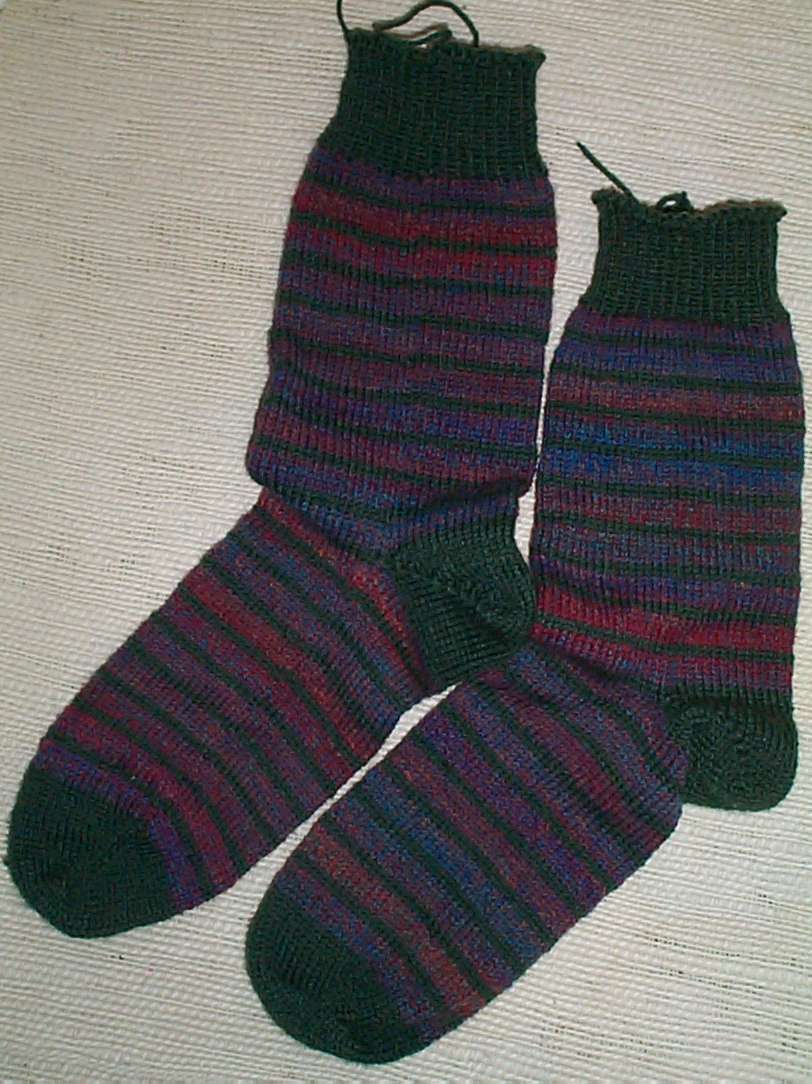
Of course the other advantage of working simple stripes on socks is to idiot-proof achieving two socks of identical size. It’s very easy to count five row units and two row units. When I had completed ten muticolored stripes, it was time to start the heel, which is much easier than having to count every row or trust in doing a measured or eyeballed estimation of foot length.
So. If you find yourself with odd lots of sock yarn, don’t despair. 100g of fingering weight sock yarn knitting is ample for most socks up to around men’s US shoe size 10.5 or so (slightly smaller if yarn-eating textures are used). You can either work color block style, using up one leftover and then another, or you can stripe. But how wide to make the stripes?
Heels, toes, and ribbing in my standard short-rowed heel sock consume about 25g (a conservative estimate). I have large and wide feet for a fem, so if you are knitting for yourself chances are that you use roughly what I do or less. Weigh it out and set it aside. Then weigh the rest of your leftovers. If you have (for example) 40g of blue, 20g of yellow and 20g of green, you’ve got a ratio of 2:1:1. If you worked a stripe repeat conforming to that ratio (let’s say two rows of blue, two rows of yellow, two rows of blue, two rows of green), you should have enough of each color to complete the pair.
Obviously, I had enough and did complete my pair. And I did have leftovers. As expected, I had a bit more of the multi left than I did the green, because my heels, toes, and narrow green stripes added up to about 60% of total yarn consumption.
QUICK SOURCES FOR KNITTING FROM VINTAGE PATTERNS
Rebecca notes that the patterns in the on-line repros of antique knitting and crochet books that I reported on yesterday call for needles specified by outmoded sizing systems, and asks for help in translating those sizes to modern ones.
I reply that there several sources for info on knitting from these older patterns floating around the Web. Here are a couple.
- The most complete size comparison chart I know about that shows older vs. modern needle sizes is at Lois Baker’s Fiber Gypsy website.
- I’ve also got one here at String that speaks to the equivalents between historical and modern needle sizes. I add some common vintage yarns typically used with those needle sizes along with suggestions for equivalent modern yarns (I’ll be updating this soon based on the new info from yesterday’s books).
- The list of ancient yarns with approximate yardages maintained at Vintage Knits is also very useful if you’re trying to work from an older pattern specifying an unknown yarn (often without yarn specs.)
- The yarn database here at wiseNeedle can be helpful, too. We’ve got a smattering of reviews for actual vintage yarns have entered by knitters who stumbled across older products in stashes or yard sales (reviews of discontinued yarns are always welcome here!). Other people have posted reviews noting that they have used various modern products as substitutes for now discontinued yarns. You can find the former by looking up the old yarn name like you would any modern one. You can also use the search comments field on our advanced search page to look for mention of an older yarn in any review.
If you’ve got a yarn review to add, the most efficient way to do it is to first look up the name and see if it’s in the collection. If it is – click on the link on the yarn’s page to add your comments. Or if the yarn is new to our collection, here’s a page where you can add both basic data and your comments at the same time.
- The knitting terms glossary also maintained here at wiseNeedle contains historical British and American usages as well as modern ones. You can limit the result to two or more languages by holding down your <CTRL> key and highlighting the desired ones from the drop-down list.
AMAZING ON-LINE REFERENCE LIBRARY
Out web-walking again, I’ve stumbled across a treasure trove of books on spinning, weaving, and other textile arts. It includes historical and recent works on lacemaking, embroidery, tatting, knitting, crochet and some other less practiced crafts, as well as ethnographic material, periodicals, and academic papers. I’m sure I’m the last to find out about it, but I share the reference all the same.
This textile-related archive is maintained by the University of Arizona. Its collections are available on-line, with the individual works so distributed either aged out of copyright, or presented with the authors’ permission. There are thousands of items – mostly geared to industry and manufacture, but with a healthy smattering of works detailing hand production. Scans are available as PDFs, with the larger books broken out into smaller segments of under 15MB. Not all are in English.
Among the works I found that are of greatest interest to me in specific are:
Whiting, Olive. Khaki Knitting Book, Allies Special Aid, 1917, 58 pages. PDF
This compendium of knitting patterns presents sweaters, wristlets, socks, scarves, mittens, hats, caps, and baby clothes intended in part for troops overseas during WWI, and for the comfort of refugee families displaced by the war. Patterns for knitting and crochet are both included. The socks shown mostly knit top-down, some have a gradually decreased instead of grafted toe. Some of the socks are worked on two needles and seamed. One pair in particular (marked as a pattern from the American Red Cross, p. 13) seems to include a written description of a grafted toe, but it does not name the technique. Directions are a bit more detailed than is usual for pre 1940 knitting booklets. Fewer than a quarter of the patterns are illustrated with finished item photos. Aside from a list of abbreviations in the front, there are no how-to or technique illustrations.
Nicoll, Maud Churchill. Knitting and Sewing. How to Make Seventy Useful Articles for Men in the Army and Navy, George H. Doran Company, New York, 1918, 209 pages. PDF
This book is a bit more detailed than the previous one. It also contains a rundown of standard troop knitting patterns – hats, mufflers, balaclavas (called helmets), mittens, socks and the like. Every project is illustrated either with a photo or a line drawing of the finished product. Instructions are written out in a fuller format than in the Khaki Knitting Book. It also has some valuable bits of instruction including a list of yarn substitutions, plus two full size color plates showing the wools used, identified by name; a small stitch dictionary section,
Of special note are some unusual mittens (including a mitten with truncated thumbs and index fingers – p.68), half-mittens – p. 77, “doddies” or mittens with an open thumb, p. 80, and double heavy mittens intended for seamen or mine sweepers hauling cables – p. 94). The grafting method of closing up sock toes is clearly described AND illustrated, but it is called “Swiss darning” (p.131). I’ve heard that term used for duplicate stitch embroidery on knitting, especially when the decorative stitches are sewn in rows mimicking actual knitting, rather than being stitched vertically, but I have never before seen it applied to actual grafting. The entire section on socks and stockings is particularly clear and useful. There are even a couple of crocheted and knit mens’ ties in the sewing section.
Finally, the sewing section (about a quarter of the book) might be useful to people doing historical costuming or regimental re-creators who are looking to augment their kit. The one drawback is that most of the sewing patterns are predicated on Butterick printed patterns, and the schematics are not provided in the book. Among the offerings are money belts, a chamois leather body protector and waistcoat, various types of shirts and undergarments, pajamas made from heavy blanket fabric, and a book bag (like a messenger’s bag).
Egenolf, Christian. Modelbuch aller art Nehewercks un Strickens, George Gilbers, 1880, 75 pages. Note: Reprint of 1527 book. PDF
Ostaus, Giovanni. La Vera Perfezione del Disegno [True Perfection in Design], 1561, 92 pages. Note: 1909 facsimile. PDF
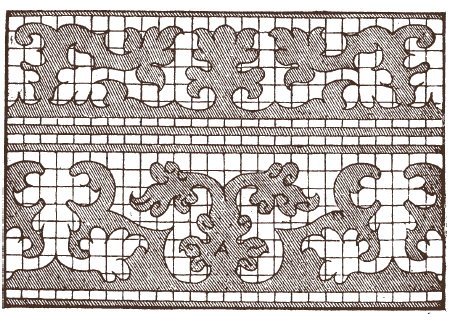
These are two modelbooks of the 1500s. There are several others in the collection, but they are mostly books of needle lace designs. Ostaus also offers up mostly patterns for the various forms of needle lace, plus some patterns that can be adapted to free-hand (as opposed to counted) embroidery, plus a large section of allegorical plates to inspire stitched medallions, slips, and cabinets. One thing I’ve always liked are some of his negative/positive patterns. These are designs that if laid out on a strip of thin leather or paper and cut can be separated longitudinally into two identical pieces. There are several of these scattered around the middle of the book.
Starting around page 73 or so there is a section of graphed patterns, a number of which landed in my New Carolingian Modelbook collection.
The Egenolf book also is mostly line drawing suitable for freehand embroidery. Some are pretty cluttered, but some are very graceful. The oak border on p. 32 has always been one of my favorites. There’s one plate with a counted pattern, on p. 72.
—. Priscilla Cotton Knitting Book, Priscilla Publishing Co., 51 pages. PDF1, PDF2, PDF3, PDF4, PDF5, PDF6.
This books is obviously a seminal source behind many of today’s reference books on knitting technique and patterns. Notation is sparse and “antique” with n (narrow) being used for k2tog, and o for yarn over, and other oddities. There’s a fair bit of circular doily knitting, but it is of the knit radially and seamed variety seen also in Abbey’s Knitting Lace. In fact many of the doilies appearing in Abbey appear to have been adapted directly from this work. You’ll also recognize many Walker treasury edging patterns in these pages.
In addition to the stitch texture and lacy knitting sections, there’s a bit on “cameo knitting” which appears to be another name for stranding (in PDF2). The section on filet knitting (in PDF3) is relatively extensive, and clearly shows both the strengths and weaknesses of this rarely described style.
—. Priscilla Irish Crochet Book No. 2, Priscilla Publishing Co., 52 pages. PDF1, PDF2, PDF3, PDF4, PDF5, PDF6, PDF7, PDF8.
This has got to be the single most complete and eye-popping source I’ve ever seen on Irish crochet. Not only does this contain an amazing amount of eye candy, it also gives directions on how to create it, offering up pattern descriptions for the individual motifs, the joining brides and grounds, and the working method of fastening the motifs to a temporary backing while the grounds are being worked.
—. Egyptisch Vlechtwerk [Sprang], Holkema & Warendorf, 36 pages.PDF1, PDF2
As an example of the depth of the collection, here’s a work on Sprang, one of the lesser known fiber manipulation crafts sometimes mistaken for early knitting. It is in Dutch and appears to be from before WWI, but it is illustrated with photos of finished pieces and works in progress.
These are just a small sample of the hundreds of works available at the University’s website. Again, most are on the industrial aspects of the textile arts, from fiber acquisition (including sericulture and sheep raising) through spinning, and weaving, but a goodly number are of direct interest to hand-crafters. Topic lists exist for knitting, crochet, embroidery, cross stitch, lace, tatting, and a multitude of other subjects. Support this valuable resource by visiting and using it. I know I’ll be combing through here for years…
MORE ON STRICKFINGERHUTS
Techknitting is posting an interesting series on stranding, and as part of it, mentioned the use of Strickfingerhuts (knitting yarn guides/knitting thimbles), linking back to my original post on the subject.
For those who are unfamiliar with them, they are those gizmos that sit on the end of the left hand index finger, that are used by Continental style knitters (pickers) to hold and separate two or more yarns while doing stranded colorwork.
Adding some more detail on the subject, I’d like to address a problem TK points out as being common among those who hold two yarns in one hand while stranding – differential feed.
If a row has more or less equal numbers of stitches of both colors, both yarn strands are consumed at the same rate. But if a row has lots of Color A, but very little Color B, A will be eaten at a much greater rate, eventually causing the knitter to readjust his or her grasp of the yarn to even things out.
Those of us who do use Strickfingerhuts find that the differential feed rate problem is greatly minimized compared to trying to hold both yarns in the left hand unassisted. Yes, eventually the difference in yarn consumption catches up with us and we have to yank the strands even, but no where near as often.
We do however find that over time we prefer to put the dominant color (the color most represented on a row) in either the left or right eyelet to minimize the feed problem. There’s no hard and fast rule to this, it’s a matter of personal preference.
In stockinette in the round, I prefer to have the dominant color in the right eyelet, and the less represented color in the left. This helps when I lock in my floats:
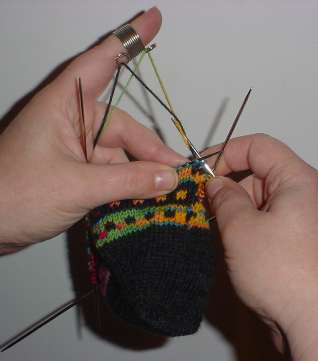
Although I usually work stranding in the round, occasionally I have to do it in the flat. If I’m knitting stockinette in the flat using a Strickfingerhut, and I’m on the purl side, I prefer to have the dominant color in the left hand eyelet.
For the record, I notice no difference in the appearance of the finished product if I mix eyelets – sometimes putting the dominant color in one, and sometimes in the other. I do however note that some other Strickfingerhut users do, and advocate always keeping the background color in the same eyelet regardless of its relative dominance on any one row. Again, experimentation is your friend.
APPLIED STRIP EDGING WITH MITERED CORNER
I’ve played around some with methods of producing and applying the edge finish to the khaki vest. First I tried the separately knit/sewn on band method, using a couple of different approaches to the seaming (fold band longitudinally, sew the band up, then apply it; sew on both sides in one pass; sew on the display side, then do a separate seam to affix the facing side). Of all of them, the last method worked best, but it was the most effort intensive of them all.
So I looked further. Plain I-Cord (knit on or applied) was too narrow to stabilize the edge, and two courses of it would have been too bulky. I didn’t like the way that picking up along the edge then knitting out looked – especially along the curve of the armhole.
Even more experiments ensued. Finally I landed on knitting-on a strip parallel to the edge, then going back and seaming down the free side on the inside of the piece. Doing that I could produce an edge of any desired width, go around curves and even plan on mitering the vest point corner. Here’s a swatch with a mitered corner. Note that I haven’t sewn down the facing on the inside yet, but natural stockinette curl is keeping it nice and neat. (For some, the inside seaming might be optional, but I plan on doing it on my finished piece).

To miter the corner of this 8-stitch strip, I used short rows. Here’s how I did it:
Applied 8-stitch Strip Facing with Mitered Corner
Start with the public side of the work facing you, holding it with the bulk of the piece on the left, so that you’re working up the right side of the thing (upside down from the picture above). Using straight needles, cast on 9 stitches, then pick up one stitch in the edge of the piece being finished. While the strip is 9 stitches wide, one is consumed during joining, so the part that protrudes is really only 8 stitches wide.
Row 1 (wrong side): P8, k1.
Row 2: S1, k6, ssk, pick up one stitch in edge of swatch
Row 3: S1, p7, k1
Repeat Rows 2 and 3 until you reach the corner, having just completed an odd number (wrong side row)
Row 4: S1, k6, wrap and turn.
Row 5: Slip the wrapped stitch, p6, wrap and turn
Row 6: Ignoring any previously wrapped stitches, S1, k5, wrap and turn
Row 7: Ignoring any previously wrapped stitches, Slip the wrapped stitch, p4, wrap and turn
Row 8: Ignoring any previously wrapped stitches, S1, k3, wrap and turn
Row 9: Ignoring any previously wrapped stitches, S1, p2, wrap and turn
Row 10: Ignoring any previously wrapped stitches, S1, k2, knit the next stitch along with the loop around its base, turn
Row 11: Ignoring any previously wrapped stitches, S the stitch you just knit, p2, purl the next stitch along with the loop around its base, turn
Row 12: Ignoring any previously wrapped stitches, S1, k3, knit the next stitch along with the loop around its base, turn
Row 13: Ignoring any previously wrapped stitches, Slip the stitch you just knit, p4, purl the next stitch along with the loop around its base, turn
Row 14: Ignoring any previously wrapped stitches, S1, k5, knit the next stitch along with the loop around its base, turn
Row 15: Ignoring any previously wrapped stitches, Slip the stitch you just knit, p6, purl the next stitch along with the loop around its base, turn
The corner is complete, return to repeating Rows 2 and 3. Optional finish – seam down the inside edge of this facing.
I’ve stated applying this same edging to the armholes of my vest (having previously seamed the shoulders).
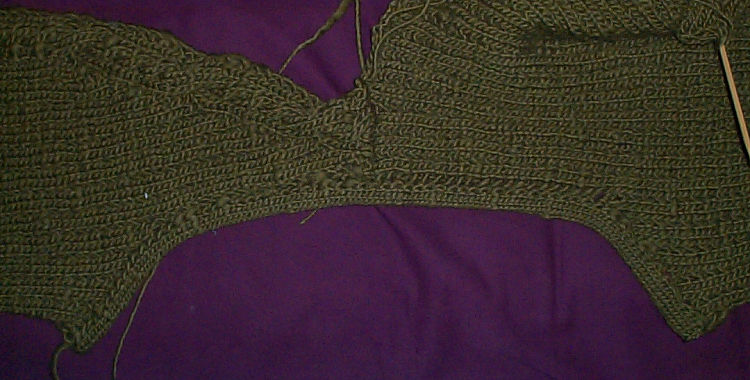
I plan to do the bottom edge next, incorporating the mitered corner on the vest points. But I haven’t played with the buttonhole band treatments yet. Sadly, I have misplaced my copy of InkKNitters. It’s here. Somewhere… Weekend plans include tossing my knitting library to find it.
Oh. Unless a monsoon is upon us, weekend plans also include attending the annual Gore Place Sheepshearing Festival in Waltham, Massachusetts. Not a big festival as fiber fairs go, but very local and lots of fun. Look for me with both Elder and Smaller Daughter in tow.
INTARSIA IN THE ROUND
After yesterday’s post on my Galaga Hat, I’ve gotten a couple of questions about the method for working back and forth seamlessly to make a tube. In specific, some people wanted to see illustrated how I make the wrap and turn join. I try to oblige them (click on pix to see them larger):

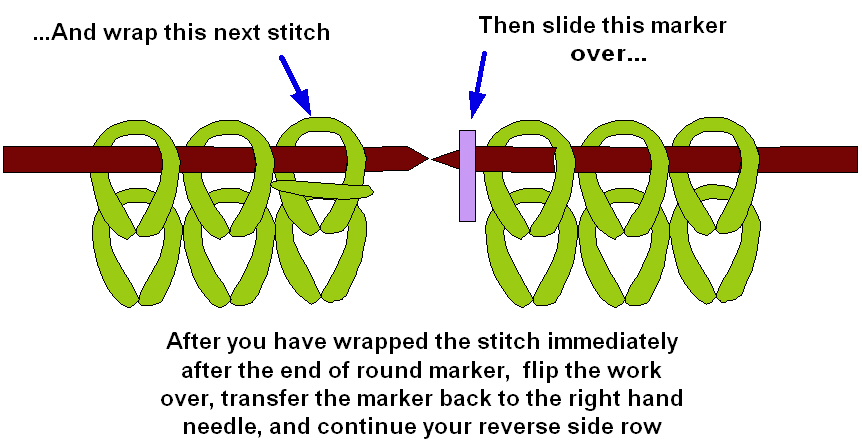
I’ve shown just the knit-side round. The purl side round works in exactly the same way. Work to the marker, making sure to work the last stitch before the marker along with the loop around its base, shift the marker over, wrap the stitch after the marker, flip the piece over, return the marker to the right-hand needle, and continue with the rest of the round.
Why go through all this trouble?
I don’t have enough yarn to strand around the entire piece. Nor do my motifs span the entire circumference of my hat. I am in effect working spot Intarsia motifs (actually I’m stranding between them, but limiting that stranding to the spot motifs). Rather than cut the yarn at the end of each motif, or stretch it back to the beginning of the spot design on each row, I am working the equivalent of flat knitting – going back and forth, alternating rows of knit and rows of purl. When I purl or knit back to my spot motif, my contrasting color ends are on the correct side of the motif for the next round. But I hate sewing up, and want to make a hat without seams. Rather than knit this totally flat (a valid option), I’m using wrap and turn to make the join at the end of each round.
WORKING AT THE SAME TIME
I had started this post back when I was up to the shoulders of my ribbed leaf pullover, but life intervened and it languished. Also, the diagrams ended up taking more time than I thought they would. For the record, I write these entries mostly in the half-hour I steal in the morning after breakfast, while my kids are getting dressed for school. Some of the longer and more illustrated ones can take a couple of days to pull together. Yet another reason why my blogging rate has fallen back since leaving the world of consulting for full-time employment.
For the record, I’m now just a couple of rows away from completing the sleeves of the ribbed leaf pullover. I’ll use the piece to do some assembly and finishing posts later this week and next.
————————
Some deadlines have passed, others remain. I did have an hour or so of knitting time last night, which I used to excellent effect, both for some much needed relaxation, and to advance my leaf pullover. I am now finishing up the front, at the point where the centermost stitches are set aside and the shoulders are completed.
Now this stage of production is one that has inspired a huge number of wiseNeedle advice board questions. The directions to join in a second ball of yarn and knit both shoulders at the same time tend to confuse people who are new to knitting. Here’s the basic concept. My postulated directions say something like
Work across 25 in pattern, place center 20 on holder, attach second ball of yarn and work remaining stitches; continue in pattern and commencing on the next wrong-side row, working both sides at the same time, decreasing 3 stitches at each neck edge 2 times, then 1 stitch at neck edge three times. Continue until piece measures 20 inches from bottom and bind off.
Here you see a basic sweater front (or back), knit in green yarn bearing a big R in the center so we can keep track of the right (read public) side. You see all 70 stitches on one needle, ready to commence a right side row.

At this point, I’ve followed the direction to “Work across 25 in pattern, place center 20 on holder”. Note that the stitches on my right hand needle have been completed.

Now I’m beginning the part that confuses many beginners, “attach second ball of yarn and work remaining stitches.” It’s not difficult. We’re going to do the left and right shoulders simultaneously, mirroring all shaping so that they are symmetrical. The stitches on the holder form the bottom of the neck opening. Sometimes the pattern specifies that they be bound off, other times it asks that they be placed on a holder so that they can be used “live” to form the collar. In either case, they are now parked and won’t be touched again until the pattern revisits collar production and finishing.
Take another ball of the same yarn and starting with the stitches on the far side of the stitch holder, finish out the row. Leave enough tail at the neck edge for easy finishing later. This next diagram shows the work after I’ve completed the “work remaining stitches” bit. I’ve finished my right side row.
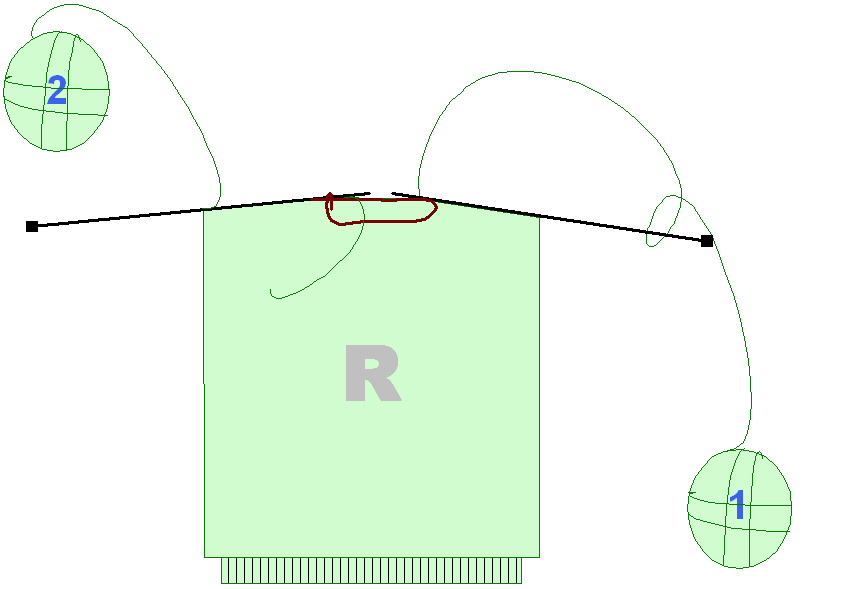
The diagram below shows the work flipped over to work back across the wrong side (the non-public side). I’ve got my two balls of yarn set up, one for each shoulder area, and I’ve indicated the spots where the decreases should happen.
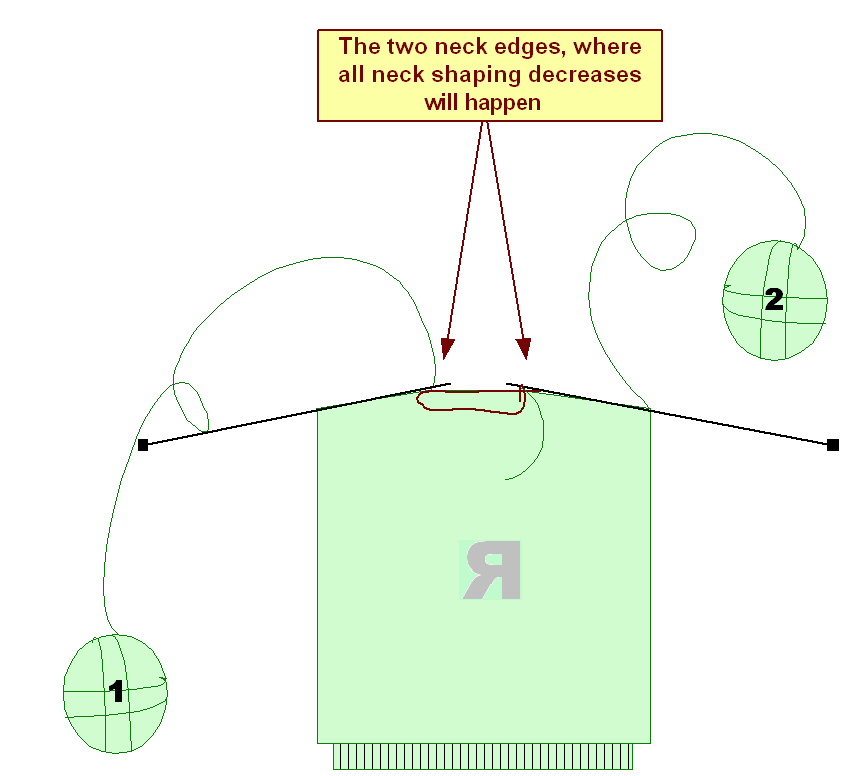
We’re up to continue in pattern, working both sides at the same time, decreasing 3 stitches at each neck edge 2 times.” The pattern is now directing the shaping of the neckline. When a pattern calls for decreasing more than one stitch at an edge I usually bind off at the beginning of a row. Yes, that makes a stepwise decrease, but as you’ll see I minimize the jaggedness a bit. The only exception to this is if I’m working in a giant superbulky (3 stitches to the inch or fewer). In a yarn that big, the steps can be quite noticeable. But back to 99.99% of all knitting.
To accomplish my first set of bind offs I have to remember to work my rows in pairs beginning on a wrong-side row- two rows each with stitches bound off at the beginning yields symmetrical decreases at the right and left edge of the work. In the diagram above, I am poised to begin my initial shoulder decrease. I have worked back across the first bunch of shoulder stitches, ending at the neck edge. No bind-offs yet. But as I begin the second set of shoulder stitches I bind off the first three, then continue across the row. Then I flip the work over to begin my right-side row, work across the shoulder side I just decreased, and perform a similar decrease on the other shoulder
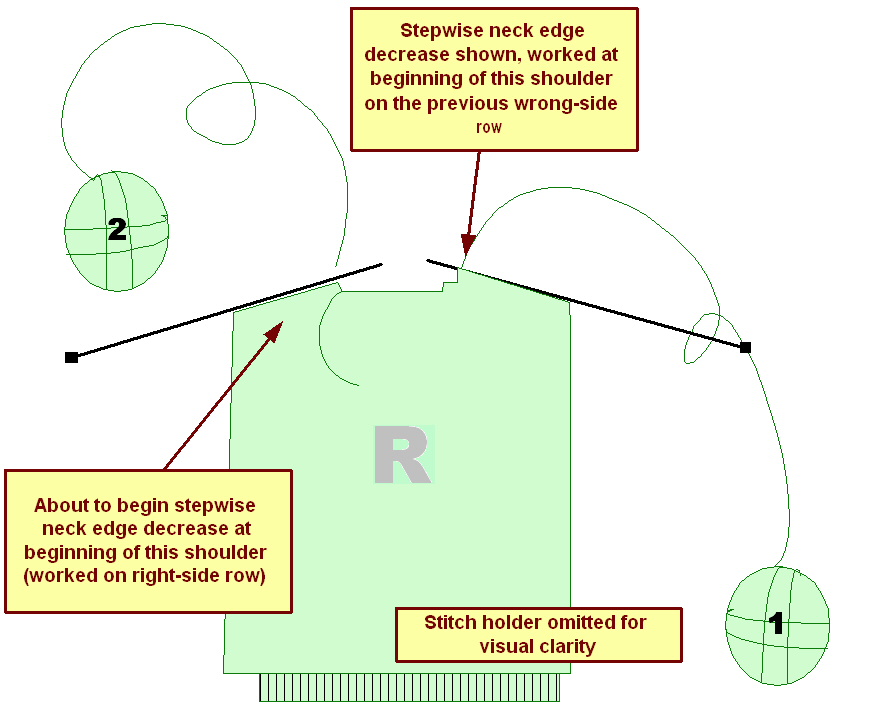
At the end of my second decrease row (in this case, a public side row) I finally have symmetrical decreases on either side of my neck edge, formed by binding off stitches at the commencement of two successive rows. My bind offs are a bit jagged and step like, but that can be diminished somewhat by slipping rather than working the first stitch bound off prior to ending it off.

I am ready to go on to the next direction in my instructions. It says to decrease “1 stitch at neck edge three times”. It doesn’t say to do this by binding off. I could do it that way, and many patterns say so. But I don’t like the jaggies formed by binding off. If I’ve got only one stitch to get rid of, I’ll use plain old K2tog and SSK decreases. Depending on the pattern, I might work them in the edgemost stitches, or in the next-to-edgemost stitches, allowing them to form some sort of decorative detail. Also unlike the bind-off style decrease, there’s no logical reason to separate these between two successive rows. I generally work them on the same row. Most of the time that’s a right-side (public side) row, but in my current project – a piece with heavy texture patterning – it’s easier to do them on the plain purl worked wrong side, using P2tog and P2tog through the back of the loop so as to produce the same effect on the public side as K2tog and SSK. In any case, I place them on either side of the neck edge, creating the curve that is the foundation for whatever collar treatment is specified by the pattern in hand.
An aside: It’s interesting to note that older patterns more commonly suggested completion of one shoulder and then the other rather than knitting them in parallel. Most often those pattens gave directions for the first shoulder, and then said something like “repeat for second shoulder, reversing shaping as necessary.” (A direction that caused me to blink in wide-eyed terror while knitting my very first sweater.) There’s no reason why patterns written in that style can’t be worked in the “at the same time” method. I prefer the two-together method because it’s how I idiot-proof my own knitting to ensure that my shoulders end up being exact cognates of each other. But not everyone likes working this way.
Reasons to stick with the older method might include the unavailability of a second ball (if for example you are working off one immense cone of yarn and don’t want to break it to create a second ball); or the need to concentrate on one set of shaping directions at a time. So long as the you take care to make sure that row counts are the same and that placement of the decreases is a parallel as possible, working one shoulder at a time is a perfectly legitimate way to go. There’s no shame in working the one at a time method, it’s just a matter of mental wiring and personal comfort.
MAILBOX AND HERO
A couple bits from my mailbox today, plus a long-lost toy.
Yards, grams, and ounces
A reader wrote to ask how to convert ounces and grams to yards, because she’d found a pattern and wanted to buy enough yarn to knit it. I answered with this:
You can’t convert ounces and grams to yards. Yards measures length. Ounces and grams measure weight. One ounce equals 28.35 grams (give or take). One gram equals roughly 0.35 ounces. There are dozens of conversion calculators on the web that can help you flip between the two if you don’t have a calculator or pencil and paper to hand.
Let’s say you had 1.75 ounces (roughly 50 grams) of a 100% wool. You could have about 250 yards of fine fingering weight yarn, or around 135 yards of sport weight wool, or around 120 yards of DK weight wool, or around 100 yards of worsted, or about 80 yards of bulky. And that’s without factoring in stuff like how lofty or dense the yarn is, whether or not it’s made up of multiple strands tightly twisted, or one giant fluffy strand. One five stitch per inch worsted for example might be about 110 yards for 50 grams, but another might be only 90, all depending on the denseness of the strand.
This is further complicated by fiber blends. 1.75 ounces of acrylic at 5 stitches per inch (the textbook definition of worsted) might have significantly higher yardage than 1.75 ounces of 5 stitch per inch wool because the acrylic fiber is in and of itself less massy.
All this being said, there are very loose guidelines of roughly how much yardage a pound of yarn might contain. But remember – use these numbers as a rough guideline only, and only for the fiber type and gauge specified. If you’re planning a yarn purchase and are going on only this type of info – buy at least 25% more than you think you need. I can guarantee that three times out of four, you’ll end up using more yarn than you originally planned. Here’s one set of rough yards per pound figures. Remember – it’s for hand-spun 100% wool only.
Why post patterns for free?
Another person wrote to ask why I post patterns for free. She specifically asked if I was doing it to undercut the people who charged, and wondered why I didn’t write for magazines or other publishers. I wrote back:
I’m flattered that you think my patterns are good enough for professional publication. I think they’re borderline. I don’t do lots of multiple sizes, they tend to be pretty sketchy. Some are more like method descriptions than hard and fast patterns with set yarn quantities.
I post patterns because I find the process of working out the problems they present to be fascinating. My patterns are posted more as a by-product of that exploration rather than the cumulative product. I want to share the fun of both inquiry and production.
I have dabbled in writing patterns for a yarn maker and an on-line magazine. I’m a proposal writer by trade. I spend my professional life running the gauntlet of multiple concurrent hard-stop deadlines. Knitting is an area where my only deadline is “whenever.” I found out that harnessing the creative process to a fixed delivery framework squeezed all the fun (and much of the creativity) out of it. I can’t work under a mandate that inspiration will occur between Thursday next and the 30th of the month, will involve one particular technique and one particular yarn in a color not of my choosing; or that the finished object and full proofed pattern in five sizes will be delivered without delay within 15 days of yarn receipt. Even the web-based magazines brook no delay. So I retreat to my own deadline-free tenth-of-never world, doing whatever the heck I want, when I want to do it.
Why not self-publish and sell the result? Because the burden of handling the business end of the thing (payments, refunds, shipments or downloads, record keeping for taxes) is not commensurate with the pocket change income the effort would bring. I’m re-thinking this in reference to my embroidery book, but to do it for lots of little knitting patterns would be a big pain. Also because patterns people pay for are held to a higher standard than are give-aways. To be competitive, I’d have to knit the trial in a color that photographs well (opposed to the color I want to use), figure out that range of sizes, and use a much higher standard of test knitting than I currently do. While I don’t put out junk as a rule, errors are there. I get to them when I can. But I don’t want to knit everything twice or more – once to create it and at least once more to test the directions, possibly trying out every size offered.
Long Lost Toy
Well, not lost. It’s been sitting in a corner for a while. I made it for Larger Daughter when she was four. Now that Smaller Daughter is out of the hobby horse years, poor Hero isn’t seeing much action. But he’s one of my favorite projects, out of all the things I have ever made.
I had no pattern, some black and green Melton wool scraps left over from some SCA outfits, stuffing, a stick, two brass rings, plus a bit of trim, glue-on jewels, a couple of and bells left over from making holiday ornaments. I improvised and here’s the result.

A stick horse menacing enough for a Nazgul’s child. Needless to say Hero will be spending his retirement here, and not getting passed down to anyone else.

